
“In the beginning, there was nothing at all that anyone could have discerned – only a yawning gap that stretched in all directions – featureless, indefinite, without orientation.”
Sarah Iles Johnston, Gods and Mortals: Ancient Greek Myths for Modern Reader
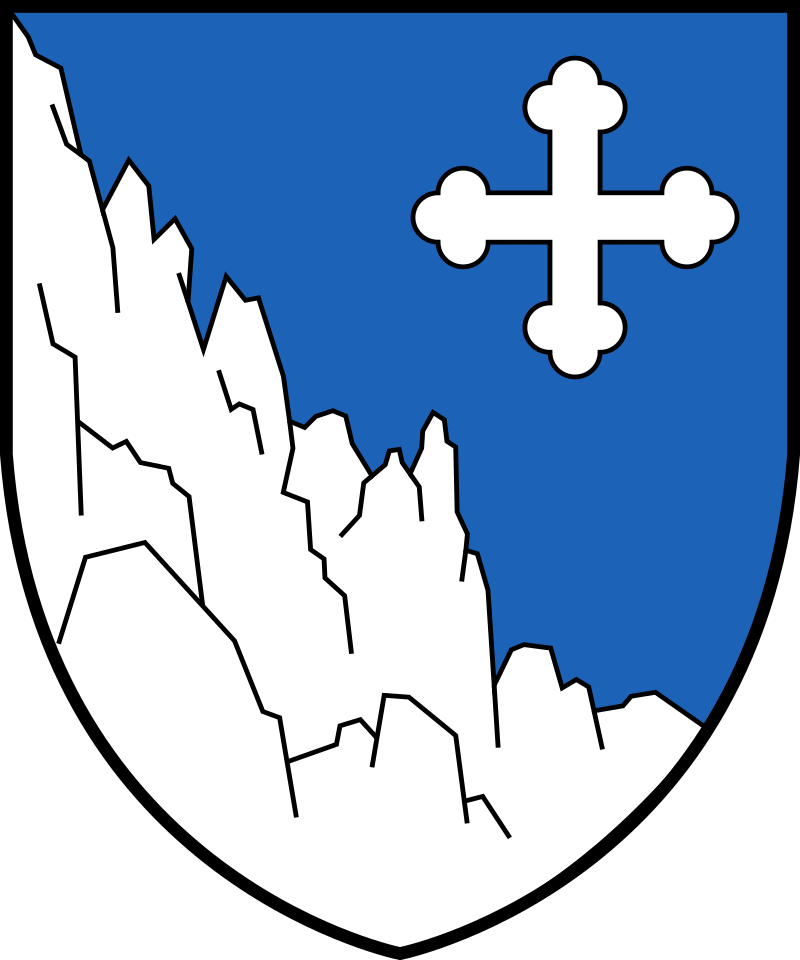
On May 28, 2025, disaster struck the Swiss village of Blatten in the Lötschental valley. Millions of cubic meters of rock and glacial ice broke off from the mountain and crashed into the valley below, obliterating the whole village. For the first time, a collapse like this – a new mix of rockfall, glacial ice, and avalanche – was captured on video in real time. We bore witness to the apocalypse, broadcast live, so to speak. As per Revelation 6:14, “…and every mountain and island were moved out of their places.” A Swiss historian said in an interview, for the first time we saw
“how this force of a mountain comes towards you, how this cloud full of rubble, rock and ice thunders into the depths.” (1)
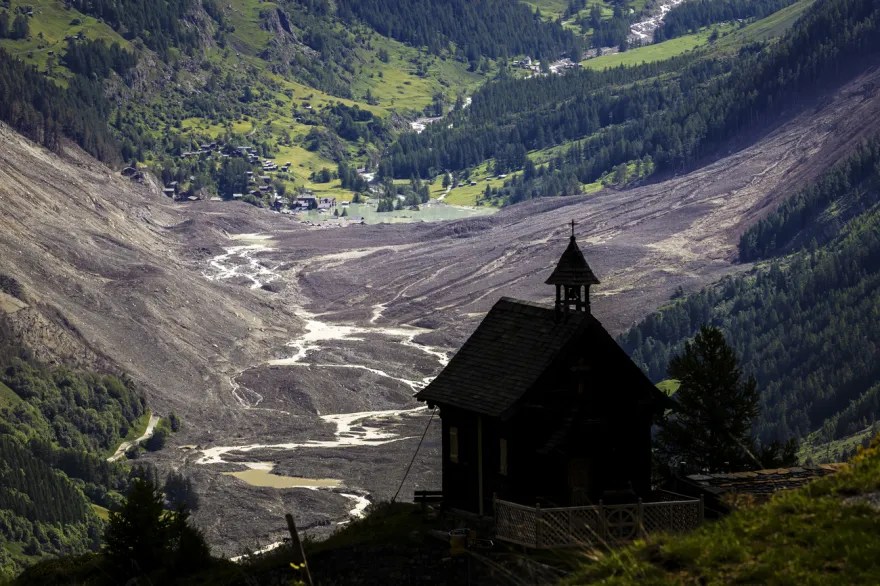
In earlier centuries, disasters like this claimed hundreds of lives, with no warning systems and no understanding of what was coming. Today, even with technology, we were still powerless to stop it.
In the same interview, Mathieu refers to previous Alpine disasters, notably the 1618 Piuro landslide, which claimed around 1000 lives:
“The mountain collapsed at the very beginning of the Thirty Years’ War, when the religious conflicts in Europe reached a boiling point. The mountain lay exactly on a front line between Protestant and Catholic areas. The landslide was seen as a punishment from God. The Protestants said the Catholics had behaved sinfully, and vice versa.” (2)
After the Blatten disaster, it felt as if the landscape had swallowed the village whole and turned back the clock, returning to a state of primordial chaos. The valley had been evacuated or stripped of human presence, as if nature had reclaimed its wild, untouched form. This reminded me of Robert MacFarlane’s description of “‘old nature’ where silence stretches back to the Ice Age – an ancient stillness beyond time or human memory.” (3) The disaster brought the valley back to that raw, formless state, where the power of nature is overwhelming and human control disappears. This creates a profound metaphor for loss of memory, history, and identity. The land forgets what was once there.

In Derborence, a remote alpine valley in the canton of Valais, Switzerland, a massive rockfall occurred in 1714. Part of the Diablerets massif collapsed, sending millions of cubic meters of rock down into the valley. The devastation was so complete that for a time, the area looked like a barren rock desert. A second, smaller rockfall followed in 1749, which added to the mythology and fear surrounding the place. Charles-Ferdinand Ramuz’s novel Derborence (1934) is based on the 1714 landslide when “the mountain has fallen,” as one of the characters expressed it. One of the novel’s most evocative passages reads:
“That was all; he had fallen silent. And, at that moment, Séraphin was silent as well; they felt growing around them something completely inhuman and, over a long time, unbearable — the silence. The silence of the high mountains, the silence of the places uninhabited by men, where men are present only temporarily, provisionally; then, if ever so little one should be silent himself, he cocks an ear in vain, he hears only that he hears nothing. It was as if nothing existed anywhere, from us to the other end of the world, from us to the bottom of heaven. Nothing, nothingness, a void, the perfection of a void; a total cessation of being, as if the world had not yet been created, or was no more, as if one were before the beginning of the world or after the end of it. And the ache lodges itself in your breast where it’s like a hand that closes round the heart.”
From our finite human perspective, mountains seem immovable and eternal. However, geologically, they are actually “temporary structures” (4). As soon as they form, erosion begins to wear them down. If given enough time, even the tallest mountains will be reduced to plains. That is another example of how the alchemical dictum “Nature delights in nature, nature conquers nature, nature masters nature” manifests.
When disasters happen in our modern world, do we still feel the sense of such mythic dimensions? Since the Age of Enlightenment, we have been searching for rational explanations. Today, global warming is viewed as “a human-engineered calamity” (5). In her book, Huet examines the etymology of the words disaster and catastrophe. The word disaster comes from the Greek for “ill star”:
“The word is … directly related to … the destruction, despair and chaos resulting from the distant power of cosmic agencies.” (6)
“Catastrophe” originally meant the “turning downward.”
Instead of seeing punishment from the gods, we now assign blame: to failed infrastructure, to political negligence, or to humanity’s impact on the climate. Without denying the hard facts of the climate change, this rational framing helps us feel less powerless, and still the emotional core remains strikingly similar to the dread felt by past generations. Even our search for causes can be seen as a modern form of apotropaic mechanism: a way to push back the chaos, to reassert order and meaning in a world that feels suddenly unstable. Just as ancient societies used rituals to appease angry gods, we now use data and responsibility to ward off the intolerable idea that disaster might be random and uncontrollable.
In the Epic of Gilgamesh, Enkidu and Gilgamesh set out to climb a sacred mountain and kill Humbaba, its terrifying protector. Before they set off, Gilgamesh had a dream:
“Enkidu, my friend, I had a dream. The dream I had filled me with terror. I walked through a valley beneath a great mountain. The mountain fell down upon me. Under the mountain was I helpless and bereft of hope. And then did the Sun rise and cast its light over the mountain.”
The mountain he seeks to overcome, overcomes him. And yet after the inevitable disaster, a ray of hope emerges. This echoes the ancient Greek myth of Pandora, who unleashed all the calamities by opening a forbidden jar. As disease, suffering, and chaos escaped into the world, one thing remained at the bottom: hope. Macfarlane sees the same motif in the myth of Ragnarök:
“Even in the Norse myth of Ragnarök, hope prevails. Although the Earth has been burnt by the fire demon Surtr, although most of the gods are dead, it is not an end. Under Yggdrasil, the great ash that links all worlds together, there is light. The woman Lif and the man Liftrasir, whose names mean ‘life’ and ‘life of the body,’ emerge from some underground shelter, the only humans to survive. A new age begins, with new gods, and new worlds.” (7)
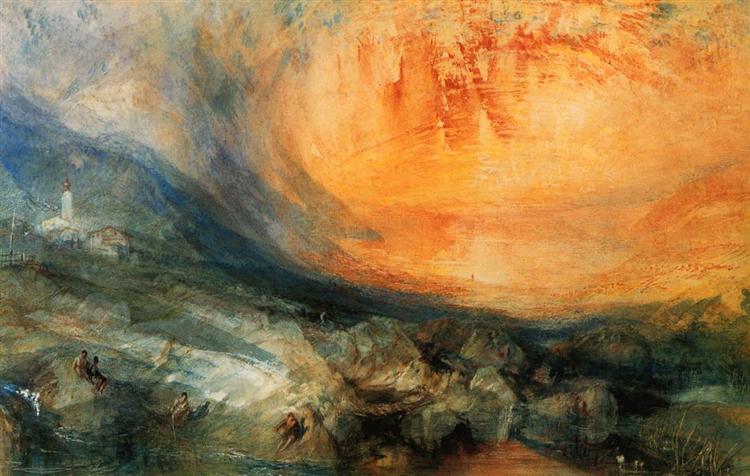
Myths like Ragnarök or the flood stories o speak not only to cosmic cataclysms but to the inner necessity of breakdown before rebirth. Carl Jung wrote in Memories, Dreams, Reflections, “Our psyche is set up in accord with the structure of the universe, and what happens in the macrocosm likewise happens in the infinitesimal and most subjective reaches of the psyche.” Outer disasters, whether personal crises or global upheavals, often reflect a deep psychic shift, a cracking of the old order to make way for something new. What collapses in the world also echoes a transformation within.
Notes:
(1) NZZ Folio. “Früher Gottes Strafe, heute die Rache der Natur: Katastrophen in den Bergen haben die Schweiz geprägt.” NZZ, 3. Juli 2025. https://www.nzz.ch/folio/frueher-gottes-strafe-heute-die-rache-der-natur-katastrophen-in-den-bergen-haben-die-schweiz-gepraegt-ld.1890626 (paywall)
(2) Ibid.
(3) Robert Macfarlane, The Wild Places (London: Penguin Books, 2007).
(4) Ibid.
(5) Marie‑Hélène Huet, The Culture of Disaster (Chicago: University of Chicago Press, 2012).
(6) Ibid.
(7) Robert Macfarlane, The Wild Places (London: Penguin Books, 2007).

Support my blog
If you enjoy my writing, please consider donating to support my work. Thank you very much in advance.
$1.00







 symbolreader