Like the Rainbow on the Waterfall: the Mystical Aura of Consumption

tumblr_o1cz8uVjKd1ummtoro1_1280

John William Waterhouse, “Sleep and His Half Brother Death,” painted after both younger brothers of the painter died of tuberculosis

While the fourteenth century was ravaged by the Black Death, the nineteenth century belonged to tuberculosis, or the White Death, a disease much more insidious and widespread. John Keats died of it at the age of twenty-six, and so did many creative geniuses of the time, such as Friedrich Schiller, Novalis, Emily Brontë, Juliusz Slowacki (a Polish Romantic poet), Frederic Chopin, and countless others. Would Romanticism ever have happened with its eruption of creative spirit, had it not been for tuberculosis? In general, is creativity ever possible without the feeling of malady and dis-ease? In ancient Greece, the sick headed for an asclepeion, a healing temple to the god Asclepius, to find cure for their maladies. In the nineteenth century, it was in the sanatoria typically located in high mountains, where TB patients sought refuge and hope. There they were ordained to take plenty of rest, inhale fresh mountain air and partake proper nutrition. However, before antibiotics were invented the statistics were very grim: around seventy per cent of patients died in the sanatoria. Those who recovered were not seriously ill in the first place. This was also true for the prestigiously located Davos, where dying patients were carefully hidden in order not to ruin the reputation of the resort. Only the rich could afford a curative stay on the Alpine heights. It is worth remembering, however, as Mary Dobson put it, that “the disease hit hardest at those whose lives were blighted by poverty and poor nutrition, and worked in badly ventilated, overcrowded, cold, damp or dusty conditions.” To this day TB remains a disease of the poor and the dispossessed, the ones who are easily forgotten, unlike the high profile figures of the Romantic period.
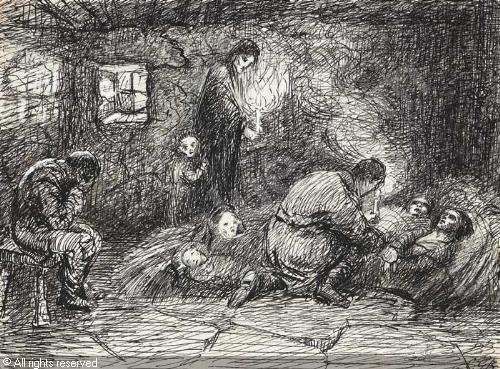
markievicz-countess-gore-booth-visit-to-a-dublin-family-durin-2109073

Constance Markievicz, “Visit To A Dublin Family During Thetuberculosis Epidemic”

The first sanatorium was built in Davos by Alexander Spengler, who also invented the famous “corpse rest” (Kadaverruhe in German).

magicmountain

Patients were advised to swaddle in warm blankets and spend hours inhaling ice cold mountain air under the beams of the sun.  This procedure was beautifully and memorably described by Thomas Mann in The Magic Mountain. Its hero Hans Castorp comes to Davos “only for two weeks” to visit his cousin, but ends up staying in the sanatorium for seven years after he is also diagnosed with consumption. Thus begins his journey of self-discovery, which leads him to the understanding that to be truly and deeply human is to be frail, to suffer and always remember about death. Or as one of the characters puts it, “to be human was to be ill.” In his Reader’s Guide to Mann’s novel, Rodney Symington quotes the echoing famous words from Beckett’s Endgame: “You’re on earth; there’s no cure for that.” A different sort of consciousness opens with such a realization: one aware of things infinite and ultimate – a mythical understanding of life. The title of the novel came from a passage in Nietzsche’s The Birth of Tragedy: “Now it is as if the Olympian magic mountain had opened before us and revealed its roots to us” (quoted after Symington). Like the World Tree, the magic mountain has its roots planted in the dark earth while its branches reach high to the sky.

08d799dd9a3a51401579f4053e2176a2

Hans Castorp was a conventional young man, a member of the affluent bourgeoisie with a robust work ethic. This conventional way of life, however, did not offer him any fulfillment:

“Hans Castorp respected work… Work was for him, in the nature of things, the most estimable attribute of life;

Exacting occupation dragged at his nerves, it wore him out; quite openly he confessed that he liked better to have his time free, not weighted with the leaden load of effort; lying spacious before him, not divided up by obstacles one had to grit one’s teeth and conquer, one after the other.”

Given the luxury and freedom of time in Davos, Hans Castorp flourished. In a secluded magical shrine of the Alpine valley he was simultaneously made us acutely aware of his own frail body and of his inner spirit. The infinite vistas of contemplation opened to him, accompanied by an aching, fleshy desire for a fellow convalescent – Clavdia Chauchat. In my absolute favorite passage Hans muses over the meaning of life:

“What then was life? It was warmth, the warmth generated by a form-preserving instability, a fever of matter, which accompanied the process of ceaseless decay and repair of albumen molecules that were too impossibly complicated, too impossibly ingenious in structure. It was the existence of the actually impossible-to-exist, of a half-sweet, half-painful balancing, in this restricted and feverish process of decay and renewal, upon the point of existence. It was not matter and it was not spirit, but something between the two, a phenomenon conveyed by matter, like the rainbow on the waterfall, and like the flame. Yet why not material – it was sentient to the point of desire and disgust, the shamelessness of matter become sensible of itself, the incontinent form of being. It was a secret and ardent stirring in the frozen chastity of the universal; it was a stolen and voluptuous impurity of sucking and secreting; an exhalation of carbonic acid gas and material impurities of mysterious origin and composition. It was a pullulation, an unfolding, a form-building (made possible by the overbalancing of its instability, yet controlled by the laws of growth inherent within it), of something brewed out of water, albumen, salt and fats, which was called flesh, and which became form, beauty, a lofty image, and yet all the time the essence of sensuality and desire. For this form and beauty were not spirit-borne; nor, like the form and beauty of sculpture, conveyed by a neutral and spirit-consumed substance, which could in all purity make beauty perceptible to the senses. Rather was it conveyed and shaped by the somehow awakened voluptuousness of matter, of the organic, dying-living substance itself, the reeking flesh.

…the image of life displayed itself to young Hans Castorp. It hovered before him, somewhere in space, remote from his grasp, yet near his sense; this body, this opaquely ehitish form, giving out exhalations, moist, clammy; the skin with all its blemishes and native impurities, with its spots, pimples, discolorations, irregularities; its horny, scalelike regions, covered over by soft streams and whorls of rudimentary lanugo.”

Life came to Hans in the shape of Clavdia.

In the nineteenth century tuberculosis was called the robber of youth. In “Elgin Marbles” Keats wrote contemplatively:

“My spirit is too weak—mortality

Weighs heavily on me like unwilling sleep,

And each imagined pinnacle and steep

Of godlike hardship tells me I must die

Like a sick eagle looking at the sky.”

Keats deathjosephsevern

Joseph Severn, “Keats’s Death”

The Romantics glorified consumption, associating it with beauty (especially in women), delicate spirit and heightened artistic sensitivity. The victims were perceived as innocent and holy. Nevertheless, the gruesome truth was that the disease totally ravaged the lungs of the victims, while the sheer amount of blood coughed up was often astounding. Still, George Sand insisted that Chopin coughed “with infinite grace” while Edgar Allan Poe described his dying wife Virginia as “delicately, morbidly angelic.”

d7d7e3bee373b0d7c80a8356a4981657

Edvard Munch, “Angel of Death”

In one of the most beautiful short stories called “The Birch Grove,” a Polish writer Jaroslaw Iwaszkiewicz gives a more realistic portrayal of the disease, yet without losing its mystical aura. There, a young consumptive man arrives in the countryside “to die.” His elder brother lives there with his young daughter, both deep in mourning after his wife’s recent death. The young man, though extremely weak and in constant pain, is greedier for life than his healthy brother. Towards the end of the story, the older brother, similarly to Hans Castorp, experiences a mystical moment of connection with all life, while standing in the birch grove in the middle of the night. The white entangled trunks remind him of feminine arms pointing upwards as if in ecstasy. This is a moment of sensual awakening, embracing life as it is in the moment. It is natural that great writers think alike, but I find it quite extraordinary that Hans Castorp experienced a very similar epiphany looking at bare arms of Clavdia Chauchat during the Walpurgis-Night ball:

“Poor Hans Castorp! He was reminded of a theory he had once held about these arms, on making their acquaintance for the first time, veiled in diaphanous gauze: that it was the gauze itself, the ‘illusion’ as he called it, which had lent them their indescribable, unreasonable seductiveness. Folly! The utter, accentuated, blinding nudity of these arms, these splendid members of an infected organism, an experience so intoxicating, compared with that earlier one, as to leave our young man no other recourse than again, with drooping heed, to whisper, soundlessly: ‘O my God!’”

A sense of approaching end must render every moment acutely and piercingly real. Looking at John Keats death mask, it is hard not to wonder whether his awareness of the imminent death was instrumental in causing his talent to flower so passionately and frenetically in the last years of his life. Perhaps in a creative individual, life and talent intensify when confronted with death. And yet a creeping feeling of waste and of tremendous loss remains, beautifully expressed by Rilke in one of his Sonnets to Orpheus (translated by Edward Snow):

“Illness was near. Already gripped by shadows,

your blood coursed darker; yet, as if only fleetingly

suspicious, it burst forth into its natural Spring.

Again and again, amid darkness and downfall,

it flared earthly. Until after terrible pounding

it stepped through the hopelessly open gate.”

3681774474_42df43768c

Keats – death mask

Sources:

Mary Dobson, Murderous Contagion: A Human History of Disease, Kindle edition

Rodney Symington, Thomas Mann’s The Magic Mountain: A Reader’s Guide, Cambridge Scholars Publishing 2011

Posted in Tuberculosis | Tagged , , , , , , , , , , , , , , , , , , , | 6 Comments

“That’s just who I am”: Is that Kafka? 99 Finds by Rainer Stach

I have got a lifelong devotion to Kafka, which can be traced back in my blog (https://symbolreader.net/2013/07/16/i-love-you-my-secret-raven/ and https://symbolreader.net/2014/05/14/kafkas-sirens/). I am very happy to reblog this well written review. The question remains: what colour were Kafka’s eyes? They were as mysterious and multiple shaded as his work. The new book casts a lot of light (literally) on the man wrongly presumed to be nothing but morose.

“Four people described Kafka’s eyes as ‘dark,’ four as ‘gray,’ three as ‘blue,’ and three as ‘brown.’ Kafka’s passport had them as ‘dark blue-gray.’ I’m personally inclined to trust the testimony of Kafka’s girlfriend, Dora. She described them as ‘shy, brown,’ which may be its very own shade.”
Via http://www.newyorker.com/books/page-turner/what-color-were-kafkas-eyes

roughghosts's avatarroughghosts

“Now I’ve taken a closer look at my desk and realized that nothing good can be produced on it. There’s so much lying around here, it creates disorder without regularity, and with none of that agreeableness of disorderly things that otherwise makes every disorder bearable.”  (Find #29 Kafka’s Desk)

I have never understood those who feel inclined to disparage Franz Kafka. It should be sufficient to admit that a writer, especially one whose work has entertained and inspired so many and has clearly withstood the test of time, is simply not one who speaks to you. Admit, if you like, that you just don’t “get it”. But why, like Joseph Epstein in a 2013 Atlantic Monthly column, declare that Kaka’s apparent joyless, dark vision of the world reflects a personal defect that undermines his worth and proclaim: “Great writers are impressed by the mysteries of life; poor Franz Kafka…

View original post 1,154 more words

Posted in Franz Kafka | Tagged , , , | 2 Comments

Sublime Music in the Face of Tragedy

“Samuel Barber’s Adagio for Strings begins softly, with a single note, a B flat, played by the violins. Two beats later the lower strings enter, creating an uneasy, shifting suspension as the melody begins a stepwise motion, like the hesitant climbing of stairs. In around eight minutes the piece is over, harmonically unresolved, never coming to rest. If any music can come close to conveying the effect of a sigh, or courage in the face of tragedy, or hope, or abiding love, it is this.”

Johanna Keller, arts journalist, via http://www.nytimes.com/2010/03/07/arts/music/07barber.html?pagewanted=all&_r=0

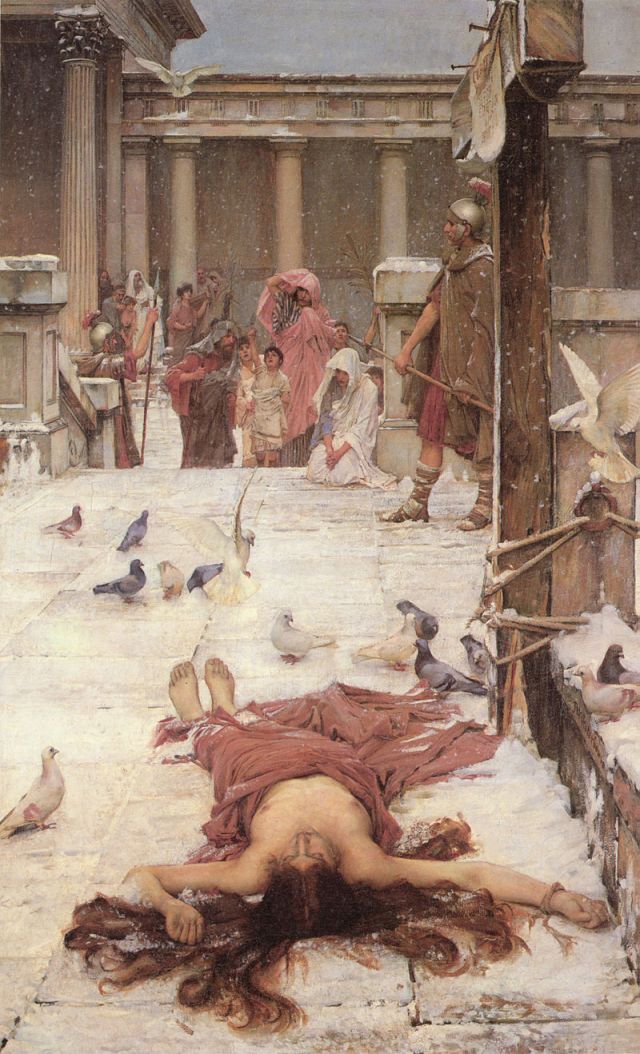
While writing on a whole different topic, this article caught my attention and did not let go: http://www.theguardian.com/uk-news/2016/mar/18/natalia-strelchenko-from-child-prodigy-to-murdered-wife. Natalia Strelchenko, a celebrated Russian pianist, brutally murdered by her controlling husband in August last year, has returned to the news because of the ongoing murder trial, which will be resolved this coming Monday. As a victim of very similar circumstances, even though I was lucky to find a way out before it was too late, I experienced a huge wave of empathy and a deep feeling of communion with her while reading her story today.  May her soul rest in peace now.

800px-John_William_Waterhouse_-_Saint_Eulalia_-_1885

John William Waterhouse, “Saint Eulalia”

Posted in violence against women | Tagged , , | 4 Comments

Krishnamurti on Suffering

“Questioner: I seem to have suffered a great deal all my life, not physically, but through death and loneliness and the utter futility of my existence. I had a son whom I greatly loved. He died in an accident. My wife left me, and that caused a great deal of pain. I suppose I am like thousands of other middle-class people with sufficient money and a steady job. I’m not complaining of my circumstances but I want to understand what sorrow means, why it comes at all. One has been told that wisdom comes through sorrow, but I have found quite the contrary.

Krishnamurti: I wonder what you have learnt from suffering. Have you learnt anything at all? What has sorrow taught you?

Questioner: It has certainly taught me never to be attached to people, and a certain bitterness, a certain aloofness and not to allow my feelings to run away with me. It has taught me to be very careful not to get hurt again.

Krishnamurti: So, as you say, it hasn’t taught you wisdom; on the contrary it has made you more cunning, more insensitive. Does sorrow teach one anything at all except the obvious self-protective reactions?

Questioner: I have always accepted suffering as part of my life, but I feel now, somehow, that I’d like to be free of it, free of all the tawdry bitterness and indifference without again going through all the pain of attachment. My life is so pointless and empty, utterly self-enclosed and insignificant. It’s a life of mediocrity, and perhaps that mediocrity is the greatest sorrow of all.

Krishnamurti: There is the personal sorrow and the sorrow of the world. There is the sorrow of ignorance and the sorrow of time. This ignorance is the lack of knowing oneself, and the sorrow of time is the deception that time can cure, heal and change. Most people are caught in that deception and either worship sorrow or explain it away. But in either case it continues, and one never asks oneself if it can come to an end.

Questioner: But I am asking now if it can come to an end, and how? How am I to end it? I understand that it’s no good running away from it, or resisting it with bitterness and cynicism. What am I to do to end the grief which I have carried for so long?

Krishnamurti: Self-pity is one of the elements of sorrow. Another element is being attached to someone and encouraging or fostering his attachment to you. Sorrow is not only there when attachment fails you but its seed is in the very beginning of that attachment. In all this the trouble is the utter lack of knowing oneself. Knowing oneself is the ending of sorrow. We are afraid to know ourselves because we have divided ourselves into the good and the bad, the evil and the noble, the pure and the impure. The good is always judging the bad, and these fragments are at war with each other.

This war is sorrow. To end sorrow is to see the fact and not invent its opposite, for the opposites contain each other. Walking in this corridor of opposites is sorrow. This fragmentation of life into the high and the low, the noble and the ignoble, God and the Devil, breeds conflict and pain. When there is sorrow, there is no love. Love and sorrow cannot live together.

Questioner: Ah! But love can inflict sorrow on another. I may love another and yet bring him sorrow.

Krishnamurti: Do you bring it, if you love, or does he? If another is attached to you, with or without encouragement, and you turn away from him and he suffers, is it you or he who has brought about his suffering?

Questioner: You mean I am not responsible for someone else’s sorrow, even if it is on my account? How does sorrow ever end then?

Krishnamurti: As we have said, it is only in knowing oneself completely that sorrow ends. Do you know yourself at a glance, or hope to after a long analysis? Through analysis you cannot know yourself. You can only know yourself without accumulation, in relationship, from moment to moment. This means that one must be aware, without any choice, of what is actually taking place. It means to see oneself as one is, without the opposite, the ideal, without the knowledge of what one has been. If you look at yourself with the eyes of resentment or rancour then what you see is coloured by the past. The shedding of the past all the time when you see yourself is the freedom from the past. Sorrow ends only when there is the light of understanding, and this light is not lit by one experience or by one flash of understanding; this understanding is lighting itself all the time. Nobody can give it to you – no book, trick, teacher or saviour. The understanding of yourself is the ending of sorrow.”

Via http://www.jkrishnamurti.org/krishnamurti-teachings/view-text.php?tid=5&chid=495

ARRIVABENE_AMOR-VINCIT-OMNIA-2014

Augustino Arrivabene, “Amor Vincit Omnia”

Posted in Quotations, Uncategorized | Tagged , , , , , , | 21 Comments

The Black Madonna of the Darker than Dark Forest

000045

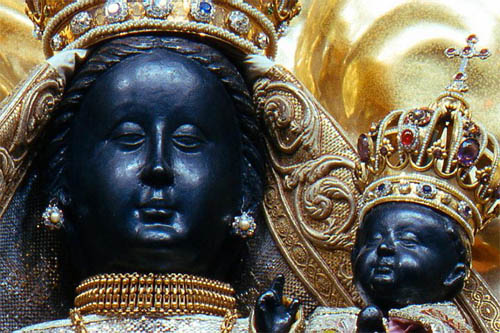
The place closest to my heart in the whole of Switzerland is the Monastery of Einsiedeln. “Einsiedeln” is a German word for “hermitage.” Surrounded by a dark, mysterious forest, situated near a scenic lake, adjacent to glorious mountain peaks, the place is second to none of the famous holy sites of the world in its beauty. It is in this area that Paracelsus was born, and perhaps more importantly – it is a place of worship of the Black Madonna of Einsiedeln, a delicate statue carved lovingly in lindenwood in the first centuries AD. She was a gift from Abbess Hildegarde of Zurich to Saint Meinrad, a monk who established the hermitage of Einsiedeln.

Meinrad was born into a privileged family but he felt he needed to walk his own path instead of rising in the ranks in an established monastery of Reichenau. He wanted to leave the familiar and the predictable behind, because above all he craved a life of solitude and contemplation. He chose the life of an eremite at Etzel, a mountain pass close to Einsiedeln. However, because his wisdom was widely known, he was visited by countless pilgrims, which disturbed his inner peace. Like Dante in Divine Comedy, he felt the pull of the Dark Forest, which seemed to hold a promise of the long awaited silence, solitude, contemplation and the intensity of deep inner work. He moved into the Finsterwald (Dark Forest), taking the Black Madonna statue with him and making Her the centre of his hermitage. “Finster” is a curious and mysterious adjective in German; it means darker than dark, pitch black, impenetrable, but at the same time it does not carry any sinister connotations. It just denotes a complete lack of light, similarly to the word “Sonnenfinsternis,” that is the solar eclipse.

il_fullxfull.194975273

Meinrad died the death of a martyr at the hands of two robbers, who clubbed him to death. According to the legend, the robbers were punished thanks to two ravens, who alarmed the locals about what had occurred. The legend of the two ravens is very compelling and symbolic of Meinrad’s individuation path. In his book on the Black Madonna of Einsiedeln, Fred Gustafson wrote this of the ravens, who symbolized the nigredo in alchemy – the first stage of the alchemical work:

“… as Meinrad made his way into the Finsterwald he noticed a nest in a fir tree, above which two hawks were hovering threateningly. The hermit chased the hawks away, climbed the tree, saved two ravens, and fed and cared for them. Finding a suitable clearing, he built a cell and a little chapel beside it. Meinrad dedicated the chapel to the Mother of God; today this is the site of the Monastery of Einsiedeln. The ravens stayed with him at his new hermitage.

In the Egyptian myth of Horus’ sparrow-hawk, as well as in the myths and symbolism of the Graeco-Roman age, the hawk is very definitely associated with the sun, that is, with the patriarchal values of logic and linear thinking. The raven, on the other hand, traditionally represents only the darker aspects, the shadow of consciousness. That the hawk would thus descend upon the young ravens symbolically represents the hostility of consciousness towards contents of the unconscious, especially embryonic contents – such as new awareness of attitudes or opinions – that need to be nourished and cared for. Meinrad’s rescue of the ravens is a spiritual victory for the emerging unconscious. The Finsterwald and the two ravens are closely related, one being the prima materia of the unconscious, the other, one’s personal relationship to the contents that begin to arise from it.

Ravens are indeed worthy and appropriate companions for St. Meinrad in that they fulfill their traditional role as messengers of gods, i.e., carriers of the vital messages of the unconscious to consciousness.”

Fred Gustafson, “The Black Madonna of Einsiedeln: An Ancient Image for Our Present Time, Kindle edition

1Bollingen_-_Kapelle_St_Meinrad_IMG_9567.JPG

St Meinrad’s chapel, via Wikipedia 

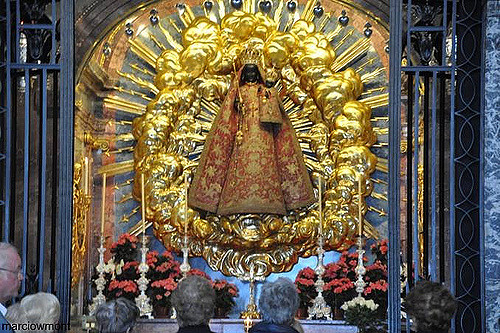
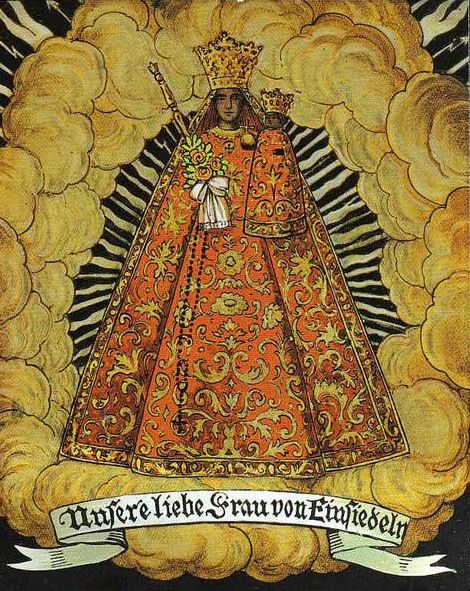
As in the case of the Dark Forest, also the darkness of the Madonna is not viewed as sinister or evil. Rather, it is peaceful, good, enveloping, and also creative, fecund, powerful and potent. It embodies the creative forces of the unconscious. The central part of the monastery is her chapel – octagonal, carved in black marble, lit by candles. In the centre, she resides surrounded by the blindingly golden halo of clouds and lightning. Her robes are extremely elaborate and ornate, and come in many shades and colours. Gustafson continues:

4316691395_1d31549a33_z

“She is elevated to a celestial-spiritual and dynamic position, the clouds emphasizing the former and the lightning the latter. Both have long figured as fertile, life-giving forces. In this respect, Augustine compared the apostles to a cloud because of the fertilizing nature of prophesies which, like clouds, come from a higher order. It is also said that lightning has an illuminating, vivifying, fertilizing, transforming, and healing function. Lightning, especially, is representative of energy and power; it symbolizes psychic energy in its most dynamic form. From another perspective, however, the gold lightning and clouds are just not a glorification of the Black Madonna; they are in fact eclipsed by her.”

The last sentence seems to say something very crucial about the Black Madonna. She is the creative force, the veiled mystery of darkness standing for the creative matrix. Her extremely potent and alluring quality, says Gustafson, “represents that side of the psyche that leads and entices an individual into life in its fullest measure.” She fascinates because she cannot be fathomed; she just suggests that what is apparent is just a thin layer covering the vast ocean of truth. She reminds us, according to the same author, that “for renewal to come in our time, it must be borne in the arms of the black, unknown maternal night of the unconscious, where humanity will once again open its psyche to that rich natural soil that is the mother of all human thought, invention, doctrinal formulation and truth.”

It is quite paradoxical that with Her mighty, formidable presence which makes one humble and full of reverence, She can simultaneously be related to in a very personal and direct way, as if She carried an individual healing message for each pilgrim’s soul. She is both of the earth (warm, accessible, maternal) and of heaven (distant, striking, regal). She is always surrounded by numerous pilgrims, both men and women. It is worth remembering that after Meinrad’s deaths Benedictine monks had full control over who had access to the Black Madonna statue and who was allowed to worship her. In that time, the so called Forest Sisters continued to live in loose communities of nuns without following any strict rules. They gathered herbs in the forest, practiced mystical arts and healed the pilgrims that flocked to Einsiedeln to visit the monastery. In the 16th century, the Benedictine monks came to the conclusion that the free community of Forest Sisters was not to be tolerated on the land of the monastery. The women were evicted from the town and had to live according to strict Benedictine rules in the town of Au. In 1703 they lost their free status. In addition, they were ordered to wear black robes. They were also banned from visiting the monastery and the town of Einsiedeln.

It is astounding how that tyrannical decision goes against the all-encompassing, all-loving wisdom of the Black Madonna, who obliterates all barriers and accepts every soul based on its inner depth rather than any accidental social status. The exclusion of Forest Sisters from the cult of Black Madonna is also symbolic of the Catholic Church patriarchal slant. However, this bias stands in direct contradiction to the true spirit of the religion and its dark, impenetrable roots.

bcff4da27e08585587494d6ea44a5b5c

Posted in Black Madonna | Tagged , , , , , , , , , | 22 Comments

“Perfect Woman” by William Wordsworth

She was a phantom of delight
When first she gleam’d upon my sight;
A lovely apparition, sent
To be a moment’s ornament;
Her eyes as stars of twilight fair;
Like twilight’s, too, her dusky hair;
But all things else about her drawn
From May-time and the cheerful dawn;
A dancing shape, an image gay,
To haunt, to startle, and waylay.

I saw her upon nearer view,
A Spirit, yet a Woman too!
Her household motions light and free,
And steps of virgin liberty;
A countenance in which did meet
Sweet records, promises as sweet;
A creature not too bright or good
For human nature’s daily food;
For transient sorrows, simple wiles,
Praise, blame, love, kisses, tears, and smiles.

And now I see with eye serene
The very pulse of the machine;
A being breathing thoughtful breath,
A traveller between life and death;
The reason firm, the temperate will,
Endurance, foresight, strength, and skill;
A perfect Woman, nobly plann’d,
To warn, to comfort, and command;
And yet a Spirit still, and bright
With something of angelic light.

231fc80da7a84870ce0c36fd9cfe4726

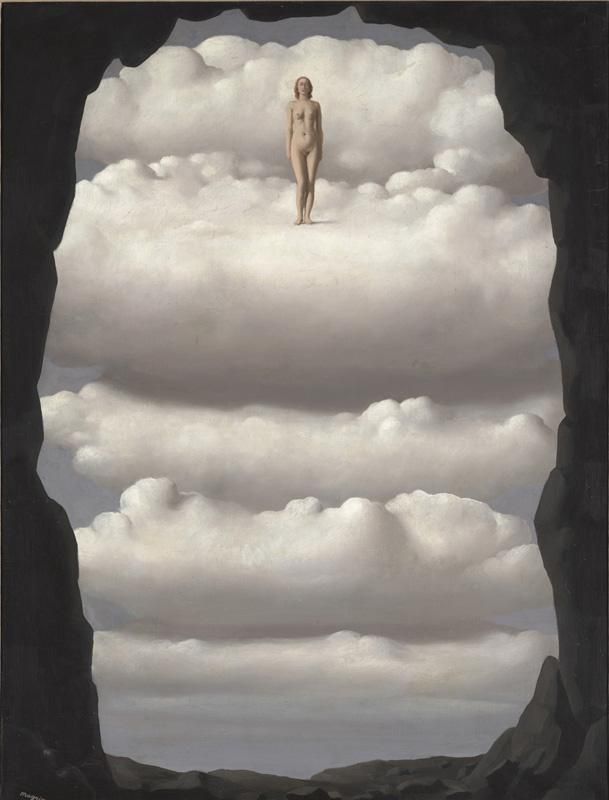
Rene Magritte, “Our Daily Bread”

Posted in Poetry, Uncategorized | Tagged , , , | 11 Comments

Shakespeare and Goethe on Love: from Despair to Hope

d1aa14db4924d949a686fc1e0caf650a

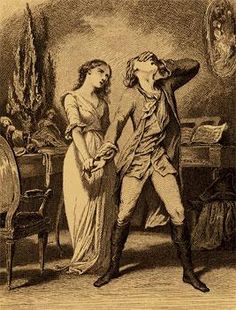
Werther and Lotte

“She had a wildness in her eyes and into it I plunged.”

Goethe, “Sorrows of Young Werther”

In January 1778 Christel von Lassberg drowned herself in the river Ilm, the reason most probably being unrequited love. A copy of Goethe’s Sorrows of Young Werther was found in her pocket. Goethe was distraught. He had written the book to purge himself of a period of suffering that a failed romance had cost him. He did achieve his catharsis but a lot of his reading public went “Werther-mad” after the book was published:

“In scores of literary, plastic, and musical forms Werther’s life was extended in Europe and America and even into China (where a porcelain factory reproduced him on tea-sets for the European market). Men dressed like him, in blue coat, buff-yellow waistcoat and knee-breeches, women wore a perfume called ‘Eau de Werther’.”

(from the Introduction by David Constantine, Oxford World’s Classics, Kindle edition)

The beautiful poem “To the Moon” that Goethe wrote shortly after Christel’s demise and possibly to commemorate her, seems to capture one of the main paradoxes of love, which was so eloquently expressed by Werther in one of his letters: “Does it have to be the case that what made a person’s felicity will become the source of his wretchedness?” In the poem Goethe receives solace and a promise of spring rebirth from the river:

River, flow the vale along,
Without rest or ease,
Murmur, whisper to my song
Gentle melodies!

Swelling in the winter night
With thy roaring flood,
Bubbling in the spring’s delight,
Over leaf and bud!

I have recently reread The Sorrows of Young Werther to find that it has not aged; quite the contrary, it is every inch as compelling as it was when I first read it. In the Introduction to the Oxford World Classic’s edition that I read, David Constantine points out an interesting tidbit: the book was written two years before The Declaration of Independence famously proclaimed: “We hold these truths to be self-evident, that all men are created equal, that they are endowed by their Creator with certain unalienable Rights, that among these are Life, Liberty and the pursuit of Happiness.” Werther’s plight stemmed from, among other things, the social mores of the times. Lotte was out of bounds for him. Nowadays, we hold a belief that there should be no barriers to love, and certainly not those erected by social strata; that who and how we love should remain at our own discretion. But the torment in our souls caused by love is just as tumultuous as it was for Werther.

Goethe’s novel abounds in beautiful passages. In a manner of true Romantics, nature plays a pertinent part in Werther’s expressions of his undying love. I particularly enjoyed the letter in which he delineates how from a state of powerful tranquility, serene contemplation and self-contentment (all that prior to meeting Lotte), his psyche was catapulted into torment and despair:

“The full and warm feeling of my heart for living Nature, my wellspring of abundant joy that turned the world to paradise on every side, has now become my unbearable tormentor, a spirit of torture pursuing me wherever I go.”

tree-of-crows

Caspar David Friedrich, “The Tree of Crows”

A_Vincent_Van_Gogh

Vincent van Gogh, “Wheatfield of Crows”

“And so I reel in fear, the energies of heaven and earth weaving around me. And all I see is an eternally devouring, eternally regurgitating monster,” he concludes. The entire book is so delightfully quotable it is hard to resist one more piece: “I wander the moors in the howling of the storm-wind that marshals ancestral ghosts in a wreathing mist in the unsteady light of the moon.” This tunnel vision drives him to self-destruction; suicide is a natural consequence, a tragic yet logical conclusion.

Lotte, who was married to a stable and predictable Albert, at one point asked Werther whether it was the impossibility of possessing her that made his desire so exciting. A portend question. The Sorrows are written in the form of letters to a friend, whose replies we can never read. This artistic decision of Goethe was acknowledged as masterstroke by the critics, for it highlights Werther’s self-absorption and his self-serving alienation. Is Lotte a woman of flesh and blood or, as Jungians would call it, a rampant anima complex possessing the hero’s psyche? Did he fall in love with a shadow that he mistook for substance, to paraphrase Ovid’s Metamorphoses?

This brings me to Shakespeare and a much more comforting masterpiece of his, namely The Winter’s Tale. This may not be his most famous play, nevertheless it is truly delightful. Neither a tragedy nor a comedy, though it ends happily, it was dubbed “a problem play.”  Yes, the consequences of love can be catastrophic, Shakespeare seems to be saying, but there is a great potential for healing in love; also, from great passion arises great art. In the story, king Leontes becomes irrationally jealous (is jealousy ever rational?) of his pregnant wife Hermione and imprisons her in a tower. Even though the Oracle of Delphi pronounces her innocent, he stubbornly persists in his paranoia. The key words of the play are uttered by Leontes to his wife: “Your actions are my dreams,” and “Affection! Thy intention stabs the centre.” In a moment of self-reflection, he laments “the infection” of his brain. He had dreamt the whole situation. But it is too late. The queen dies, while the infant daughter is abandoned in a wasteland of a foreign land of Bohemia by the king’s servant. Leontes mourns her for years.

Perdita_Anthony_Frederick_Augustus_Sandys

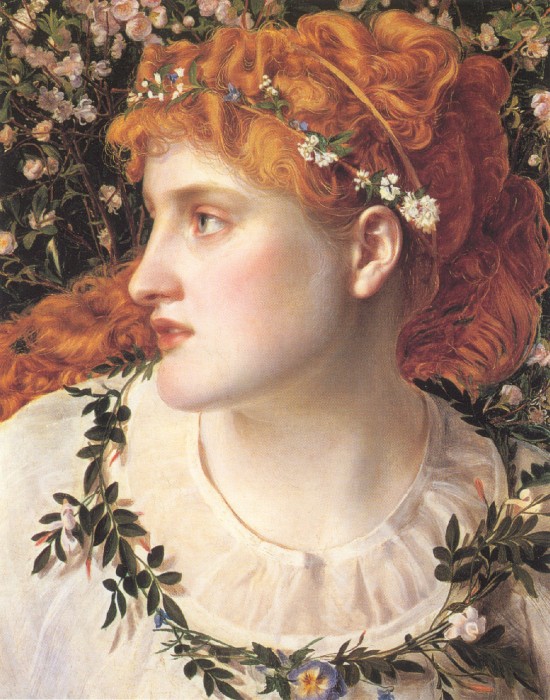
Anthony Frederick Augustus Sandys, “Perdita”

His lost daughter is raised by a pair of shepherds who name her Perdita (the lost one). Shakespeare lovingly portrays her as a delight of spring that brings and end to the woes of winter’s tale. The servant who abandoned her to die himself dies devoured by a bear. Much can be said about the symbolism of that scene. Bear, being connected with Artemis, goddess of childbirth, exacts revenge in the name of Nature. In addition, the bear’s winter hibernation alludes to the hope of spring and rebirth. But bears also stand for senseless cruelty as epitomized by the tyrant Leontes, who wielded his power in the very wrong cause.

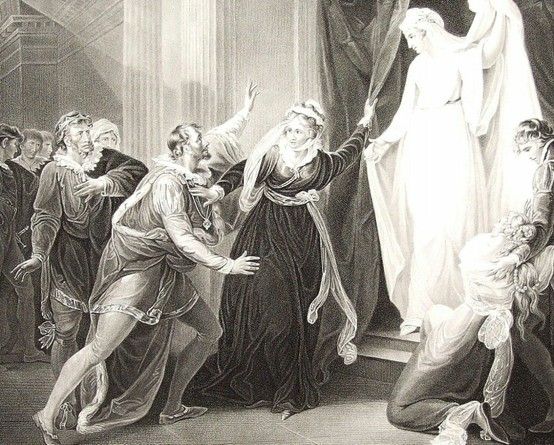
In a very moving ending of the play, the queen Hermione is brought back as a lifelike statue that had stood motionless for years. She is revived in a wonderful spectacle and reunited with her happy and repentant husband. On the one hand, the beautiful statue may well be a symbol artistic expression born out of torment and suffering. On the other, it is an image of frozen emotions, a typical reaction in a face of a major trauma. This passive, frozen immobility, arrested movement, is transformed into a wave of love that washes over the audience watching the final scene of Winter’s Tale. Maybe this is not really Hermione, but only an image revived by Leontes in his imagination. Nevertheless, healing is achieved, and that is all that matters.

4ba1834b53cf2db06d13ec4efbc9b2b1

Posted in love, Uncategorized | Tagged , , , , , , , , , , , , , , , , , , , | 10 Comments

Shadow Inhales and Illumination Exhales Light

In his book The Eyes of the Skin: Architecture and the Senses, Juhani Pallasmaa argues that our culture privileges the senses of vision and hearing as the most sociable, while the sense of smell, touch and taste are deemed archaic “with a merely private function, and they are usually suppressed by the code of culture.” Without integrating all the senses, we will never be able to be in the world completely, with a full sense of belonging, intimacy and integration. A passage that stood out for me was dedicated to the significance of the shadow, which puts all senses on an equal footing:

“How much more mysterious and inviting is the street of an old town with its alternating realms of darkness and light than are the brightly and evenly lit streets of today! … In order to think clearly, the sharpness of vision has to be suppressed, for thoughts travel with an absent-minded and unfocused gaze. … The human eye is most perfectly tuned for twilight rather than bright daylight.

… the extraordinarily powerful sense  of focus and presence in the paintings of Caravaggio and Rembrandt arises from the depth of shadow in which the protagonist is embedded like a precious object on a dark velvet background that absorbs light. The shadow gives shape and light to the object in light. … The art of chiaroscuro is a skill of the master architect too. In great architectural spaces, there is a constant, deep breathing of shadow and light; shadow inhales and illumination exhales light.”

Today around noon, while running through empty fields and along a forest, I saw a beautiful weather spectacle. Half of the sky was brightly illumined by the sun, the other was still submerged in fog. Wisps of smoky fog were dancing on the fields. The February sun was not its usual bright self, but more dim and hazy. The whole scenery plunged me into the depths of contemplation. In such moments, as the author of the above quoted book would undoubtedly agree, all the senses form a unity; they seem to coalesce and gently touch one another. I had a sense of being airborne, as if something was carrying me through the landscape. I had a brief moment of an utmost sharpness of thoughts and vision, with the body being the intricate part of it. While contemplating the deeply dark façade of the forest, I saw how wholeness does not let light stand above darkness, or the mind above the body. Jun’ichiro Tanizaki wrote in his book “In Praise of Shadows”

“A phosphorescent jewel gives off its glow and color in the dark and loses its beauty in the light of day. Were it not for the shadows, there would be no beauty.”

Were it not for full sensual participation in the world, there would be no beautiful thoughts, either.

800px-El_Greco_-_A_Boy_Blowing_on_an_Ember_to_Light_a_Candle_(Soplón)_-_WGA10422

El Greco, “A Boy Blowing on an Ember to Light a Candle”

Related posts:

Smell – A Potent Wizard

The All-Seeing Eye


Posted in darkness and light, Uncategorized | Tagged , , , , , , , | 6 Comments

No Such Thing as Woman

“What I saw, with jarring clarity, was that there is no such thing as woman. Woman, I realised, is a thing of legend, a phantasm who flies through the world, settling here and there on this or that unsuspecting mortal female, whom she turns, briefly but momentously, into an object of yearning, veneration and terror.”

John Banville, “The Blue Guitar”

E_Eve_-452x600

Emily Balivet, “Eve” via http://www.emilybalivet.com/Eve.html

Posted in Quotations | Tagged , , , | 4 Comments

Black Holes: A Silent, Secret Essence


rings_full

Rings of X-ray light centered on V404 Cygni, a binary system containing an erupting black hole (dot at center), via https://www.nasa.gov/feature/goddard/nasa-s-hubble-finds-evidence-of-galaxy-star-birth-regulated-by-black-hole-fountain

I.“He had begun by speaking of mines and metals, of gold and diamonds and all precious elements buried deep in the earth, but now, without my knowing how, he had ranged out into the depths of space, and was telling me of quasars and pulsars, of red giants and brown dwarfs and black holes, of heat death and the Hubble constant, of quarks and quirks and multiple infinities. And of dark matter. The universe, according to him, contains a missing mass we cannot see or feel or measure. There is much, much more of it than there is of anything else, and the visible universe, the one that we know, is sparse and puny in comparison. I thought of it, this vast invisible sea of weightless and transparent stuff, present everywhere, undetected, through which we move, unsuspecting swimmers, and which moves through us, a silent, secret essence.”

John Banville, “Ancient Light”

II.“Ever incomplete, terrestrial, and then again celestial,

you circle around in pursuit of sprightly phantoms,

you force light into the nether world…”

Orphic Hymn to Night

III. “You have no form, even though with the help of Maya, you take on myriads of forms. You have no beginning, though you are the beginning of all. It is you who creates, upholds and dissolves the worlds.”

Mahanirvana Tantra (quoted from “Shiva: The Wild God of Power and Ecstasy” by Wolf-Dieter, Ph.D. Storl)

Having listened to a recent episode of BBC Radio 4’s In Our Time dedicated to black holes, I was particularly struck by one observation made during the show. The remark was a definition of singularity, which lies at the centre of a black hole – “a place where gravity becomes infinite and where physics transcends what we now understand.” Anything that enters a black hole, having crossed the so-called event horizon, enters the sphere of mystery: it is no longer observable, while all communication with it is lost. A hypothetical body sucked into the black hole by way of its irresistible gravitational pull would be cruelly ripped apart.  It is dense mass and gravity that overwhelms all other forces, including light, and also obliterating the power of time. Anything that falls into the black hole will release infinite amount of energy, emitting blinding brightness of quasars or exploding stars. Although no energy comes from the black hole itself, objects interacting with it are energized to a tremendous extent.

A fascinating issue divides physicists: what happens with the information that gets sucked into a black hole? Some believe it is just lost, though this goes against the scientific axiom of quantum mechanics that it should be conserved. Stephen Hawking upholds that the information must survive:

“’I propose that the information is stored not in the interior of the black hole as one might expect, but on its boundary, the event horizon,’ Hawking said at a conference back in August 2015. ‘The message of this lecture is that black holes ain’t as black as they are painted. They are not the eternal prisons they were once thought. Things can get out of a black hole both on the outside and possibly come out in another universe.’

The idea is that when charged particles get sucked into a black hole, their information leaves behind a kind of two-dimensional holographic imprint on the event horizon. This means that while all the physical components of an object would be so totally obliterated by a black hole encounter, its blueprint lives on.”

Via http://www.sciencealert.com/stephen-hawking-just-published-new-solution-to-the-black-hole-information-paradox

tumblr_mbzxd2q4Kv1ru88yzo1_1280

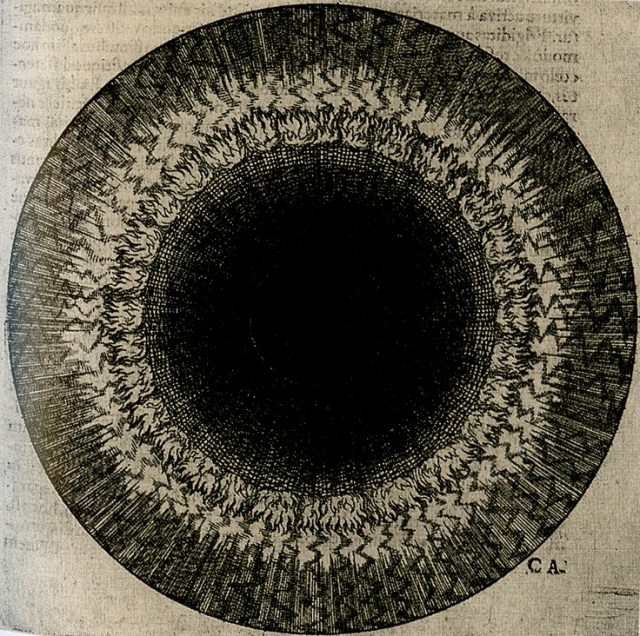
Robert Fludd, “Utriusque Cosmi”


Leaving an exciting possibility of black holes being portals to other universes aside, another question seems even more pressing: Was the Big Bang and the creation of the universe a result of a black hole seeding the manifest reality? This has been strongly suggested by Stephen Hawking. However, nothing is certain or proven as of yet:

“It could be time to bid the Big Bang bye-bye. Cosmologists have speculated that the Universe formed from the debris ejected when a four-dimensional star collapsed into a black hole — a scenario that would help to explain why the cosmos seems to be so uniform in all directions. The standard Big Bang model tells us that the Universe exploded out of an infinitely dense point, or singularity. But nobody knows what would have triggered this outburst: the known laws of physics cannot tell us what happened at that moment.

‘For all physicists know, dragons could have come flying out of the singularity,’ says Niayesh Afshordi, an astrophysicist at the Perimeter Institute for Theoretical Physics in Waterloo, Canada.”

via http://www.nature.com/news/did-a-hyper-black-hole-spawn-the-universe-1.13743

Black holes are said to be extremely efficient in converting matter into energy through the process of accretion. The spinning matter forms a brightly shining belt around the event horizon of the black hole. This luminous halo is called a quasar. It is postulated that a supermassive black hole lies at the very centre of our galaxy. Before the twentieth century and the theory of relativity, such an idea was inconceivable. The concept of the existence of black holes has been proven beyond doubt now, but when the idea was first postulated by John Mitchell as early as in 1783, nobody was mentally equipped to grasp it. The long-forgotten concept had to be rediscovered in the last century.

79cf68daf4b987d2a82e04f15a606f5f

Robert Fludd, “Utriusque Cosmi”

In 1848, Edgar Allan Poe published a non-fiction work called Eureka: A Prose Poem. A part of it was subsequently interpreted as postulating the existence of black holes, albeit in a purely intuitive, non-scientific fashion. In an essay dedicated to Eureka, David Grantz wrote:

“Poe states that God created matter from His spirit. The matter originally assumed its simplest form, without distinct kind, character, nature, size, or form. This primary particle comprised Oneness, which Poe believed to be the ‘natural’ condition of the universe. … However, for reasons unknown, the primary particle was willed by God into the ‘abnormal condition of Many.’ Because of gravity and according to their proximity, the irradiated atoms coalesced, later becoming suns, galaxies, planets, moons, and other cosmic debris. Finally, differentiation of particles by size, kind, form, character, and nature became possible, awaiting only the dualistic mind required to perceive the differentiations. Today’s astro-physicists speak more specifically in their discussion of particles than did Poe, who merely speaks of atoms; but the process of the irradiating universe is the same.

Very important is Poe’s idea that the normal condition of the universe can be achieved only in the unity of the primary particle. As a result, all matter longs to return to that which gave it birth. The force which compels all matter to return to simpler forms is gravity. Because of gravity, all atoms lump together in the most comfortable posture possible until the particle proper is completely reassembled.

Even before the primary particle becomes completely reassembled, aggregations of ‘various unique masses’ (Harrison 210) are possible, each mass assuming the characteristics of the original One. Today scientists call these particles black holes. They constitute energy and matter in their undifferentiated form, possessing gravity so great that not even light can escape from them.

Poe believed that the multitude of stars, having spiraled from their source, were bound to return to the Unity from which they were spun.”

Via http://www.poedecoder.com/essays/eureka/

I read on black holes with fascination, and if you are anything like me, you will agree that they are incredibly poetic. Echoing the Heart Sutra, to understand black holes is to understand that “emptiness does not differ from form, form does not differ from emptiness, whatever is emptiness, that is form” (translated by E. Conze). I can imagine the mysterious singularity, simultaneously acting and non-acting, as the Heart of Perfect Wisdom. The sphinx-like qualities of black holes fascinate and elude full understanding. They seem to be associated with stillness, yet the objects pulled by them are locked in an ecstatic dance, swirling around the invisible dark centre.

PQ4315_13_C3_1868pg230c

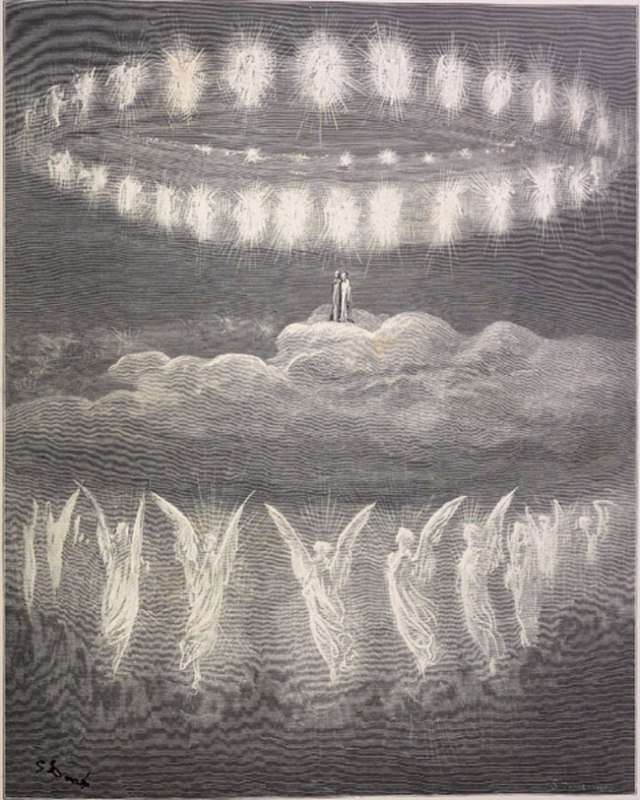
Gustave Dore, “Heavenly Host,” Dante’s “Divine Comedy” – Paradise


Posted in Black Holes, Uncategorized | Tagged , , , , , , , , , , , , , , , | 19 Comments