
Before the 30-year-old Antoni Gaudí designed the Nativity Facade of the Sagrada Família, he underwent a strict twenty-day fast that left him emaciated. The full name of the Basilica is the Expiatory Temple of the Holy Family. Its foundation stone was laid on 19 March 1882, conceived as “a way of repairing the sins of mankind.” (1) This grand basilica stood as Gaudí’s greatest and final masterpiece, upon which he diligently worked until his tragic death at the age of 73, resulting from being struck by a tram. His devotion to his craft was so profound that “God’s Architect,” as he was then known, had been neglecting his personal appearance. Mistaken for a beggar due to his disheveled state, he received scant assistance in the hospital and passed away just two days later. Today, in our hurried consumption of art, we often fail to mirror the fervor and devotion displayed by the artists themselves.
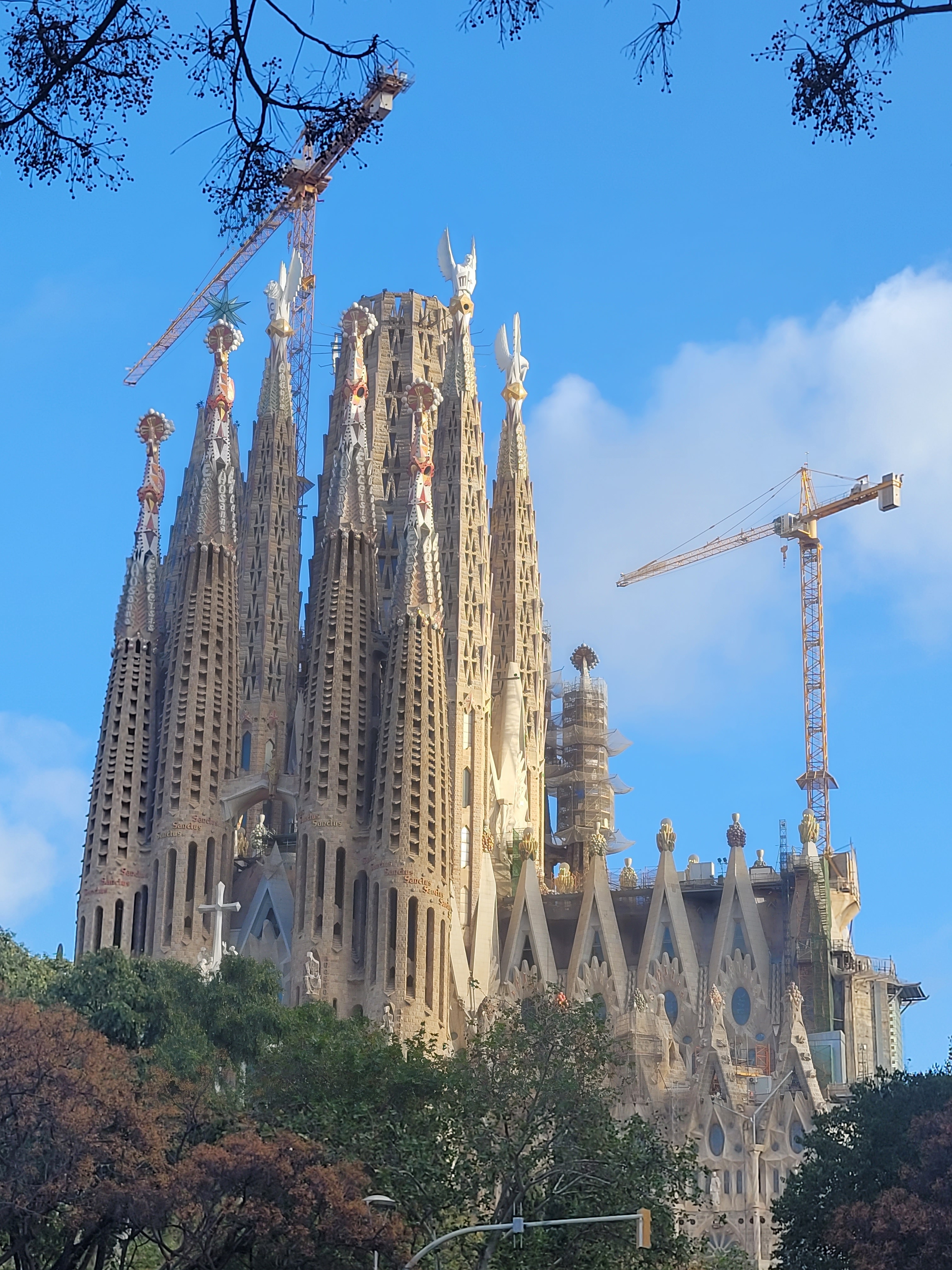
People flock here in thousands and are all struck by the bizarre intensity and profusion of Sagrada Família:
“Geometrical symbols, animals and plants, figures in relief or in sculpture – all of these form part of a vertiginous panorama that passes before the astonished gaze of anyone who approaches this complete edifice…” (2)

While trying to take in as much as I can, I was pondering on the chief difference between the Protestant and the Catholic approach to sacral art. In summary, Catholic churches generally incorporate a wide array of icons, religious symbols, and ornate decorations to create a visually rich and spiritually meaningful environment. In contrast, Evangelical (Protestant) churches tend to have a simpler aesthetic, often with minimal use of icons and symbols, placing more emphasis on the word of the scripture and its teachings. Martin Luther sought to ban “visually seductive” and “emotionally charged” images from the House of God. (3) As the fervor of Reformation wreaked havoc in Europe, image-breakers (iconoclasts) “burned, toppled, beheaded and hanged” religious artwork with utter scorn and delight. (4) By doing that, the followers of Luther rejected the suffering flesh of Christ and martyrs. Not only were the images rejected, also the music was treated with suspicion. As a result, faith became more spiritual but less incarnate:
“In essence … the Word is made Flesh – becomes reversed and the Flesh is made Word.” (5)
Gaudí, in stark contrast, takes the Catholic love of the image to the extreme. The Modernist style, (known as Art Nouveau in France and Sezession in Austria) which he represented, was already the antithesis of austerity, but he elevated it to an unprecedented level.
The main source of inspiration for the representatives of the Modernist movement was nature:
“[They took] ideas from plants (flowers and shoots), animals (insects and birds) and the waves of the ocean. … The predominant idea was that of eternal movement, brevity, in relation to … beauty and death. Floral and plant decorations signifying the ephemeral or the fertile were frequently used in buildings and objects.” (6)
Gaudí understood true originality as “getting close to the origin,” to the source of creation. He strove to imitate forms found in nature, for example the hexagon, the spiral and many others. He thus elucidated the motto of his art:
“The great open book one must strive to read is the book of nature; all the other books are extracted from it and contain man’s erroneous interpretations.” (7)
He called his architecture organic; I would describe it as embodied. His architectural projects appear to be alive and moving. I am reminded of Casa Battló, a renowned building located in the heart of Barcelona. Casa Batlló’s facade is the most famous aspect of the building. It is adorned with a mosaic of colorful ceramic tiles and undulating forms resembling scales. The facade is “suggestive of an aquatic landscape like that of a river embedded with stones worn away by water.” (8) The balconies resemble masks or skulls, and the roof depicts the back of a dragon, covered in iridescent tiles that change color as the sunlight hits them. As usually in Gaudí’s work, organic elements are permeated with myth and fantasy.

In his customary fashion, Gaudí transcended the sources of his inspiration, such as Modernism and Gothic architecture, ingeniously reinterpreting and creatively reshaping and enhancing them within his work. He painstakingly imitated the geometry found in nature: the spiral, the hexagon, the undulating forms of the water, the tree trunk. He envisioned the interior of Sagrada Família as the forest of columns. The Sagrada Família’s roof, adorned with skylights softly filtering daylight, evokes the intricate foliage of a forest canopy. His signature column “generated a double helicoidal movement, the natural movement of growth in plants.” (9)
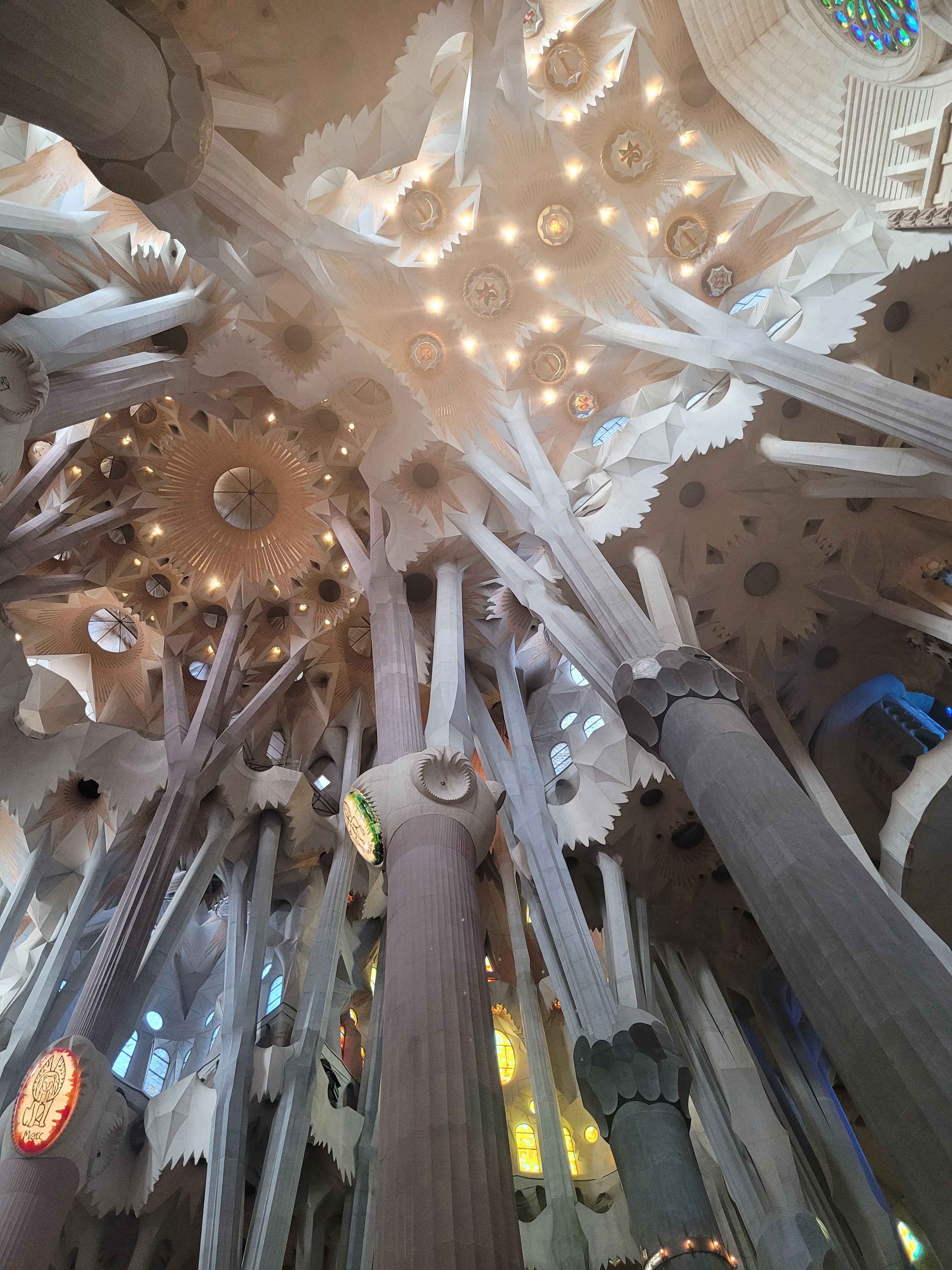

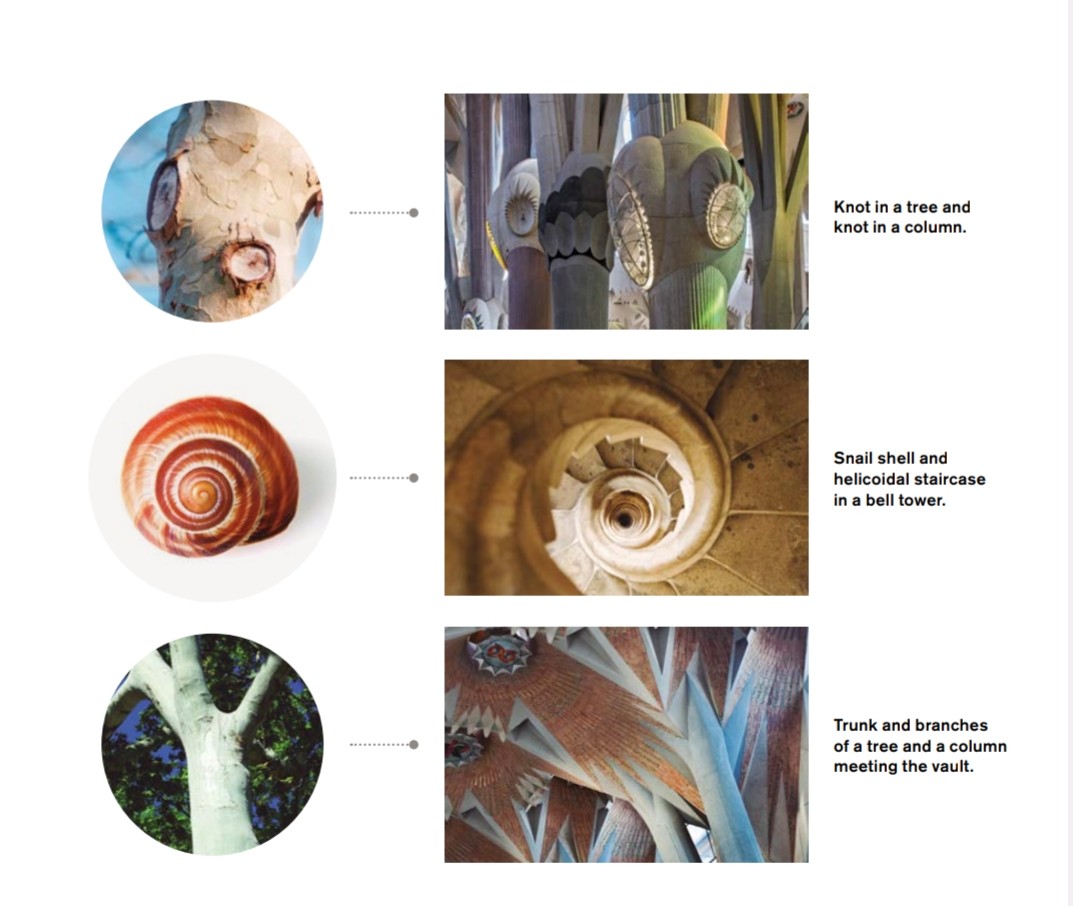
La Sagrada Família is to this day unfinished: it remains a work in progress. Gaudí was aware that such a grand project must be a collective effort of many generations. The extraordinary Nativity Facade was fully designed by Gaudí and finished in his lifetime. The sculptures illustrating the birth and infancy of Jesus are surrounded by the local flora and fauna depicted in stone. To be exact, thirty-one botanical species and sixty-eight different types of animals are depicted. The gargoyles were given the shape of Catalonian amphibians and reptiles. The pinnacles of the apse reproduce enlarged flower buds. (10)
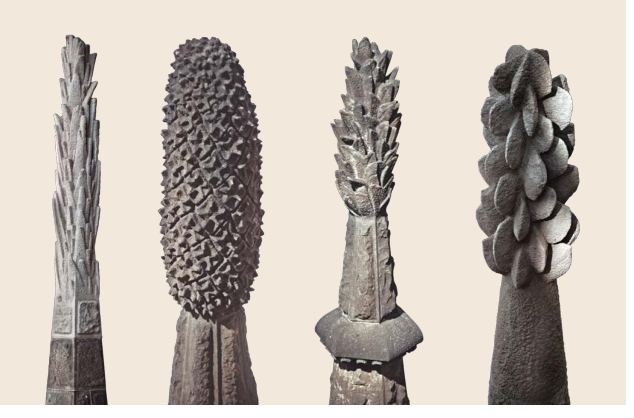

Gaudí had worthy successors. Although a lot of the master’s original designs got lost in the chaos of the Spanish Civil War, his legacy was continued by the likes of Josep Maria Subirachs, who designed the Passion Facade. Admittedly, it stands in stark contrast to the profuse Nativity Facade, yet its stark geometry and bone-like aesthetic was extremely striking to me.


But what I found truly stunning were the doors to the Nativity Facade, which were designed by a Japanese sculptor Etsuro Sotoo. Sotoo was originally drawn to Barcelona and the works of Gaudí in the late 1970s. He embraced Gaudí’s unique style and vision, eventually converting to Catholicism and dedicating himself entirely to following in Gaudí ‘s footsteps. I believe the doors he designed are a true expression of Gaudí ‘s spirit. The doors, decorated with plants, insects and small animals, were inaugurated in 2015. During my visit this year, I found myself captivated by them; they made me think of a door to a secret garden.


In the age of overtourism, it is an arduous task to immerse yourself into the beauty of famous landmarks. A brilliant entry point to acquaint oneself with the work of Antoni Gaudí is a 1984 documentary directed by Hiroshi Teshigara, who chose to show Gaudí’s masterpieces with sublime music and sparing commentary.

Support my blog
If you enjoy my writing, consider supporting my work. Thank you very much in advance.
$1.00
Notes:
(1) Artigas, Isabel. Gaudí: Complete Works. 2007. Taschen.
(2) Sola-Morales, Ignasi de. Gaudi. Rizzoli. 1984. New York.
(3)Koerner, Joseph Leo. The Reformation of the Image. University of Chicago Press, 2004.
(4) Ibid.
(5) McGilchrist, Ian. The Master and His Emissary: The Divided Brain and the Making of the Western World. Yale University Press, 2012.
(6) Artigas, Isabel. Gaudí: Complete Works. 2007. Taschen.
(7) Angles, Jordi Cusso. Gaudí’s Sagrada Familia: A Monument to Nature. Milenio Publicaciones S.L., 2010.
(8) Artigas, Isabel. Gaudí: Complete Works. 2007. Taschen.
(9) Angles, Jordi Cusso. Gaudí’s Sagrada Familia: A Monument to Nature. Milenio Publicaciones S.L., 2010.
(10) Ibid.





 symbolreader
Wonderful post. Gaudi holds strong fascination. His works are otherworldly and maybe what architecture looks like in the future or on other planets. Happy to hear there are devotees carrying on for him. I like the work of the two you included pics of, yet I feel they don’t pick up where Gaudi left off. Thank you for the youtube doc. Will watch it later and it may be one I watched awhile back. Did you feel any particular energy when near or in the buildings?
LikeLiked by 1 person
Thank you very much. I totally agree: there was only one Gaudi. The Sagrada Familia has an indescribable energy: it is otherworldly (I loved what you said about other planets) and so absorbing that one does not notice or mind the other people. I saw the other of his buildings only from outside but I can say they all possess a magnetic quality.
LikeLiked by 1 person
You’re welcome and thank you for sharing your visit here. Imagining beings approaching the planet and scanning it and being delighted to learn someone of their kind has been here before. Like finding a coke can in the middle of an uncharted South American jungle 😉
LikeLiked by 1 person
It has the holiest feeling of peace and belonging I have ever felt inside of a church. I am not religious, and when I stepped inside La Sagrada Familia I felt at home.
LikeLiked by 1 person
Absolutely – beautifully put. I just wanted to add that I am not conventionally religious, either. But La Sagrada Familia touched me all the same. It was also amazing to see a line “Give us our daily bread” from Lord’s Prayer written in all possible languages. I agree: this is not the usual “parochial” space.
LikeLiked by 1 person
It is a church for everyone ❤
LikeLiked by 1 person
Thanks for this share. I hope to visit one day in person. I appreciate your special flare and attention to detail.
Merry Solstice Monika! ❤️
LikeLiked by 1 person
Thank you very much, Linda. You’d love Gaudi especially because of his signature mosaics.
Have a blessed Solstice, too!
LikeLiked by 1 person
Absolutely, but there is sooooo much to love about this work in progress. Gaudi was a true artistic pioneer.
LikeLiked by 1 person
I also loved that he never settled but constantly revised and transformed his ideas about where the project was going.
LikeLike