
“Her hair was as a wet fleece of gold, and each separate hair as a thread of fine gold in a cup of glass. Her body was as white ivory, and her tail was of silver and pearl. Silver and pearl was her tail, and the green weeds of the sea coiled round it; and like sea-shells were her ears, and her lips were like sea-coral.”
Oscar Wilde, “The Fisherman and His Soul”
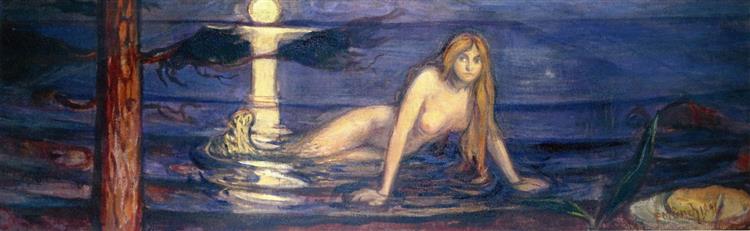
In 1948, Pablo Picasso visited post-war Communist Warsaw and was invited to view an apartment in an unfinished building. Spontaneously, he sketched a large mermaid on the wall, referencing the coat of arms of the Polish capital. Picasso’s mermaid held a hammer instead of the traditional sword. However, five years later, the apartment’s owners had the mural painted over, unable to bear the constant flow of visitors eager for a glimpse of the artwork. (1)

Picasso’s mermaid, much like her mythical counterpart, revealed herself only fleetingly before vanishing once more into the waters of the collective unconscious. Mermaids hold such a prominent place in symbolism due to their shimmering and elusive nature. Like the play of light on water’s surface, they cannot be captured or solidified. Ever in motion, they slip away from any fixed definition, embodying a mercurial quality that makes them as elusive as the unconscious itself. They embody Rudolf Otto’s concept of Mysterium tremendum et fascinans” (fearful and fascinating mystery).
The mermaid is a liminal and hybrid being, able to cross the threshold between the conscious and unconscious realms. There is a yearning for connection on both sides: she bears gifts of the depths to offer, yet she also longs for something which can only be found on the human side – our individual souls. Dane Rudhyar expresses this beautifully:
“The mermaid personifies a stage of awareness still partially enveloped by the ever-moving and ever-elusive ocean of the collective Unconscious, yet already half formulated by the conscious mind.” (2)
Giving birth to ideas from the unconscious is often a painful process. (3) In Hans Christian Andersen’s The Little Mermaid, the protagonist sacrifices her divine voice for human legs, and every step she takes feels like walking on sharp knives. The mermaid archetype embodies an aspect that resists being shaped into form, refusing to be domesticated. Clarissa Pinkola Estes writes about the Wild Woman, emphasizing that periodic renewal is essential for the wild soul within every woman. In the tale of the Selkie, who lives as a seal in the water but can shed her skin to become human, Estes highlights this need for renewal. In the myth, Selkies, whose “skin shimmered with little silver dots like those on the salmon in springtime,” gather to dance together. (4) Various myths highlight the mermaid’s “ability to cross the threshold into the world of humans and ‘pass’ there as human while never fully belonging.” (5) In Western myths and stories, there is often an element of control over the creature emerging from the watery depths:
“These tales speak to the discrepancy between men’s longing for a woman unfettered by social mores and their attempt to control her by domesticating her. The mermaid is beautiful, and men yearn to possess her, but it must be on their terms and not the mermaid’s.” (6)
For C. G. Jung, mermaids were one of the many personifications of the anima, who can be a negative or a positive expression of the unconscious:
“The unknown woman, therefore, has an exceedingly contradictory character and cannot be related to any normal woman. She represents some fabulous being, a kind of fairy; and indeed fairies have the most varied characters. There are wicked fairies and good fairies; they too can change themselves into animals, they can become invisible, they are of uncertain age, now young, now old, elfin in nature, with part-souls, alluring, dangerous, and possessed of superior knowledge. We shall hardly be wrong in assuming that this motif is identical with the parallel ideas to be found in mythology, where we come across this elfin creature in a variety of forms —nymph, oread, sylph, undine, nixie, hamadryad, succubus, lamia, vampire, witch, and what not. Indeed the whole world of myth and fable is an outgrowth of unconscious fantasy just like the dream. Frequently this motif replaces the water-motif. Just as water denotes the unconscious in general, so the figure of the unknown woman is a personification of the unconscious, which I have called the anima.” (7)
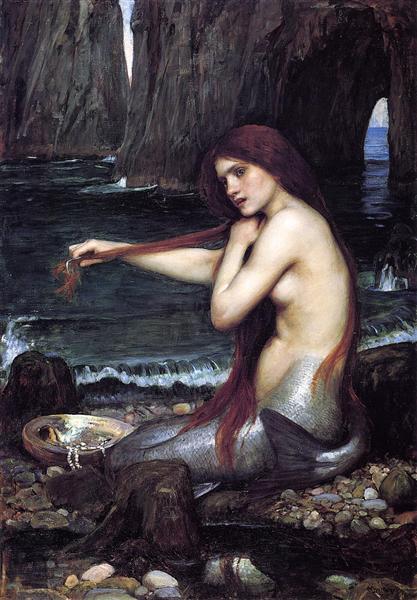
Collectively, we remain enchanted by the medieval mermaid, which shapes our common perception of her. Depictions of mermaids began to emerge in Romanesque churches around the eighth century, likely influenced by Atargatis, the fish-tailed goddess of the Aramaeans in Syria. Atargatis was a deity associated with fertility, water, and protection, embodying both nurturing and fearsome qualities. According to legend, she transformed into a mermaid as an act of penance after falling in love with a shepherd. Overcome with grief, she cast herself into a lake, taking on the form of a fish to dwell in the water. Since ancient times, mermaid tales have centered around themes of heartbreak and tragedy.
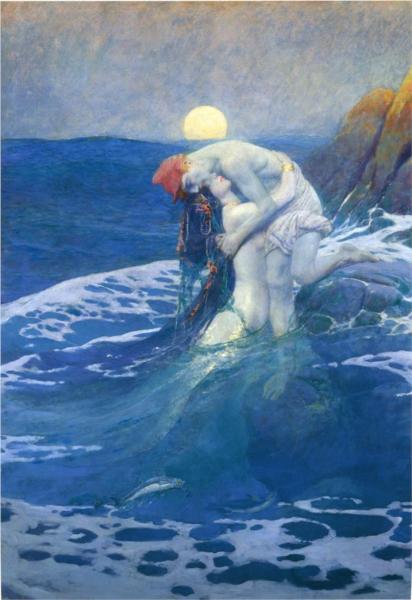
The worship of the Greek goddess Aphrodite has its roots in the veneration of Atargatis. Born of the sea, and venerated as the goddess of the sea, Aphrodite was accompanied by Tritons and is associated with the myth of the two fish (Pisces). This connection stems from a Greek myth involving Aphrodite and her son, Eros, as they fled from the monster Typhon. According to the tale, Typhon—a massive serpent-like creature—threatened the mother and son. To escape him, Aphrodite and Eros transformed into fish and leaped into the Euphrates River, where they swam to safety. Pisces symbolizes the duality of the unconscious and the boundary-crossing nature of Aphrodite, Atargatis, and mermaids in general. Medieval mermaids inherited the symbolism of mirrors and pearls from their ancient counterparts.(8) Cirlot writes this on the nature of the unconscious and the mermaid as its emanation in his Dictionary of Symbols:
“Given that the sea is the lower abyss and an image of the unconscious, then the twin fish-tail, pertaining to the sea, must express a duality (or conflict) within the watery deeps.”
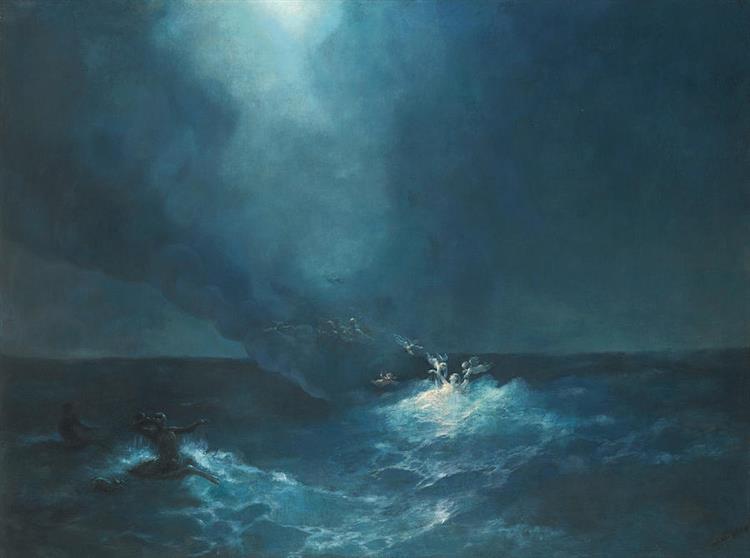
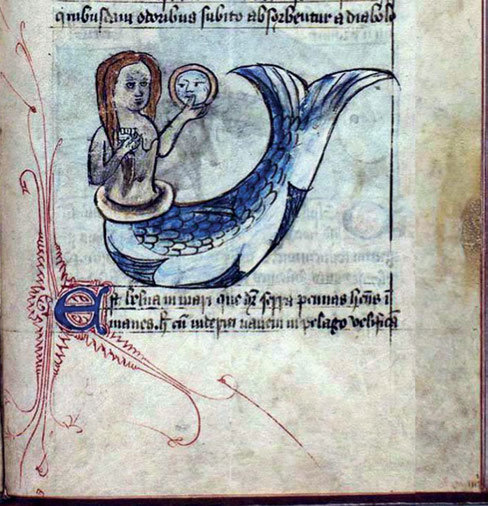
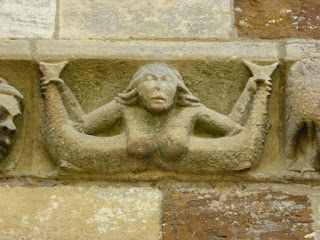
Before the High Middle Ages (12th to 13th century), mermaids were primarily depicted as seductive figures, representing a heathen counterpart to the chaste Virgin Mary and symbolizing unrestrained sexuality. According to Scribner, early medieval churchmen appropriated an ancient (likely Etruscan) image of a water deity with two tails. Sculptors depicted these mermaids as “spreading” their tails apart, revealing their reproductive area—or vesica piscis (Latin for “vessel of the fish”)—in graphic detail. (9) In doing so, church leaders aimed to evoke shock and disgust, alerting the faithful to the ensnaring and treacherous nature of the feminine form. Ironically, however, they created an iconic mermaid whose allure endures to this day. The mermaid in the Starbucks logo, for example, was based on an image of a medieval mermaid that the logo’s creator found in Cirlot’s Dictionary of Symbols. The current design focuses on her face, concealing her sexual features. (10)

After consulting both Cirlot’s Dictionary of Symbols and The Penguin Dictionary of Symbols, I was surprised to find that both sources remain rooted in the medieval, reductive notion that mermaids symbolize the danger of death through their unchecked sexuality. Cirlot wrote:
“It seems that they are largely symbols of the ‘temptations’ scattered along the path of life (or of symbolic navigation) impeding the evolution of the spirit by bewitchment, beguiling it into remaining on the magic island; or, in other words, causing its premature death.”
Similarly, Chevalier, the author of The Penguin Dictionary of Symbols, issues an even sterner warning:
“They symbolize the self-destructive power of desire, to which the depraved imagination offers only a senseless dream instead of objective reality and a viable action. Like Odysseus, one must lash oneself to the mainmast, the spirit’s vital axis, if one is to escape the delusions of passion.”
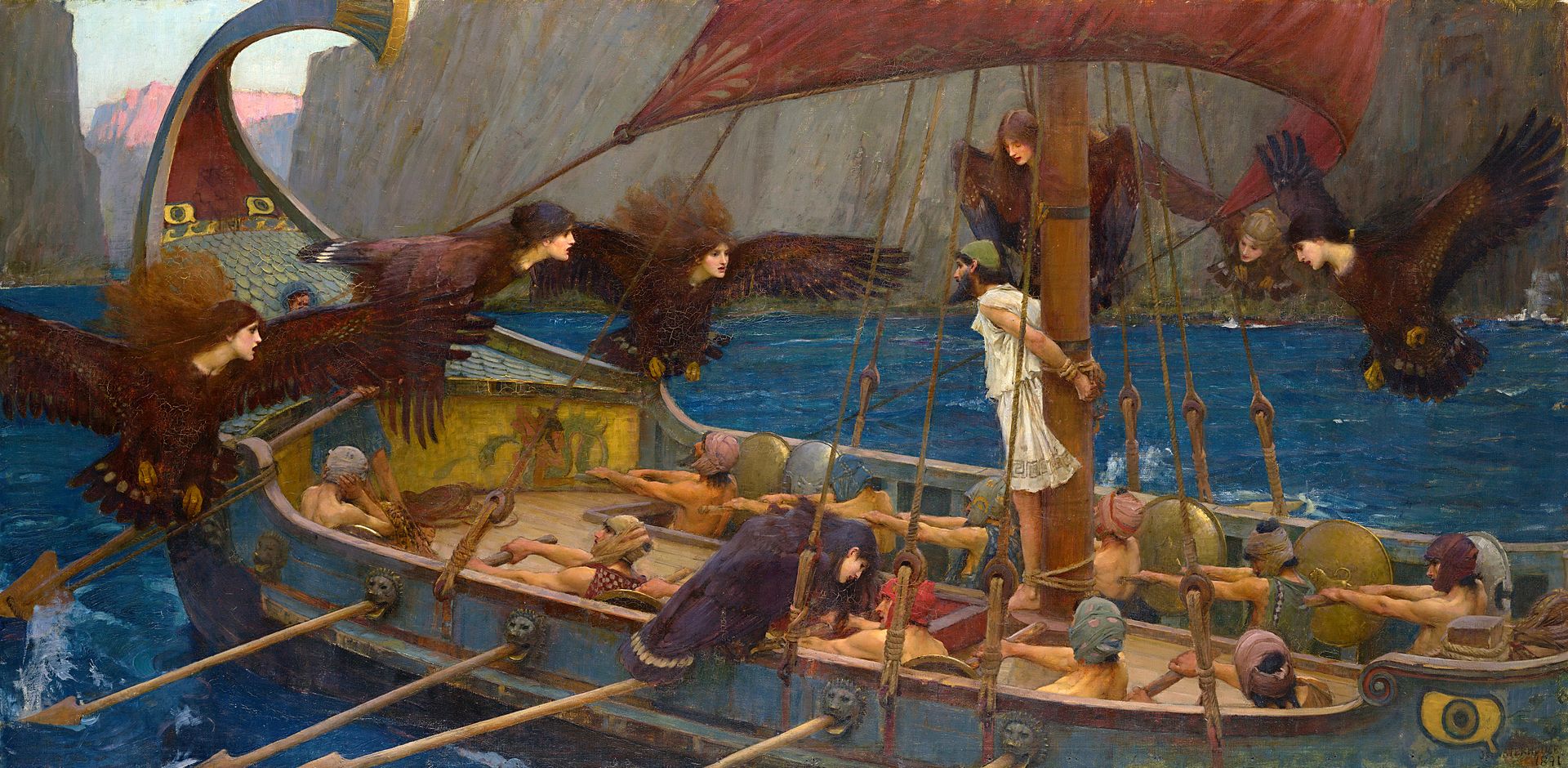
Crucially, the sirens in The Odyssey were not depicted with fish tails but as airy, winged creatures. Moreover, their song was not one of seduction but of timeless wisdom. Homer’s Sirens sing, “Approach! thy soul shall into raptures rise! Approach! and learn new wisdom from the wise!” Clearly, there is more to sirens and mermaids than mere physical allure:
“Homer’s Sirens sing a song that promises knowledge—a wisdom that bridges worlds—instead of pleasure. While their appearance differs from that of the mermaids with whom they are later conflated, the Sirens’ music is still a portal that draws humans into a different dimension.” (11)
Every epoch has its mermaids, even the Enlightenment – the least magical and metaphysical of eras. The mermaids of the Age of Reason were described as “ugly creatures for ugly times.” (12) To my mind, this reflects the prevailing cultural attitude toward the unconscious during each era. While antiquity, the Middle Ages, the Renaissance, and Romanticism were all ages of wonder, the Enlightenment sought to sever the vital connection between consciousness and the collective unconscious.
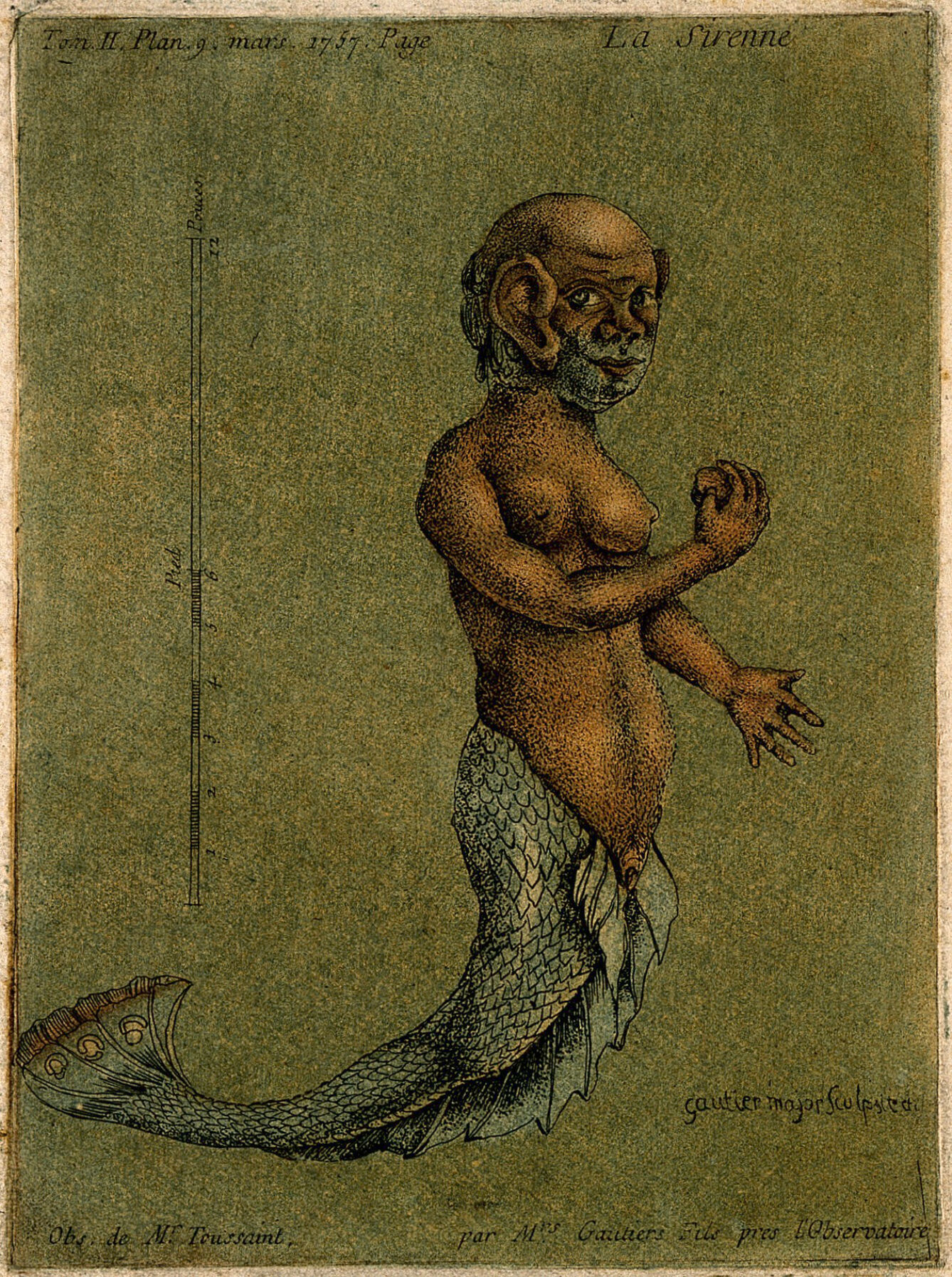
On the other hand, Gautier’s mermaid/merperson looks surprisingly modern and refreshing. Words like monster and ugly carry negative and highly subjective connotations. With their hybrid, fluid nature, mermaids have become an icon of the queer culture. Mermaids and other “monsters” are never “ugly,” but they inspire both fear and awe, embodying the etymology of the Latin monstrum—”that which reveals,” “that which warns.” (13) Mermaids, as messengers from the depths, convey symbols from the unconscious to the individual soul through their haunting, alluring siren song. Abyssus Abyssum Invocat (14)—”deep calls to deep,” as Psalm 42 reads in the King James Bible—evokes the mermaid’s yearning for a soul and the human desire for the unconscious depths, sometimes at the cost of an individual life. Here, as Rudhyar observed, lies a mutual pull—a shared, magnetic attraction that draws the human and the mythical into a profound and timeless connection.
Notes:
(1) A. Müller, C. Halls, and B. Williamson, Mermaids: Art, Symbolism and Mythology (Exeter: University of Exeter Press, 2022)
(2) D. Rudhyar, An Astrological Mandala: The Cycle of Transformations and Its 360 Symbolic Phases (Vintage Books, 1974)
(3) Ronnberg, Ami, ed., The Book of Symbols: Reflections on Archetypal Images. (New York: Archive for Research in Archetypal Symbolism, 2010)
(4) Clarissa Pinkola Estes, Women Who Run with the Wolves: Myths and Stories of the Wild Woman Archetype (New York: Ballantine Books, 1992)
(5) C. Bacchilega and M. A. Brown, eds, The Penguin Book of Mermaids (New York: Penguin Books, 2019)
(6) Ibid.
(7) C.G. Jung, CW 16, para 17
(8) A. Müller, C. Halls, and B. Williamson, Mermaids: Art, Symbolism and Mythology (Exeter: University of Exeter Press, 2022)
(9) V. Scribner, Merpeople: A Human History (London: Reaktion Books, 2020)
(10) Ibid.
(11) C. Bacchilega and M. A. Brown, editors, The Penguin Book of Mermaids (New York: Penguin Books, 2019)
(12) V. Scribner, Merpeople: A Human History (London: Reaktion Books, 2020)
(13) C. Bacchilega and M. A. Brown, editors, The Penguin Book of Mermaids (New York: Penguin Books, 2019)
(14) Ibid.
Support my blog
If you enjoy my writing, please consider donating to support my work. Thank you very much in advance.
$1.00





 symbolreader
So interesting! Thank you for this history of our fascination with mermaids through the ages, and their symbolism.
LikeLiked by 1 person
Thank you very much. It really is incredible that mermaids do live on in our collective fascination.
LikeLike
I appreciate and look forward to reading your posts. I think that the archetypal and mythopoetic world is much closer and exerts a type of subtle influence. I look as it as a filmic overlay on our subjective view of ‘reality.’
Have you seen the film Ondine? A poignant adult fairy tale that I recommend if you haven’t.
If you can point me to another symbol book as great as the Book of Symbols was, I am all in!
LikeLiked by 1 person
Thank you for your comment and such beautiful words about the mythopoetic realm. I have seen Undine and absolutely loved it. I also think mermaids are as alive and relevant as ever. I cannot think of a better boon than the Book of Symbols at the moment. It really is delightful and I often hang on its every word. ARAS, its publisher, has a very good website but it operates on subscription.
LikeLiked by 2 people
Monika, women are forever misunderstood and minimized and or demonized. You did an incredible job here, weaving astrology and mythology together. Venus and Neptune together are so beautiful and ethereal, perhaps part of the Anima description?
Love to you,
Linda ❤️
LikeLiked by 1 person
Thank you so much, Linda. You always understand so well what I want to say. That is indeed the main “message” I wanted to share.
LikeLiked by 1 person
That is very kind to say. In case you don’t know, you are an incredible writer and I often marvel at what you are able to impart to the reader.
LikeLiked by 1 person
Thank you 💕
LikeLike
Pingback: 人魚 – 豊かさの森