
“The sight of evil kindles evil in the soul—there is no getting away from this fact. The victim is not the only sufferer; everybody in the vicinity of the crime, including the murderer, suffers with him. Something of the abysmal darkness of the world has broken in on us, poisoning the very air we breathe and befouling the pure water with the stale, nauseating taste of blood. True, we are innocent, we are the victims, robbed, betrayed, outraged; and yet for all that, or precisely because of it, the flame of evil glowers in our moral indignation. It must be so, for it is necessary that someone should feel indignant, that someone should let himself be the sword of judgment wielded by fate. Evil calls for expiation, otherwise the wicked will destroy the world utterly, or the good suffocate in their rage which they cannot vent, and in either case no good will come of it.”
C. G. Jung, Civilization in Transition, Collected Works, Vol. 10, par. 410
The famous balloon-globe scene in The Great Dictator distills Charlie Chaplin’s satire of tyranny into a single, haunting image of narcissism. Adenoid Hynkel, i.e. “the Great Dictator”, treats the world as a toy, tossing and caressing it with childlike delight, as though global domination were no more than a game. His is an empire inflated by vanity, ready to collapse at the slightest touch. When it bursts, the dictator’s fantasy dissolves in an instant, exposing the absurdity and futility of his lust for power. The evil he embodies is both destructive and ridiculous.
This summer, I had the opportunity to visit the wonderful Chaplin’s World in Vevey, Switzerland. This was his last home, where he spent the final twenty-four years of his life. While watching this scene at the museum, I marvelled how it reminded me of the world today. The only comfort we have is that tyrannical evil is inherently unstable: the balloon collapses, the ring of Sauron is destroyed in the end.
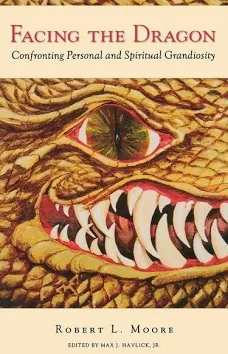
In the above-featured book, published in 2003, the Jungian analyst Robert L. Moore talked about “the agency of evil” and its roots in the collective psyche. There are very perilous forces lurking in the depths of our souls, he insists. He speaks of ancient cultures, which saw evil as possession; a malicious entity that colonizes souls and “seduces individuals into states of enchantment that compromise their ability to liberate themselves or even realize the destructiveness of their behavior.” This force presents itself as “the centre of life,” yet in truth it swallows and annihilates “Being itself,” much like a black hole. It invades the human ego from the recesses of the collective unconscious, which Moore calls the “Great Self Within.” He writes,
“Part of a person’s psyche is hell-bent on destroying her and not allowing her to have any love, not allowing her to have any trust, not allowing her to have any successful transformation of her patterns of relatedness and her patterns of human interaction.”
The kind of evil he describes goes hand in hand with grandiosity. As Moore puts it,
“There is no one alive who does not have a grandiose, exhibitionistic self-organization, an actual psychological structure or entity that thinks it is God.”
The grandiose Self hates limitations above all else. We all carry the divine likeness within our souls but the secret is not to let it inflate the ego, for it will burst like Chaplin’s balloon. These Godlike energies of the collective psyche suffuse our lives with enchantment but they can also be destructive. Moore calls the dark aspect of the collective unconscious, the great dragon. This particular beast that seeks to take over our souls cannot be slain, he says,
“The only thing that can be slain, however, is an ego organization that has merged unconsciously with the great dragon. The great dragon cannot be killed. It must be related to in a conscious way…”
Moore emphasises that it is naive to believe that archetypal forces want nothing but good things for us. On the contrary, he asserts that “the archetypal Self, if you are not awake, will eat you alive.” Not a single human soul is free of this danger.
If we fail to own our inner dragon of grandiosity, we inevitably project it onto others. We then elevate destructive leaders, idolized by a spellbound crowd. They proclaim themselves the very centre of truth and life, while dismissing everyone beyond their circle as worthless. As Moore explains,
“When dragon energies are present unconsciously, we have little concern for even the most blatant inequities. Injustice is not high on our list of concerns. We look for ways to stay in denial, to rationalize our acceptance of poverty, disease, political oppression, and environmental despoilation.”
Moore’s book is perhaps my favourite work by a Jungian analyst. I find his work strikingly relevant for our day and age not just for our time, but for any era. I was shattered to find out about the tragic circumstances of his death. You do not poke the Great Dragon without the tragic consequences, it would seem.
If you want to support my blog via PayPal, you can still do it by scrolling to the bottom of this page and clicking on the PayPal button. Thank you very much in advance. You can also find it here https://symbolreader.net/about/





 symbolreader
A very powerful piece.Thank you. Sent from my iPhone
LikeLiked by 2 people
Thank you very much.
LikeLike
Hi Monika, I was wondering if you were still writing and here you are with a powerful essay. Evil.and radical.and dragon are used often on the US these days. Many theories abound about the nature of good and evil. I like your take and it strongly resonates to the current authoritarian movements throughout the globe. These ideas also feel Plutonian and 12th house in scope.
Take care,
❤️ Linda
LikeLiked by 1 person
Thank you so much, Linda. I decided not to name any names but those who know, know.
LikeLiked by 1 person
thank you Monika. This is very powerful and relevant.
LikeLiked by 1 person
Thank you very much, Susan.
LikeLiked by 1 person
Thank you. Powerful and chastening.
LikeLiked by 1 person
The book was that for me. Thank you.
LikeLiked by 1 person
Thank you! Mark Stavish’s book is also informative for those who feel caught up in a grandiose cultish delusion https://www.simonandschuster.com/books/Egregores/Mark-Stavish/9781620555774
LikeLiked by 1 person
Thank you for this recommendation. I will check it out.
LikeLike
Excellent archetypal amplification of current “one-sided” geopolitic-mythophoetic “governing”/”parental” “Zone of Interest” “nuclear-war-heads” of “monumental hegemonic dominance” in a “White House”…
LikeLiked by 1 person
Thank you!
LikeLike