The Symbolic Power of Mushrooms

The Symbolic Power of Mushrooms

In the collective consciousness since the recent pandemic, two symbols of self-destruction have emerged, both connected to mushrooms. In the HBO series “The Last of Us,” mind-manipulating mushrooms known as ophiocordyceps possess the minds of their human hosts. In the biopic “Oppenheimer,” a mushroom cloud ominously represents humanity’s capacity for self-destruction. These archetypes emerging at this moment in history are not accidental, as C.G. Jung extensively wrote about the parallels between the human psyche and its manifestations in the world.

Jung compared psychology to modern physics by stating that “they both approach the hitherto ‘transcendental’ region of the Invisible and Intangible.” (1) Both encounter the ultimate energies of creation and its shadow – destruction. As he wrote,

“From this it is clear that the psyche not only disturbs the natural order but, if it loses its balance, actually destroys its own creation. Therefore the careful consideration of psychic factors is of importance in restoring not merely the individual’s balance, but society’s as well, otherwise the destructive tendencies easily gain the upper hand. In the same way that the atom-bomb is an unparalleled means of physical mass destruction, so the misguided development of the soul must lead to psychic mass destruction.” (2)

Jung warned against the “godlike” power falling into the human hands. In another letter he wrote,

“Man confuses himself with God, is identical with the demiurge and begins to usurp cosmic powers of destruction, i.e., to arrange a second Deluge.” (3)

The kernel of the Jungian wisdom is that we all partake in the collective psyche’s destructive and creative aspects. “None of us stands outside humanity’s black collective shadow,” said Jung (4) But the human tendency is to drive evil far away from us – like in the Old Testament, in which the scapegoat was carried into the wilderness. Similarly, in “Oppenheimer”, Los Alamos serves as the wilderness, where the “evil” atomic bomb is developed. And like the proverbial scapegoat, Robert Oppenheimer is the one who is made to carry the shadow of the collective psyche.

Jung often referenced a line from the Romantic poet Hölderlin, “Wherein lies the danger, grows also the saving power.” This idea is reflected in the constellating nature of all archetypes, encompassing both light and shadow aspects. Much like mushrooms, archetypes emerge into consciousness unexpectedly, but they are, in reality, manifestations of what already thrives in invisible dimensions(5) This raises the question: how can we interpret the messages conveyed by mushrooms in popular culture?

Like the unconscious psyche, mushrooms are the most mysterious of all species. Merlin Sheldrake has written a fascinating book about them, in which he reveal that these organisms, forming a separate kingdom, stand apart from both animals and plants Over ninety per cent of all fungi remains undocumented. Mushrooms form our “biological dark matter” or “dark life.”(6) Despite their enigmatic nature, mushrooms hold valuable insights into understanding ourselves and our planet. Much like the archetypes of the collective unconscious, mushrooms possess a dual nature, being both nourishing and deadly.
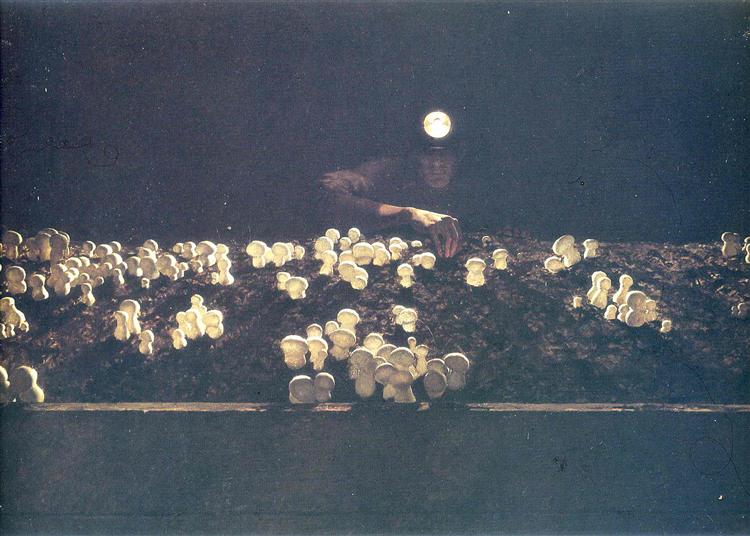
Jamie Wyeth, “Mushroom Picker”

Sheldrake emphasizes that there would be no plant life without fungi. This is because the roots of more than ninety percent of plants are linked with a species of mycorrhizal (mykes – fungus, rhiza – root) fungi. The same fungi ensure communication between plants, the process which has been dubbed the wood wide web. As Sheldrake puts it, “Mycelium is ecological connective tissue, the living seam by which much of the world is stitched into relation.” All that at the invisible, root level. Sadly, modern farming ignores all that swarming, entangled life and chooses to view plants as autonomous individuals. This leads to the destruction of the fungal mycelium in the soil. As Sheldrake puts it, “In viewing soils as more or less lifeless places, agricultural practices have ravaged the underground communities that sustain the life we eat.”
Mushrooms are perfect examples of collective intelligence. One famous example of slime mold intelligence is the “Tokyo railway experiment.” In 2010, scientists at the Future University Hakodate in Japan recreated the map of the Tokyo metropolitan area using oat flakes to represent cities. The slime mold Physarum polycephalum managed to recreate a replica of the Tokyo railway system within a few hours, indicating its capacity for solving complex spatial problems.

From the fungal perspective, “life is an entangled whole.” There is no centre of control; rather the whole control is dispersed and can emerge momentarily and organically, only to dissolve later and appear somewhere else, as needed.

According to Sheldrake, the lesson learned from the entanglement of plants and mushrooms is that “plants that share a network with others grow more quickly and have better survival rates compared to neighboring plants excluded from the common network.” However, that does not exclude competition for resources and destructive tendencies. It is not an Utopian vision of sharing and caring, either. The entanglement involves both light and dark aspects. It is not an accident, says Sheldrake, that biologists started to ponder the phenomenon of symbiosis and coexistence precisely when the world was torn by the Cold War. The issue of co-existence remains unresolved to this day.

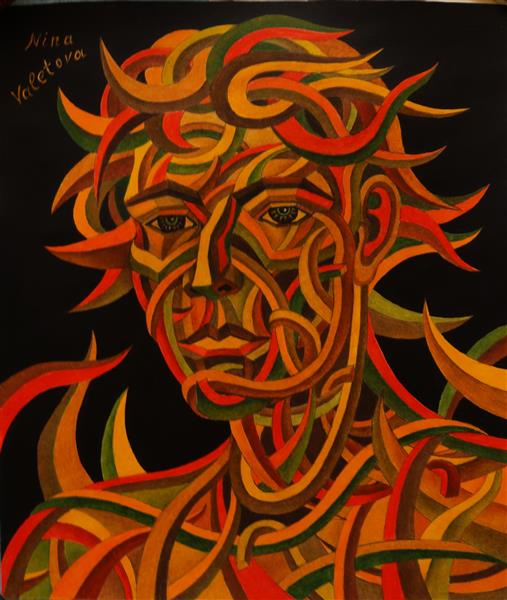
Nina Tokhtaman Valetova, “Entangled Fate”


Another important lesson is about us humans. “We” are also ecosystems, who “emerge from a complex tangle of relationships only now becoming known.” Going beyond the ego can be a healing process, which has been reported in a growing number of studies related to the use of psilocybin mushrooms and LSD, also derived from a fungus. The psychedelic healing effect comes from the mushroom’s ability to induce “feelings of merging with something greater, and a reimagined sense of one’s relationship to the world.”  

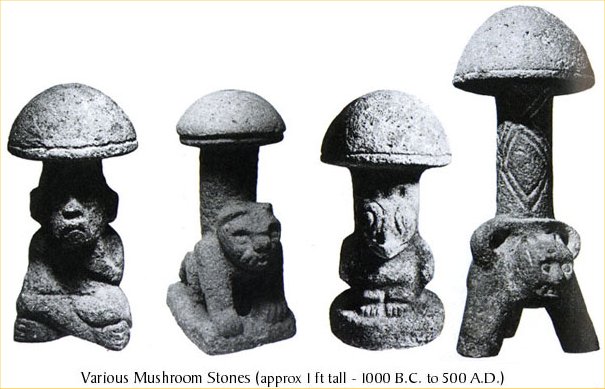
Ancient cultures of Mesoamerica were aware of the power of psychedelic mushrooms. The Aztecs referred to them as “teonanácatl,” which translates to “flesh of the gods.” They believed that by consuming them they communicated with the divine by entering an altered state of consciousness. Also in Ancient Egypt mushrooms were treated as food of immortality gifted by the god Osiris.

Psilocybe Mushrooms statues (via Wikipedia – fungi in art)

I see mushrooms as symbolic expressions of the workings of the unconscious psyche. Jung extensively wrote about the divinity of the psyche, emphasizing its light and shadow aspects. While watching the movie “Oppenheimer,” a small historical fact caught my attention. During the scientists’ work on a weapon of mass destruction, an unusually high number of children were born in that isolated facility. The quote “I am become Death, the destroyer of worlds” originated from Oppenheimer’s recollection of the first successful test of the atomic bomb at the Trinity site. This quote from the Bhagavad Gita, uttered by Krishna, reveals the god in his terrifying and destructive aspect.

However, the most horrible destruction is usually followed by a period of regeneration , rebirth and renewed activity. Thus, the benevolent face of god may emerge, offering hope and the potential for transformation amidst the destructive forces in the world and its breeding ground – the psyche.

Konstantin Somov, “The Girl with Mushrooms under the Rainbow”

Notes:

(1) Letters of C.G. Jung, Volume II: 1951-1961. Letter to Benjamin Nelson, 17 June 1956. Published by Routledge.

(2) Jung, C.G. The Collected Works of C.G. Jung, Volume 8: The Structure and Dynamics of the Psyche. Bollingen Series XX. Princeton University Press, 1960. par. 428

3) Letters of C.G. Jung, Volume II: 1951-1961. Letter to Jakob Amtstutz, 28 March 1953. Published by Routledge.

(4) Jung, C.G. The Undiscovered Self: With Symbols and the Interpretation of Dreams (Jung Extracts Book 31). Princeton University Press; Revised edition (January 12, 2012). p. 53

(5) The Book of Symbols: Reflections on Archetypal Images, edited by Ami Ronnberg. ARAS (Archive for Research in Archetypal Symbolism), New York, 2010.

(6) Sheldrake, Merlin. Entangled Life: How Fungi Make Our Worlds, Change Our Minds & Shape Our Futures. Random House, 2020. All subsequent facts and quotes about mushrooms come from this book.

91ydo2ckqfl._ac_uf8941000_ql80_

Support my blog

If you enjoy my writing, please consider donating to support my work. Thank you very much in advance.

$1.00

Posted in Mushrooms | Tagged , , , , , , , , , , , , , , , , , , , , , , , , , , , , , , , , , , , , , , , | 6 Comments

The Eight Mountains

This post is an attempt at a symbolic reconstruction of a movie I have seen recently. After seeing it, I was so deeply moved that I immediately rewatched it and proceeded to jot down hurriedly ten pages of notes and impressions that it spurred me to. The movie is called The Eight Mountains (2022) and was co-directed by Felix van Groeningen and Charlotte Vandermeersch. My post is going to contain a lot of details relating to the plot, so if you would like to discover “what happened” on your own, you have been warned.

This is a summary of “what the movie is about” that I found on the website of the British Film Institute:

“It’s 1984 when Pietro … first arrives in the Italian Alps for a summer holiday with his mother…. At his first meeting with Bruno, the difference between the pair is stark. Pietro is a soft-spoken 11-year-old in bright woolly jumpers and shiny hair; Bruno …, slightly older, is all wellies and cow muck. … Bruno is foul-mouthed and has to interrupt their play to milk the cows. They literally speak different languages as Bruno teaches Pietro the dialect of the village where he is the only remaining boy, everyone else fleeing in the face of an economic reality that has made rural life untenable.

Despite the idyllic setting, …, the friendship has its complications. The boys both have dysfunctional relationships with their fathers, and Pietro feels some jealousy when his parents appraise Bruno’s situation and try to take him back to Turin for schooling. When this falls through, the boys grow distant.”

This premise of the story reminded me of the friendship between the “civilized” Gilgamesh and the wild Enkidu, where Enkidu’s connection with the natural world and his more instinctual nature provide a contrasting perspective that influences Gilgamesh’s growth and development throughout the epic. When the parents want to take Bruno to the city Pietro is outraged and says: “A city will ruin a person like Bruno!” Much later, when they are both older in a moment of self-reflection Bruno describes himself as a wild man: one third man, one third beast and one third tree. Bruno is in the heart of the story: all characters define themselves in relation to him. He symbolizes the part of the soul lost or repressed in the modern world: the wildness of nature.

Enkidu, Gilgamesh’s friend. From Ur, Iraq. 2027-1763 BC. Iraq Museum

With one caveat, though. When the adult Pietro brings his city friends to the Alpine village to meet Bruno, one of the friends expresses his wonder of the unspoilt nature in the mountains. Bruno retorts: “It’s just you from the city who call it nature. It’s so abstract in your mind that even the name is abstract. Here we say woods, pastures, river, rock, path.” The groundedness of direct experience stands in start contrast to intellectual abstractions.

The mountainous regions have a true symbolic power. C.G. Jung spoke of solemnity of the mountains as a place where God’s work is done. The lush valleys stand for the horizontal dimension: this is where things are born, where flowers grow, where the rivers flow and the animals graze. As the Dalai Lama expressed it in a letter to Peter Goullart, “Soul is at home in the deep, shaded valleys.” In contrast, mountain peaks crown the vertical axis. Here the soul is drawn to the divine. As the Dalai Lama puts it, “Spirit is a land of high, white peaks and glittering jewellike lakes and flowers.” Here life is solitary. As the movie progresses, Bruno leaves his higher place more and more reluctantly. The mountain claims his soul. His roots are so strong that he cannot be moved any more.

The central metaphor of the movie is that of the eight mountains. Pietro hears this myth on his journey through Nepal. The mount Meru (or Sumeru) is the cosmic mountain, which Eliade referred to as “the earth’s navel, the point at which the Creation began.” It is the source of creation, where Brahma the Creator dwells. Located at the centre of the universe, Meru “is a vertical shaft which links macrocosm with microcosm, gods with men, timelessness with time.” (1) Meru is thus “a preeminent motif for mandala symbolism.” (2) Its centre points both upward to divinity and inward – to the individual soul. The rest of the world revolves in constant twirls but the centre is always immovable.

While Pietro travels through Nepal in a later part of the story, he gets asked by the locals if he is making the tour of the eight mountains. This is directly connected to the Nepalese legend of Eight Mother Goddesses (Ashta Matrika), who are believed to reside on eight mountain peaks that tower over the Kathmandu Valley. It is believed that these eight mountains surround the cosmic Mount Sumeru. Pietro tells Bruno the myth and asks him, who learns more – the one who has seen eight mountains and eight sees or the one who has reached the top of the Mount Sumeru. Bruno understands immediately that he is the one who does not ever move from the holy mountain while Pietro has been making the tours of the eight mountains. Pietro, who at some point says, “I was tired of the old me. I wanted to transform, evolve, leave” is the one who is on the move while Bruno remains, strengthening his roots more and more with the coming years. He and his place on earth become inseparable.  

Kathmandu, via https://nepal8thwonder.com/mountains-from-kathmandu/

A central motive in the story is the father complex that Pietro embarks on healing. Pietro’s father had a dream of building a house high up next to the peak of Mount Grenon (the name is fictitious but the movie was shot in Italy in the Aosta Valley). After amassing a pile of rocks from an ancient wall, the father suddenly passes away, leaving Bruno with the solemn pledge to construct the house in his memory. Pietro is shocked upon discovering that his father had kept in touch with Bruno and that they both had been climbing the mountains in Bruno’s village. Dejected, he says, “I inherited a ruin, a pile of rocks.”

Pietro also discovers a map left by his father, where he marked the trails they had walked in different colours. Pietro decides to walk all of these trails himself and carefully takes the time to add his mark on the map, too. He literally follows in his father’s footsteps and muses, “I lost my first father, who was a stranger to me, and found the second father – the father of the mountains.” On each peak that he climbs he flips through a summit book, where climbers note down the thoughts they had on the peak together with their names and the date of the climb. He reads all the words left by his father as a sort of a last message to him.  

Perhaps the most touching and beautiful aspect of the movie is the friendship between Bruno and Pietro. When they were children, Bruno called Pietro Berio, which in his dialect meant “rock” as Pietro’s name also ultimately derives from the Greek petra (rock). And quite literally, although they lose touch for some time, they are both each other’s rocks. Together they undertake a project of building a mountain shelter to fulfil the dream of Pietro’s late father. They call the hut Barma Drola, which in the local dialect means “a protrusion in the rock, the ‘shelter’ you squeeze into during a storm in the mountains. (3) It is a refuge away from the world, where they both meet every year to renew their friendship. It is so close to the cosmic mountain that at some point the mountain claims it back to its womb. When Bruno dies, Pietro makes the decision never to return to the mountain again. He chooses the horizontal path, the path of life and incarnation. Bruno chose the path of ascension and had become one with the spirit of the mountain.

At the end of the movie Pietro becomes a writer and moves to Nepal, where he marries. During their last meeting at Barma Bruno says to Pietro, “I’m glad you have found your words.” As the son of the mountain, Bruno helps all the main characters to get in touch with their soul, to evolve towards their true essence. In this way, he takes upon himself the mantle of the sage or even the guru. I have found it quite fitting that alongside the 108 auspicious beads, each mala has a larger bead called Sumeru or Meru, which holds the mala together. It is also called the guru bead. Bruno is the guru bead of this beautiful story. He is the living, beating heart that not only sustains the story but also serves as a transformative force, breathing life into every character, infusing them with his wisdom and vitality. He functions as a guiding guru, shaping and inspiring the growth of each character within the narrative.

Notes:

(1) Mabbett, I. W. “The Symbolism of Mount Meru.” History of Religions, vol. 23, no. 1, Aug. 1983, pp. 64-83. Published by The University of Chicago Press.

(2) Ibid.

(3) https://www.lovevda.it/en/database/22/room-rentals-chambres-d-hotes/brusson/a-barma-drola/9003893

111603

Support my blog

If you enjoy my writing, please consider donating to support my work. Thank you in advance.

$1.00

Posted in The Eight Mountains - movie | Tagged , , , , , , , , , , , , , , , , , , , , , , , , , , , , , | 2 Comments

Odilon Redon: Master of Life

​“Not only are we the products of multiple entangled ancestors, spanning vast ranges of the evolutionary field; we are not even individuals at all. Rather, we are walking assemblages: riotous communities of multi-species, multi-bodied beings, inside and outside of our very cells. Life is soupy, mixed up and tumultuous. Muddying the waters is precisely the point, because it’s from such nutritious streams that life grows.”

James Bridle, “Ways of Being: Animals, Plants, Machines: The Search for the Planetary Intelligence”

Odilon Redon’s symbolic art is never disembodied, mystical as it is. On the contrary, his aesthetic, otherworldly as it may be seen, is firmly rooted in the tangible and the material. The real and the fantastic are parts of the same mystery of Life. Paul Gauguin was of the same opinion,

“Thus, we take for real the strange creatures populating Redon’s drawings…. In his work. dreams become reality because of the believability he gives them. All of his plants, his embryonic and essentially human creatures have lived with us beyond a doubt…” (1)

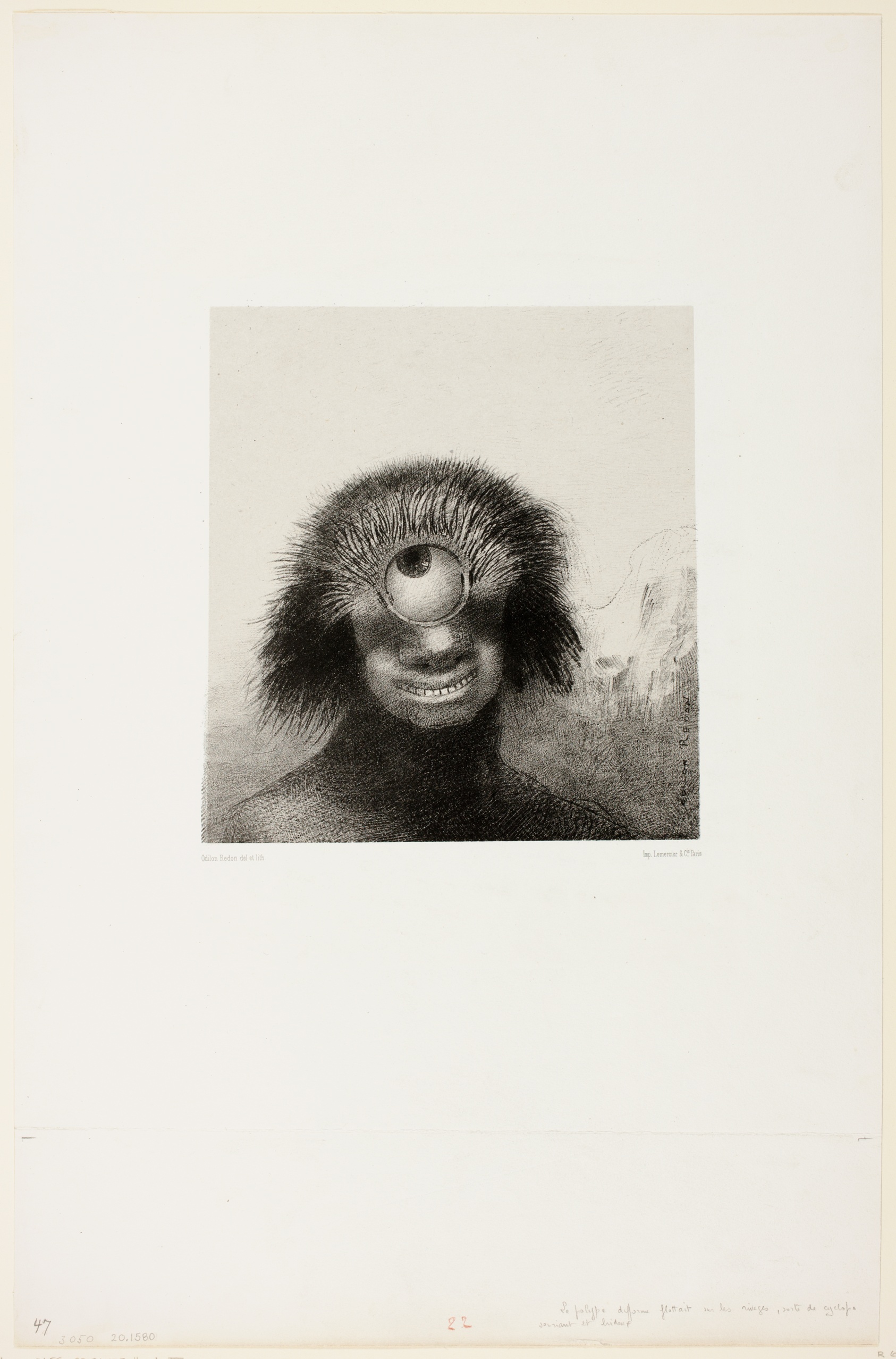
Odilon Redon, The Misshapen Polyp Floated on the Shores, a Sort of Smiling and Hideous Cyclops, plate 3 of 8 from “Les Origines”

And as Redon phrased it himself, what his art did was put “the logic of the visible at the service of the invisible.” (2)

Life captured by Redon seems to be governed by the law of metamorphosis; it is never static, always changing and becoming, never fully formed. Like in the alchemical opus, his painting evolved from an early nigredo – the black period, which brought his noirs, towards light and colour of his later years. In his art, there is constant shapeshifting, not only of forms and organisms, but also of colours, which melt into one another in wonderful diffusion.

“The Birth of Venus”

He was especially fascinated by the theory of evolution and the sea as the cradle of life. As Hauptmann writes,

“For Redon, the swirling sea and its creatures anemones, sea horses, coral (it is interesting to note that these pictures do not include larger marine animals like fish, sharks, dolphins, and whales, concentrating instead on those on the lower rungs of the evolutionary ladder) became the perfect subject for an aesthetic focused on change and transformation.”

“Underwater Vision”

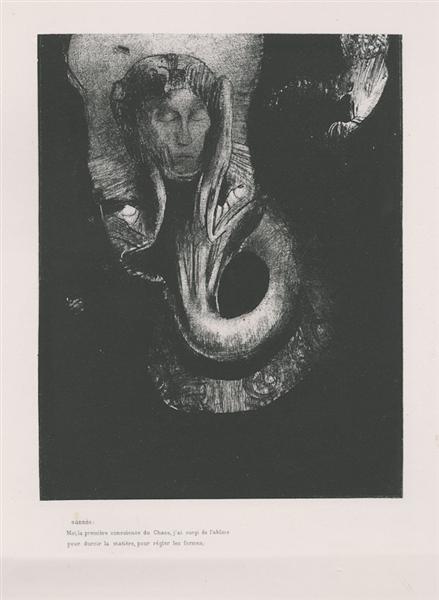
Especially beautiful is his “Underwater Vision” with Neptune who “dissolves into the texture of the water,” clad in beautiful coral robes. (3) The creatures of the sea are unidentifiable here: it is hard to say if they are plants, animals or perhaps both. Oannes is another mythical amphibious being portrayed by Redon.  In ancient Mesopotamia, Oannes is described as a creature with the lower body of a fish and the upper body of a human. He emerged from the ocean in order to impart wisdom to humanity.

Oannès: I, the First Consciousness of Chaos, Arose from the Abyss to Harden Matter, to
Regulate Form; from The Temptation of Saint Anthony 1896

In 1913 Redon published a collection of lithographs called Origines, in which he explored the themes of creation and evolution. There he depicted “a place of chaos and indeterminacy, of murky swamplands” and “the prehistoric mire.” (4). Despite Darwin’s theory of evolution, which was put forward in Redon’s lifetime, many still believed then, as they do even now, that humans are the crown of creation, that the human shape is the crowning achievement of the evolutionary process. Redon’s vision denies this illusion:

“By grafting human features onto the most shapeless creatures known to science, Redon has radically revised long-held models of human corporeality rooted in the idea of an original wholeness: man’s origins are as formless, as base, as the earliest primordial matter. Moreover, what Redon seems to articulate in this album is that this original, lacking state can never be overcome…” (5).

Siren Coming out of the Waves, Dressed in Flames, plate 4 of 8 from “Les Origines”

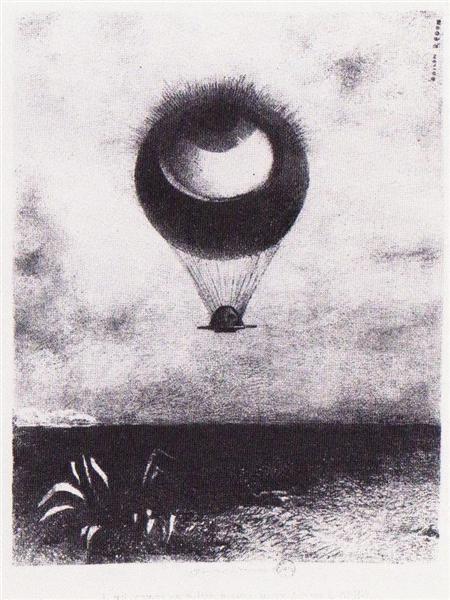
Only now does science slowly wake up to the idea that human intelligence does not stand above creation. Redon was aware that all forms of life live in entanglement (6). What is more, he seems to have known that “there are no hierarchies: no ‘higher’ or ‘lower’; none more, or less, evolved. Everything is intelligent.” (7) Everything is conscious and consciousness permeates everything, and that explains the symbolic value of the eye, which appears in so many Redon’s paintings.

“The eye like a strange balloon goes to infinity”

Notes:

(1) Hauptman, J. (2005). Beyond the Visible: The Art of Odilon Redon. Museum of Modern Art.

(2) Ibid.

(3) Ibid.

(4) Martha Lucy, “Into the Primeval Slime: Body and Self in Redon’s Evolutionary Universe” https://www.erudit.org/en/journals/racar/2009-v34-n1-racar05297/1069497ar/

(5) Ibid.

(6) James Bridle (2022). Ways of Being: Animals, Plants, Machines: The Search for the Planetary Intelligence. Penguin.

(7) Ibid.

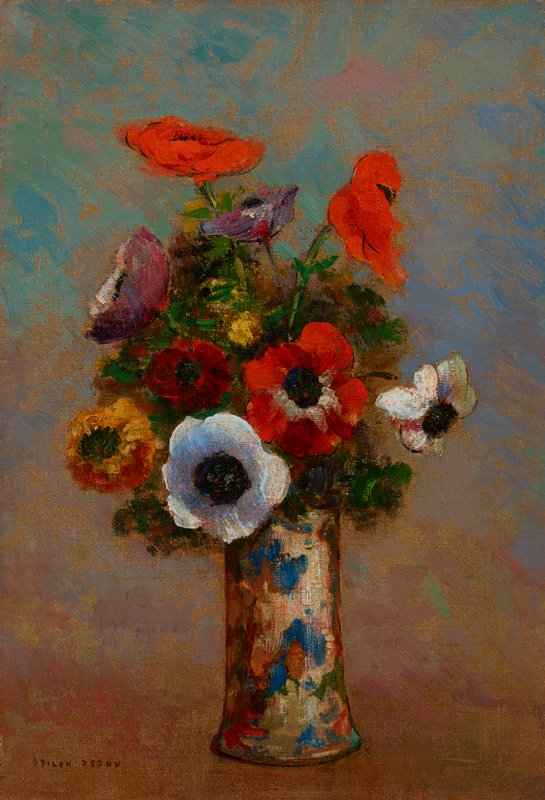
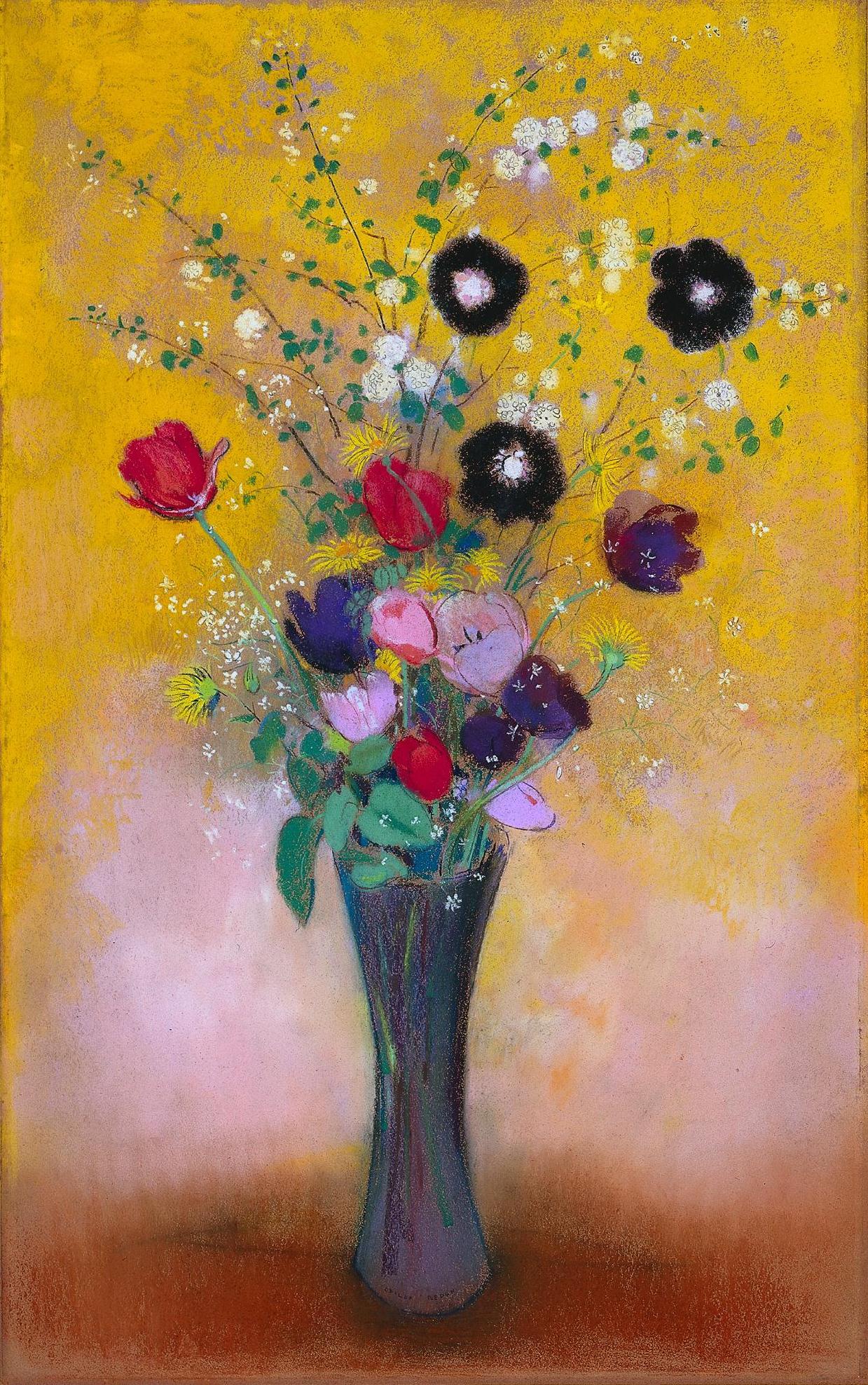
odilon_redon_-_vase_of_flowers

Support my blog

If you enjoy my content, please consider donating to support my blog. Thank you very much in advance.

$1.00

Posted in Painting | Tagged , , , , , , , , , , , , , , , , , , | 10 Comments

Gentleman Overboard: Existential Loneliness

“‘Where is it,’ thought Raskolnikov. ‘Where is it I’ve read that someone condemned to death says or thinks, an hour before his death, that if he had to live on some high rock, on such a narrow ledge that he’d only room to stand, and the ocean, everlasting darkness, everlasting solitude, everlasting tempest around him, if he had to remain standing on a square yard of space all his life, a thousand years, eternity, it were better to live so than to die at once.”

Dostoevsky, “Crime and Punishment”

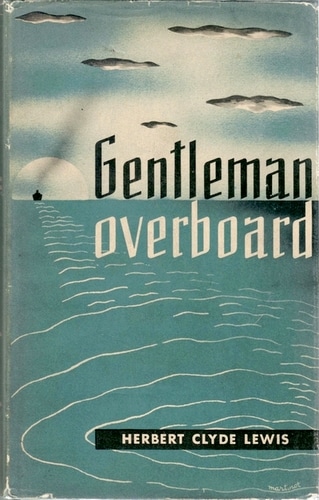
Kafka wrote once that the only books worth reading are those that “affect us like a disaster, that grieve us deeply.” Gentleman Overboard, a novella written in 1937 by Herbert Clyde Lewis, came to me highly recommended and shook me to the core. The book was out of print for 80 years before it was rediscovered in 2009. I was gripped right from the first passage:


“When Henry Preston Standish fell headlong into the Pacific Ocean, the sun was just rising on the eastern horizon. The sea was as calm as a lagoon; the weather so balmy and the breeze so gentle that a man could not help but feel gloriously sad.”


A perfect gentleman slips on a grease stain and falls overboard. He manages to survive until the sunset. The time space in between is filled with his backstory and all the lowly and the sublime thoughts that go through his head and heart on the last day of his life.


There seem to be three essential thematic components to the story.


1. The awakening


“… one day in spring only three months ago, shortly after he had quietly celebrated his seventh wedding anniversary … Standish, sitting in his private office downtown, suddenly found himself assailed by a vague unrest. He stopped what he was doing and looked around at familiar things, the papers on his desk, the windows, the pictures on the walls, the two telephones. All these appurtenances had always been desirable and comforting; but now, Standish realized in amazement, they were but dust in his mouth. He felt sick, tired, and depressed. Making suitable apologies to Pym and Bingley, who were too preoccupied with financial transactions to observe how serious was his affliction, he went for a long and lonely walk around Battery Park.

Forces beyond his control grasped him and shook him by the shoulders, whispering between clenched teeth: “You must go away from here, you must go away!””


Standish decides to go on a long cruise alone. During his travels, he became especially mesmerized by the water and the sunsets. He felt a new zest for life. For the first time his soul had opened to something bigger.

Victor Brauner, “Consciousness of Shock”


2. Stripping off the layer of civilization


Standish would wear prim suits and ties on every day of the cruise. Having fallen into the water, however, the clothes became a heavy burden. Gradually, he had to remove his shoes, socks, trousers, finally the whole suit. He desperately tried to secure his wallet in the trunks. A few hours later, when the sunset was near, he did the ultimate:


“He suddenly realized his blue-and-yellow shorts and tight-fitting athletic shirt were a heavy weight. In a fitful outburst of temper he started ripping them off his body. The shorts came off easily, but he had to tug and strain hard to pull off the undershirt. He flailed around insanely in the water, tugging madly at the shoulder straps. Finally they came off somehow; he was free and naked. Being naked was a new sensation for which Standish was momentarily grateful. For a while he actually felt comfortable in the water. But then he realized with stark terror that that was because all his life swimming in the nude had been a pleasure, a relaxation, something to look forward to on a hot day. At the Athletic Club in New York, in the strictly male swimming pool that smelled of chlorine, he had swum naked on many pleasant occasions. Now being naked had a far different significance, and it made him shudder and feel clammily cold and exhausted when he thought about it. He had stripped to the flesh to prepare himself for death—it was as simple as that. Undertakers stripped their victims before dressing them for burial.”

Standish could not deny what was happening any longer. Nobody was coming to the rescue. He was now but a dot on “the endless swells of the remorseless sea.”

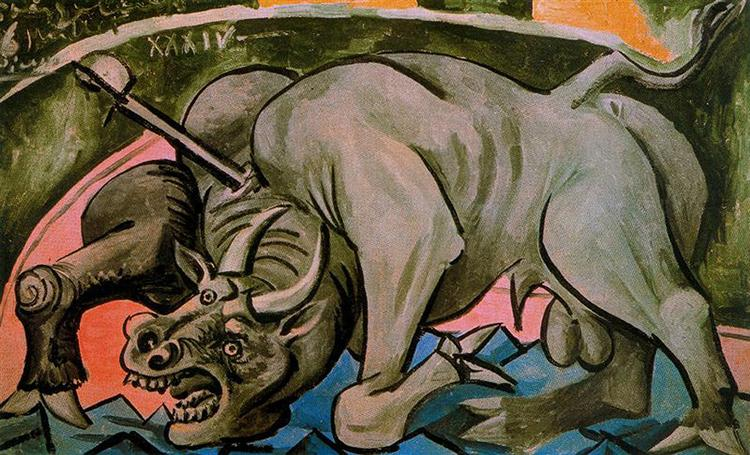
Pablo Picasso, “Dying Bull”


3. Existential loneliness and death

The beautiful sunset that he saw was also the sign that the Land of the Dead was now claiming him. He poignantly thinks to himself how when he is gone “New York City would be dotted with spaces that could never be filled by anyone but the real Henry Preston Standish.” The reader experiences haunting sense of loss. Standish ponders:

“It was a lonely way to die, but that made no difference, for all deaths, including the few seconds of falling off a roof, were singularly and completely lonely…”

Marie Louise von Franz devoted a lot of time to the themes of death and the dreams of dying patients. Through her research she concluded that the unconscious psyche held a firm belief in life after death. Under this link you can listen to a fragment from her lecture on the topic:

https://www.youtube.com/watch?v=q0s4UDxek94&ab_channel=IndividuationPortal

It seems that once a terminally person accepts that his or her death is inevitable, dreams undergo a distinct change. There are hints of continuing in the beyond and a sense of deep reassurance is conveyed. The final passage of Gentleman Overboard has a similar otherworldly, almost angelic feel:

“Out of the deepening purple the words came crazily melodious, sweeping him back into his mother’s arms: ‘You were only hair dust and warm body, a heart beating naked before me and a sorrowful voice like the murmur of water foredoomed forever to fall from a cave to a cave….'”

I was deeply touched by the ending. There is majesty in this man’s death: at one point he imagines there is a bell tolling for him. This resonates with Hemingway’s For Whom the Bell Tolls and the motto he took from John Donne – “Any man’s death diminishes me because I am involved in mankind.” Mind you, Hemingway’s book was published three years later than this one. But one may argue that both novels share the theme of life being cut short tragically and prematurely.

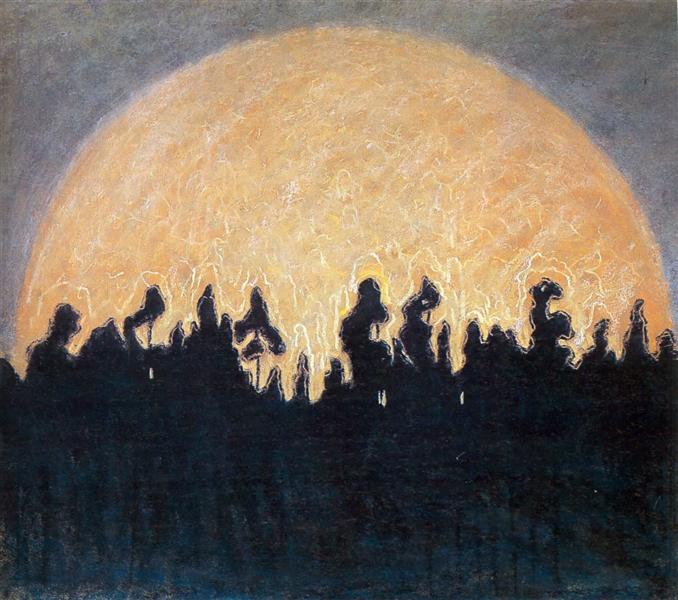
Mikalojus Konstantinas Ciurlionis, “Sunset”

If you want to find out more about the author of the book, who himself died alone and forgotten, read this excellent article.

Support my blog

If you enjoy my writing, please consider donating to support my work. Thank you very much in advance.

$1.00


Posted in Gentleman Overboard | Tagged , , , , , , , , , , , , | 6 Comments

Christiana Morgan: Her Invisible Life

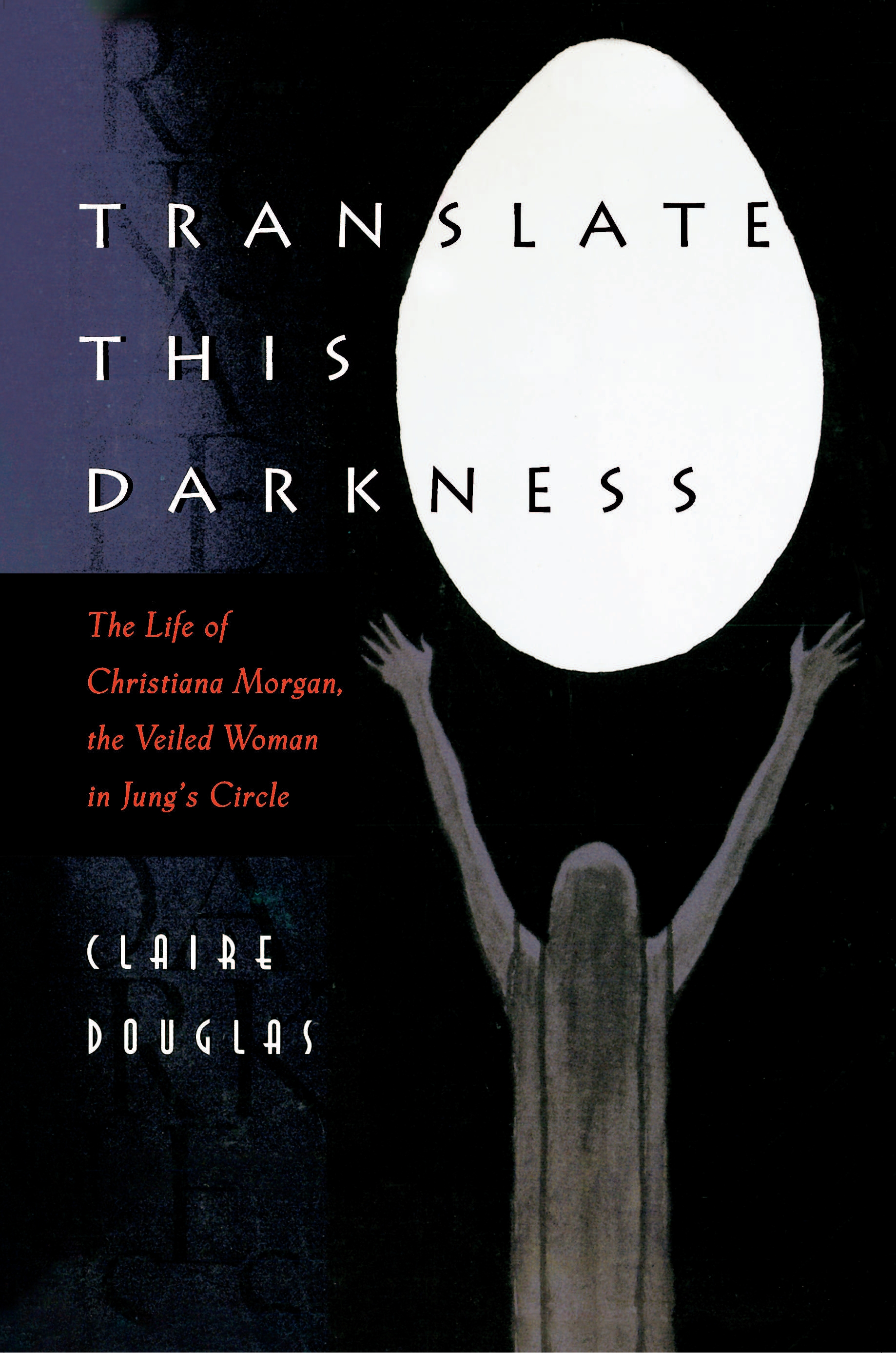
This is a beautifully written biography of an extraordinary woman, who, as the author puts it, “remains at most a footnote in other people’s history.” She was a prominent patient of Jung’s, who used her paintings and visions as material for his four-year psychological seminar. Jung called this material “a most beautiful example of the original initiation process.” The years she spent in Küsnacht in intensive therapy with Jung were decisive for her whole life. In a letter to Henry A. Murray she thus summarized her impressions of Jung:

“… he has indeed the true fire. I never dreamed that anyone could talk so directly and so instantly to the spirit or the core. … There is no question that he is the prophet.”

The undeniable gift of Jung was to put his patients in touch with their inner lives. A memorable quote from his own memoirs, Memories, Dreams, Reflections says:

“Outer experiences were never so very essential anyhow, or were so only in that they coincided with phases of my inner development. An enormous part of these “outer’ manifestations of my life has vanished from my memory…”

A prime example of such an inner-life biography is the three-volume masterpiece on Kafka’s life by Reiner Stach. There the author wonders about a possible meaning of a biographical endeavor:

“But what does such a representation mean for a person whose life unfolds in the depths, in an overwhelming inner intensity? Kafka often spent half the day in bed or on a sofa, languid, inaccessible, daydreaming. … We know that millions of people would later be awestruck by some of what he daydreamed.”

Naturally, also Christiana Morgan had an “outer” life. It seems that the kernel of that life involved her lifelong love relationship with the esteemed Harvard psychologist Henry A. Murray, who refused to leave his wife for her. She worked at Harvard Clinic alongside Murray, with whom she co-authored the Thematic Apperception Test in the 1930s, which is still in use today. The central thesis of Douglas’s biography seems to be that Christiana Morgan betrayed her visions by choosing to remain by Murray’s side. In moments of clarity, Christiana described her relationship with Henry as dry and draining, while she craved warmth and earthiness. Douglas appears to blame Jung for pushing Morgan into the limiting anima woman role:

“…he instructed Morgan to live her life in the same way Toni Wolff lived hers – as adjunct to and in the service of her lover. In the analysis, Jung soon started to shift his focus away from Morgan and onto Murray as the center of the relationship; … In moments like these, and there were many, Jung forgot Christiana Morgan while he glorified her role as an anima figure and inspiratrice for a man.”

Jung supposedly told her, “Your function is to create a man.” He encouraged her to record her visions, which she generated between July 1926 and May 1927. He told her that by doing so, she will be feeding her soul by getting in touch with her inferior function, which in her case was feeling (as opposed to her main ego feeding function – thinking). Douglas wrote:

“Christiana Morgan’s visions in their entirety depicted an archetypal representation of women’s psychological development for which neither she nor Jung was ready, one that is coming into consciousness only today. Her visions instructed Morgan that she had to free herself from traditional ideas about women and discover her own, vastly different idea.

Morgan’s visions depicted a way of development that was far ahead of the traditionally feminine one of her era; it was a woman’s heroic quest, a type of quest that Morgan may have been the first to envision. Seen this way, the visions in their entirety become a vital and energizing mystery. They have much to offer women exploring and recovering the darkly potent side of women’s psychology and have much in common with aspects of Inanna, Lilith, Hecate, and Kali – aspects of the powerfully active, dark, and sometimes loathsome feminine archetype.”

Even after her therapy ended, Christiana continued having more visions:

“Powerful feminine images continued to burst up from Christiana’s unconscious at this time, including witches, ancient mothers, dragons, volcano goddesses, sky mothers and earth mothers, harpies, maenads … slowly they replaced the male images on which Jung concentrated.”

Jung was especially impressed with Christiana’s ability to go into mystical trance and afterwards being able to return and relate her findings in a clear, intellectual fashion. He seemed to possess a similar talent himself. As he decided not to publish his own Red Book visions in his lifetime, he chose to run a long series of seminars dedicated to Christiana’s visions. She remained anonymous throughout the process, though towards the end her identity was revealed. Shortly after that the seminars were discontinued.

The richness of Morgan’s visions is astounding. I was particularly struck by Jung’s analysis of the symbolim of the veil. Christiana noted:

“Someone was putting a black veil over my head. It seemed to me that I was meant to wear it always. I said, “This veil will always show,” Someone answered, “No, it is thin, it is worn over the back part of the head, not over the face.”

In response to this vision, Jung and the seminar participants spent a considerable amount of time analyzing the symbolism of Black Madonna. Jung alluded to the symbolism of the black, fertile earth and the analogy of Isis and the Black Madonna. He spoke at length about the mysteries of Eleusis. He brilliantly pointed out that since the veil is not worn over her face, the vision seems to suggest that she is not supposed to withdraw from the world of desires. But she should remain aware of the darkness of the unconscious and the danger it may bring – since the veil covers the back of the head and not the face.

Furthermore, the veil symbolism is connected with revelation. In the Bible the veil separated the holy place from the most holy. In the Penguin Dictionary of Symbols, Jean Chevalier states hat the rending of the veil “shows the abruptness of revelation effected by unveiling and bears a sense of initiation.” Perhaps Christiana’s unveiled face symbolizes her ability to see the light of truth.

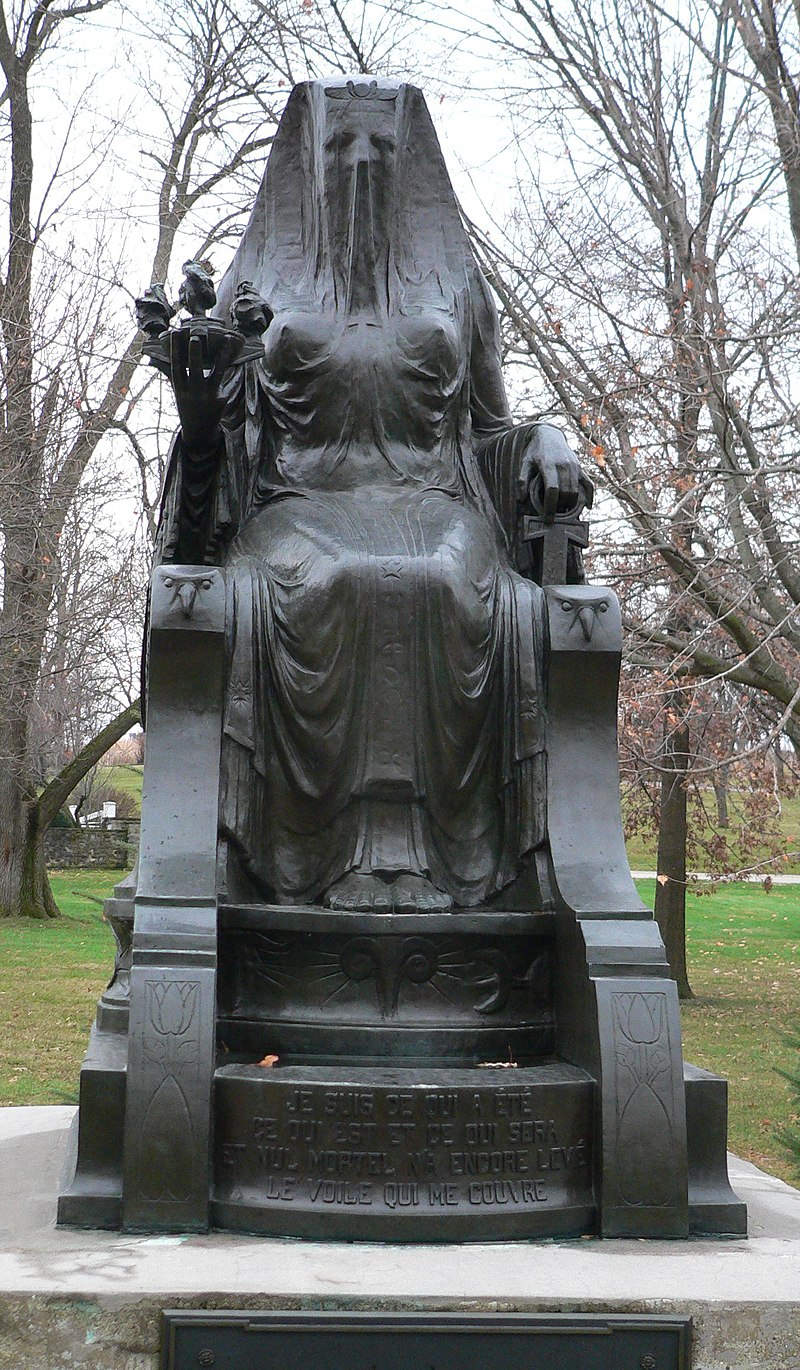
Isis as the Veiled Goddess by Auguste Puttemans: “I am all that has been, and is, and shall be; and no mortal has ever lifted my veil.”

Admittedly, the symbolism of the veil seemed to pervade her life. She did not make a name for herself either in the Jungian circle or in the Harvard Clinic, where her role as a lay academic was downplayed while her scandalous involvement with Murray marred hers (but not his, as is usually the case) reputation. While he chased new love interests, she spent her days in the tower, which Murray rented for her and for their meetings. They were both inspired by Jung’s Bollingen tower. Yet unlike for Jung, Christiana’s tower did not bring her bliss. She succumbed to alcoholism and presumably died of suicide by drowning. She left a poem by Conrad Aiken poem to be read at her funeral:

“O sweet clean earth, from whom the green blade cometh!
When we are dead, my blest beloved and I,
Embrace us well, that we may rest forever,
Sending up grass and blossoms to the sky.”

In these four verses the tragedy of her life is revealed. She longed for a fertile life of happiness in the sun, yet she performed her quiet work in darkness and obscurity.

You can look and read about Christiana Morgan’s visions here.

download

Support my blog

If you enjoy my writing, consider donating to support my work. Thank you very much in advance.

$1.00

Posted in Christiana Morgan | Tagged , , , , , , , , , , , , , , , , , , | 6 Comments

Prague: A Threshold

You may have heard of two magical triangles, one of black, the other of white magic. The origins of that legend are impossible to fathom. The white magic triangle is said to include Lyon, Prague and Turin, while the black one is supposedly composed of San Francisco, London and Turin. Thus Turin is the focal point of both triangles. I have written about this fascinating city and its interplay of light and darkness here. After Lyon, which I wrote about here, it is time to complete the white magic triangle and focus on Prague. Please note that my writing, as always, focuses on myths and legends, which means I do not usually aspire to presenting the so-called historical truth. My focus is on the landscape of the soul.

I. “Since the Middle Ages, Prague had exerted a cultural and political influence that spread far beyond its national borders. The Bohemian capital frequently took center stage in European history, becoming the intellectual focal point of the continent.”

Harald Salfellner, “Franz Kafka and Prague: A Literary Guide”

II. “Prague does not let go. This little mother has claws.”

Franz Kafka

III. “And I say: when I seek another word for mystery, the only word I can find is Prague.”

Angelo Maria Ripellino, “Magic Prague”

IV. “Prague is certainly the best place in the world for my music.”

Mozart

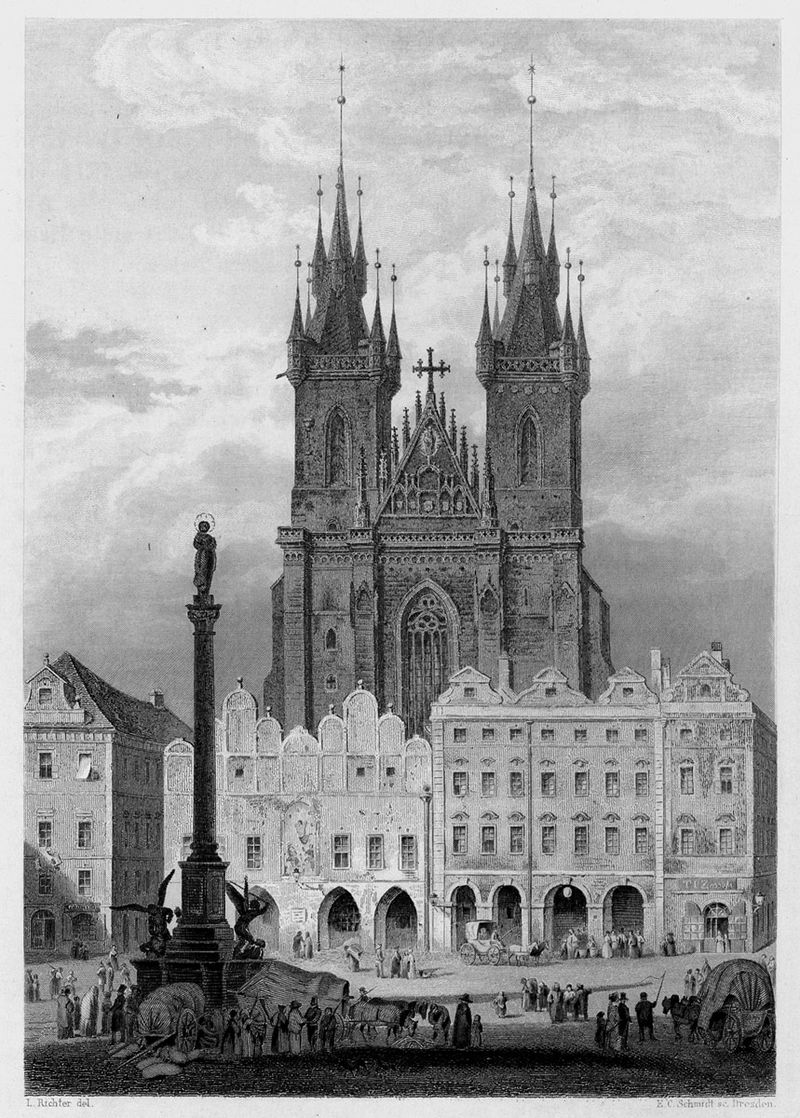
Old Town Square Prague in 19th century with the Church of Our Lady before Týn, via https://de.wikipedia.org/wiki/Altst%C3%A4dter_Ring#/media/Datei:Praha_Staromestske_namesti_c1841.jpg

What makes the city magical? Giovanni Pico della Mirandola, an Italian Renaissance philosopher and scholar, was one of many who attempted to define magic. In Oration on the Dignity of Man, he wrote that magic “embraces the most profound contemplation of the deepest secrets of things and finally knowledge of the whole of nature.” The crucial moment of magic is when heaven, the above, is united with the earth, the below. There are certain places where the distinction between the above and below seems to be obliterated. We can speak here of special places of power. Prague has a reputation of being one.

Charles Bridge and the Castle in the distance

The city swept me off my feet. While crossing the Legion Bridge and entering the city for the first time, I gasped. The towers of the castle and Charles Bridge were visible to the left. It all looked decisively otherworldly. Didn’t Gustav Meyrink write that Prague is a threshold between the life on earth and heaven? Didn’t André Breton call the city the magic capital of old Europe? Not to mention that the contested etymology of the city’s name goes back to the Czech word práh, i.e. the threshold or a gate according to other sources. Absorbing all the beauty of the city, I had another association. I had a feeling I was inside an old music box, hypnotized by all its wonders.

The romantic and evocative name Bohemia is derived from the Boii, the Celtic people who inhabited the area in the 2nd century B.C. Until the 16th century Bohemia was a kingdom within the Holy Roman Empire. It was always a melting pot of cultures, religions and ethnicities. Prague was known as the city of three peoples; the Czechs, the Germans and the Jews. This commingling of influences is easily discernible on the multilingual streets of Prague but also in its cafes and restaurants, where the dishes served are a colourful juxtaposition of various influences. The elegant cafés were especially alluring to me, for the reason that they were frequented by Franz Kafka, who loved Café Louvre, Café Slavia and Café Savoy to name just a few I simply had to visit.

Café Savoy

But going back to the mythical origins of Prague, Peter Marshall thus summarizes the founding legend:

“One legend popular at the time has it that Libussa, queen of Bohemia, sought out a husband. With the help of the gods, she mounted a magic white horse which took her to a place where she met a handsome young peasant called Přemysl. Then, one summer’s evening, while she stood with her new husband and the elders of her people on a cliff overlooking the great Vltava River, she pointed across the water to the wooded hills beyond and was moved to prophesy: ‘I see a great city whose fame will touch the stars!’ She led her people to the spot on the hill where there was a man raising the threshold (prah in Czech) of a house and asked them to build a castle. Together they founded a dynasty and the city of Praha, Prague.” (1)

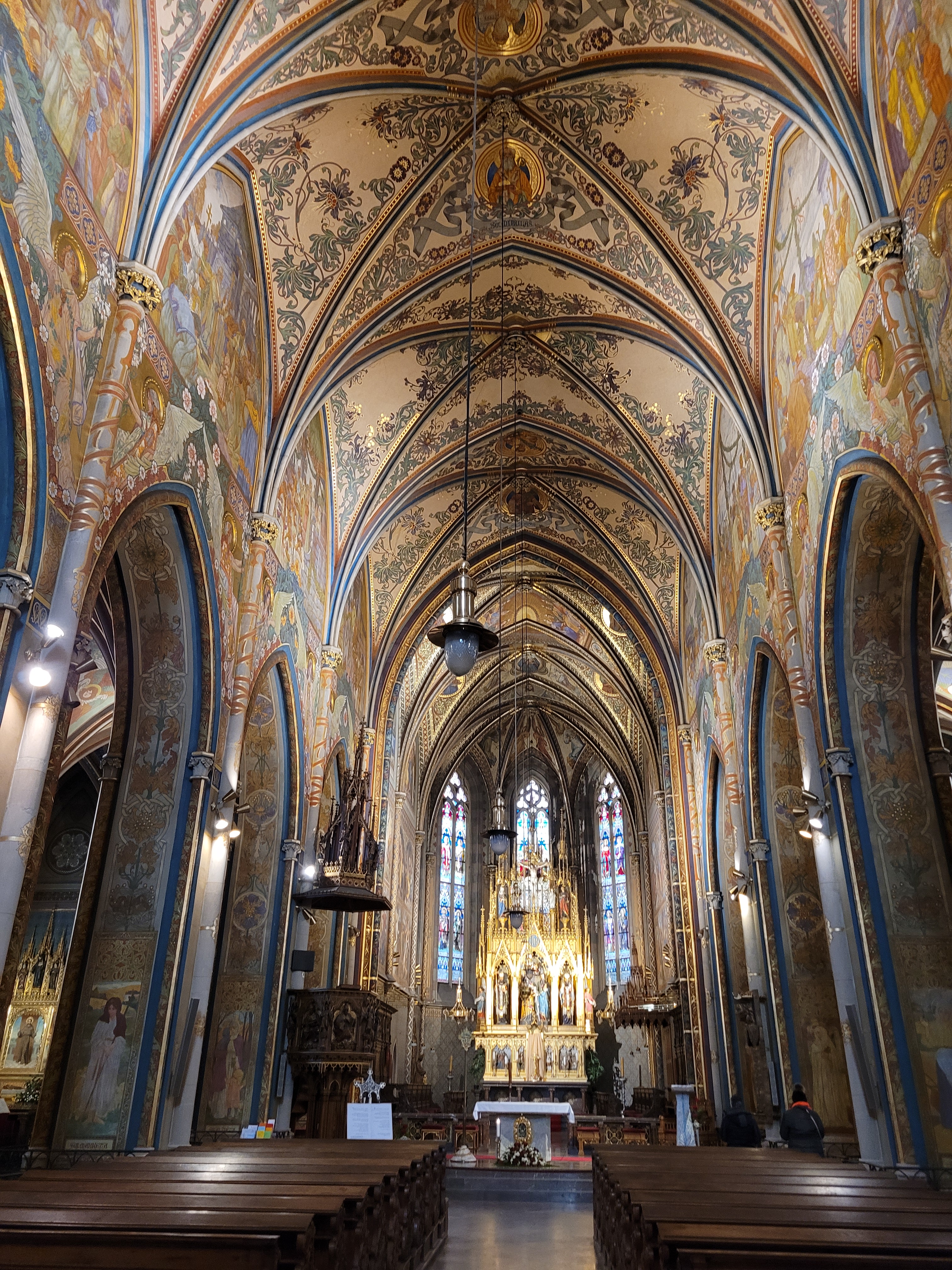
The legendary spot on the hill, called the mythical cradle of Prague, is called Vysehrad (Czech for higher castle). It is located on the edge of the city, three kilometres away from the medieval Prague castle. It is a quiet spot now with decisively fewer tourists than in the centre. There you can visit the magnificent Peter and Paul Basilica, whose interior enchanted me most in Prague. The surrounding park is full of statues; especially interesting to me was the Devil’s Column:

“There are many theories as to where Devil’s Column comes from. The most famous speaks of a certain local priest who made a bet with the Devil. The Devil was to bring a column from the Basilica of Santa Maria in Trastevere in Rome to Vyšehrad before the end of evening mass. So, the Devil flew to Rome, ripped out a column, and started making his way back. But his return trip was hindered by St. Peter (one of the patrons of Vyšehrad, along with St. Paul), causing the Devil to fall into the Venetian Lagoon three times. In the end, he arrived late, and, in his fury, the Devil flung the column through the basilica roof.”

via https://english.radio.cz/landmark-prague-stories-8685642/2

Peter and Paul Basilica

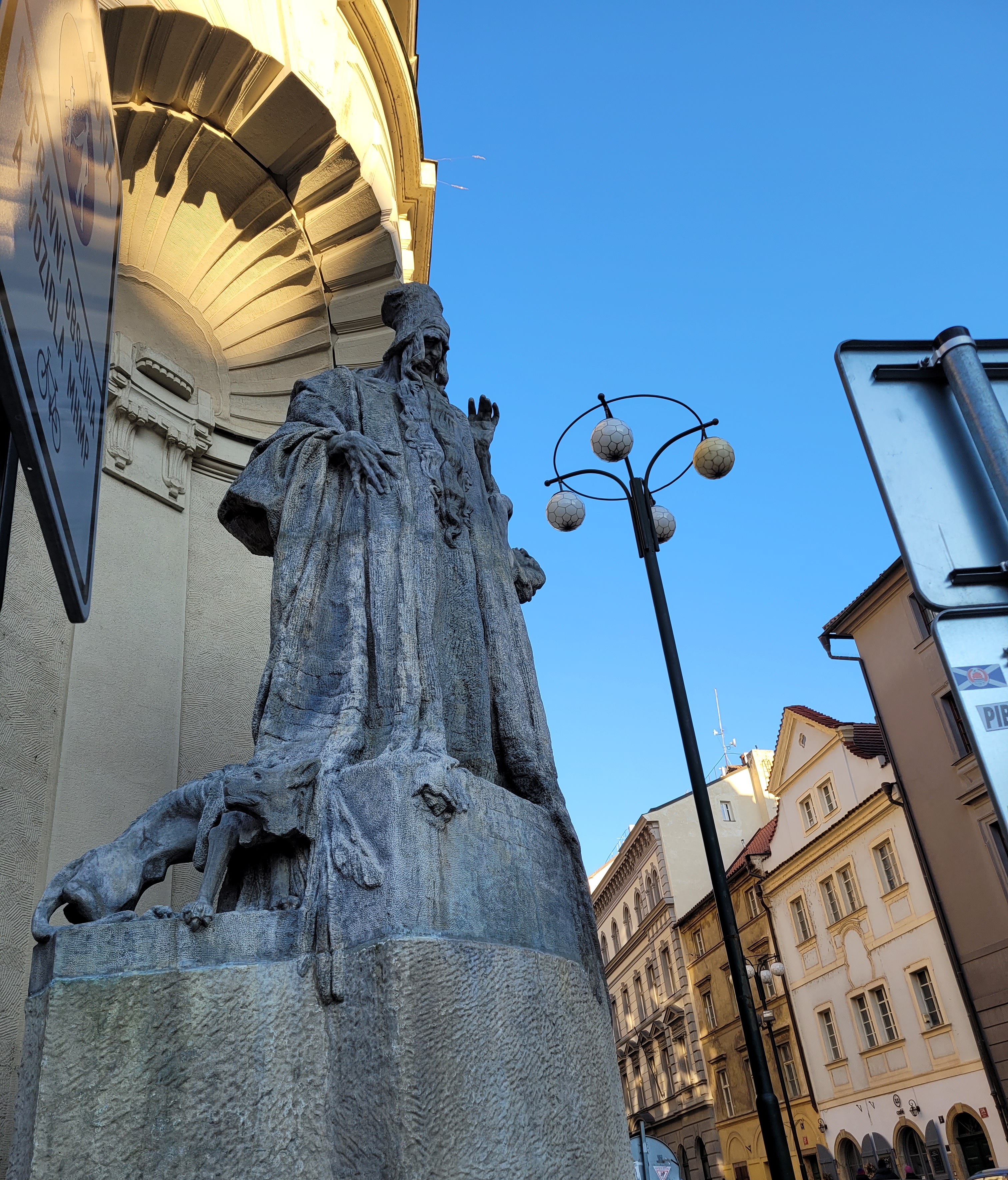
This kind of apotropaic magic permeates numerous Prague legends, the most famous being the creation of Golem. According to a legend, Golem, the being from Jewish folklore, made of clay or mud, was created through magic to protect the Jews from persecution. The legend kept returning in many iterations. Rabbi Judah Loew was believed to have created Golem out of the mud of the Vltava river. Ultimately, the creature had to be destroyed because it went out of control. His heart is said to be resting in the Old-New Synagogue in Prague.

Monument of Rabbi Judah Loew

The Middle Ages was also the time when the iconic Charles Bridge was constructed. This happened exactly on 9 July 1357 at 5.31 a.m,

“… a time chosen carefully for its propitious astrological and numerological associations. At that very moment a conjunction of the Sun with Saturn occurred, with the great luminary of the sky overpowering the gloomy influence of the malefic planet. … In addition, the setting sun on the summer solstice lined up Charles Bridge with an architrave of the Castle’s cathedral.” (2)

As the Dark Ages were drawing to a close, another celebrated Prague marvel was constructed – the astronomical clock. Unlike other similar clocks un Europe, this one showed the time in both Old Bohemian time and Babylonian time.

Renaissance was without a doubt the golden age of Prague. Under the Holy Roman Emperor Rudolf II, the city attracted a lot of luminaries, especially adepts of hermeticism, alchemists, astrologers and magicians. Rudolf II had a profound impact on the cultural history of Europe:

“He provided an island of intellectual security at a time of growing religious conflict, especially between Catholics and Protestants. By encouraging religious tolerance and the freedom of enquiry, he helped lay the foundations of the Rosicrucian Enlightenment, as well as the Age of Reason which eventually forced it underground.” (3)

Upon his birth, Rudolf’s parents had Nostradamus cast a horoscope for the future emperor. He was to become known as “the Recluse of Prague,” since he would spent most of his time in the castle and its gardens. The sombre, brooding atmosphere of the city suited his melancholic temperament. Shunning political machinations, he devoted his time almost entirely to hermeticism in all its forms. He established an alchemy workshop, to which he attracted the greats such as John Dee, Edward Kelley, Michael Maier and Martin Ruland.

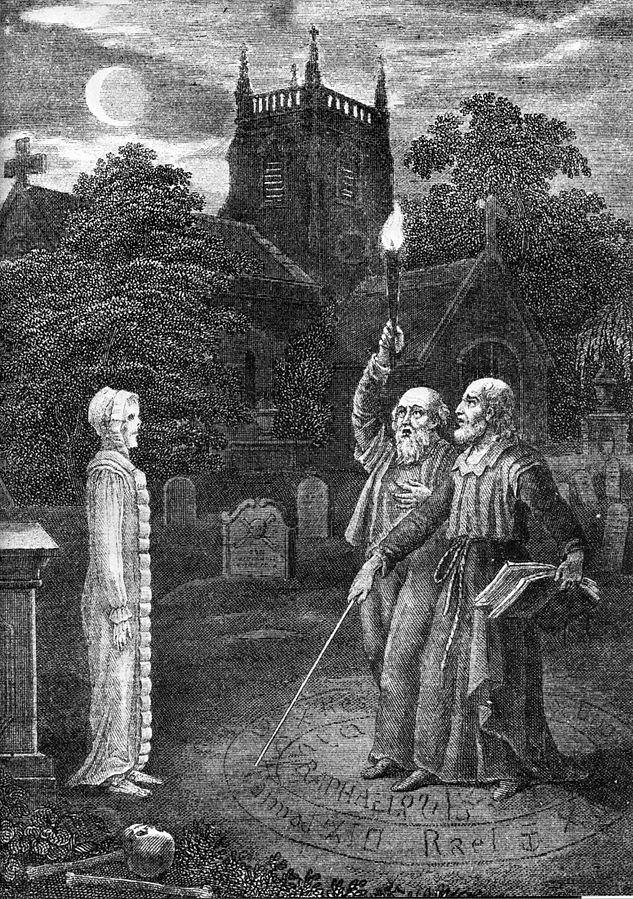
John Dee and Edward Kelley evoking a spirit, via https://commons.wikimedia.org/wiki/File:John_Dee_and_Edward_Keeley.jpg

Rudolf II engaged the illustrious Tycho Brahe as his court astronomer and astrologer:

“Rudolf was particularly fond of a lion given to him by the Sultan of Turkey in a rare lull in the fighting between the Ottoman Empire and the Holy Roman Empire. It was reported that Tycho Brahe, who became Rudolf’s court astronomer, declared that since they shared similar horoscopes they would suffer a similar fate. The prophecy proved to be accurate: when the lion eventually died, Rudolf locked himself in his chambers, refusing all medicine and help, and died three days later.” (5)

In 1600, Johannes Kepler joined Tycho Brahe in his work for the emperor. He spent the next twelve years in Prague, during which time he wrote Astronomia Nova as well as cast horoscopes for Rudolf II. There are a lot of imagination-stirring stories associated with those colourful characters of the Rudolfian Era. Back in Denmark, Tycho Brahe had had his nose cut off in a duel. He fashioned a number of prosthetics to replace the precious organ: the ordinary every day one made of brass and silver and gold ones for special occasions. Kepler had a lot of disagreements with the eccentric Brahe. Nevertheless, his Prague period was the most creative and productive of his life.

At the height of his era, Rudolf’s castle was surrounded by magnificent gardens with plants and animals brought from all over the world, while the castle became

“a unique centre of learning and an inspirational milieu for creative and original work. He opened the doors of its chambers and vaults and built galleries, workshops, laboratories and studios for anyone who could help him in his grand project to unveil the mysteries of the world.” (6)

Giuseppe Arcimboldo, Portrait of Rudol II as Vertumnus (the Roman god of seasons, change and plant growth)

Rudolf II was also an indefatigable collector. His vast Kunstkammer included paintings, prints, drawings, sculptures, the vast proportion of which was dedicated to alchemy and astrology. The emperor even managed to acquire the mysterious Voynich manuscript. He amassed a great number of scientific instruments, telescopes, globes, astrolabes, weapons and a plethora of clocks, which especially captured his heart. What is more:

“Rudolf valued precious stones and crystals for their secret virtues and he always carried one next to his heart to calm his palpitations, an inherited Habsburg weakness. His magical arsenal, which he increasingly drew on when normal methods to influence the course of history failed, included dried roots of mandrake, bizarre foetuses, a basilisk, parrots’ feathers, corals, fossils, ancient stones with indecipherable markings, whales’ teeth, rhinoceroses’ horns, the jawbone of a Greek siren, a fur fallen from the sky and a crystal lion. He also had such wonders as unicorns’ horns and dragons.” (7)

After his death, the emperor’s collection was dispersed and gradually sold off. But the legend of Prague as the city of alchemy remained. There is a tiny street with Lilliputian houses right next to Prague Castle. It is called the Golden Lane. The name most probably stems from its association with goldsmiths, who used to work there. However, there is a widespread belief that once alchemists inhabited those tiny houses. Whatever the truth may be, in 1916 one of the greatest literary alchemists lived at number 22 of the Golden Lane. His name was Franz Kafka. The eerie atmosphere of the street and the looming castle above it is depicted in Kafka’s’ unfinished novel The Castle.

Golden Lane with Kafka’s house (the blue one)

Martin Stejskal described the Royal Way from the Powder Gate to the Castle in alchemical terms:

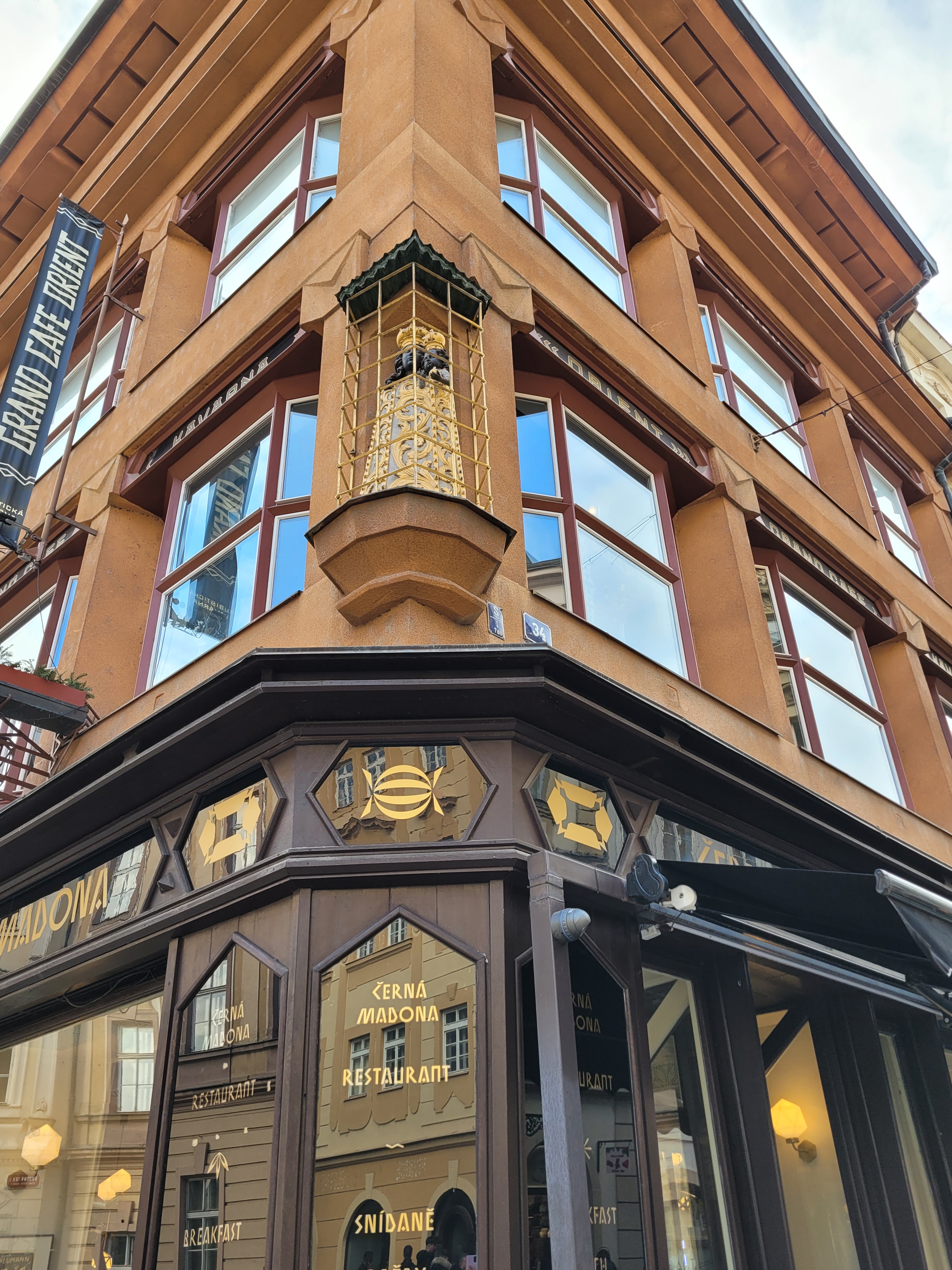
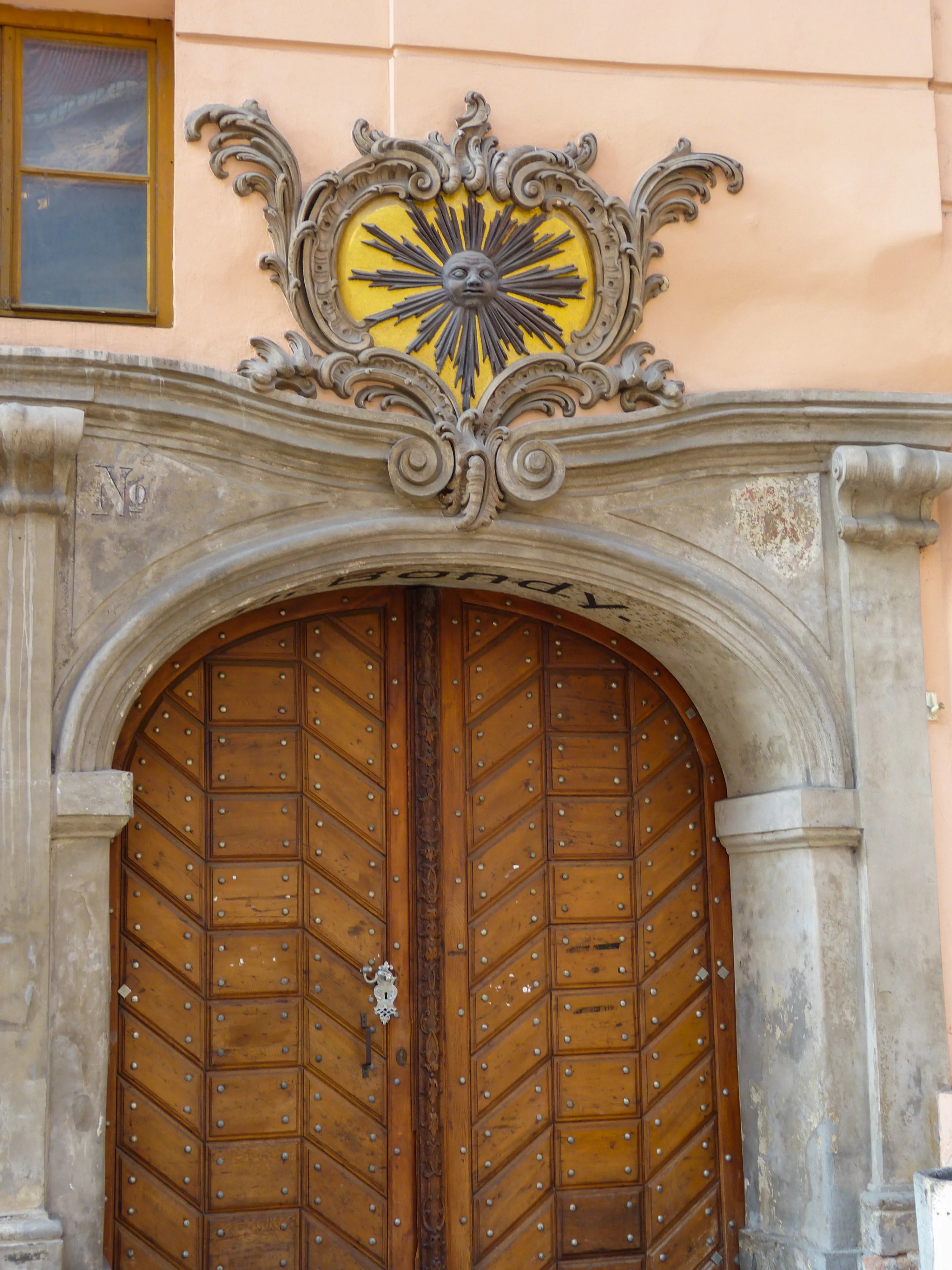
“The Royal Way enters the Old Town from the east, at the Powder Gate, which symbolises the threshold of the alchemical way … and continues … near the House of the Black Madonna, the source of the primary matter to the Great Work. … The route … to Old Town Square … passes through a forest of symbols. … Next comes The House of the Black Sun, …, the House at the Two Golden Bears recalls that, as matter can be controlled, the bear, too, can be mastered. … The sgraffiti of the Virgin’s gushing breast milk on The House at the Minute symbolise the beginning of… albedo. … On Charles Bridge, the gestures of the row of saints clearly show the traveller the way to the west. … On the final stretch, the House of the Golden Apple symbolises the philosopher’s stone, which is now very close.” (4)

The House of the Black Madonna
The House of the Black Sun

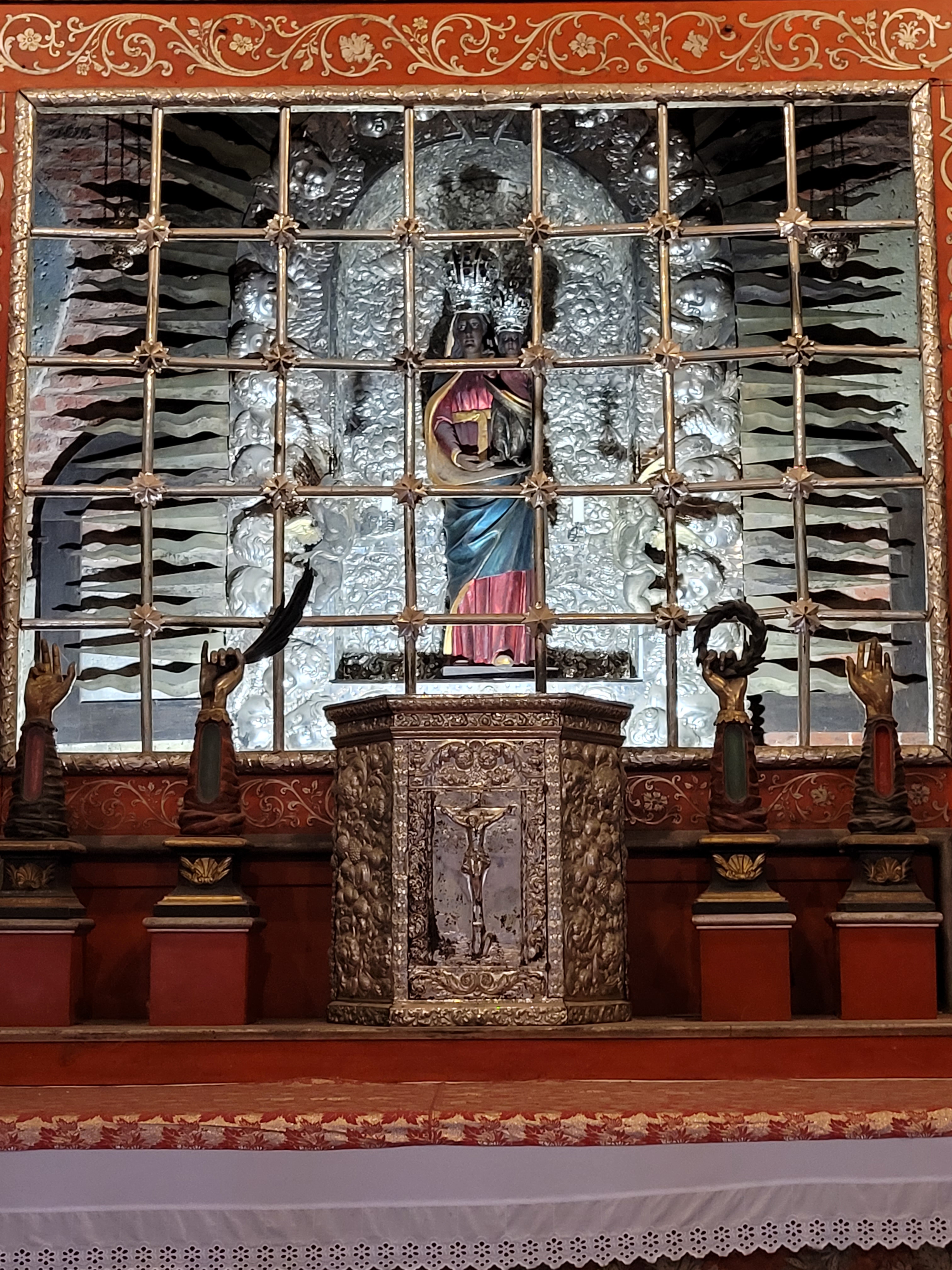
In his book Stejskal does not mention the second Black Madonna of Prague, who is to be found quite near the castle, at the very end of the Royal Way. She is in the Baroque Loreta chapel. Like in the image of the uroboros, the beginning of the Great Work meets here the end to renew the cycle eternally.

Loreta Chapel

When I attempted to probe the symbolism of Prague in my ruminations, all I knew with certainty was that this is a feminine city. Prague unveiled herself to me as a woman. It seems that others shared the same impression, since

“a number of writers belonging to the early twentieth-century “Secese” (Secession or Art Nouveau) movement portrayed the city on the Vltava as a tempting and treacherous woman, a capricious harlot. Oskar Wiener, compared her to a “dark Salome.” (8)

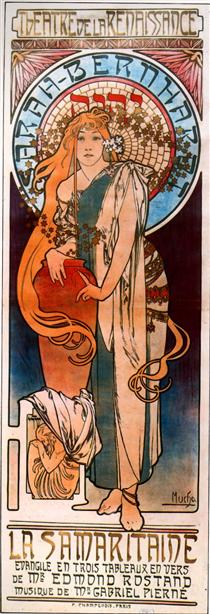
I think Prague constellates both dark and light side of the feminine archetype. The predominance of Art Nouveau architecture with its undulating forms and organic feel contributes to this impression. There is so much intricate detail everywhere; plant and floral elements, the constant interplay of light and shadow and the ubiquitous stained glass windows create a mesmerizing effect. It is impossible not to be charmed. Alphonse Mucha is the epitome of this esthetic.

A. Mucha, “The Samaritan”
A. Mucha, “Evening Reverie” (Nocturnal Slumber)

The night seems to be the most natural time for Prague. It makes it look even more otherworldly but also very tender. I delighted in that aura of nocturnal mystery and its starry veil. If I were to assign a Zodiac sign that I associate with the city, I would go for Cancer. Even Prague’s coat of arms resonates with this energy, as it emphasizes the highest level of protection.

Interestingly, Rudolf II was a Cancerian and so was Franz Kafka. C.G. Jung associated the symbolism of all cities with the mother:

“The city is a maternal symbol, a woman who harbours the inhabitants in herself like children. It is therefore understandable that the three mother goddesses, Rhea, Cybele, and Diana, all wear the mural crown.” (10)

This makes Prague the ultimate city in symbolic terms.

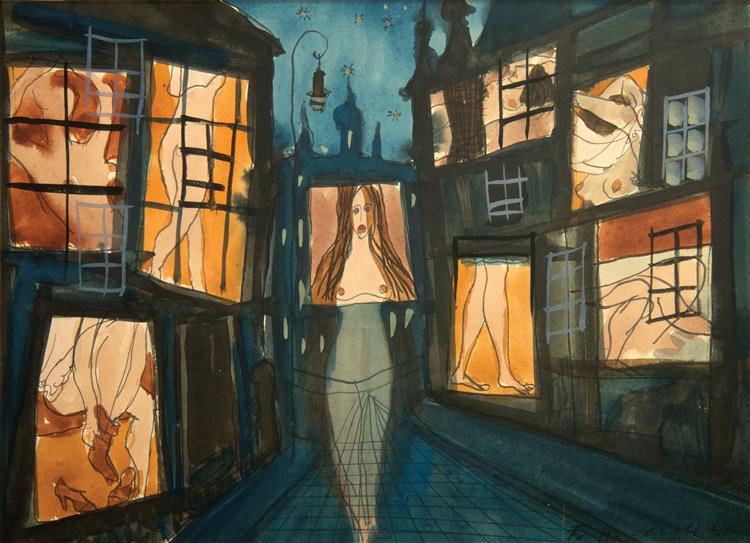
František Hudeček, “Street at the Time When Women Go to Sleep”

Wandering the streets of Prague during the day, my thoughts frequently returned to Franz Kafka, who apparently adored walking and spent hours strolling the numerous lanes of Prague. (9) He wrote the following poem about Charles Bridge and dedicated it to his friend Oskar Pollak:

“People who walk over dark bridges,

Past holy stone saints

With feeble light upon them.

Clouds that wander over grey skies

Past churches

With fading towers.

Someone who leans on the stone parapet

And looks into the evening water

His hands resting on old stones.” (11)

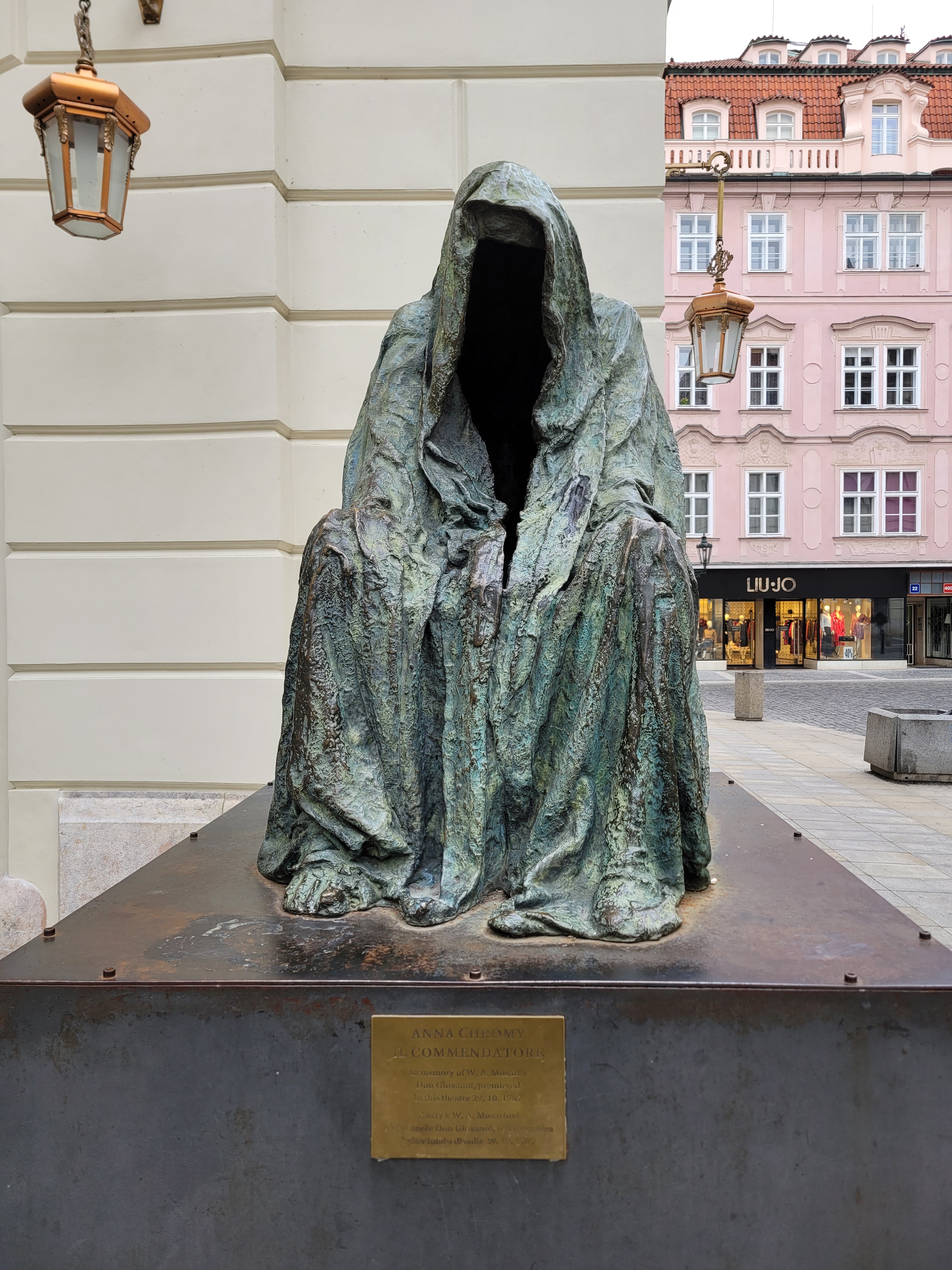
Two striking monuments in Prague offer a unique look into the heart of Prague. They both feature emptiness, which is perhaps the ultimate symbol of mystery. One is the statue of Kafka by Jaroslav Rona. A small Kafka figure rides on the shoulders of a large man, or rather a large and empty suit, which has no arms and no head. The artist was inspired by Kafka’s short story Description of the Struggle. The theme of the story is anxiety about not being able to fulfil societal expectations. This early story of Kafka shows his insecurities, the inner turmoil and struggles to find his place in the world. The second statue is by Anna Chromy and has the title Il Commendatore. It is a hooded figure, a spectre with no body – just a cloak. Il Commendatore is a character in Mozart’s opera Don Giovanni, which had its premiere in Prague. The spectre was the father of one of the women seduced by the opera’s main character, Don Giovanni. Il Commendatore appears in the opera as a statue, brought to life by supernatural forces in order to exact vengeance on Don Giovanni. This statue is related to other works by Anna Chromy, which she labelled collectively as The Cloak of Conscience. She explains:

“Designed as a place to rediscover one’s inner self, Anna created an interior space for meditation, which allows people to consult their conscience, the lost faculty to perceive the hidden, eternal truth.”

via https://annachromy.com/cloak-of-conscience/michelangelos-code/

The symbolism of the cloak seems to go hand in hand with that of Prague. The cloak, as Cirlot puts it in his Dictionary of Symbols, is like “a veil cutting off a person from the world.” Taking the habit means withdrawing from the world and focusing on the inner world, where the divine dwells. Prague’s sacred womb enables the visitor to do precisely that. As Reiner Maria Rilke, who was born in Prague in 1875 and spent his youth there, wrote in Letters on Life, “Where does the soul begin that subsists on its own mystery?”

download

Support my blog

If you enjoy my writing, please consider donating to support my work.

$1.00

Notes:

(1) Peter Marshall, The Mercurial Emperor: The Magic Circle of Rudolf II in Renaissance Prague

(2) Ibid.

(3) Ibid.

(4) Martin Stejskal, Secret Prague

(5) Peter Marshall, The Mercurial Emperor: The Magic Circle of Rudolf II in Renaissance Prague

(6) Ibid.

(7) Ibid.

(8) Angelo Maria Ripellino, Magic Prague

(9) Harald Salfellner, Franz Kafka and Prague: A Literary Guide

(10) C.G. Jung, Symbols of Transformation (CW 5), par. 303

(11) Harald Salfellner, Franz Kafka and Prague: A Literary Guide

Posted in Prague | Tagged , , , , , , , , , , , , , , , , , , , , , , , , , , , , , | 7 Comments

His Dark Materials

William Blake: Copy D, plate 1, frontispiece: “The Ancient of Days”; a bearded nude male (probably Urizen) crouching in a heavenly sphere, its light partially covered by clouds; his left arm holding a pair of compasses and reaching down with them, measuring the surrounding darkness.(via https://www.britishmuseum.org/collection/object/P_1859-0625-72)

Philip Pullman finished his trilogy of fantasy novels His Dark Materials in 2000. But I feel his epic has a lot to say about the symbolic portents of our times and the near future. I tremendously enjoyed the HBO/BBC adaptation of the novels, which ended in December last year. There is a curious personal connection between the Pullman universe and my humble blog. I had chosen the name Symbolreader a long time before I heard about the alethiometer, a.k.a. symbol-reader, which plays such an important role in Pullman’s universe. The alethiometer (from Greek – a truth-measuring device) is a compass-like device used by Lyra, the main character of the books, to gain truthful answers to her questions. The needles of the device point to images, whose interpretation is only possible when one is in a state of deep contemplation. Reading the alethiometer is a skill that can only be mastered through years of diligent studies. However, Lyra, who is still a child, has a unique gift of reading the golden symbolic compass. She accomplishes this by communicating directly with the conscious particles called Dust. Lyra’s name Belacqua is obviously an allusion to the intuitive properties of water. What is more, her nickname Lara Silvertongue links her with the alchemical Mercurius. Dust can be likened to the alchemical primal matter, with which Lyra has a very special connection. In accordance with her Mercurius credentials, at one point in the story Lyra descends to the Underworld to free the souls kept in limbo by the evil Authority.

Lyra with her daemon Pantalaimon

In Lyra’s universe conscious particles are referred to as Dust. In “our” world, Dust is called Dark Matter or Shadow particles, and there is indeed a strong Jungian resonance here. Pullman conceived of Dust as conscious and sentient. Creatures made entirely of Dust were called Angels. Dust is attracted to adults, especially the creative ones. The title of Pullman’s trilogy refers to a quote from Milton’s Paradise Lost, in which God, the Almighty Maker, uses “his dark materials” to create new worlds. Pullman’s visionary undertaking is awe-inspiring in both its depth and breadth. It alludes to Gnosticism, Orthodox religions, Jungian psychology, William Blake’s cosmology, alchemy, the Kabbalah, and has been successfully interpreted in light of all of those systems, and more.

Metatron, the Regent of the Authority

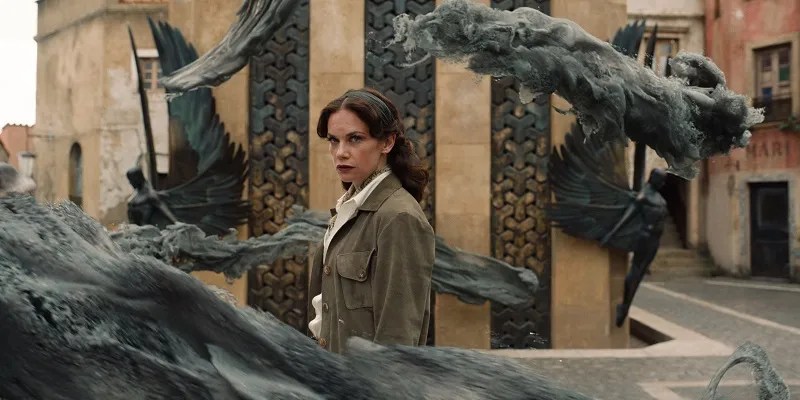
Central in Pullman’s story is the human soul and its struggle to free itself from the tyranny of orthodoxy. Organized religion is not portrayed kindly. But also the limited nature of science and rationalism are exposed. It seems that both scientists and members of the clergy strive for power and are more than happy to sacrifice individual souls if the “greater cause” of their fixed convictions demands it. Lord Asriel, a free thinker and a scientist, who opposes the Magisterium (thinly-disguised metaphor for Church) turns out to be as ruthless and close-minded as his mighty opponents. He does not stop short of child sacrifice. Yet he is still a full-blooded character, since Pullman does not limit himself to simple dichotomies of good and evil in his superb storytelling. Together with his estranged partner, Marisa Coulter, Asriel manages to defeat the Authority, thus redeeming himself to a certain extent. Both he and Marisa are marvellously-conceived tragic characters: capable of utter evil in the name of ambition but also driven by deep love and soulful striving.

Marisa Coulter surrounded by the Spectres (malevolent soul-eaters, which fed on Dust)

In Lyra’s universe people’s souls are called daemons and take the form of an animal. The animal changes shapes multiple times until it settles for one species in adulthood. In “our” world daemons are not visible, but the chosen few can train themselves to perceive them. Daemons were normally the opposite gender to their master, which must be a hint at the Jungian concept of anima and animus being the soulful companions of respectively men and women. At the moment of physical death daemons dissolve into Dust, which is beautifully shown in the TV adaptation. The unique loving bond between human and their daemon rests upon the latter’s ability to mirror the unconscious emotions of the person, to provide them with intuitive insights as well as to warn them of any danger. Animals also provide grounding and a connection with primal instincts.

I was struck how timely Pullman’s epic is in relation to the long-announced Age of Aquarius. It seems to be a task of the individual soul to navigate their way through the dominant religious and social systems, which so often seek to mould and oppress by offering false security. Without a doubt, the most liberating factor seems to be the symbolic imagination. I think Pullman would agree with the following words from Jung’s Red Book:

“Our freedom does not lie outside us, but within us. One can be bound outside, and yet one will still feel free since one has burst inner bonds. One can certainly gain outer freedom through powerful actions, but one creates inner freedom only through the symbol.”

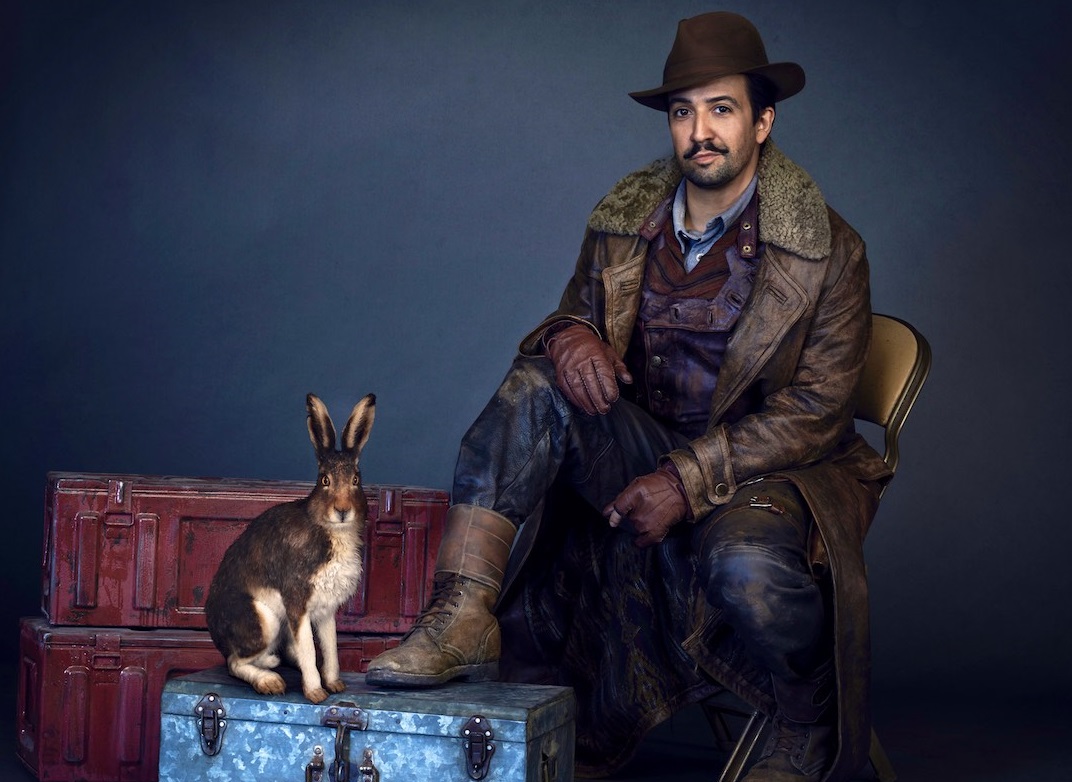
There is freedom in the air. Air is about freedom. Interestingly, one of the most compelling characters of the trilogy is Lee Scoresby, an aeronaut, whose balloon serves as an instrument of liberation and protection for quite a few characters. Air is heavily populated in Pullman’s universe: there are witches and angels spreading their wings over humanity in loving embrace and offering constant guidance.

Lee Scoresby with his daemon Hester
download

Support my blog

If you enjoy my writing, please consider supporting my blog. Thank you very much in advance.

$1.00

Posted in His Dark Materials | Tagged , , , , , , , , , , , , , , , , , , , , , , , | 10 Comments

Symbolism of the Cave

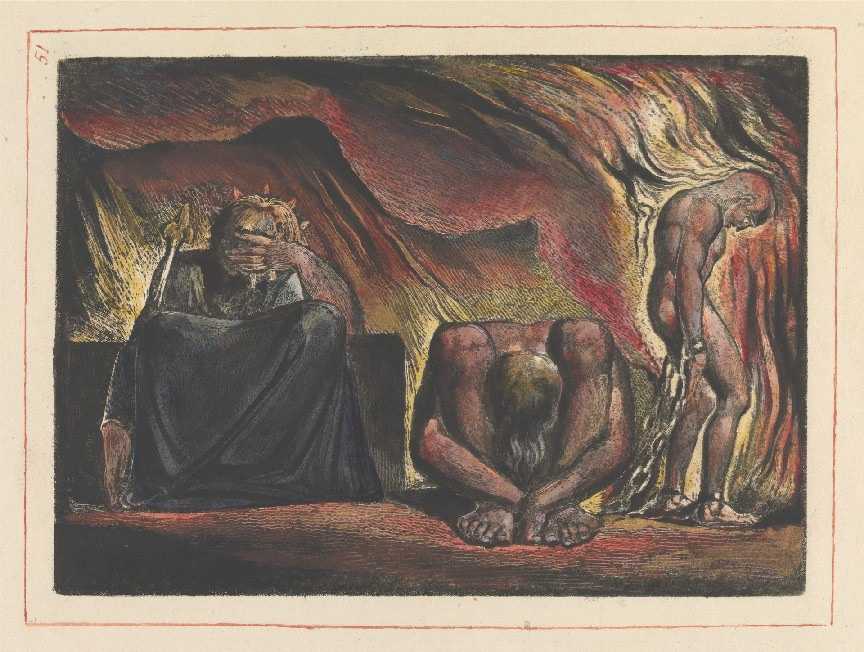
A well-known passage from Plato’s Republic describes how a group of people, chained to the wall of a deep cavern, spend their entire lives looking at the shadows dancing on the cave wall in front of them. The captives are oblivious to the source of divine light behind them. The shadows are synonymous with illusory objects spun by the goddess Maia, as the Hindu would probably say, while the light symbolizes the true and real world of eternal forms. In Plato’s universe, what we take for real are mere shadows.

William Blake, Jerusalem, Plate 51

The allegory of the cave was also popular with Neoplatonists, notably with Porphyry, author of the treatise “On the Cave of the Nymphs.” When Odysseus, the “complicated” (polytropos) man who wandered and was lost, finally arrives in Ithaca, the first place he visits is the Cave of the Nymphs. For Porphyry, “a cave is a symbol of the sensible world because caverns are dark, stony, and humid.” Here the Naiades are busy clothing the incarnating souls into bodily forms. It would seem that for Plato the cave was a place one ought to seek freedom from whereas for Porphyry it was a reservoir of gigantic generative powers as well as a place of initiation. In his Science and Religion in Archaic Greece, Roger Sworder also says that in Homer ”this Ithacan cave is symbolically transformed into the whole earth.” In the Odyssey, as Sworder elaborates “the southward path leads to mortal death, the northward path to immortality.” Thus, Odysseus’ and Athena’s passage through the southern entrance of the cave brings his spiritual rebirth. Although Plato and Porphyry claim it is necessary to seek flight from the cave, it seems that the generative Earth-born energies of caves are affirmed by Porphyry.

William Blake’s illustration showing the Cave of the Nymphs

In Man and His Symbols, Jung referred to caves as “a place of meditation and of the mystery of transformation from the earthly to the heavenly, from the carnal to the spiritual.” For Jung the cave was an alchemical vessel, a symbol of the unconscious, where transformative processes can brew in peace and concealment from the unwanted eye. The unconscious is a dark place, where our daylight orientation methods become unreliable. Entering a cave has been traditionally associated with incubation and introspection for the depths of the unconscious psyche are indeed cavernous.  

Symbolically, caves have been associated with the womb or as Erich Neumann wrote in The Great Mother:

“To this world belong not only the subterranean darkness as hell and night but also such symbols as chasm, cave, abyss, valley, depths, which in innumerable rites and myths play the part of the earth womb that demands to be fructified.”

Some American Indian tribes believed that “mankind was born of embryos which matured within underground caverns,” says The Penguin Dictionary of Symbols. In Book 19 of The Odyssey (transl. by Emily Wilson), Odysseus “narrowly escaped the winds and found a refuge, mooring his ships in Amnisus, beside the cave of Eileithyia.” This was the Cretan goddess of childbirth, daughter of Hera and Zeus, who in Cretan myth was also born in a cave. Near the cave of Eileithyia many votive offerings were found by archaeologists.

In this connection, pre-historic cave paintings can be recalled. As Jean Clottes states, prehistoric peoples saw the cave as “a place crawling with spirits and animal forms…” (1). Caves were consequently felt to be “places of power, a power that could be attained and made use of.” Perhaps this could explain the mysterious hand markings found in prehistoric caves, for example in the Argentinian Cueva de los Manos. Caves were “liminal points of contact with the supernatural,” concludes Clottes. Similarly in Tibet, some features of the landscape, including sacred caves, were believed to possess “gnas” or power. (2) 

Elaine de Kooning, “Torchlight Cave Drawing V

Especially fascinating was the role caves played in Egyptian cosmology. Cave-like spaces were constructed there because the area lacked natural caves. The Egyptians believed that the life-giving inundation of the Nile had its source in a cave. (3) Egyptian temples incorporated the imagery of the underworld through construction of restricted dark “caves.” Similarly, so many Catholic churches not only house crypts were sometimes built near a cave, Lourdes being a prominent example. Black Madonna statues are often to be found in these hidden recesses of the Christian temples.  Caves, where prominent teachers would meditate, were also frequent foundational elements of Tibetan temples and monasteries such as Potala Palace.

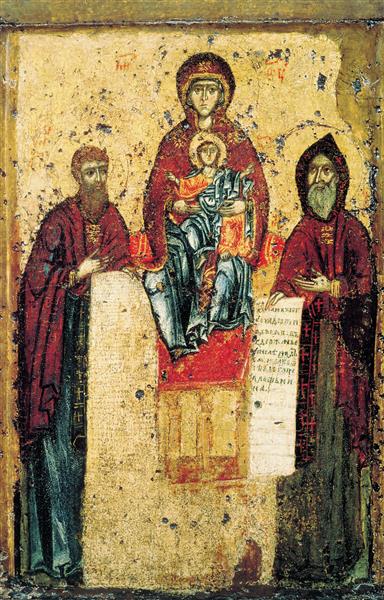
Theotokos of the Caves (Kyiv School of Icon Painting)

Cave symbolism naturally incorporates a full circle of life, as caves were also traditional places of burial. They were also believed to be entrances to the underworld, which the Ancient Egyptians called “the Swallower of All.” In German, the words Höhle (cave) and Hölle (hell) are closely related. In Greek myth the entrance to the Underworld was known as Charon’s cave. Also novelists are not blind to the dreadful symbolic dimension of the cave. There is a short story by Haruki Murakami called “The Wind Cave.” In it, a 12-year old sister of the narrator dies of a heart disease. Some time before that a family had been hiking around the caves of Mount Fuji. At one point the children found a narrow passage and the girl decided to explore it. She was gone for a long time, which made the boy increasingly uneasy. At the end of the story, when the sister had already died, the narrator’s thoughts return to the cave incident: 

“At that time, a thought struck me: that maybe, even before the doctor at the hospital officially pronounced her dead two years later, her life had already been snatched from her while she was deep inside that cave. I was actually convinced of it. She’d already been lost inside that hole, and left this world, but I, mistakenly thinking she was still alive, had put her on the train with me and taken her back to Tokyo.“

William Blake, Skeleton of Urizen from A Small Book of Design

The terrifying symbolic quality of caves is conveyed in another short story, by a Korean writer Bora Chung. In her story collection called Cursed Bunny, one of the scariest has the title “Scars.” A young orphan boy is thrown into a cave by the villagers. He is preyed upon by a monster:

“Flashing sunlight or suffocating darkness, the blinding sky or the damp and moldy air of the cave, water as cold as ice or sticky humidity and feces – there was nothing in between for the boy and no foretelling of what would happen when. It came to the boy once a month, pierced his bones, and sucked at his marrow.”

Thoughts of death also accompany modern explorers of caves. I found the following passage dedicated to potholing (extreme caving) very striking:

 “The language of extreme caving is often openly mortal and tacitly mythic: stretches of passageway ‘dead out’, one reaches ‘terminal sumps’ and ‘chokes’, the furthest-down regions are known as ‘the dead zone’. But over time I saw that – as with extreme mountaineering – there was another aspect to the thanatos at work. Divers and cave divers often describe their experiences in terms of ecstasy and transcendence. ‘I have had such beautiful moments in the water,’ says the British diver Don Shirley, who dived below 790 feet in Boesmansgat. ‘You are absolutely, completely in a void, like being in outer space . . . You get to the point where there is no God, no past, no future, just now and the next millisecond. It’s not a threatening environment – just total serenity.” (4)

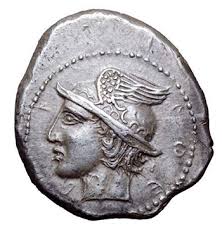
That is perhaps what sages and hermits looked for in caves as the most perfect spaces for meditation. Whatever caves mean, their fascination has been with humankind since the beginning. From the Homeric hymn to Hermes we learn that “the luck-bringing messenger of the immortals,” “a bringer of dreams,” and “a watcher by night” was born in “a deep, shady cave” at dawn, when the first light was penetrating the darkness of earth’s womb. His mother’s name was Maia, which has an apt resonance with the Hindu goddess mentioned at the beginning. In symbolism there is perhaps nothing more stirring for the imagination than the cave.

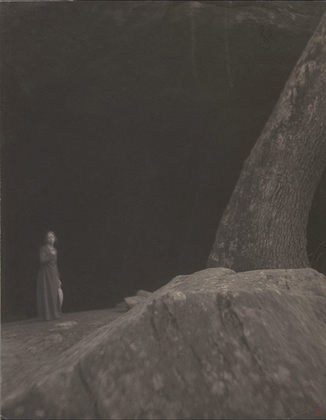
Clarence White, “The Cave”

Notes:

(1) Jean Clottes, “Ritual Cave Use in European Paleolithic Caves” in : Holley Moyes, ed., Sacred Darkness: A Global Perspective on the Ritual Use of Caves

(2) Mark Aldenderfer, “Caves as Sacred Spaces on the Tibetan Plateau” in: Holley Moyes, ed., Sacred Darkness: A Global Perspective on the Ritual Use of Caves

(3) Stuart Tyson Smith, “The Chamber of Secrets: Grottoes, Caves and the Underworld in Ancient Egyptian Religion” in: Holley Moyes, ed., Sacred Darkness: A Global Perspective on the Ritual Use of Caves

(4) Robert Macfarlane, Underland: A Deep Time Journey

download

Support my blog

If you enjoy my writing, please consider supporting my blog. Thank you very much in advance.

$1.00

Posted in cave | Tagged , , , , , , , , , , , , , , , , , , , , | 7 Comments

Reading The Red Book (45)

“The one God, to whom worship is due, is in the middle.”

C.G. Jung, Black Book 5

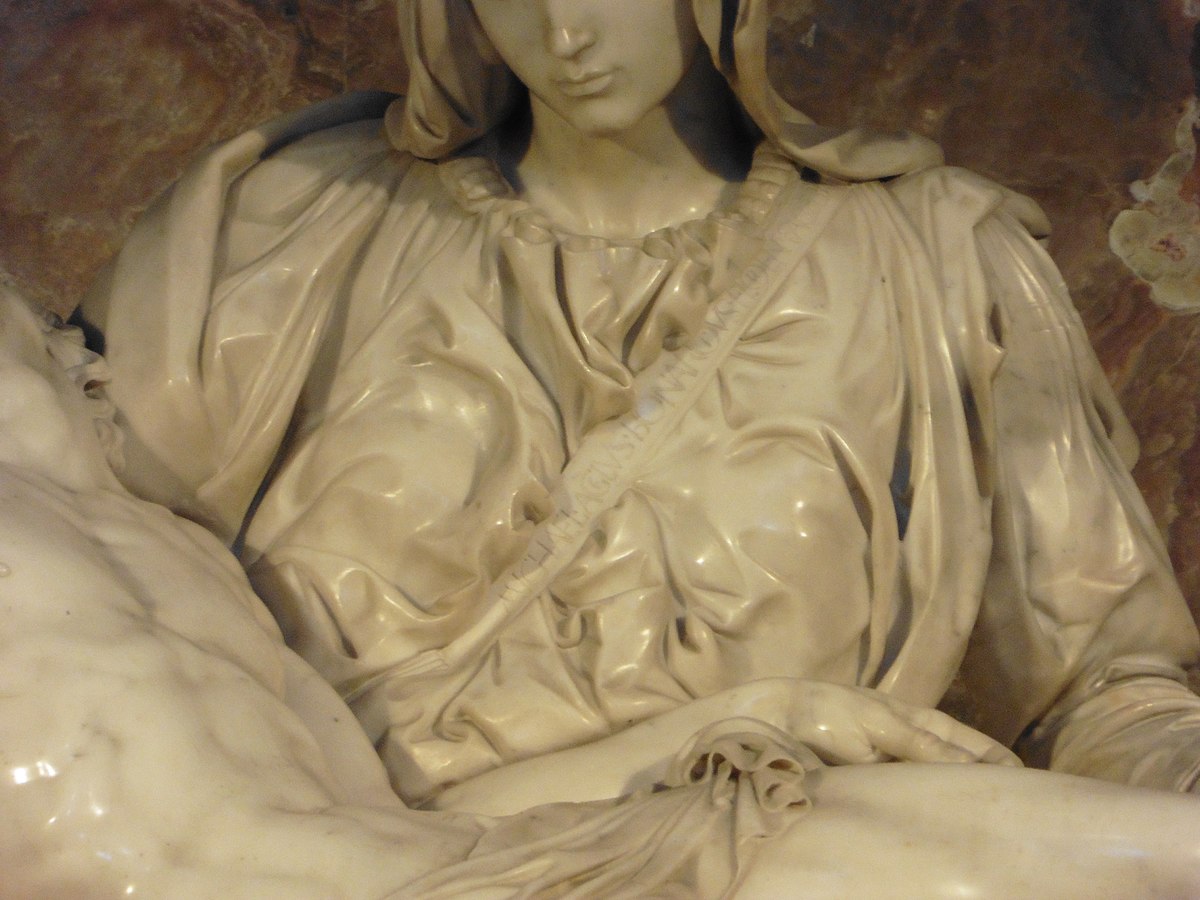
“I knew how frightfully inadequate this undertaking was, but despite much work and many distractions I remained true to it, even if another possibility never …” wrote Jung in the Epilogue to The Red Book. These final words will remain forever unfinished and so will Liber Novus. Great Renaissance artists such as Donatello or Michelangelo often left their works “non finito” for an array of reasons, partly due to external annoyances but, perhaps more significantly, stemming from their refusal to deliver an imperfect work. Pieta, an example of sublime perfection, was the only sculpture that bears Michelangelo’s signature. He chiseled, “MICHEL ANGELUS BONAROTUS FLORENT FACIEBAT.” Faciebat being an imperfect aspect of the past tense, which could be rendered as “was doing” in English as opposed to “did” or “has done.”

Pieta with Michelangelo’s signature

Kafka’s The Castle similarly ends in mid-sentence, and like The Red Book, was published posthumously presumably against the author’s wishes. One could argue that such great creative endeavors have an existence independent of their authors: they simply will push up through the soil towards the light, no matter the resistance.

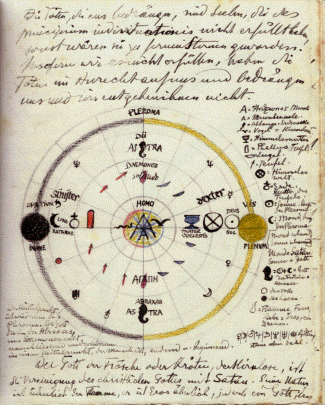
Appendix A to The Red Book contains a mandala called Systema munditotius (The system of all worlds), drawn by Jung in 1916. Jung published it anonymously in 1955, having removed some of the astrological glyphs, which appeared in the first sketch (see both below).

Jung believed the diagram to be directly connected to the teachings of Philemon expressed in The Seven Sermons to the Dead. He thus commented on it:

“It portrays the antinomies of the microcosm within the macrocosmic world and its antinomies. At the very top, the figure of the young boy in the winged egg, called Erikapaios or Phanes and thus reminiscent as a spiritual figure of the Orphic Gods. His dark antithesis in the depths is here designated as Abraxas. He represents the dominus mundi, the lord of the physical world, and is a world-creator of an ambivalent nature. Sprouting from him we see the tree of life, labeled vita (“life”) while its upper counterpart is a light-tree in the form of a seven-branched candelabra labeled ignis (“fire”) and Eros (“love”). Its light points to the spiritual world of the divine child. Art and science also belong to this spiritual realm, the first represented as a winged serpent and the second as a winged mouse (as hole-digging activity!). — The candelabra is based on the principle of the spiritual number three (twice-three flames with one large flame in the middle), while the lower world of Abraxas is characterized by five, the number of natural man (the twice-five rays of his star). The accompanying animals of the natural world are a devilish monster and a larva. This signifies death and rebirth. A further division of the mandala is horizontal. To the left we see a circle indicating the body or the blood, and from it rears the serpent, which winds itself around the phallus, as the generative principle. The serpent is dark and light, signifying the dark realm of the earth, the moon, and the void (therefore called Satanus). The light realm of rich fulness lies to the right, where from the bright circle frigus sive amor dei [cold, or the love of God] the dove of the Holy Ghost takes wing, and wisdom (Sophia) pours from a double beaker to left and right. — This feminine sphere is that of heaven. — The large sphere characterized by zigzag lines or rays represents an inner sun; within this sphere the macrocosm is repeated, but with the upper and lower regions reversed as in a mirror. These repetitions should be conceived of as endless in number, growing even smaller until the innermost core, the actual microcosm, is reached.”

Jung painted the mandala before he wrote Scrutinies, the third part of The Red Book. He said its meaning was unknown to him at the time. Liz Greene writes that the Systema can be viewed as “a cosmological map,” which shows “the place of the human microcosm within the greater macrocosm.” (1) Abraxas is the ruler of the lower, bodily realm of incarnation while Phanes presides over the upper heavenly or spiritual realm.

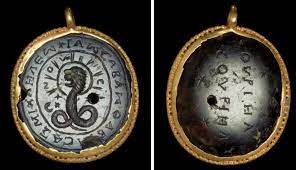
Liz Greene offers a detailed analysis of the diagram. She draws our attention to the lion-headed serpent, who is visible in both hemispheres of the painting. This is Chnoumis, often featured in ancient magical amulets, like the one below.

This deity symbolically reunited the spiritual realm with the corporeal realm. The crowned lion’s head stands for the solar spiritual principle while the serpent refers to the manifested world. Similarly, the Eros principle “indicated the capacity of Eros to bridge spiritual and instinctual realms.” (2) The intermediaries between the spiritual and earthly realms are the daimons. All of these are crucial elements of Jung’s cosmology depicted in the Systema.

The left hemisphere of the mandala is connected with darkness while the right hemisphere is that of light. Symbolically, the left side was always the “sinister” one (Latin word “sinister” means simply “left”). In the Last Judgement the wicked where sent to the left, i.e. to Hell. In Christian and Rabbinical thought, the left side was dark, female and unconscious.(3) In his diagram Jung placed the Black Moon on the left together with the Full Moon as a symbol of opulent mother earth. On the right he placed the Celestial Mother and the Sun God. This is totally in agreement with the cosmology delineated in the Seven Sermons. The divine feminine has both dark and light aspects – she partakes both of the earth and of the heavens. It is also important to note, says Greene, that “there can be darkness in Phanes’ domain, as there can be light in the domain of Abraxas.” For Jung, light and darkness partake in equal measure of upper (spiritual) and lower (bodily) realms.

Appendix B contains commentaries written by Jung on chapters 9, 10 and 11 of Liber Primus. As Shamdasani points out in his introduction to The Red Book, “this manuscript indicates the amount of work he put into understanding each and every detail of his fantasies.” Jung writes about Salome, who represents the principle of Eros and her father Elijah, whom he connects with Logos. The fact that Salome is blind means for Jung that Logos has subjugated Eros. Salome asks Jung for help: his task is to free the erotic and the feminine and give her vision. We may argue that The Red Book is the voice of Eros – the unconscious feminine soul – speaking through Jung.

Another interesting interpretative passage refers to the scene in which Salome declares herself as the mother of the “I” speaking in The Red Book. Jung muses:

“There is a child in each of us; in the elderly, it is even the only thing still alive. One can have recourse to the childlike anytime, on account of its inexhaustible freshness and adherence. Everything, even the most ominous, can be rendered harmless through retranslation into the childlike.”

Not only did he introduce the terms extroversion and introversion, it is also Jung who is believed first to have used the term “inner child” in psychology. On the one hand, it symbolizes the youthful, animating force of creativity, its formative and positive function supporting growth and opposing stagnation. The child emerges from the unconscious to bring a change into the conscious life. Yet sometimes Jung uses the term inner child negatively to denote the clinging herd instinct, lack of individuality and fear of solitude. Rejecting collective norms requires growing up and giving up childlike attitudes. As Jung remarks here, “Eros demonstrates to the I the impossibility of being a child.”

Albrecht Dürer, “Putti Dancing and Making Music”

Because the whole of The Red Book may be regarded as a manifesto of seeking the middle path between the extremes of the opposites, Jung yet again treats us to one of his typical paradoxical statements:

“Essentially, the good needs to be regarded as an inherently no-less-dangerous principle than evil.”

One-sidedness is never desirable in the Jungian world.

Finally, Appendix C to The Red Book contains a passage from Black Book 5 devoted to the cosmology of the Seven Sermons. Here Jung appears to be speaking directly to the reader as the voice of the Soul:

“I, your soul, am your mother, who tenderly and frightfully surrounds you, your nourisher and corrupter; I prepare good things and poison for you. I am your intercessor with Abraxas. I teach you the arts that protect you from Abraxas. I stand between you and Abraxas the all-encompassing. I am your body, your shadow, your effectiveness in this world, your manifestation in the world of the Gods, your effulgence, your breath, your odor, your magical force. You should call me if you want to live with men, but the one God if you want to rise above the human world to the divine and eternal solitude of the star.”

The soul speaking through Jung admonishes us not to fear or escape from Abraxas, for the pain and disappointment of incarnation are inevitable. The star god, the one true god of the middle way, who is independent of Abraxas, can only be reached by going through earthly suffering connected with the terrible Abraxas so that the human “ransom” is repaid. Only few of us reach the state of “absolute individuality,” through which the endless Pleroma (the collective unconscious) becomes concentrated into a shining star – “the point that contains the greatest tension” and is “immeasurably small.” Such an individual can be compared to a small sun that can emit fire. Jung concludes:

“You yourself are a creator of worlds and a created being.”

Mikalojus Konstantinas Ciurlionis, “The Sun”
download

Support my blog

This is my 500th post on symbolreader and the final post dedicated to The Red Book. If you appreciate my writing, please consider donating.

$1.00

Notes:

(1) Liz Greene, The Astrological World of Jung’s Liber Novus: Daimons, Gods and the Planetary Journey

(2) Ibid.

(3) The Penguin Dictionary of Symbols by Jean Chevalier and Alain Gheerbrant

Posted in The Red Book by C.G. Jung | Tagged , , , , , , , , , , , , , , , , , , , , , | 6 Comments

Shiva and Parvati: the Birth of Kali

I have across a fascinating version of the birth of goddess Kali. In this myth she came to the world as a result of Parvati’s anger, which she shed and transformed during her spiritual practice.

Lake Manasarovar at the foot of Mount Kailash where a yogi receives the Ganges from Shiva, Cleveland Museum of Art

After Parvati married Shiva, she moved with him to the icy caves of the Himalayas to pursue the life of asceticism. They lived on the mountain Kailasa close to the lake Manasarovar (lake of the mind):

“If Shiva’s principal function was destruction, hers was preservation and reconstruction, thus offsetting his violence. She had a calming, civilizing influence on Shiva. Under the soothing effect of her charming presence, he changed his wild, rude, and often mad behavior.

Many comparisons are given in the Puranas to show this interdependence. Shiva is the sky and Parvati the earth; Shiva is the ocean and Parvati the shore; Shiva is the sun and Parvati the light. Parvati is all qualities, and Shiva the enjoyer of all qualities. Parvati is the embodiment of all souls, and Shiva the supreme soul itself. Parvati is all forms, and Shiva the thinker of the forms. Parvati is speech and Shiva meaning.

The representation of the lingam and yoni also points to an aspect of this interdependence. As a great yogi, Shiva accumulates great sexual potency that must be released in creation so that it will not be utilized for destruction. … Shiva is the figure for moksha or liberation and Parvati for dharma or righteous living in the world.

One day Shiva teased Parvati about her dark color. In a fit of temper she went to the forest and started tapas in order to change her color. Seeing her intense austerities, Brahma came to her and asked her to take another form and rid the world of the two demons Shumbha and Nishumbha, who had been reincarnated and were terrorizing the world.

Acceding to this request, the goddess Parvati shed her dark skin and became fair in color. In this form she came to be known as Gauri, the radiant one, the shining one, the fair one. Her dark outer skin took the form of Kaali, the virgin goddess, with the luster of a black rain cloud. Kaali held the conch and discus of Vishnu as well as the trident of Shiva, for she had the strength of both. Gauri told her to go with Brahma to slay the demons.”

From Vanamali, “Shakti: Realm of the Divine Mother”

Dakshineswar Kali Temple, Kalkota

Posted in Kali | Tagged , , , , , , , , , , , , , , , | Leave a comment