1.“Illumination comes to those who hear the song of Light unchanged, unflickering, eternal — Light that is one though the lamps be many.”
Dane Rudhyar
2.”The eye is the lamp of the body; so then if your eye is clear, your whole body will be full of light.
Mathew 6:22
3.“O father, I have been made steadfast through God; I now see not with the eyes, but by the operation of spiritual energy in the powers. I am in heaven, in earth, in water, in the air; I am in living creatures and plants; I am in the womb, before the womb, after the womb. I am present everywhere.”
The Corpus Hermeticum, Book 13, translated by Clement Salaman
4.“Mere intellectual enlightenment cannot recognize the spiritual. As the sun puts out a fire, so spirit puts out the eyes of mere intellect.”
W. Howitt (quoted after H.P. Blavatsky)
Although in the mainstream view the All-Seeing Eye is quite a compromised symbol nowadays– either bringing to mind a sinister “Illuminati“ elite reigning from the shadows or at best the less and less popular institutionalized religion, I have always felt awe and inspiration toward this particular image. I rarely share personal stories but there is one instance of an All-Seeing Eye sighting I will never forget. I was walking along Szewska street in Krakow with an astrologer friend of mine and sharing some depressing details about my situation back then. Basically, I felt at a dead end and uninspired at that time and I was asking the friend how much longer I would have to endure this predicament. I also joked: “God, please give me a sign now.“ As I looked up at that precise moment I saw an All-Seeing eye on one of the buildings, which took my breath away for a brief moment. This is exactly what I saw:
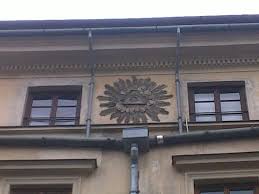
I experienced the mysterious on that day: I feel that the All-Seeing Eye sent a message to my dormant third eye that it was time to wake up. A famous painting by Magritte, and one of my favourite works of art, entitled “False Mirror“ forces the viewer to just do that: wake up to the reality that your vision is limited and imperfect.
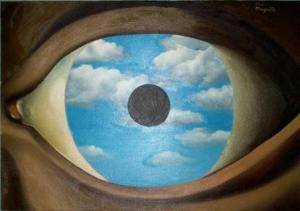
It may be an invitation to look within and to look at the world differently, with a fresh perspective. It may be time to view the All-Seeing Eye differently also, remembering what Dane Rudhyar wrote:
“ Symbols however may die the death of all memories supplanted by a fresher crop of living experiences at a new level of being. New men call for new symbols. …
It is for us, who have not forgotten that at the birth of all cycles the world belongs to poets and bards bringing new names to a race ecstatic with birthing and confused with the crashing of the old, to read the signatures which the new Ideas, that are God-born, inscribe upon the open book of the world.“
Humanity is experiencing the pangs of birth of a new consciousness and a new vision, which calls for a new understanding of symbols based on an accurate illumination of ancient wisdom. Cirlot, the author of The Dictionary of Symbols that I mostly rely on, stresses then symbolic interrelation between the symbolic eye and the Sun. Plotinus himself wrote this:
“If the eye that adventures the vision be dimmed by vice, impure, or weak, and unable in its cowardly blenching to see the uttermost brightness, then it sees nothing even though another point to what lies plain to sight before it. To any vision must be brought an eye adapted to what is to be seen, and having some likeness to it. Never did eye see the sun unless it had first become sunlike, and never can the soul have vision of the First Beauty unless itself be beautiful.“
The All-Seeing Eye and the sun, at the deepest level, are one. The astrological glyph for the sun looks like an eye:

In this powerful image, the dot at the centre of the circle is “the Point of Emergence, the Creative Source, the Alpha of the great cosmic cycle of existence, the Undying Root, …, the Germ of the Universe,“ says Rudhyar, while the circle is a symbol of “space before any manifestation of existence occurs,“ “a virgin field within the boundaries of which a universe will take place.“ Already for Ancient Egyptians, God was the Eye of the Universe, “ the symbol of the Deity revealing itself in the wisdom of its own creation,” as Madame Blavatsky put it. It is also Blavatsky who emphasizes that the ancients did not believe the Sun to be the real cause of heat and light. What they believed was that the real master of the orchestra was hidden behind the scene and the light from beyond was only transmitted through the Sun to the earth that received it. The Sun was called by the Egyptians the Eye of Re, but also, in Blavatsky’s words, the Eye of Osiris – “the Logos, the First-begotten, or light made manifest to the world, which is the mind and divine intellect of the Concealed.” The hieroglyphic for god Osiris featured an open eye. The etymology of his name has not been firmly established, but Plutarch claimed it meant “many-eyed,” while Wolfhart Westendorf‘s (1987) more recent suggestion has been “she who bears the eye” (information from Wikipedia). Geraldine Pinch illuminates the hidden meaning of the eye for Egyptians when she shares in her book that divine eyes were in fact personified as goddesses because the Egyptian word for “eye,“ – “irt“ – was feminine in gender. The eye of Re was in fact Re’s daughter and protector. Horus, on the other hand, who was the son of Isis and Osiris, was imagined to have had two eyes – continues Pinch – and his right eye was the sun while his left eye was the moon. The complete and healed eye restored to Horus by Thoth after it being mutilated by Set was called Wadjet (Eye of Horus), which is the whole or completed eye. To me it is the symbol that encompasses the whole secret wisdom of Ancient Egypt that I can only revere ad be in awe of.
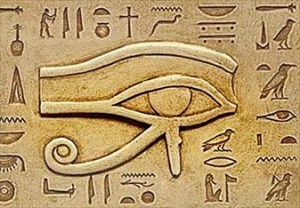
The eye was one of the most crucial and central symbols in Ancient Egypt. In my effort ot understand its significance, I was greatly helped by delving deep into the wisdom of Manly P. Hall, who got me acquainted with a brilliant 16th century Paracelsian physician, one Robert Fludd, according to whom the sun has three distinct properties: life, light and heat.

Hall says: “In all probability, Osiris represents the third, or material, aspect of solar activity, which by its beneficent influences vitalizes and enlivens the flora and fauna of the earth. Osiris is not the sun, but the sun is symbolic of the vital principle of Nature, which the ancients knew as Osiris.“ While Re represents pure light of the spirit, Osiris is the body of the sun god on the earth.

Osiris and Re-Atum
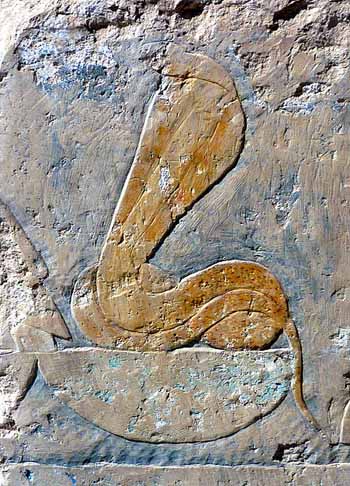
Every night Re descended into the underworld to unite with Osiris in the underworld. Isis, the consort of Osiris and his lunar lover, gave him a son – Horus, whose both eyes bring together the wisdom of the Spirit and the wisdom of the Soul, the wisdom of the sun and the wisdom of the moon, the wisdom of the god and the wisdom of the goddess. The name Wadjet means “the green one,“ which strengthens her healing and revitalizing properties. Wadjet was also the protective cobra goddess wrapped around the solar disk of Re. She was yet another symbol of the power of the risen Kundalini energy in ancient Egypt.

Wadjet at Luxor
I started by talking about the activation of my pineal gland that occurred when I saw that image of the All-Seeing Eye in Krakow. In astrology, as Rudhyar points out, the pineal gland is ruled by the Moon: it is like a cup ready to receive the living waters and the light of the descending spirit. I think the secret of spiritual awakening lies in the integration of the energies symbolized by the Eye of Horus. Gary Lachman has been on a quest for Hermes Trismegistus, which helped him reveal a lot of lost ancient wisdom that he shared in his book. He associates opening of the third eye with “the reawakening of an ancient spiritual vision” that has been forgotten in modern times marked by the descent into the world of matter and a loss of consciousness. The older forms of consciousness are hidden in the “old brain” that “the new (cortical) brain” should observe and analyze and subsequently bring to our modern awareness. Lachman includes a quote from Mavromatis illuminating the symbolism of the caduceus:

Alex Grey, “Caduceus”
“In the West, this latter level is often represented by the god Hermes’ scepter, the caduceus, depicting two snakes entwined around a central rod which culminates in a small sphere or cone flanked by two wings … It is worth noting that the snakes represent the two supposedly opposite sides of man, whereas the sphere or cone stands for the unity of consciousness. The two wing sprouting from the sphere are both higher representations of the two sides of man and the symbols of completion and of liberation of consciousness: they are the two cerebral hemispheres flanking, and practically encasing, the pineal gland.”
Interestingly, both the staff of Hermes (the caduceus) and the staff of Osiris feature the pine cone symbol standing for the pineal gland and the third eye.

Staff of Osiris
The pineal gland, our inner “organ of consciousness,” is linked to the body’s perception of light and to our wake-sleep patterns. It is where the healing energy passes through when it rises in the body. Isn’t it curious that the largest pine cone statue in the world is placed in the Vatican in the famous Court of the Pine Cone?

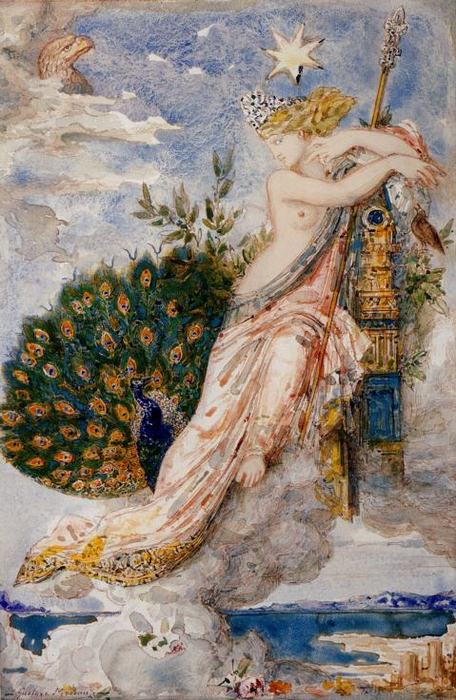
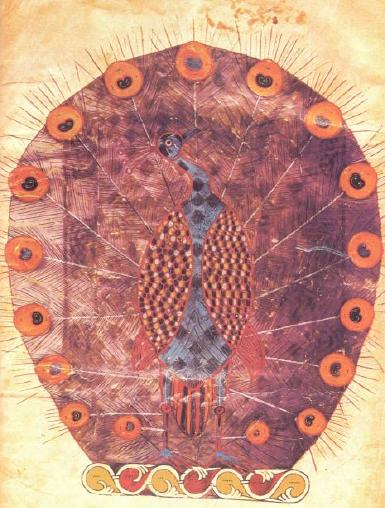
There, the pine cone is flanked by none other than two peacocks. In Rome, the peacock was the bird of Juno and symbolized, according to Barbara G. Walker, the many coloured veils of the goddess and the manifested world as well as the Goddess’ watchfulness and omnipresence. It also meant that the single eye of the spirit, i.e the celestial God Jove, is united with Juno, his divine consort presiding over the multitude and diversity of the manifested forms. In alchemy, the peacock’s tail (cauda pavonis) stood for a wondrous display of colours and visions bringing about mystical awareness of the dreamlike nature of existence born out of blackness and despair experienced in the phase of Putrefaction.

Gustave Moreau, “The Peacock Complaining to Juno”

Alchemical Peacock
The painting by Magritte mentioned in the first part showcases beautifully the mystery of the pupil of the eye. Roberto Calasso’s quote is one I want to close my thoughts with for today:
“…the pupil, as Socrates says to Alcibiades, ‘is the finest part of the eye,‘ not just because it is ‘the part which sees‘ but because it is the place where another person looking will find ‘the image of himself looking.‘ And if, as Socrates claims, the Delphic maxim ‘Know thyself‘ can be understood only if translated as ‘Look at thyself,‘ then the pupil becomes the sole means of self-knowledge . . .“
Sources:
Alchemy: http://azothalchemy.org/azoth_ritual.htm
H.P Blavatsky, Isis Unveiled
Roberto Calasso, The Marriage of Cadmus and Harmony
Gary Lachman, The Quest for Hermes Trismegistus from Ancient Egypt to the Modern World
Geraldine Pinch, Handbook of Egyptian Mythology
Plotinus, The Enneades, http://www.sacred-texts.com/cla/plotenn/enn069.htm
Dane Rudhyar, “New Mansions for New Men: A Spiritual Interpretation of Astrology in the Light of Universal Symbolism.“ http://khaldea.com/rudhyar/nmnm/
Dane Rudhyar, “The Planets and Their Symbols“ http://www.khaldea.com/rudhyar/astroarticles/planetssymbols_1.shtml
Clement Salaman, Dorine van Oyen, William D. Wharton, Jean-Pierre Mahe, The Way of Hermes: New Translations of the Corpus Hermeticum and the Definitions of Hermes Trismegistus to Asclepius
Barbara G. Walker, The Women’s Encyclopedia of Myths and Secrets
















 symbolreader