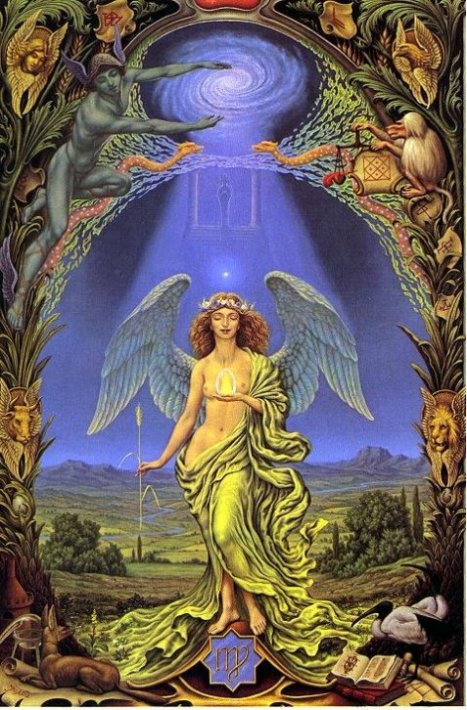
Johfra Bosschart, Virgo
I adore this image. It reminds me of a precious and delicate porcelain figurine that you hold delicately between your fingers, marveling at its fragile beauty. I like to spend a longer time looking at the Zodiac image before I start writing about it. I try to think of a literary work, preferably a poem, that I would associate with the image. For some reason Virgo directed my thoughts towards a Polish poet and a Nobel laureate, Czeslaw Milosz and his Song on Porcelain. In this beautiful poem, he voices his regret about beautiful porcelain being smashed by soldiers’ boots. Here is the first stanza:
Rose-colored cup and saucer,
Flowery demitasses:
They lie beside the river
Where an armored column passes.
Winds from across the meadow
Sprinkle the banks with down;
A torn apple tree’s shadow
Falls on the muddy path;
The ground everywhere is strewn
With bits of brittle froth –
Of all things broken and lost
The porcelain troubles me most.
To me this poem is a song of innocence and experience, and these two themes are very important for Virgo – the Virgin. The poem evokes the second world war. When I was a schoolgirl I Poland, September marked the anniversary of Hitler’s invasion on Poland (followed by Stalin’s some two weeks later). This happened when the Sun was in Virgo: our collective innocence was shattered and we paid dearly for the experience we gained.
In my last post of the series dedicated to Leo I pondered on the symbol of the Sphinx: half-lion, half-maiden. I have recently looked at Dane Rudhyar’s writings to see what he had to say about the sign Virgo. He also thinks that the Sphinx is a very important symbol to understand if we want to fathom the meaning of Virgo. He writes:
In Leo the creative thinker is born. With Virgo this new birth becomes substantiated. The fiery activity of the creative personality, dramatizing itself and releasing its energies from within outward, reaches a circumference and the cold winds of space. … the personalized emotional power of the human ego … transforms itself into the potentiality and expectancy of the virgin Woman, waiting for fecundity – within the sanctuary of the Pyramid. … The Virgin is alone – and expectant. She expects the performance of a Mystery which will destroy both her aloneness and her virginity.
…
The Sphinx is the symbolical expression of the crisis which must come at a certain stage of evolution if the creative, self-projecting, dramatic aloneness of the human ego (Leo) is to become the expectant, potentially fruitful aloneness of the human Soul (Virgo).
This fragment touches upon the many mysteries surrounding the sign Virgo and underlies a lot of the ostensive paradoxes of that sign. It alludes to ancient mysteries and female priestesses (often also sacred prostitutes as was the case in the cult of goddesses such as Atargatis and the Ephesian Artemis) who took part in them. Liz Greene quotes extensively from an essay by John Layard on the virgin archetype. I hope to read the original source one day but at this point I am quoting from it after Liz Greene:
… though we now think of the word ‘virgin’ as being synonymous with ‘chaste’, this was not the case either with the Greek word parthenos or with the Hebrew almah of which ‘virgin’ is the most usual biblical translation. For the Greek word was used of an unmarried girl whether she was chaste or not, and was in fact also applied to unmarried mothers. The Hebrew word means likewise ‘unmarried’ without reference to premarital chastity. … Thus in this sense the word ‘virgin’ does not mean chastity but the reverse, the pregnancy of nature, free and uncontrolled, corresponding on the human plane to unmarried love…”
A mind untrained to think symbolically takes everything literally. It is sad that for most of us in modern times virginity is limited to biology. This was not the case in ancient times.
Who is the female figure in the image? She is the Greek Astraea (or Dike), she is the Syrian Atargatis, and she is the Egyptian Isis. Let us look at them in turn. Dike represents the principle of justice and natural law. She used to live on the earth but got severely disappointed with human depravity and flew up to heaven to her father Zeus, becoming the constellation of Virgo. Like Demeter, Dike was usually depicted carrying a sheaf of barley. Liz Greene, herself a Virgo, writes the following about her:
She seems to be an image of the intrinsic orderliness of nature, and her disgust at humanity is a mythic image of the traditional Virgoan disgust at disorder, chaos and wastage of time and substance.
Atargatis is a fascinating goddess, one of my favourites that I feel a strong urge to learn more about. Atargatis’ epithets included ‘pure,’ ‘virgin’ and ‘Mother of the Gods.’ She was the great mother and a goddess of fertility, often portrayed as a mermaid with fish as her sacred emblems. Her cult had orgiastic elements. In the Latin novel The Golden Ass by Apuleius, the chief protagonist called Lucius is transformed into a donkey. The donkey’s evolution involves living out his brutish lustful nature. At one point Lucius as a donkey joins the orgiastic cult of Atargatis. This experience taught him something very crucial for the sign Virgo: the sacredness of the ritual and the sanctity of the body as the vessel of the divine. In the end, it is the goddess Isis who transforms him back into the human form. Ancient Egyptians associated Isis with the sign Virgo and portrayed her with huge, sheltering wings. She helped her consort Osiris to civilize Egypt by teaching women to grind corn, to spin and to weave. After the dark god Seth murdered Osiris and cut his body into 14 pieces (note that I am shortening the myth significantly here), she lovingly collected all the pieces save one – his penis, which had been swallowed by a fish. In the end in a sacred sex ritual she brought him back to life with her magic and they conceived a son – Horus. After this act of sacred sex Osiris became the King of the Underworld. In the Egyptian Book of the Dead the sign of Virgo is represented as the gateway to the kingdom of Osiris.
The word I associate with the Virgin archetype is integrity, being one-in-herself, intact, and adept at preserving boundaries. Her eyes are closed in the painting because she follows her own commands and bows only to the dictates of her own nature. She gives of herself guided by her own inner principles. Two quotes by Liz Greene capture this idea beautifully:
The issue of bestowing one’s gifts or one’s bounty as one wishes, according to inner laws, rather than satisfying expectations to gain rewards, seems fundamental to the mythic figure of the Virgin.
Virgos of both sexes are often caught in the dilemma of having to choose between the safe, well-paid and ultimately barren path of external compliance and the fertile but often lonely path of inner loyalty.
The traditional ruler of Virgo is Mercury (I will return to this) but her esoteric ruler is the Moon. The archetype of the Great Mother (“the universal primordial substance from which the material cosmos is condensed,” as Johfra puts it) is essentially Virgoan. Mother and matter share the same etymological root: the sign Virgo is an expression of matter divided into tiny atoms. The four Evangelists included in the four corners of the image allude to the four elements (the tetramorph, Greek tetra: four, morph: shape): the angel in the top left-hand corner is Matthew (the air element, presented in human form because his gospel stresses the humanity of Christ), the eagle is John (the water element as the eagle is a higher expression of Scorpio and symbolic of Logos – the word of God), the lion is Mark (fire; in his gospel the royal dignity of Christ is in the foreground), and the ox is Luke (earth; this gospel speaks of Christ’s sacrifice). The four of them are an expression of Christ consciousness.
Erich Neumann explored the Virgin archetype in astonishing detail in his wonderful book The Great Mother:
The childbearing virgin, the Great Mother as a unity of mother and virgin, appears in a very early period as the virgin with the ear of grain, the heavenly gold of the stars, which corresponds to the earthly gold of the wheat. This golden ear is a symbol of the luminous son who on the lower plane is borne as grain in the earth and in the crib, and on the higher plane appears in the heavens as the immortal luminous son of night. Thus the virgin with the spica, the ear of grain, and the torch-bearer, Phosphora, are identical to the virgin with the child.
In the painting she holds an ancient fertility symbol – the egg – which contains a flame. As the Sun is the child of the Night, so Virgin Mary gave birth to Christ or Isis to Horus. Liz Greene emphasizes also that the sign Virgo is about mothering in the deeper sense as “the nurturing of potentials and the bringing to birth of the inner pattern in outer life.” The fire she holds is feminine fire – fire of the earth, the libido that flames up in the act of sacred sex. The white wings not only stand for chastity but also for the upward movement starting on the earth, in the mundane, amidst nature, and rising towards the upper spiritual realms.
The traditional ruler of Virgo is Mercury presented on the left as Hermes and on the right as the Egyptian Thoth (the baboon). Rudhyar asserts that Virgo stands for “mental fecundity” and “critical faculty.” In search of meaning, Virgo questions, criticizes and passes value judgements, “breaking everything down as finely as possible” (Johfra). With a graceful gesture, Hermes is trying to encompass the universe with the mind. Thoth performs quality control of the souls of the dead, placing their hearts on one scale and the feather of Maat (measure, truth, balance, morality, justice) on the other. Maat was the Egyptian goddess who set the order of the universe out of chaos.
In conclusion, let me look at the remaining elements depicted in this image. There is the ibis in the lower right-hand corner, a bird sacred to Thoth, the Egyptian god of wisdom. It is guarding the scrolls of wisdom (we can see the Kabbalistic Tree of Life on the cover). A stride of the ibis was used as a measure in building temples. The jackal, an animal seen at burial grounds, alludes to an important function of Hermes – that of psychopompos, i.e. the conductor of souls through the underworld, the only god that was allowed to enter Hades. The mysterious figure on the steps emerging from the luminous mist is Osiris. He is awaiting the souls at the gate to the kingdom of the dead. But in alchemical terms, Osiris is also awaiting the initiates who took part in secret mysteries and who through them acquired universal consciousness and eternal life.
If you appreciate my writing, consider donating and make my day. Thank you in advance.
Sources:
Johfra Bosschart, Astrology
Juan Eduardo Cirlot, The Dictionary of Symbols
Liz Greene, The Astrology of Fate
Erich Neumann, The Great Mother
Dane Rudhyar, The Zodiac as The Universal Matrix
Related posts:
Images of the Zodiac: Contemplating Aries
Images of the Zodiac: Contemplating Taurus
Images of the Zodiac: Contemplating Gemini
Images of the Zodiac: Contemplating Cancer
Images of the Zodiac: Contemplating Leo
Images of the Zodiac: Contemplating Libra
Images of the Zodiac: Contemplating Scorpio
Images of the Zodiac: Contemplating Sagittarius
Images of the Zodiac: Contemplating Capricorn
Images of the Zodiac: Contemplating Aquarius
Images of the Zodiac: Contemplating Pisces















 symbolreader