The Fountain by Darren Aronofsky is by far the most powerful symbolic movie I have seen in the last few years. Watching it is always like being transported into another reality; the music, the powerful images and the three interwoven stories that are presented are just hypnotizing. The core story is that of Tommy Creo, a doctor who is losing his wife Izzi to cancer. Instead of sharing their last moments together he focuses on finding a cure for her and embarks on a hopeless, quixotic fight with her disease. After she inevitably dies he keeps on resuscitating her for a prolonged, painful stretch of time, refusing to let go and accept that she is no longer with him. She, on the other hand, accepted her situation with a lot of grace and dignity. Up to her death, her heart and mind had been occupied with the book she had started writing and wanted her husband to finish after her death. She was writing a story called The Fountain about a 16th century Spanish Queen Isabela, whose country suffered under the bondage of the Grand Inquisitor, who relished in torturing people and wanted to destroy the Queen and take over her kingdom, not unlike the tumour wreaking havoc with Izzi’s body. She sends a conquistador Tomás, her consort, to the Mayan territory in Central America to find the Tree of Life and deliver her and Spain from bondage. The last futuristic story is about an astronaut Tom, who travels in a giant spaceship looking like a bubble, with the Tree of Life on deck, towards the golden nebula of Xibalba (the Mayan underworld, literally ‘the place of fear’). Hugh Jackman and Rachel Weisz play the two main characters in each story. The stories echo and converse with each other; the mythical motives appear and reappear weaving a closely interlinked pattern of human fate consisting in being cast out of Paradise into the world in which we all need to face pain, separation, loss, death and suffering. I also see it as a movie on the healing and transcending power of love. It is the love for his wife that compels Tommy/ Tomás /Tom to keep reincarnating throughout eternity always looking for his divine Other, and finally enables him to let go of fear, and reach release and Enlightenment in the movie’s final scene.


I would not like to go into too much detail about each storyline in case there is anyone reading it who has not seen the film. I would like to focus instead on the symbolic richness of the story. The main symbols of the movie seem to be the Fountain, the Tree of Life, the Book, the Ring (wedding ring in the 21-century story and engagement ring in the conquistador story, and most probably the breathtaking golden ring round the nebula in the futuristic story). The main symbol is undoubtedly that of the Fountain (or Source), which emerges from the Tree of Life. In the words of Cirlot:
In the image of the terrestrial Paradise, four rivers are shown emerging from the centre, that is, from the foot of the Tree of Life itself, to branch out in the four directions of the Cardinal Points. (The Dictionary of Symbols)
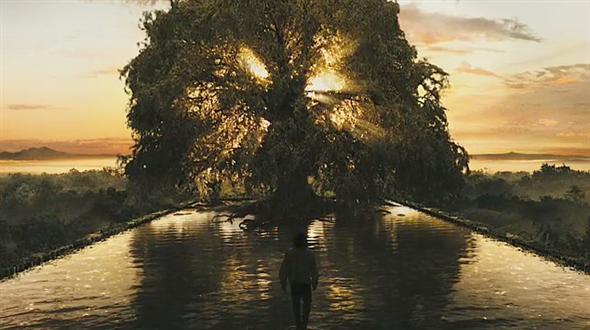
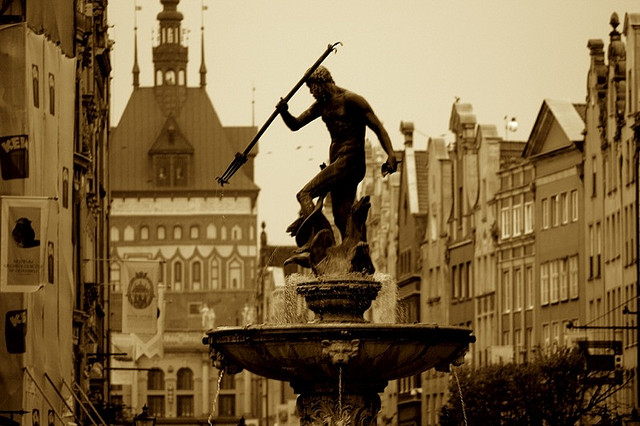
From the Source the seeds of creation are sown upon the material plane. The Source is the symbolic matrix which fecundates the world as we know it. The Fountain is the life force itself. In the movie, the main characters discover the true source of immortality. Carl Jung himself wrote a lot about the symbolism of fountains. He likened the Fountain to the Soul as the source of spiritual life and energy.

Hieronymus Bosch, Garden of Earthly Delight, Fountain (detail)
It is fascinating that, as life was leaving her body and cancer was spreading, Izzy found her inner Fountain of fecundity and creativity, and wrote a beautiful book. She seemed to have become whole right before she passed away, as this wonderful dialogue from the movie attests:
Izzi: Remember Moses Morales?
Tom Verde: Who?
Izzi: The Mayan guide I told you about.
Tom Verde: From your trip.
Izzi: Yeah. The last night I was with him, he told me about his father, who had died. Well Moses wouldn’t believe it.
Tom Verde: Izzi…
Izzi: [embraces Tom] No, no. Listen, listen. He said that if they dug his father’s body up, it would be gone. They planted a seed over his grave. The seed became a tree. Moses said his father became a part of that tree. He grew into the wood, into the bloom. And when a sparrow ate the tree’s fruit, his father flew with the birds. He said… death was his father’s road to awe. That’s what he called it. The road to awe. Now, I’ve been trying to write the last chapter and I haven’t been able to get that out of my head!
Tom Verde: Why are you telling me this?
Izzi: I’m not afraid any more, Tommy.

Tommy and Izzy spotting Xibalba
Once again Cirlot speaks about the symbol of the Tree most eloquently:
In its most general sense, the symbolism of the tree denotes the life of the cosmos: its consistence, growth, proliferation, generative and regenerative processes. It stands for inexhaustible life, and is therefore equivalent to a symbol of immortality. According to Eliade, the concept of ‘life without death’ stands, ontologically speaking, for ‘absolute reality’ and, consequently, the tree becomes a symbol of this absolute reality, that is, of the centre of the world.
The Tree of Life from the 16th-century part becomes a cosmic tree in the futuristic part of the movie. Tom takes the tree with him from the earth into space; the upward movement signifying him reaching higher understanding and release. In the final scene of the movie the cosmic tree is bathed in the golden light. You might remember there were two trees in the Biblical paradise: one was the Tree of Knowledge of Good and Evil, the other the Tree of Life; the latter being well hidden and almost impossible to find. I love how the film explores this perennial myth of immortality and of the mysterious dualism of Life and Knowledge.

The movie’s cosmic tree
The ring, which keeps appearing in many scenes, is symbolic of both the loving connection between the main characters, of their souls reincarnating throughout the ages, and also of their wholeness and connection with the divine Self that they both finally reach but in different time frames. The doctor loses the ring at one point, which is symbolic of him losing the connection with Izzy his anima (soul). He is too focused on fixing and conquering the problem instead of just being with her and accepting of what is happening. It is interesting that Cirlot would note additionally that the ring should be symbolically related to a link of a chain. He does not elaborate on that remark, but the theme of bondage seems to permeate the movie. We are bound to this earth and to matter like Prometheus chained to the rock of Caucasus. The only transcendence we can hope for is through finding a connection with our inner Fountain. As an aside, I just had an illumination that the elusive symbolism of the ring in Tolkien is closely related to the bondage of our passions (Jung’s inferno of passions), fears, anxieties and all else that is related to the life of the flesh. And finally the Book that Izzi creates is a powerful testimony that out of physical frailty and transience arise infinite achievements of the human spirit.

Support my blog
If you appreciate my writing, consider donating and make my day. Thank you in advance.
$1.00