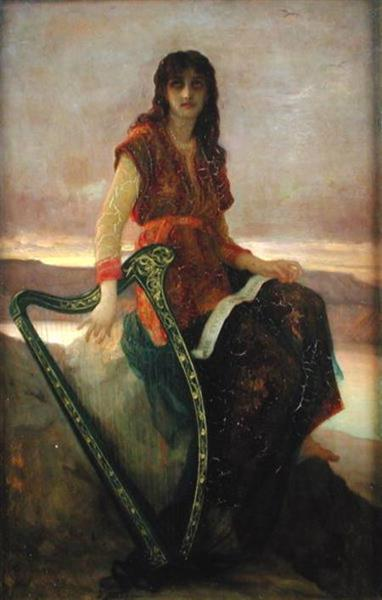
I have not written for a long time because my journey to Ireland in February left me with an experience so profound that I have been trying to come to terms with it ever since. Slowly, I feel myself emerging from that silence, ready at last to begin telling the story. Perhaps it is fitting that I should begin with the harp, Ireland’s national symbol: an instrument whose music gives voice to what words alone cannot express. J. E. Cirlot had this to say about the symbolism of the harp in his Dictionary of Symbols:
“It acts as a bridge between heaven and earth. This is why, in the Edda, heroes express their desire to have a harp buried with them in their grave, so as to facilitate their access to the other world. . . . It might also be regarded as a symbol of the tension inherent in the strings with its striving towards love and the supernatural world, a situation of stress which crucifies man in every moment of the anguished expectation of his earthly life. This would explain the detail of Bosch’s Garden of Delights, where a human figure hangs crucified on the strings of a harp.”
In order to understand Ireland symbolically, we have to go back to its mythical beginnings, which did not include a harp but there was a poem. In the Lebor Gabála Érenn (Book of Invasions), the Sons of Míl, legendary ancestors of the Gaels (better known now as Celts), are said to have arrived in Ireland on Beltane, 1 May. (1) Landing in the south-west, in what is now County Kerry, their chief poet, Amergin, is the first to set foot on Irish soil. At that moment he recites a poem:
“I am wind on sea
I am ocean wave
I am roar of sea
I am stag of seven tines
I am hawk on cliff
I am shining tear of sun
I am gentle herbs…” (2)
The poem presents the bard not as a detached observer of nature but as someone who participates in, and speaks through, the entire living world.
At that time, according to myth, the Emerald Isle was inhabited by the Túatha Dé Danann, a supernatural race endowed with extraordinary powers. In later tradition, they became associated with Ireland’s ancient megalithic monuments, and were even believed to have built the great passage tombs and burial mounds. After claiming the island and defeating the Túatha Dé Danann (tribe of the goddess Danu), the Gaels travelled towards Tara, the great ceremonial and political centre of ancient Ireland. Along the way to Tara the Gaels encounter Ériu, from whom the name Éire (Ireland) derives.
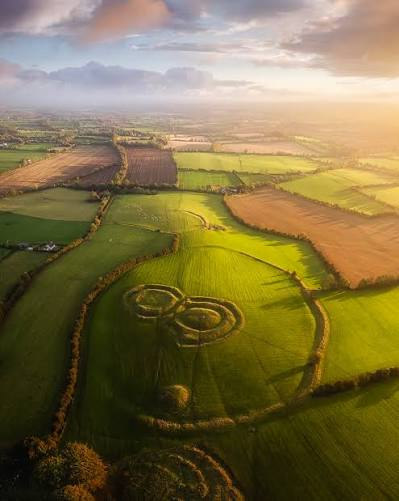
The Hill of Tara (image from Wikipedia)
Túatha Dé Danann retreated into the sídhe, the otherworldly hills and mounds, where they transformed into gods, goddesses and the fairy folk of Irish tradition. This connection between poetry, music and a ceremonial act of claiming the land appears again in the figure of Dagda, one of the principal gods of the Túatha Dé Danann. Often portrayed as a father-like or sovereign figure, the Dagda with his magic cauldron was associated with abundance, wisdom, power and magic, and was also a poet and musician. His harp, called the Uaithne, was no ordinary instrument. In Irish tradition it was enchanted and possessed a will of its own: the Dagda could summon it to him, and the harp could play different kinds of music at his command.
It is important to point out that the pre-Christian Celts of Ireland left no written records of their own. Yet their stories survived through a powerful oral tradition. From the early medieval period onwards, Irish scribes began recording this material in manuscripts. As one author explains,
“These continental Celtic-speaking people did not commit anything to writing. This is certainly not to say they were an ignorant people. By tradition, information was committed to memory and passed on orally.
There are no written records in Ireland before the arrival of Christianity in the fifth century, but there were sophisticated schools of memory where poets, storytellers, and lawyers would memorize what their various disciplines required.
So successful was this method that when writing did arrive in Ireland it merely gave form to the rich culture, which had predated it and in many ways survived for hundreds of years after the arrival of the first Christian missionaries.
The Romans claimed that the Celts were elitists and would not commit anything to writing for fear that the information would become commonplace and available to all.” (3)
Writing in the first century BC, the Greek historian Diodorus Siculus observed of the Gauls that “in conversation they . . . speak in riddles, for the most part hinting of things and leaving a great deal to be understood.” (4)
Thus, what we know about the Irish Celts comes to us largely through Roman accounts, the writings of Irish monks, and the indirect evidence preserved in the archaeological record.
The question who the Celts were has been with me for a long time. I resonated with what Alice Roberts wrote about the Roman attitude to the Celts,
“what it was that had made these pre-Roman Iron Age peoples so alien, foreign and disturbing to those tiresome empire builders with their pen-pushers and their armies of uniformed, identikit soldiers that marched in time, like marionettes.
All across Europe, the Romans left a smoking ruin of the Celtic world. It had been a civilization and a society made of thousands of years of history. The Celts were descended from peoples who had, thousands of years before, made a science out of the study of the night sky, of the cosmos, and, indeed, of their place within it.
They are the first northern European ancestors we know by name – but even the name is a problem. ‘Celts’ was a word used by the Greeks and Romans to refer to the barbarians (as they saw them) of central and western Europe.
They left virtually no written records, but they made stunning art, knew the secrets of metallurgy and had their own myths and religion.
But the Celts had no such empire, nor any central leadership structure or citizenship, nor indeed any consistent cultural signature.
It can be very difficult to get away from that classical view of the Celts as barbarians – it’s very powerful propaganda.” (5)
I have been walking in Celtic footsteps. In Lyon, the ancient Lugdunum, I found myself in a city whose name preserves the memory of Lugh, one of the great figures of Celtic mythology. The Romans compared him to Mercury but he was also the radiant god with a strong solar Apollo-like presence. Lugh was a god of extraordinary versatility, associated with skill, mastery and kingship, and celebrated in Irish tradition as Samildánach – the master of many arts. He was a warrior, but not merely a warrior; his power lay in the ability to excel in many different forms of knowledge and craft.
My adopted country, Switzerland, also has Celtic heritage. Before Roman rule, the Swiss Plateau was inhabited by Celtic-speaking peoples, among them the Helvetii, whose name features in the country’s formal Latin name, Confoederatio Helvetica. On the northern shore of Lake Neuchâtel lies La Tène, an archaeological site whose remarkable Iron Age finds gave their name to a major period of European prehistory, roughly from 450 BC to the first century BC, and to the artistic style we now associate strongly with the ancient Celts. La Tène art is distinguished by its flowing, organic lines, imitating the natural world. As Miranda Aldhouse-Green put it:
“La Tène art employs iconography which endows even the simplest items with symbolism.” (6)
And further:
“Celtic sacral depiction, whether of human, animal or inanimate subjects, frequently exhibits features which transform ‘real’ imagery (that is copied from life) into something deliberately less life-like. This was achieved in a number of ways, but all have the dual effect of removing the image from the world of reality and – in some instances at least – of augmenting its power as a symbol.”
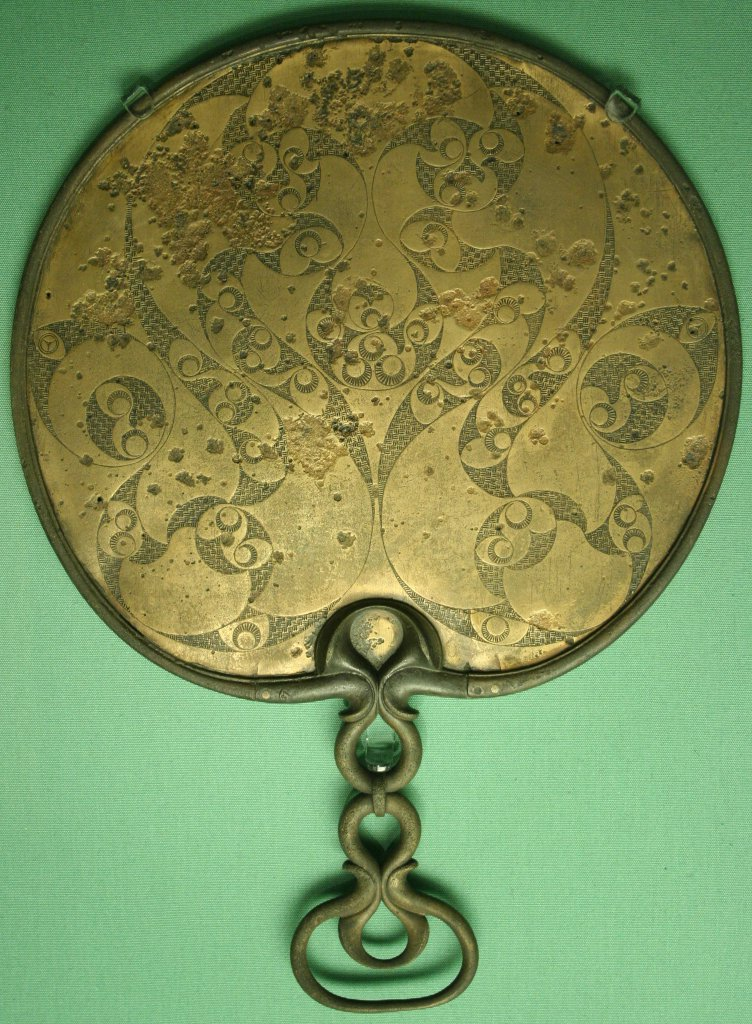
Celtic mirror, England, c. 50 BC
Aldhouse-Green explains the intricacies of that style further:
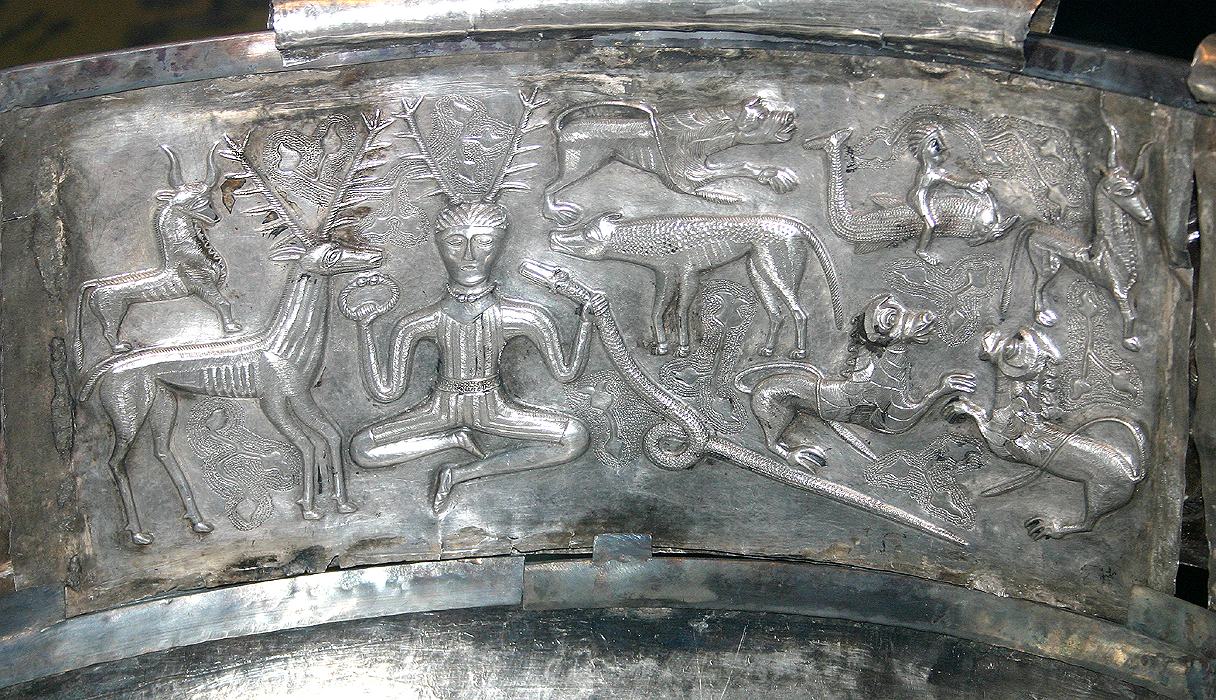
“It may involve exaggeration of one element or, at its most extreme, by the representation of pars pro toto. Enhancement by addition may either be a straightforward multiplication of the whole or part of the image, or it may involve the introduction of a new, alien element or attribute to form a composite depiction.
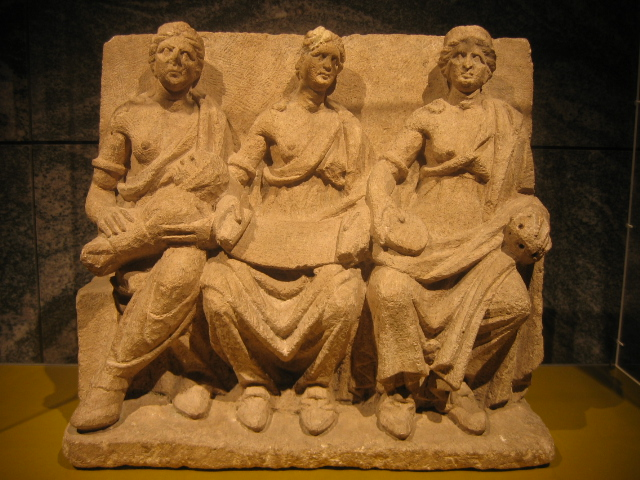
Triplication of Celtic mother-goddesses is an example of the former and ram-horns added to a depiction of a serpent of the latter.
As well as by plurality, emphasis may be created by the exaggeration of an otherwise normal part of an image. This is exemplified most clearly in cases where the head has been enlarged out of proportion (culminating in the representation of the head alone). Conversely, other less important parts of the body may be shrunken to create more (or less) emphasis.”
The antlered man with two ram-headed snakes from the Gundestrup cauldron (late La Tene or early Roman Iron Age), Denmark
Matres de Vertault, France
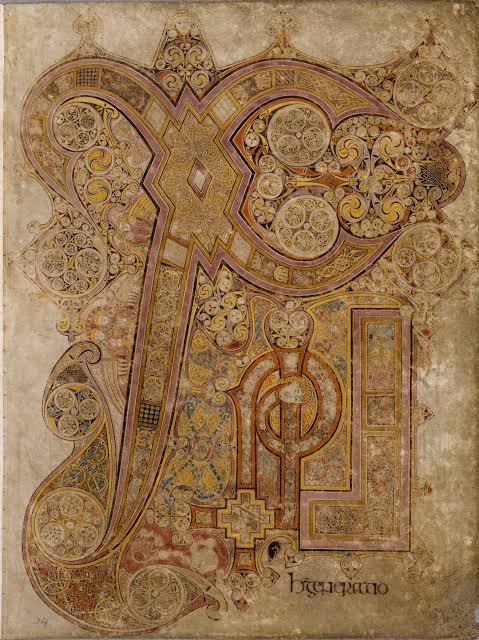
This old Celtic iconography found a new life in Christian Ireland and Britain. The spirals, flowing curves, stylised animals and intricate patterns associated with La Tène and the wider tradition of Celtic art reappeared in the decoration of Christian manuscripts, metalwork and stone crosses. The supreme example of this is the Book of Kells, the magnificent illuminated Gospel manuscript displayed at the Trinity College Library in Dublin. Its pages are alive with spirals, interlacing ribbons, knotted serpents, birds, animals and minute human figures, all woven into elaborate compositions around the sacred text. On the famous Chi-Rho page, where the Greek letters ΧΡ abbreviate Christos, the name of Christ turns into a beautiful ornament.
The Book of Kells
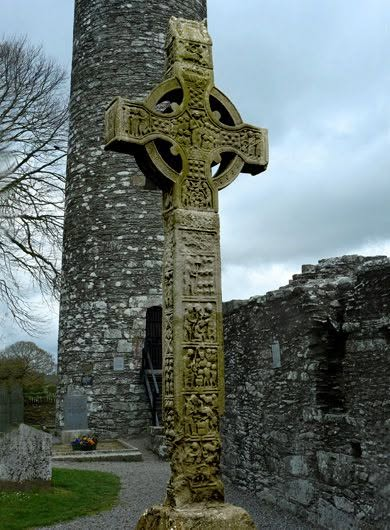
The same synthesis of Christianity and Celtic paganism can be seen in the high (“Celtic”) stone crosses of Ireland and Britain. These monuments combine the Christian cross with elaborate interlace, spirals, geometric patterns and stylised animal forms. Their symbolism is very ancient and profound:
“In the earliest Indian cosmogony, reflected in the Rig Veda about 1500 BC, the cosmic pillar is the mythical axis of the world both separating and uniting heaven and earth. Founded in the waters below the earth, this pillar was the channel through which cosmic order was imposed on the world. When the sun unites with its summit, sun and pillar become a metaphysical unity represented by a wheel above the pillar. This is the cakrastambha or ‘wheel-pillar,’ a carved pillar surmounted by a solar wheel, a relatively common Buddhist symbol.
This formation of pillar and wheel finds an exceptionally interesting and power- ful parallel in the Navan timber post with its superimposed wheel image in the upper cairn. The wet foundations of the pillar may be important too, for the Indian evidence indicates that the presence of water was a necessary element in the foundation of votive pillars, whether of wood or stone.
… The great pillar united heaven, earth and netherworld.
…
Like the adoption of the circular enclosure, the cosmic symbolism of the wheel-pillar was fully understood and readily absorbed by early Christians in these islands and replicated in the circular head of the high cross. After all, the axis mundi, in the form of both the Tree of Life and the Tree of Knowledge, was a central feature of the Garden of Eden…” (7)
Muiredach’s Cross at Monasterboice, Louth in Ireland
But perhaps at the heart of the Celtic mystery stand the Druids. Miranda Aldhouse-Green is the author of Rethinking the Ancient Druids and an expert on the subject. She speaks of Druids as a group whose identity remained in the shadow, though their power was without question. Julius Caesar saw them as “sophisticated philosophers, scientists, time lords, keepers of memory and curators of tradition.” (8) They were shamans, whose influence extended to the times long after Christianity was established. One piece of evidence is an underground Celtic shrine discovered in Chartres. The name Chartres comes from the Celtic tribes of Carnutes, who presided over an important annual high assembly of the druids in that area. During the later Middle Ages, a tradition developed that the druids of Chartres had worshipped a statue of a woman who would give birth to a son. This all serves to show a spiritual continuity between paganism and early Christianity.
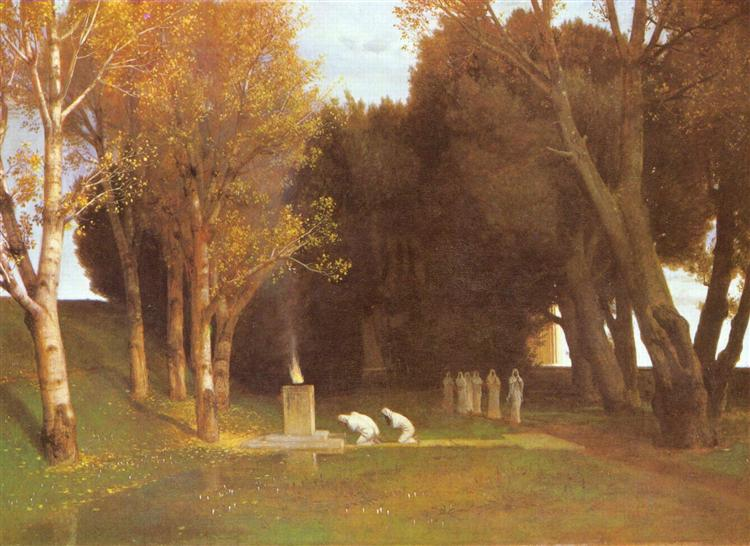
Arnold Böcklin, The Sacred Grove
The word druid is supposedly derived from “oak” though this etymology is not certain. Magan writes in Listen to the Land speak:
“Roman historians from the first century AD, such as Pliny and Publius Cornelius Tacitus, claimed that people who spoke Celtic languages throughout Europe worshipped at groves of trees (mostly oak) that were considered sacred, called nemeta (singular nemeton). The word is connected with the Old Irish nemeid, meaning ‘sacred’ or ‘venerable’, or ‘consecrated place’.” (9)
Aldhouse-Green emphasises that Druids preferred natural sanctuaries, such as sacred groves, to roofed temples. I am reminded of Arnold Böcklin’s Der heilige Hain (The Sacred Grove, 1882), one of the most haunting paintings I have ever seen. For the Celts, natural features of the landscape were, as Aldhouse-Green puts it, “endowed with sanctity”. They would deposit precious votive offerings in lakes and rivers, as well as revere individual trees. This reverence for trees has echoes in modern Ireland, where certain solitary trees, known as fairy trees, are still treated with great respect. Often associated with the sí, which is the supernatural world of Irish folklore, they are sometimes left untouched even when roads or other developments are being planned nearby. (10)
This enduring sense of an enchanted landscape also found expression in the so-called Celtic Revival of the late nineteenth and early twentieth centuries, particularly in the work of W. B. Yeats, whose The Celtic Twilight (1893) drew on Irish folklore, supernatural traditions and the belief that the visible world connects to the Otherworld, where fairies dwell.
As Dennis Gaffin writes,
“. . . the cosmic geography of the various worlds is constructed in such a fashion that fairies and fairy consciousness arise primarily in Ireland and the Celtic lands. The veils, the membranes between the Fairy World and the human world, are thinnest there, where there is more porosity between the physical body, the mind, and spiritual energies and beings.” (11)
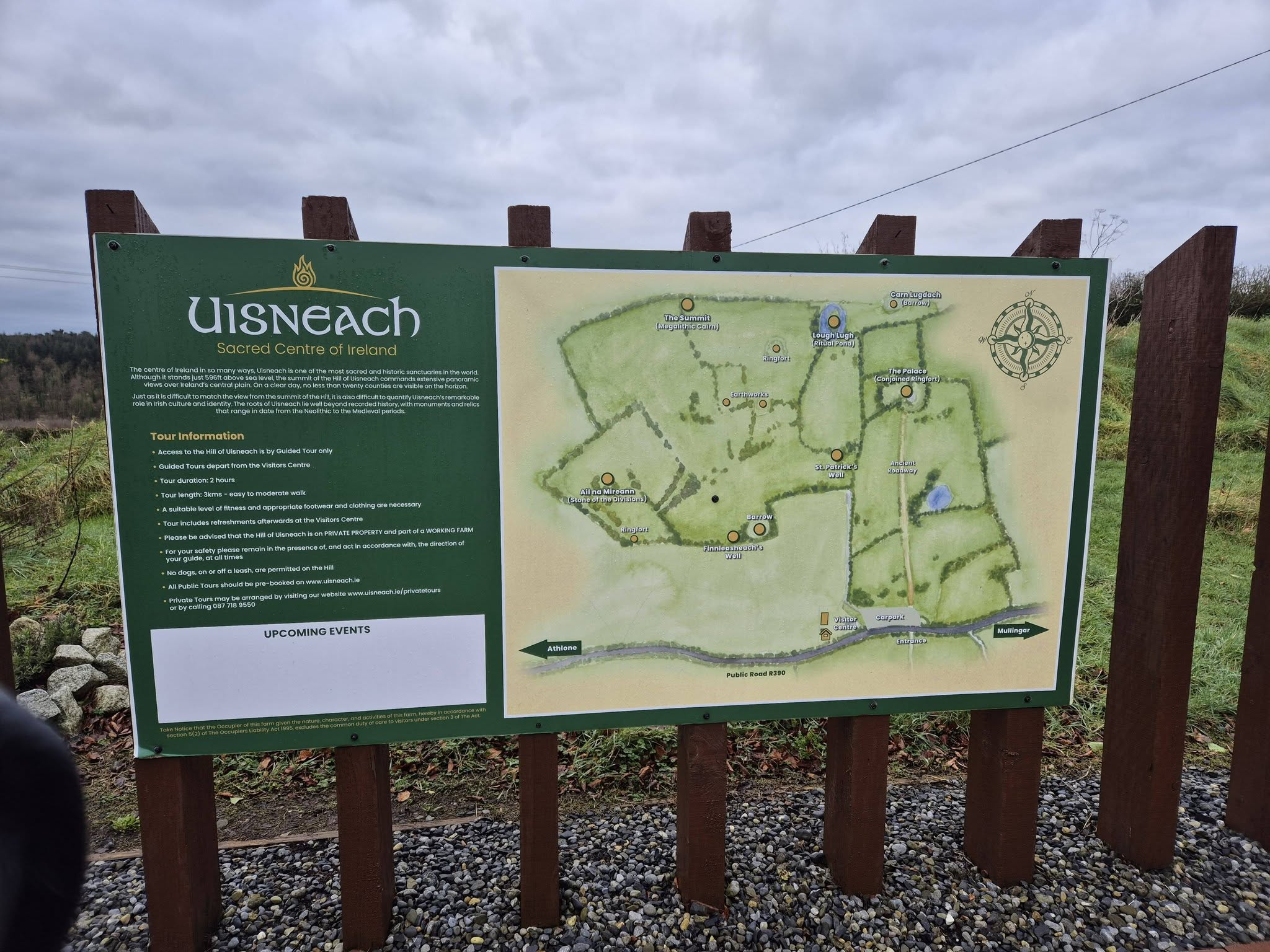
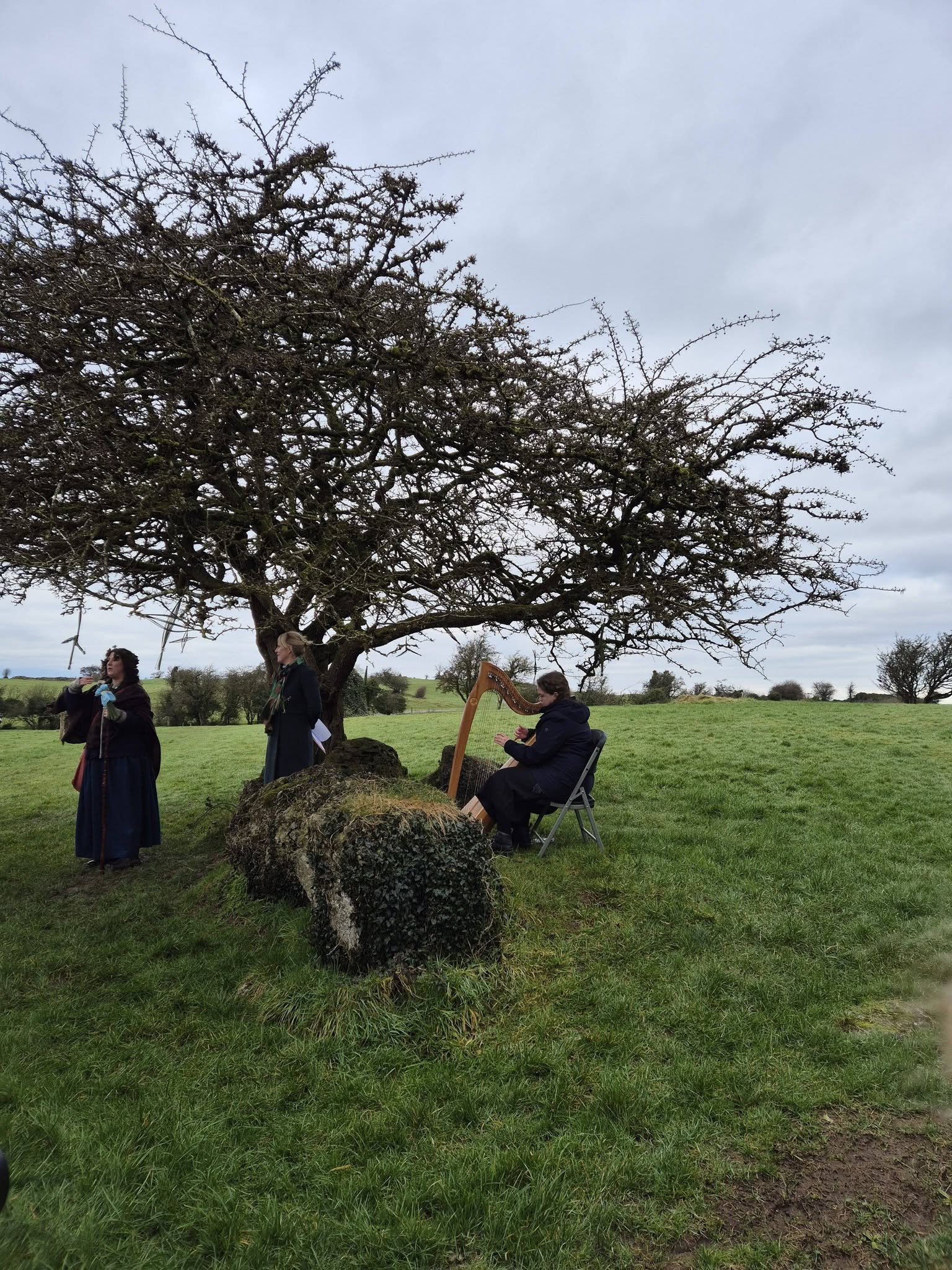
This is a bold and yet compelling observation. I experienced something of this sense of the land’s sacredness in February this year, when I had the opportunity to take part in an Imbolc celebration at Uisneach, described as the sacred centre of Ireland. According to tradition, this was the place where each year the first sacred fire was kindled at Bealtaine. From there, the flame was said to have been carried outwards, with fires being lit across the surrounding landscape. Manchán Magan evokes this intimate relationship between land, memory and myth beautifully in Listen to the Land Speak. Uisneach is also associated with the goddess Ériu, whose resting place is traditionally identified with the Cat Stone, or Aill na Míreann.
Standing on Uisneach Hill at Imbolc, I felt I was touching something of what sacred Irishness might mean: a relationship with the land, its stories and the generations who have inhabited it. Ancient legends were recounted, poems recited, and we gathered around a solitary hawthorn, a tree traditionally associated with the fairies and treated with particular reverence in Irish folklore. We listened to the harp, whose music seemed to belong to the landscape itself.
One of the women shared the story of Brigid, whose feast day, 1 February, coincides with Imbolc. In a well-known Christian legend, Brigid asks the King of Leinster for land on which to build a monastery. He refuses, but agrees to give her as much land as her cloak can cover. Brigid spreads her cloak, which miraculously expands across the surrounding countryside, securing the ground she needs for her religious community at Kildare. The story belongs to the Christian tradition of Saint Brigid, though it resonates with the older figure of the goddess whose name and associations she inherited.
Uisneach remains a low-profile place but its symbolic significance is great. It is not a place firmly established on the tourist map of Ireland. This is perhaps because it really belongs to the Otherworld. This tension between the impulse to map the land and the desire to preserve its mysteries lies at the heart of Maggie O’Farrell’s novel Land, which I have read recently. Set in the nineteenth-century Ireland, during the Ordnance Survey’s systematic mapping of the country under British rule, the novel follows Tomás, an Irish surveyor whose work requires him to measure, classify and record the landscape. In the course of his work, he discovers a secluded place of extraordinary beauty, which he calls “the source”. Faced with the prospect of recording it on the English surveyors’ maps and thereby exposing it to the world beyond, he considers a quiet act of resistance: leaving it unmarked, keeping it hidden. O’Farrell describes the place like this:
“No one, he might venture, had been in this place for a very long time: the moss underfoot was lush and springy, the stones and fallen trees covered with its thick, bright blanket. Ancient stumps cradled the supple growth of saplings, their decaying matter feeding the newer life, the next generation of their particular species. All around him was the sense of growth and renewal and the teeming circularity of life; he fancied he could almost hear the roots drawing up moisture and nutrients from the soil, the dissolved leaf-fall, the decaying fallen trunks, the many streams.
He would have to come back, he decided, as he bent over the water to cup and lift a mouthful to his lips. The taste was startling, in its way, with a sharp, peaty coolness. He swallowed it down, then wiped his chin. He would return tomorrow, with his instruments, for the whole place must be surveyed from scratch, in better light than this, if he was to include it on the new map sheets. What if he didn’t, though, what if he let it be? He was paid to rigorously record and set down every feature of the land, yet he found himself suddenly seized by an urge to break the rules, just for once.”
Perhaps this is why, throughout my time in Ireland, I felt as though I had wandered into the Otherworld itself. The landscape seemed to retain mystery that I rarely encounter elsewhere. I kept thinking of W. B. Yeats and his The Stolen Child, a poem that Loreena McKennitt made famous with her song:
“Come away, O human child! To the waters and the wild With a faery, hand in hand, For the world’s more full of weeping than you can understand.”
With Samain approaching, when the boundary between the human world and the Otherworld was believed to grow thin, such an invitation might seem entirely natural. For the Celts Samain marked the beginning of the new year. They believed that the boundary between the human world and the Otherworld temporarily dissolved, allowing the spirits of the dead to emerge from their burial places and mingle with the living.
If you wish to support my blog via PayPal, you can do so by scrolling to the bottom of this page and clicking on the PayPal button. You can also find a link here https://symbolreader.net/about/ Thank you very much in advance.
Notes:
(1) Carmel McCaffrey and Leo Eaton, In Search of Ancient Ireland: The Origins of the Irish from Neolithic Times to the Coming of the English (Chicago: Ivan R. Dee, 2003), Kindle edition. Also see: https://vimeo.com/317334272
(2) Manchán Magan, Thirty-Two Words for Field: Lost Words of the Irish Landscape (Ithaka, 2024).
(3) Carmel McCaffrey and Leo Eaton, In Search of Ancient Ireland: The Origins of the Irish from Neolithic Times to the Coming of the English (Chicago: Ivan R. Dee, 2003), Kindle edition.
(4) Miranda Aldhouse-Green, The Gods of the Celts (Stroud, UK: Sutton Publishing, 1986), Kindle edition.
(5) Alice Roberts, The Celts: Search for a Civilization (Coventry: Heron Books, 2015), Kindle edition.
(6) Miranda Aldhouse-Green, The Gods of the Celts (Stroud, UK: Sutton Publishing, 1986), Kindle edition.
(7) John Waddell, Pagan Ireland: Ritual and Belief in Another World (Dublin: Wordwell, 2023).
(8) Miranda Aldhouse-Green, Rethinking the Ancient Druids: An Archaeological Perspective (Cardiff: University of Wales Press, 2021).
(9) Manchán Magan, Listen to the Land Speak: A Journey into the Wisdom of What Lies Beneath Us (Dublin: Gill Books, 2022).
(11) Dennis Gaffin, Running with the Fairies: Towards a Transpersonal Anthropology of Religion (Newcastle upon Tyne: Cambridge Scholars Publishing, 2012).