The Jupiter and Uranus Cycle

This writing is permeated with fiery energy urging to open the gates of our consciousness so that caravans loaded with spiritual gifts from the farther lands may enter. Right now this creative energy of fire is very palpable to me.

Posted in Uncategorized | 1 Comment

The River of Alchemical Mercury

yin_yang_by_jhzero-d5x3d0h

via: http://jhzero.deviantart.com/art/Yin-Yang-357915041

“You all know what mercury looks like-at room temperature it’s a silvery liquid that flows, it’s like a mirror. For the alchemists, and this is just a very short exercise in alchemical thinking, for the alchemists mercury was mind itself, in a sense, and by tracing through the steps by which they reached that conclusion you can have a taste of what alchemical thinking was about. Mercury takes the form of its container. If I pour mercury into a cup, it takes the shape of the cup, if I pour it into a test tube, it takes the shape of the test tube. This taking the shape of its container is a quality of mind and yet here it is present in a flowing, silvery metal.

The other thing is, mercury is a reflecting surface. You never see mercury, what you see is the world which surrounds it, which is perfectly reflected in its surface like a moving mirror, you see. And then if you’ve ever, as a child, I mean I have no idea how toxic this process is, but I spent a lot of time as a child hounding my grandfather for his hearing aid batteries which I would then smash with a hammer and get the mercury out and collect it in little bottles and carry it around with me. Well, the wonderful thing about mercury is when you pour it out on a surface and it beads up, then each bead of mercury becomes a little microcosm of the world. And yet the mercury flows back together into a unity. Well, as a child I had not yet imbibed the assumptions and the ontology of science. I was functioning as an alchemist. For me, mercury was this fascinating magical substance onto which I could project the contents of my mind. And a child playing with mercury is an alchemist hard at work, no doubt about it.

… I remember Al Wong once said to me, we were talking about the yin yang symbol, and he said you know the interesting thing is not the yin or the yang, the interesting thing is the s shaped surface that runs between them. And that s shaped surface is a river of alchemical mercury. Now, where the alchemists saw this river of alchemical mercury is in the boundary between waking and sleeping. There is a place, not quite sleeping, not quite waking, and there flows this river of alchemical mercury where you can project the contents of the unconscious and you can read it back to yourself.”

Terence McKenna, “Lectures on Alchemy“

thebean

“The bean“ in Chicago (via http://kenkenphotoblog.blogspot.ch/2011_04_01_archive.html)

Posted in Mercurius, Quotations | Tagged , , , , , , , , | 27 Comments

Primal Knowledge

“I suddenly realized that … everything actually was all-meaningful, that every symbol and combination of symbols led not hither and yon, not to single examples, experiments, and proofs, but into the center, the mystery and innermost heart of the world, into primal knowledge. Every transition from major to minor in a sonata, every transformation of a myth or a religious cult, every classical or artistic formulation was, I realized in that flashing moment, if seen with a meditative mind, nothing but a direct route into the interior of the cosmic mystery, where in the alternation between inhaling and exhaling, between heaven and earth, between Yin and Yang, holiness is forever being created.”

Hermann Hesse, “The Glass Beads Game“

3973982544_0bc9a81c28_o

Yaroslav Gerzhedovich, “Sphere Landscape” 

http://flickrhivemind.net/User/Yaroslav%20Gerzhedovich


Posted in Quotations | Tagged , , , , , | 21 Comments

Homage to the Unicorn

the-unicorns

Gustave Moreau, “The Unicorns”

 “He dwells in equivocal twilights; and he can stare the sun out of countenance…. Unicorn sings ravishing melodies for those who possess the inner ear of mystics and poets. When angered he echoes the Seven Thunders of the Apocalypse, and we hear of desperate rumours of fire, flood, and disaster. And he haunts those ivory gates of sleep whence come ineffable dreams to mortals…. We must believe in the reality of our Unicorn.”

James Huneker, “Unicorns”

The most magical, luminous and magnificent creature of all: the gentle white unicorn appears to Alice in Through the Looking-Glass:

 “’This is a child!’ Haigha replied eagerly, coming in front of Alice to introduce her, and spreading out both his hands towards her in an Anglo-Saxon attitude. ‘We only found it to-day. It’s as large as life, and twice as natural!’

‘I always thought they were fabulous monsters!’ said the Unicorn. ‘Is it alive?’

‘It can talk,’ said Haigha solemnly.

The Unicorn looked dreamily at Alice, and said ‘Talk, child.’

Alice could not help her lips curling up into a smile as she began: ‘Do you know, I always thought Unicorns were fabulous monsters, too? I never saw one alive before!’

‘Well, now that we have seen each other,’ said the Unicorn, ‘if you’ll believe in me, I’ll believe in you. Is that a bargain?’

‘Yes, if you like,’ said Alice.”

I have been hunting for the elusive meaning of the unicorn for the last two weeks, and, as the legend wants it, the creature once again proved to be impossible to be captured or tamed. Having collected a delightful horn of plenty of all kinds of information on the elusive creature I can say that only one thing is certain: the unicorn continues to enchant me as the most sublime and the most resplendent miracle. Its origins are lost in the mists of the mythical Source: some legends suggest it came from Tibet, others speak of India, still others point to the Mountains of the Moon in Africa. New Age thinkers are convinced the unicorn originated in Atlantis. I shall return to this later.

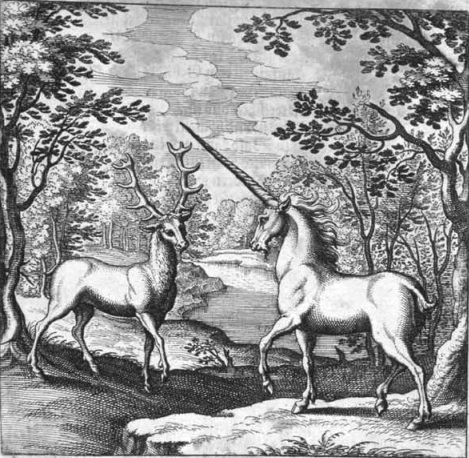
Carl Jung traces the meaning of the unicorn in alchemy. In the 17th century alchemical Book of Lambspring (http://www.alchemywebsite.com/lambsprg.html), we read:

„In the Body [the forest] there is Soul [the deer] and Spirit [the unicorn]…He that knows how to tame and master them by art, and to couple them together, may justly be called a master, for we rightly judge that he has attained the golden flesh.“

DeerUnicorn

Book of Lambspring, Deer and Unicorn

Another animal that the alchemists commonly paired the unicorn with was the lion. For Jung, both animals illustrate “the wild, rampant, masculine, penetrating force of the spiritus mercurialis” (the world-creating spirit) but the unicorn is more spiritual than the lion. Jung also notices that the horn is a dual symbol: “The horn as an emblem of vigour and strength has a masculine character, but at the same time it is a cup, which, as a receptacle, is feminine.” Odell Shepard delved deeper into the connection between the lion and the unicorn by associating the yellow lion with the sun and the luminously white unicorn with the moon:

“That there is some kind of connection between the moon and the unicorn is not a theory but a fact. … The unicorn is commonly, though not always, thought of as white in body; it is an emblem of chastity; it is very swift; according to the best authorities it cannot be taken alive. The animal is most readily associated with the new or crescent moon, which might indeed seem to dwellers by the sea to be leading the stars down to the water and to dip its own horn therein before they descend. The crescent moon has been used for ages to represent both celestial motherhood and virginity, whether of Ishtar, Isis, Artemis, or the Madonna. … The ki-lin, or unicorn of China, is commonly represented in bronze, bearing a crescent moon among clouds on his back.”

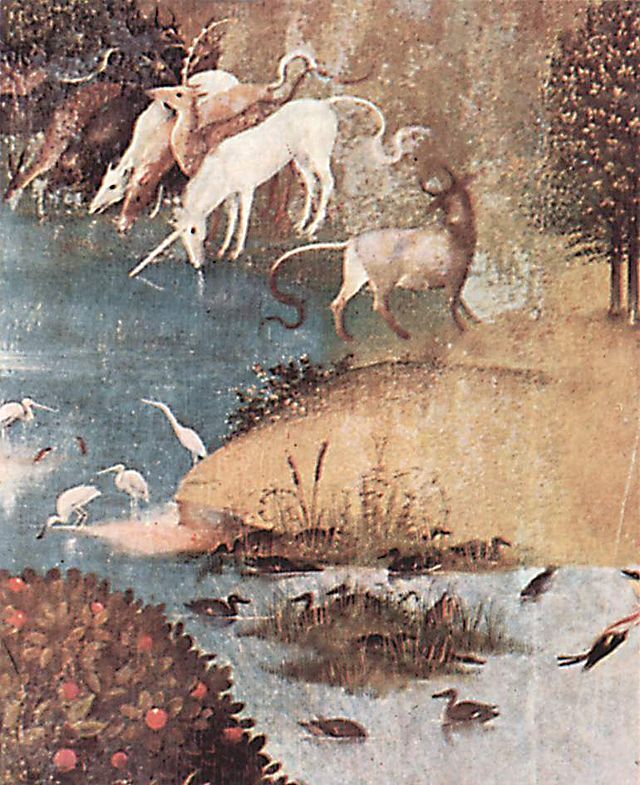
This agrees with the common belief held in medieval and Renaissance Europe that the unicorn’s horn (called the alicorn) had healing properties and could have been used to purify water.

Hieronymus_Bosch_020


Hieronymus Bosch, “Vanity in the Garden of Earthly Delights” (a unicorn purifying water – detail)

Now we must make a slight detour into the Christian imagery of unicorns, which, as it turns out, is not incongruent with the alchemical and pagan symbolism. It all started with the Old Testament, which contains quite a few mysterious references to the unicorn:

“God brought them out of Egypt; he hath as it were the strength of a unicorn.“ (Numbers 23:22)

„His glory is like the firstling of his bullock, and his horns are like the horns of unicorns“’ (Deuteronomy 33:17)

“Will the unicorn be willing to serve thee, or abide by thy crib? Can’st thou bind the unicorn with his band in the furrow?“
 (Job 39:9-12)

“Save me from the lion’s mouth: for thou hast heard me from the horns of the unicorns.“ (Psalms 22:21)

Chris Lavers demystifies unicorn’s presence in the Bible in quite a cruel way, though I still secretly cherish the idea that the unicorn wanted to be in the Bible and made sure it got there. It turns out that the scholars of Alexandria who translated the Old Testament into Hebrew encountered a little lingusitic problem on the way: a horned animal called a reem. None of the translators knew what the reem was, so they translated it into Greek as “monoceros“ – one-horn. Years later, after the Mesopotamian cuneiform texts were deciphered, the mysterious reem that haunted the translators of the Bible reappeared as the rimu; when the Old Testament was being translated, the animal had long been extinct. The rimu was “a large and fearsome, though otherwise ordinary, ox,“ says Lavers but I do not think that the animal that may have measured even two metres at the top of the shoulder and may have been as high as 1.75 metres and which weighed a tonne, was ordinary. Do not forget that this animal was the ancestor of our domestic cattle. Now we fastforward to the Middle Ages, when the fathers of the church were busy proving that the Old Testament must have prophesized the coming of Christ. The eminent Bishop Ambrose of Milan was certain that the unicorn represented the son of God and did everything to prove his point. From then on Christ and Unicorn became one. Round about that time an extremely popular book was Physiologus, which was a Christian bestiary that said this about the Unicorn:

“UNICORNIS the unicorn, which is also called Rhinoceros by the Greeks, is of the following nature. He is a very small animal like a kid, excessively swift, with one horn in the middle of his forehead, and no hunter can catch him. But he can be trapped by the following stratagem. A virgin girl is led to where he lurks, and there she is sent off by herself into the wood. He soon leaps into her lap when he sees her, and embraces her, and hence gets caught. And the lesson: Our Lord Jesus Christ is also a unicorn spiritually, about whom it is said: “And he was beloved like the Son of the unicorns.“

unicorn_tapestry3

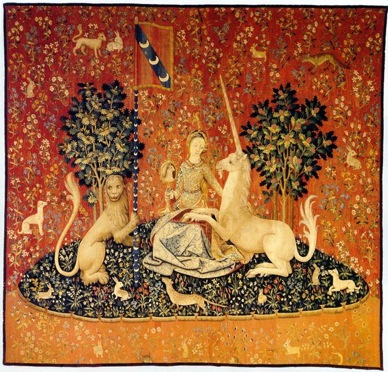
Unicorn Tapestries

This is how the most popular medieval depiction of the Unicorn was born: a tamed creature on a virgin’s lap sitting next to a tree. Now we can let Shepard continue his train of thought regarding the lunar-solar connection between the unicorn and the lion:

“If the unicorn is to represent the moon, then the lion, a common solar emblem, should of course represent the sun, and we have only the tree left to be explained. Trees are involved in several problems concerning the unicorn. Many descriptions of the virgin-capture specify that the maiden must be seated either in a wood or under a tree, and nearly all the mediaeval illuminations place her there.

Professor Otto Wiener has advanced an ingenious theory that in the original form of the story the animal was captured by the tree itself, and in the story now before us the tree does take the place of the virgin as the lion takes that of the huntsman and his dogs. Unicorned animals are often found on Assyrian cylinder-seals grouped with a single conventionalized tree in symbolical arrangement. This tree of the cylinder-seals is usually called the Tree of Fortune, but it seems to be ultimately indistinguishable from the Cosmogonic Tree, the Tree of the World, springing from the nether darkness and holding the earth and heavenly bodies in its branches, familiar in the myths of many peoples but best known to us by the Scandinavian name Yggdrasil. If the lion and unicorn are to represent sun and moon they will need no less a tree than this as the scene of their encounter.

We are now prepared for a bald statement of the solar-lunar theory concerning the lion-capture, and I make it in the words of that theory’s most enthusiastic exponent: “The Lion-sun flies from the rising Unicorn-moon and hides behind the Tree or Grove of the Underworld; the Moon pursues, and, sinking in her turn, is sun-slain.” In other words, just as the lion of our story slips behind the tree to avoid the unicorn’s onrush, so the sun goes behind the Tree of the World, or perhaps into that western grove called the Garden of the Hesperides; and as the unicorn is caught by the horn so the moon is held fast during the interlunar period–at which time, as many myths assert, the sun eats it up.”

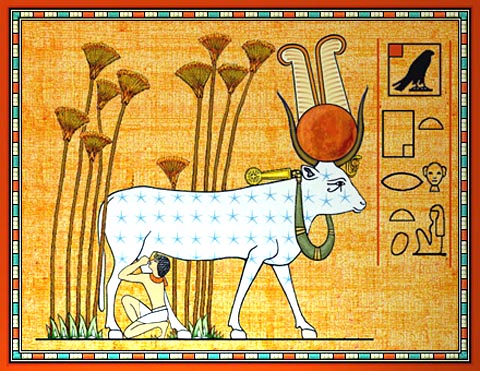
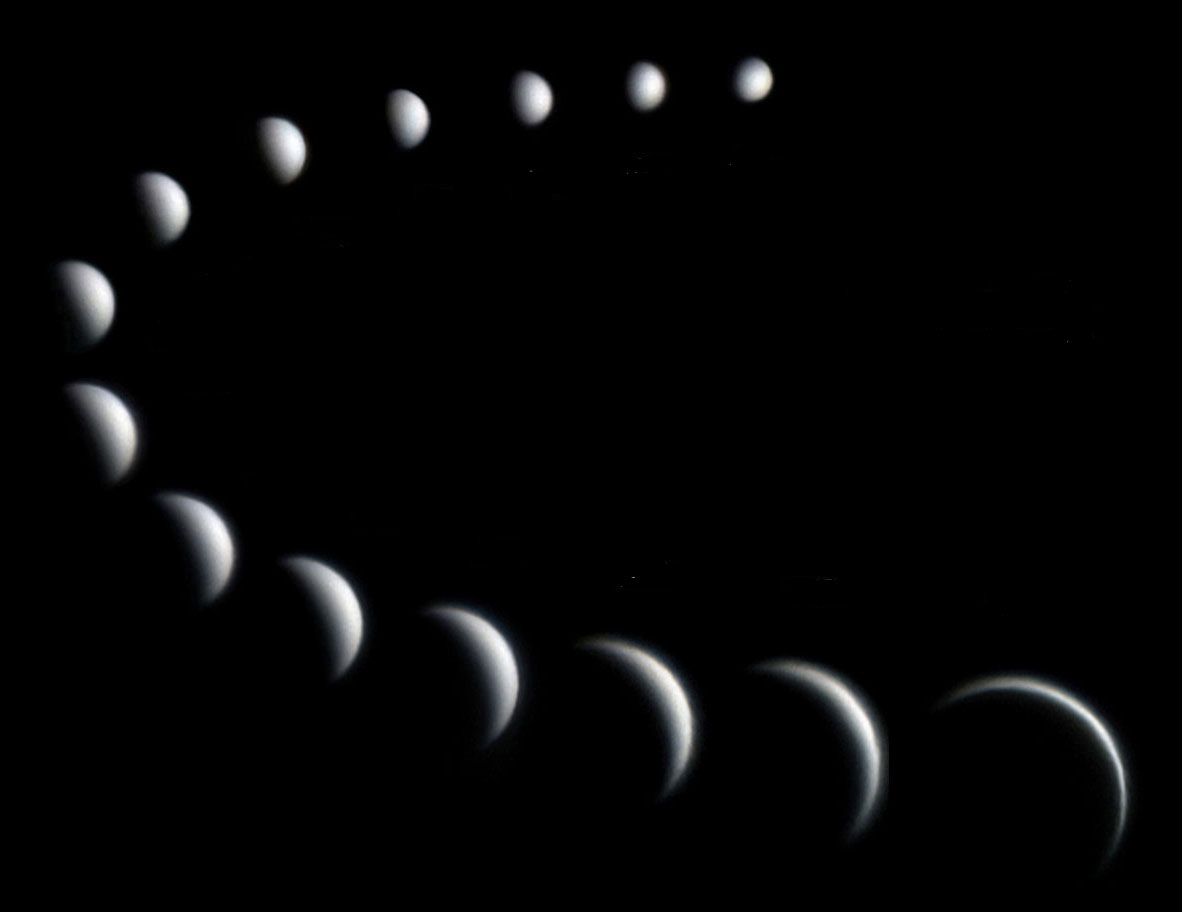
Now, let us consider this theory for a moment. Think of the lunar crescent that has always been associated with the horn in symbolism, think of all the horned goddesses and also of the phases of Venus which give the planet a horned look.

hathor-holy-cow

phases of venus

Phases of Venus

The power of the horns seems to have captivated humans since times immemorial: one horn, a unique horn seems to be an extra powerful emblem of concentrated piercing power and strength. As it protrudes from the forehead, it also inevitably brings to mind the third eye symbolism.

According to the Talmud, the unicorn escaped the flood by being tied to the ark because its body was too large to fit into the vessel. This tale links the unicorn to the pimordial waters but at the same time it stays tied to the hard matter of the ark. It is a liminal creature that possesses transcendental abilities, just like the alchemical mercurius. Odell Shepard points out that in other tales, the unicorn was actually destroyed by the Flood:

“…one would like to toy with the notion that the original home of the unicorn was the Lost Atlantis. Let us consider what may be said for this. Here we have a very ancient and persistent legend concerning a beast that seems to have vanished from the earth. The belief is of long standing that this beast, although as actual as the mammoth or the sabre-tooth tiger, was destroyed by the flood. Now it is generally agreed among Atlanteans that the world-wide tradition of the Flood–which Hebraizers will persist in calling “Noah’s Flood”–is a racial memory of the submergence of the Atlantic Continent. Most significant are the few but startling evidences that the aborigines of the Western Hemisphere had their own legend of the unicorn, and that they actually used its supposed horn for magical ends. Legends so similar and so peculiar, found in both hemispheres, must have spread East and West from a common distributing centre, and that centre may well have been the vast region that has been covered for at least ten thousand years by the Atlantic waves.”

Even though the unicorn may have perished with the Atlantis, it seems to be enjoying an incredible comeback because its popularity is bigger than ever. It seems that no great fruits of human imagination can possibly ignore the beautiful creature. Its true meaning will always elude us: “Like every other thing or idea that we pursue to the limits of our powers and knowledge he goes forth into mystery,“ says Odell.

unicorn1

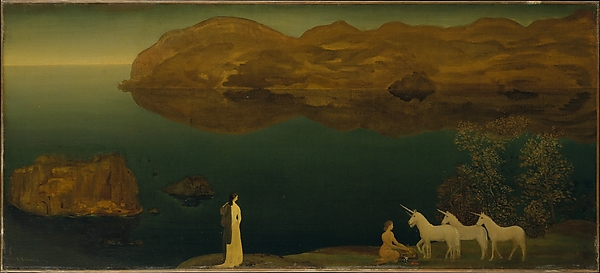
Arthur B. Davies, “Unicorns (Legend – Sea Calm)”

Support my blog

If you appreciate my writing, consider donating and make my day. Thank you in advance.

$1.00

Sources:

James Huneker, Unicorns

C.G. Jung, Psychology and Alchemy

Chris Lavers, The Natural History of Unicorns

Odell Shepard, The Lore of the Unicorn

Posted in The Unicorn | Tagged , , , , , , , , , , , , , , , , , , , , | 37 Comments

Life and Mind and Language

“The incomparable feature of human language is that its magical community with things is immaterial and purely mental, and the symbol of this is sound. The Bible expresses this symbolic fact when it says that God breathes his breath into man: this is at once life and mind and language.”
Walter Benjamin, “On Language as Such and on a Language of Man”

image

image

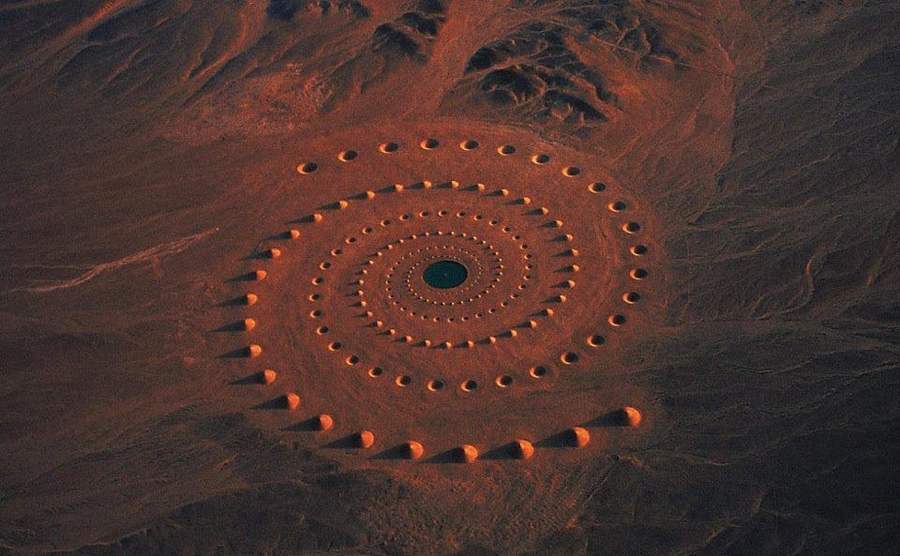
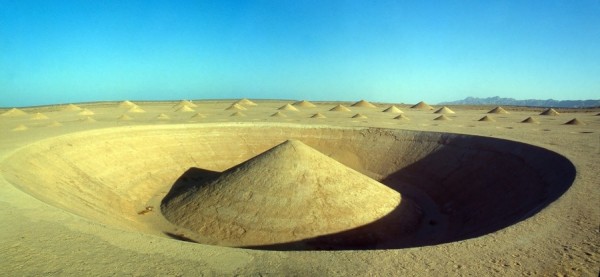
Art: “Desert Breath” by Danae Stratou

Posted in Language, Quotations | Tagged , , , , , , , , , | 24 Comments

1 September

“About Troy“ by Zbigniew Herbert

Troy O Troy
an archeologist
will sift your ashes through his fingers
yet a fire occurred greater than that of the Iliad
for seven strings–

too few strings
one needs a chorus
a sea of laments
and thunder of mountains
rain of stone

–how to lead
people away from the ruins
how to lead
the chorus from poems–

thinks the faultless poet
respectably mute
as a pillar of salt
–The song will escape unharmed
It escaped
with flaming wing
into a pure sky

The moon rises over the ruins
Troy O Troy
The city is silent

The poet struggles with his own shadow
The poet cries like a bird in the void

The moon repeats its landscape
gentle metal in smoldering ash

They walked along ravines of former streets
as if on a red sea of cinders

and wind lifted the red dust
faithfully painted the sunset of the city

They walked along ravines of former streets
they breathed on the frozen dawn in vain

they said: long years will pass
before the first house stands here

they walked along ravines of former streets
they thought they would find some traces

a cripple plays
on a harmonica
about the braids of a willow
about a girl

the poet is silent
rain falls

On 1 September 1939 Poland was vanquished by the Nazi invasion.  Today I looked again at a famous collection of photos taken by Hugo Jaeger, a personal photographer to Hitler, at the very beginning of the German occupation of Poland. What touched me especially is how little the photographed people seem to suspect what disaster and suffering is awaiting them. Those haunting photographs are very hard to look at but also make me ponder on the mercy of peaceful obliviousness for this doomed gallery. We must never forget their faces.

http://life.time.com/history/world-war-ii-color-photos-from-nazi-occupied-poland-1939-1940/#1

Zdzisław-Beksiński-night-creeper

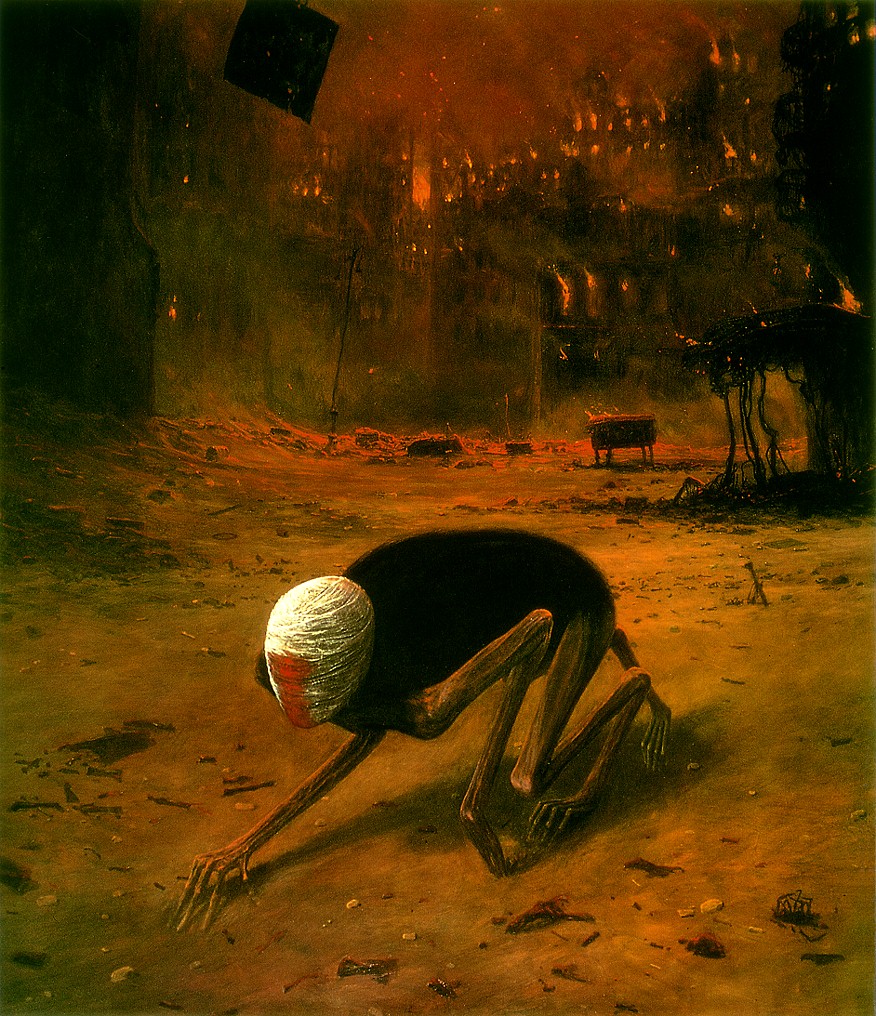
Zdzisław Beksiński, “Night Creeper“

Posted in Krakow | Tagged , , , , , , , | 23 Comments

The All-Seeing Eye

1.“Illumination comes to those who hear the song of Light unchanged, unflickering, eternal — Light that is one though the lamps be many.”

Dane Rudhyar

2.”The eye is the lamp of the body; so then if your eye is clear, your whole body will be full of light.

Mathew 6:22

3.“O father, I have been made steadfast through God; I now see not with the eyes, but by the operation of spiritual energy in the powers. I am in heaven, in earth, in water, in the air; I am in living creatures and plants; I am in the womb, before the womb, after the womb. I am present everywhere.”

The Corpus Hermeticum, Book 13, translated by Clement Salaman

4.“Mere intellectual enlightenment cannot recognize the spiritual. As the sun puts out a fire, so spirit puts out the eyes of mere intellect.”

W. Howitt (quoted after H.P. Blavatsky)

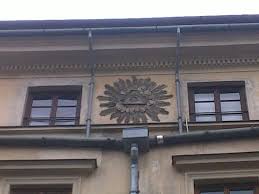
Although in the mainstream view the All-Seeing Eye is quite a compromised symbol nowadays– either bringing to mind a sinister “Illuminati“ elite reigning from the shadows or at best the less and less popular institutionalized religion, I have always felt awe and inspiration toward this particular image. I rarely share personal stories but there is one instance of an All-Seeing Eye sighting I will never forget. I was walking along Szewska street in Krakow with an astrologer friend of mine and sharing some depressing details about my situation back then. Basically, I felt at a dead end and uninspired at that time and I was asking the friend how much longer I would have to endure this predicament. I also joked: “God, please give me a sign now.“ As I looked up at that precise moment I saw an All-Seeing eye on one of the buildings, which took my breath away for a brief moment. This is exactly what I saw:
okoopatrznosci

I experienced the mysterious on that day: I feel that the All-Seeing Eye sent a message to my dormant third eye  that it was time to wake up. A famous painting by Magritte, and one of my favourite works of art, entitled “False Mirror“ forces the viewer to just do that: wake up to the reality that your vision is limited and imperfect.
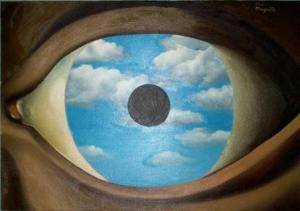
magritte

It may be an invitation to look within and to look at the world differently, with a fresh perspective. It may be time to view the All-Seeing Eye differently also, remembering what Dane Rudhyar wrote:

“ Symbols however may die the death of all memories supplanted by a fresher crop of living experiences at a new level of being. New men call for new symbols. …

It is for us, who have not forgotten that at the birth of all cycles the world belongs to poets and bards bringing new names to a race ecstatic with birthing and confused with the crashing of the old, to read the signatures which the new Ideas, that are God-born, inscribe upon the open book of the world.“

Humanity is experiencing the pangs of birth of a new consciousness and a new vision, which calls for a new understanding of symbols based on an accurate illumination of ancient wisdom. Cirlot, the author of The Dictionary of Symbols that I mostly rely on, stresses then symbolic interrelation between the symbolic eye and the Sun. Plotinus himself wrote this:

“If the eye that adventures the vision be dimmed by vice, impure, or weak, and unable in its cowardly blenching to see the uttermost brightness, then it sees nothing even though another point to what lies plain to sight before it. To any vision must be brought an eye adapted to what is to be seen, and having some likeness to it. Never did eye see the sun unless it had first become sunlike, and never can the soul have vision of the First Beauty unless itself be beautiful.“

The All-Seeing Eye and the sun, at the deepest level, are one. The astrological glyph for the sun looks like an eye:

Sun_astrology

In this powerful image, the dot at the centre of  the circle is “the Point of Emergence, the Creative Source, the Alpha of the great cosmic cycle of existence, the Undying Root, …, the Germ of the Universe,“ says Rudhyar, while the circle is a symbol of “space before any manifestation of existence occurs,“ “a virgin field within the boundaries of which a universe will take place.“ Already for Ancient Egyptians, God was the Eye of the Universe, “ the symbol of the Deity revealing itself in the wisdom of its own creation,” as Madame Blavatsky put it. It is also Blavatsky who emphasizes that the ancients did not believe the Sun to be the real cause of heat and light. What they believed was that the real master of the orchestra was hidden behind the scene and the light from beyond was only transmitted through the Sun to the earth that received it. The Sun was called by the Egyptians the Eye of Re, but also, in Blavatsky’s words, the Eye of Osiris – “the Logos, the First-begotten, or light made manifest to the world, which is the mind and divine intellect of the Concealed.” The hieroglyphic for god Osiris featured an open eye. The etymology of his name has not been firmly established, but Plutarch claimed it meant “many-eyed,” while Wolfhart Westendorf‘s (1987) more recent suggestion has been “she who bears the eye” (information from Wikipedia). Geraldine Pinch illuminates the hidden meaning of the eye for Egyptians when she shares in her book that divine eyes were in fact personified as goddesses because the Egyptian word for “eye,“ – “irt“ – was feminine in gender. The eye of Re was in fact Re’s daughter and protector. Horus, on the other hand, who was the son of Isis and Osiris, was imagined to have had two eyes – continues Pinch – and his right eye was the sun while his left eye was the moon. The complete and healed eye restored to Horus by Thoth after it being mutilated by Set was called Wadjet (Eye of Horus), which is the whole or completed eye. To me it is the symbol that encompasses the whole secret wisdom of Ancient Egypt that I can only revere ad be in awe of.
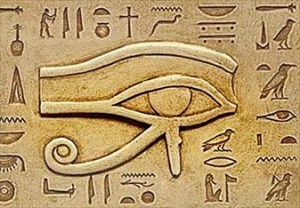
EyeofHorus-glyph

The eye was one of the most crucial and central symbols in Ancient Egypt. In my effort ot understand its significance, I was greatly helped by delving deep into the wisdom of Manly P. Hall, who got me acquainted with a brilliant 16th century Paracelsian physician, one Robert Fludd, according to whom the sun has three distinct properties: life, light and heat.

Fludd-SublimeSun(744x721)

Hall says: “In all probability, Osiris represents the third, or material, aspect of solar activity, which by its beneficent influences vitalizes and enlivens the flora and fauna of the earth. Osiris is not the sun, but the sun is symbolic of the vital principle of Nature, which the ancients knew as Osiris.“ While Re represents pure light of the spirit, Osiris is the body of the sun god on the earth.

Osiris_and_Atum_seated_with_Offerings

Osiris and Re-Atum

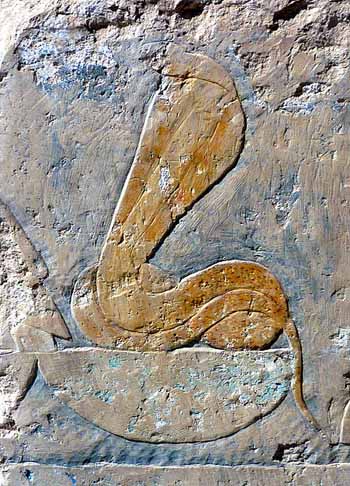
Every night Re descended into the underworld to unite with Osiris in the underworld. Isis, the consort of Osiris and his lunar lover, gave him a son – Horus,  whose both eyes bring together the wisdom of the Spirit and the wisdom of the Soul, the wisdom of the sun and the wisdom of the moon, the wisdom of the god and the wisdom of the goddess. The name Wadjet means “the green one,“ which strengthens her healing and revitalizing properties. Wadjet was also the protective cobra goddess wrapped around the solar disk of Re. She was yet another symbol of the power of the risen Kundalini energy in ancient Egypt.

WadjetHatshepsut1

Wadjet at Luxor

I started by talking about the activation of my pineal gland that occurred when I saw that image of the All-Seeing Eye in Krakow. In astrology, as Rudhyar points out, the pineal gland is ruled by the Moon: it is like a cup ready to receive the living waters and the light of the descending spirit. I think the secret of spiritual awakening lies in the integration of the energies symbolized by the Eye of Horus. Gary Lachman has been on a quest for Hermes Trismegistus, which helped him reveal a lot of lost ancient wisdom that he shared in his book. He associates opening of the third eye with “the reawakening of an ancient spiritual vision” that has been forgotten in modern times marked by the descent into the world of matter and a loss of consciousness. The older forms of consciousness are hidden in the “old brain” that “the new (cortical) brain” should observe and analyze and subsequently bring to our modern awareness. Lachman includes a quote from Mavromatis illuminating the symbolism of the caduceus:

alex-grey

Alex Grey, “Caduceus”

“In the West, this latter level is often represented by the god Hermes’ scepter, the caduceus, depicting two snakes entwined around a central rod which culminates in a small sphere or cone flanked by two wings … It is worth noting that the snakes represent the two supposedly opposite sides of man, whereas the sphere or cone stands for the unity of consciousness. The two wing sprouting from the sphere are both higher representations of the two sides of man and the symbols of completion and of liberation of consciousness: they are the two cerebral hemispheres flanking, and practically encasing, the pineal gland.”

Interestingly, both the staff of Hermes (the caduceus) and the staff of Osiris feature the pine cone symbol standing for the pineal gland and the third eye.

Cone03

Staff of Osiris

The pineal gland, our inner “organ of consciousness,” is linked to the body’s perception of light and to our wake-sleep patterns. It is where the healing energy passes through when it rises in the body. Isn’t it curious that the largest pine cone statue in the world is placed in the Vatican in the famous Court of the Pine Cone?

Pine-Cone-Symbolism-Pigna

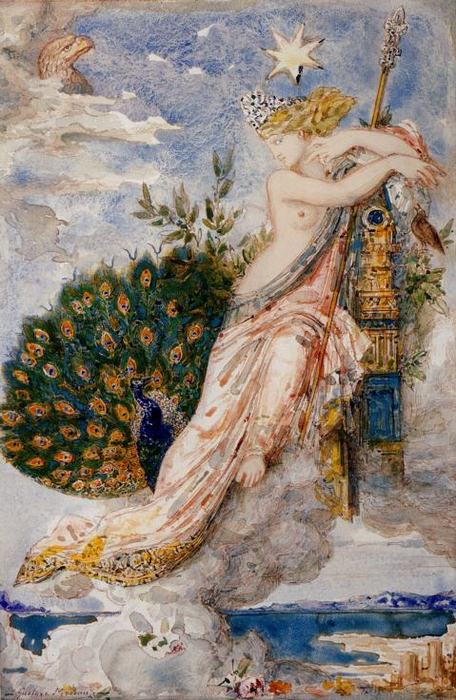
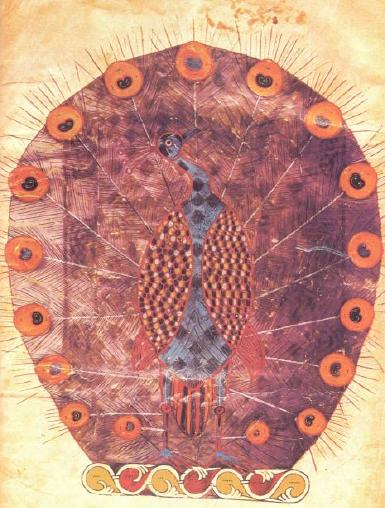
There, the pine cone is flanked by none other than two peacocks. In Rome, the peacock was the bird of Juno and symbolized, according to Barbara G. Walker, the many coloured veils of the goddess and the manifested world as well as the Goddess’ watchfulness and omnipresence. It also meant that the single eye of the spirit, i.e the celestial God Jove, is united with Juno, his divine consort presiding over the multitude and diversity of the manifested forms. In alchemy, the peacock’s tail (cauda pavonis) stood for a wondrous display of colours and visions bringing about mystical awareness of the dreamlike nature of existence born out of blackness and despair experienced in the phase of Putrefaction.


juno

Gustave Moreau, “The Peacock Complaining to Juno”

ALKPeacock

Alchemical Peacock

The painting by Magritte mentioned in the first part showcases beautifully the mystery of the pupil of the eye. Roberto Calasso’s quote is one I want to close my thoughts with for today:

“…the pupil, as Socrates says to Alcibiades, ‘is the finest part of the eye,‘ not just because it is ‘the part which sees‘ but because it is the place where another person looking will find ‘the image of himself looking.‘ And if, as Socrates claims, the Delphic maxim ‘Know thyself‘ can be understood only if translated as ‘Look at thyself,‘ then the pupil becomes the sole means of self-knowledge . . .“

Sources:

Alchemy: http://azothalchemy.org/azoth_ritual.htm

H.P Blavatsky, Isis Unveiled

Roberto Calasso, The Marriage of Cadmus and Harmony

Gary Lachman, The Quest for Hermes Trismegistus from Ancient Egypt to the Modern World

Geraldine Pinch, Handbook of Egyptian Mythology

Plotinus, The Enneades, http://www.sacred-texts.com/cla/plotenn/enn069.htm

Dane Rudhyar, “New Mansions for New Men: A Spiritual Interpretation of Astrology in the Light of Universal Symbolism.“ http://khaldea.com/rudhyar/nmnm/

Dane Rudhyar, “The Planets and Their Symbols“ http://www.khaldea.com/rudhyar/astroarticles/planetssymbols_1.shtml

Clement Salaman, Dorine van Oyen, William D. Wharton, Jean-Pierre Mahe, The Way of Hermes: New Translations of the Corpus Hermeticum and the Definitions of Hermes Trismegistus to Asclepius

Barbara G. Walker, The Women’s Encyclopedia of Myths and Secrets

Posted in The All-Seeing Eye | Tagged , , , , , , , , , , , , , , , , , , , , , , , , , , , , , , , , , | 34 Comments

Like a Night Bird

owl1

Utagawa Hiroshige, “Small Horned Owl on a Maple Branch under Full Moon”

“The human heart is like a night bird. Silently waiting for something, and when the time comes, it flies straight toward it.”

Hatuki Murakami, “Colourless Tsukuru Tazaki and His Years of Pilgrimage”

I have just finished this breathtaking book and need some quiet time to rest in it, absorb its beauty, and then I hope to write more about it.

Posted in Quotations | Tagged , , , , , , , , | 10 Comments

“The Goddess“ by Denise Levertov

640px-Paul_Gauguin_-_Te_aa_no_areois_-_Google_Art_Project

Paul Gauguin, “The Seed of the Areoi”


THE GODDESS, by Denise Levertov

“She in whose lip service
I passed my time,
whose name I knew, but not her face,
came upon me where I lay in Lie Castle!

Flung me across the room, and
room after room (hitting the wall, re-
bounding—to the last
sticky wall—wrenching away from it
pulled hair out!)
till I lay
outside the outer walls!

There in cold air
lying still where her hand had thrown me,
I tasted the mud that splattered my lips:
the seeds of a forest were in it,
asleep and growing! I tasted
her power!

The silence was answering my silence,
a forest was pushing itself
out of sleep between my submerged fingers.
I bit on a seed and it spoke on my tongue
of day that shone already among the stars
in the water-mirror of low ground,

and a wind rising ruffled the lights:
she passed near me in returning from the encounter,
she who plucked me from the close rooms,

without whom nothing
flowers, fruits, sleeps in season,
without whom nothing
speaks in its own tongue, but returns
lie for lie!”

Posted in Poetry | Tagged , , , , , , | 12 Comments

The Lightening Message of Grace

514_400x400_Peel

Kanji symbol for cherry blossom

150px-Tilia_johnsoni_01

Linden tree fossil

In his book On the Way to Language (1959), the philosopher Martin Heidegger includes a philosophical dialogue between an “Inquirer“ (I) and a Japanese man (J). This particular exchange really stirred my imagination, though I do not speak or understand Japanese at all:

“I: What is the Japanese word for ‘language‘?

J: (after further hesitation) It is Koto ba.‘

I: And what does that say?

J: ‘ba’ means leaves, including and especially the leaves of a blossom-petals. Think of cherry-blossoms or plum blossoms.

I: And what does ‘Koto say?

J: This is the question most difficult to answer. But it is easier now to attempt an answer because we have ventured to explain ‘Iki: the pure delight of the beckoning stillness. The breath of stillness that makes this beckoning delight come into its own is the reign under which that delight is made to come. But ‘Koto‘ always also names that which in the event gives delight, itself, that which uniquely in each unrepeatable moment comes to radiance in the fullness of its grace.

I: ‘Koto, then, would be the appropriating occurrence of the lightening message of grace

J: Beautifully said!“

I think the passage from Heidegger captures the profound mystery and beauty of the origin of language. Isn’t it is a wonderful coincidence that the Latin word “liber” (book) signifies the inner bark of a tree? I sense a deeper significance to this than just the fact that books are made of paper, which is made from trees. Before papyrus became popular, people used to write on leaves and barks of trees, especially on the bark of the linden tree. The Greek word for linden tree is Philyra, who in Greek myth was mother of Chiron. The gods transformed her into a linden tree because she could not bear looking at her monstrous Centaur son. She was known as the goddess of writing. I see parallels between the birth of Pegasus, the winged horse, patron of poets and the source of their inspiration, and the transformation of Philyra. Philyra mated with Cronus, who came to her in the shape of a stallion and later gave birth to the wise Centaur Chiron; Pegasus sprang out of the monster Medusa’s blood after Perseus slew her. The source of poetry seems to be far from ethereal: it is fleshy, bloody, characterized by paroxysms of passion.

philyra

Saturn and Philyra: the naked goddess, on the right, is holding the head of the god turned into a horse; both are floating among clouds. 1548 Etching, via:http://www.britishmuseum.org/research/collection_online/collection_object_details.aspx?objectId=1404765&partId=1&people=40500&peoA=40500-1-7&page=1

Posted in Language | Tagged , , , , , , , , , , , , , , , , , | 14 Comments