

The story of Psyche and Eros is a tale of soul-making and deep transformation. As Elisabeth Eowyn Nelson, author of Psyche’s Knife, put it: “Just as Psyche’s fate is entwined with Eros, the soul’s fate is always erotic. We work out our fate by discovering what we desire, what we value, and what we would die for.” I like to look at mythical stories as perfect narratives that cannot possibly be improved. I am not able to judge or criticize mythical characters. Nevertheless, in my previous post I was mildly critical of Psyche when I wrote that she was in love with the idea of love rather than the “real” Eros. Actually, Psyche has been mercilessly criticized by many interpreters of the myth as meek, spineless or weak. I’ve got to confess that I adore her childlike tenderness and vulnerability. I am not wired to look for dysfunctions in mythical stories. I simply cannot blame Psyche for being vulnerable and tender-hearted, and I actually love the part of the story where she is staying in Eros’s palace, not allowed to see his face. After all, darkness, containment, privacy, exclusivity and secrecy are very much connected with Eros and erotic love. However, the intimacy shared by Eros and Psyche cannot last: it must be counterbalanced by the light of consciousness. Both characters know that, otherwise Eros would not allow Psyche to receive the visit of her sisters. I had further reflections spurred by Psyche’s stay in the palace of Eros. How does love happen? Perhaps first we fall in love with the image, the archetype of the Beloved, whose divine image is imprinted in our souls. The Beloved that we seek dwells within our own psyches, always. The union that we seek is the desire of our own wholeness and completeness. I feel that when writing about myths we should always have in mind the following words of Jung from The Psychology of the Child Archetype: “Nor for a moment dare we succumb to the illusion that an archetype can be finally explained and disposed of. The most we can do is dream the myth onwards.”
Psyche may have lived a dream life in a dream palace but the story must unfold, the sleeping must wake up. Psyche will have to leave the blissful palatial womb. Her sisters, whose intentions are wicked and dictated by envy, instill doubt in our heroine, acting as the necessary evil that spurs the character towards individuation, like Mephistopheles in Faust. Psyche is not able to see through their wickedness, inexperienced and isolated as she is. At the beginning of her story she strikes me as a beautiful incarnation of the archetype of the divine child. Children are naturally wise but they are often overlooked or patronized, as is Psyche by many of those who interpret her myth. I think it may be interesting to look at this story by viewing Eros as the primordial god and by viewing his beloved Psyche as Life, Soul and the Divine Child that emerges out of the primordial (erotic) chaos. In Essays on a Science of Mythology, Jung wrote: “The child motif represents the pre-conscious, childhood aspect of the collective psyche.” And further: “The child distinguishes itself by deeds which point to the conquest of the dark.” The special phenomenology of the child archetype is quite visible in Psyche’s story. She has an aura of specialness. From the very beginning of her story she is taken under the wing of Nature, which will be even more visible in the impossible tasks that Aphrodite will command her to fulfill. The child archetype and the archetype of the Self are closely connected:
“The child is born out of the womb of the unconscious, begotten out of the depths of human nature, or rather out of living Nature herself. It is a personification of vital forces quite outside the limited range of our conscious mind; … a wholeness which embraces the very depths of Nature. It represents the strongest, the most ineluctable urge in every being, namely the urge to realize itself…. The grandeur and invincibility of the “child” is bound up in Hindu speculation with the nature of the Atman. The latter corresponds to the “smaller than small yet bigger than big” idea. As an individual phenomenon, the self is “smaller than small,” as the equivalent of the cosmos it is “bigger than big.”

The Sun (The Star Tarot deck by Cathy McClelland, via http://www.cathymcclelland.com/enlarge_htm_pages/Tarot/sun.htm)
The concept of Atman is directly connected with Psyche’s story as this word literally means “essence, breath, soul.” Let us continue Psyche’s story, quoting from Psyche’s Knife, as in my last post. Although Eros forbade Psyche to look at him, she decides to approach her lover while he is asleep with a knife (in case he is a monster) and an oil lamp:
“As she approached the sleeper, the light revealed an astonishing sight. Her unknown husband was none other than Eros, the beautiful god of love. … When her eye caught the brace of weapons near the bed, she curiously began to examine them.
Troy Howell, Eros and Psyche
She held up an arrow, tipped with the poison that heats the blood of Eros’s victims. But because she was still trembling at the discovery of the god, she accidentally pricked a finger on one of the sharp points – and passionately fell in love with the god of love. Psyche drank in his extraordinary beauty with even more passion and began to kiss him fervently. Just then, a drop of hot oil leapt from the lamp onto his shoulder and painfully scalded his unblemished skin. Eros awakened, saw Psyche, the lamp, and the knife, and flew out of bed in a rage.
Psyche piteously clung to Eros as he flew above her head, but to no avail. He ignored her tears and pleas and scolded her in bitter words.”
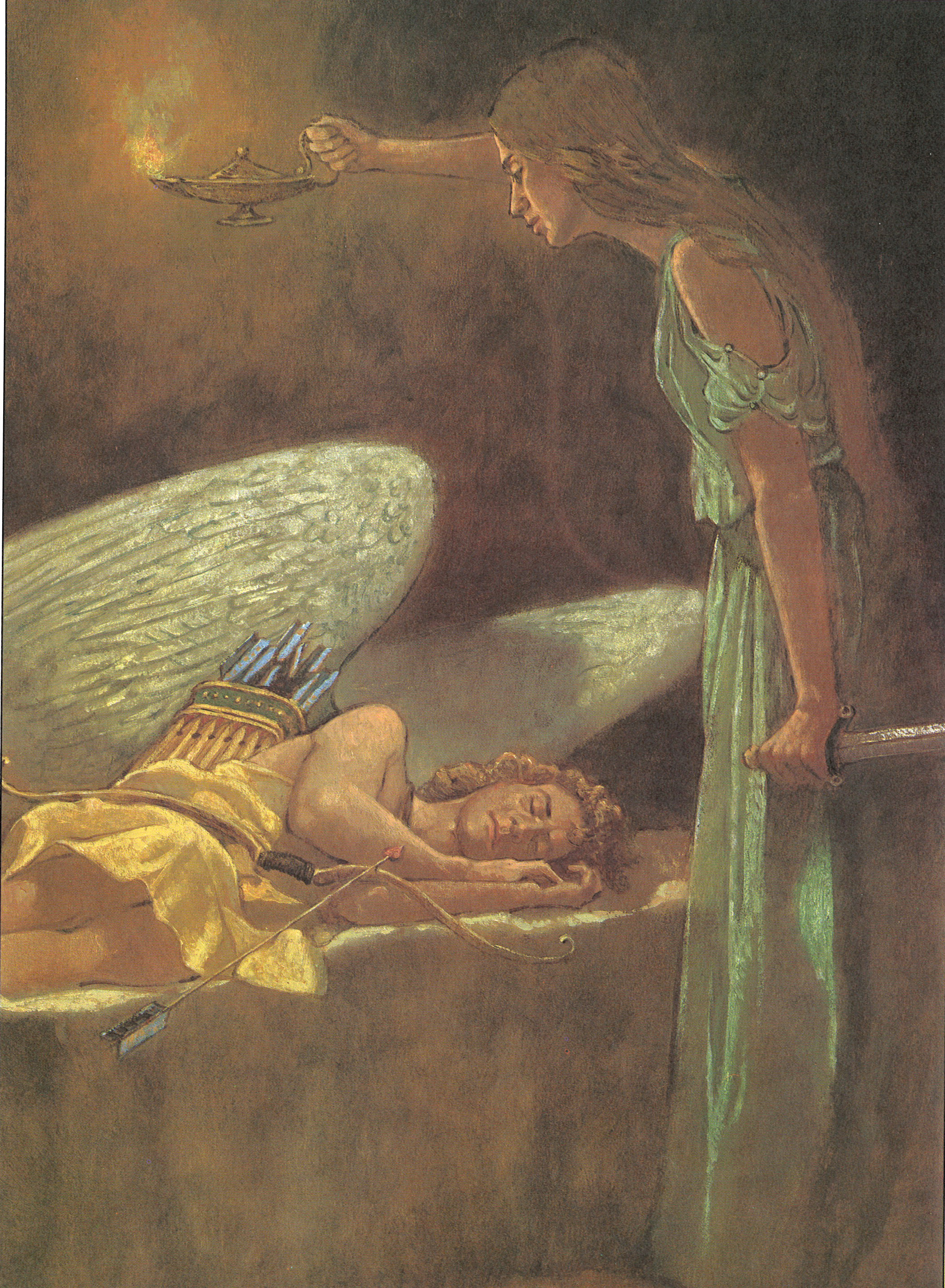
Then he left, and Psyche fell into despair. Eros’s arrow is a reminder of the inevitable suffering that love entails. Psyche awakens to consciousness and she must leave the safety of Eros’s palace: her individuation path is stretching in front of her. The knife she got hold of was necessary as a way to cut through the illusion and confusion of her situation. It can be viewed as a tool of discrimination and separation. It taught her to become more discriminating. In heroic myths, the light and the knife (or the sword) are attributes of masculine heroes used to overcome dragons and other monsters of darkness. But instead of bloody combat Psyche experiences a conscious, love encounter. She encounters her inner divinity by looking at a god. You may remember from my previous post that according to Orphic beliefs nobody could look directly at the face of Eros without going blind: he was the primordial god, the light of the Self. For Psyche, looking at Eros is a moment of epiphany: all her future struggles and ordeals follow from that one mystical moment of revelation.
Psyche’s knife stands for the conflicts, tortures and agonies of love. It stands for the mind’s power of discriminating and prioritizing, and of assessing danger, which at the beginning of the tale Psyche is unable to do. The author of Psyche’s Knife devoted a lot of time to research, and conjectured that Psyche actually wielded a double-headed ax of the Goddess: the weapon common among women of the Minoan culture of the island of Crete. It was “a flat blade with two sharp edges shaped something like butterfly wings attached to a sturdy shaft.” It was the weapon of the Minoan serpent goddess and might have symbolically evoked her transformative power, characteristic both of serpents and butterflies.

Priestessess before the Great Goddess with Double Butterfly Axe, gold ring 1500 BC, via http://rolfgross.dreamhosters.com/The-Stones-of-Greece/2012StonesofGreeceEnglish/Crete/Crete.html
Nelson emphasizes the pain inherent in a butterfly’s transformation: “Literally and figuratively the caterpillar is consumed alive by transformation.” We seldom realize that the pain of the transmutation is grinding and agonizing for the caterpillar. Further, the double ax, as a symbol of wholeness, may also symbolize the simultaneous creation and destruction, the ecstasy of life and death. The knife is also an alchemical tool as it separates and differentiates. Only that which is carefully and neatly separated can be united. The coniunctio reaches its highest expression when the two principles that are to be united are uniquely distinct in the first place.
Related post:





















 symbolreader