
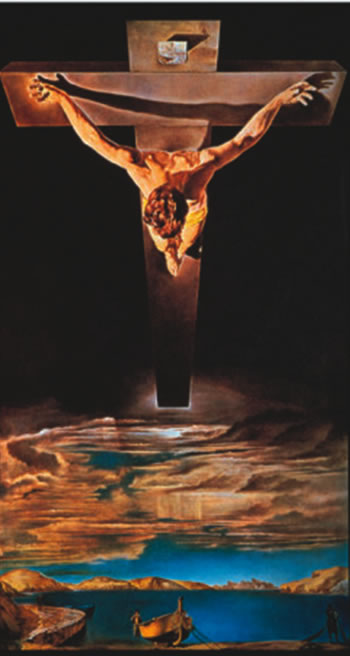
Salvador Dali, Christ of Saint John of the Cross
The symbol of the cross has held a fascination with me for a very long time now. I don’t wear a lot of jewellery but the Celtic cross is something I wear very often. Both the Ankh (juxtaposing the eternal circle with the four arms symbolizing the material plane; an Egyptian symbol of life and fertility) and the Celtic cross hold an evocative power for me.
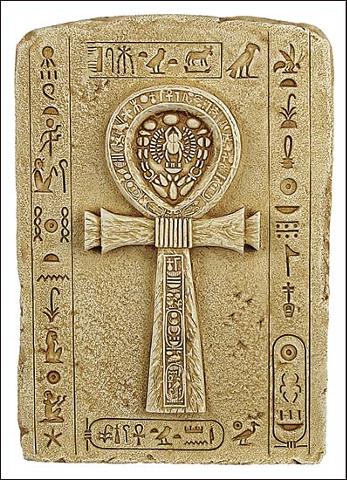
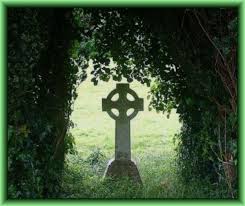
image via http://www.trekearth.com/gallery/Europe/Ireland/South/Kerry/Muckross/photo1258736.htm
I remember seeing Salvador Dali’s painting Christ of Saint John of the Cross for the first time during an Arts lesson at school. It had a tremendous effect on me, which only now I can rationalize. All its elements: the dark sky, a body of water and a fisherman’s boat emanate with a primal archetypal force. It is a crucifixion but it is not an image of physical suffering, at least not with the usual gory display. Apparently, the vision of the painting came to Dali in a dream, in which he was admonished not to present Christ with the crown of thorn or blood. The lighting used in the painting is extraordinary and so is perspective. We view the painting from above, so to speak, which to me emphasizes its eternal quality and shows the significance of Christ’s passion for the whole humanity. Nevertheless, the sea below is not shown from a bird’s eye view, which makes this painting quite unique and surreal, creating a mixed perspective and a feeling of vertigo which I get looking at it. To me the essence of this image is the following: the earthly perspective is juxtaposed with the heavenly one. The transcendent is overlooking the mundane. The mystical dimension pointing towards the earth cannot be ignored; it has urgency about it and affects the viewer on a physiological level, making his or her head spin. The cross in this painting is the axis mundi, the world axis connecting Heaven and Earth. Dali himself wrote:
In the first place, in 1950, I had a ‘cosmic dream’ in which I saw this image in colour and which in my dream represented the ‘nucleus of the atom.’ This nucleus later took on a metaphysical sense; I considered it ‘the very unity of the universe,’ the Christ!
I love reading about the history of the cross symbol throughout the ages. Long before Christianity the symbol of tau (the letter T) was allegedly drawn on foreheads of mystery initiates. The Pagan roots of Christianity are compelling to anybody who just takes a cursory glance at world mythologies. Death and suffering of a god was not invented by Christianity. Tammuz, Orpheus, Osiris, Mithra and other ancient deities also died and some were even resurrected.
What is the synthesis of the meaning of the cross? The Ankh symbol shows how the divine principle (symbolized by the circle) descends to the material plane via the vertical line of the cross. The vertical line is an active principle descending on the passive horizontal plane. The vertical line of the cross symbolizes what is active and positive, the horizontal what is passive and negative. The cross is a very dramatic juxtaposition of opposites, complete opposite to the symbol of uroboros (the divine serpent eating its tail), which shows the dynamic interplay of opposites, the chaos preceding the order of creation. The cross is a symbol of the human drama connected with being incarnated into hard matter, where the opposites create conflict, tension, pain and suffering. It is a symbol of human existence on the material plane here and now.
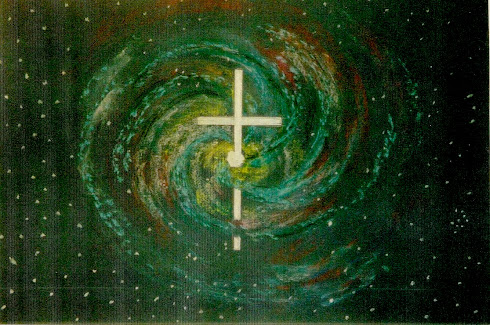
image via http://crossandcosmos.blogspot.ch/







 symbolreader