“Pile of Stone-henge! so proud to hint yet keep Thy secrets, thou that lov’st to stand and hear
The Plain resounding to the whirlwind’s sweep,
Inmate of lonesome Nature’s endless year.”
William Wordsworth’s , “Guilt and sorrow; or incidents upon Salisbury Plain”

By John Constable
Never mind the busy motorway nearby, never mind the throngs of tourists, Stonehenge was a consciousness-shattering experience. The horizontal lintels placed on massive vertical posts looked like portals, which, though ruinous now, are still capable of transporting the mind beyond itself. The Romantics so rightly spoke of the “sublime terror” of the monument; while contemporary authors, such as John North, marvel at its embodiment of spiritual forces. This undeniable sense of awe and wonder is not shrunk by the awareness that we may never know why it was built, and what purpose it served. The scholarly consensus is that it was a place of burial, that the stones were aligned in astronomically significant ways, and that it always attracted great numbers of people, even from most distant places. In an article in the Smithsonian Magazine, Ed Caesar talks to archeologist Vince Gaffney, who compares the experience of Stonehenge to Jerusalem Syndrome, “the feeling of intense emotion experienced by pilgrims on their first sighting of the Holy City.” The eerie, “cathedralesque” monument has always sparked utmost awe and devotion.

The Heel Stone
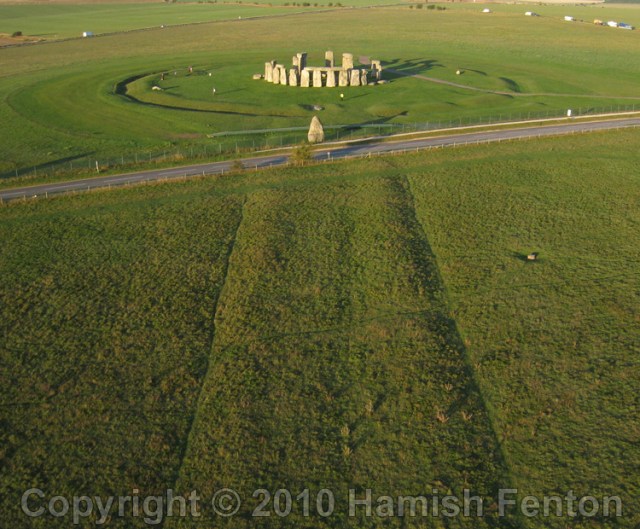
It is perhaps universally known that the so-called Heel Stone aligns with the rising sun on the summer solstice as seen from the stone circle. It is perhaps less known that on the same day the sun rises along the Avenue, a pathway which in present time is cut off from the henge by a road. However, some authors, notably Paul D. Burley, have suggested that there exists a deeper correspondence between the Stonehenge Landscape and the heavens above. His findings have not been scholarly acknowledged; nevertheless, they are worth considering. He sees Stonehenge and an extensive area surrounding it as a ritual landscape, place of healing and domain of ancestors. A similar assumption has also been made by renowned professors and experts on Stonehenge, Tim Darvill and Geoff Wainwright. According to them, people came to Stonehenge to be cured. The so-called blue stones, which are smaller and located in the centre of the monument, were believed to have healing properties. They came from an unbelievable distance of 200 miles and were brought from a mountain in Wales. To this day, it has not been established what methods were used to transport them to the Salisbury Plain.
Burley, however, goes even further and deeper in his claims about the symbolism of Stonehenge, which was built around the same time as the Egyptian pyramids. While I do not share his absolute confidence that lo and behold we have solved the ancient mystery, I found his book worthwhile. Personally, I have no doubt that Stonehenge, equally to the pyramids, holds the key to astounding secrets and truths about the dawn of our civilization. Burley puts forward an intriguing hypothesis of a translocation of the Winter Hexagon, the Milky Way and Orion onto the Stonehenge Landscape. The Winter Hexagon, an egg-shaped asterism, was, as Burley writes, perceived by ancient and indigenous cultures as the source of life – “where life began and where life returns.” Further, Burley sees the Greater Cursus (a long trench-like structure) as representing the Milky Way, or “the pathway for the spirit’s return to its home in the cosmos.” The Avenue, in turn, is supposed to be “the product of translocating the right arm of Orion onto the Stonehenge Landscape.” The arm of Orion receives the body of the dead, welcoming it to the Netherworld. I find the following passages from Burley’s book particularly significant:

The Winter Hexagon
“There is notable difference in shape between the Greater Cursus and the Avenue built centuries later. The cursus appears to be very much inorganic in form, constructed of straight lines and sharp corners, like broken ice, sherds of pottery, flakes from toolmaking, triangles formed by the astral nodes and links of constellations. It is the spirit’s gateway between Earth and sky. Conversely, the Avenue has no sharp corners. It is organic in shape, curved, flowing, getaway to the end of life made manifest.
…
The Greater Cursus is immense. Its size, shape and outline in white … was meant to be seen from above, the cosmos and Creator looking at earth and seeing a reflection of themselves.
…
The Winter Hexagon is where spirits come from, and where spirits return. Upon death the body was interred to Earth, while the spirit took to the spirit path – the Milky Way beginning at Sirius – on its return journey from Earth to the centre of the Winter Hexagon. That is where Orion as the psychopomp Sky King or Queen (perhaps both) waited to welcome the spirit in his right hand.
…
Sunrise occurred in the constellation Cancer during summer solstice morning in 2500 BCE. … if we could see below the horizon at sunrise on summer solstice Orion would appear with right arm raised, pointing directly toward the sun, as if bringing forth the sun into the sky… In this capacity we see why Orion … is called the ‘Bringer of Light.’”

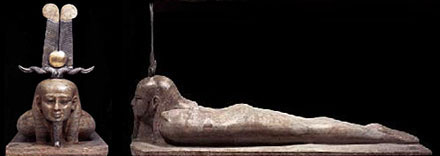
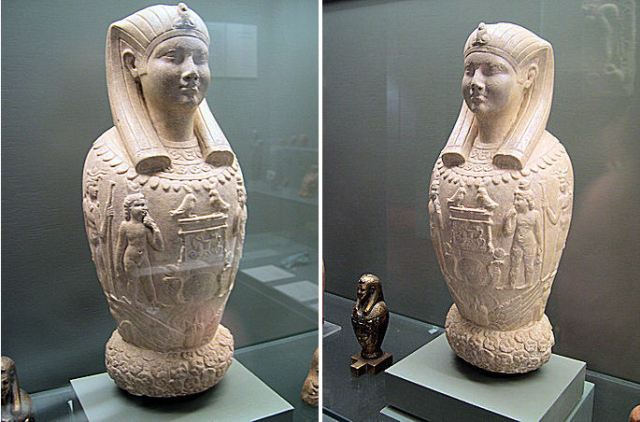
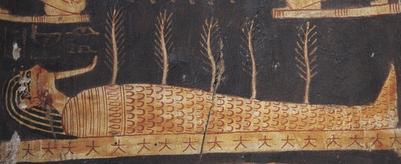
In Greek myth, Orion assaulted Merope and was blinded in revenge by her father. He recovered his eyesight thanks to the rays of the sun god Helius after being guided in the direction of the rising sun. There he fell in love with Eos, goddess of the dawn. For Ancient Egyptians, Orion was a manifestation of Osiris, while Sirius was associated with Isis. Together they brought to life Horus, the New King. Burley sees an analogy between a Late Neolithic festival and the ancient Egyptian myth of death and rebirth. The germinating seed, the zygote, so intimately associated with Osiris and Isis in Ancient Egypt, seems to be a universal symbol, connected across times and cultures to the area of the sky known as the Orion constellation. Says Burley:
“There are cultural traditions which may explain a sacred ritual-based transfer of Orion from sky to Stonehenge. The connection may be associated with a Late Neolithic festival and ritual similar to the Iron Age Celtic Lughnasadh. In ancient Irish mythology Lugh is a hero and a High King. The bright One with the strong hand , related to Latin lux light.
…the beginning of a prototypal two week Lughnasadh celebration ca. 2500 BC coincided with the first appearance (heliacal rising) of Orion, ending with the joining of Orion with Earth at Stonehenge during mid-August. For the people of Salisbury Plain… this intercourse ensuring new life in the following year was between Lugh … and the Earth Goddess.
With appearance of the symbolic king (Lugh as Orion) the people may have begun anticipating consummation of life by the new king and Earth inside the goddess’s enclosure – the womb – the centre of Stonehenge.”
It never ceases to amaze me how consistent religious symbolism is across cultures. Can there be any other explanation than the Jungian collective unconscious churning out symbols from within individual psyches across time and space? And yet, I would like Stonehenge to be free of any reductive explanations. It may be that forcing all kinds of symbolic robes on the bare and primal Stones is an exercise in futility. What if the Stones, like constellations, precede all such attempts? They come from the times before gods were named, when sacred symbols were only emerging. They have that numinous quality so beautifully described by Rudolf Otto:
“…we are dealing with something for which there is only one appropriate expression, mysterium tremendum. . . . The feeling of it may at times come sweeping like a gentle tide pervading the mind with a tranquil mood of deepest worship. It may pass over into a more set and lasting attitude of the soul, continuing, as it were, thrillingly vibrant and resonant, until at last it dies away and the soul resumes its “profane,” non-religious mood of everyday experience. . . . It has its crude, barbaric antecedents and early manifestations, and again it may be developed into something beautiful and pure and glorious. It may become the hushed, trembling, and speechless humility of the creature in the presence of—whom or what? In the presence of that which is a Mystery inexpressible and above all creatures.”
Via https://www.britannica.com/biography/Rudolf-Otto#ref226756
Perhaps all we can do is bow before them in silence.
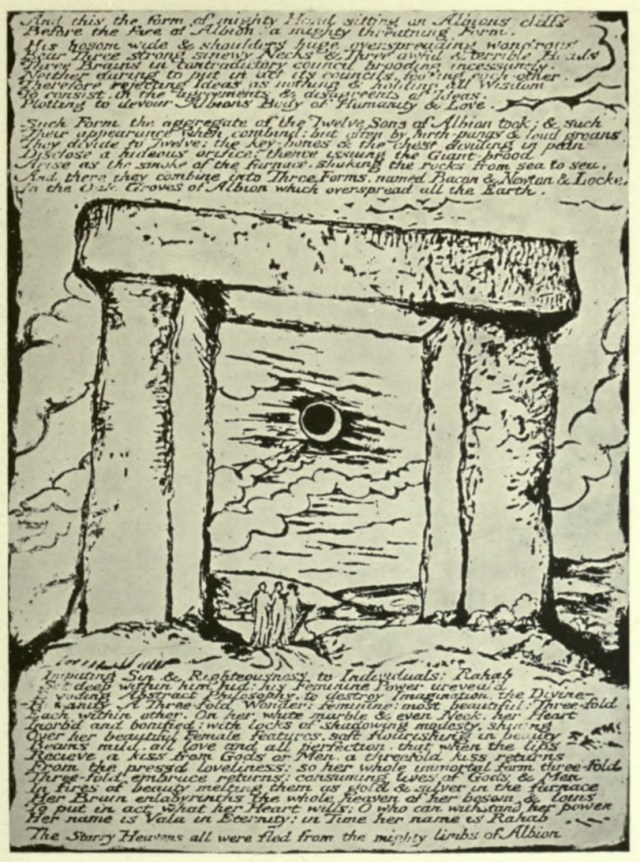
By William Blake
Sources and links:
Paul D. Burley, Stonehenge – As above, so below: Unveiling the Spirit Path on Salisbury Plain, New Generation Publishing 2014
Ed Caesar, “What Lies Benath Stonehenge?”, via http://www.smithsonianmag.com/history/what-lies-beneath-Stonehenge-180952437/
Jesse Harasta, History’s Greatest Mysteries: Stonehenge, Charles Rivera editors, Kindle edition
Jonathan Morris, Stonehenge: Solving the Neolithic Universe, Kindle edition
John North, Stonehenge: Neolithic Man and the Cosmos, Kindle edition
https://www.theguardian.com/science/2008/sep/23/archaeology.heritage
https://www.theguardian.com/uk-news/2017/apr/25/stonehenge-tunnel-desecration-prehistoric-traffic-jams

















 symbolreader