It is entirely conceivable that life’s splendor forever lies in wait about each one of us in all its fulness, but veiled from view, deep down, invisible, far off. It is there, though, not hostile, not reluctant, not deaf. If you summon it by the right word, by its right name, it will come. This is the essence of magic, which does not create but summons.
You do not need to leave your room. Remain sitting at your table and listen. Do not even listen, simply wait, be quiet, still and solitary. The world will freely offer itself to you to be unmasked, it has no choice, it will roll in ecstasy at your feet.
Franz Kafka

FIRST SENTENCE, FIRST LOVE
I have always paid a lot of attention to the first sentences of my favourite novels. I especially like it when the sentence appears to be inspired, complete and you simply cannot imagine a different one as the beginning. Franz Kafka was a master of first sentences. No unnecessary adornments, no attempts to flirt with or dazzle the reader or to be charming – just a brutal throwing into the middle of things. We are somewhere in an existential situation that happened in the past, is happening right now and will be happening in the future. We are in the middle of the existential struggle. The sentences are oddly impersonal, symbolic, archetypal, and, at least in me, they never fail to awake the deepest emotions. Who has not read this one from the Metamorphosis:
As Gregor Samsa awoke one morning from uneasy dreams he found himself transformed in his bed into a gigantic insect.
Or my favourite from The Castle:
It was late evening when K. arrived.
Why I fawn on this, I do not know exactly, but I always do. I think the key is that his writing stirs me to the core and has a transformative quality that few other authors can offer. I also like the air of mystery and the haunting impossibility of interpretation. It is good not to be able to understand it completely. Kafka was not a religious man but one of the famous critics, whose name I do not remember, called him the greatest religious author of the twentieth century. For me his writing is numinous and revelatory; a lot of its meaning is hidden and veiled, as it should be. I have no key to Kafka and I am not looking for it. I would never dream of deconstructing the meaning behind the Castle; I find it quite interesting that both in Polish (my native language) and in German (Kafka wrote in German) the world castle sounds the same (or very similar in the case of German) to the lock. Let that lock be not tampered with.
DO NOT EDIT YOUR SOUL
Admittedly, Kafka’s Diaries are tedious at times, fascinating at some points, very private, very meticulous, very deep. What I value about his fiction, on the other hand, is its condensed brevity, wit, dreamlike quality, deep, multi-faceted symbolism and universality. There are no trivial, unnecessary details, just raw but chiseled perfection. Furthermore, what captured me right from the start was the emotional impact of his writing. He wrote once: “Don’t bend; don’t water it down; don’t try to make it logical; don’t edit your own soul according to the fashion. Rather, follow your most intense obsessions mercilessly.” His writing is indeed merciless – probing very deep like “the axe for the frozen sea within us.” (another celebrated quote of his). Haruki Murakami, a Japanese author I am really fond of, was influenced by Kafka. The following quote from his novel 1q84 struck me as very Kafkaesque:
He had always had something like a clod of frozen dirt stuck in his heart – a hard, cold core he had always lived with. He had never even felt it as cold. For him this was the normal temperature. Even so, Fuka-Eri’s gaze had, if even for a moment, melted that icy core. And it brought on the dull ache. The warmth and the pain came as a pair, and unless he accepted the pain, he wouldn’t feel the warmth. It was a kind of trade-off.
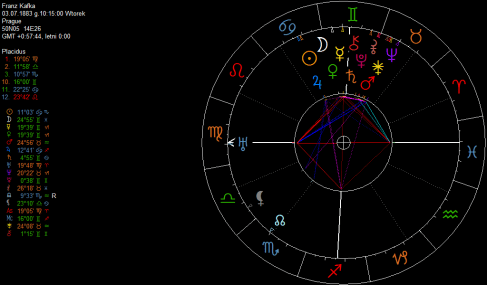
You can see Kafka’s natal chart below. He was a Cancer with a stellium in Gemini. What I found particularly striking was the conjunction of Chiron, Saturn and Pluto in Gemini. With his writing he confronts us with our deepest wounds, limitations and fears. His time of birth is unknown, it is only my intuition which gives him the Virgo Ascendant. I will return to this later.
THE INNER TURMOIL OF THE SECRET RAVEN
His Diaries reveal a deeply troubled soul. Sickly (he died of tuberculosis at the age of 41), dependent on his parents (he described his parental home as a prison erected especially for him, with no visible bars or walls and therefore impossible to escape), afraid of women and his own lustful instincts, forced to work in a dull office job, which robbed him of the precious time for writing, he saw no way out of his inner conflict. In his photograph he looks like some kind of a grotesque elf, his eyes are so desperate and lost; he looks like a being from another planet or dimension. This is one of the most significant quotes from his Diaries:
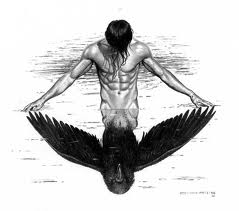
I don’t believe people exist whose inner plight resembles mine; still, it is possible for me to imagine such people but that the secret raven forever flaps about their heads as it does about mine, even to imagine that is impossible.

Raven vs Man, Image via http://mtjforever.deviantart.com/art/Raven-vs-Man-307940612
He did look for help, even in the most unlikely places. In his Diaries, he describes in detail what he said in conversation with the celebrated esotericist, Rudolf Steiner, but characteristically he remains quiet about how the luminary of antroposophy responded:
Aside from my family relationships, I could not live by literature if only, to begin with, because of the slow maturing of my work and its special character; besides, I am prevented also by my health and my character from devoting myself to what is, in the most favourable case, an uncertain life. I have therefore become an official in a social insurance agency. Now these two professions can never be reconciled with one another… The smallest good fortune in on becomes a great misfortune in the other. If I have written something good one evening, I am afire the next day in the office and can bring nothing to completion. … Outwardly, I fulfill my duties satisfactorily in the office, not my inner duties, however, and every unfulfilled inner duty becomes a misfortune that never leaves.
Daryl Sharp, a brilliant Jungian analyst and author, wrote a treatise about Kafka’s individuation under the title Secret Raven: Conflict and Transformation in the Life of Franz Kafka. His analysis of Kafka’s inner life and his interpretation of his dreams have been very inspiring to me. I am going to supplement his observations with some astrological and mythological musings.
Kafka undoubtedly struggled under a neurotic conflict; he was deeply torn and ambivalent about love and work, which, according to Freud, form the cornerstones of our humanness. Six planets in Gemini, including his Moon, means that he was forever fighting his inner twin. I love Liz Greene’s analysis of the myth behind the sign of Gemini. For her the twins reflect the experience of opposites. In the mythical story, Castor is a mortal twin, Polydeucus immortal. Castor gets slain in a battle. Struck by grief, Polydeucus asked Zeus to bring his brother back to life or to allow Polydeucus to sacrifice his own life for that of his brother. Zeus allows the twins to alternate between Hades and Olympus – to go from death and darkness into the pleasures of eternal life and back again. Liz Greene says that this myth portrays “the conflicting experiences of bondage to a mortal body with its sense of loss and death, and exaltation to the realm of spirit and eternal life” (The Astrology of Fate). Geminis are always brought in conflict with what they perceive to be their opposite, but what is in fact their own shadow. Reconciling the warring principles was Kafka’s life mission, which he might have succeeded in in the last year of his life. Until then, he was reenacting the myth of Tantalus – the fruit of his desire was within reach (his only love and desire was to devote all his time to his writing) but he was too tormented, too scared to pluck it. As a result of his plight, he experienced chronic insomnia, lack of energy, headaches, deep sadness and a whole array of other bodily symptoms. My intuition tells me that his Ascendant must have been in Virgo with Uranus on the Ascendant. He was obsessed with purity and often displayed the abhorrence of lustful instinct, putting a sharp break on all his libido drives. Guilt and shame are the most frequent emotions experienced by the characters in his works. He was not interested in astrology but his symbolic thinking was brilliant, which is revealed in the following quote from his Diaries again:
“Incapable of writing a line . . . . Hollow as a clamshell on the beach, ready to be pulverized by the tread of a foot.”
How incredible he should compare himself to a crab, a creature which in myth was indeed trodden upon and vanquished by Hercules fighting the hydra.
With all that air and (possibly) the freedom loving Uranus on the Ascendant, he craved independence but feared it simultaneously because he abhorred uncertain existence. He was said to have carried out his office duties to the letter, even excessively and obsessively. He knew his job was futile and could have been done by a lesser man intellectually but he felt compelled to excel at it, nevertheless. It was always a tragic conundrum that ate at his soul.
Daryl Sharp does a brilliant analysis of a dream of his that I am quoting from his Diaries:
I dreamed today of a donkey that looked like a greyhound, it was very cautious in its movements. I looked at it closely because I was aware how unusual a phenomenon it was, but remember only that its narrow human feet could not please me because of their length and uniformity. I offered it a bunch of fresh, dark green cypress leaves which I had just received from an old Zürich lady (it all took place in Zürich), it did not want it, just sniffed at it; but then, when I left the cypress on a table, it devoured it so completely that only a scarcely recognizable kernel resembling a chestnut was left. Later there was talk that this donkey had never yet gone on all fours but always held itself erect like a human being and showed its silvery shining breast and its little belly.
What follows is a summary of Daryl Sharp’s interpretation of that dream. The donkey is a symbol of lasciviousness as an animal connected with Dionysus, the god of wine, ecstasy and sexuality. In the Egyptian myth it is associated with Set – the murderer of Osiris, the dark god symbolizing brutality and evil. However, it was the donkey that Christ chose to ride into Jerusalem. Also, the manger in Betlehem was surrounded by benevolent donkeys. The donkey is thus both chthonic (earthy) and Christlike. In Kafka’s dream it resembled a greyhound, a superfast lean dog that barely touches the ground while running. Sharp suggests that the lightness of the greyhound contradicts the bodily nature of the donkey – there is too much spirit where there should be body. The narrow human feet also suggest excessive humanization of the pure instinct. In Apuleius’ story The Golden Ass the donkey must first live out his brutish lustful nature before he can transform by eating the roses of Isis. The donkey from Kafka’s dream holds itself erect, desperately trying to be human and rejecting its animality. The abnormality of the creature shows the quarrel of opposites and a rejection of animal instincts by consciousness.
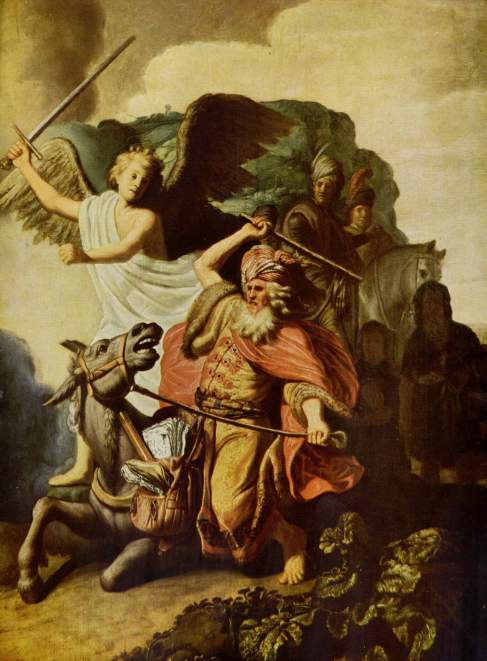
Rembrandt, Balaam’s Ass
The cypress, a graveyard tree, is a very important symbol of death and resurrection. It was believed in ancient China that its leaves are rich in yang substance and give long life. It is the life food for the chthonic donkey, who does not eat while being observed because the instinct switches off when we watch and analyze it too closely. Kafka starved his inner donkey – this seems to be the message of the dream. He hated his body (there are long pages in his Diaries, where he writes about being ashamed to swim in public swimming pools for fear of being laughed at), was ashamed of it and always censoring and reproaching his instincts.
As I have already mentioned, he suffered from the incurable tuberculosis, but in the last two years of his life he finally gave in to instincts and desires, left the parental home and moved in with his lover, Dora Diamant. For her, he turned his life upside down and apparently overnight. When he first saw her she was scaling a fish in the kitchen. Daryl Sharp was amazed by the symbolism of this scene. He writes of fish as “a symbol of (to name but a few) fertility (Ishtar, Oannes), sexuality (Osiris, Aphrodite), resurrection and immortality (Osiris, Christ, Noah), salvation (Vishnu, the Rabbinical Messiah, Christ, Pisces), wisdom (Oannes, Varuna), the beginning of all things (Tiamat, Leviathan), wholeness (the lapis in alchemy), healing (Tobias in The Book of Tobit), and redemption through suffering (Christ).” She was the key to Kafka’s final transformation and rebirth, which happened when he was forty, which is symbolic in its own right. Christ spent 40 hours in his tomb before resurrection and on earth 40 days before ascension. The prophet Elijah spent 40 days in the desert, where he was fed by ravens (!). In alchemy the philosopher’s stone appears in the retort after 40 days. Kafka himself wrote: “I have been forty years wandering from Canaan.”
Dora Diamant
“Self-knowledge has certain ethical consequences which are not just impassively recognized but demand to be carried out in practice,” wrote Jung. It took Kafka almost forty years to put his self-knowledge to practice. He was the most creative in that last period of his life and this is when he started writing The Castle, my favourite novel of his, which he did not have time to finish. It still has dark themes because even though Kafka finally found the courage to stand on his own two feet, sadness and melancholy were always in his nature – like the dark twin in the myth. But he had stopped living what Jung called “the provisional life” in which we never have what we want, are always “about” to take the plunge into the real life, our future plans never reach fruition and we are lost in endless fantasies of what could be. In the preceding neurotic period he had written: “My life is a hesitation before birth.” What a paradox that he was reborn only short before his death. It was then that he finally realized that what he felt was the most important and not all the should’s and ought to’s that always stem from fear.
MY (TENTATIVE) TAKE ON THE CASTLE
Here is the beautiful beginning of The Castle:
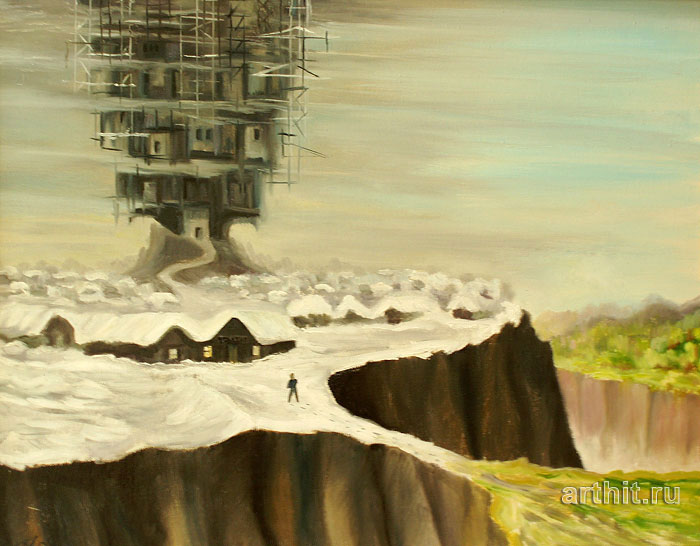
It was late evening when K. arrived. The village lay under deep snow. There was no sign of the Castle hill, fog and darkness surrounded it, not even the faintest gleam of light suggested the large Castle. K. stood a long time on the wooden bridge that leads from the main road to the village, gazing upward into the seeming emptiness.

Sergey Voolazkin, Kafka’s World: The Castle, via http://www.arthit.ru/landscapes/0089/landscapes-7.html
In the novel, K., a land surveyor, tries in vain to gain access to the mysterious castle looming over the village. On the one hand, the Castle seems to be a gigantic bureaucratic apparatus. The Castle officials spend their working day sitting behind a long desk, reading large books and dictating to clerks in a barely audible whisper. On the other, the villagers seem to almost pray to the Castle and its dwellers; it seems to be a luminous and numinous mystery, a shining star guiding the main character, an unreachable goal or ideal. It turns out K. is a stranger who is not authorized to even stay in the village, let alone carry out his surveying duties. The theme of rootlessness, not belonging is obvious and very autobiographical in the case of Kafka.
For me the Castle may also symbolize the absurdity of day to day duties that we impose on ourselves, the invisible structure that can devolve into our prison. Kafka’s conflict with his father is apparent here – from his Diaries the father appears to be a fleshy, dominant man looming over the frail, thin Kafka with his threatening presence and unforgivable authority. All the dwellers of the Castle are male adults. The Castle officials do not interact with villagers unless they require sexual services of village women. Writing the novel must have been incredibly therapeutic for Kafka: the ominous Castle is still there, still bothering his unconscious, but the main protagonist is able to blend in with the villagers, to love and to feel, to experience sensual pleasure and a sense of belonging, if only transitory. Still, the theme of duality does not seem to leave him: the Castle is juxtaposed with the village, also K. has two bothersome assistants who act like twins and tricksters and are hard to tell apart. They were “newly freed from the severity of Castle discipline, and therefore always a little excited and bewildered and in that state apt to get up to silly mischief.” K. was always angry with them, which might suggest Kafka’s inner torment and being torn between dark, heavy moods and the usual playfulness, silliness and happiness of all that Gemini energy in his chart.
In symbolism, the meaning of the castle is very complex. I am summarizing J.E. Cirlot’s description of that symbol. First of all, it is a symbol of the transcendent soul. Kafka was an extremely sensitive man with an enormous thirst for transcendence but he was not spiritual because of his inherently skeptical nature. He brushed shoulders with some esotericists, such as Rudolf Steiner, but could not bring himself to accept any belief or practice that they offered. He was perhaps too self-absorbed, mean critics might claim, but the result of this self-absorption is nothing short of perfection.
The castle is also an embattled, spiritual power, ever on the watch. The Castle of Darkness is where Hades lived and no living soul ever returned from. In that sense the Castle might have been foreshadowing Kafka’s anticipation of death as his final initiation. I do not see any qualities of light associated with the Castle in the novel. The only redemption K. seems to find is in engaging life and letting go of the obsession with the transcendent, which in his case seemed unreachable. But he might have found his salvation in immanent revelations.
As a final note, I would like to invite you to watch a short, animated film on Kafka created by a brilliant Polish artist, Piotr Dumala. Dumala (born on 9 July, so another Cancer) deserves a separate post, but briefly here is a short note from Wikipedia about his technique:
While training to be a sculptor, he discovered that scratching images into painted plaster could be a beautiful way to create animations. This is only one technique of a method called destructive animation, where one image is erased (in this case, painted over) and re-drawn to create the next frame in the sequence.
He places plasterboard painted in black under the camera. Each phase of movement is engraved with thin needles. He scratches the paint and thus obtains white lines and hatches on the dark background. Each drawing has a very high graphic value. However, after being recorded, every drawing is repainted with black paint so that they live shorter than a drawing made by a finger on a steamy window. His work has placed him among the greatest creators who have improved the technique of animation with original innovations.
The result of this painstaking approach is stunning and shows his deep understanding of Kafka’s inner life. Here is the link:
http://www.openculture.com/2013/07/watch_ifranz_kafkai_the_wonderful_animated_film_by_piotr_dumala.html



















 symbolreader