
"The deepest core of life is poetry and symbol." - Dane Rudhyar
Like Symbol Reader on Facebook
-
-
Recent Posts
Categories
Archives
Meta



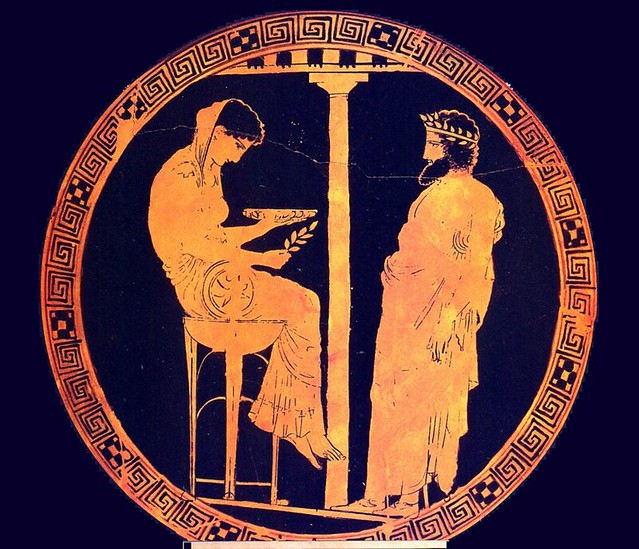


The Thirst Inside the Syllables

Today is the anniversary of Pablo Neruda’s birthday. He is most famous for his love poems but for me he was first and foremost an outstanding symbolist. It is astonishing how many great poets and writers were born under the sign of Cancer. I am working on a post about Kafka (born 3 July), who I worship obsessively, but Neruda has oftentimes given me a sense of rapture, especially if I realize they were originally written in Spanish, which to my ears is the most beautiful sounding language in the world (En el amor, como agua del mar te has desatado… – In love, you have loosened yourself like seawater). I appreciate also that his verses are so full of life and very earthy, fleshy and sensual. This is actually why I wanted to learn Spanish and tried it diligently for a few years, but sadly now a lot has been lost.
I have chosen some of his more beautiful verses:
Love is the mystery of water and the star.
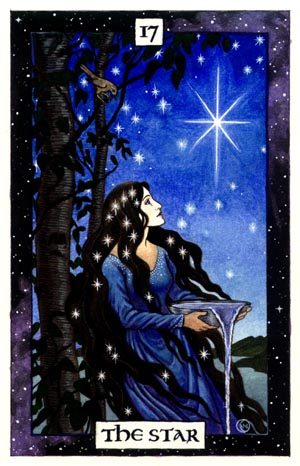
…so I wait for you like a lonely house
till you will see me again and live in me.
Till then my windows ache.
Give me silence, water, hope
Give me struggle, iron, volcanoes.
Everything is ceremony in the wild garden of childhood.
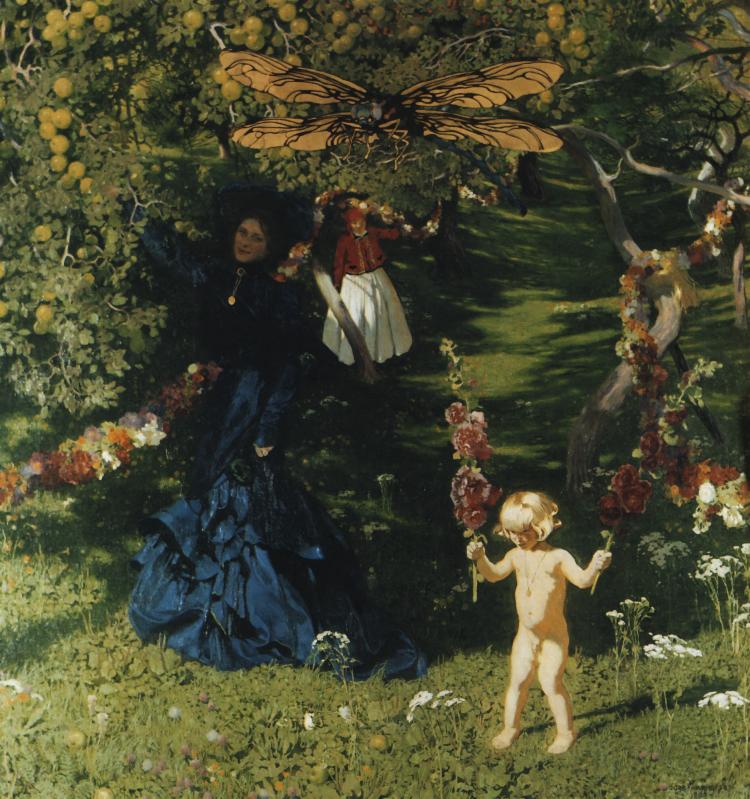
Jozef Mehoffer, Strange Garden (a great Polish painter)
And the verse falls to the soul like dew to the pasture.
So it does indeed.
CHIRON: A DISCARDED GREEK GOD REDISCOVERED © Copyright by Hilary Bond PhD.
This is a rich and utterly wonderful exploration of Chiron – the gentle wise Centaur, mentor and healer. Carl Kerenyi called him “the inventor of the art of healing.” He resided in his cave on Mount Pelion, a wondrous area abundant in healing plants and herbs. He was a mentor to a number of eminent heroes and he is an archetype that guides our souls to heroic greatness. The symbolism of linden tree is explained beautifully by the author; I was especially touched by this part because there is a huge linden tree right in front of my window.

CHIRON: A DISCARDED GREEK GOD REDISCOVERED © Copyright by Hilary Bond PhD.
Chiron, a possible comet or planetoid in our solar system, with an amazing elliptical orbit; which travels between Saturn and Uranus; but also can be found as close to us as Jupiter and as far out as Neptune; was rediscovered on November 1st, 1977 by Charles Kowal. Kowal immediately called Chiron a “maverick”, because of this elliptical orbit. Zane Stein, Barbara Hand Clow and Melanie Reinhart are the best known of the first researching astrologers, who sought to analyse this steadfast, healing, mentoring Greek God. The immortal Chiron’s major concern, in his myths, is to accomplish his own brand of mentoring (with unfailing success), equipping heroes with the strength and abilities needed for their lives ahead. I too have been interested in Chiron since his rediscovery, as I have Chiron dominating my chart. In this article…
View original post 5,994 more words
Posted in Uncategorized
Tagged archetypes, Centaur, Chiron, Greek mythology, healing, myth, mythology, symbolism, symbols
6 Comments
Thinking of Love
This malady which Swann’s love had become had so proliferated, was so closely interwoven with all his habits, with all his actions, with his thoughts, his health, his sleep, his life, even with what he hoped for after his death, was so utterly inseparable from him, that it would have been impossible to eradicate it without almost entirely destroying him; as surgeons say, his love was no longer operable.
The quote above comes from Proust, whose birthday is approaching on 10 July. I love to lose myself in his long, meandering sentences. With the New Moon in Cancer and a number of planets in water signs I have been thinking a lot about love. The quote is about romantic love but I have been casting my net more widely today. I have been pondering on Love as Plato saw it in Phaedrus. He wrote: “Each man in his life honours, and imitates as well as he can, that god to whose choir he belonged.” Plato suggests that what we love is our own essence which we see reflected in the object of love. Furthermore, what we love is strongly connected with our destiny: we often pursue objects which reflect the yet unevolved parts of ourselves. Wanting to unite with an object of our affection is a desire to redeem the deepest part of our souls, the ones that may have been lost or sacrificed.
The sign Cancer, which rules the heavens today, has a lot to teach us about love. I read these beautiful words in Liz Greene’s Astrology of Fate today:
Uroboros is the most ancient symbol of man’s origins, arising from the depth of beginning where world and psyche are still one … In answer to the query, ‘Where did I come from?’ this powerful image arises from the depths, which is both mother and father at once. It is the original perfection before opposites and conflict began, the egg out of which the world was formed. Therefore Uroboros is the primal creative element – what Jung termed the ocean of the collective unconscious – which slays, weds and impregnates itself for all time. Cancer represents this maternal womb, but it is not solely maternal. It is also a union of masculine and feminine opposites, the World Parents joined in eternal cohabitation. I feel that Cancer is driven to seek this divine source; that is its daimon, which is imaged both as the beginning of life before physical separation and birth, and the end of life when the soul is one again joined in unity with the One. Thus it is both a regressive longing for the womb, and a mystical longing for God.

When we are doing what we love time and boundaries disappear. We are in the ocean of limitless creativity. Joseph Campbell’s most famous admonition was “follow your bliss.” I feel we have a unique chance this summer, with all the planetary alignments, notably the Grand Water Trine, to discover what it is that we love and suffuse our daily lives with It.

A unique bookshop in Venice: my kind of Paradise
Posted in Uncategorized
Tagged archetypes, astrology, Astrology of Fate, Cancer, destiny, Grand Water Trine, Liz Greene, love, passion, Proust, symbols, uroboros
16 Comments
The Dark Face of the Goddess
“I am dark, but lovely,” proclaims the Shulamite in the Song of Songs. The highest and purest form of the feminine archetype is Sophia, the white dove symbolizing the wisdom of the feminine side of God and the deepest wisdom of the soul. But deep within the world of matter and flesh beats the heart of the dark goddess, whose wisdom is of no lesser mettle. What can we learn from her?
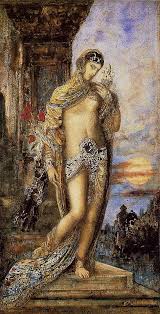
Gustave Moreau, The Song of Songs
I remember my feeling of rapture and intense esthetic satisfaction when I saw for the first time the Black Madonna of Einsiedeln, Switzerland. She holds a baby Jesus who himself has a black bird in his hand. She is commonly associated with healing and miracles, similarly to the celebrated Polish Black Madonna, whose image is the holiest religious painting in my native country. Thousands of people make a pilgrimage every year to pay homage to the “Queen and Protectress of Poland.”


The Madonna of Einsiedeln

Polish Black Madonna
Both Madonnas are subject of legends and enormous reverence. The Black Madonna chapel is located where previously was the hermitage of St Meinrad, who started the cult of Mary in Einsiedeln (the word Einsiedeln itself means ‘hermitage’). He was said to have rescued two black ravens threatened by a pair of hawks. The two ravens are now the emblem of the monastery. It is an unusual legend because the forces of darkness and dark primeval prophetic wisdom (the ravens) are threatened by the forces of light and consciousness (the hawks). Carl Jung believed that the Black Madonna of Einsiedeln to be a manifestation of the Egyptian goddess Isis, whose cult had spread in Europe before the advent of Christianity.
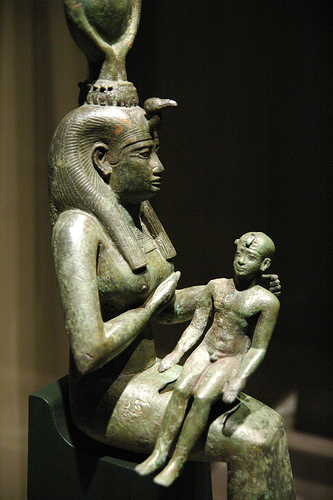
Horus and Isis
The monastery of Einsiedeln is located in the Dark Forest, an area believed to be a centre of powerful magnetic energy of the earth. If there were a grain of truth in it, the healing properties of the wonderful Madonna would be strongly connected with her place of residence and with the earth itself. All I can vouch for is that she indeed radiates an extraordinary aura of wonder and mystery. Also the cult of Polish Madonna has a lot of ecstatic and trance elements to it.
Having been raised in a Catholic country and family, I still remember a lot of religious hymns. I particularly remember these lines from the hymn to the Black Madonna: “Oh Madonna, Black Madonna, it is good to be your child, it is good to hide in your arms.” Black Madonnas appear to be earthly, maternal, wise and possessing magical and healing qualities. China Galland, author of Longing for Darkness: Tara and the Black Madonna, wrote this about the Madonna of Einsiedeln: “this is the darkness of … the womb, of the earth, of the unknown, of sorrow, of the imagination, the darkness of death, of the human heart, of the unconscious, of the darkness beyond light, of matter, of the descent, of the body, of the shadow of the Most High.” Erich Neumann, a student of Jung and an authority on all things related to the sacred feminine, is an author of a book of essays “The Fear of the Feminine,” where he writes very eloquently about the earth archetype, which the Einsiedeln Madonna seems to channel very strongly. I find Neumann’s work extremely illuminating and very complex.
He puts an equality mark between the Earth and the Dark Mother, whose womb begets all living things and who, in her aspect as the Terrible Mother, devours everything that is born, swallowing it back into herself. She is “the grave, the flesh-devouring sarcophagus, hell and the underworld,…, the inside of the earth, the dark abyss of everything living.” Looking at Madonna of Einsiedeln, I sensed that both extremes of the archetype (creation and destruction) meet in her. Her face seemed to be hiding mysteries of initiation and ancient wisdom. Neumann emphasizes that initiation and ancient mysteries rituals always took place underground, in caves, i.e. in the uterus of the Great Mother. “Inire” means to go into, go deeper, go inside, facing the realm of dark instinctuality and sacred sexuality. On the path of his individuation every hero needs to encounter and integrate this perilous darkness, often represented by a monster or a dragon. Says Neumann:
Leaping into the hell of one’s passions and into the emotional side of the underlying nature of humanity is truly a fate that makes plain once and for all to everyone who has experienced it why it is that man’s anxiety over consciousness has done everything to denigrate this earth aspect, to warn against it, and to brand it as “the quintessence of danger.”
Throughout the ages and up to this day the woman has been accused of enslaving the male, seducing him, bounding him to vile earthly things and endangering the stability of his conscious, methodical, well-organized and purposeful existence. Freud spoke of men splitting the image of the female into the holy one – the mother, the wife, the lawful partner, and the dirty, earthy one – the seductive lover, the evil witch or the prostitute. Jung made us acutely aware that the dark feminine is also a part of the male psyche and is met by him through projection.
A fascinating archetype of the dark feminine, who seems to personify all the negatively charged and rejected parts of the feminine psyche, is Lilith, Adam’s first sexual partner, created from dark earth, she refused to be subservient to him. She was banished from Eden and subsequently Eva took her place as a lawful wife of Adam. Lilith has had her renaissance in the last decades among feminists, Jungian psychologists, astrologers and other New Age thinkers. The stone which the builders rejected has become the cornerstone of the emerging sacred feminine.

Lilith
It is important to remember that Lilith is the archetype present in the psyche of both men and women. At its undeveloped stage it symbolizes rage caused by rejection and not fitting in the system or the established (patriarchal) order. Connie Zweig and Steve Wolf write about Lilith in Romancing the Shadow:
For women today who have been victimized and rendered passive and obedient, there is gold lying hidden in this shadow character: She can represent a woman’s capacity to say no, her desire for equality and independence, and her natural, wild instincts, which may return while healing.
I have a feeling it is a good approximation of the meaning of Lilith, but I also think that her rage an indignation is not something that can be easily disregarded and should be more emphasized. For me she represents the forces of chaos, pure instinct and an overpowering will to merge with a partner. However, she also symbolizes fear and anxiety connected with intimacy. As Dallett puts it:
If you cannot express love because you feel too vulnerable, if you are afraid to care, lest you become dependent, look for Lilith.
Cold and unfeeling, she becomes invulnerable in order to protect herself from being hurt. She cuts off that part of her which is connected with dependence and love of others. It is extremely hard to be an independent woman in a patriarchal culture. This is why most women need to repress their wild side, to deny a vital part of themselves that Lilith symbolizes. But she raises her head in the form of rage and vengefulness (overt or hidden), coldness or cruel speech. Says Dallett:
In the most primal depths of the psyche, Eve and Lilith carry the two halves of feminine wholeness. For several millennia, Eve dominated Western culture. Lilith has scarcely been permitted to exist.
We are fascinated by independent women: the media, literature and popular music testify to that. Do you know the amazing song Venus in Furs by the Velvet Underground? For me she is present in that song. But she is often like a wonderful beast admired from afar because hardly anybody is brave enough to approach her. There are male characters in art and myth, who were able to tame her wild nature. One was Aragorn and his horse Brego. Neumann wrote beautifully about the aspect of the goddess associated with wild nature – he called her the Lady of the Beasts.
The Great Goddess evinces her rule over the bull and the lions. And for millenniums she stands or sits enthroned upon lions, as the Mesopotamian goddess Lilith of night, evil, and death, winged, bird-footed, and accompanied by owls.
Neumann seems to merge Ishtar and Lilith, which is a very interesting supposition. Ishtar or Inanna, the chief female deity of Babylon/Mesopotamia, had lions as her chief attributes.
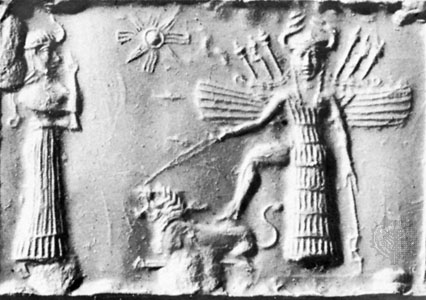
Ishtar
In a well-known myth she undergoes an initiation by descending to the realm of her sister Ereshkigal, lady of the underworld. She dies and is reborn as the one who has successfully tamed and integrated her own dark aspect – Lilith (it is important to remember, though that Lilith can never be completely tamed).
The Lady of the Beasts is beautifully portrayed in the following Homeric hymn:
After her came gray wolves, fawning on her, and grim-eyed lions, ad bears, and fleet leopards, ravenous for deer; and she was glad in heart to see them, and put desire in their breasts, so that they all mated, two together, about the shadowy vales.
Artemis, the wild lunar goddess of hunt, wild animals and wilderness, was the most widely venerated Lady of the Beasts. Neumann wrote of her as the goddess of the “outside” – she as huntress dominates the world of wild instincts and rules the world which lies outside of official culture and consciousness. She is a vessel of mysterious life processes, a virgin goddess who, like nature, begets herself without the need of a male. Historically it was the woman who tamed domestic animals and harnessed their power for the benefit of household. Neumann suggests also that it was the female who tamed and domesticated the male, creating human culture. Through her power of love, she sublimates all life and “raises it to a development where, without losing its bond with the root and formulation, it achieves the highest forms of psychic reality.” This sublimation is symbolized by her wings. Not only Isis or Ishtar have wings but even Lilith does, which suggests her capacity for sublimation and transformation. The opposite end to sublimation is abasement – we all remember the sorceress Circe who transformed men in the Odyssey into pigs. Neumann warns:
And how close ecstasy is to madness, enthusiasm to death, creativeness to psychosis, is shown by mythology, by the history of religions, and by the lives of innumerable great men for whom the gift from the depths has spelled doom.

Circe
One of the chief characteristics of the Lady of the Beasts, or of the goddess in her darker aspect, is her capacity for wrath and outrage. There are numerous stories in myth on goddesses exacting their revenge if some kind of natural law has been broken. One of them is the story of the Ethiopian sphinx that Hera sends against the people of Thebes. This is the dark aspect of the Sphinx, not the sublimated Egyptian one. The Sphinx from Oedipus myth is merciless and devours human flesh. She is out of control, cannot be transformed and has to be destroyed.

Gustave Moreau, Oedipus and the Sphinx
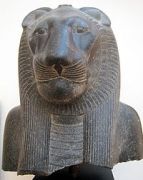
But there is another mythical story, which tells of a sublimation of wrathful instincts. It is an Egyptian myth of Sekhmet. Jean Shinoda Bolen dedicates part of her book Goddesses in Older Women to this goddess. Sekhmet, the lionhead goddess presided over divine order. She was the goddess of wrath and peace. Her name meant “the powerful.”

Statue of Sekhmet in the Turn Museum, Italy
In a famous Sekhmet myth, humans conspire to overthrow the gods and take over their power. The god Ra sends Sekhmet to punish the evil plotters. Sekhmet, similarly to the Indian goddess Kali, goes on a slaughtering rampage, feasting on human flesh. She gets intoxicated on her rage and blood and cannot be restrained. Gods have to prepare a magical mind-altering potion to calm her down. In the end, Sekhmet is welcome back by Ra, who addresses her as the One Who Comes in Peace. Clearly, the myth seems to show that at times peace can only be achieved through a period of destruction and righteous anger that can redress all the wrongdoing.
The Polish Black Madonna has got two scars on her face. She, like Lilith, is a wounded female. A legend says a soldier slashed the painting when the monastery was besieged. When I look at her I see noble suffering and wisdom resulting from forgiveness and acceptance. Her blackness and vibrancy are balanced by love and wisdom. She looks like the dark goddess who has found her peace.

Support my blog
If you appreciate my writing, consider donating and make my day. Thank you in advance.
$1.00
Related post:
Posted in The Dark Goddess
Tagged Dark goddess, earth archetype, Erich Neumann, Hekate, Inanna, Ishtar, Kali, Lamashtu, Lamia, Lilith, Medea, Medusa, Oedipus, sacred feminine, Sekhmet, sphinx, the Great Mother, the Terrible Mother
49 Comments
The Embodied Soul
I often wonder at the wisdom of words. If you trace back the roots of words, their etymology, you will often discover important truths. We often use the word psyche, but what do we really mean by it? Jung defined it as the totality of conscious and unconscious psychological processes. The etymology of the word has been traced in the following way:
Psyche (Greek) – spirit, soul, mind, breath, breath of life; after the goddess Psyche
Psycho (Greek) – I breathe; an onomatopoeic word representing out- followed by in- breathing
Psychicus (Latin) – animalistic, carnal
I am marveling at the wisdom of this. The soul and the body are inseparable (while we are alive). Psyche is the embodied soul.

Edward Burne-Jones, Pan and Psyche
Fair as the Moon, Clear as the Sun and Terrible as an Army with Banners
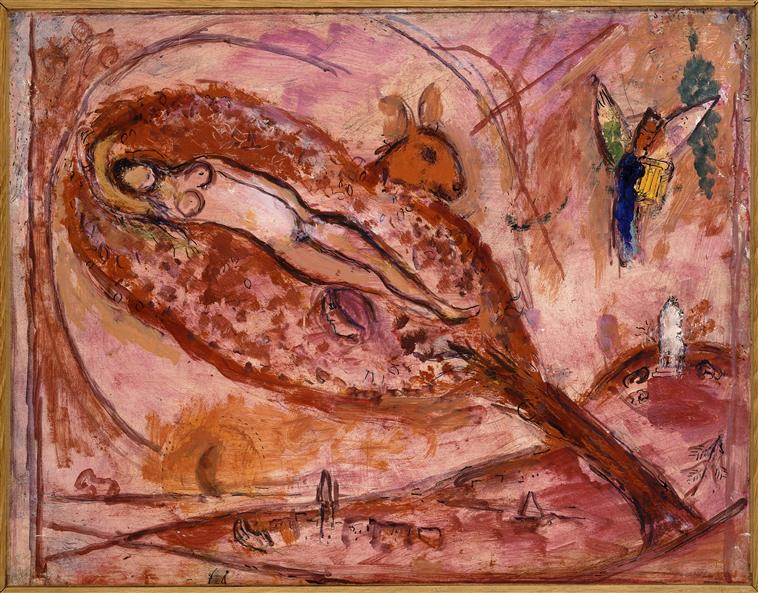
Marc Chagall, Song of Songs II
The title today comes from The Song of Songs. I think these words are are a beautiful expression of the power and the essence of the sacred feminine.
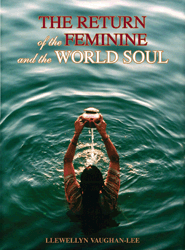
I am still smitten by The Return of the Feminine and the World Soul by Llewellyn Vaughan-Lee. It does not happen very often that you pick a book that expresses clearly and beautifully what you have been long suspecting, feeling and longing for. I could never aspire to write like this. His words are like notes played on the harp of my soul.
I am posting a few pearls I have gathered from the book. They are almost exact quotes; the order of sentences has been rearranged by me to form a patchwork of meaning. I have got a paper copy but I have seen that the book is available for download here for a small fee:
http://goldensufi.org/book_pdf_feminine.html
What follows does not contain any passages from the three appendices that are attached to the book. These attachments are quite amazing, especially the one devoted to Vaughan-Lee’s interpretation of Jung’s concept of anima. I might still post on them soon.
Here go the quotes:
- A world that is not connected to its soul cannot heal.
- The world Soul (anima mundi) is a living spiritual substance within us and around us. Just as the individual soul pervades the whole human being – our body, thoughts, and feelings – the nature of the World Soul is that it is present within everything. It pervades all of creation, and is a unifying principle within the world.
- The light we discover in our own depths is a spark of the World Soul, and the world needs this light to evolve. It is the light hidden in matter that will redeem the world.
- It is from the inner dimension of images and symbols that the soul is nourished. Recognizing and working with symbols requires an attitude of receptivity that allows the symbols to communicate in their own language.
- We look for rational answers to our problems rather than working with the divine that is our very core.
- The feminine is always attuned to the oneness, the interconnected wholeness of life. In the cells of her body she carries the light of the consciousness of oneness, a light that is not present in men’s bodies.
- Because our patriarchal culture has separated the spiritual and the physical, one of the first steps in healing the planet is to acknowledge the spiritual potential of matter, to align the world with its divine consciousness. Part of the patriarchal power drive has been to deny matter it magical nature; in this way men could gain power over matter.
- To fully encounter the divine feminine we must be prepared for her anger, for the pain that has come from her abuse.
- On the spiritual path, human beings often have to be healed first before they can develop spiritually.
- The moment of crisis is always a moment of potential. The gates of grace open in a way they were not open before. It is a strange thing: when human beings reach a real crisis, we are given a grace we are not otherwise given.
- Now it is time for the wisdom of the feminine to be combined with masculine consciousness, so that a new understanding of the wholeness of life can be used to help us to heal the world. This synergy of consciousness and matter is a gift of our future.
- At this time of transition the light of the soul of the world has a new vibration; it carries the consciousness of a new era.
I usually read a few books simultaneously and I still haven’t finished The Astrology of Fate by Liz Greene. I was quite amused when I discovered that in the chapter I am reading she is also writing about anima mundi; what is more, her take illuminates and clarifies the concept even further.
For Jung … symbolic products of the psyche hold the borderland between the … world of the archetypes and the daylight world of consciousness. These images are the ‘stuff’ in between, the anima mundi or soul of the world. They and their ground of psychic substance fall under the governorship of Hermes, lord of borders and roadways and crossroads, who in alchemy is called Mercurius.
…
… Anima mundi bears a strong relationship with the ‘objective psyche’ as Jung calls it, the indefinable world-stuff which stretches across the boundaries between psyche and body, between spirit and substance, which belongs to both and to neither, and which is accessible to us through the images of our dreams and fantasies. Work on this stuff in accordance with one’s natural pattern … and one builds the connecting link (or participates in a link which is already existent but unexperienced) between God and his creation, between Ideas and corporeal reality, between archetype and instinct, between freedom and fate.
The Return of the Feminine and the World Soul
Part of the difficulty of understanding and describing the feminine is her very elusive nature, the veil that surround her, as well as our patriarchal repression and denial of her wisdom and power. Also the ancient feminine mysteries, her initiations and teachings, were never written down. She is not easily fixed and defined, but is mysterious in her continual movement and change. She belongs to the silvery light of the moon and its many reflections rather than the harsh glare of masculine sunshine and its rational constructs. She is more easily alluded to and hinted at, expressing the mystery and matrix of creation that is always a wonder rather than something to be explained.
Llewellyn Vaughan-Lee, The Return of the Feminine and the World Soul
I am grateful to embark on reading this book, written by a Sufi teacher, who claims that feminine consciousness needs our attention in order to redeem our civilization and our world.
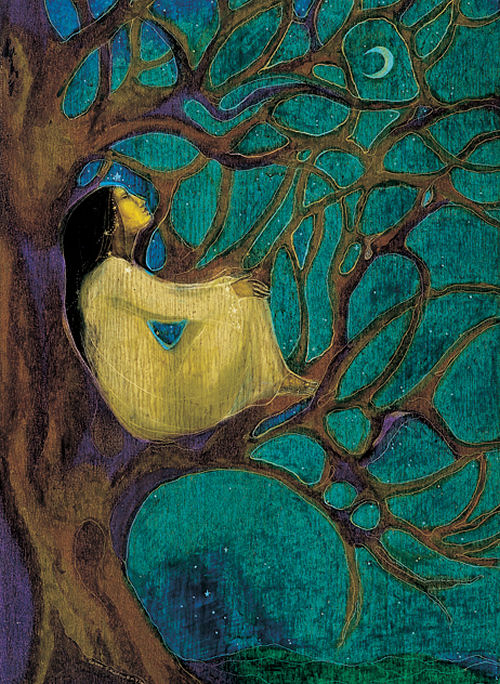
Susan Seddon Boulet, Skywatcher
“We need to return to the core of our being, to where the sacred comes into existence. And the mystical feminine holds the key to this work of redemption and transformation.” (from the blurb)
Images of the Zodiac: Contemplating Cancer
It is 1975, a glorious spring in Istanbul. Kemal, member of one of the city’s wealthiest families, is about to become engaged to Sibel, daughter of another prominent family, when he encounters Füsun, a beautiful shop assistant and a distant relative. They embark on a secret love affair but Kemal cannot make up his mind whether he should break up with Sibel. When he reaches his resolve and breaks off his engagement, it is already too late. In the meantime, his love for Füsun has become an obsession. He has turned into a compulsive collector of objects that chronicle his love for her. She lives with her parents now and does not appear to be interested in a relationship with him. However, she tolerates his frequent visits during which he steals various objects belonging to her. With that loot he builds a museum, a shrine dedicated to his lost love. His treasures include hairpins, a salt shaker that she touched and all manner of objects that remind him of their precious moments together. In the chapter entitled “The Consolation of Objects” his obsession reaches disturbing proportions:
One palliative for this new wave of pain, I discovered, was to seize upon an object of our common memories that bore her essence; to put it into my mouth and taste it brought some relief.
(about a cigarette butt) I picked it up and rubbed the end that had once touched her lips against my cheeks, my forehead, my neck, and the recesses under my eyes, as gently and kindly as a nurse salving a wound. Distant continents appeared before my eyes, sparkling with the promise of happiness, and scenes from heaven; I remembered the tenderness my mother had shown me as a child…
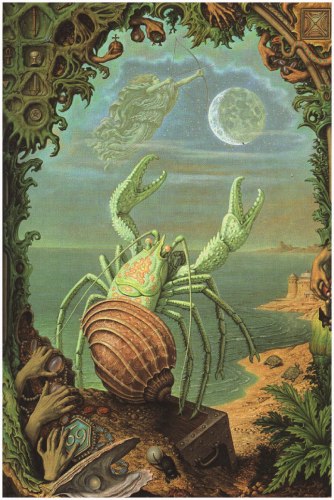
The Museum of Innocence by Orhan Pamuk contains a stunning vision of an obsession with the past and a lost happiness. The feeling of nostalgia accompanied by a compulsion to collect various memorabilia is a mark of the sign Cancer. The treasure chest featured in Johfra’s painting is a rich, multi-faceted symbol, and one of its possible meanings is that it stores the objects treasured by the Soul. It is buried in the sand for safekeeping. Crab’s pincers, the hands and chest being deeply embedded in the sand all symbolize the Cancer’s tendency to cling to the objects of their affection. Excessive attachment can be a true vice of Cancer.
Even more than other Johfra’s paintings that I have already written about, the one depicting Cancer begs for quiet contemplation. Words may not do justice to its haunting atmosphere, the feeling of getting lost in one’s deeper musings that it evokes, the nostalgia, dreaminess, wistfulness and melancholy that I feel looking at it. Marcel Proust could have written In Search of the Lost Time on that beach. He could have if he had not been a loner afraid to leave his safe nest of an apartment. He spent the last three years of his life never leaving his cork-lined super safe bedroom. He would write at night and sleep during the day. He was a true Cancerian after all with four planets in Cancer in the fourth house, which is ruled by Cancer. A safe container, a secure space mimicking the mother’s womb is Cancer’s bliss. The sign Cancer is ruled by the Moon and the Moon is “a symbol of that aspect of the psyche which contains and supports life. … it is also an image of … the mother, who is our physical container during pregnancy and our psychic container during childhood. “ (Liz Greene, The Astrology of Fate)
The treasure chest contains two important symbols – the scarab rolling a pearl and a crab coming out of its shell. The pearl symbolizes the mystic Centre, the human Soul. Pearls are the only gemstones made by living organisms, therefore there are not two identical pearls. What is more, each pearl has some imperfections. Born in confined darkness and in a sealed vessel (associations with alchemy spring to mind), the pearl symbolizes the lower instincts being purified into a white, luminous sphere – an image of the enlightened Soul. The pearl is also an important gnostic symbol. The Hymn of the Soul is a beautiful account of raising up the treasure from the dark waters of the unconscious. Here is what Johfra adds about the meaning of the pearl:
I have chosen the pearl to represent the acquisition of emotional experiences; it is the classic symbol of suffering that leads to insight. A pearl is by way of being a symptom of illness in the oyster. Should a foreign body – a stone or fragment of shell – enter the oyster’s shell, its weak, sensitive body is irritated and it reacts by covering the alien object with layer upon layer of pearl, so smoothing it and making it less painful. In this way suffering brings about the growth of a beautiful jewel – the eternal essence of spiritual wealth.
The scarab, the Egyptian symbol of rebirth, is rolling the pearl up the hill. For me it is a beautiful image of the Soul’s immortality achieved through reincarnation. In the Egyptian Zodiac, it was the scarab beetle which was placed in the position of Cancer:
“The beetle is clearly linked to the moon’s twenty-eight day cycle. It deposits its ball of eggs, rolled in dung in the earth, for the space of twenty-eight days, which is the time it takes for the moon to complete a full revolution through the twelve zodiacal signs. The Egyptians considered the twenty-ninth day to be a day of resurrection, and according to lunar markings, there occurs the baptism of the beetle, when the scarabeus casts his ball into the water, opening to give birth to the young beetle. This immersion and baptism became naturally associated with renewal and regeneration. In this way, the lunar god was always declared to be self-created, never born. This symbolism seems to fit very aptly for the sign of Cancer, so seemingly introverted and self-contained.
The Summer Solstice marks the entry of the sun into Cancer in the tropical zodiac on 21st June and we can find this symbolism highlighted through the behaviour of the scarab beetle. The creature certainly carries solar symbolism, perhaps on account of its ray-like head and the dung ball representing the Sun. The scarab-beetle god was known as Khepera and was believed to push the setting sun along the sky in the same manner as the beetle pushes his ball of dung, a scene frequently depicted in various artefacts. The beetle would, for example, push the dung ball to the top of a sand ridge and then allow it roll down again, a motion that would seem to reflect that of the Sun rising to its zenith in the sky at Summer Solstice before descending again. The scarab can be seen in various depictions apparently holding the sun aloft, suggestive perhaps of the solstice sun.”
Retrieved from http://www.thealchemicaljourney.co.uk/uncategorized/cancer-the-crab-the-scarab
Another emblem of longevity is a pair of tortoises on the beach, which also carry the symbolism of the Great Mother and of matter or material existence. It is hard not to think of the World Turtle in Hindu mythology that supports and contains the World.
The castle visible on the shore is a complex symbol also associated with Cancer. It is simultaneously a house, an enclosure and it usually contains walls for protection. Retreating to a safe lair and preserving safety are Cancerian characteristics. The Great Wall of China is a magnificent Cancerian symbol, all the more interesting when we realize that China in mundane astrology is assigned to the sign Cancer.
The veil of darkness endows any Cancer with a feeling of security. In the painting, the giant crab seems to be bathing in moonlight, worshipping the Moon and the lunar goddess Artemis. Cancer is adept at defense but quite poor at attack. According to myth, Hera sent a crab while Heracles was fighting the Hydra. The crab bit the hero on the foot and was crushed swiftly and mercilessly.
The goddess Artemis has long been one of my favourites. Here is a passage from The Marriage of Cadmus and Harmony by Roberto Calasso:
The infant Artemis sat on Zeus’s lap. She knew what she wanted for the future and told her father all her wishes one by one: to remain forever a virgin, to have many names, to rival her brother, to possess a bow and arrow,…, to hunt wild beasts, to have sixty Oceanides as an escort, … to hold sway over all mountains; she could get by without the cities.
She defended ferociously what she held dear. We often underestimate Cancer natives and think of them as weak. When Artemis’ protective instincts were awoken, she could be ruthless and efficient. The poor Actaeon, who by accident saw her bathing, was turned into a stag by her and torn to pieces by Artemis’s dogs. Artemis was cruel, wild and unforgiving like Nature herself. She was not the attacker, though, but the defender and protector.
In Ephesus she was worshipped as a mother goddess and her cult image was adorned with multiple breasts. Breastfeeding is connected with the sign Cancer, which rules breasts. In Shakespeare’s Macbeth we find a wonderful metaphor of ‘the milk of human kindness’ symbolizing care and compassion for others. Lady Macbeth accuses her husband of being too kind and thus unable to destroy his opponents and realize his political ambitions. As the anatomical chest houses the heart, so the chest contains a treasure. The ultimate treasure sought by Cancer is Christ Consciousness, limitless compassion and bringing nourishment to the whole world. The esoteric ruler of Cancer is Neptune symbolized by the primordial ocean featured in the painting. A Soul-centred Cancerian becomes Great Mother to all humanity, and all the precious gemstones that the Crab has gathered in the Neptunian unconscious ocean depths will be symbolic of the eternal gifts of pure Spirit.
Support my blog
If you appreciate my writing, consider donating and make my day. Thank you in advance.
$1.00
Related posts:
Posted in Johfra Bosschart
Tagged archetypes, Artemis, astrology, Cancer, Johfra, Johfra Bosschart, Moon, Pamuk, pearl, Proust, scarab, symbols symbolism, the Great Mother, the Museum of Innocence, tortoise, Zodiac
50 Comments
The Shadow Archetype
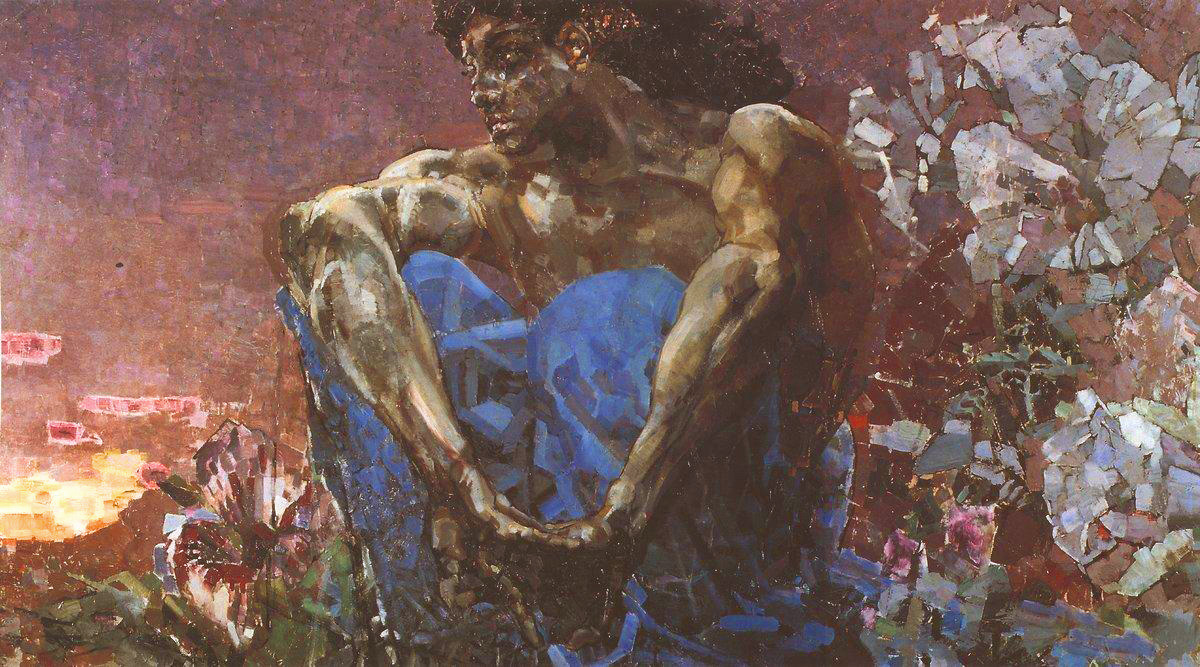
Mikhail Vrubel, The Demon
Where there is light, there must be shadow, and where there is shadow there must be light. There is no shadow without light and no light without shadow. Karl Jung said this about ‘the Shadow’ in one of his books: ‘It is as evil as we are positive… the more desperately we try to be good and wonderful and perfect, the more the Shadow develops a definite will to be black and evil and destructive… The fact is that if one tries beyond one’s capacity to be perfect, the shadow descends to hell and becomes the devil. For it is just as sinful from the standpoint of nature and of truth to be above oneself as to be below oneself.
Haruki Murakami, 1q84
I came across this quote yesterday, while reading Haruki Murakami’s novel, which is excellent by the way but very long (1000 pages) taking forever to finish. Still, I am savouring it and taking so much in. Jung’s quote that the Japanese author uses here comes from the book Visions: Notes of the Seminar Given in 1930-1934 by C.G. Jung.
In the Critical Dictionary of Jungian Analysis, edited by Andrew Samuels and others, we can read that the shadow is all that a person does not want to be. It is a primitive worthless and inferior part of our nature. As an archetype the shadow is autonomous, potent and inextricable from the Psyche. It has to be consciously acknowledged and integrated because otherwise it will haunt us and we will always see it outside as a projection.
With all due respect, I find Samuel’s definition lacking because he seems to value the shadow very negatively and he emphasizes its destructive force too much. My understanding of the shadow is that it is a part of the personality which is incompatible with what we believe ourselves to be, with the chosen attitude towards ourselves. Here is what Jung wrote about the shadow in Aion:
If it has been believed hitherto that the human shadow was the source of all evil, it can now be ascertained on closer investigation that the unconscious man, that is, his shadow, does not consist only of morally reprehensible tendencies, but also displays a number of good qualities, such as normal instincts, appropriate reactions, realistic insights, creative impulses, etc.
And this is why I like returning to the source and reading Jung himself instead of Jungians or other commentators. This last quote made me think of Anthony Soprano, played by the magnificent James Gandolfini, who passed away a few days ago. His conscious attitude was that of a gangster and as a gangster he was expected to be ruthless and evil. But his shadow was a gentle giant, a kind-hearted and warm being. What drew me to that TV series was precisely this duality, this inner split within this character. The dreams that he tells his therapist often reveal his need to achieve wholeness by integrating the softer, feminine side of his nature, which he does not acknowledge consciously because he is compelled to play a strong Italian macho mobster. He cherishes and feed ducks that visit his swimming pool and once he has a dream about them:
I had a dream last night. My belly-button was a phillips head screw, and I’m workin’ unscrewin’ it, and when I get it unscrewed, my penis falls off.
You know, I pick it up. And I’m holdin’ it and I’m runnin’ around lookin’ for the guy who used to work on my lincoln, when I drove lincolns, so he can put it back on. And, I’m holdin’ it up, and this bird swoops down and grabs it in its beak and flies off with it.
You can watch a 2-minute clip on youtube, where he tells the dream:
I believe the dream shows his fear that if he opens up to his emotions (the belly) he will lose his masculinity (the penis).
What The Sopranos series showed to me was that we all walk a very fine line between good and evil, between the light and the shadow parts of our nature. I think if any redemption were possible it would have to do with trying to be more accepting of ourselves and of the truth that we are all fallible, imperfect beings striving towards light.
As another memorable quote from 1q84 goes:
In this world, there is no absolute good, no absolute evil,” the man said. “Good and evil are not fixed, stable entities, but are continually trading places. A good may be transformed into an evil in the next second. And vice versa. Such was the way of the world that Dostoevsky depicted in The Brothers Karamazov. The most important thing is to maintain the balance between the constantly moving good and evil. If you lean too much in either direction, it becomes difficult to maintain actual morals. Indeed, balance itself is the good.

Charles-Paul Landon, Daedalus and Icarus
Posted in The Shadow
Tagged 1q84, Antony Sopranos and the ducks, archetypes, Carl Gustav Jung, darkness, duck dream, evil, good, Jung, light, Murakami, shadow, The Sopranos, Tony Soprano
48 Comments
 symbolreader