Images of the Zodiac: Contemplating Leo

Image

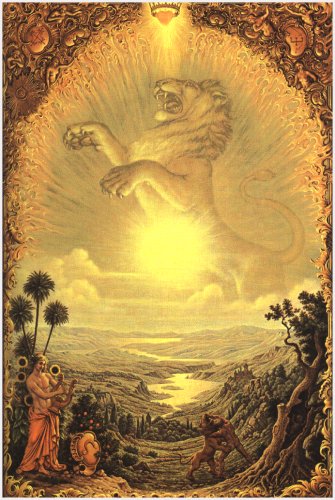
Johfra Bosschart, Leo

The whole scene is bathed in golden light of the most beautiful shade of gold. The landscape is regal and luxuriant – the intricate golden frame, the majestic palms, the erect cypresses, wonderful sunflowers, citrus bushes and the oak tree on the right. Nothing short of perfection for the King to show off his dominion.  The keynote of Leo, according to Rudhyar, is personalized expression of creative power. This sign is aligned with the realm of Logos and its symbolism revolves around emotional instinctuality, the heart, the sun, kingship and, as Rudhyar put it, “an emotional urge to go forth and to conquer, to multiply oneself through a multitude of creations stamped with one’s image.”

The sign Leo is the channel of enormous fiery power – fire in being, which is fixed, stable and indistinguishable. This power keeps the heart beating and the rhythm of life operating. Leo begins the second quarter of the Zodiac, which, according to Rudhyar, represents individual and personal activity. Each level begins with a fire sign because the element Fire releases the power to transform what has been into what will be. Let me stop or a moment by that oak tree although it is not the central image. This is a hollow tree, which is significant from an alchemical perspective. In alchemy, the hollow oak was an image of Athanor – a furnace which had to be kept at a constant temperature for the Philosopher’s Stone to be born. Leo’s quest is to give birth to the Philosopher’s Stone – the radiant Self.

Image

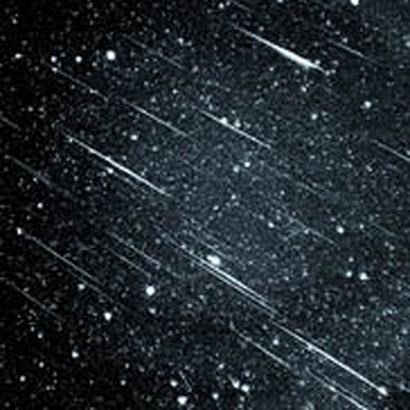
How did the Lion become such a powerful and universal symbol? The first appearance of the Lion as a symbol seems to be the Great Sphinx of Giza. Recent geological tests seem to prove that the Sphinx is much older than the pyramids. In his book Fingerprints of the Gods, Graham Hancock argues that the Sphinx may date back to 10,000 BC, when humanity was in the Age of Leo. In his other book, Heaven’s Mirror, Hancock wrote: “Computer simulations show that in 10,500 BC the constellation of Leo housed the sun on the spring equinox – i.e. an hour before dawn in that epoch Leo would have reclined due east along the horizon in the place where the sun would soon rise. This means that the lion-bodied Sphinx, with its due-east orientation, would have gazed directly on that morning at the one constellation in the sky that might reasonably be regarded as its own celestial counterpart.”  It is important to remember that at one time in history, the Vernal Equinox indicated New Year’s Day in our calendar until Julius Caesar moved it to January 1 in 45 BC. So, in the time of the Sphinx, a new year started with the sign Leo, not Aries.  The Sphinx was probably built to face the rising Leo constellation with its brightest star, Regulus, each morning. Edgar Cayce, the sleeping prophet, who I always listen to very closely, had a vision that the Sphinx had been built in 10,000 BC. He claimed that the survivors of Atlantis had concealed beneath it a Hall of Records containing the wisdom of their civilization and the history of the human race. Possibly in the approaching Age of Aquarius this truth will be revealed since Aquarius is the sign opposing Leo. In addition, the fixed star Regulus moved from Leo, where it had spent over 2000 years, to Virgo last year, which further emphasizes the mystery of the Sphinx, as the Sphinx is a lion with a maiden’s face and its symbolism rests on the interconnection between Leo and Virgo. I have already written about the Sphinx here and here.

Image

Next to the Sphinx figure, archaeologists have discovered the remnants of the Sphinx temple dedicated to sun worship. The temple was designed to track the movements of the sun; furthermore, the sacred complex was supposed to harness the power of the sun. According to some channellers, notably Rudolf Steiner and Madame Blavatsky, this links the Sphinx to Atlantis, whose inhabitants worshiped the sun and harnessed its power with expertise.

The reason why I am writing about the Sphinx at such length is primarily to trace back the origins of the archetypal connection between the lion, the sun and kingship, but secondly because for some mysterious reasons I resonate very deeply with the symbolism of Leo. I once had a dream that I was a master of two lion cubs, who trusted me completely, lay on my lap and were tamed and loyal to me.  Then I read that lions were indeed kept as pets in ancient Egypt, which I had not known before. I have a strong Leonine energy in my birth chart – my Ascendant is conjunct the star Regulus mentioned above and my Venus is in the first degree of Leo in the twelfth house. All I can say is that the symbolism of the Sphinx and Leo always struck me on a deep and profoundly personal level, awakening distant memories and feelings I cannot exactly describe. I have no logical proof for scientists out there but there is no doubt in my mind whatsoever that Edgar Cayce was right about the significance of the Sphinx.

The sign Leo rules the heart. Like the sun is the centre of the Solar System, the King the centre of his tribe, so the heart is the central organ of the body. Interestingly enough, ancient Egyptians always left the heart inside the mummy while removing all the other organs. For the alchemists, the heart was indeed the image of the sun within an individual, while gold was the image of the sun on earth. We often talk of the necessity to follow one’s heart and intuition, to keep true to oneself instead of being stuck in social conformity. The Leo must learn to stand alone and, at the same time, integrate the Aquarian polarity, i.e. not to be estranged from the collective but rather to contribute his or her essence to it. Carl Gustav Jung was a Leo, who fittingly developed the concept of individuation, understood as the quest to find and develop one’s unique individual essence. This essence needs to be connected to something larger than the ego – to communicate with the realm of divine eternity. To attain his inner essence, Jung could not have stayed with Freud as his disciple and a faithful follower. He intuitively knew the inevitable truth: spiritually oriented Leos need to follow the lonely road into their own depths. What he developed was based on his experience, his intuition and his own deepest conviction. Once again, Rudhyar is spot on in expressing the essence of Leo-Aquarius axis:

It is before the New Age opens that the new creative impulse, the fecundating logos spermatikos, “descends” from the divine realm into one man, and secondarily a group of men, who incorporate it and make it manifest at least to a particularly open and responsive “creative minority.

The true change always starts with the individual fecundated by Spirit. Leos are so often disappointed with their biological fathers because their true mission, like that of Perceval, is to reunite with their divine father who helps them connect with their own radiant, transpersonal, divine essence.

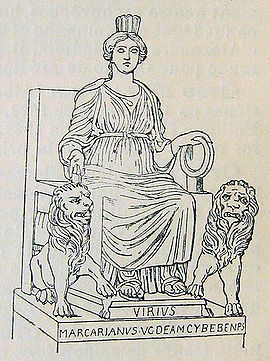
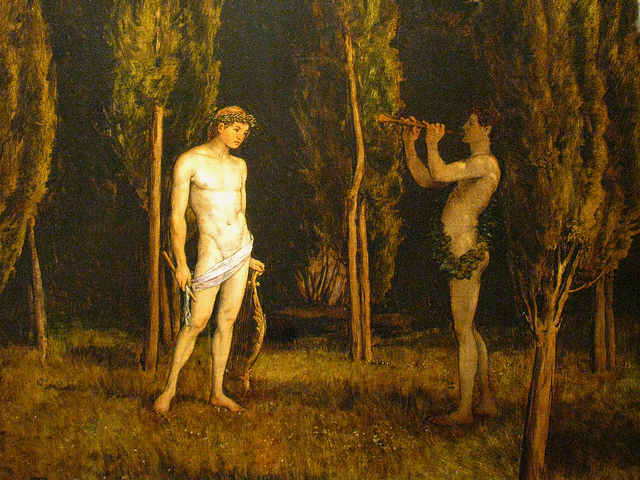
But before a Leo can contribute to the collective and perhaps rule them as their benevolent King, he or she needs to wrestle with passions and fiery impulses. The lion cannot remain in his bestial form if he wants to be accepted by the society. In Johfra’s  painting this process is symbolized by Herakles’ fight with the Nemean lion. In Astrology of Fate, Liz Greene beautifully and in rich detail retells the myths of all Zodiac signs. She writes that the Nemean lion was actually sent from the moon to earth by Hera, who hated Herakles as an illegitimate son of Zeus. Since very ancient times and in cultures across the globe, lions have been associated with the Great Goddess, passionate emotionality, concupiscence and eroticism (they also followed Dionysos, the god of wine and ecstasy).

Image

Dionysos

Image

Cybele, Anatolian mother goddess

Herakles had to engage the lion, because the Leonine hero has to live through his bodily passions and instincts in order to learn how to tame them and achieve individuality. The lion fell and the hero flayed it and put on its hide. A real strength emerges from a full and direct experience of one’s instincts and impulses.

The heart depicted at the top of the painting is crowned because the Leo archetype is connected with that of the King. In a book King, Warrior, Magician, Lover: Rediscovering the Archetypes of the Mature Masculine, Robert Moore and Douglas Gillette describe this archetype beautifully but what is missing for me is the assertion that a woman can also embody this archetype. We all have the Sun in our astrological chart, and the Sun is the King archetype.

The King is the primordial man, the Hindu Atman, the inner image of God. Historically, Kings have always been sacred. They were larger than life and were sometimes possessed by this archetype, which posed a threat to their survival. Their physical lives were threatened because in ancient times they were killed when they were no longer able to fulfill their archetypal role for the collective. The advent of the new King always renewed the land and its people. He brought in a principle of order, fertility, creativity, vitality, joy and blessings to his subjects. The King was the organizer, the giver of laws and rational patterns – outside of his influence was chaos, demons and non-world. Like Apollo overcoming the Python, the King often fought the forces of chaos and overpowered them. He was “the earthly conduit from the Divine World… the central artery … that allowed the blood of the life-force to flow into the human world.” This archetype denotes our own integrity of being and of purpose, “our own central calmness about who we are.” A good King is able to nurture others and encourage them to express their true essence.

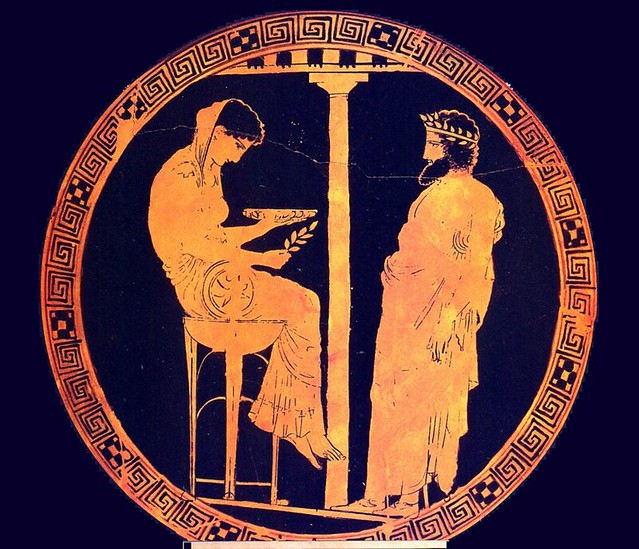
On the left side of the painting stands the God Apollo. Know Thyself, the inscription in his oracle of Delphi, is the ultimate motto of Leo. Apollo’s epithet was Phoebus meaning pure and holy. He was an unblemished image of the loftiness of Spirit, the most awe-inspiring god among the Olympians. When he was coming to this world on the island of Delos, miraculous golden light enveloped the island. The gold anchored the floating island to the seabed. Leo is a fixed sign, so that is very fitting archetypally. Our inner essence, the inner light of our Self, is like an anchor amidst the changing circumstances of everyday life. As Liz Greene put it: “He removes the pollution of corporeal reality and restores the unclean man or woman to a state of grace.” His art and music stilled turbulent emotions, brought back harmony and had healing properties. He personified beauty, clarity, rationality and order.

The dark aspect of Apollo was how easy he took offense, for example punishing the poor Marsyas for winning a musical duel with the god.  The punishment for Marsyas was quite gruesome – he was flayed alive. I think there are two possible explanations of this disturbing myth. On the one hand, it is a warning regarding the narcissistic side of Leos, who take offense easily and can be outraged and merciless when not worshiped or put on a pedestal. On the other hand, it was Marsyas who was guilty of hubris, i.e. excessive pride. Apollo embodied the divine Logos, the source of divine power that Marsyas misappropriated, thinking it was his own. The lesson here seems to be that humans are channels, not the source of this energy. The shadow of Apollo was Dionysos, associated with wild/chaotic nature and ecstasy. They always sat side by side at the Olympian table. There is a beautiful poem by Zbigniew Herbert, one of my favourite Polish poets, in which he seems to accuse Apollo of cruelty, tyranny and lack of compassion and no reverence for the human body, all traits of a tyrant, the wicked king.

Apollo and Marsyas

The real duel of Apollo
with Marsyas
(absolute ear
versus immense range)
takes place in the evening
when as we already know
the judges
have awarded victory to the god

bound tight to a tree
meticulously stripped of his skin
Marsyas
howls
before the howl reaches
his tall ears
he reposes in the shadow of that howl

shaken by a shudder of disgust
Apollo is cleaning his instrument
only seemingly
is the voice of Marsyas
monotonous
and composed of a single vowel A

in reality
Marsyas relates
the inexhaustible health
of his body

bald mountains of liver
white ravines of aliment
rustling forests of lung
sweet hillocks of muscle
joints bile blood and shudders
the wintry wind of bone
over the salt of memory

shaken by a shudder of disgust
Apollo is cleaning his instrument

now to the chorus
is joined the backbone of Marsyas
in principle the same A
only deeper with the addition of rust

this is already beyond the endurance
of the god with nerves of artificial fibre

along a gravel path
hedged with box
the victor departs
wondering
whether out of Marsyas’ bowling
there will not some day arie
a new kind

of art—let us say—concrete

suddenly
at his feet
falls a petrified nightingale

he looks back
and sees
that the hair of the tree to which Marsyas was fastened

is white

completely

Image

Hans Thoma, Apollo and Marsyas

Compassion and empathy can sometimes be difficult for Leos. Where there is so much light and radiance, there must lurk a deep shadow. I find it fitting, though, to finish on a more radiant note by quoting a brilliant passage from the Upanishads:

‘Yâavalkya,’ he said, ‘what is the light of man?’

avalkya replied: ‘The sun, O King; for, having the sun alone for his light, man sits, moves about, does his work, and returns.’

Ganaka Vaideha said: ‘So indeed it is, O Yâavalkya.’

Ganaka Vaideha said: ‘When the sun has set, O Yâavalkya, what is then the light of man?’

avalkya replied: ‘The moon indeed is his light; for, having the moon alone for his light, man sits, moves about, does his work, and returns.’

Ganaka Vaideha said: ‘So indeed it is, O Yâavalkya.’

Ganaka Vaideha said: ‘When the sun has set, O Yâavalkya, and the moon has set, what is the light of man?’

avalkya replied: ‘Fire indeed is his light; for, having fire alone for his light, man sits, moves about, does his work, and returns.’

Ganaka Vaideha said: ‘When the sun has set, O Yâavalkya, and the moon has set, and the fire is gone out, what is then the light of man?’sound alone for his light, man sits, moves about, does his work, and returns. Therefore, O King, when one cannot see even one’s own hand, yet when a sound is raised, one goes towards it.’

Ganaka Vaideha said: ‘So indeed it is, O Yâavalkya.’

6. Ganaka Vaideha said: ‘When the sun has set, O Yâavalkya, and the moon has set, and the fire is gone out, and the sound hushed, what is then the light of man?’

avalkya said: ‘The Self indeed is his light; for, having the Self alone as his light, man sits, moves about, does his work, and returns.’

Ganaka Vaideha said: ‘Who is that Self?’

avalkya replied: ‘He who is within the heart, surrounded by the Prânas (senses), the person of light, consisting of knowledge.’

Support my blog

If you appreciate my writing, consider donating and make my day. Thank you in advance.

$1.00

Related posts:

Images of the Zodiac: Contemplating Aries

Images of the Zodiac: Contemplating Taurus

Images of the Zodiac: Contemplating Gemini

Images of the Zodiac: Contemplating Cancer

Images of the Zodiac: Contemplating Virgo

Images of the Zodiac: Contemplating Libra

Images of the Zodiac: Contemplating Scorpio

Images of the Zodiac: Contemplating Sagittarius

Images of the Zodiac: Contemplating Capricorn

Images of the Zodiac: Contemplating Aquarius

Images of the Zodiac: Contemplating Pisces

Posted in Johfra Bosschart | Tagged , , , , , , , , , , , , , , , , , , , , | 37 Comments

Power at the Crossroads

Image

Dane Rudhyar, Power at the Crossroads

I was quite shocked to read the following post yesterday:

http://reikiserpent.wordpress.com/2013/08/07/cameron-strikes-again-you-wont-believe-this/

Then I followed up on it here:

http://www.wakingtimes.com/2013/08/02/war-on-consciousness-takes-to-the-internet-as-esoteric-websites-to-be-censored-in-uk/

In short: “The UK government has proposed a bill to make Internet service providers automatically block websites dubbed esoteric material”. That means people in the UK could be shut off from websites the UK government deems “esoteric” unless they go in and manually un-tick their network filters.”

I may be naive but I doubt whether this initiative will be followed through. But it is symptomatic of the uneasiness of the Plutocrats as to how much power the so called “esoteric websites” have been having in what Dane Rudhyar called the reorientation and repolarization of human consciousness. Rudhyar was one of the seed man of the New Aga cultural revolution, one of the brightest minds of the previous century and a pioneer of modern transpersonal free-will astrology. He was a brilliant writer, painter and composer. I have reread his article “Astrological Timing: The Transition to the New Age,“ (source: http://www.khaldea.com/rudhyar/at/at_pro_p1.shtml) where I found a passage on how Rudhyar envisions the transition to the New Era of consciousness, which might be of interest to James Cameron, the British Prime Minister who proposed the bill, if only he were able to listen:

 What seems to me more likely is that the very basis of our science, our technology, our way of programming social existence will be altered. It may not be altered rapidly by man-made wars and revolution or by telluric upheavals. It may not be altered everywhere at the same time. There may be “germinal groups” co-existing with an increasingly deteriorating technocratic Establishment, whether at the global, or only at the national level. It is not even inconceivable that the parallel to a Roman Empire after the beginning of the Aquarian Age will be a network of deeply spiritually intent groups and communities whose members will not only intellectually, but occultly or “telepathically,” realize their unity as components of the global organism of MAN while the “Barbarians” will be represented by the power-greedy politicians, the intellectuals, the worshipers of university knowledge and of machine-technology. The roles may thus be reversed, but eventually the followers of the old order would become spiritually fecundated by those groups which they probably would have tried to destroy, as Germanic tribes became Christianized and transformed by the symbols, the language, the social concepts and to some extent the manners of those they conquered.

Image

Dane Rudhyar, Meditation on Power

Posted in Uncategorized | Tagged , , , , , | 51 Comments

The Sage Travels All Day Yet Never Leaves His Inner Treasure

My destination is no longer a place, rather a new way of seeing.

Marcel Proust

During my recent travels I had the opportunity to visit a planetarium in the birthplace of Nicolaus Copernicus in Torun, Poland. I was compelled to look at his birth chart and was particularly impressed by the conjunction of the Moon and Jupiter in the fourth house, which I read as his deepest yearning for distant travels, a need for ceaseless exploration, a dream to reach beyond the horizon. He did go very far indeed, but not in terms of physical distance.

Image

A monument to Copernicus holding a Zodiac in Torun, Poland

“Eppur Si Muove!” (“And yet it moves”)  uttered defiantly Galileo Galilei when facing the Inquisition. The earth moves together with other planets. The Greeks called the planets planētai, which means “wanderers.” What moves the planets causing them to wander? In his book Conversing With the Planet, Anthony Aveni writes that it is important to remember that for ancient Greeks the planets were not moved by gravitation, but they were looked upon as self-willed beings, endowed with life and soul:

Medieval minds conceived the power that connected all nature’s components as the pneuma, an elastic, airlike, invisible fluid that permeated everything and endowed the entire universe with a collective soullike quality; it was literally “the breath of the universe.”

Modern science proclaims a more mechanistic model of the universe but as I sat there at the planetarium watching the movement of the planets I knew that the Greeks were right.

Like the planets, our inner Self is always on the move. The man is a microcosm and “the revolutions of the celestial spheres” (the title of Copernicus’ revolutionary treatise) can also be applied to the inner workings of the psyche.

Image

Like the solar system, the psyche can be symbolized by the mandala – a sacred circle constructed around a middle point, which is the most secret centre of the soul, the source of consciousness and spirit.

Image

image via http://www.nepaltibetancrafts.com/mandalathangkapainting.php

The centre of the mandala is a focal point for a process of circumambulatio, a Jungian term describing round, circular movement. All our outward journeys point towards this centre, all or explorations have one ultimate goal – self-knowledge and self-centredness. We all seek the treasure of inner self.

Image

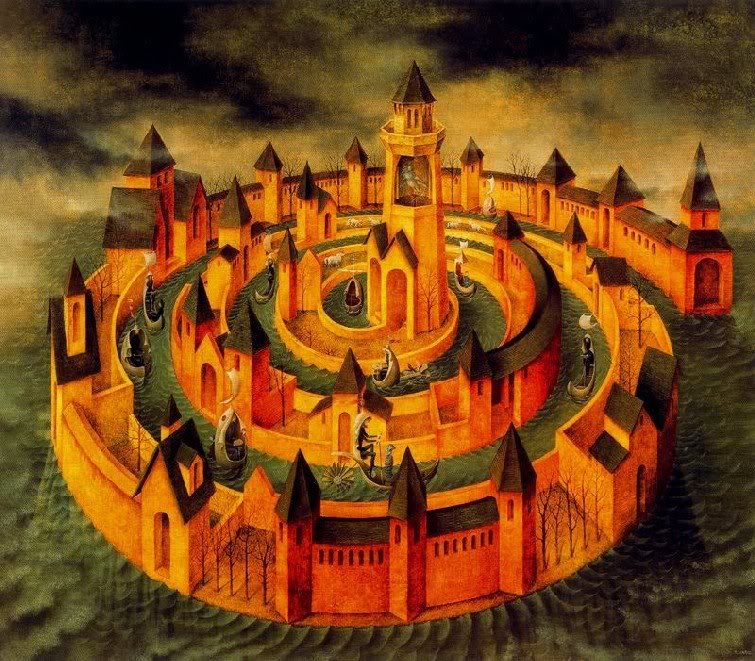
Remedios Varo, Spiral Transit

The act of moving around a sacred object is practised in many religions. There is a popular story about a Hindu god Ganesha, which is used to explain the origin of this practice. Once upon a time Shiva and Parvati wished to test their two sons – Ganesha and Karthikeya. “Whichever one of you goes around the world and comes back first is the winner,” said Shiva to his sons. The ambitious Karthikeya tried to circle the earth as fast as he could, but Ganesha simply went around his parents three times. “Why are you circling us?” asked Shiva. ‘”You are my parents and you represent the whole world to me,” said Ganesha, thus winning the contest.

I think this story is also an important reminder that we always need to consider whether the journeys we embark on are soulful or are just pointless distractions. Modern tourism often consists in mindless ticking off of destinations. I am reminded of a fantastic book written by Tiziano Terzani, an Italian journalist famous for his reporting work from Asia.

Image

Tiziano Terzani

The book is called A Fortune-Teller Told Me: Earth-bound Travels in the Far East and recounts his travels in one year of his life when he travelled all over Asia using all means of transport but the plane. A Chinese fortune teller had forbidden him to fly during that year. Although initially skeptical, Terzani decided to listen to the fortune teller’s advice and not fly during that year. Here are a handful of his reflections:

Suddenly, no longer able to rush off to an airport, pay by credit card and be swept off in a flash to literally anywhere, I was obliged once again to see the world as a complex network of countries divided by rivers and seas that required crossing. …

Covering great distances by train or boat restored my sense of the earth’s immensity. And above all it led me to rediscover the majority of humanity whose very existence we well-nigh forget by dint of flying: the humanity that moves about burdened with bundles and children while the world of the airplane passes in every sense over their heads.

My undertaking not to fly turned into a game full of surprises. If you pretend to be blind for a while, you find that the other senses grow sharper to compensate for the lack of sight. Avoiding planes has a similar effect: the train journey, with its ample time and cramped space, reanimates an atrophied curiosity about details. You give keener attention to what lies around you, to what hurtles past the window. …

As soon as you decide to do without planes, you realize how they impose their limited way of looking at things on you. Oh, they diminish distances, which is handy enough, but they end up diminishing everything, including your understanding of the world. You leave Rome at sunset, have dinner, sleep awhile, and at dawn you are in India. But in reality each country has its own special character. We need time if we are to prepare ourselves for the encounter; we must make an effort if we are to enjoy the conquest.

Frontiers, created by nature and history and rooted in the consciousness of the people who live within them, lose their meaning and cease to exist for those who travel to and from the air-conditioned bubbles of airports, where the border is a policeman in front of a computer screen, where the first encounter with the new place is a baggage carousel…

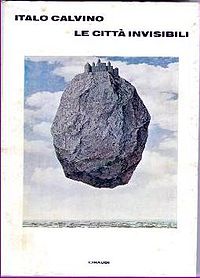
We have irrevocably lost the magic moment of ancient travels: looking at a new city emerging on the horizon. I sometimes feel nostalgic that we no longer conquer the world like Alexander the Great, on horseback. A famous Venetian traveller, Marco Polo, travelled in Asia for twenty-four years. His real travels were fascinating enough and are beautifully described in his travelogues, but there is a different book related to Marco Polo that I want to talk about. It is called Invisible Cities and was written by Italo Calvino, another brilliant Italian author.

Image

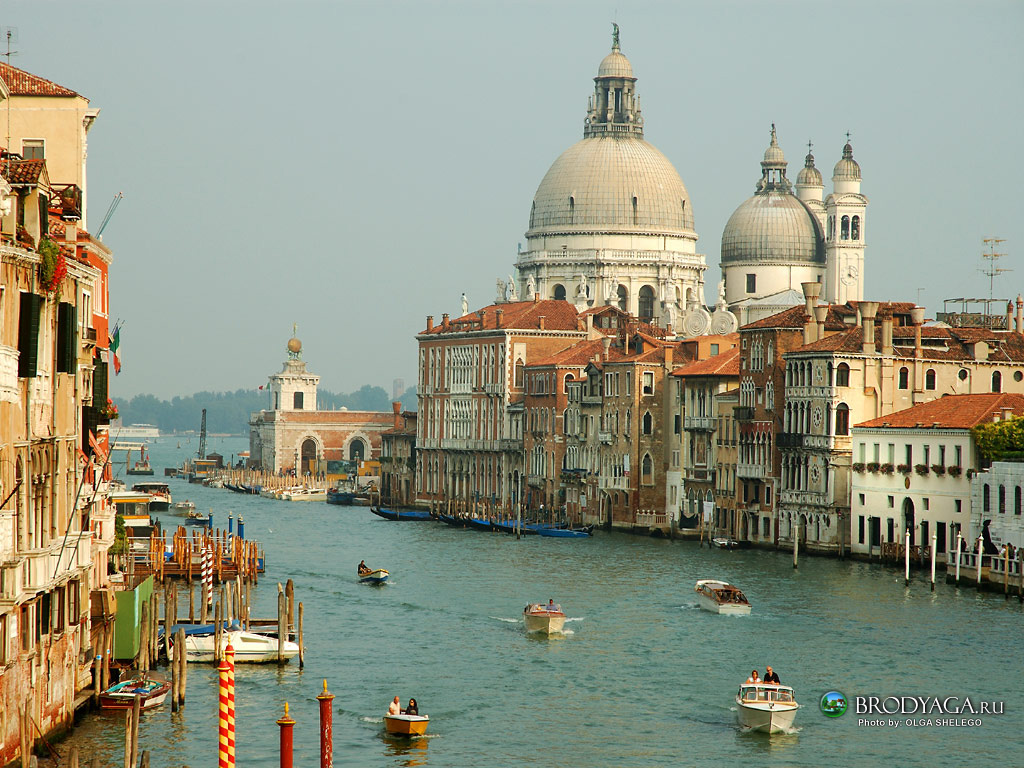
It is a wonderful feat of imagination,  containing 55 poetic descriptions of fantastic cities explored and described by Marco Polo to emperor Kublai Khan. The book deserves a separate post because it is so rich and imaginative, but I am mentioning it here because the key to the book is that all the cities the Venetian traveller described were in fact Venice, the city of cities, his hometown, the soul of Europe.

Marco Polo said to the Khan: “Every time I describe a city I am saying something about Venice.” The book, like the mandala, has a sacred centre, which is Venice, and every description of every city revolves around Venice and points to it.

Image

Venice

Reading the book I thought this to myself: Every soulful journey, every soulful movement contains stillness coming from the central, focal point. I particularly remember this dialogue:

Kublai Khan: I do not know when you have had the time to visit all the countries you describe to me. It seems to me you have never moved from this garden.

Marco Polo: Everything I see and do assumes meaning in a mental space where the same calm reigns as here, the same penumbra, the same silence streaked by the rustling of leaves. At the moment when I concentrate and reflect, I find myself again, always, in this garden, at this hour of the evening, in your august presence, though I continue, without a moment’s pause, moving up a river green with crocodiles or counting the barrels of salted fish being lowered into the hold.

As Lao Tzu said: “The Sage travels all day yet never leaves his inner treasure.”

Posted in Travels | Tagged , , , , , , , , , , , , , , , , , , , , , , , , , , | 27 Comments

Fascinating Mythical Creatures: Proteus

Image

image via http://www.deviantart.com/morelikethis/artists/244344135?view_mode=2

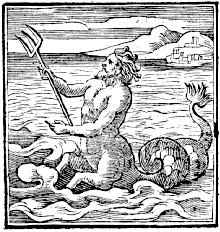
Proteus was a wise Greek sea god, a shape changer and a prophet. Pictured as fish-tailed, he was able to change himself into a lion, a serpent, a panther, a wild boar, a tree and flowing water. In order to get answers from him concerning the future, it was necessary to wrestle him and bind him, then wait patiently through all the transformations for the voice of prophecy. He is an image of something elusive, flickering and ineffable that wriggles shakes and transforms many times before it stabilizes as an image that can be comprehended by consciousness.

Image

Proteus is a great metaphor of working with archetypes and symbols. They are creatures of the deep ocean of the collective unconscious and this is where they feel best. They do not fare well in the world of hard matter or clear-cut mental distinctions. Out of water they may get too dry, lose their colour, become lifeless. Like Proteus, they cannot wait to return to their proper realm. Waking up in the morning, we try to capture the dream images, but they change their shapes rapidly, often fading away too fast for the consciousness to capture their meaning. Whatever we say about them will never be enough: it would always be possible to go deeper because their Protean oceanic wisdom is unfathomable. How many times their wisdom is lost, annihilated by the stern voice of the classifying mind. As Jung wrote in Memories, Dreams, Reflections:

I felt that at some time or other I had passed through the valley of diamonds, but I could convince no-one – not even myself, when I looked more closely – that the specimens I had brought back were not mere pieces of gravel.

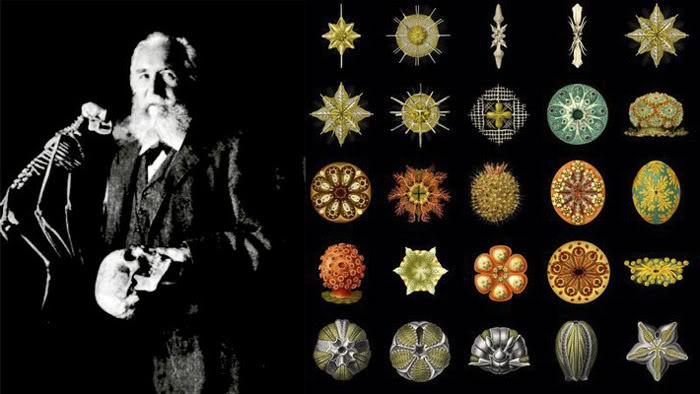
All the manifest forms have emerged out of the protean, shifting, unstable, shaping and reshaping watery realms of imagination and ceaseless creativity. A 2004 documentary on Ernst Haeckel, a nineteenth-century biologist and artist, who studied tiny radiolaria, ancient one-celled marine organisms, includes stunning animation sequences of the shapeshifting of these tiny creatures, whose geometric skeletons show the infinite creativity of form and pattern. It is a mystical vision: the organic world of radiolaria mirrors the world of the archetypes in its breathtaking beauty and diversity, eternal unity in manifold manifestation. Haeckel went to the valley of diamonds and brought back precious and beautiful gems.

Image

Ernst Haeckel

Posted in Proteus | Tagged , , , , , , , , , | 37 Comments

Grand Trine in Water – Memory of the Future, Part 1

There is so much I like about this post: its depth and clarity in rare equilibrium, the fact that it can be understood by astrological laypeople, the musings on time and memory, and some etymology as a cherry on top. The second part also makes a great reading:

http://thenightride.wordpress.com/2013/07/22/grand-trine-in-water-memory-of-the-future-part-2/

Posted in Uncategorized | 6 Comments

Flying Kites

Image

Symbolreader will be away, taking some time off, summer vacationing, walking in nature and reading under trees.

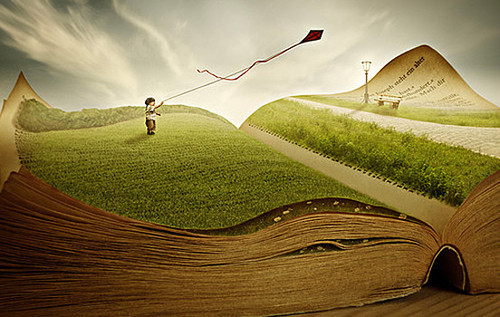
To feel most beautifully alive means to be reading something beautiful, ready always to apprehend in the flow of language the sudden flash of poetry.

A word is a bud attempting to become a twig. How can one not dream while writing? It is the pen which dreams. The blank page gives the right to dream.

Gaston Bachelard


Posted in Uncategorized | Tagged , , | 34 Comments

Colour Symbolism: Blue

Image

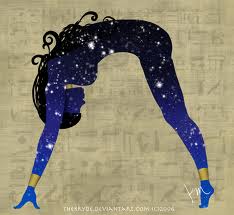
the modern Nut, via http://the-broom-cupboard.blogspot.ch/2011/07/facebook-page-for-goddess-nut.html

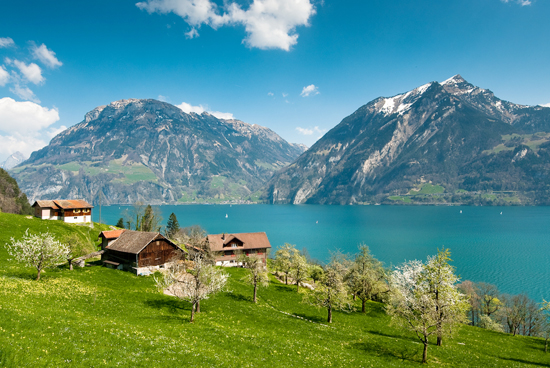
If it is true, as Flaubert says, that one does not choose their subject matter but rather submits to it, then I must write about the colour blue today. You have heard of the Grand Water Trine currently in operation on our beautiful Blue Planet. At the moment, I am dreaming of nothing else but submerging myself in a crystal clear, blue lagoon and never leaving. Alternatively, I could spend hours now gazing at some azure Alpine lake or just sitting on the shores of Lake Lucerne and dreaming.

Image

Lake Lucerne

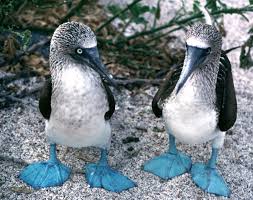
Then there are other meaningful coincidences. While shopping for clothes I need to decide – the red or the dark blue blouse? Very uncharacteristically for myself, I went for the latter. Before the days of gender equality, boys’ rooms were painted blue, girls’ pink – I thought to myself but did not see my decision as an act of defiance, but more as an act of giving in to my thirst for blue. Then I saw this wonderful bird on the Internet – the blue-footed booby. Its bright blue feet are a sexually selected trait. Males display their feet in an elaborate mating ritual by basically dancing, which you can see on youtube. Brighter feet are deemed more attractive.

Image

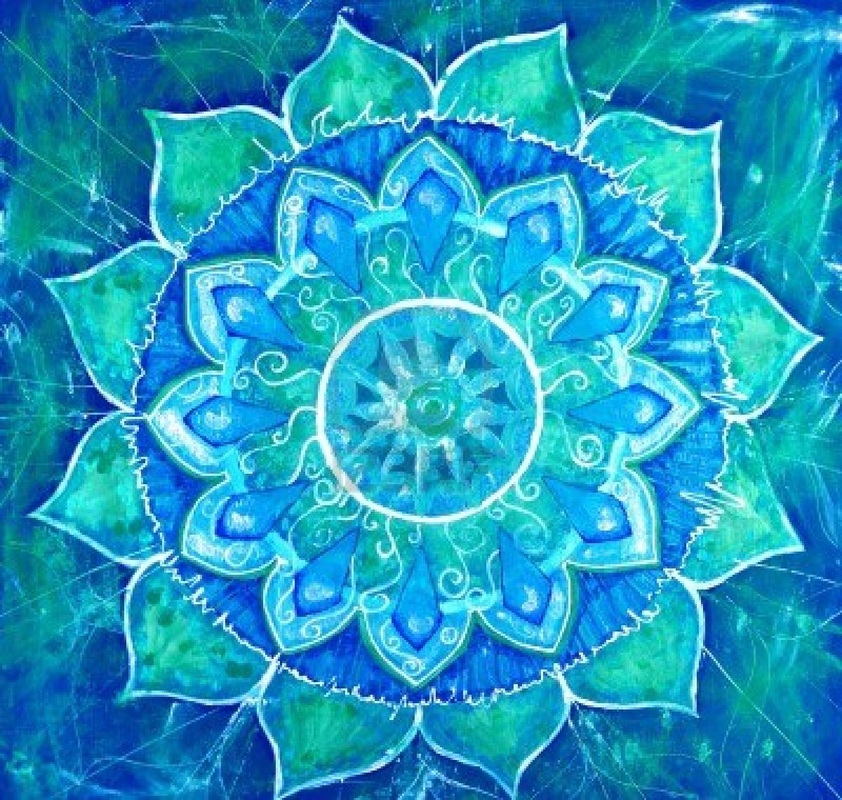
Symbolically, dark blue belongs to a group of colours that correspond to dissimilation and passivity along with violet and black. But clear or light blue stands for thinking and clarity, a quality denied to girls in the past. Dark blue is the colour of the night and the unconscious processes of the psyche. Blue is a wonderful symbolic colour because it stands for height (sky) and depth (ocean) at the same time. Soaring with the Great Spirit and going deeper and deeper with only your Soul as a companion. Transcendence and immanence. Darkness and clarity.  Blue is the colour of the throat chakra, which symbolizes our ability to express ourselves through speech. The throat chakra also deals with decisiveness and self-expression via communication. Forgiving yourself and forgiving others for the wrong words that have been said and learning to trust again is what I also associate with this energy centre. I would also like to acquire a voice that is heard and listened to. How to be an authority without being condescending or paternal? How to stand your ground but speak with empathy and kindness?

Image

the throat chakra, via http://www.thejoyoflivingwell.com/1/post/2013/01/forgiveness-and-the-throat-chakra.html

I would also like to express my gratitude to a fellow blogger from ptero9.wordpress.com for her series on James Hillman’s Alchemical Psychology. I have not read that book but I hope to in the future. Here is a link to part II dedicated to the colour blue: http://ptero9.com/2013/07/18/alchemical-psychology-part-ii-blue/

But you may want to take a look at the first part about black as well.

According to Hillman, in the alchemical process, from the depression and despair connected with black comes the blue reflection. In the darker times of our lives we need to disown and let go of certain attachments that no longer serve us. With it inevitably comes a sense of sadness – feeling blue as it were. Forgiveness is a necessary part of the process. Quoting Hillman after my blogger friend:

The dark blue of the Madonna’s robe bears many shadows, and these give her depths of understanding, just as the mind made on the moon has lived with Lilith so that its thought can never be naive, never cease to strike deep toward shadows.  Blue protects white from innocence.

Less innocent and naïve but wiser perhaps. I like this sentence from her post: “Blue keeps us in touch with the black of the underworld, the darkness and sometimes terrifying nature of life, giving us enough distance that we neither identify with the darkness, nor the childish insistence that everything is good.” There are certain events in life which decisively mark the end of childhood innocence.  I am compelled to reread Night by Elie Wiesel about his experience as a prisoner in the concentration camp of Auschwitz, where he as a teenager was with his father. As a matter of fact, I was not born far from that place and a school trip there is still painfully vivid in my memory. Wiesel’s series Night, Dawn and Day shows his transition from the darkness of post-Holocaust despair to a new light and hope. As I remember it, the book is ruthless and painful.

Image

Image

Elie Wiesel

One of the protagonists of Night says: “I pray to the God within me that He will give me the strength to ask Him the right questions.”

I pray to find my own voice that is both deep as dark water and clear as blue sky.

Image

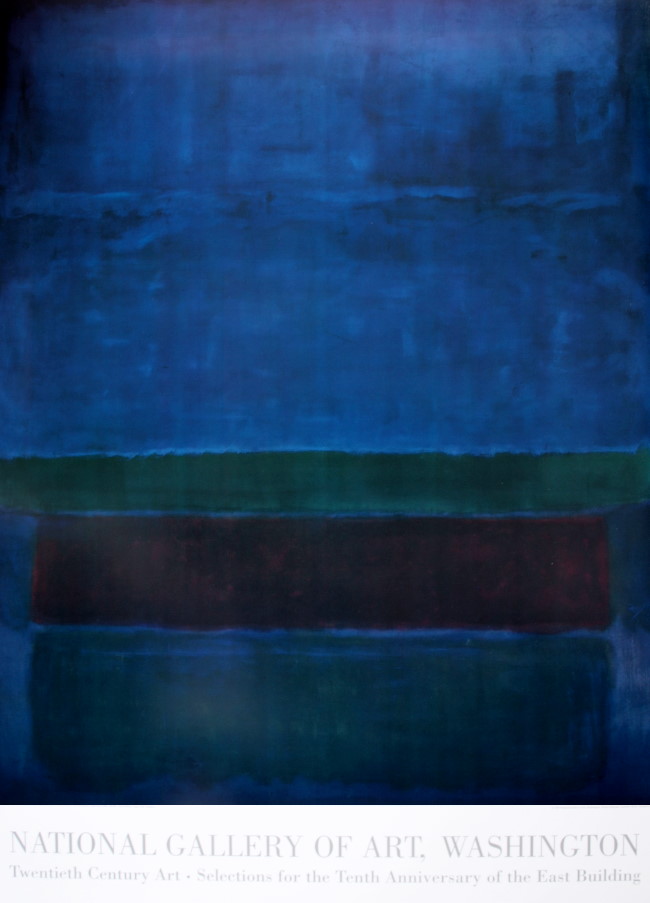
Rothko, Blue, Green and Brown (no other painter understood colour better than him)

Image

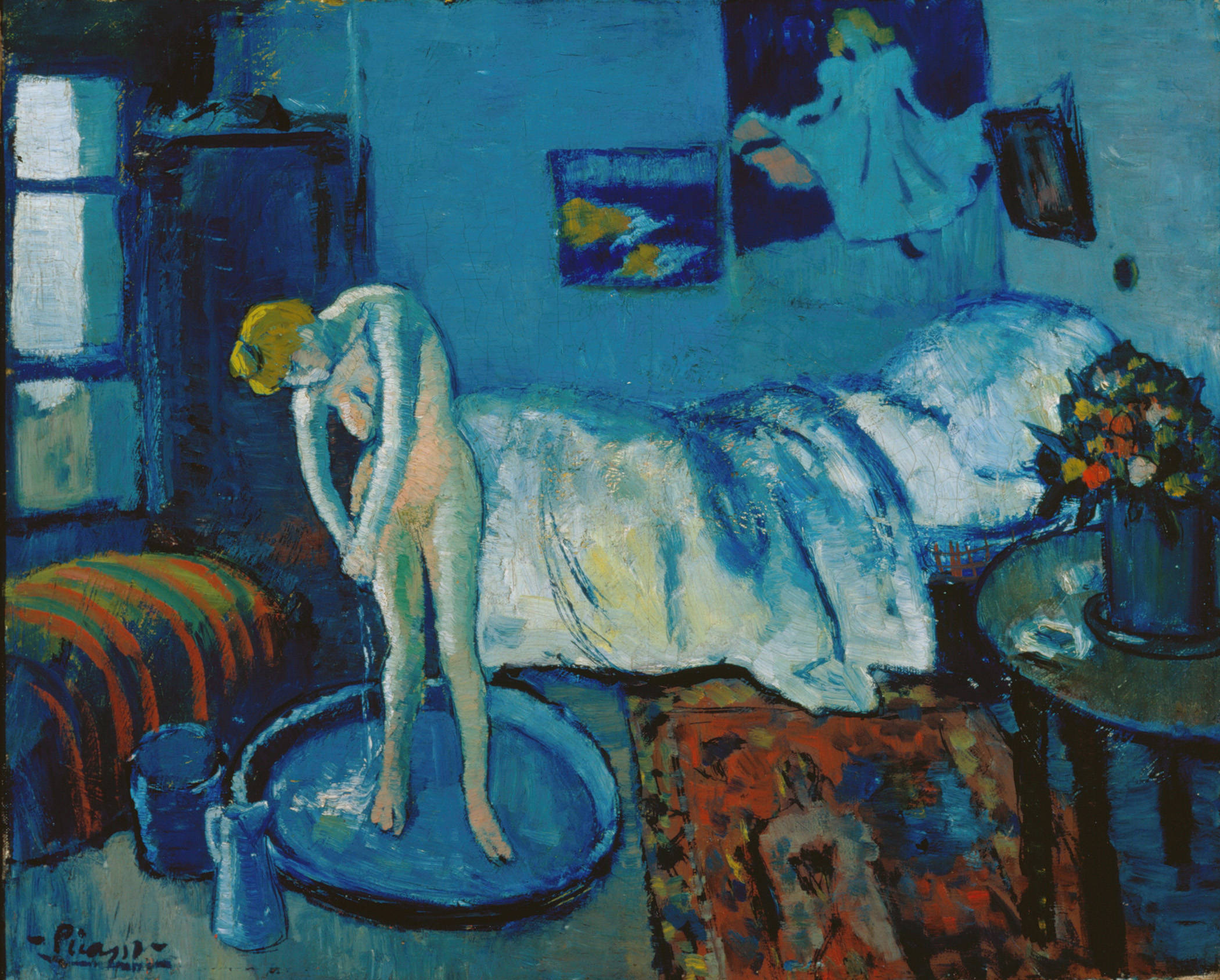
Picasso, The Blue Room

Posted in Blue | Tagged , , , , , , , , , | 44 Comments

I Love You, My Secret Raven

It is entirely conceivable that life’s splendor forever lies in wait about each one of us in all its fulness, but veiled from view, deep down, invisible, far off. It is there, though, not hostile, not reluctant, not deaf. If you summon it by the right word, by its right name, it will come. This is the essence of magic, which does not create but summons.

You do not need to leave your room. Remain sitting at your table and listen. Do not even listen, simply wait, be quiet, still and solitary. The world will freely offer itself to you to be unmasked, it has no choice, it will roll in ecstasy at your feet.

Franz Kafka

Image

FIRST SENTENCE, FIRST LOVE

I have always paid a lot of attention to the first sentences of my favourite novels. I especially like it when the sentence appears to be inspired, complete and you simply cannot imagine a different one as the beginning. Franz Kafka was a master of first sentences. No unnecessary adornments, no attempts to flirt with or dazzle the reader or to be charming  – just a brutal throwing into the middle of things. We are somewhere in an existential situation that happened in the past, is happening right now and will be happening in the future. We are in the middle of the existential struggle. The sentences are oddly impersonal, symbolic, archetypal, and, at least in me, they never fail to awake the deepest emotions. Who has not read this one from the Metamorphosis:

 As Gregor Samsa awoke one morning from uneasy dreams he found himself transformed in his bed into a gigantic insect.

Or my favourite from The Castle:

 It was late evening when K. arrived.

Why I fawn on this, I do not know exactly, but I always do. I think the key is that his writing stirs me to the core and has a transformative quality that few other authors can offer. I also like the air of mystery and the haunting impossibility of interpretation. It is good not to be able to understand it completely. Kafka was not a religious man but one of the famous critics, whose name I do not remember, called him the greatest religious author of the twentieth century. For me his writing is numinous and revelatory; a lot of its meaning is hidden and veiled, as it should be. I have no key to Kafka and I am not looking for it. I would never dream of deconstructing the meaning behind the Castle; I find it quite interesting that both in Polish (my native language) and in German (Kafka wrote in German) the world castle sounds the same (or very similar in the case of German) to the lock. Let that lock be not tampered with.

DO NOT EDIT YOUR SOUL

Admittedly, Kafka’s Diaries are tedious at times, fascinating at some points, very private, very meticulous, very deep. What I value about his fiction, on the other hand, is its condensed brevity, wit, dreamlike quality, deep, multi-faceted symbolism and universality. There are no trivial, unnecessary details, just raw but chiseled perfection. Furthermore, what captured me right from the start was the emotional impact of his writing. He wrote once: “Don’t bend; don’t water it down; don’t try to make it logical; don’t edit your own soul according to the fashion. Rather, follow your most intense obsessions mercilessly.” His writing is indeed merciless – probing very deep like “the axe for the frozen sea within us.” (another celebrated quote of his). Haruki Murakami, a Japanese author I am really fond of, was influenced by Kafka. The following quote from his novel 1q84 struck me as very Kafkaesque:

 He had always had something like a clod of frozen dirt stuck in his heart – a hard, cold core he had always lived with. He had never even felt it as cold. For him this was the normal temperature. Even so, Fuka-Eri’s gaze had, if even for a moment, melted that icy core. And it brought on the dull ache. The warmth and the pain came as a pair, and unless he accepted the pain, he wouldn’t feel the warmth. It was a kind of trade-off.

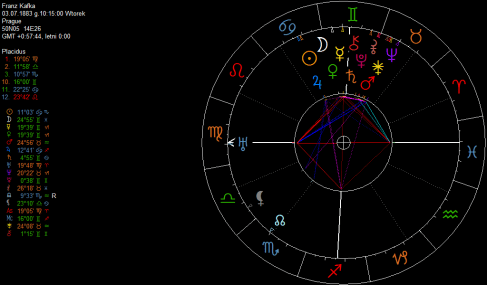
You can see Kafka’s natal chart below. He was a Cancer with a stellium in Gemini. What I found particularly striking was the conjunction of Chiron, Saturn and Pluto in Gemini. With his writing he confronts us with our deepest wounds, limitations and fears. His time of birth is unknown, it is only my intuition which gives him the Virgo Ascendant. I will return to this later.
Image

THE INNER TURMOIL OF THE SECRET RAVEN

His Diaries reveal a deeply troubled soul. Sickly (he died of tuberculosis at the age of 41), dependent on his parents (he described his parental home as a prison erected especially for him, with no visible bars or walls and therefore impossible to escape), afraid of women and his own lustful instincts, forced to work in a dull office job, which robbed him of the precious time for writing, he saw no way out of his inner conflict. In his photograph he looks like some kind of a grotesque elf, his eyes are so desperate and lost; he looks like a being from another planet or dimension. This is one of the most significant quotes from his Diaries:

 I don’t believe people exist whose inner plight resembles mine; still, it is possible for me to imagine such people but that the secret raven forever flaps about their heads as it does about mine, even to imagine that is impossible.

Image

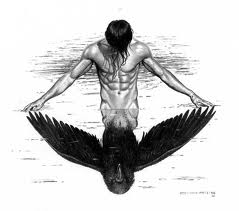
Raven vs Man, Image via http://mtjforever.deviantart.com/art/Raven-vs-Man-307940612

He did look for help, even in the most unlikely places. In his Diaries, he describes in detail what he said in conversation with the celebrated esotericist, Rudolf Steiner, but characteristically he remains quiet about how the luminary of antroposophy responded:

 Aside from my family relationships, I could not live by literature if only, to begin with, because of the slow maturing of my work and its special character; besides, I am prevented also by my health and my character from devoting myself to what is, in the most favourable case, an uncertain life. I have therefore become an official in a social insurance agency. Now these two professions can never be reconciled with one another… The smallest good fortune in on becomes a great misfortune in the other. If I have written something good one evening, I am afire the next day in the office and can bring nothing to completion. … Outwardly, I fulfill my duties satisfactorily in the office, not my inner duties, however, and every unfulfilled inner duty becomes a misfortune that never leaves.

Daryl Sharp, a brilliant Jungian analyst and author, wrote a treatise about Kafka’s individuation under the title Secret Raven: Conflict and Transformation in the Life of Franz Kafka. His analysis of Kafka’s inner life and his interpretation of his dreams have been very inspiring to me. I am going to supplement his observations with some astrological and mythological musings.

Kafka undoubtedly struggled under a neurotic conflict; he was deeply torn and ambivalent about love and work, which, according to Freud, form the cornerstones of our humanness. Six planets in Gemini, including his Moon, means that he was forever fighting his inner twin. I love Liz Greene’s analysis of the myth behind the sign of Gemini. For her the twins reflect the experience of opposites. In the mythical story, Castor is a mortal twin, Polydeucus immortal. Castor gets slain in a battle. Struck by grief, Polydeucus asked Zeus to bring his brother back to life or to allow Polydeucus to sacrifice his own life for that of his brother. Zeus allows the twins to alternate between Hades and Olympus – to go from death and darkness into the pleasures of eternal life and back again. Liz Greene says that this myth portrays “the conflicting experiences of bondage to a mortal body with its sense of loss and death, and exaltation to the realm of spirit and eternal life” (The Astrology of Fate). Geminis are always brought in conflict with what they perceive to be their opposite, but what is in fact their own shadow. Reconciling the warring principles was Kafka’s life mission, which he might have succeeded in in the last year of his life. Until then, he was reenacting the myth of Tantalus – the fruit of his desire was within reach (his only love and desire was to devote all his time to his writing) but he was too tormented, too scared to pluck it. As a result of his plight, he experienced chronic insomnia, lack of energy, headaches, deep sadness and a whole array of other bodily symptoms. My intuition tells me that his Ascendant must have been in Virgo with Uranus on the Ascendant. He was obsessed with purity and often displayed the abhorrence of lustful instinct, putting a sharp break on all his libido drives. Guilt and shame are the most frequent emotions experienced by the characters in his works. He was not interested in astrology but his symbolic thinking was brilliant, which is revealed in the following quote from his Diaries again:

 “Incapable of writing a line . . . . Hollow as a clamshell on the beach, ready to be pulverized by the tread of a foot.”

How incredible he should compare himself to a crab, a creature which in myth was indeed trodden upon and vanquished by Hercules fighting the hydra.

With all that air and (possibly) the freedom loving Uranus on the Ascendant, he craved independence but feared it simultaneously because he abhorred uncertain existence. He was said to have carried out his office duties to the letter, even excessively and obsessively. He knew his job was futile and could have been done by a lesser man intellectually but he felt compelled to excel at it, nevertheless. It was always a tragic conundrum that ate at his soul.

Daryl Sharp does a brilliant analysis of a dream of his that I am quoting from his Diaries:

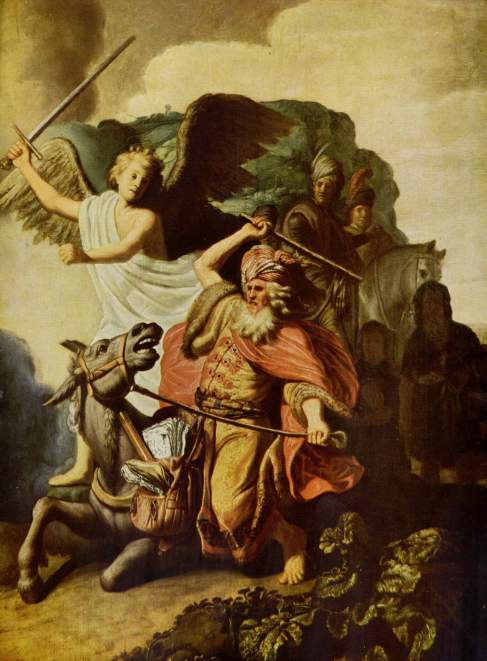
 I dreamed today of a donkey that looked like a greyhound, it was very cautious in its movements. I looked at it closely because I was aware how unusual a phenomenon it was, but remember only that its narrow human feet could not please me because of their length and uniformity. I offered it a bunch of fresh, dark green cypress leaves which I had just received from an old Zürich lady (it all took place in Zürich), it did not want it, just sniffed at it; but then, when I left the cypress on a table, it devoured it so completely that only a scarcely recognizable kernel resembling a chestnut was left. Later there was talk that this donkey had never yet gone on all fours but always held itself erect like a human being and showed its silvery shining breast and its little belly.

What follows is a summary of Daryl Sharp’s interpretation of that dream. The donkey is a symbol of lasciviousness as an animal connected with Dionysus, the god of wine, ecstasy and sexuality. In the Egyptian myth it is associated with Set – the murderer of Osiris, the dark god symbolizing brutality and evil. However, it was the donkey that Christ chose to ride into Jerusalem. Also, the manger in Betlehem was surrounded by benevolent donkeys. The donkey is thus both chthonic (earthy) and Christlike. In Kafka’s dream it resembled a greyhound, a superfast lean dog that barely touches the ground while running. Sharp suggests that the lightness of the greyhound contradicts the bodily nature of the donkey – there is too much spirit where there should be body. The narrow human feet also suggest excessive humanization of the pure instinct. In Apuleius’ story The Golden Ass the donkey must first live out his brutish lustful nature before he can transform by eating the roses of Isis. The donkey from Kafka’s dream holds itself erect, desperately trying to be human and rejecting its animality. The abnormality of the creature shows the quarrel of opposites and a rejection of animal instincts by consciousness.
Image

Rembrandt, Balaam’s Ass

The cypress, a graveyard tree, is a very important symbol of death and resurrection. It was believed in ancient China that its leaves are rich in yang substance and give long life. It is the life food for the chthonic donkey, who does not eat while being observed because the instinct switches off when we watch and analyze it too closely. Kafka starved his inner donkey – this seems to be the message of the dream. He hated his body (there are long pages in his Diaries, where he writes about being ashamed to swim in public swimming pools for fear of being laughed at), was ashamed of it and always censoring and reproaching his instincts.

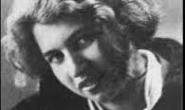
As I have already mentioned, he suffered from the incurable tuberculosis, but in the last two years of his life he finally gave in to instincts and desires, left the parental home and moved in with his lover, Dora Diamant. For her, he turned his life upside down and apparently overnight. When he first saw her she was scaling a fish in the kitchen. Daryl Sharp was amazed by the symbolism of this scene. He writes of fish as “a symbol of (to name but a few) fertility (Ishtar, Oannes), sexuality (Osiris, Aphrodite), resurrection and immortality (Osiris, Christ, Noah), salvation (Vishnu, the Rabbinical Messiah, Christ, Pisces), wisdom (Oannes, Varuna), the beginning of all things (Tiamat, Leviathan), wholeness (the lapis in alchemy), healing (Tobias in The Book of Tobit), and redemption through suffering (Christ).” She was the key to Kafka’s final transformation and rebirth, which happened when he was forty, which is symbolic in its own right. Christ spent 40 hours in his tomb before resurrection and on earth 40 days before ascension. The prophet Elijah spent 40 days in the desert, where he was fed by ravens (!). In alchemy the philosopher’s stone appears in the retort after 40 days. Kafka himself wrote: “I have been forty years wandering from Canaan.”
Image

Dora Diamant

“Self-knowledge has certain ethical consequences which are not just impassively recognized but demand to be carried out in practice,” wrote Jung. It took Kafka almost forty years to put his self-knowledge to practice. He was the most creative in that last period of his life and this is when he started writing The Castle, my favourite novel of his, which he did not have time to finish. It still has dark themes because even though Kafka finally found the courage to stand on his own two feet, sadness and melancholy were always in his nature  – like the dark twin in the myth. But he had stopped living what Jung called “the provisional life” in which we never have what we want, are always “about” to take the plunge into the real life, our future plans never reach fruition and we are lost in endless fantasies of what could be. In the preceding neurotic period he had written: “My life is a hesitation before birth.” What a paradox that he was reborn only short before his death. It was then that he finally realized that what he felt was the most important and not all the should’s and ought to’s that always stem from fear.

 MY (TENTATIVE) TAKE ON THE CASTLE

Here is the beautiful beginning of The Castle:

It was late evening when K. arrived. The village lay under deep snow. There was no sign of the Castle hill, fog and darkness surrounded it, not even the faintest gleam of light suggested the large Castle. K. stood a long time on the wooden bridge that leads from the main road to the village, gazing upward into the seeming emptiness.

Image

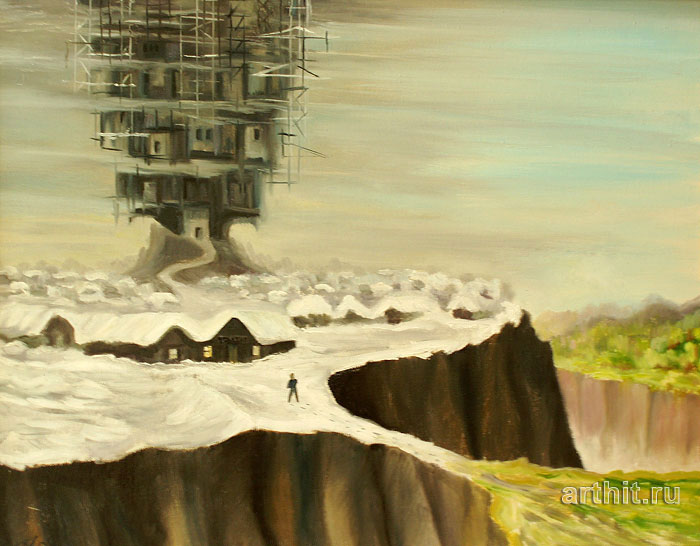
Sergey Voolazkin, Kafka’s World: The Castle, via http://www.arthit.ru/landscapes/0089/landscapes-7.html

In the novel, K., a land surveyor, tries in vain to gain access to the mysterious castle looming over the village. On the one hand, the Castle seems to be a gigantic bureaucratic apparatus. The Castle officials spend their working day sitting behind a long desk, reading large books and dictating to clerks in a barely audible whisper. On the other, the villagers seem to almost pray to the Castle and its dwellers; it seems to be a luminous and numinous mystery, a shining star guiding the main character, an unreachable goal or ideal. It turns out K. is a stranger who is not authorized to even stay in the village, let alone carry out his surveying duties. The theme of rootlessness, not belonging is obvious and very autobiographical in the case of Kafka.

For me the Castle may also symbolize the absurdity of day to day duties that we impose on ourselves, the invisible structure that can devolve into our prison.  Kafka’s conflict with his father is apparent here – from his Diaries the father appears to be a fleshy, dominant man looming over the frail, thin Kafka with his threatening presence and unforgivable authority. All the dwellers of the Castle are male adults. The Castle officials do not interact with villagers unless they require sexual services of village women. Writing the novel must have been incredibly therapeutic for Kafka: the ominous Castle is still there, still bothering his unconscious, but the main protagonist is able to blend in with the villagers, to love and to feel, to experience sensual pleasure and a sense of belonging, if only transitory. Still, the theme of duality does not seem to leave him: the Castle is juxtaposed with the village, also K. has two bothersome assistants who act like twins and tricksters and are hard to tell apart. They were “newly freed from the severity of Castle discipline, and therefore always a little excited and bewildered and in that state apt to get up to silly mischief.” K. was always angry with them, which might suggest Kafka’s inner torment and being torn between dark, heavy moods and the usual playfulness, silliness and happiness of all that Gemini energy in his chart.

In symbolism, the meaning of the castle is very complex. I am summarizing J.E. Cirlot’s description of that symbol. First of all, it is a symbol of the transcendent soul. Kafka was an extremely sensitive man with an enormous thirst for transcendence but he was not spiritual because of his inherently skeptical nature.  He brushed shoulders with some esotericists, such as Rudolf Steiner, but could not bring himself to accept any belief or practice that they offered. He was perhaps too self-absorbed, mean critics might claim, but the result of this self-absorption is nothing short of perfection.

The castle is also an embattled, spiritual power, ever on the watch. The Castle of Darkness is where Hades lived and no living soul ever returned from. In that sense the Castle might have been foreshadowing Kafka’s anticipation of death as his final initiation. I do not see any qualities of light associated with the Castle in the novel. The only redemption K. seems to find is in engaging life and letting go of the obsession with the transcendent, which in his case seemed unreachable. But he might have found his salvation in immanent revelations.

As a final note, I would like to invite you to watch  a short, animated film on Kafka created by a brilliant Polish artist, Piotr Dumala. Dumala (born on 9 July, so another Cancer) deserves a separate post, but briefly here is a short note from Wikipedia about his technique:

 While training to be a sculptor, he discovered that scratching images into painted plaster could be a beautiful way to create animations. This is only one technique of a method called destructive animation, where one image is erased (in this case, painted over) and re-drawn to create the next frame in the sequence.

He places plasterboard painted in black under the camera. Each phase of movement is engraved with thin needles. He scratches the paint and thus obtains white lines and hatches on the dark background. Each drawing has a very high graphic value. However, after being recorded, every drawing is repainted with black paint so that they live shorter than a drawing made by a finger on a steamy window. His work has placed him among the greatest creators who have improved the technique of animation with original innovations.

The result of this painstaking approach is stunning and shows his deep understanding of Kafka’s inner life. Here is the link:

http://www.openculture.com/2013/07/watch_ifranz_kafkai_the_wonderful_animated_film_by_piotr_dumala.html

Posted in Franz Kafka | Tagged , , , , , , , , , , , , , , , , , , , , , | 52 Comments

Side by Side

Posted in Uncategorized | 2 Comments

The Thirst Inside the Syllables

Image

Today is the anniversary of Pablo Neruda’s birthday. He is most famous for his love poems but for me he was first and foremost an outstanding symbolist. It is astonishing how many great poets and writers were born under the sign of Cancer. I am working on a post about Kafka (born 3 July), who I worship obsessively, but Neruda has oftentimes given me a sense of rapture, especially if I realize they were originally written in Spanish, which to my ears is the most beautiful sounding language in the world (En el amor, como agua del mar te has desatado… – In love, you have loosened yourself like seawater). I appreciate also that his verses are so full of life and very earthy, fleshy and sensual. This is actually why I wanted to learn Spanish and tried it diligently for a few years, but sadly now a lot has been lost.

I have chosen some of his more beautiful verses:

 Love is the mystery of water and the star.

Image

 …so I wait for you like a lonely house
till you will see me again and live in me.
Till then my windows ache.

Give me silence, water, hope
Give me struggle, iron, volcanoes.

Everything is ceremony in the wild garden of childhood.

Image

Jozef Mehoffer, Strange Garden (a great Polish painter)

And the verse falls to the soul like dew to the pasture.

So it does indeed.

Posted in Poetry | Tagged , , , , | 12 Comments