The Blessings of Darkness and Light: Tribute to Khalil Gibran

gibran_el_profeta

I.“Now I know that I am the sphere, and all life in rhythmic fragments moves within me.”

“The reality of the other person is not in what he reveals to you, but in what he cannot reveal to you.”

“Love is the veil between lover and lover.”

Khalil Gibran, “Sand and Foam”

II.“And think not you can direct the course of love, for love, if it finds you worthy, directs your course.

Love has no other desire but to fulfil itself.”

“The deeper that sorrow carves into your being, the more joy you can contain.”

“Your pain is the breaking of the shell that encloses your understanding.”

Khalil Gibran, “The Prophet”

On 6 January, birth day of Khalil Gibran, The New Yorker shared an article “Prophet Motive,” which was originally published in 2008. To speak of Khalil Gibran without any kind of spiritual sensitivity is a travesty, and this is precisely what I thought of the article. The author gleefully expresses her contempt that The Prophet, though largely shunned by literary critics, is the third best selling book of all time, giving way only to Shakespeare and Lao-Tsy. The article contains a lot of unfounded conjectures concerning Gibran’s private life (also his inner life) and relationships, while simultaneously dismissing his writing in passages such as this, devoted to The Prophet:

“Almustafa’s advice is not bad: love involves suffering; children should be given their independence. Who, these days, would say otherwise? More than the soundness of its advice, however, the mere fact that “The Prophet” was an advice book—or, more precisely, “inspirational literature”—probably insured a substantial readership at the start. Gibran’s closest counterpart today is the Brazilian sage Paulo Coelho, and his books have sold nearly a hundred million copies.

Then, there is the pleasing ambiguity of Almustafa’s counsels. In the manner of horoscopes, the statements are so widely applicable (“your creativity,” “your family problems”) that almost anyone could think that they were addressed to him. At times, Almustafa’s vagueness is such that you can’t figure out what he means. If you look closely, though, you will see that much of the time he is saying something specific; namely, that everything is everything else. Freedom is slavery; waking is dreaming; belief is doubt; joy is pain; death is life. So, whatever you’re doing, you needn’t worry, because you’re also doing the opposite.”

The profound mystical truth of the unity of opposites was first put forward by Heraclitus. It reverberated in the work of the greatest mystics of centuries to come: Nicholas of Cusa, Meister Eckhart, Paracelsus, Carl Jung, Gershom Scholem, William Blake, to name just a few; as well as in Buddhism, Hinduism, Taoism and Sufism. Coincidentia oppositorum was the aim of the alchemical opus. Thus, the secret of Gibran’s appeal is not his simplicity but its quality of uniting and transcending all creeds, religions and dogmas, finding their shared spiritual and mystical core. Comparing Gibran to Paulo Coelho is both sad and hilarious, if I may add another paradox to the writer’s list. But calling The Prophet an advice book captures rather ingeniously everything that is wrong with the arid shallowness and soullessness of Western intellectualism.

art-Divine_World

Khalil Gibran, “Divine World”

The Prophet is, to me, one of the most profound works ever created. Surely, from purely literary perspective it may be lacking (English was not Gibran’s first language – he came to America not speaking it at all), but its spiritual impact, its wisdom and the way it stirs the heart, more than compensates for all its alleged shortcomings. Also, some turns of phrase are sheer beauty. And perhaps most importantly, i strongly believe that the words of Khalil Gibran possess a healing quality, though I cannot prove it. It is an extraordinary legacy to the strength of his spirit how he, a child of poor parents from Lebanon, whose mother was forced to leave her native country, with the help of rich patrons and his own strength of character managed to overcome his initial cultural and linguistic handicap. Not completely, though, because as an Arab immigrant he was never able to quite shed the stigma. He remained a second-class citizen, which might have driven him into alcoholism and depression, though this is sheer speculation. In a BBC documentary much more sympathizing with Gibran than the New Yorker article, it is suggested that being an immigrant he was not able to marry his lifelong patroness Mary Haskell because she would have lost her job and her family if that had happened.

mary_haskell

Mary Haskell

However, the New Yorker article claims that he never intended to marry her and simply took financial advantage of her weakness towards him. How does gold digging fit, though, when even if he was making a fortune on his royalties (which came much later in his life) he never left his New York studio apartment, which he lit with candles and called his hermitage? The same article deals quite offensively with the year 1902, when Gibran’s mother, brother and sister all died, suddenly leaving him alone in the world. The following quote from the article is simply stunning in its arbitrariness: “…there is no evidence that Gibran mourned any of them for long. It is hard to escape the thought that this ambitious young man was not inconvenienced by the loss of his slum-dwelling family.” The BBC documentary, on the other hand, paints a picture of a young man deeply struck by tragedy. It was this painful experience that made the lines in The Prophet devoted to pain and suffering so deeply moving: “It is the bitter potion by which the physician within you heals your sick self.”

87681

Kahlil Gibran, “Towards the Infinite (Kamila Gibran, mother of the artist), 1916, via http://www.metmuseum.org/collection/the-collection-online/search/487710

What The Prophet imparts is not simplistic or fluffy or “new-agey.”  My personal favourite passages are concerned with the role and nature of evil in the world. Consider this excerpt and its implications:

“And this also, though the word lie heavy upon your hearts:

The murdered is not unaccountable for his own murder,

And the robbed is not blameless in being robbed.

The righteous is not innocent of the deeds of the wicked,

And the white-handed is not clean in the doings of the felon.

Yea, the guilty is oftentimes the victim of the injured,

And still more often the condemned is the burden bearer for the guiltless and unblamed.

You cannot separate the just from the unjust and the good from the wicked;

And if any of you would punish in the name of righteousness and lay the axe unto the evil tree, let him see to its roots;

And verily he will find the roots of the good and the bad, the fruitful and the fruitless, all entwined together in the silent heart of the earth.”

32.45.5 - color

Khalil Gibran, Sketch for “Jesus the Son of Man,” via http://www.metmuseum.org/collection/the-collection-online/search/487711

In Gibran’s lesser known, but excellent work called Jesus, the Son of Men, those who knew Jesus are given voice to speak about him. For example, John, his beloved disciple, says of Jesus: “I loved Him because He quickened my spirit to heights beyond my stature, and to depths beyond my sounding.” Gibran is said to have had a lifelong fascination with Jesus, and the above quote is also true of his impact on many souls of his contemporaries and of those who still continue to discover the book today. By Muslims he is predominantly viewed as a rebel. He advocated the rights of women and called for reforming Islam. Yet, he is the most overpowering when speaking of universal and eternal themes that do not touch religion or politics but express the profoundest depths of the human soul, like this famous passage on love from The Prophet:

Gibran05

Drawing by Gibran

“When love beckons to you, follow him,

Though his ways are hard and steep.

And when his wings enfold you yield to him,

Though the sword hidden among his pinions may wound you.

And when he speaks to you believe in him,

Though his voice may shatter your dreams as the north wind lays waste the garden.

For even as love crowns you so shall he crucify you.

Even as he is for your growth so is he for your pruning.

Even as he ascends to your height and caresses your tenderest branches that quiver in the sun,

So shall he descend to your roots and shake them in their clinging to the earth.

Like sheaves of corn he gathers you unto himself.

He threshes you to make you naked.

He sifts you to free you from your husks.

He grinds you to whiteness.

He kneads you until you are pliant;

And then he assigns you to his sacred fire

that you may become sacred bread for God’s sacred feast.”

Source of quotes:

Kahlil Gibran, Collected Works, Edited by Dr Chandrad Prasad, Kindle edition
Posted in Khalil Gibran, Uncategorized | Tagged , , , , , , , , , , , , , | 20 Comments

Two Poems by Yehuda Amichai

I. “A Man in His Life”

“A man doesn’t have time in his life
to have time for everything.
He doesn’t have seasons enough to have
a season for every purpose. Ecclesiastes
was wrong about that.

A man needs to love and to hate at the same moment,
to laugh and cry with the same eyes,
with the same hands to throw stones and to gather them,
to make love in war and war in love.

And to hate and forgive and remember and forget,
to arrange and confuse, to eat and to digest
what history
takes years and years to do.

A man doesn’t have time.
When he loses he seeks, when he finds
he forgets, when he forgets he loves, when he loves
he begins to forget.

And his soul is seasoned, his soul
is very professional.
Only his body remains forever
an amateur. It tries and it misses,
gets muddled, doesn’t learn a thing,
drunk and blind in its pleasures
and its pains.

He will die as figs die in autumn,
Shriveled and full of himself and sweet,
the leaves growing dry on the ground,
the bare branches pointing to the place
where there’s time for everything.”

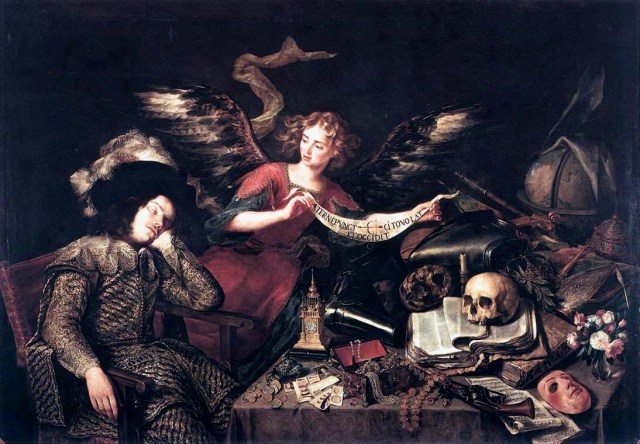
Antonio_de_Pereda_-_The_Knight's_Dream

Antonio de Pereda, “The Knight’s Dream”

II. “The Place Where We Are Right”

“From the place where we are right
flowers will never grow
in the spring.

The place where we are right
is hard and trampled
like a yard.

But doubts and loves
dig up the world
like a mole, a plow.
And a whisper will be heard in the place
where the ruined
house once stood.”

6251930001_f7a40c6ed5

Bear grass after fire: thanks to rhizomes, it is often the first flower to grow after fire; via http://www.oregonhikers.org/forum/viewtopic.php?t=9776

From The Selected Poetry of Yehuda Amichai, edited and translated from the Hebrew by Chana Bloch and Stephen Mitchell

Posted in Poetry | Tagged , , | 12 Comments

Mary

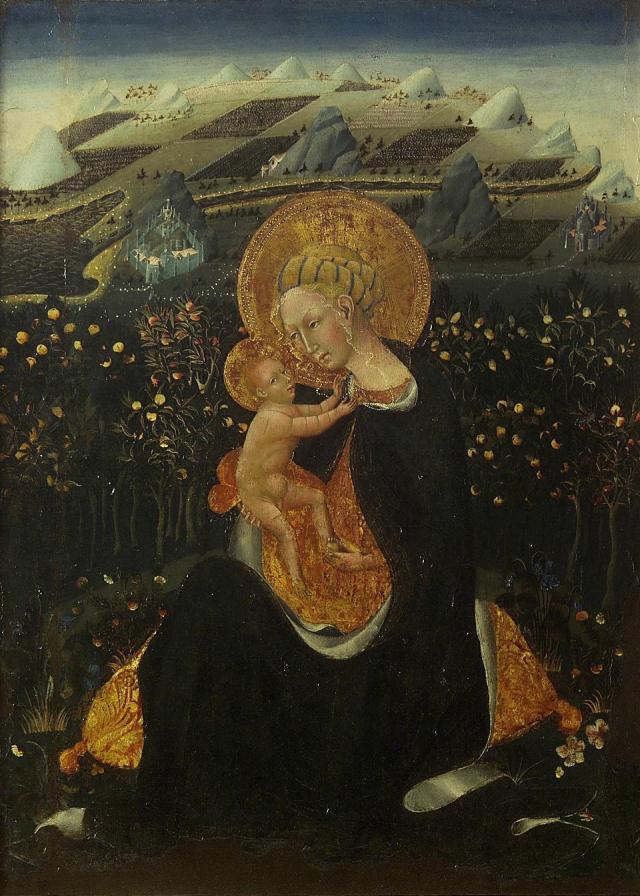
giovanni-di-paolo-madonna-of-humility-ca-1450-pinacoteca-nazionale-siena

Giovanni di Paolo, “Madonna of Humility”


In the new issue of National Geographic there is an absorbing article on “Mary: The Most Powerful Woman in the World.” The article, which I cannot recommend enough, can be read here: http://ngm.nationalgeographic.com/2015/12/virgin-mary-text

The holiest woman, even in the Koran, until the 12th century had been portrayed as a royal, imperial figure but later on evolved into the universally accessible force of Love that knows no political or social boundaries, as we know Her today. She attracts millions to shrines, where her apparitions have been recorded, though only 16 have found the official acceptance of the church. There is no one, self-proclaimed skeptics included, who can resist the force of this archetype. From the symbolic standpoint, I have not seen a better account of the meaning of Mary than the one in The Lost Language of Symbolism – An Inquiry into the Origin of Certain Letters, Words, Names, Fairy Tales, Folklore and Mythologies by Harold Bayley (published in 1912). The following are excerpts from chapter “The Star of the Sea” devoted to Mary (page 232):

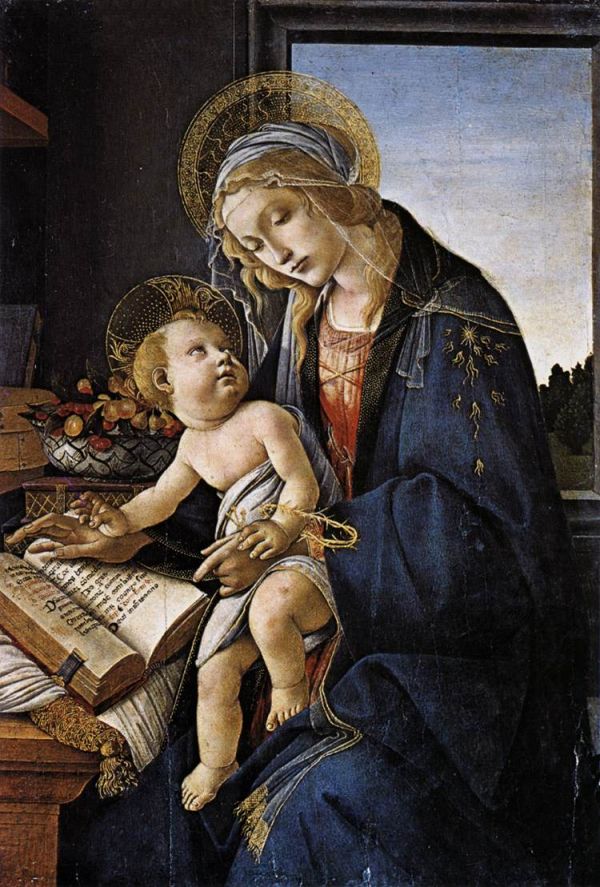
madonna-of-the-book-madonna-del-libro-by-sandro-botticelli-1387632903_b

Sandro Botticelli, “Madonna of the Book”

“The worship of the Queen of Heaven was flourishing long before the time of Jeremiah,and when the Christian Church appointed its festivals, it fixed upon 25th March as “Lady Day” for the reason that this date was celebrated throughout the Grecian and Roman world as the festival of the miraculous conception of the ” Blessed Virgin Juno.” The month of May, now dedicated to the Virgin Mary, was likewise the month of the pagan virgin mothers. The titles of ” Our Lady,”” Queen of Heaven,” and ” Mother of God ” were borne by Isis the immaculate, and, Assumption-like, Isis was represented standing on the crescent moon and surrounded by twelve stars.

Among the titles of Queen Mary is Stella Maris, the Star of the Sea—-an appellation for which it is difficult to discern any Biblical justification. “Star of the Sea” was, however, one of the titles of Isis and other pagan goddesses, and one must assume that it was sanctioned by Christianity for the usual reason that the people obstinately refused to relinquish it.

The Star of the Sea is represented in the accompanying Water-Mother emblems, Mary, Maria, Myrrha, Miriam, or Mara, the sparkling light of the waters, the virgin daughter of Labismina, the Great Abyss.

There is hardly a nation whose history has come down to us that does not record the existence of some Saviour God born of an Immaculate Virgin, and not infrequently this Virgin Mother is named Maria or an equivalent word, pointing to the Sea. Dionysos was born of the virgin Myrrha; Hermes, the Logos of the Greeks, was born of the virgin Myrrha or Maia, and the mother of the Siamese Saviour was called Maya Maria. All these names are related to Mare, the Sea…

When the letter M was taken over from the Egyptians by the Phoenicians, it was supposed to resemble ripples and was christened Mem, “the waters.” The word em is Hebrew for water…

The Indian Goddess of Beauty was, like Aphrodite, said to have been born of the Sea, and there is an inscription to Isis which hails her as:

“Blessed Goddess and Mother, Isis of the many names,

To whom the heavens gave birth on the glittering waves of the sea,

And whom the darkness begat as the light for all mankind.”

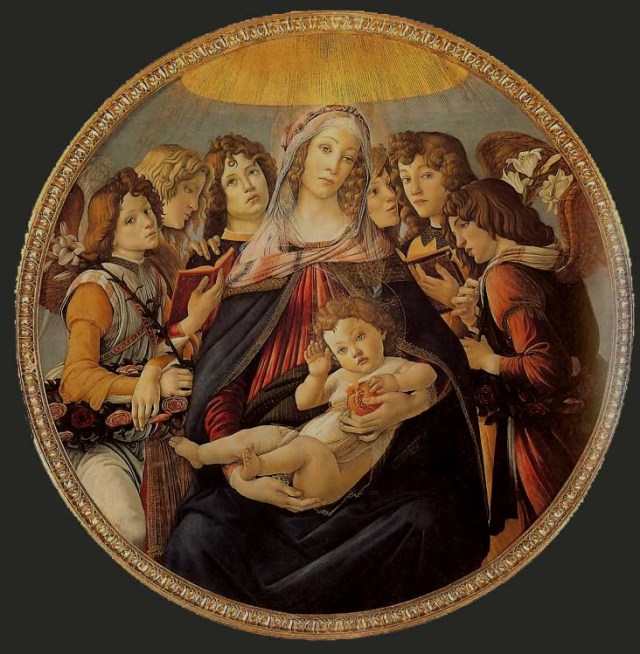
24_Madonna_of_the_Pomegrana_jpg

Sandro Botticelli, “Madonna of the Pomegranate”


Posted in Uncategorized | Tagged , , , , , , , | 12 Comments

Stamped on the Underside of My Memory

Every aurate woman I have loved in my life, and I use the word loved in its widest sense, has left her impression on me, as the old gods of creation are said to have left their thumbprints on the temples of the men that they fashioned out of mud and turned into us. Just so do I retain a particular trace of each one of my women—for I think of them all as mine still—stamped indelibly on the underside of my memory. I will glimpse in the street a head of wheat-coloured hair retreating among the hurrying crowd, or a slender hand lifted and waving farewell in a certain way; I will hear a phrase of laughter from the far side of a hotel lobby, or just a word spoken with a recognised, warm inflection, and on the instant this or that she will be there, vividly, fleetingly, and my heart like an old dog will scramble up and give a wistful woof.”

John Banville, “Ancient Light”

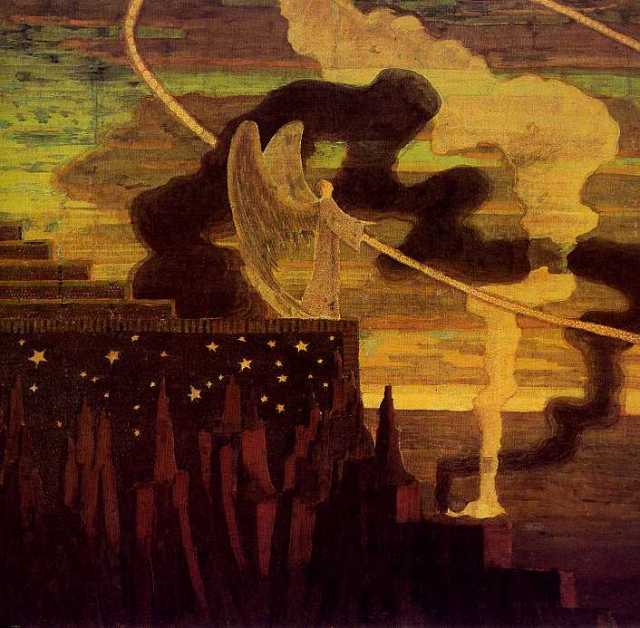
theoffering

M.K.Ciurlionis, “The Offering”

Posted in Quotations, Uncategorized | Tagged , , , , , | 9 Comments

In the Crystalline Maze: Symbolism of the Mirror

a9a07dc1f3bb6807252a6b88129e4120

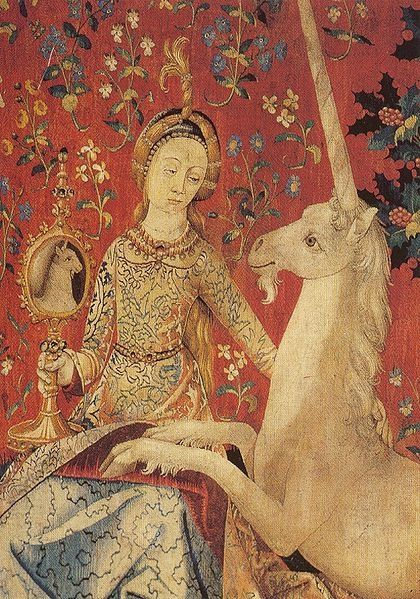
The magic of mirrors and their tremendous mystic powers cannot be doubted. The soul’s primal instinct is to seek unity in love. We project our Selves onto the world and onto others in an attempt to see our own soul reflected. With the same captivation we look at our own photographs, always seeking confirmation of our existence. The soul cannot know its essence if it does not find a mirror it can gaze into in order to divine its own nature.

Walter Crane_The Mirror of Venus_1890_Watercolour and Gouache_13 15_16x10 in (35.4x25.4cm)

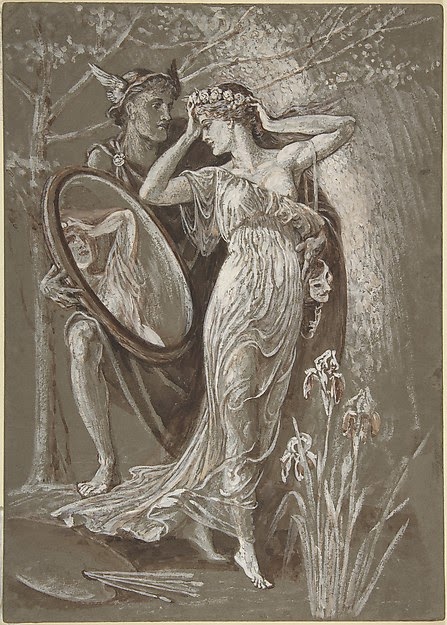
Walter Crane, “The Mirror of Venus”

330px-Anch

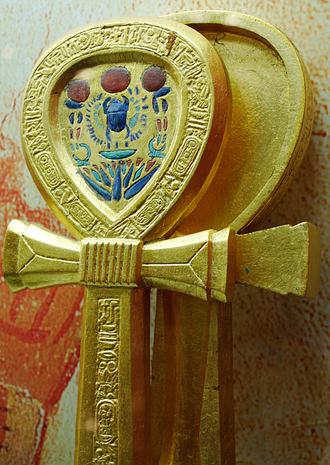
An Ankh-shaped mirror case (via Wikipedia)

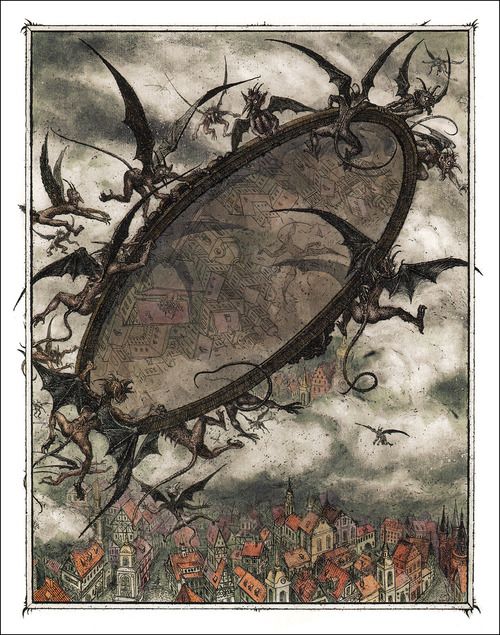
In ancient China, mirrors were buried with the dead as ritual objects which allowed the deceased to communicate with the divine world beyond. They were supposed to bring the dead in harmony with the universe and remind them that their soul reflects the light of the sun that shines eternally. In Egypt, the word ankh was also the word for mirror. The mirror, sacred to the goddess Hathor, was not treated as a passive object but it was called “a living one.” Researcher Lesley Jackson wrote that Egyptian mirrors were labelled “one who sees like Re” and “one who sees the face.” In both cultures mirrors were believed to be connected with divination derived from the wisdom reflected from the higher realms. Especially in the Middle Ages, the mirror was feared as an instrument of the devil, who may have used it to convey the knowledge of evil.


4876d37372b8e1a65f003e7fbd36cd46

The Snow Queen’s evil mirror, by Boris Diodorov

Though we take them for granted nowadays, mirrors which show a clear, undistorted image are a relatively new invention. In the times of yore, humans used to seek their reflection in still water, polished obsidian, brass or metal. The images thus obtained could not have been very clear. Flat glass mirrors as we know them today are a relatively late invention. In the sixteenth century, they were manufactured as exorbitantly expensive luxuries in Venice, a city whose beauty is magnified and reflected by the silvery surfaces of her waters.  Psychoanalysis speaks of the so called “mirror stage” of a child’s life involves their ability to view oneself as an object, which occurs between 15 to 18 months of age. By analogy, in the infant years of humanity, before clear and universally available mirrors were invented, we swam in the imaginative waters of participation mystique, when subject and object were not clearly differentiated, and we were tied by instinct to the symbolic order. A similar idea is found in a traditional Chinese mythical story retold by Borges under the title Fauna of Mirrors. The story goes back to the times of the legendary Yellow Emperor:

“In those days the world of mirrors and the world of men were not, as they are now, cut off from each other. They were, besides, quite different; neither beings nor colours nor shapes were the same. Both kingdoms, the specular and the human, lived in harmony; you could come and go through mirrors. One night the mirror people invaded the earth. Their power was great, but at the end of bloody warfare the magic arts of the Yellow Emperor prevailed. He repulsed the invaders, imprisoned them in their mirrors, and forced on them the task of repeating, as though in a kind of dream, all the actions of men. He stripped them of their power and of their forms and reduced them to mere slavish reflections. Nonetheless, a day will come when the magic spell will be shaken off.

The first to awaken will be the Fish. Deep in the mirror we will perceive a very faint line and the colour of this line will be like no other colour. Later on, other shapes will begin to stir. Little by little they will differ from us; little by little they will not imitate us. They will break through the barriers of glass or metal and this time will not be defeated. Side by side with these mirror creatures, the creatures of water will join the battle.”

The imaginary world of beyond invading the waking world is what may happen to anybody who chooses to gaze for too long into a mirror.

In the philosophy of Plato, humans were portrayed as cut off from “the world behind the mirror.” The main idea of Plato was that our world is a mere reflection of the luminous reality of eternal ideas. We are imprisoned in a cave, taking the shadows on the wall for reality, while the real source of light (the spiritual Sun) is hidden from us. Neoplatonists such as Plotinus compared matter to a mirror that reflects the images projected by the Universal Soul. What we perceive as material reality is nothing else but a reflection of the generative spiritual matrix emanating all forms of being from itself. The scholar Sergius Kodera devoted one of his books to the Neoplatonism of the Renaissance, which described the embodiment of the soul precisely in terms of reflection in a mirror:

“In the Neoplatonic tradition, this embodiment of the soul is described in terms of reflection in a mirror. In most instances, Ficino describes the descent of soul into the corporeal world as a disastrous event that imprisons a spiritual being into a body and thus diverts soul from its proper goal, which is intellectual contemplation.”

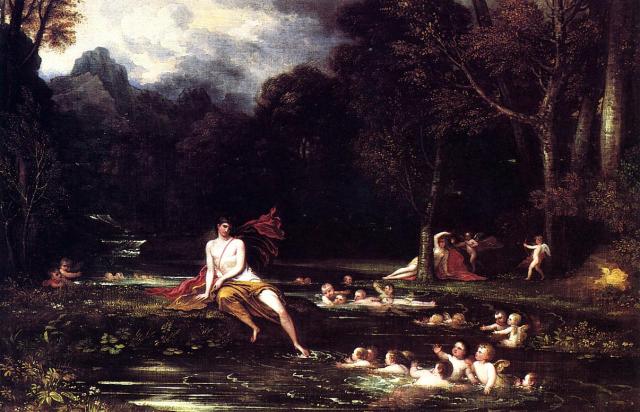
Kodera goes on to quote Ficino directly: “Only our soul, I say, is so captivated by the charms of corporeal beauty that it neglects its own beauty, and forgetting itself, runs after the beauty of the body, which is a mere shadow of its own beauty.” However, Kodera expresses an objection to the idea that the soul be imprisoned in matter. He goes as far as suggest that the myth of Narcissus, which must be mentioned in any discussion of symbolism of the mirror, was wrongly interpreted by the Renaissance Neoplatonists, notably by Marsilio Ficino. I must say I find his views on the matter quite captivating:

“Amazingly to the modern reader, Ficino … maintains that Narcissus does not look at his own face, but sees something different in the unstable reflection of the water — a beauty that is only a shadow. Narcissus is thus not an emblem for conscious self-love, but rather an allegory for soul that falls victim to the deceiving powers of a mirror. The surface in the pond is tied to a negative description of the physical world and the mirror image in the pond serves as an allegory for soul’s calamitous descent into body. Ficino’s reading was not uncommon, for the myth of Narcissus was highly popular throughout Antiquity and during the Middle Ages when it was linked to the soul’s descent into the material world. Obviously, Ficino’s interpretation marks a significant alteration to the original account. According to Ovid, Narcissus was chastised by Eros for his refusal to participate in the sexual life appropriate to free Greek men by sharing his body with men and women alike. The punishment imposed on the beautiful youth, solicited by a rejected lover — the nymph Echo — consists in his falling in love with his own image, a reflection he continues to worship in Hades even after his death. … Plotinus had already related this story to an entirely different context, namely to the soul’s failure to contemplate the higher world, which resulted in its getting lost in the shadowy and totally illusory world of matter.”

narcissus-and-echo-1805

Benjamin West, “Narcissus and Echo”

Kodera argues that the descent of the soul into body can be also viewed as a creative and positive act, and not as a calamity. This is precisely how the embodiment of the soul is described in Poimandres, a chapter in the Corpus Hermeticum. At the beginning, the primordial man – a soul without a body – looked down upon the world of nature:

“Nature smiled for love when she saw him whose fairness brings no surfeit 〈and〉 who holds in himself all the energy of the governors [planets] and the form of god, for in the water she saw the shape of the man’s fairest form and upon the earth its shadow. When the man saw in the water the form like himself as it was in nature, he loved it and wished to inhabit it; … Nature took hold of her beloved, hugged him all about and embraced him, for they were lovers.” (par. 14)

The soul unites with the body in an act of love. The already existing substance, the world of matter, yearns to receive the world of spirit. What is more, the world of matter is not seen as a shadow or a mere reflection of the world of ideas. Rather, both require each other to form perfect unity.

Erte-Femme_Fatale-2

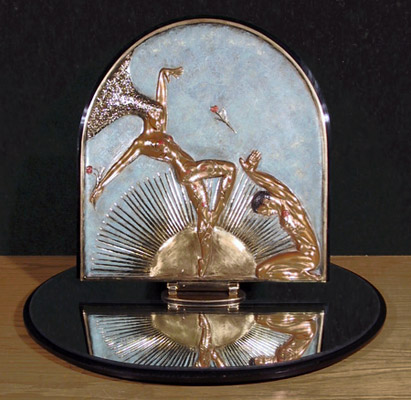
Erte, “Femme Fatale” (mirror sculpture)

Returning to Borges and his lifelong obsession with mirrors, in his story Tlön, Uqbar, Orbis Tertius, there is a famous quote which says that “mirrors and copulation are abominable since they both multiply the number of men….” Thanks to the mirror’s capacity to receive, retain and reproduce all sorts of constantly changing images, it can be symbolically likened to the womb. As such, it becomes an emblem of the soul’s receptivity towards spirit, which grants the soul the powers of divination. In this role, the mirror can be deceptive, but it can also “focus and enhance light, thus acting as a screen that receives and eventually itself becomes creative,” says Kodera. And this is the essence of the mirror’s magic – to unite the above with the below with loving devotion to both spirit and matter.


fbb0be6bc81ad042b83fc7ef7210638e

By Jaroslav Gerzhedovich

Support my blog

If you appreciate my writing, consider donating and make my day. Thank you in advance.

$1.00

Sources:

Jorge Luis Borges, The Book of Imaginary Beings, Penguin 1974

Hermetica: The Greek Corpus Hermeticum and the Latin Asclepius in a New English Translation, with Notes and Introduction, by Brian P. Copenhaver, Kindle edition
Lesley Jackson, Hathor: A Reintroduction to an Ancient Egyptian Goddess, Kindle edition
Sergius Kodera, Disreputable Bodies: Magic, Medicine, and Gender in Renaissance Natural Philosophy (Essays and Studies, Volume 23), chapter 2 “Matter as a Mirror: Marcilio Ficino and Renaissance Neoplatonism” via http://www.itergateway.org/resources/id=19 (free ebook)

Posted in The Mirror, Uncategorized | Tagged , , , , , , , , , , , , , | 26 Comments

Dancing Dragons and Horses Soaring into the Air: 3000 Years of Chinese Calligraphy

I had an enormous fortune today to see an exhibition dedicated to 3000 years of Chinese calligraphy. I found it very illuminating how the organizers juxtaposed traditional and contemporary art, creating a very compelling dialogue between them. In the 11th century, one calligrapher asked another, “How many years have you been writing on red leaves in solitary temples?” It seems that the same spirit of devout contemplation accompanies contemporary artists as well.

Chinese calligraphic characters are believed to have been shown to humans by Nature. The secretary to the mythical Yellow Emperor (the color yellow representing earth, dragons and the centre in Chinese symbolism) developed the Chinese writing whilst observing animal tracks that he saw in the sand. The oldest Chinese script discovered were actually inscriptions on animal bones, which were used for divination by means of fire (pyromancy). From early on writing was inextricably linked with earth and nature on the one hand and the realm of heaven and spirit on the other. It was positioned directly on the intersection between the divine and the earthly. As we can read in the most famous work of calligraphy of all time – Orchid Pavillion Preface by Wang Xizhi (born in 265): “We gazed up to comprehend the vastness of the universe. We looked down and observed the numerous species of plants and creatures.”

I want to share a few highlights of the exhibition, in a strictly subjective order. As I entered, my eyes were drawn to “Myth of Lost Dynasties” (1999) by Gu Wenda.

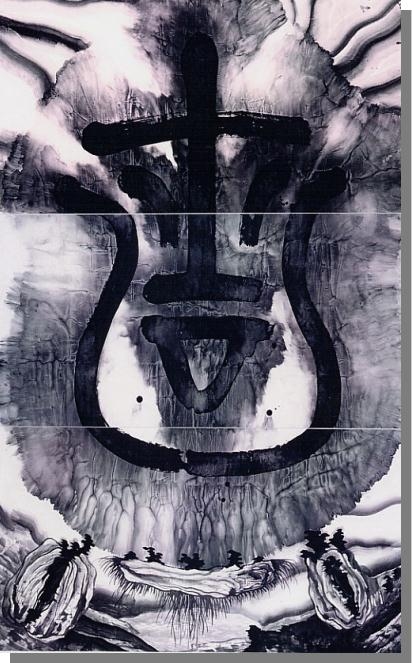
  1. Gu Wenda (born in 1955), “Myth of Lost Dynasties”

1

From the description next to it:

“Like a cult image, a character stylistically reminiscent of the archaic seal script, albeit illegible, is suspended above a surrealistic landscape. For the famous avant-garde artist Gu Wenda, his ‘pseudo characters’ symbolize the mystical and inexplicable aspects of our world, those things that cannot be grasped by language. Embedded in the landscape, the characters evoke the mythical idea of the secret power of the written word, derived from nature…”

  1. Zhu Yunming (born in 1460), poem in cursive script

2

The Chinese believed that the individual writing style reveals a character. I was fascinated by the cursive script of that particular poet. He was said to possess “an expansive and uninhibited flair.”

From the official description:

“One admirer compares the powerful rhythmical movements of the brush with ‘dancing dragon’ or a ‘heavenly horse soaring into the air.’”

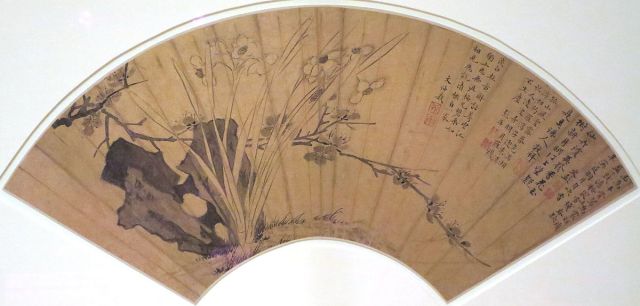
  1. Wang Guxiang (born in ca. 1501), “Narcissus, Plum Blossoms and Rock”

3

This is another beautiful example of a Gesamtkunstwerk (all-embracing art form), which combines painting, poetry and calligraphy – known as the three perfections. Mesmerizing.

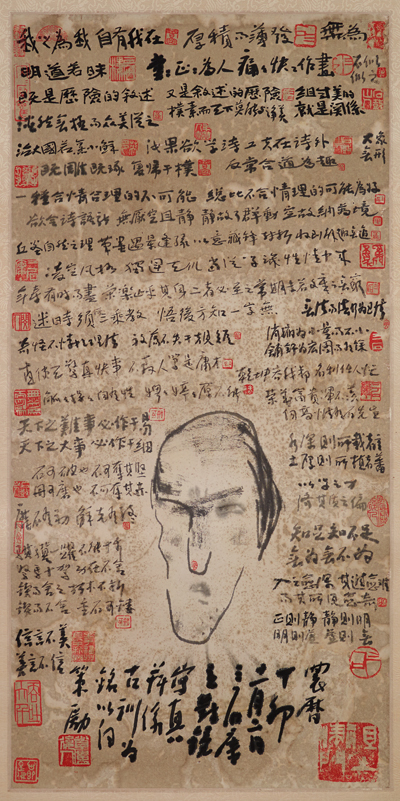
  1. Zeng Mi (born in 1935), “Self-Portrait”

4

The poem integrated into the drawing translates:

“The cosmos allows me to find peace, let others chase after fame and profit. / A stone, but not its strength, can be broken into pieces; vermillion, but not its red, can be pulverized. / True words are not beautiful, beautiful words are not true. / Be an honest person and paint to your heart content. / Everything has a beginning, but it seldom happens that it has a conclusion. / The deeper one digs, the harder it becomes, yet all the more fascinating. / A noble horse can cover more than 10 paces in a single jump, a bad horse can cover longer stretches through stamina. / It really is a great pleasure to frighten the heavens. / A person would be mediocre if he were not cursed by others.”

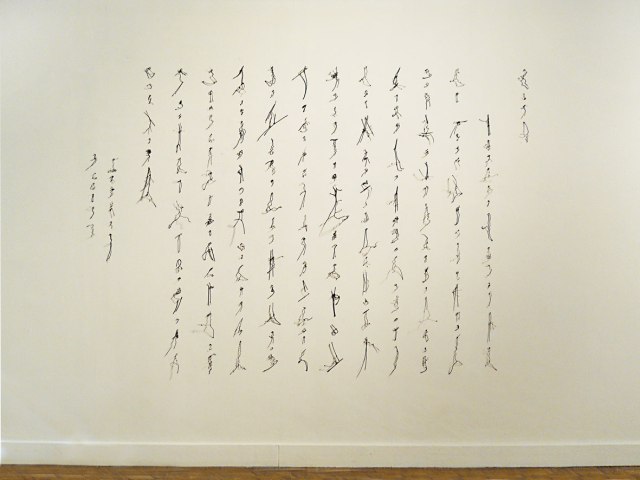
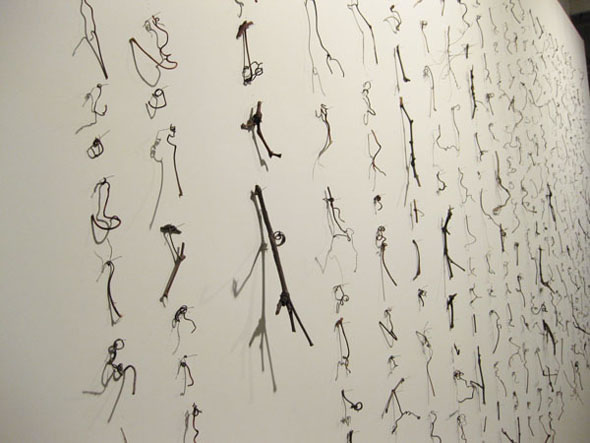
  1. Cui Fei (a contemporary artist), “Manuscript of Nature V”

5a

5b

She is famous for using sticks and thorns to represent Chinese calligraphic characters. In an interview she said, “Discovering the twigs and tendrils was an accident,” … “During one summer, I had to relocate my studio twice. While moving a large installation I had made with grape vines through a narrow door, many of the tendrils fell off the piece, leaving a mess behind. Sweeping up the fallen twigs, I suddenly noticed that the tendrils looked like Chinese calligraphic brush strokes in the grass writing style. Soon afterward I began removing the tendrils from my old installation and installing them directly on the wall.” (via http://www.gsebooks.com/natures-manuscript-art-that-radiates-permanence-harmony-and-meaning/)

Reading nature, discovering and hearing what it has to say are concepts that I find particularly appealing.

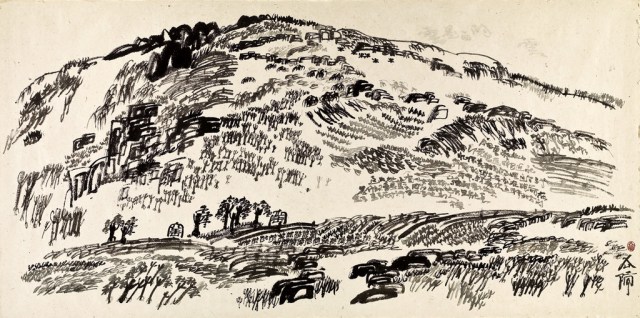
  1. Xu Bing (born in 1955), “Landscript”

6

This landscape is composed almost entirely of Chinese characters.

  1. Zhang Huan (born in 1965), “Family Tree”

7

From the description:

“Zhang had three calligraphers spend all day writing words and sentences on his face concerning his family, his cultural origins and his personal fate. In the evening the artist’s face was completely covered in black ink: ‘…it was as if my identity no longer existed. I had disappeared.’”

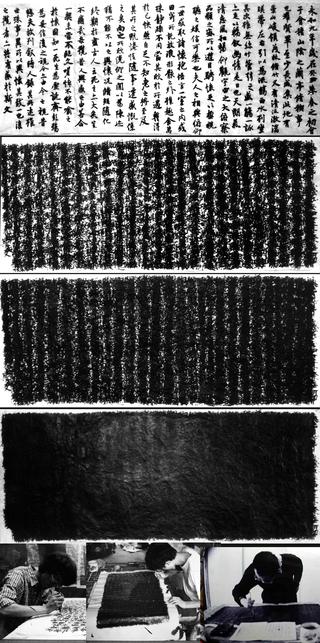
  1. Qiu Zhijie (born in 1969), “Copying the Orchid Pavilion Preface 1000 Times”

lantingtotal

From the description:

“He copied Wang Xizhi’s keywork a thousand times onto the same piece of paper over a period of 5 years. By the 50th time the paper had become a pure field of black. Qiu then continued to write with a dry brush. This written meditation represents for Qiu the quintessence of traditional calligraphic practice: writing as a means of self-cultivation and self-discovery.”

“In Buddhism and in religious Taoism, written words have functions that extend far beyond the teaching of religious doctrine. In Buddhism, copying sacred texts is considered a pious and meritorious activity. Believers therefore made numerous such copies, using not only ink or gold paint but sometimes, if they were especially devout, even their own blood.”

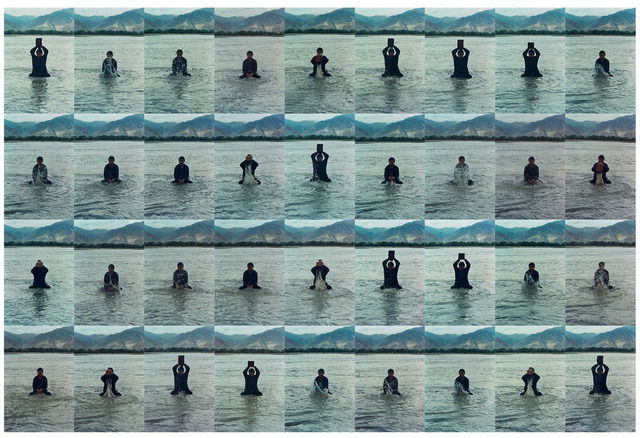
  1. Song Dong (born in 1966), “Printing on Water,” performance in the Lhasa River, Tibet, 1996

9

From the description:

“Sitting in the Lhasa river, the artist spent an hour repeatedly stamping the flowing water with a large wooden seal, always performing the same meditative gesture. The only thing engraved on the seal was the Chinese character for ‘water.’”

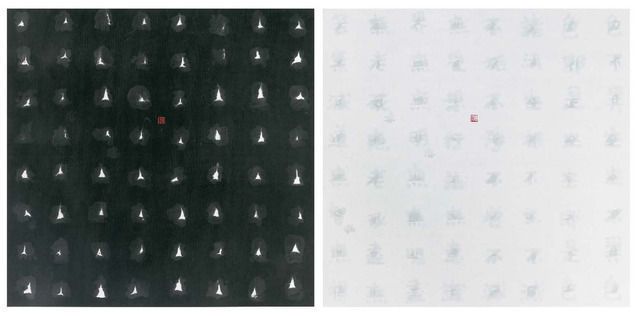
10.Fung Ming Chip (born in 1951), “The Buddhist Heart Sutra”

10

From the description:

“’Form is emptiness, emptiness is form.’ The experimental language artist and calligrapher has created a visual equivalent of the central statement from the Heart Sutra by writing the same passage twice: once in ‘transparent script’ – using scarcely perceptible pale ink – and once in ‘luminous script’ in which the characters shine like ghostly traces against the black background.”

Posted in Chinese Calligraphy, Language, Uncategorized | Tagged , , , , , , , , , , , , , , , , | 12 Comments

“Desire” by Boleslaw Lesmian

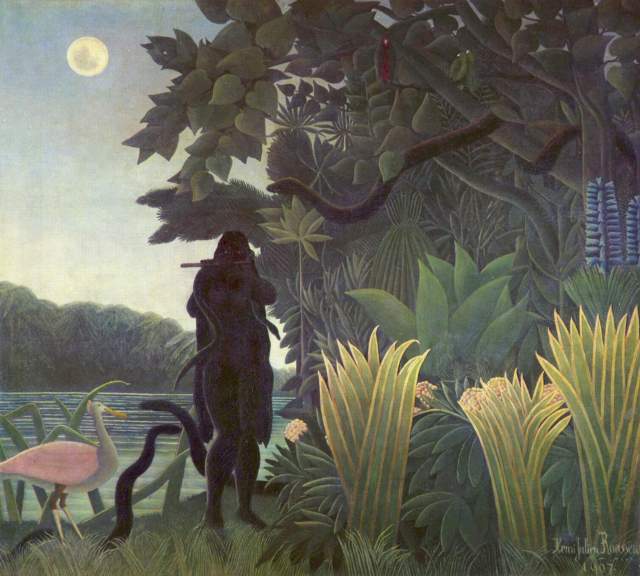
Henri_Rousseau_011

Henri Rousseau, “Snake Charmer”

“I’d like to have a hut in the wild forest density,
Made of firewood and a spatial scarcity,
Hanged high among old branch pinions,
Over jaguar caves and snake canyons.
There, on moss, swung with a mad storm,
I’d like to play with a maid, strange and warm.
Eat her breast, torn apart with my teeth,
And kiss her face, given as a feast.
Hear the storm, around my sinful indulge;
A thunderbolt dying noiselessly at large,
Roaring beasts our bodies-smell-attracted,
Ruptured bodies, elevated, in the spasm contracted.
And there, through an accidental among branches hole,
I’d like to look into the night and stars that glow.
And take for god – any brightness in the sky.
And on the girl’s bosom wait-over the night.
But welcome sun, with a howl, screams and cries.
Live blindfold, not knowing the life.
And laughing boldly at the sky one night,
Not knowing redemption or prayer nor fright,
Like a fruit which devouring jaw awaits,
Fall into death darkness with rumbles and yells!”

translated by Marek Urban, via http://www.poemhunter.com/best-poems/marek-urban/desire-by-boleslaw-lesmian-translated-by-marek-urban

Although Leśmian, born in 1877, is my most cherished Polish poet, I have not included any of his poetry on my blog so far, simply because I do not own his poems in English. His poetry was visionary and richly symbolic, containing folk and grotesque elements, and at the same time sensual, fleshy and very erotic. His poems were full of words that he himself invented, and which later entered the Polish language. When read aloud, his verses have a direct, trance like effect on me, as if I was listening to a chanting of some primordial sounds.


Posted in Poetry, Uncategorized | Tagged , , , , | 11 Comments

The Rhythm of Silence is the Spring of Words

the-way-of-silence.jpg!Blog

Frantisek Kupka, “The Way of Silence”

I.“…thou sweet spring for the thirsty in the desert; it is closed for those who speak there, it is open for those who keep silence there. When the silent man cometh, he findeth the spring.”

A Hymn to Thoth from the Sallier Papyrus, via Erman Adolf, Handbook of Egyptian Religion, p. 84

II.“When writing poetry one is always assisted and even carried away by the rhythm of all things outside, for the lyric cadence is that of nature: of the waters, the wind, the night. But in order to shape prose rhythmically, one has to immerse oneself deeply within oneself and detect the blood’s anonymous, multi-varied rhythm. Prose is to be built like a cathedral: there one is truly without name, without ambition, without help: up in the scaffolding, alone with one’s conscience.”

Rainer Maria Rilke, “Letters on Life,” New Prose Translations by Ulrich Baer (excerpts of Rilke’s letters arranged by theme), Kindle edition
III.”It was the steeple of Saint-Hilaire which shaped and crowned and consecrated every occupation, every hour of the day, every point of view in the town.

And in the evening, as I came in from my walk and thought of the approaching moment when I must say good night to my mother and see her no more, the steeple was by contrast so kindly, there at the close of day, that I would imagine it as being laid, like a brown velvet cushion, against—as being thrust into the pallid sky which had yielded beneath its pressure, had sunk slightly so as to make room for it, and had correspondingly risen on either side; while the cries of the birds wheeling to and fro about it seemed to intensify its silence, to elongate its spire still further, and to invest it with some quality beyond the power of words.”

Marcel Proust, “Swann’s Way,” translated by K. Scott Moncrieff, Kindle edition
Posted in Quotations, Uncategorized | Tagged , , , , , | 8 Comments

The Eternal Essence of the Floating World

800px-Johannes_Vermeer_-_The_lacemaker_(c.1669-1671)

Johannes Vermeer, “The Lacemaker”

Lately, my thoughts have been spiraling around a deep need to focus, to cut off all the extraneous details by finding a focus of devoted dedication. In a painting by Vermeer that I have always loved and was lucky to see in the Louvre many years ago, a young lacemaker is utterly dedicated to her task. We are feeling the sheer density and gravity of the moment. Our eyes gravitate towards the centre of the painting with the V shaped threads that are sharp in focus as opposed to the rest of the painting, which forms a blurry background. But at the same time and quite miraculously, out of that gravity arise extraordinary lightness and luminosity, as if the moment was transcended and made eternal. A famous quote from Rilke’s letters comes to mind:

“…it is our task to impress this provisional, transient earth upon ourselves so deeply, so agonizingly, and so passionately that its essence rises up again ‘invisibly’ within us. We are the bees of the invisible. We ceaselessly gather the honey of the visible to store it in the great golden hive of the Invisible.”

“Letters on Life,” New Prose Translations by Ulrich Baer (excerpts of Rilke’s letters arranged by theme), Kindle edition
Every moment carries seeds of eternity. Like in another widely celebrated work of art – Utagawa Hiroshige’s One Hundred Famous Views of Edo– the artist intensely focuses on the moment in space and time in order to experience the transcendent lightness of the Invisible breaking through the hard crust of matter. As an art critic wrote:

“Hiroshige’s vision is evident in the name he gave to this collection. Within the title, Meisho Edo Hyakkei—literally, ‘one hundred views of the famous Edo,’ the word meisho carries multiple meanings. The word means ‘a place with a name,’ but it implies that the named place contains poetic attributes. In other words, these ‘views’ are less important than their poetic associations are. Hiroshige chose to depict these views because of what they symbolize poetically and artistically. His woodblock prints are not postcard pictures, but rather visual allegories.

But unlike the Impressionists, who strove to depict the transience and immediacy of a single moment, Hiroshige instills his images with a poetic vision that renders them timeless. Hiroshige’s prints follow the tradition of ukiyo-e, meaning “pictures of the floating world.” Ukiyo-e embraces the Buddhist idea of the transience of the visible world and the impermanence of nature, an ideal that sounds like that which the Impressionist project attempted to achieve in its paintings. Unlike the Impressionists, however, the Japanese did not intend to depict this transience but rather to capture the eternal essence of each moment as it passes.”
Michelle Knudson, “One Hundred Famous Views of Edo,” Columbia Daily Spectator, Volume CXXIV, Number 42, 29 March 2000, retrieved from http://spectatorarchive.library.columbia.edu/cgi-bin/columbia?a=d&d=cs20000329-01.2.28&e=——-en-20–1–txt-txIN——#

100_views_edo_101

Part of the series One Hundred Famous Views of Edo, no. 101, part 4: Winter, via Wikipedia


Posted in Painting, Uncategorized | Tagged , , , , , , , , , , | 18 Comments

Last Worshippers of Artemis: Cats Walking the Ruins of Ephesus

36144288_deta_5

The lion mosaic in residential unit 3 in terrace house 2, Ephesus

“But the wildest of all the wild animals was the Cat. He walked by himself, and all places were alike to him.”

“…when the moon gets up and night comes, he is the Cat that walks by himself, and all places are alike to him. Then he goes out to the Wet Wild Woods or up the Wet Wild Trees or on the Wet Wild Roofs, waving his wild tail and walking by his wild lone.”

Rudhyard Kipling, “The Cat that Walked by Himself”

Ephesus, located in present day Turkey, was an ancient Greek city famous for the Temple of Artemis, one of the Seven Wonders of the World, as well as the birthplace of the philosopher Heraclitus. In Roman times it was the capital of Asia, the richest province of the Roman Empire. I was inspired to expand my knowledge on that ancient city after being gifted a beautiful and unique book that explores the ruins of the city from a very special perspective. It was written by an Austrian scientist and leader of the archaeological excavations, Sabine Ladstätter, who teamed up with an excellent photographer Lois Lammerhuber to capture the life of cats roaming the ancient ruins in large numbers. She wrote:

cats_of_ephesos_cover1380714390.6903

“They seem to be the last worshippers of the goddess. They draw themselves up to full height, paws raised towards heaven, their eyes set on something not immediately recognizable to the human observer. The cats of Ephesus love hunting bees. Their poses are adopted while they hunt for the insect once regarded as a symbol of the Artemis of Ephesus in antiquity.”

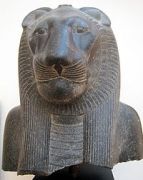
The Greeks believed that the goddess Artemis sometimes appeared in cat form herself. This is why she was identified with the Egyptian Bastet, the cat goddess who ruled pleasure, eroticism and joy, and who was seen as mild and benevolent on the one hand, but ferocious and vengeful on the other. Like Artemis, she was believed to protect women during pregnancy. She was viewed as a protective deity able to counter the dark forces, which, according to ancient Egyptian beliefs, were especially active at the end of the year. For that reason cat amulets were popular New Year gifts in ancient Egypt.

diosa_bastet_2

Bastet

The ambivalence of cat symbolism carried on into later times, especially into the Middle Ages and the times of witch hunts, as Biedermann, who associates the negative valuation of the cat with “an aggressive attitude to that which is female,” observes:
“The eye of the cat, which appears to change as the light strikes it from different angles, was considered deceptive, and the animal’s ability to hunt even in virtual darkness led to the belief that it was in league with the forces of darkness. … The cat is tireless and cunning when going after its prey – the virtues of a good soldier. This is why the Swabians, Swiss, and Burgundians of old had cats in their coats of arms, standing for liberty.”

Hans Biedermann, “Dictionary of Symbolism: Cultural Icons and the Meanings Behind Them”

Z-Scheibler44ps

via commons.wikimedia.org

Interestingly, according to some ancient legends, Ephesus was first settled around 6000 BC by the Amazons, the mythical tribe of female warriors. They may have built a shrine to Cybele millennia before the site became the centre of the cult of Artemis. One thing very obviously always remained unchanged, though, namely the association of Ephesus with the goddess. Even early Christians appropriated the place as the site of the cult of Mary.  According to a legend, Mother of Jesus may have spent her last years in Ephesus. To this day The House of the Virgin Mary, believed by some to be her last home built by Apostle John, is a popular place of pilgrimage.

c09ff13b73a5fd95f33dce6791c00ce0

Susan Seddon Boulet, “Bast”
Cats are undoubtedly creatures of the goddess. Like Artemis and earlier the Amazons, they are wild, free and virtually untamed. Excellent hunters (much more skillful and effective than dogs), cats are believed to be only semi-domesticated by modern science. They love to roam the ruins of Ephesus, as these appear to be such a perfect interface between nature and culture. What archeologists expose, nature reclaims quickly. Thick vegetation covers the ancient walls unless painstaking maintenance effort is made continuously. Unfortunately, virtually nothing is left of the legendary temple of Artemis, with its countless marble columns, the cedar ceiling, cypress doors and the magnificent statue of the goddess with many breasts, eggs or bull testicles, depending on the source.

Artemis_of_Ephesus.jpg

Artemis of Ephesus

The temple was burnt by a mad man seeking fame. In a fascinating turn of event, this calamity coincided with the birth of Alexander the Great:

“…Philip II, who had just been released from captivity in Thebes, was appointed regent of Macedonia. Three years later, his wife, Olympias, gave birth to a baby boy, whom they named Alexander, and on the very same day, a man named Herostratus intentionally burned down the Temple of Artemis in Ephesus. According to Plutarch, ‘All the Magi, who were then at Ephesus, looked upon the fire as a sign which betokened a much greater misfortune: they ran about the town, beating their faces and crying ‘that they day had brought forth the great scourge and destroyer of Asia.’”

“Ancient Ephesus: The History and Legacy of One’s of Antiquity’s Greatest Cities” by Charles River Editors

After conquering Ephesus, however, Alexander the Great treated its citizens with reverence and respect. Perhaps he was aware that even without the temple, the spirit of Ephesus could not be vanquished. The city flourished under ancient Romans and was very significant during the subsequent Byzantine Empire as well. Today, cats symbolically reclaim the city for the goddess.

04

Late antique inscription base, with the facade of the Library of Celsus in the background


Posted in Cats, Ephesus, Uncategorized | Tagged , , , , , , , , , | 15 Comments