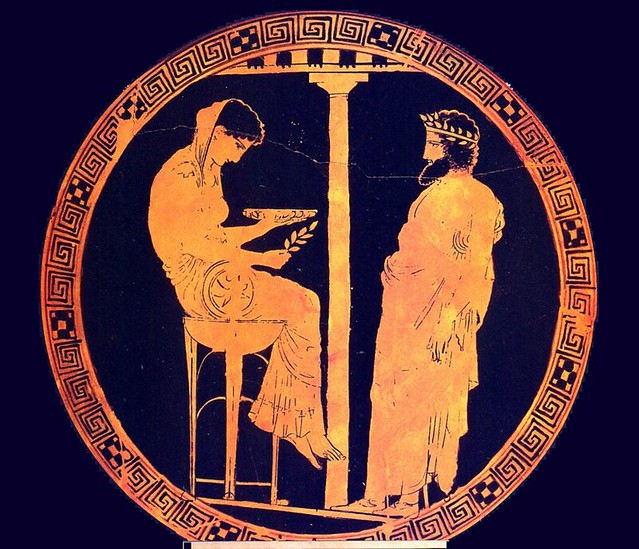
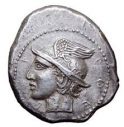
Jung on Alchemy (5): Hermes, the Arcane Interpreter of All

“Mercurius is an adumbration of the primordial light-bringer, who is never himself the light, but…who brings the light of nature, the light of the moon and the stars which fades before the new morning light.” C.G. Jung, Alchemical Studies, par. 300

“And as all things were by the contemplation of the one, so all things arose from this one by a single act of adaptation.”

The Emerald Tablet

d4042540x

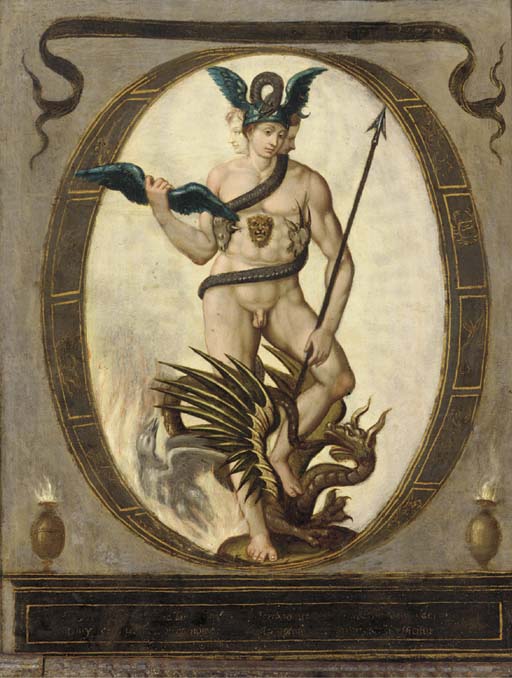
By Bartholomaeus Spranger

The chief figure of alchemy was Hermes/Mercurius. He was both the beginning (the prima materia), the middle (the process, the means) and the end (the philosopher’s stone – Filius Macrocosmi or the Cosmic Son) of the opus. As a symbol of wholeness, the animating principle and the world soul, he gathered all elements in himself. In Alchemical Studies Jung thus summarizes the role of Mercurius:

“The multiple aspects of Mercurius may be summarized as follows: (1) Mercurius consists of all conceivable opposites. He is thus quite obviously a duality, but is named a unity in spite of the fact that his innumerable inner contradictions can dramatically fly apart into an equal number of disparate and apparently independent figures. (2) He is both material and spiritual. (3) He is the process by which the lower and material is transformed into the higher and spiritual, and vice versa. (4) He is the devil, a redeeming psychopomp, an evasive trickster, and God’s reflection in physical nature. (5) He is also the reflection of a mystical experience of the artifex that coincides with the opus alchymicum. (6) As such, he represents on the one hand the self and on the other the individuation process and, because of the limitless number of his names, also the collective unconscious. (par. 284)

His fiery aspect was sulfurous, active and masculine, and yet invisible and working in secret. He was the fire of hell, “a rearrangement of the heavenly, spiritual powers in the lower, chthonic world of matter,” found in the centre of the earth, in the dragon’s belly (Jung, Alchemical Studies, par. 257). At the same time, he was “the universal and scintillating fire of the light of nature, which carries the heavenly spirit within it.” This fiery spiritual seed impregnated the Virgin, i.e. the feminine aspect of the hermaphroditic Mercurius. He was also synonymous with divine water, “the spirit of life, not only indwelling in all living things, but immanent in everything that exists.” (Psychology and Alchemy, par. 528) Further, he is the “great south wind,” who is both an active agent in its fiery aspect and a passive receptacle in its watery, quicksilver aspect. Jung reminds us that Hermes was originally a wind god, and so was the Egyptian Thoth, who made the souls breathe. As quicksilver, Mercurius was imagined as fluid and volatile, like water “that does not make the hands wet,” “that indefinable, fascinating, irritating, and elusive thing which attracts an unconscious projection” (Alchemical Studies, par. 257). Like the serpent of wisdom that encircles everything, Mercurius “has something of everything in herself.” (Psychology and Alchemy, par. 528). As the World Soul, the mercurial serpent was said to impart “beauty and ripeness to all things, life-giving power like a glue, holding the world together and standing in the middle between body and spirit” (Alchemical Studies, par. 263). He was present when the world was created; his role was to impregnate the waters with the seed of life. Although he bore the light that filled the whole world, he remained hidden and worked in secret.

fb12020b2a1825d1a6895b80e8088b8d

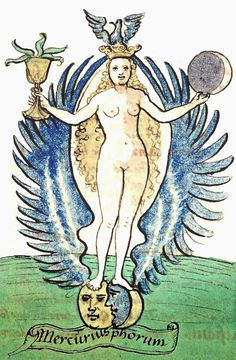
Mercurius as Anima Mundi

A question arises whether the alchemical Mercury ties in with the Greek Hermes and his Egyptian counterpart, Thoth. Very much so, but we need to dig deeper than the conventional descriptions of the nimble footed messenger of the gods, the god of merchants and thieves. Hermes is both young and old, or perhaps he defies time, as his beginnings are untraceable. In Women’s Encyclopedia of Myths and Secrets by Barbara G. Walker, we can read that Hermes, god of magic, letters, medicine and occult wisdom, was “one of the Aegean Great Mother’s primal serpent-consorts, partaking of her wisdom because he was once a part of her.” Hermes and Aphrodite begot a child together – Hermaphroditus – or alternatively, according to some occult understandings, they were one god – a symbol of unity.

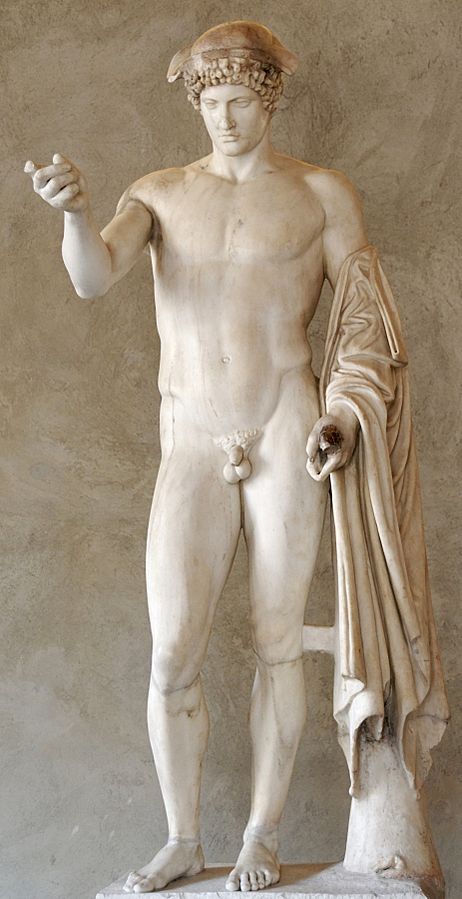
Hermes_Logios_Altemps_Inv8624_n2

Hermes from Palazzo Altemps, Rome

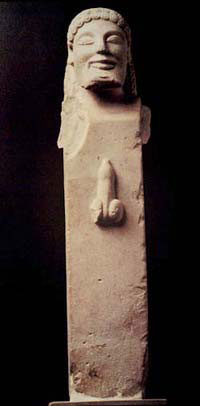
In Greek myth, his mother was Maia, the oldest and the most beautiful of the Pleiades. Her name can be linguistically traced to “mother” and the Sanskrit name Maya, mother of the Buddha, goddess of creation and manifestation, says Munya Andrews in her wonderful book The Seven Sisters of the Pleiades. One of Hermes’s first inventions was the seven-string lyre, which symbolically connects to seven divine sounds that are the source of creation and the foundation of cosmic order. Madame Blavatsky claimed that the Pleiades, together with the stars of Ursa Major, control cycles of time and destiny. Also Hermes, as the guide of souls in his union with the Great Goddess, ruled over death and rebirth. In his incarnation as Hermes Trismegistus, he was the “creator of civilization, responsible for medicine, chemistry, writing, laws, art, astrology, music, magic, rhetoric, philosophy, geography, mathematics and much more,” to quote Gary Lachman from his book The Quest for Hermes Trismegistus. Hermes was both celestial and terrestrial, and so hermetic wisdom connects what is above with the plane of manifestation lying below. In Phrygia and Samothrace he was worshiped as a phallic deity and part of the trinity with Mother Earth and father Hades. The phallic stone pillars with the head of Hermes, called herms, used to protect crossroads all throughout the Greco Roman world. Also among the Saxons Hermes was closely connected to the Mother Earth and the phallic principle, as Barbara G. Walker summarizes:

h-herm

A herm

“Saxons worshipped Hermes as the phallic spirit of the Hermeseul, or lrminsul, planted in the earth at the Mother-mount of Heresburg (Hera’s Mount). It is now known as Eresburg, and a church of St. Peter stands where Hermes’s ancient sanctuary united the phallic principle with Mother Earth. Other Germanic tribes worshipped Hermes under the name of Thot or Teutatis, “Father of Teutons.” Hermes-Mercury was the same as the Germanic father-god Woden, which is why the Hermetic day, Wednesday, is Woden’s Day in English but Mercury’s Day in Latin languages.”

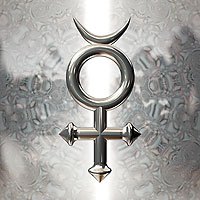
The number four was especially sacred to Hermes. He was the liminal god of the crossroads (and thus of all boundaries, which he was allowed to cross with no restrictions), the four elements, the four seasons, the cardinal cross, the cross of incarnation (of spirit into matter). The astrological symbol of Mercury is a circle (spirit) with a cross of matter, which is an expression of Logos, i.e. the word of God made flesh, crowned by a lunar crescent, tying him to the goddess.

mercury_s

Every god, like every archetype, had an ominous shadow side, and so did Mercurius. In Alchemical Studies (par. 303) Jung warns that Hermes comes as the lumen naturae (light of nature) only to those who are mindful and vigilantly strive towards it, while for many the same light “turns into a perilous ignis fatuus [foolish fire, an illusion], and the psychopomp into a diabolical seducer.” He is, after all, the son of Maya, a great goddess of Illusion. In an Orphic Hymn, Hermes is called “the Interpreter of All.” There is indeed a real danger connected with Mercurius, which is being caught in the web (Maya) of lies, sleek word propaganda disguised as the ultimate truth. As Nietzsche ironically put it in “On Truth and Lie in an Extra-moral Sense”:

“truths are illusions about which one has forgotten that this is what they are; metaphors which are worn out and without sensuous power; coins which have lost their pictures and now matter only as metal, no longer as coins.”

As we engage in interpreting messages constantly coming to us from within and without, we would be wise to remember that truth is not fixed or constant but it is always shifting with quicksilver speed. The Greek word for truth is alétheia, which means un-concealing. Truth is hidden, concealed, elusive, always somewhere “out there.” Un-concealing the veils of Maya means embodying and manifesting that which lies as a potential in the depths of the individual psyche. Perhaps it can be uncovered only by “the meditation of the One,” to quote once again from the Emerald Tablet of Hermes Trismegistus.

hermes_mercurius_trismegistus_siena_cathedral

Hermes Trismegistus of the Siena cathedral

Support my blog

If you appreciate my writing, consider donating and make my day. Thank you in advance.

$1.00

Related posts:

Jung on Alchemy (1): The Moist and Earthly Foundation

Jung on Alchemy (2): The Mandala

Jung on Alchemy (3): Meditation and Imagination

Jung on Alchemy (4): Prima Materia – The One, Who Art All

Jung on Alchemy (6): Sol and Sulphur – the Fiery Ferment of the Soul’s Hidden Depth

Posted in Alchemy, Hermes, Uncategorized | Tagged , , , , , , , , , , , , , , | 13 Comments

Deeper and Deeper into the Heart of Darkness

On 10 July 1941, the most shameful chapter of my native Poland’s history was written. In a small town of Jedwabne, occupied by the Nazis, its sizeable Jewish community was brutally murdered by the Poles. For years, the perpetrators shifted the blame away from themselves. It took sixty years for the Polish president to say these memorable words at the site of the massacre in 2001: “This was a particularly cruel crime. It was justified by nothing. The victims were helpless and defenseless. For this crime, we should beg the souls of the dead and their families for forgiveness. This is why today, as a citizen and as president of the Republic of Poland, I apologize.” In the same year, a book was published by Jan T. Gross under the title Neighbors: The Destruction of the Jewish Community of Jedwabne, Poland. It caused a storm. To this day, many Poles refuse to accept its undeniable truth: that in 1941 some 600-900 Jews were herded in a barn and burned alive by the Poles. Those who had hidden or escaped were tracked down and mercilessly murdered. Undeniably, on that day the Polish victims of the Nazis turned into most cruel perpetrators; and not without a large dose of relish, mockery, even joy:

 “The Jews were wrenched from their houses and beaten, driven to the marketplace and ordered to weed it with spoons, forced to break up a statue of Lenin and run around the marketplace carrying its pieces while singing ‘the war’s our fault.’”

Via http://www.nybooks.com/articles/archives/2015/nov/19/jedwabne-even-worse-we-thought/

The quote comes from a review of a Polish book most recently translated into English: The Crime and the Silence: Confronting the Massacre of Jews in Wartime Jedwabne by Anna Bikont.

Before the war, the Jews were treated as aliens all over Europe. In Poland:

 “As elsewhere, the Jews were placed in all sorts of inescapable double binds. If they were forcibly kept apart from society, it meant that they were by nature separate and alien; if they assimilated, it was because they wanted to undermine Poland from within. They were forbidden from buying land in pre-war Poland, then told that—despite centuries of presence—they were ‘guests’ with ‘no tie to the land.’”

It is not wrong to look for such rational explanations in the face of atrocity, but the hardest questions will always remain unanswerable; especially if we persist in looking for answers outside – in the social order, in others, in the circumstances, but always away from the dark roots of our own hatred and fear.

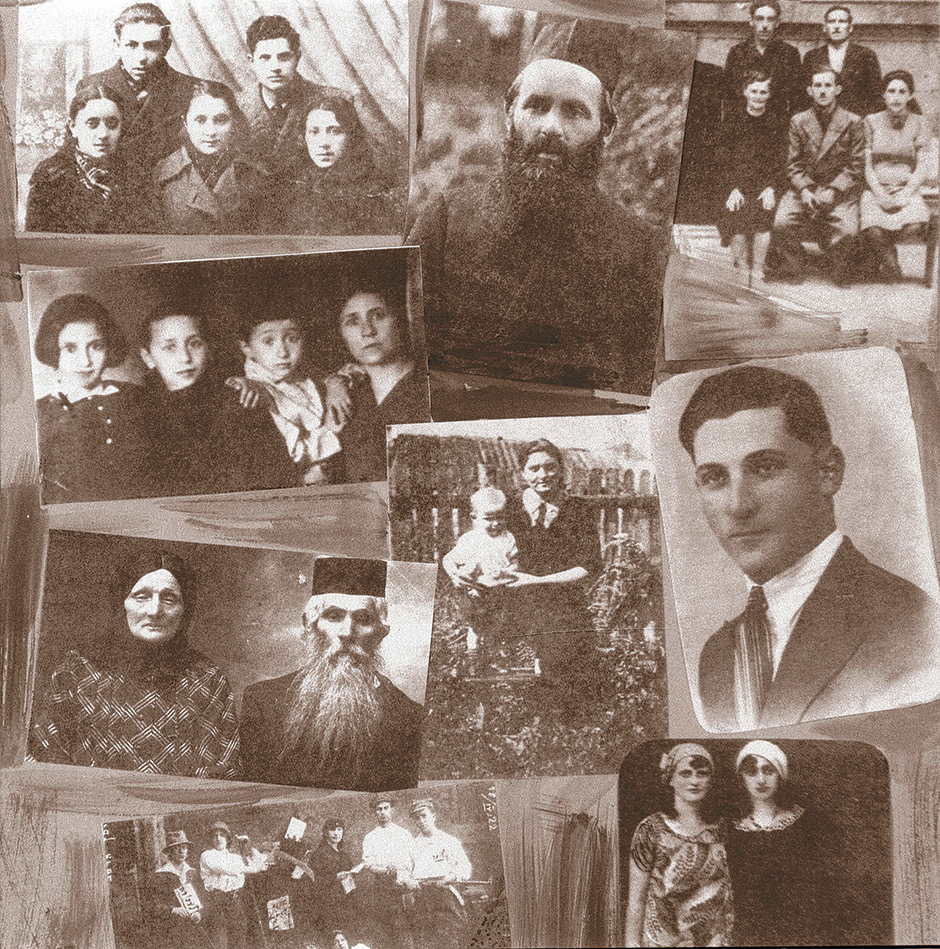
The Jews of Jedwabne

The Jews of Jedwabne

Posted in Jedwabne | Tagged , , , , , , , , , , , , , , | 21 Comments

“From love’s first fever to her plague” by Dylan Thomas: A Study of Consciousness

“From love’s first fever to her plague, from the soft second
And to the hollow minute of the womb,
From the unfolding to the scissored caul,
The time for breast and the green apron age
When no mouth stirred about the hanging famine,
All world was one, one windy nothing,
My world was christened in a stream of milk.
And earth and sky were as one airy hill.
The sun and moon shed one white light.

From the first print of the unshodden foot, the lifting
Hand, the breaking of the hair,
From the first scent of the heart, the warning ghost,
And to the first dumb wonder at the flesh,
The sun was red, the moon was grey,
The earth and sky were as two mountains meeting.

The body prospered, teeth in the marrowed gums,
The growing bones, the rumour of the manseed
Within the hallowed gland, blood blessed the heart,
And the four winds, that had long blown as one,
Shone in my ears the light of sound,
Called in my eyes the sound of light.
And yellow was the multiplying sand,
Each golden grain spat life into its fellow,
Green was the singing house.

The plum my mother picked matured slowly,
The boy she dropped from darkness at her side
Into the sided lap of light grew strong,
Was muscled, matted, wise to the crying thigh,
And to the voice that, like a voice of hunger,
Itched in the noise of wind and sun.

And from the first declension of the flesh
I learnt man’s tongue, to twist the shapes of thoughts
Into the stony idiom of the brain,
To shade and knit anew the patch of words
Left by the dead who, in their moonless acre,
Need no word’s warmth.
The root of tongues ends in a spentout cancer,
That but a name, where maggots have their X.

I learnt the verbs of will, and had my secret;
The code of night tapped on my tongue;
What had been one was many sounding minded.

One wound, one mind, spewed out the matter,
One breast gave suck the fever’s issue;
From the divorcing sky I learnt the double,
The two-framed globe that spun into a score;
A million minds gave suck to such a bud
As forks my eye;
Youth did condense; the tears of spring
Dissolved in summer and the hundred seasons;
One sun, one manna, warmed and fed.”

I find this poem strikingly beautiful. It has been viewed as rendering the evolution of a poet from the simplicity of childhood through the complexity of confusing adolescence back to the simplicity of conscious maturity. The first stanzas, which describe the budding consciousness of a child, are smoother and lighter, in comparison to the closing lines, which are slower and heavier, as if loaded with complex and manifold life experience. Reaching maturity means returning to oneness that characterized childhood, yet it is now of a deeper and more substantial quality. The poem seems to point out that mature consciousness is both simple and complex, simultaneously turning inwards and outwards. In childhood it is undifferentiated, then it differentiates and polarizes (especially by means of language and thinking) amidst the turmoils of adolescence, only to subsequently reach a synthesis, but now from a richer perspective. Manna – the nourishment sent by God to the Israelis wondering through the desert – has a deeply human and maternal connotation, and yet it is warmed by the rays of the Sun, which is the most universal symbol of distant divine consciousness. On account of its tremendous maturity, it is extraordinary that Dylan Thomas was only eighteen when he wrote the poem. I cannot think of a better expression of growing into consciousness than this.

Source of inspiration for interpreting the poem:

Helma Louise Baughan Murdy, “Sound and Meaning in Dylan Thomas’s Poetry” Via https://archive.org/stream/soundmeaningindy00murd/soundmeaningindy00murd_djvu.txt

Posted in Poetry | Tagged , , , , , , , , , , , , , , , | Leave a comment

Ariadne Awakens

Giorgio de Chirico, “The Awakening of Ariadne”

Giorgio de Chirico, “The Awakening of Ariadne”

“Enter the turret of your love, and lie
close in the arms of the sea; let in new suns
that beat and echo in the mind like sounds
risen from sunken cities lost to fear;
let in the light that answers your desire
awakening at midnight with the fire,
until its magic burns the wavering sea
and flames caress the windows of your tower.”

Denise Levertov, “The Sea’s Wash in the Hollow of the Heart…”

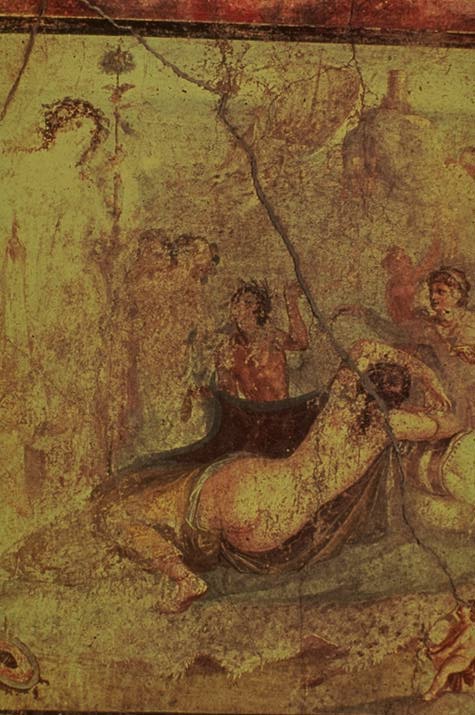
The threads of Ariadne’s mythical story are manifold and contradictory. Her name, according to Graves, meant “most pure” and “high fruitful mother of the barley.” According to this scholar, she was the Cretan snake goddess, and the Mistress of the Labyrinth, where she led other maidens in a sensuous winding dance. In a popular myth, she helps Theseus catch the Minotaur by offering him a ball of thread to navigate his way through the Labyrinth, where the monstrous half man, half bull lived, and feasted regularly on human flesh. The Minotaur was a dark and beastly shadow figure, contradictory to Ariadne’s purity.  He was the offspring of Pasiphaë and a beautiful white bull, which Minos – Pasiphaë’s husband and Ariadne’s father – refused to sacrifice to Poseidon due to greed. Poseidon made Pasiphaë fall in love with the bull as an act of revenge on Minos.

Picasso, "Minotaur kneeling over sleeping girl"

Picasso, “Minotaur kneeling over sleeping girl”

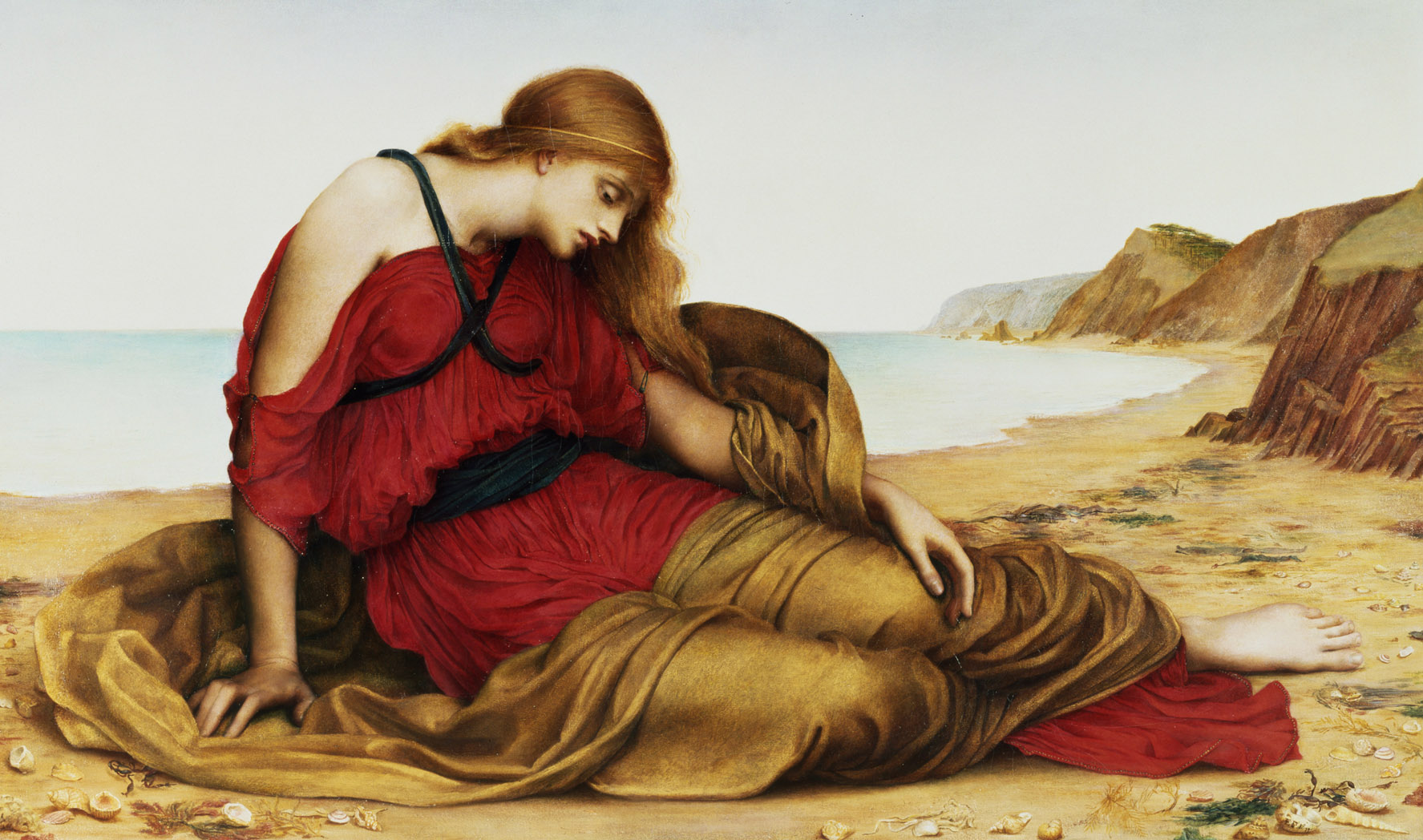
Because she had fallen in love with Theseus, she renounced her family and her native land to follow him to Athens. But Theseus abandoned her on the desolate island of Naxos:

Evelyn de Morgan, “Ariadne on Naxos”

Evelyn de Morgan, “Ariadne on Naxos”

“Not the home where she was born, and certainly not the home she hoped to be welcomed in, nor even some country in between. Just a beach lashed by thundering waves, an abstract place where only the seaweed moves. It is the island where no one lives, the place where obsession turns round and round on itself, with no way out. A constant flaunting of death. This is a place of the soul.

Ariadne has been left behind. The clothes fall from her body one by one. It is a scene of mourning. Awake now, but still as the statue of a Bacchant, Minos’s daughter gazes into the distance toward the eternal absentee, for Theseus’s swift ship has already disappeared over the horizon, and her mind rises and falls with the waves. The thin ribbon that held her blond hair slips off, her cloak falls away leaving her chest bare, her breasts are no longer supported by their sash. One after another, the clothes in which she left Crete forever fall and scatter at her feet. The waves toy with them in the sand and seaweed.”

Roberto Calasso, “The Marriage of Cadmus and Harmony”

The possible continuations of the story were many, as Calasso continues:

“Abandoned in Naxos, Ariadne was shot dead by Artemis’s arrow; Dionysus ordered the killing and stood watching, motionless. Or: Ariadne hung herself in Naxos, after being left by Theseus. Or: pregnant by Theseus and shipwrecked in Cyprus, she died there in childbirth. Or: Dionysus came to Ariadne in Naxos, together with his band of followers; they celebrated a divine marriage, after which she rose into the sky, where we still see her today amid the northern constellations. Or: Dionysus came to Ariadne in Naxos, after which she followed him around on his adventures, sharing his bed and fighting with his soldiers; when Dionysus attacked Perseus in the country near Argos, Ariadne went with him, armed to fight amid the ranks of the crazed Bacchants, until Perseus shook the deadly face of Medusa in front of her and Ariadne was turned to stone. And there she stayed, a stone in a field.

No other woman, or goddess, had so many deaths as Ariadne. That stone in Argos, that constellation in the sky, that hanging corpse, that death by childbirth, that girl with an arrow through her breast: Ariadne was all of this.”

Dionysos surprising the sleeping Ariadne; Pompeian wall painting (House of the Vetti)

Dionysos surprising the sleeping Ariadne; Pompeian wall painting (House of the Vetti)

In his Seven Sermons to the Dead, C.G. Jung wrote: “The sexuality of man is more earthly, while the sexuality of woman is more heavenly. The spirituality of man is more heavenly, for it moves in the direction of the greater. On the other hand, the spirituality of woman is more earthly, for it moves in the direction of the smaller.” The heavenly luminous and pure feminine essence shudders at the encounter with the lustful Minotaur, which symbolizes the dark, maze-like entrapment of the senses and desires. But liberation can only happen by entering the Labyrinth. The movement of the spiritual towards the earthly inevitably entails suffering through multiple symbolic deaths, as was the case with Ariadne. The Worthy Bull was one of the epithets of Dionysus, whom Ariadne married and for whom she bore many notable children. In some versions of the myth, after marrying Dionysus Ariadne received a new name – Libera (Liberty). Her wedding gift from the god was a crown, made by Hephaestus of “fiery gold and Indian gems, set in the shape of roses.” (Graves). It was set among the stars as the constellation of the Corona Borealis.

Corona Borealis

Corona Borealis

On the website The Constellation of Words, the author discusses the manifold symbolism of the crown, going as far as linking it to the Statue of Liberty. The crown encompasses a rich symbolism of being bounded by fate, being bound like slaves, but also being bound by an auspicious and fruitful (marital) union:

“The Statue of Liberty symbolically represents Libertas (liberty), Ancient Rome’s goddess of freedom from slavery, oppression and tyranny. Ariadne was marooned on an island. To be marooned is to be put ashore on a deserted island or coast and intentionally abandoned. A Maroon was the word for a fugitive slave in the West Indies in the 17th and 18th centuries. Liberia, a country in West Africa, was founded and settled mainly by freed slaves. …The crown has associations with both liberty and also slavery ‘in ancient times slaves taken by right of conquest were sold wearing garlands, and hence were said to be sold ‘under a crown.’ …the crown was a sign that those who were being sold were captives.’”

Retrieved from http://www.constellationsofwords.com/Constellations/CoronaBorealis.html

Ariadne – both a mortal woman and a goddess, abandoned and rescued, bounded and liberated, a Labyrinth guide who became lost and marooned on a desert island, is one of the most fascinating faces of the eternal feminine. Her gentleness and purity is palpable in Picasso’s painting showing a blind Minotaur being led by a girl with a white dove.

Pablo Picasso, "Blind Minotaur Led by a Girl in the Night"

Pablo Picasso, “Blind Minotaur Led by a Girl in the Night”

After the beast was slayed, she told Theseus to sacrifice the Minotaur to Poseidon – the god of the sea. It is in the sea where all the opposing forces dissolve: power and tenderness, lust and love, slavery and liberty, become One again. However, in the earthly world of the senses, Ariadne had to experience the awakening to the world of piercing, conflicting desires and emotions.

Posted in Ariadne | Tagged , , , , , , , , , , , , , , , , , , , , , | 12 Comments

The Fateful Shipwreck of Antikythera

“All streams flow into the sea, yet the sea is never full. To the place the streams come from, there they return again.”

Ecclesiastes 1:7

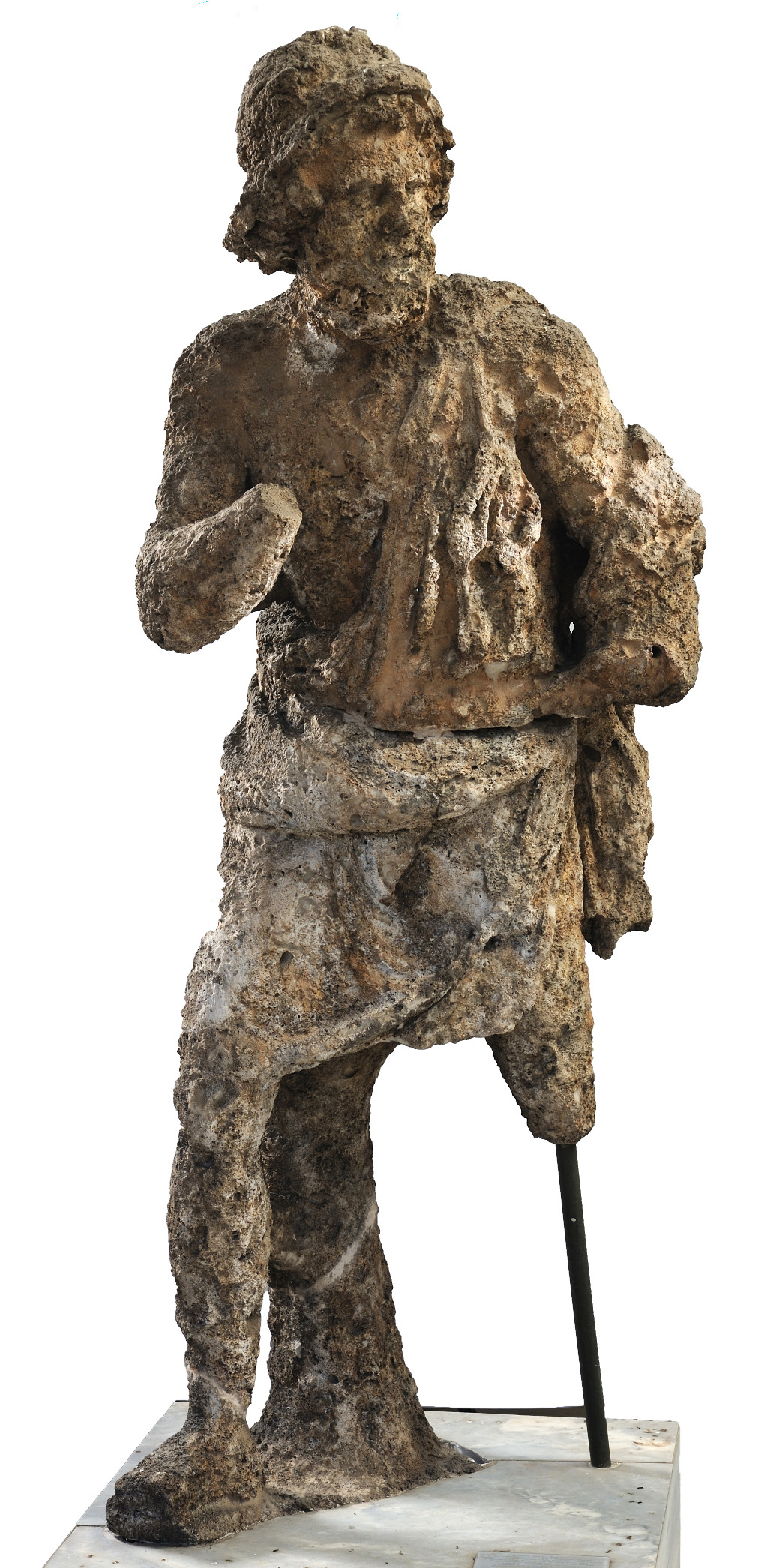
I have had the opportunity recently to see a splendid exhibition that arrived in Basel, Switzerland from Athens. Its subject matter was the most important ancient shipwreck ever recovered: the Antikythera wreck. Most media attention was captured by the most famous artifact recovered from the wreck – a highly sophisticated mechanism, which was a precise astrolabe (an astronomical computer) used for calculating the position of planets, timing of the eclipses, casting astrological charts, etc.  Its significance, which stunned scientists, has been well documented both by esoteric (astrological) (http://www.demetra-george.com/resources/articles/164-the-antikythera-mechanism-revealed-a-2000-year-old-astro-computer) and mainstream sources (https://www.youtube.com/watch?v=Q124C7W0WYA). My focus, however, was mainly on the collection of the marble and bronze masterpieces recovered from the wreck. Two statues startled me most: the marble Odysseus and the bronze Apollo.

The corroded, horror-like appearance of the marble statues on display was a testimony that this material does not withstand salt water well. Centuries spent on the sea bed led to their gradual disintegration. The parts that were buried in the sand withstood the cruelty of salt water. Marble is very fragile (Venus of Milo comes to mind), yet even the crippled, chipped, maimed fragments of Greek sculptures that survived until our times have an aura of stunning, perfect beauty about them. As if Father Time cannot claim them, because they are mightier than him. The weathered, corroded look of Odysseus was extremely becoming, I thought. It made him lifelike, human, and incarnate. I imagine the polished marble Odysseus would not be happy as an objet d’art in a Roman villa (the ship is believed to have been sailing from Greece to the territory of the Roman Empire). Doesn’t his decrepit look reveal more of his years of wearisome suffering?

Bronze, as opposed to marble, withstands the ravages of salt water very well. In classical antiquity, there were some bronze alloys, notably the Corinthian bronze, which were considered to be very precious. The main composites of bronze are tin and copper, which correspond symbolically to Jupiter and Venus, the ancient benefic planets. Copper, the metal of Venus, is soft and pliable, but when combined with tin to create bronze it does not lose its beautiful reddish hue, yet it gets hard and resistant. Bronze statues are created for eternity. The perfectly preserved statue of Apollo (a copy of a Pompeii statue) had a supernatural, spine-chilling aspect to it.  I could not look away, though it was a haunting, disconcerting experience.

Apollo

Apollo

The exhibition made me also ponder the symbolism of ships and navigation. Perhaps in symbolic terms, the Greek ship’s cargo, destined to decorate the villas and palaces of the Roman Empire, found its more fitting abode on the bottom of the sea. For many ancient cultures, especially the Vikings, the sea was both the cradle and the coffin. By sinking the ship before it left the Greek waters, the Aegean Sea Mother seemed to have claimed her due from ancient Romans.  In her Women’s Encyclopedia of Myths and Secrets, Barbara Walker traces back the etymology of the Teutonic Schiff (ship) to the word fate. A strong feeling of fateful necessity accompanied me during my whole trip to Basel. The ship sank, its whole crew drowned, yet the Sea Goddess chose to cradle its treasures over long centuries. There is fatedness in the ship getting so much attention only now. Perhaps we are finally ready to fully comprehend how much ancient wisdom has been lost and needs to be retrieved from the depths of the collective unconscious.

Posted in The Antikythera | Tagged , , , , , , , , , , , , , , , , | 17 Comments

The Magnificent Imperia of Constance

IMG_1685

She is splendid, imposing, imperial. 9 metres high, she slowly revolves round her axis, revealing all the facets of her provocative ensemble. In her left palm sits a naked minuscule pope, in her right – a minuscule naked emperor; both look ludicrous in their Hats of Power. This landmark statue, towering magnificently over the harbor of the German city of Constance, was installed clandestinely at night in 1993. Its controversy did not sit well with the city council, who, however, had no jurisdiction over the harbor, controlled by the German Railways, who welcomed the statue of Imperia with open hands. The woman portrayed by the statue is called Imperia. She is the work of Peter Lenk Bildhauer, who, inspired by a short story by Balzac, wanted to commemorate the notorious Council of Constance (1414-1418).

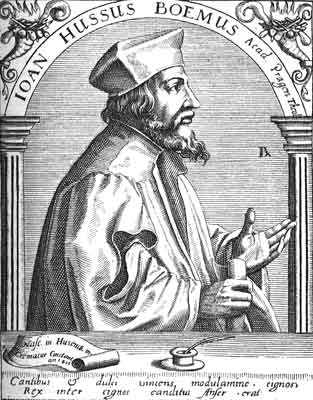
Jan Hus

Jan Hus

Before the Council was convoked, as many as three popes had been claiming the right to the papal throne. The church was corrupt and in disarray. The general public was kept in the dark about it. “Sancta Simplicitas” (Oh, Holy Naiveté), Jan Hus was supposed to have exclaimed when he saw an elderly pious woman eagerly adding brushwood to his burning stake. This enlightened church reformer, an intellectual, a Czech precursor of Protestantism, who made a grave mistake of condemning the dubious moral conduct of the clergy, was sentenced to death by the Council of Constance. The integrity of the Council was questionable for yet another reason: with the arrival of holier-than-thou men of the cloth, the city of Constance observed a steep rise in prostitution (1500 prostitutes alone arrived as permanent members of churchmen’s retinues). In Balzac’s story, which inspired the German sculptor, the magnificent courtesan Imperia holds sway over numerous pious members of the council. They are not able to withstand her seductiveness and one by one let themselves get swept off their feet.

The name of the city – Constance – seems to point to what is truly constant, unchanging: the eternal power of the feminine. To me, by her gesture, Imperia evokes the Minoan Snake Goddess (ca 1600 BC). Her snake invested power is immortal, and she has the magnificence of Lilith in her stature.

The Minoan Snake Goddess

Posted in Imperia of Constance | Tagged , , , , , , , , , , , , | 21 Comments

Asclepius: Earth-Walking Healer, Son of Apollo

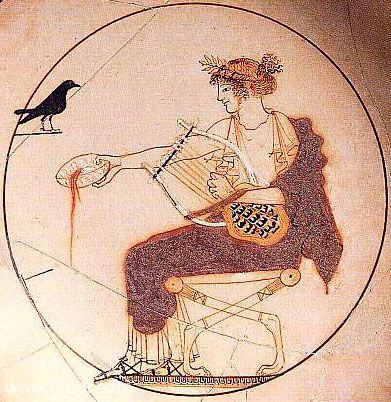
“Coronis was pregnant by Apollo when she found herself attracted to a stranger. He came from Arcadia, and his name was Ischys. A white crow watched over her. Apollo had told the bird to guard the woman he loved, ‘so that no one might violate her purity.’ The crow saw Coronis give herself to Ischys. So off it flew to Delphi and its master to tell the tale. It said it had discovered Coronis’s ‘secret doings.’ In his fury, Apollo threw down his plectrum. His laurel crown fell in the dust. Looking at the crow, his eyes were full of hatred, and the creature’s feathers turned black as pitch. Then Apollo asked his sister Artemis to go and kill Coronis, in Lacereia. Artemis’s arrow pierced the faithless woman’s breast. … Before dying, Coronis whispered to the god that he had killed his own son too. At which Apollo tried to save her. In vain. His medical skills were not up to it. But when the woman’s sweet-smelling body was stretched on a pyre high as a wall, the flames parted before the god’s grasping hand, and from the dead mother’s belly, safe and sound, he pulled out Asclepius, the healer.”

Roberto Calasso, “The Marriage of Cadmus and Harmony”

Apollo

Apollo

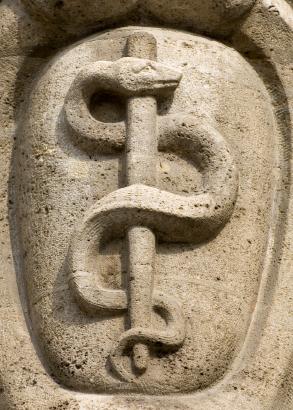
“When he promised to resuscitate the dead son of king Minos, Glaucus, Asclepius retreated into the woods in order to think about a cure. A snake wound itself around his staff; angered at being disturbed, he killed it, but then observed another snake bringing an herb and reviving its dead companion. He used the same herb to cure Glaucus, adopted the snake as his sacred animal, and made the staff with the snake his symbol.”

Fritz Graf, “Apollo (Gods and Heroes of the Ancient World)

The rod of Asclepius

The rod of Asclepius

When grown up, Asclepius became the best physician that ever existed. Carried away by his success, however, he forgot the limits that Zeus had set to mortal men: he tried to resuscitate the dead. Zeus killed him with his lightning, restoring the cosmic order which Asclepius threatened.

Fritz Graf, “Apollo (Gods and Heroes of the Ancient World)”

Asclepius, a healer, a redeemer, a son who by his tender devotion atoned for his father’s haughtiness and hubris, may be the most sublime figure of the Greek pantheon. Similarly to Chiron, who raised him, Asclepius, the “unceasingly gentle”, bridged the gap between nature and culture, as Fritz Graf put it, by connecting the material world of the sense with the abstract world of the divine mind. Always accompanied by his daughters, most notable of whom were Hygeia and Panacea, he redeemed the feminine violated by his father and other prominent Olympian gods. Asclepian healing practice was very different from that administered by his formidable father. The healing granted by Apollo, the Averter of Evil, the Purger and Purifier, was swift, coming from afar, abstract, detached, and as sudden as a lightning bolt, since he was a god of healing and a god of punishment in equal measure. Apollo healed the plagues he sent. The followers of the path of Asclepius, however, relied heavily on ritual (incubation), honored the right time and place, and always paid homage to the earth goddess.

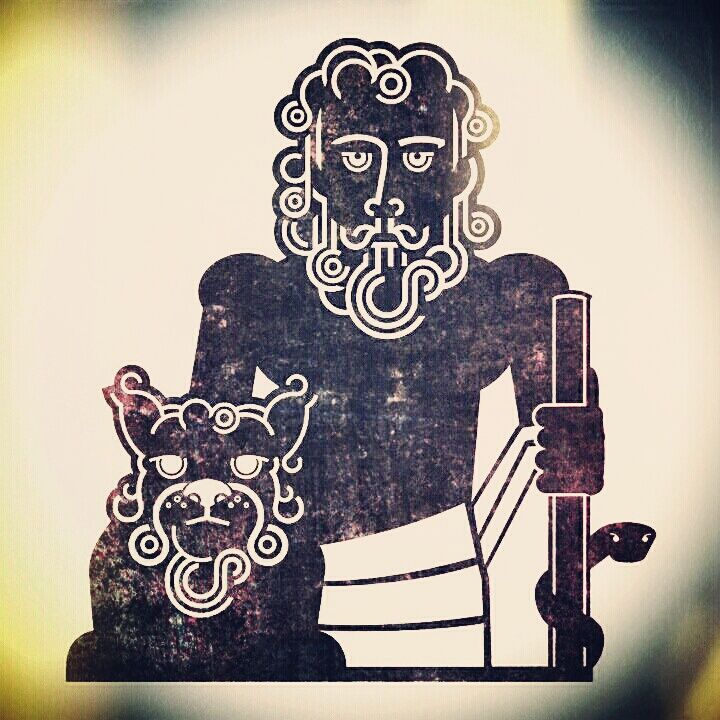
There are at least three different versions of Asclepius’ birth. In one of them recounted by Robert Graves, it was not Apollo who snatched the baby out of the funeral pyre, but Hermes. I find this tidbit quite appealing, because Asclepios seems to be a very Hermetic figure to me. He walked the earth with a staff in his hand (known today the rod of Asclepius), devoting his time to “praxis kai logos,” i.e. “treating with hands and by speaking magic words.” To describe the process, Meier quotes from the Emerald Tablet of Hermes Trismegistus: “He ascends to Heaven from earth, and again descends to earth, and is endowed with the strength of the Powers above and below”. Asclepius is in fact one of the prominent characters of Corpus Hermeticum, in which he makes an appearance as a devoted follower and disciple of Hermes Trismegistus himself. Hermes admonishes Asclepius to devote himself to the world rather than escape it by saying to him in Book IX that “sense and understanding both flow together in man, as they are entwined with each other. It is neither possible to understand without sense nor to sense without understanding.” Higher understanding must be rooted in the body – this is the essence of hermeticism. Furthermore, number three seems to be of special significance to Asclepius, as it is to Hermes. There are three myths related to his birth, there are three animals sacred to him – the snake, the cock and the dog. The cock, like Hermes, connects to the inherent duality of being as an animal that, as Tick puts it, “straddles yin and yang, darkness and light, day and night. It calls us to consciousness, crying at the break of dawn to awaken us from dreams.” It heralds the sunrise, and so did Asclepius derive his divine gifts from his father, the sun god.
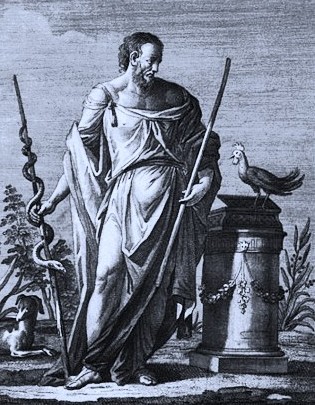
As a figure that united opposites – both god and human – Asclepius represents further dualities; for example, he was often portrayed both as a boy and as a mature man. He was born amidst fire and died being struck by a lightning bolt, but his life on earth revolved around sacred groves and springs, and was of a very earthy nature. After he was killed, thanks to his apotheosis he became associated with the constellation of Ophiuchus (the Serpent Bearer, the Snake Charmer). Furthermore, Ophiuchus was understood as “the fetus attached to the umbilicus cord”:

“Ophiuchus, from Greek Ophiukhos, literally ‘holding a serpent’, from Greek opis (or ophis), the Greek word for ‘serpent’, + Greek ekhein, ‘to hold, keep, have’. … there is a suggestion that there is a likely relationship between the Greek words ophis and *omphi-. [Omphi from the Indo-European root *nobh-. Related words ‘umbilicus’, ‘omphallus’, ‘navel’, ‘nave’, the hub of a wheel]. The constellation Ophiuchus is identified with Asclepius who was cut from his mother’s womb as a foetus. The long tube-like shape of a snake bears a resemblance to an umbilical cord. When the snake is curled up it might appear to be like the nave or hub of a wheel. [The womb is represented by Delphinus.] Ophiuchus was called Ciconia, the Stork, by the Arabian astronomers. They had depicted a stork in the place of Ophiuchus.”

Via http://www.constellationsofwords.com/Constellations/Ophiuchus.html
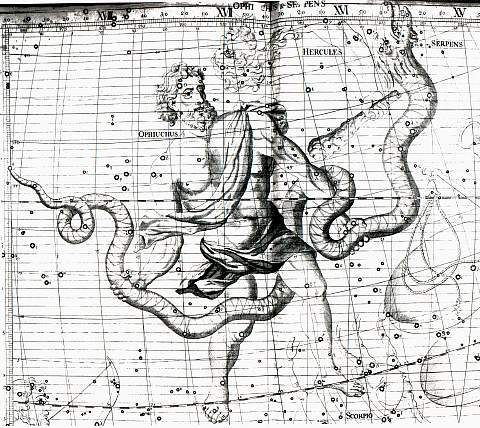
Asclepius entered and exited the world in an equally dramatic fashion, indicating his connection with liminal states, balancing between death and life, being exposed to the ultimate realities of existence symbolized by the divine fire.  Those who received a healing from him saw him as a kind, compassionate and gentle figure, like Chiron.  He was compared to both the sun and the moon: his wisdom was solar and paternal, his care and tenderness lunar and maternal. One of the versions of Asclepius’ origins has him as a pre-olympian primordial god of the earth, one of the “chthonioi” or spirits that lived in “the dark recesses of the earth.” As such a demon, he was not only a healer but also an oracle. The vestiges of this myth are visible in the choice of animals sacred to Asclepius: both the dog and the snake have an obvious affinity with the underworld. They are conjoined symbolically in the mythological figure of the hydra which was both the snake and the hound. A large number of underground monsters such as the Erinyes, the Gorgon or Cerberus shared the characteristics of both animals. Further, both the serpent and the dog, as guardians of inner treasure, connect to the underworld and the souls of the dead, the dog being their guide, while the snake being symbolic of death and rebirth. After Medusa was slain, her blood was divided between Athena and Asclepius. It was believed that the blood from her right vein cured, and from the left killed. Any healing work requires a careful and loving unification of opposites. Both the name Medusa and the word ‘medicine’ come from the same Greek root word med– which means ‘to devise, to use powerful means, to consider, judge, estimate and measure.’ It was Apollo who called for moderation in everything at his Delphic oracle; with excess any remedy could turn into poison.

The snake as a healing symbol has a long-standing tradition. In his essay “The Snake is Not a Symbol,” included in his book Animal Presences, James Hillman provides a summary of twelve meanings of the snake, some of which are:

1.The snake is renewal and rebirth, because it sheds its skin.

  1. It is a feminine symbol, having a sympathetic relation with Eve and goddesses in Crete, India, Africa, and elsewhere.
  2. The snake is a phallus, because it stiffens, erects its head, and ejects fluid from its tip. Besides, it penetrates crevices.

  1. The snake is a healer; it is a medicine. …
  2. It is a guardian of holy men and wise men – even the New Testament says that serpents are wise.
  3. The snake brings fertility, for it is found by wells and springs and represents the cool, moist element.
  4. A snake is Death, because of its poison and the instant anxiety it arouses.
  5. It is the inmost truth of the body, like the sympathetic and para-sympathetic nervous system of the serpent power of Kundalini yoga.
  6. The snake is the symbol for the unconscious psyche – particularly the introverting libido, the inward-turning energy that goes back and down and in. Its seduction draws us into darkness and deeps. It is always a “both”: creative-destructive, male-female, poisonous-healing, dry-moist, spiritual-material …

It is worth pointing out that all chthonic gods had a strong connection to phallic energies perceived as regenerative and procreative.

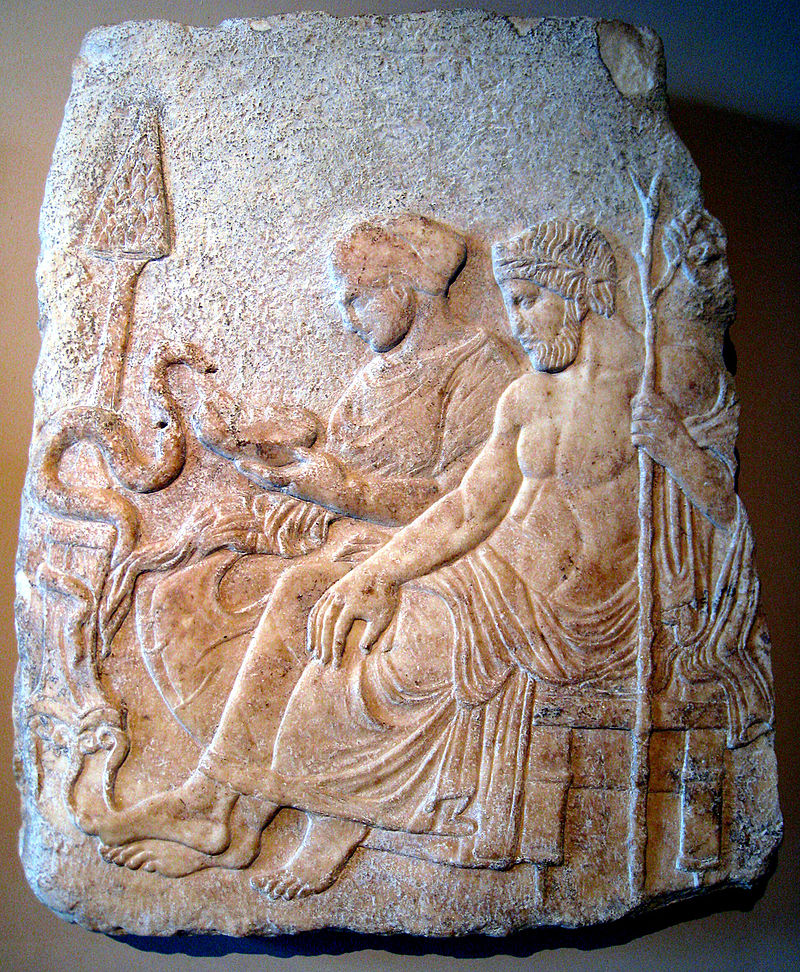
Asclepius and Hygieia feeding the snake

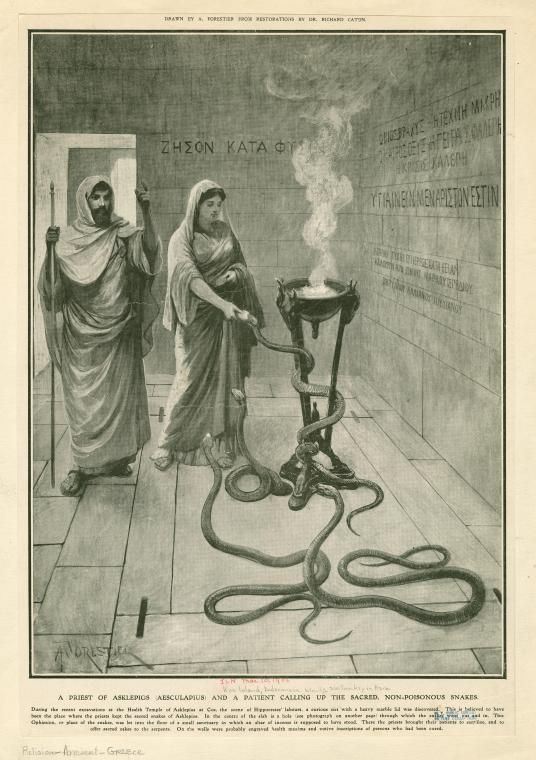
How was healing effectuated in the Asclepeion, i.e. a healing temple of Asclepius? In the most famous sanctuary at Epidaurus, built in the valley below Apollo’s shrine, harmless snakes and dogs accompanied the sick throughout all healing rituals. Other outstanding features were the ubiquity of water (supposedly flowing through a sacred labyrinth) and musical performances. The central healing ritual was incubation, which can be likened to a dream questing. As Meier points out, for Greeks dreams were not figments of imagination but “something that really happened.” They were perceived as stimulating the natural “soothsaying of the psyche.” Symptoms were always viewed as external expressions of the deeper underlying reality of the psyche. In other words, the correspondence (synchronicity) between body and mind, the outer and inner world, is what constituted every symptom. While incubating, the sick person slept in the abaton, lying on a klinē, from which our modern word “clinic” is derived. The abaton or adyton was, as Meier describes, a “place not to be entered unbidden.” It was the holiest part of the temple. Scholars conjecture that it was supposed to be entered only by those who were invited or called to do so. The ritual of incubation was very much an initiation into a mystery, a crossing over to the higher dimension of being. In a similar fashion, the healing sanctuary of Isis in Tithorea, Greece, could not have been entered by those not invited by the goddess in a dream. Coming uninvited incurred a harsh punishment. The rite of incubation brought about healing on many levels. The participants were encouraged to wear white garments that symbolized purity and receptivity of the soul, its return to the original innocence. Before approaching such sacred powers, the daily mind had to be silenced, the body cleansed, senses purified. Meier adds that the rite also “healed people of bad fate or destiny.” Asclepius himself appeared in a dream or a vision, touched the sick organ, thus healing it.

The Orphic hymn to Asclepius calls him mighty and soothing, one that “charms away the pain.” He, like the earth goddess Demeter, was invoked as “a blessed spirit of joyful growth.” Interestingly, Demeter was also regarded as a healing goddess that was accompanied by serpents. Meier says that the Demeter-Persephone mysteries of Eleusis featured Asclepius as its prominent deity ever since he himself was initiated into the Mysteries. Like most secrets of Eleusinian mysteries, the intricacies of the healing that occurred under the cover of the night at an Asclepian sanctuary will forever remain veiled to our daytime understanding. The work of healing incubation was highly individualized and case sensitive. Each case was treated as different and unique, because “the waking have one world and a common one, but when asleep everyone turns away from it into their own world,” as Heraclitus wrote in the famous fragment 89.
Support my blog

If you appreciate my writing, consider donating and make my day. Thank you in advance.

$1.00

Sources:

Fritz Graf, Apollo (Gods and Heroes of the Ancient World), Kindle edition

James Hillman, Animal Presences, Kindle edition

C.A. Meier, Healing Dream and Ritual: Ancient Incubation and Modern Psychotherapy, Kindle edition

The Orphic Hymns, translated by Apostolos N. Athanassakis and Benjamin M. Wolkow

Edward Tick, The Practice of Dream Healing: Bringing Ancient Greek Mysteries into Modern Medicine, Quest Books 2001

Posted in Asclepius | Tagged , , , , , , , , , , , , , , , , , , , , , , , , , , , , , , | 26 Comments

“The Canticle of the Void” by Paul Murray

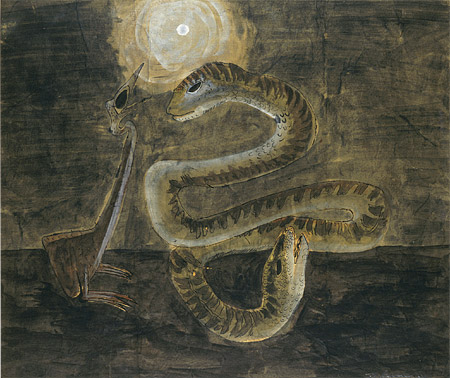
Morris Graves,

Morris Graves, “Bird, Snake and Moon”

“Smaller than the small
I am that still centre
within you
that needle’s eye
through which all the threads
of the universe are drawn.

Perhaps you think you know me
but you do not know me.

Of everything that is,
of every word that is spoken
on the lips
or in the heart,
of every thought and hope and wish,
I am the silent witness.

Nearer to you than ecstasy
in the blood
yet more mysterious far

I am the guardian of every colour
that catches the eye,
of every taste
that pleases the tongue,
of every word
that speaks to the heart.

Perhaps you think you know me
but you do not know me.

Mine is the voice
that sings out of the voiceless
night, that rises
like music out of the root
of the dark thorn, out of the lucid
throat of the fountain.

Smaller than the small

I am the seed
of all that is known
and unknown.

I am the root
and stem of meaning,
the ground

of wonder. Through me,
each leading
tendril of desire
is drawn,
and breathes in
consciousness of Being.

And yet when you open
your ears to my voice
and listen with all your hearing
and listen again,
no subtle joining of notes and words,
no vertical song is heard

but silence is singing.

And when you open your eyes
to my appearance
but cannot see me,
or when you close your eyes
and close your ears in concentration
and look with your hands
and turn back again the pages
of sleep’s dark scripture,
no great or terrible sign awakes,
no vision burns

but absence is shining.

Mine is the secret
that lies hidden
like the lustrous pearl

gleaming
within its oyster

the deepest secret
the secret
hidden within the secret.”

By Paul Murray

Posted in Poetry | Tagged , , , , , , , | 17 Comments

The Scent of Autumn Earth

“September 13, 1907 (Friday) . . . never has heather so touched and almost thrilled me as recently, when I found those three twigs in your sweet letter. Since then they have been lying in my Book of Pictures and have permeated it with their strong stern odor, which is really only the scent of autumn earth. How glorious it is, though, that fragrance. Never, it seems to me, can the earth be thus inhaled in a single smell, the ripe earth; in a smell that means no less than the smell of the sea, bitter where it borders on taste, and more than honey- sweet where one feels it must be impinging on the beginnings of tone. Containing depth within it, darkness, the grave almost, and yet again wind too; tar and turpentine and Ceylon tea. Serious and shabby like the smell of a begging friar and yet again resinous and hearty like costly frankincense…”
Reiner Maria Rilke, “Letters on Cezanne,” translated by Jane Bannard Greene and M.D. Herter Norton

image

Posted in Quotations | Tagged , , , , , | 12 Comments

Struggle for Love in a Dream

Poliphilo enters a dense and pathless forest

Poliphilo enters a dense and pathless forest

Hypnerotomachia Poliphili (Poliphilo’s Strife of Love in a Dream or Poliphilo’s Struggle for Love in a Dream), more than just a book but rather a milestone in depth psychology, was published in Venice in 1499. It featured beautiful woodcut illustrations and told a bizarre story that resembled the logic of a dream:

“The action of the ‘Hypnerotomachia Poliphili’ takes place in a dream. The books opens on the hero, Poliphilo, who has spent a restless night because his beloved, Polia, has shunned him. At the break of day, he finally falls into a deep slumber and his ‘Hypnerotomachia,’ or, as it can be roughly translated, ‘struggle for love in a dream,’ begins. The action is particularly absurd, however, even by the standards of the genre. Poliphilo is transported into a wild forest. He gets lost, escapes, and falls asleep once more. He then awakens in a second dream, dreamed inside the first. Within it, he is taken by some nymphs to meet their queen. There he is asked to declare his love for Polia, which he does. He is then directed by two nymphs to three gates. He chooses the third, and there he discovers his beloved. They are taken by some more nymphs to a temple to be engaged. Along the way they come across no less than five triumphal processions celebrating the union of the lovers. Then they are taken to the island of Cythera by barge, with Cupid as the boatswain; there they see another triumphal procession celebrating their union. The narrative is uninterrupted, and a second voice takes over, as Polia describes the erotomachia from her own point of view. This takes up one fifth of the book, after which the hero resumes his narrative. They are blissfully wed, but Polia vanishes into thin air as Poliphilo is about to take her into his arms.”

Via http://mitpress2.mit.edu/e-books/HP/hyptext0.htm

This “frenetic, fantastic specimen” of a book, as Liane Lefaivre describes it, is full of mysterious messages in various languages. It is a testament to boundless creativity and simmering mutability of the psyche, ceaselessly spouting foam, creating mirages, blowing soap bubbles, while painting internal, breathtaking landscapes of the soul. Poliphilo chases Polia through grottos, landscapes and gardens which get increasingly fantastical, with an aquatic labyrinth taking the crown. Poliphilo, “lover of many things,” and Polia, “many things,” symbolize the boundedness of Psyche to Eros – as one cannot exist without the other. Yet they both delight in endless hot pursuit.

Links:

http://mitpress2.mit.edu/e-books/HP/index.htm

http://www.harvardartmuseums.org/search-results?q=Hypnerotomachia+Poliphili

Posted in Hypnerotomachia Poliphili | Tagged , , , , , , , , , , , , , | 10 Comments