Icy Lechery: Art by Tamara de Lempicka

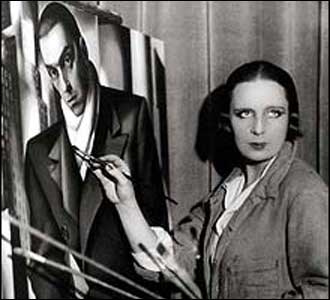
Self Portrait

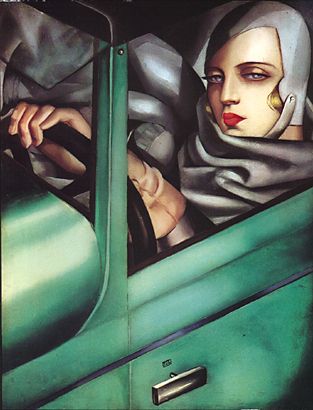
Self Portrait

“Was it true that, according to her final wishes, the ashes of the Polish-Russian artist Tamara de Lempicka were dropped from a helicopter by her daughter Kizette into the crater of the Mexican volcano Popocatépetl? What an Olympian, cataclysmic, magnificent way for the woman to say goodbye to this world, a woman who, as her paintings testified, knew not only how to paint but how to enjoy herself, an artist whose fingers imparted an exalted and at the same time icy lasciviousness to these supple, slithering, rounded, opulent nudes who paraded before his eyes: Rhythm, La Belle Rafaela, Myrto, The Model, The Slave. His five favorites. Who said that art deco and eroticism were incompatible? In the 1920s and 1930s, this Polish-Russian woman with the tweezed eyebrows, burning, voracious eyes, sensual mouth, and crude hands populated her canvases with an intense lechery, icy only in appearance, because in the imagination and sensibility of an attentive spectator the sculptural immobility of the canvas disappeared and the figures became animated, intertwined, they assailed, caressed, united with, loved, and enjoyed one another with complete shamelessness. A beautiful, marvelous, exciting spectacle: those women portrayed or invented by Tamara de Lempicka in Paris, Milan, New York, Hollywood, and in her final seclusion in Cuernavaca. Inflated, fleshy, exuberant, elegant, they proudly displayed the triangular navels for which Tamara must have felt a particular predilection, as great as the one inspired by the abundant, succulent thighs of immodest aristocrats whom she stripped only to clothe them in lechery and carnal insolence. … He slowly turned the pages of the book, barely stopping at the mannered aristocratic men, with blue tubercular circles under their eyes, pausing at the splendid, languid female figures with shifting eyes, hair as flat as helmets, scarlet nails, upright breasts, majestic hips, who almost always seemed to be writhing like cats in heat.

He was ecstatic over these beautiful damsels decked out in low-cut, transparent dresses, gleaming jewels, all of them possessed by a profound desire that struggled to become manifest in their enormous eyes. ‘To go from art deco to abstraction, what madness, Tamara,’ he thought. Though even the abstract paintings of Tamara de Lempicka exuded a mysterious sensuality.”

Mario Vargas Llosa, “The Discreet Hero”

"Girl with Gloves"

“Girl with Gloves”

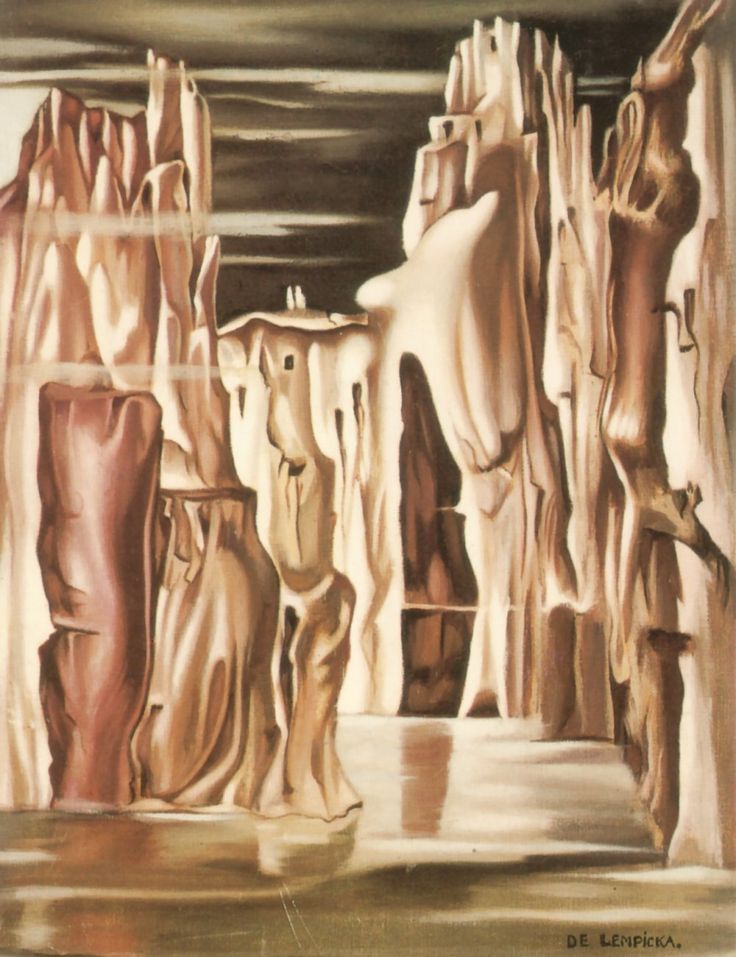
"Surrealist landscape"

“Surrealist landscape”

Posted in Painting, Quotations | Tagged , , , , , , , , , | 10 Comments

Apollo and the Pythia: the Oracle of Delphi

1.“I count the grains of sand on the beach and measure the sea; I understand the speech of the dumb and hear the voiceless.”

The Pythia

  1. “Tell the king, the fair-wrought house has fallen. No shelter has Apollo, nor sacred laurel leaves; The fountains now are silent; the voice is stilled.”

Pythia’s last oracular reply

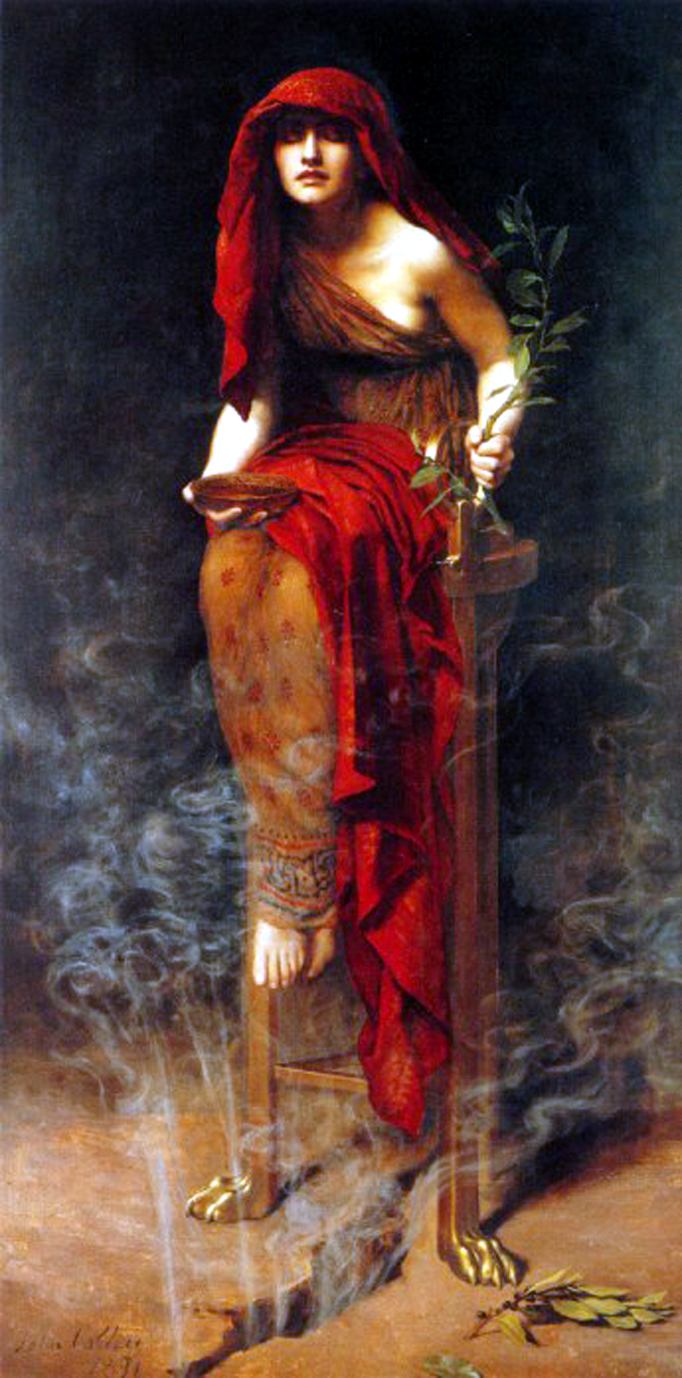
John Collier,

John Collier, “Priestess of Delphi”

In an extraordinary poem “Archaic Torso of Apollo,” Reiner Maria Rilke is faced with the ultimate mystery of divinity. A torso of the Greek sun god reveals to him his own inner God image – that elusive, transcendent centre of the psyche, which, like the mysterious centre of a mandala, or our inner galactic rotational centre, attracts, magnetizes and organizes all of our psychological processes. Jung called it the Self. The last line of the poem – “You must change your life” – echoes the famous inscription “Know Thyself” from the Apollonian oracle in Delphi. To know oneself means to accept the supremacy of the Self, that mysterious mover and shaker that brings about what we call Fate for lack of a better word. This process must and will result in a transformation. I am quoting the poem in Edward Snow’s translation:

“We never knew his head and all the light

that ripened in his fabled eyes. But

his torso still glows like a gas lamp dimmed

in which his gaze, lit long ago,

holds fast and shines. Otherwise the surge of the breast

could not blind you, nor a smile

run through the slight twist of the loins

toward that center where procreation thrived.

Otherwise this stone would stand deformed and curt

under the shoulders’ transparent plunge

and not glisten just like wild beasts’ fur

and not burst forth from all its contours

like a star: for there is no place

that does not see you. You must change your life.”

On of Apollo’s epithets was Phoebus, which meant pure or holy. He presided over most of Greek renowned oracular shrines, where multitudes flocked to reconnect with their own inner pure and holy place, and thus find answers to questions of various magnitude. His was Didyma, Delphi and Clarus, while only Dodona belonged to Zeus, whose priestesses called Sybils interpreted the rustling of oak leaves. Porphyry thus described the three methods of divination used by three main Apollonian oracles:

“There are those who give oracles having drunk water, such as the priest of Clarian Apollo in Colophon; others are sitting over openings in the ground, such as the women who give oracles in Delphi; others again are breathing inspiration from water, such as the prophetesses in Didyma.”

Delphi was by far the greatest and most renowned. It marked the centre of the Greek inhabited world. As Roger Sworder explains:

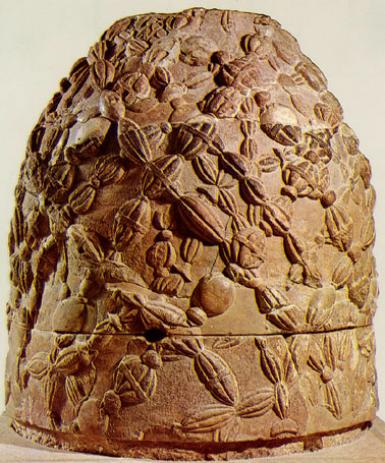
“Inside the temple of Apollo at Delphi was a certain stone, the navel stone or omphalos, …. The story went that two eagles or swans flying in opposite directions from the furthest parts of the earth had met in Delphi at this stone. … The navel stone was hemispherical and sacred to the goddess Earth. …

The stone was inside the temple of Apollo. Also inside the temple was the oracular shrine of the Pythian prophetess. As in a womb, delphys, male and female, waking and sleeping, light and night were joined here. What was done here enacted the hidden point of the cosmic genesis and organized the ancient Greek world after its pattern. The omphalos showed that this was where the womb was. …

It was called the navel stone because it marked the representation of the cosmic womb. In this place the heart of space, the heart of thought and the heart of generation were at one. It is usual for oracular shrines to be placed at geographic centres. In the Vedas it is said that all oracles are set as is the nave within the wheel. A word for an oracular pronouncement in Greek is omphe, which is connected with omphalos. From here the Greek world opened out, guided by the principal thought at its center.”

The Omphalos

The Omphalos

He continues:

“Delphi was the location of Mount Parnassus, a favorite place of Apollo and the Muses.

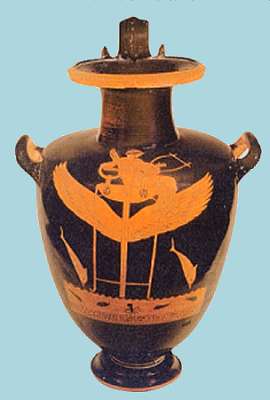
… The early Hymn to Pythian Apollo describes how the god came to Krisa, a foothill facing west beneath snowy Parnassus, and there decided to site his temple. Then he laid out all the foundations, wide and very long. The longer sides of the building were aligned east and west; the shorter sides, in one of which was the main entrance, north and south. … Guided by Justice Apollo surveyed the earth from his chariot, going from west to east in his yearly journey round the zodiac. In his temple he was the geographer of the Greeks. His laying out of its foundations symbolizes his nature. The lines he drew on the surfaces of earth and heaven ran straight as the arrows he shot from his bow. With this bow he killed Tityus and also the dragon from whose decay Delphi was called Pytho. These were victories of the mind which measures rather than of the reason which overcomes passion. He is pictured on many vases seated on the omphalos inside the temple, his bow and quiver hanging from a peg. The omphalos is covered with a net or knotted ropes, other symbols of geodesy.”
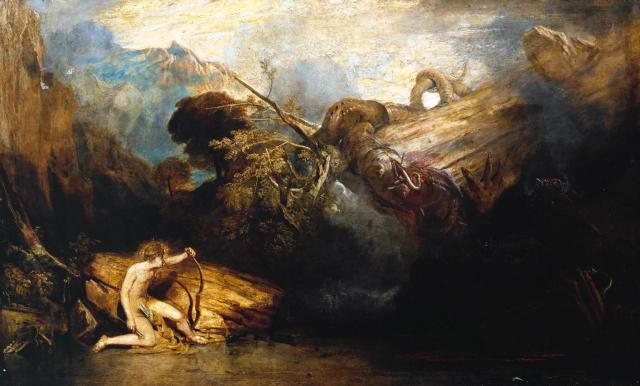
J.M.W. Turner,

J.M.W. Turner, “Apollo and Python”

Similarly, Fritz Graf calls the establishment of the oracle at Delphi “a mythical feat that has cosmic dimensions, marking the beginning of the world as we know it.” According to the Homeric hymn to Apollo, the god killed a serpent/dragon and proceeded to call the place Pytho (Stinkton) after the stench of the rotting beast. We can also choose to read the story as one of an aggressive male God taking over the place, which long before him was sacred to earth goddess (with the snake as one of her attributes) and famous for its oracular properties. However, one simple fact seems to disprove that version, at least in my eyes: The Pythia, the high priestess of Delphi, was the highest spiritual authority and the only channel of divine will. She was the true and only messenger of the gods. Oracles revered the powers of the earth, its sacred springs and lofty rock formations. That was perhaps not a conquest but a loving assimilation, showing deeper understanding of the nature of divine inspiration.

A vase depicting Apollo on a winged tripod over the sea with dolphins

A vase depicting Apollo on a winged tripod over the sea with dolphins

Before Apollo, the presiding deity in Delphi was Gaia, the earth goddess. In a scientific (and yet deeply spiritual) book on Delphi’s secrets, which was a true revelation for me, William J. Broad describes how from a geological perspective, with its mountains, canyons and cliffs, this is an absolutely unique, one-of-a-kind place in the world, “a place where primal forces have thrown open the secrets of the earth to human inquiry.” Behind the temple, the view was dominated by twin limestone cliffs called the Phaedriades (the Bright Ones or the Shining Rocks), which put on a golden hue as the sun rose and set. The cleft that nested the sanctuary was indeed like the womb, naturally flanked by imposing mountains on three sides. The place abounded in crystalline clear springs, which were believed by the locals to possess magical qualities. All this made Delphi a secluded retreat and a stunning sanctuary. Pilgrims must have been dazzled by an awesome display of Oracle’s wealth. A wide road lead through a row of impressive statues donated to Delphi by grateful rulers of ancient cities, past imposing buildings, up to the monumental Doric temple. The peak of Mount Parnassus, home of the Muses, a mountain sacred to both Apollo and Dionysus, towered over the sanctuary. Broad writes:

“First-time visitors surely gazed about in reverential silence. Some probably wept. Scores of statues of Apollo greeted pilgrims, one looking down from a height of nearly sixty feet. Made of bronze, it could gleam in the clear mountain air, not unlike the god of the sun himself.

The temple itself was a Doric gem. A bit smaller than the Parthenon, it arose in the fourth century BCE during Greece’s classical age and represented the culminating edifice of a series of temples that were increasingly large and stately. Its entrance bore such inscriptions as ‘Know Thyself’ and ‘Avoid Extremes’ lest visitors doubt their arrival at the epicenter of wisdom.”

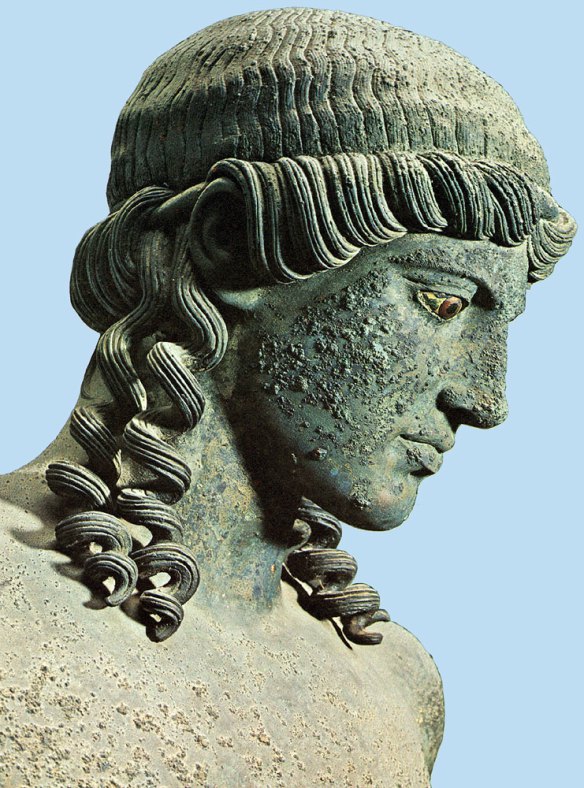
Bronze head of Apollo from the Temple of Apollo in Pompeii

The importance and centrality of the Oracle in the culture of Ancient Greece cannot be overestimated, Broad emphasizes:

“No seer or diviner stood higher. No voice, civil or religious, carried further. No authority was more sought after or more influential. None. She quite literally had the power to depose kings. …

The evidence suggests that her words repeatedly changed the course of history. Over a vast period—ages in which peoples came and went, empires rose and fell—the Oracle proved to be the most durable and compelling force in what was arguably the most important society that humans ever devised. She was the guide star of Greek civilization. We have no equivalent. No religious or secular figure, no pope or imam, no celebrity or scientist, commands the kind of respect that the Greeks accorded the Oracle of Delphi. Her sacred precinct on the flanks of Mount Parnassus was the spiritual heart of the Hellenic world.”

A French archaeologist was quoted to say that the place was “full of mystery, grandeur and divine terror.” He was referring to his team unearthing the adyton – the sacred chamber positioned in the temple, where Pythia delivered her prophecies. She prophesized sitting on a tripod inside the adyton, which in ancient Greek means “do not enter.” She inhaled mysterious vapors rising from a cleft beneath her feet and enveloping her in a supernatural mist. Before a consultation, the Pythia would bathe herself in the waters of the Castalia spring. Priests would purify themselves in its waters, too. Next, they would all proceed to yet another holy spring – the Kassotis, which emerged from within the sanctuary itself. There the Pythia would drink its sacred waters.  Finally, the Oracle would descend to the adyton, where she would sit on a tripod with the view of the omphalos flanked by two golden eagles of Zeus. Other sacred objects included a statue of Apollo and Grave of Dionysus. Her spiritual union with the god aided by her inhaling of sacred pneuma ensued. Broad summarizes: “The Pythia, presiding over the adyton, rapturous in her divine intoxication, would turn inward, reflect on the question, shake a laurel branch as the spirit of Apollo swept through her, and utter the god’s response. As the Pythia spoke, the priest recorded her words.”

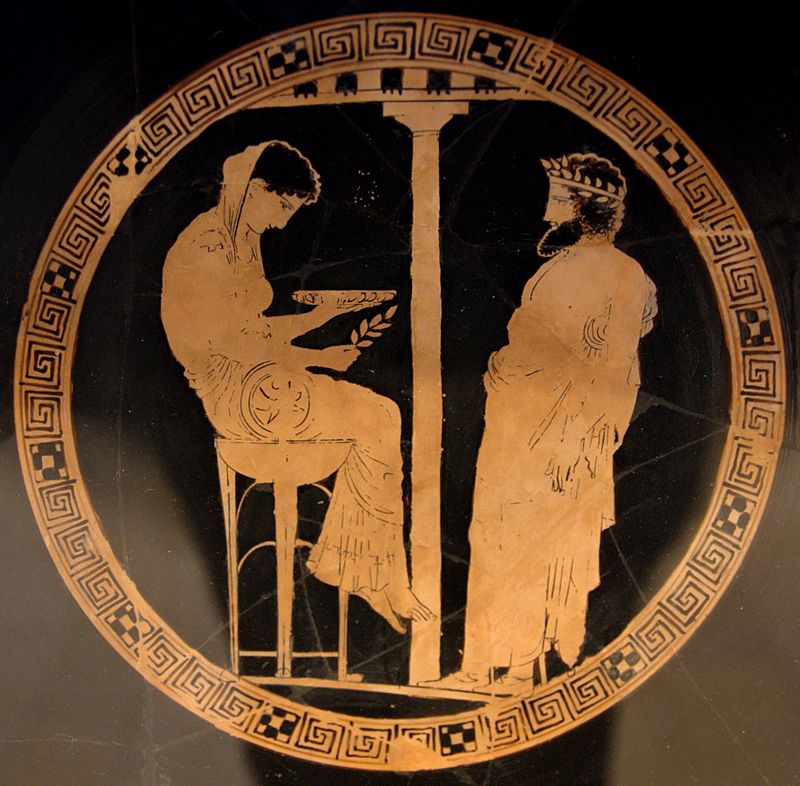
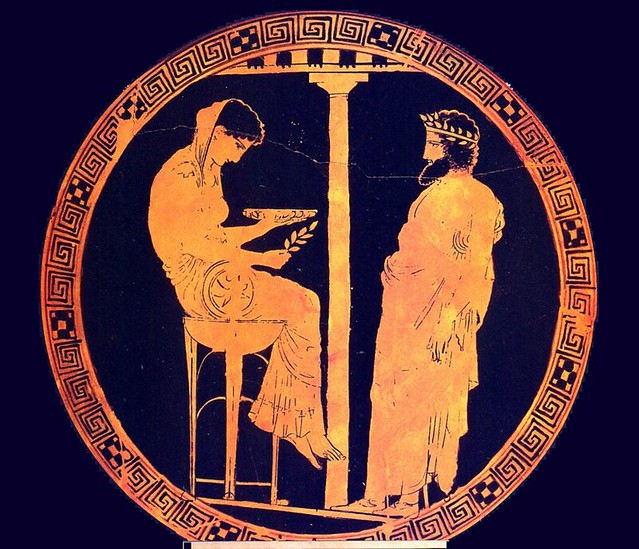
“Around 440 BCE, an Athenian potter decorated a large cup with a portrait of the Delphic Oracle in the midst of a prophetic session. It turns out to be the only surviving image that we have of the Pythia from her own day. The illustration shows neither a rustic maid nor a youthful seductress. Rather, it portrays a woman in her prime, with full breasts and supple gracefulness, her long alb coming down to her ankles. She sits on the tripod, her bare feet dangling off the floor, her body slumped, not quite herself, thoughtful, her eyes gazing down, looking into a small dish, presumably filled with water from a sacred spring, perhaps fragrant with a sweet aroma. In her right hand she holds a sprig of laurel, Apollo’s holy plant. The ceiling of her oracular chamber is low, and beneath her feet, below the floor, the artist has depicted a void.” William J. Broad

“Around 440 BCE, an Athenian potter decorated a large cup with a portrait of the Delphic Oracle in the midst of a prophetic session. It turns out to be the only surviving image that we have of the Pythia from her own day. The illustration shows neither a rustic maid nor a youthful seductress. Rather, it portrays a woman in her prime, with full breasts and supple gracefulness, her long alb coming down to her ankles. She sits on the tripod, her bare feet dangling off the floor, her body slumped, not quite herself, thoughtful, her eyes gazing down, looking into a small dish, presumably filled with water from a sacred spring, perhaps fragrant with a sweet aroma. In her right hand she holds a sprig of laurel, Apollo’s holy plant. The ceiling of her oracular chamber is low, and beneath her feet, below the floor, the artist has depicted a void.”
William J. Broad

Who was the Pythia? Contrary to what a twentieth-century scientific consensus claimed, she was neither a dupe nor a tool in the hands of savvy priests. She was not a junkie babbling under the influence of subterranean gas, either. Nor was she possessed by the devil who was violating her disguised as Apollo, as believed early Christians. Those outrageous modern claims have nothing in common with what respectable ancient sources and greatest intellectual authorities stated about her. For them, she embodied the holiest of all mysteries: of the possibility of human connection and communication with the divine. She was revered by the greatest minds of her times. Granted, ancient Greece was to all intents and purposes a misogynistic culture. Broad writes:

“Such regard was extraordinary for anyone, much less a woman. Most of ancient Greece lived by a code of extreme male chauvinism, at times of misogyny. Philosophers taught that men were superior to women even as artists such as Euripides railed against the oppression of females. For the middle and upper classes of Athens, a woman’s place tended to be in the home, working as a mother and a domestic manager, rarely allowed out except during festivals. Female babies were often victims of infanticide because of the economic drain of dowries. Men ruled public life. Some temples banned women and pigs. Some gods, such as Heracles Misogynous, sang the virtues of hating women. Even in the sacred environs of Delphi, woman petitioners seldom if ever had the authority to question the Oracle directly but instead had to put their questions through male intermediaries. Yet the jarring contradiction—suitable for any number of psychoanalytic studies—is that the greatest authority of ancient Greece was a woman.”

More precisely, there were numerous Pythias, one succeeding the other. They were members of mystical sisterhood, a sorority carefully guiding their sacred secrets. They enjoyed high social standing and freedom, unlike other Greek women. Men working at the sanctuary knew little of their comings and goings. One of the Pythias named Clea was close friends with Plutarch, himself a high priest of Apollo. He held her wisdom in extremely high esteem and had a lot of respect for her secrets.

In winter months, the oracle grounds were taken over by ecstatic worshipers of Dionysus. It seems that Clea was a member of that cult as well. Plutarch did not reveal her secrets, but just wrote instead: “Let us leave undisturbed what may not be told.” Dionysus was an inherent part of the Delphic mystery. The east side of the temple was dedicated to Apollo, but its west side was sacred to Dionysus – the god of wine and animal impulse, the loosener of civilized bonds. His side of the temple faced the setting sun and connected to Night and eerie orgiastic cults of the maenads. As Broad describes:

“In the chill night air, often under the stars, accompanied by torches and a beating drum, led by a double flute and a youth playing the role of Dionysus, the worshippers would dance their way up the cliffs behind the temple and climb seven miles to the Korykian cave, where their rites continued amid the large stalagmites that were easily seen in flickering light as divine phalli. Little is known of what occurred there because the rite was part of a mystery cult whose initiates pledged to keep their activities secret. It appears that the orgy could include sexual liberties in which the women might swiftly embrace their male companions, though scholars say the god did not demand such tribute. His rapturous devotees were free to act, or not, amid the surrender of the human spirit to the will of the god. The frenzied women were known as maenads, after the Greek verb meaning to be mad or furious.

Plutarch tells us that the rites culminated in screams and shouts and heads thrown back.”
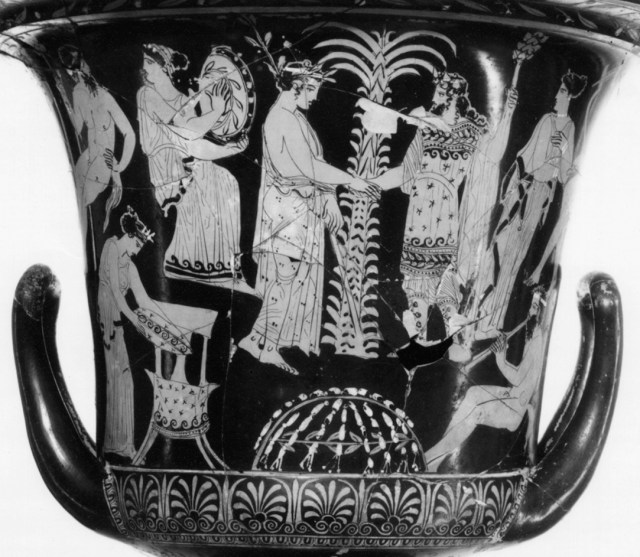
Apollo and Dionysus at Delphi, Attic vase, fourth century BC

Apollo and Dionysus at Delphi, Attic vase, fourth century BC

After the secret rites of winter brought about rebirth through a reconnection with the sacred chaos, the Oracle could proceed with its sheer blinding brilliance and keep delivering its uncannily accurate predictions in the months when the sun was at the height of its power. The messages of the Oracle were lofty but never arrogant. She always acknowledged the limits of knowledge. She protected the sanctity of life, regardless of the person’s social position. Notably, she used her power to free thousands of slaves. And she had little patience for arrogant wealthy supplicants.

Orestes at Delphi, via Wikipedia

Orestes at Delphi, via Wikipedia

The greatest minds of the time – Socrates, Aristotle and Plato – were closely connected with Delphi. In a famous prophecy, the Pythia professed that no man was wiser than Socrates. Humbled, the great philosopher spent his life searching for the meaning of this prophesy. In Broad’s words: “Even as his constant questioning made him poor and unpopular, religious duty kept him asking and searching, trying to understand the Oracle’s meaning. In the end, he decided it meant that real wisdom is the exclusive property of the gods and Apollo’s reference to him was ‘as if he would say to us, the wisest of you men is he who has realized, like Socrates, that in respect of wisdom he is really worthless.’” I know that I know nothing, as per the Socratic paradox. When another great man of his times, Cicero asked the Oracle what he should do to attain the highest fame, she responded that “he should make his own nature, not the opinion of others, his guide in life.” He became a master orator.

In the fourth century, the oracle ceased to operate. The site was pillaged, its ruins buried under a village now called Kastri. Nobody remembered the glorious past until in 1463 Cyriac of Ancona, a Renaissance scholar, climbed the Parnassus and realized with astonishment what he was looking at. William Broad’s extraordinary book narrates the history of rediscovery of Delphi, most notably the scientific discomfort with the mystical aura surrounding the place until this day. First, the hypotheses of subterranean gases was vehemently rejected on the grounds that the Oracle was nothing but a fraud. When it turned out that there were in fact gases emitted into the sacred chamber, a new theory emerged, according to which the Pythia was high, and her babbling incoherent mutterings had to be made worthy of the gods by the male priests. Wisdom and inspiration of the Pythia accompanied by her obvious psychic abilities was not something readily accepted by science. She will remain elusive and unknown. “The wisps of ethylene and bouts of rapturous intoxication” do not prove that what happened in Delphi was a purely physical process. As the scientist Jelle Zeilinga de Boer, the scientist chiefly responsible for the discovery of the Delphi subterranean gases, remarked in an interview with William Broad:

“… the chemical stimulus in no way explained the Oracle’s cultural and religious power, her role as a font of knowledge, her liberation of hundreds of slaves, her encouragement of personal morality, her influence in helping the Greeks invent themselves, or—by extension—whether she really had psychic powers. Even if her prognostications were judged to have no basis in literal foreknowledge, it gave no explanation for how she reflected the underlying currents of ancient Greek society and how her utterances stood for ages as monuments of wisdom. It said nothing of how the priestess inspired Socrates or functioned as a social mirror, revealing the subconscious fears and hopes of those who sought her guidance, or of how she often worked as a catalyst, letting kings and commoners act on their dreams. In futility, the situation was like attributing masterworks of twentieth-century literature to the fact that major authors indulged in heavy drinking.”

The Pythia eludes all attempts to demystify her. A Victorian painter John Collier captured her spirit wonderfully in his painting done in 1891. In this wonderful canvas, her eyes are closed, her concentration deep, “as if her mind was moving through all time and space” (Broad’s description). Will we ever fathom her divine ecstasy?

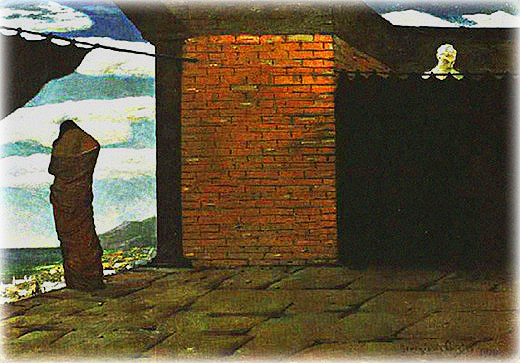
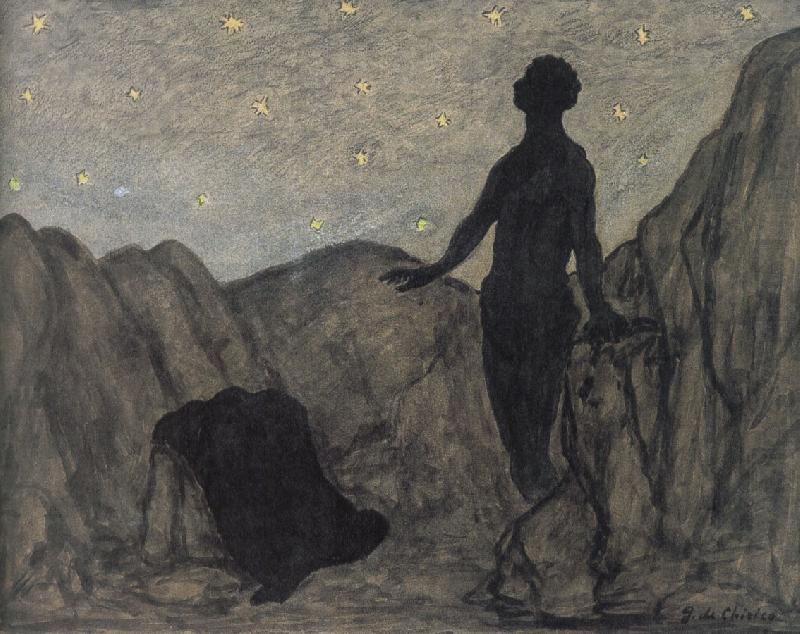
Giorgio de Chirico,

Giorgio de Chirico, “The Enigma of the Oracle”

Support my blog

If you appreciate my writing, consider donating and make my day. Thank you in advance.

$1.00

Sites with photos of Delphi:

http://www.discovergreece.com/en/mainland/central-greece/delphi

http://ancient-greece.org/history/delphi.html

http://ancient-greece.org/archaeology/delphi-archaeology.html

Sources:

William J. Broad, The Oracle: Ancient Delphi and the Science Behind Its Lost Secrets, Kindle edition

Fritz Graf, Apollo (Gods and Heroes of the Ancient World), Kindle edition

Roger Sworder, Science and Religion in Archaic Greece: Homer on Immortality and Parmenides at Delphi, Kindle edition

Related posts:

https://symbolreader.net/2015/08/23/to-apollo-the-averter-of-evil-the-bringer-of-harmony-part-1/

http://thetarotnook.com/2013/09/06/the-fascinating-flickering-tongue-of-the-pythia/

Posted in Apollo, The Oracle of Delphi | Tagged , , , , , , , , , , , , , , , , , , , , , , | 17 Comments

Poetry and Mystery: “Women” by Evelyn Scott

By Yaroslav Gerzhedovich

By Yaroslav Gerzhedovich

“Crystal columns,
When they bend they crack;
Brittle souls,
Conforming, yet not conforming–
Mirrors.

Masculine souls pass across the mirrors:
Whirling, gliding ecstasies–
Retreating, retreating,
Dimly, dimly,
Like dreams fading across the mirrors.

Then the mirrors,
Stark and brilliant in the sunshine,
Blank as the desert,
Blank as the Sphinx,
Winking golden eyes in the twinkles of light,
Silent, immutable, vacuous infinity,
Illimitable capacity for absorption,
Absorbing nothing.

Have the shapes and the shadows been swallowed up
In your recesses without depth,
You drinkers of life,
Twinkling maliciously
Your golden yellow eyes,
Mirrors winking in the sunshine?”

Gustave Moreau, "The Victorious Sphinx"

Gustave Moreau, “The Victorious Sphinx”

Posted in Poetry | Tagged , , , , , | 6 Comments

To Apollo: The Averter of Evil, the Bringer of Harmony (part 1)

1.“I am the eye with which the Universe
Beholds itself, and knows it is divine;
All harmony of instrument or verse,
All prophecy, all medicine, is mine,
All light of art or nature; – to my song
Victory and praise in its own right belong.”

Percy Bysshe Shelley, “Hymn of Apollo”

2.“In Classical times, music, poetry, philosophy, astronomy, mathematics, medicine, and science came under Apollo’s control. As the enemy of barbarism, he stood for moderation in all things, and the seven strings of his lyre were connected with the seven vowels of the later Greek alphabet, given mystical significance and used for therapeutic music. Finally, because of his identification with the Child Horus, a solar concept, he was worshipped as the sun, ….and his sister Artemis was, rightly, identified with the moon.”

Robert Graves, “Greek Myths”

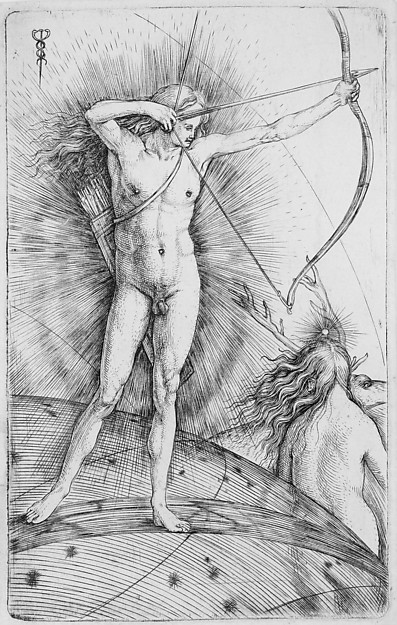
Jacopo de' Barbari,

Jacopo de’ Barbari, “Apollo and Diana,” engraving, via http://www.metmuseum.org/collection/the-collection-online/search/360380

  1. “Coronis was washing her feet in Lake Boebeis. Apollo saw her and desired her. Desire came as a sudden shock, it caught him by surprise, and immediately he wanted to have done with it. He descended on Coronis like the night. Their coupling was violent, exhilarating, and fast. In Apollo’s mind the clutch of a body and the shooting of an arrow were superimposed. The meeting of their bodies was not a mingling, as for Dionysus, but a collision.”

Roberto Calasso, “The Marriage of Cadmus and Harmony”

As nothing can surpass the radiance of the Sun, so no other Olympian god was perceived as more radiant than the superior and grandiose Apollo. Liz Greene calls him “an image of loftiness of spirit,” Walter Otto “the manifestation of the divine amidst the desolation and confusion of the world.” He bestows grace and sublimity even on the most godforsaken places. It was exactly so with Delos, where he was born. Roberto Calasso wrote that it was “a hump of deserted Rock, drifting about the sea like a stalk of asphodel.” Yet, this barren piece of rock was surrounded by swans as if waiting for the miracle about to occur. Leto had been running from the wrath of Hera, who, jealous of Zeus, had forbidden her to give birth on stable earth. A floating poor island of Delos gained a lot from being the birthplace of Zeus’ favorite son. Calasso:

“Then Apollo emerged, and everything turned to gold, from top to bottom. Even the water in the river turned to gold and the leaves on the olive tree likewise. And the gold must have stretched downward into the depths, because it anchored Delos to the seabed. From that day on, the island drifted no more.”

Delos temple, white lions, via Wikipedia

Delos temple, white lions, via Wikipedia

Apollo, the Sun god, has been likened to no less than the Holy Grail by Liz Greene. He is the light of pure divinity of the Jungian Self that is possessed by each of us. He is the inner jewel of royalty that can shine on any desolate landscape and conquer the direst of circumstances. He is the spiritual centre of gravity; he is what sustains us when all the other modes of support have failed. Calasso calls him “unnatural,” “serene,” “abstracted,” looking down on the world, with his “eyes … elsewhere, as if gazing at an invisible mirror, where … (he finds his) own images detached from all else.”

Where there is so much blinding light, the shadow must be deep and equally enormous. Apollo’s dark side is his deadliness, his vicious competitiveness, and utter lack of forgiveness. His is the power that obliterates whatever came before it.  As he is a master archer, death by his hand comes swiftly and unexpectedly. The Homeric hymn to Delian Apollo begins with a startling scene showing the gods frightened of Apollo:

“I will remember and not be unmindful of Apollo who shoots afar. As he goes through the house of Zeus, the gods tremble before him and all spring up from their seats when he draws near, as he bends his bright bow.”

Via http://www.perseus.tufts.edu/hopper/text?doc=Perseus%3Atext%3A1999.01.0138%3Ahymn%3D3

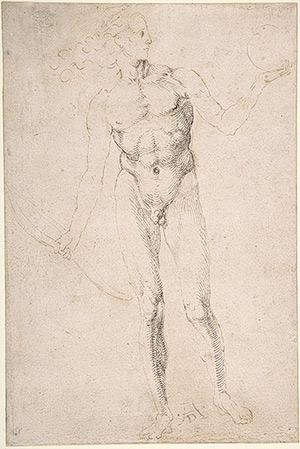
Albrecht Dürer,

Albrecht Dürer, “Poynter Apollo”, holding a bow and an orb, via http://www.metmuseum.org/toah/works-of-art/63.212

He was a conqueror in love, too, though with varied success. His first love was the aloof nymph Daphne. As Ovid wrote in his Metamorphoses, “the smitten god went up in flames until his heart was utterly afire, and hope sustained his unrequited passion.” And in a further brilliant passage, “admonished by his own passion, he accelerates, and runs as swiftly as a Gallic hound chasing a rabbit through an open field.” According to Graves, the myth of Daphne metamorphosing into a laurel tree to escape the hot pursuit of Apollo refers to “the Hellenic capture of Tempe, where the goddess Daphoene (‘bloody one’) was worshiped by a college of orgiastic laurel-chewing Maenads.” Apollo and a new solar religion took over all major mother earth shrines with the most famous one at Delphi (a subject of my next post).

Bernini,

Bernini, “Apollo and Daphne”

I admire Roberto Calasso’s perspicacity when he observes that in fact Apollo did not want to possess Daphne. This aloof god was after the idea of Daphne, her divine essence, and to him her worth was embodied in a symbol she left behind – a laurel leaf that he made into a poet’s crown. The Greek word “nymphólēptos “- “possession” comes from the word Nymph. Apollo made extensive use of archetypally feminine trance and possession states in all of his major oracles. He took the wild young girls from Helicon to train and cultivate their skills. The Greeks believed that he imposed the laws of civilization, divine order and measure upon the wild chaos – thus the Muses and Art were born. In the Homeric hymn to Pythian Apollo, summarized by Graf, “As soon as he enters the assembly, ‘the minds of the immortals turn to lyre and song’, and the Muses sing a hymn about gods and men. ‘The fair-tressed Graces and joyful Seasons, with Harmony, Youth, and Aphrodite the daughter of Zeus, hold hands by the wrist and dance’, and Artemis, Ares, and Hermes join them. ‘But Phoibos Apollo plays on the lyre, stepping fine and high.’” Apollonian mousika was an ultimate expression of beauty and harmony; it could still the most turbulent and confused hearts.

The songs performed by and for Apollo were paeans, which also connect with Apollo’s healing powers (the subject of my future article). Paeans, as Graf describes, were sung “before battle or after victory, at the beginning of a symposium, or before any risky undertaking, such as setting sail or, in comic parody, going to court.” They were also sung at weddings, “yet another uncertain beginning.” Apollo was seen as the Averter of Evil addressed by paeans in situations of danger and uncertainty. In a beautiful Orphic hymn to Apollo we read:

 “You make everything bloom

with your versatile lyre,

you harmonize the poles.”

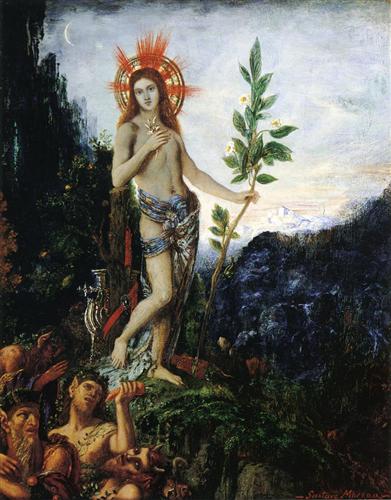
Gustave Moreau,

Gustave Moreau, “Apollo Receiving the Shepherds’ Offerings”

Sources:

Roberto Calasso, The Marriage of Cadmus and Harmony, Kindle edition

Fritz Graf, Apollo (Gods and Heroes of the Ancient World), Kindle edition

Robert Graves, Greek Myths

Liz Greene, The Astrology of Fate, Kindle edition

Ovid, Metamorphoses, translated by Charles Martin, Kindle edition

The Orphic Hymns, translated by Apostolos N Athanassakis, Kindle edition

Posted in Apollo | Tagged , , , , , , , , , , , , , , , , , , , , , , , | 21 Comments

The Attraction to the Divine Unknown

“I find it relevant to quote here a formulation devised by Dio of Prusa (‘Dio Chrysostom’), a Greek thinker who lived in a period straddling the first and the second centuries CE. In what I am about to quote, taken from his Olympic Discourse (Oration 12), Dio is representing a hypothetical speech delivered by none other than the great sculptor Pheidias of Athens, who is speaking about his masterpiece, the colossal statue of Zeus that he sculpted for the temple of Zeus at Olympia in Elis. In the passage I will be quoting, Pheidias explains his idealizing of the human form in creating the spectacular statue of Olympian Zeus. To justify the idealized human form that he creates for Zeus, the sculptor speaks about a universal need felt by humans not only to imagine gods as existing in the sky or in the cosmos in general but also to have a feeling of divine immediacy by being physically near them, close to them – a feeling achieved by way of mental or even physical contact with statues and with paintings and with other images of the gods:

‘Because of their attraction to the divine unknown [daimonion], all humans have a powerful erotic desire [erōs] to worship … and to take care of [therapeuein] the divinity [theion] that they do know, by being up close to it and near to it, as they approach it and try to touch it in an act of persuasion, and they sacrifice to it and offer it garlands. Quite simply, they are like disconnected … children who have been torn away from their father or mother and who, feeling a terrific urge … and longing [pothos], often reach out their hands while they are dreaming, in the direction of their parents who are not there, so also are humans in their relationship with the gods, loving them as they do, and justifiably so, because the gods do good things for them and have an affinity with them. And, in their love for the gods, humans strive in all possible ways to be with them and in their company.’

(This word daimonion is derived from daimōn, which refers to an unspecified god, whereas theos refers to a specific god)”

Gregory Nagy, “Ancient Greek Hero in 24 Hours,” Kindle edition

Giorgio de Chirico, "Extase"

Giorgio de Chirico, “Extase”

Posted in Quotations | Tagged , , , , , , , , | 13 Comments

Light and Matter: the Perseid Meteor Shower

This year has been announced to be perfect to watch the Perseid meteor shower because the moon will be dark. This shooting star feast usually peaks around 10-13 August (http://earthsky.org/astronomy-essentials/earthskys-meteor-shower-guide#perseids). I am reposting my own writing about the symbolism of Perseids from August 2013.

Posted in Uncategorized | 3 Comments

“Epilogue” by D.H. Lawrence: Poetry for Hot, Sultry Dog Days of the Summer

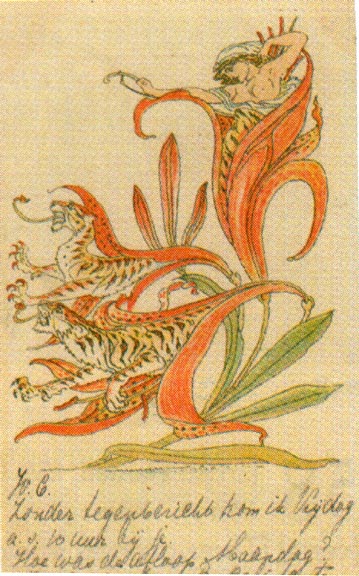
Walter Crane, "Then lilies turned to tiger blaze, amid the garden's tangled maze"

Walter Crane, “Then lilies turned to tiger blaze, amid the garden’s tangled maze”

“PATIENCE, little Heart.
One day a heavy, June-hot woman
Will enter and shut the door to stay.

And when your stifling heart would summon
Cool, lonely night, her roused breasts will keep the night at bay,
Sitting in your room like two tiger-lilies
Flaming on after sunset,
Destroying the cool, lonely night with the glow of their hot twilight;
There in the morning, still, while the fierce strange scent comes yet
Stronger, hot and red; till you thirst for the daffodillies
With an anguished, husky thirst that you cannot assuage,
When the daffodillies are dead, and a woman of the dog-days holds you in gage.
Patience, little Heart.”

Posted in Poetry | Tagged , , , , | 9 Comments

Rusalki: the Slavic Nymphs

Wilhelm Kotarbinski,

Wilhelm Kotarbinski, “Water Nymph”

“She shook the bright drops from her hair

And gazed upon the anchorite;

To look upon her form so fair

The good monk trembled with affright.

And he beheld her from afar

With head and hand strange signals make,

Then swifter than a shooting star

Dive back into the silent lake.”

Alexander Pushkin, “Rusalka”

We do not have any written records of Slavic mythology; sadly, we have to make do with second-hand accounts and archaeological findings. As much as I am fascinated by Greek and Egyptian mythology, my roots are Slavic, and consequently any exposure to the Slavic lore has a visceral effect on me, not comparable to anything else. Stories of water nymphs, mermaids and sirens are fascinating, but none of them bear quite the same imprint on my unconscious as the stories of the rusalki (Slavic water nymphs, plural of rusalka). Recently, I have come across a great book by Joanna Hubbs Mother Russia: The Feminine Myth in Russian Culture. One of its section is dedicated to the rusalki lore. In the nineteenth century, these mythological creatures were vilified as death demons, but for ancient Slavs they were predominantly kind, though powerful and sometimes feared, nature spirits. They played a key role in pagan fertility rituals. Their predecessors were called bereginy (bereg means ‘shore’) and connected water and earth in their cult. Their sacred tree was the birch. The later rusalki or vily were believed to live in water and also on land and in trees; they were half women – half fish or half women – half birds. Hubbs refers to them as “spinners” who regulated “human and animal fertility, the cycle of the seasons, the moon, and the weather.” As it is in Rusalka, the famous opera by Antoni Dvorak, rusalki were usually part of a group of mysterious maidens – daughters of a sea or bird king. Their roots are very archaic, says Hubbs:

“Every incarnation of the water nymph suggests the archaic image of the bird-headed transformational goddess who accompanies humanity from the period of the hunt to that of horticulture, herding – and warfare. She is the goddess who creates parthenogenetically by bringing moisture to the earth from below and above, unaided by male consorts. She is one yet multiple, chooses her mate like the shamanic Mistress of Animals, and confers power (military or otherwise) on the male, whom, like the Great Goddess of the Neolithic, she then destroys. She is virginal like Artemis, and yet the giver of life and death.”

Walter Crane,

Walter Crane, “Swan Maidens”

The rusalka was portrayed as half-bird or half-fish (sirin), sometimes with a lion or a horse, sometimes as “a dragon or lion-tailed creature with the wings of a bird.” Other animals strongly connected with her were the deer and the snake. Her hair looked like entangled snakes – combing it produced rain, called “the milk from heaven.” She was the goddess of the sun, the moon and the rain, fertility, renewal and rebirth, which was symbolized by the snake shedding its skin and the deer shedding its antlers. As birds, rusalki rode on clouds to direct the rains. Floods were caused by too energetic combing of their long serpent tresses. They had under their dominion phases of the moon and the production of winds. Continues Hubbs:

“Artifacts from the twelfth and thirteenth centuries found around Kiev show that the Slavic bereginy, like the Russian rusalki, were emulated in their moisture-making functions by young girls, whirling in long-sleeved blouses,… who played the part of rainmakers, bringers of fertility. The very name for ‘girl’ in Russian, deva, suggests linguistic ties with Indian and Persian religious and mythological figures of feminine divinity. … Div or deva in Sanskrit means ‘light’ and ‘pure.’”

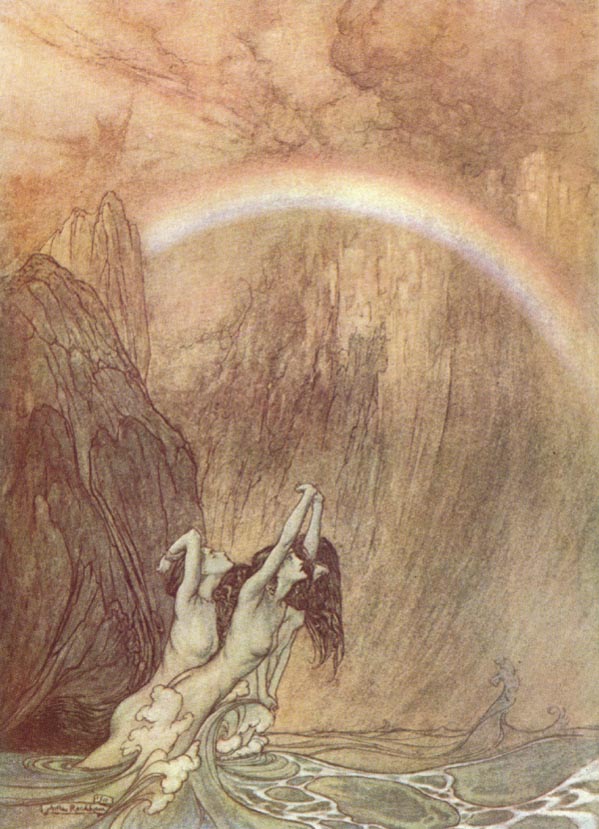
Arthur Rackham,

Arthur Rackham, “The Rhine Maidens”

While reflecting on this etymology, a thought occurred to me. This lightness and purity of the archetypal feminine means that rusalki, as well as their mermaid and water nymph sisters, stand for the forces of the unconscious struggling to become conscious. In Dvorak’s opera, the title-character falls in love with a prince and decides to accept human form for him. The story does not end well, though the characters learn the value and power of true love. There seems to be a mortal danger present in crossing the line from the unconscious to consciousness. Paradigms are not shifted peacefully but rather in tumultuous birth pangs. This is beautifully expressed by Dane Rudhyar in his interpretation of the Sabian Symbol for 29 Leo (A MERMAID EMERGES FROM THE OCEAN WAVES READY FOR REBIRTH IN HUMAN FORM):

“KEYNOTE: The stage at which an intense feeling­ intuition rising from the unconscious is about to take form as a conscious thought.

The mermaid personifies a stage of awareness still partially enveloped by the ever­ moving and ever elusive ocean of the collective Unconscious, yet already half formulated by the conscious mind. Any creative thinker or artist knows well the peculiar mixture of elation and anxiety characterizing such a stage. Will the intuitive feeling fade away reabsorbed into the unconscious, or will the inexpressible realization acquire the concreteness and expressible form of a concept or a definite motif in an art form? This fourth symbol in the thirtieth five­fold sequence suggests that the fire of desire for concrete and steady form burns at the root of all techniques of self-­expression. An unconscious energy archetype is reaching toward consciousness through the creator, as cosmic Love seeks tangible manifestation through human lovers. The whole pre­human universe reaches eagerly to the human stage of clear and steady consciousness. It is this great evolutionary urge, this elan vital, which is implied in this symbol of the mermaid seeking human incarnation — the YEARNING FOR CONSCIOUS FORM AND SOLIDITY.”

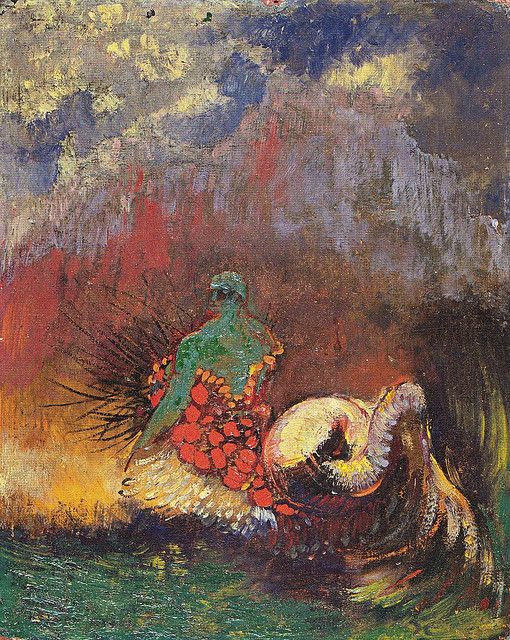
Odilon Redon,

Odilon Redon, “Mermaid”

As our culture progressively divorced itself from its archetypal bedrock, so did the meaning of rusalki and their Greek mythological counterparts transition, stressing now their destructive powers, luring men into their deaths. Unwanted and ignored, they had to exercise their powers from the underworld (the unconscious). The denigration of unconscious powers always ends in a horrible backlash. What was suppressed is now rising with an upsurge. It looks like the magical powers of the feminine have been finding their way into the collective consciousness. We are culturally ready to be reinitiated into the deepest mysteries of Her nature.

Posted in Uncategorized | Tagged , , , , , , , , , | 26 Comments

Two Shimmering Thoughts by Jung on His Birthday

1.“The unconscious can be reached and expressed only by symbols, and for this reason the process of individuation can never do without the symbol.”

Carl Gustav Jung, Collected Works Volume 13, “Alchemical Studies,” section 44

2.“What takes place between light and darkness, what unites the opposites, has a share in both sides and can be judged just as well from the left as from the right, without our becoming any the wiser: indeed, we can only open up the opposition again. Here only the symbol helps, for, in accordance with its paradoxical nature, it represents the “tertium” that in logic does not exist, but which in reality is the living truth. So we should not begrudge Paracelsus and the alchemists their secret language: deeper insight into the problems of psychic development soon teaches us how much better it is to reserve judgment instead of prematurely announcing to all and sundry what’s what. Of course we all have an understandable desire for crystal clarity, but we are apt to forget that in psychic matters we are dealing with processes of experience, that is, with transformations which should never be given hard and fast names if their living movement is not to petrify into something static. The protean mythologem and the shimmering symbol express the processes of the psyche far more trenchantly and, in the end, far more clearly than the clearest concept; for the symbol not only conveys a visualization of the process but—and this is perhaps just as important—it also brings a re-experiencing of it, of that twilight which we can learn to understand only through inoffensive empathy, but which too much clarity only dispels.”

Carl Gustav Jung, Collected Works Volume 13, “Alchemical Studies,” section 199

C.G.Jung Institute, Zurich, photo taken by me last month

C.G.Jung Institute, Zurich, photo taken by me last month

Posted in The Symbol | Tagged , , , , | 16 Comments

On the Birth of Aphrodite

Gustave Moreau,

Gustave Moreau, “The Birth of Venus”

If our exact time of place and birth is like a lodestar to interpreting our qualities and our destiny, it must make a lot of sense to look closely at the birth of Venus and relate what we find to her archetypal significance. She has a most extraordinary birth tale, after all. At the beginning of time, the sky god Uranus and the earth goddess Gaia were locked in never ending lovemaking. Yet there was no happiness, for she was groaning under the oppression of constant pregnancies as Uranus chased all the offspring back into her womb. In desperation, she gave a white sickle to her son Kronos, who castrated his father and threw his testicles into the sea:

“Earth took into herself the bloody drops that rained down. Within a year she gave birth to the powerful Erinyes, the Furies. … From the immortal flesh that fell into the surging sea there arose in time a white froth, or aphros. Inside the foam was nurtured a lovely girl. First she floated toward holy Kythera, and then to Cyprus pounded by the sea. Out she stepped from the waves, a queenly beautiful goddess, and around her slender feet fresh grass sprouted.” (Martin)

“Circles formed on the surface of the water, and one of them was edged with white foam. From the middle rose Aphrodite, together with her first serving maids, Apate and Zelos, Deceit and Rivalry.” (Calasso)

Dissecting the myth, which Liz Greene is particularly good at, it is worth pointing out that Kronos is “not an independent masculine principle, but rather the masculine side of the generative principle over which the Mother presides.” He is associated with the yearly ritual of king sacrifice, whose purpose was to “fertilise the earth and renew the crops.” Right at the beginning, as it appears, the principle of Aphrodite/Venus and the principle of fertility go hand in hand. Other Venusian principles in plain sight would be: conflict, strife, violence, which eventually beget breathtaking beauty and harmony. Furthermore, Aphrodite seems to combine celestial and terrestrial aspects in her archetypal make-up: she has the Uranian disembodied, abstract aestheticism and perfection coupled with an equally strong chthonic, carnal and sensual aspect. By standing up against the father, the titan Kronos made a necessary step in his individuation process. When the principle of Venus is activated, families may get shattered, which will awaken the Furies (Erinyes). There is blood and suffering at the core of Beauty, it seems.

Odilon Redon,

Odilon Redon, “The Birth of Venus”

As progeny of a primordial god, Aphrodite is older than the Olympians. She has enormous generative power at her disposal, and is a solar (the Golden One) rather than lunar deity. As Venus she competes in her brightness with the sun. Sworder remarks:

“…the phallus of the sky god is the sun and the saw toothed stone which Cronus takes to it is the jagged ridge of the western horizon, and the very moment of excision is that lovely moment as the sun sinks slowly out of sight beneath the world’s edge. Then the western sky is reddened by bloody member till in the midst of it appears the Evening Star.

For as star she is seen to stand above the sun after he has sunk beneath the western horizon, as she stands above him before he rises in the east.”

By the same token, Friedrich, quoted by Greene talks of her “sunlit sexuality” – she unashamed, usually portrayed nude, as opposed to other more modest goddesses. Her incarnation is fully blownl: she openly chooses mortal men as lovers, and does not punish their desires as Artemis or Hera did. Liz Greene quotes Paul Friedrich:

“The drives of sexuality are natural; on the other hand, sophisticated love-making is highly cultural. Aphrodite mediates between the two, ‘puts them together’. Or, better, she does not make them identical but interrelates them and makes them overlap to a high degree. To put it yet another way, we can agree that she is a ‘goddess of rapture’ but ought to recognise that this rapture harmoniously blends natural and cultural ingredients.”

William Blake Richmond,

William Blake Richmond, “Venus and Anchises”
“Yet in turn Aphrodite laughed at them and boasted of how she had driven gods to mate with women, but never herself had wanted a mortal’s bed. Zeus decided he’d change that. He filled Aphrodite with sweet longing for Anchises, who lived in the rugged uplands of Mt. Ida near Troy. He was a handsome young man with a common trade: herding cattle. One day she was sitting on Olympus, assured of her powers, smugly looking over the world, when she noticed him. That was all it took. Aphrodite instantly began to feel the pangs of desire for this unsuspecting youth. She hurried to Paphos and her temple there, filled with the scent of cypress. She gently closed the shining doors of the inner chamber and undressed, bathed luxuriantly, then clothed herself (with the help of the Graces) in a gown permeated with the most alluring perfumes. Then she rushed north toward Troy, striding high above the clouds, until she set herself down on Mt. Ida. The place was well known as “mother of beasts,” and as soon as she set foot there, they came out to greet her. Gray wolves that fawned at her feet, lions with glaring eyes, bears, leopards. Aphrodite was delighted seeing them, and by her very presence she infused them with the joyous urge to love. Two by two the animals went to lie and mate in the shadowy woods.”
Richard P. Martin

Uranian blood shedding finds its reflection in the two most typical Venusian symbols – the apple and the rose. They are united by the sensual symbolism of the color red. In this connection, Sworder offers his own take on the symbolism of the birth of Aphrodite:

“Red are our lips and nipples and our most private parts, reddest when closest to the consummation of love. Then they distend and bloom with the redness of blood. This is the blood shed by Cronus when he castrates his father Uranus and the phallus falls into the sea. The phallus is the sun which froths and colors the white cloud and the star of the goddess appear standing over its redness.”

Georgia O'Keeffe,

Georgia O’Keeffe, “Red Hills with White Shell”

Among its many significations, an apple seems to bring to mind the infamous “apple of discord.” Love can bring harmony and satisfaction of desire, but just as often it causes misery, jealousy, rivalry and all sorts of destructive passions. Roberto Calasso ingeniously links Aphrodite with Ananke – the goddess of necessity. While Ananke, together with Kronos, symbolizes the precision of karmic laws, with their austerity and relentlessness, Aphrodite seems to embody “a rebellion of lightness.” To quote Calasso with his uncanny precision:

“Olympus is a rebellion of lightness against the precision of the law, which at that time was referred to as pondus et mensura, “weight and measure.” A vain rebellion, but divine. Kronos’s chains become Hephaestus’s golden web. The gods know that the two imprisoning nets are the same; what has changed is the aesthetic appearance. And it is on this that life on Olympus is based. Of the two, they prefer to submit to Eros rather than Ananke, even though they know that Eros is just a dazzling cover for Ananke. And cover in the literal sense: Ananke’s inflexible bond, which tightens in a great circle around the world, is covered by a speckled belt, which we see in the sky as the Milky Way. But we can also see it, in perfect miniature, on the body of Aphrodite when the goddess wears her ‘many-hued, embroidered girdle in which all charms and spells reside: tenderness and desire are there, and softly whispered words, the seduction that has stolen the intellect even from those of sound mind.’ Unraveled across the darkness of the sky, that belt denotes not deceit but the splendor of the world. Worn by Aphrodite, the girdle becomes both splendor and deceit. But perhaps this was precisely what the Olympians wanted: that a soft, deceiving sash should cover the inflexible bond of necessity.”

Our Venusian encounters are sealed with fatedness. Lightness quickly and imperceptibly becomes heaviness. Consequences weigh on lovers with Ananke’s unforgiveness.

The cycle of Venus, Detail from James Ferguson’s, Astronomy Explained Upon Sir Isaac Newton’s Principles, 1799 ed., plate III, opp. p. 67, via http://freemasonry.bcy.ca/anti-masonry/venus.html

The cycle of Venus, Detail from James Ferguson’s, Astronomy Explained Upon Sir Isaac Newton’s Principles, 1799 ed., plate III, opp. p. 67, via http://freemasonry.bcy.ca/anti-masonry/venus.html

In astrological symbolism, Venus relates to the golden ratio – the measurable aspect of beauty. Nobody has expressed the beauty of the birth of Venus in a more outstanding fashion than Rilke in his poem “The Birth of Venus,” in Edward Snow’s translation:

“In the morning after that night which fearfully

has passed in outcry, tumult, uproar,—

the sea split open once again and screamed.

And as the scream slowly closed again

and from the sky’s pale light and brightness fell back into the mute fishes’ chasm—:

the sea gave birth.


From first sun the hair-froth shimmered

on the wide curl of wave, on whose lip

the girl stood—white, wet, confused.

As a blade of new green leaf stirs,

stretches, uncoils itself and slowly opens,

her body unfolded into cool sea-air

and into untouched early morning breeze.


Like moons the knees rose brightly

and ducked into the cloud­ rims of the thighs;

the calves’ slender shadows retreated,

the feet flexed and grew luminous,

and the joints came alive like the throats

of drinkers.


And in the hips’ chalice lay the belly,

like a young fruit in a child’s hand.

Within its navel’s narrow cup was all

the darkness that this bright life contained.

Beneath it the small wave rose lightly

and lapped continuously toward the loins,

where now and then there was a silent ripple.

But translucent and yet without shadow,

like a birch stand in early April,

warm, empty, and unhidden, lay the sex.


Now the shoulders’ quick scales stood already

in perfect balance on the upright body,

which rose from the pelvis like a fountain

and fell hesitantly in the long arms

and more swiftly in the hairs’ cascades.


Then very slowly the face went past:

out of downtilted darkness

into clear, horizontal upliftedness.

And behind it the sharp closing of the chin.


Now, with the neck stretched like a ray of light,

and like flower-stalks in which the sap rises,

the arms too stretched out like necks

of swans, when they are searching for the shore.


Then into this body’s dark dawning

came the first breath like morning wind.

In the vein-trees’ tenderest branches

a whispering arose, and the blood began

rushing louder over its deep places.

And this wind increased; now it plunged

with all its might into the newborn breasts

and filled them and crowded into them,-

so that like sails full of distance

they drove the light girl toward the shore.


And thus the goddess landed.


Behind her,

as she strode swiftly on through the young shores,

all morning the flowers and the grasses

sprang up, warm, confused,

as from embracing. And she walked and ran.


But at noon, in the heaviest hour,

the sea rose up once more and threw

a dolphin on that selfsame spot.

Dead, red, and open.”

Sandro Botticelli, "The Birth of Venus"

Sandro Botticelli, “The Birth of Venus”

References:

Roberto Calasso, Marriage of Cadmus and Harmony, Kindle edition

Liz Greene, The Astrology of Fate, Kindle edition

Richard P. Martin, Myths of the Ancient Greeks, Kindle edition

Reiner Maria Rilke, New Poems, Kindle edition

Roger Sworder, Science and Religion in Archaic Greece: Homer on Immortality and Parmenides at Delphi, Kindle edition

Posted in Aphrodite/Venus | Tagged , , , , , , , , , , , , , , , , , , , , , , , , , | 17 Comments