The Alchemical Salt and Its Taste of Infinitude

I.“Thus the fire began to work upon the air and brought forth Sulphur. Then the air began to work upon the water and brought forth Mercurius. The water began to work upon the earth and brought forth Salt. But the earth, having nothing to work upon, brought forth nothing, so the product remained within it. Therefore only three principles were produced, and the earth became the nurse and matrix of the others. From these three principles were produced male and female, the male obviously from Sulphur and Mercurius, and the female from Mercurius and Salt. Together they bring forth the “incorruptible One,” the quinta essentia…”

Anonymous alchemical treatise “De sulphure” (quoted by Jung in “Mysterium Coniunctionis”)

II.“Yet the real carrier of life is the individual. He alone feels happiness, he alone has virtue and responsibility and any ethics whatever. The masses and the state have nothing of the kind. Only man as an individual human being lives; the state is just a system, a mere machine for sorting and tabulating the masses.”

C.G. Jung, “Mysterium Coniunctionis”

III.

“This salt
in the salt cellar
I once saw in the salt mines.
I know
you won’t
believe me
but
it sings
salt sings, the skin
of the salt mines
sings
with a mouth smothered
by the earth.
I shivered in those
solitudes
when I heard
the voice
of
the salt
in the desert.
Near Antofagasta
the nitrous
pampa
resounds:
a
broken
v oice,
a mournful
song.

In its caves
the salt moans, mountain
of buried light,
translucent cathedral,
crystal of the sea, oblivion
of the waves.
And then on every table
in the world,
salt,
we see your piquant
powder
sprinkling
vital light
upon
our food.
Preserver
of the ancient
holds of ships,
discoverer
on
the high seas,
earliest
sailor
of the unknown, shifting
byways of the foam.
Dust of the sea, in you
the tongue receives a kiss
from ocean night:
taste imparts to every seasoned
dish your ocean essence;
the smallest,
miniature
wave from the saltcellar
reveals to us
more than domestic whiteness;
in it, we taste infinitude.”

Pablo Neruda, “Ode to Salt”

Wieliczka_salt_mine_chandelier

Wieliczka salt mine, crystal chandelier (via Wikipedia)

In the early sixteenth-century England the Church strictly controlled the access to God’s word by forbidding translating the Bible into English. The scholar William Tyndale defied the ban, working ceaselessly on his translations of the Holy Book right until his cruel death by execution. In his Adventure of English, Melvyn Bragg sings the praises of the “soaringly poetic” and yet “always earthed” English of Tyndale’s Gospels. Those rhythmically beautiful English words, with their “instant memorability and authority” shook the foundations of the church establishment. The famous verses from the Gospel of St Matthew still sound beautiful in Old English:

“Blessed are the povre in sprete: for theirs is the kyngdome off heven.

Blessed are they that morne: for they shal be comforted.

Blessed are the meke: for they shall inherit the erth.

Blessed are they which honger and thurst for rightewesnes: for they shal be filled

Blessed are the mercifull: for they shall obteyne mercy.

Blessed are the pure in herte: for they shall se God.

Blessed are the peacemakers: for they shal be called the chyldren of God.

Blessed are they which suffre persecucion for rightwenes sake: for theirs ys the kyngdome off heven.

Blessed are ye when men shall reuyle you and persecute you and shall falsly say all manner of yvell saynges against you ffor my sake.

Reioyce and be glad for greate is youre rewarde in heven.

For so persecuted they the prophets which were before youre dayes.

Ye are the salt of the erthe.”

Alchemists viewed salt as a paradoxical, arcane substance, which in itself had corruption and protection against it. Like the alchemical salt, the language of Tyndale corroded the establishment, while simultaneously crystallizing the newly risen power of the individual, who was now able to get acquainted with the Holy Book without the church’s mediation.

Paracelsus equated Sal (salt) with the soul, “the stable basis of life, its earth, ground, body.” Jung offered many enlightening quotes from the alchemist Vigenerus, who saw salt as “that virginal and pure earth which is contained in the centre of all composite elementals, or in the depths of the same.” Hillman calls salt “the ground of subjectivity” and “felt experience.” While the alchemical sulphur is masculine and solar, salt is feminine and lunar. It deals with life, the individual soul embodied in the concrete and the material. Thanks to salt, says Hillman,

“we descend into the experiential component of this body – its blood, sweat, tears, and urine – to find our salt. … salt is the mineral, impersonal, objective ground of personal experience making experience possible.

Salt is soluble. Weeping, bleeding, sweating, urinating bring salt out of its interior underground mines. It appears in our moistures, which are the flow of salt to the surface. “During the work the salt assumes the appearance of blood” …  Moments of dissolution are not mere collapses; they release a sense of personal human value from the encrustations of habit. “I, too, am a human being worth my salt” – hence my blood, sweat, and tears.

Pain implicates us at once in body, and psychic pain in psychic body. We are always subjected to pain, so that events that hurt, like childhood traumas, abuse, and rape, force our subjectivity upon us. These events seem in memory to be more real than any others because they carry the force of subjective reality.

These traumatic events initiate in the soul a sense of its embodiment as a vulnerable experiencing subject.”

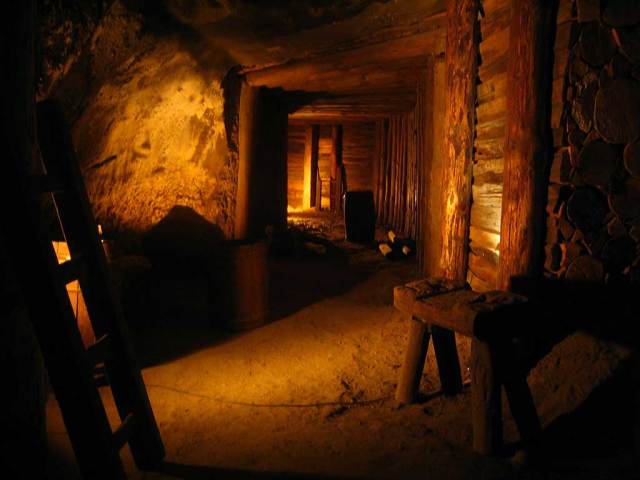
Wieliczka_salt_mine_old_corridor

Wieliczka salt mine, old corridor, via Wikipedia

Too much salt, however, may bring about fixation on past wounds – the immobile bitterness of Lot’s wife turned into a pillar of salt.

lots-wife-kent-monkman

Kent Monkman, “Lot’s Wife”

The right amount of salt denotes wit (cum grano salis), emotional, erotic participation and excitement, which arouses passion and desire. Hence the Ancient Romans called a man in love “salax” (modern English still uses the word “salacious” with a similar meaning). All meanings of the alchemical salt seem to revolve around the feminine, the earthy, the body (including the emotional body), the feeling nature, the moistness of being. The ancients valued salt so much that they associated it with fecundity, and by extension with money and wealth (the word “salary” is derived from “salt”). Jones explains (quoting Schneider):

“The sea was unquestionably the fructifying, creative element. … the offspring of sea creatures are to be counted by thousands and hundreds of thousands. This was all the more easily ascribed to the salt of the sea, since other observations believed to have been made were connected with it.”

For the Egyptians, salt guaranteed rebirth. Mummies were washed and preserved with the use of a brine solution called natron, which was perceived as birth-fluid, or as Barbara Walker puts it, “the Mother’s regenerative blood.” Natron was also used by the Egyptians as a beautifying, cleansing product, as a way to get rid of toxins and cleanse the household of vermin, as well as for spiritual purification. In ancient Rome, it was the Vestal virgins who were responsible for handling salt in sacrificial religious rituals. As Hillman wrote,

“The inherent capability of salt to crystallize its own essence is what I would call the inherent virginity of salt. By virginity here I mean the self-same, self-enclosed devotion to purity.”

Alchemists were not interested in the common salt, but in what they called Sal Sapientiae (salt of wisdom). On the one hand, salt and sulphur were viewed as opposing substances, as it was believed that “Sal inflicts on Sulphur an incurable wound.” (Jung) However, salt, the feminine and lunar principle, needed the solar and masculine ardour of sulphur to avoid the risk of rigidity and puritanism. When does the soul need salt? asks Hillman:

“There is another time and place for salt: when the soul needs earthing. When dreams and events do not feel real enough, when the uses of the world taste stale, flat and unprofitable, when we feel uncomfortable in community and have lost our personal ‘me-ness’ – weak, alienated, drifting – then the soul needs salt.

We mistake our medicine at times and reach for sulfur: action, false extraversion, trying harder. However, the move toward the macrocosm may first have to go back toward the microcosm, so that the world can be experienced and not merely joined with and acted upon as an abstract field. World must become earth; and this move from world as idea to tangible presence requires salt.

This effect of salt proceeds from its own fervor, a fervor of fixity that can be distinguished from the fervor of sulfuric enthusiasm and its manic boil of action, as well as from the fervor of mercury and its effervescent volatility.

When we sit still and sweat it out, we are stabilizing and adding salt to the solution so that it becomes a genuine one. Problems seem not to go away until they have first been thoroughly received.”

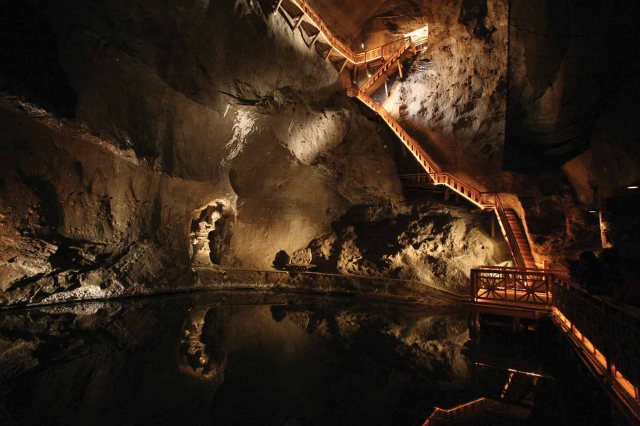
wieliczka-lake

Wieliczka salt mine lake

Sources:

James Hillman, “Salt,” chapter in Alchemical Psychology

Ernest Jones, “The symbolic significance of salt in folklore and superstition”

C.G. Jung, Mysterium Coniunctionis

Barbara G. Walker, Women’s Encyclopedia of Myths and Secrets

Posted in Alchemy, Salt | Tagged , , , , , , , | 15 Comments

Symbolism of the Lighthouse

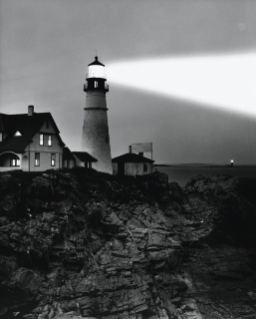
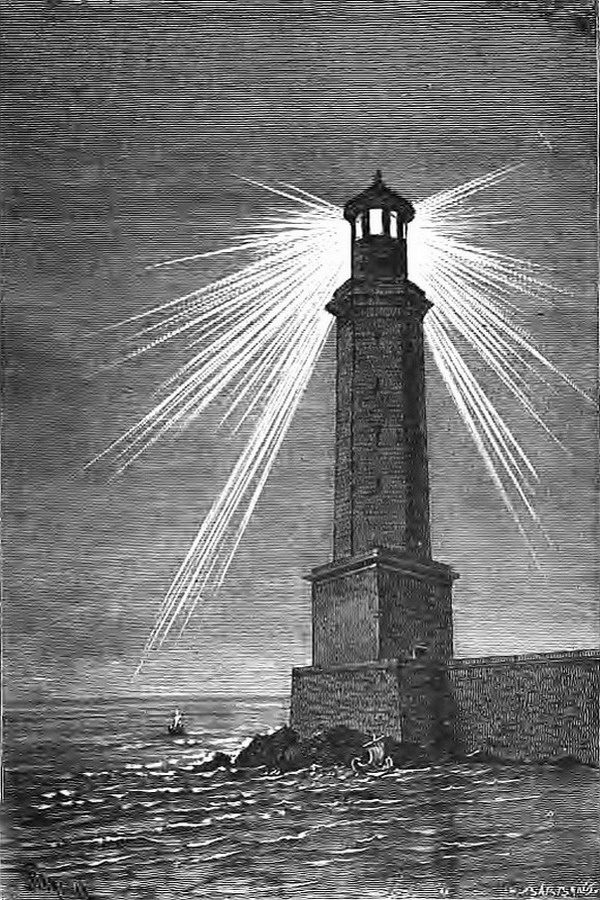
The world’s first lighthouse, the Pharos, was erected in the ancient city of Alexandria. One of the Seven Wonders of the Ancient World, it turned the insignificant port of Pharos into one of the greatest cities of the ancient world. It was most probably built out of dazzlingly white limestone and around up to 600 feet (180 metres) tall. Not only was it a beacon for sea travelers but it also served as a sort of welcome centre or a shining portal for all newcomers into the magnificent city.

Mosaique_St_Marc_Alexandrie

Mosaic in St. Mark’s basilica representing the saint arriving in Alexandria, showing the Pharos Lighthouse

It is quite easy to see why lighthouses stir our romantic core. They are a stark image – tall, austere towers which are nevertheless comforting as they are there to guide mariners to a safe harbor through treacherous waters. The symbolism of any tower is dual at its core: on the one hand it is phallic, mighty, erect, denoting power and spirit reaching from the earth to the heavens. On the other hand, it is feminine, reminiscent of an enclosed area, a walled sanctuary, and a safe haven. The Tower of Ivory was one of the names given to the Virgin Mary in her protective role of offering refuge and comfort.

The lighthouse may be seen as symbolic of individual consciousness, which kindles “a light in the darkness of mere being,” as Jung famously put it in his memoirs. He also wrote these words of warning in Psychology and Alchemy:

“The meeting between the … individual consciousness and the vast expanse of the collective unconscious is dangerous, because the unconscious has a decidedly disintegrating effect on consciousness.”

Lighthouses used to be built near the most dangerous waters, only after a plethora of horrific sea disasters had taken place in the area. As such, they brilliantly symbolize the perils of individuation – a constant danger of being swallowed by the unconscious forces beyond our control. In a fascinating article, Nathaniel Rich of The New York Review of Books, compares these “brilliant beacons” to “cenotaphs, marking deathtraps that for centuries devoured mariners along the continent’s coasts.” Granted, thousands of lives were saved thanks to lighthouses, but at the same time their keepers were in constant mortal danger, living in utter and often desperate isolation.  As Jung wrote:

“By becoming conscious, the individual is threatened more and more with isolation, which is nevertheless the sine qua non of conscious differentiation.”

Lighthouse keepers often paid a high price for performing an invaluable service to the collective. Specific examples of their plight mentioned by Rich are quite eye-opening. A lot of lighthouses burnt because the whale oil used to fuel the lighthouse fire at the beginnings of the twentieth century was highly combustible. Furthermore,

“the keeper’s life was not at all quiet. During periods of low visibility, keepers had to sound fog signals, which depending on the era might involve blasting canons, shooting guns, ringing bells, or blowing horns.

Keepers not only had to maintain the light and fog signals but also clean the lens, trim the lantern wicks, and scrub the walls, floors, windows, balconies, and railings, inside and outside. The many brass fixtures and appliances had to be polished diligently, a job that of itself was enough to drive keepers to madness… Inspectors appeared without warning wearing white gloves…”

The job of the lighthouse keeper evidently required diligence, vigilance and a fair amount of drudgery. Like priestesses of Vesta tending the sacred fire, he or she had to maintain focus on purity. Harold Bayley in The Lost Language of Symbolism, claims that the words fire and sphere are derived from the same root. Both are the most ancient symbols of divinity understood as the primeval cause of the universe as well as the inner spark of the individual soul. Heraclitus wrote this on fire: “That which always was and is, and will be everlasting fire, the same for all, the cosmos, made neither by god nor man, replenishes in measure as it burns away.” Keeping the fire ablaze while living on the edge of society, bearing loneliness as a price paid for individuation, is the main task of the (symbolically understood) lighthouse keeper.

Support my blog

If you appreciate my writing, consider donating and make my day. Thank you in advance.

$1.00

Posted in Lighthouse | Tagged , , , , , , , , , , , | 16 Comments

“Alchemy” by Jane Yeh

If it could be done, I’d do it
In an instant. I’ve got the charts,
The mortar and pestle, the fullest
Array of flasks that side of Rome.
My walls are papered with symbols,
and the biggest
Is gold. There’s a cabinet full
Of rejects: salt and cow hair,
Rye harvested under a full moon and
tin.
Magnesium and saints’ spit. I could
show you
Calculation, the reams of vellum in
my closet, enough
Ink for ten octopi. Instead I promise
you piles of gold,
Shining heaps higher than
Your bed, weighing more
Than the both of us.

At night I sit alone, poring
Over books in older tongues; none
Of the words are in my dictionary.
Signs stare down at me – calcium,
Saturn,
Silver, lead – mean as Chinese, like a
maze.
When I fall asleep I dream the
metals.
And planets sweep me up, wrap me
In their dark mesh bed and I can’t
see
To read any more. But I wake to
The jars of cow parts, the cup and
balance
Waiting to measure, and the open
mouths of flasks
That say You will still be hungry
When you are full.

Walter+Crane-The+Stranger+Appearing+To+Midas

Walter Crane, “The Stranger Appearing to Midas”

Posted in Poetry | Tagged , , , | 7 Comments

Shiva and Shakti – Consciousness and Power

I. “Since Shiva is only the silent, immobile witness, whereas she is the power herself, the devotees of Shakti and Devi have concluded that it might be best to direct one’s attention and prayers exclusively to the Goddess. Not the distant Father, but she, the Mother of All, protects her children and fulfills their wishes. Periodically, Christians have followed a similar mode of thought, turning foremost to Mary the Virgin, who bore God and who is the Mother of the universe.

Indian monism demands that there be only one ultimate reality. Therefore, Shiva and the Goddess are not really two, but one: he is the center of being and she is the energy radiating from it. They cannot be separated, yet her (illusive) forms and expressions are without number. Consequently, the universe is filled with more gods and ‘realities’ than there are grains of sand on the seashore.”

Wolf-Dieter, Ph.D. Storl, “Shiva: The Wild God of Power and Ecstasy,” Kindle edition

II. “True power arises from an inner feminine source—from Shakti. This is true whether the power appears in the cosmos (as in the big bang and the thrust of evolution) or in a human being—as our powers of thought, feeling, and action. In the West, we are used to associating power with masculinity and thinking of the feminine as purely passive, nurturing, and receptive. Tantra tells us that it’s the other way around. From a Tantric perspective, the inner masculine—Shiva—is the source of consciousness, awareness. But in order to act, to stir, he must take energy from the inner feminine. In ordinary life, this is exactly what many men do when they project their creative energy outward into a muse, a nurturing wife or assistant, who then pours her energy into him.

In turn, the feminine is grounded and focused by the masculine quality of awareness. Awareness allows the feminine to see herself and gives both containment and direction to her energy. Whether cosmically or individually, every genuinely creative project emerges out of a marriage of consciousness and power. For full creative empowerment, these masculine and feminine polarities need to come together. We need the stability of linear focus—the masculine quality—to merge with the feminine quality of energy, with its invitation to inspiration, Eros, and aliveness.”

Sally Kempton, “Awakening Shakti: The Transformative Power of the Goddesses of Yoga,” Kindle edition

By Agostino Arrivabene, via http://agostinoarrivabene.tumblr.com/

Posted in Quotations | Tagged , , , , , | 8 Comments

Discovering Intellectual Fire: the Birth of English

smp_futhorc

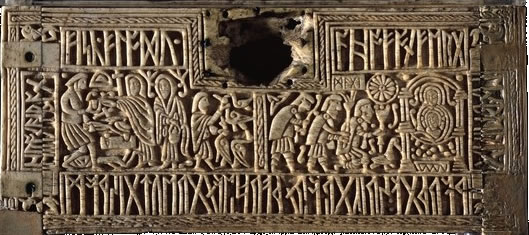
Franks Casket, an Anglo-Saxon chest with rune inscriptions, via http://www.omniglot.com/writing/futhorc.htm

The written word is both of the earth and of the spirit, positioned on the intersection between mind and flesh. It freezes the living, shimmering organism of language in time, petrifies it, making it immortal. The intangible, impenetrable roots of almost all European languages (apart from Finnish, Hungarian, Basque and Estonian) are planted in India – “the country of hundred nations and a hundred tongues, of a thousand religions and two million gods, cradle of the human race, birthplace of human speech, mother of history, grandmother of legend, great-grandmother of traditions,” in the unforgettable words of Mark Twain, or, as Salman Rushdie called his own country, “a collective fiction in which anything was possible, a fable rivalled only by the two other mighty fantasies: money and God.”

The beginnings of any language are fabled and mythical. Though deeply mysterious, these origins are still worth exploring not only because they are fascinating but also because there is still a vital and vitalizing connection between how our distant ancestors constructed their world by means of their language and how we use the language to grasp our reality nowadays. The historical roots of English are to be found in the hard surfaces of wood, metal, stone, and in the softness of the English soil. The Chinese traced the origins of their alphabet in marks left by animals in the sand, but the original, primary Old English alphabet was comprised of the Runes chiseled on hard surfaces. The language was brought by warrior tribes from across the sea in the fifth century. Eventually, they took over the land previously occupied by the Celts and proclaimed themselves its owners. As Melvyn Bragg writes:

 “That is one powerful image – English arriving on the scene like a fury from hell, brought to the soft shores of an abandoned imperial outpost by fearless pagan fighting men, riding along the whale’s way on their wave-steeds. It is an image of the spread of English which has been matched by reality many times, often savagely, across one and a half millennia. This dramatic colonisation became over time one of its chief characteristics.”

In time, the ruthless invaders turned into peaceful farmers:

 “Through their occupation English was earthed. This ability to plant itself deep in foreign territory became another powerful characteristic of the language.”

Although we nowadays perceive English as a hybrid composed of numerous languages it has conquered and absorbed throughout its history, its Anglo-Saxon roots were solid, almost impenetrable. The language of the Celts was preserved in Wales and Cornwall, but where the invading tribes chose to live it was ruthlessly eradicated. Melvyn Bragg’s explanation of this fact is quite compelling:

“… I speculate that English, finding a new home, its powerful voice freed by water from old roots, groping towards the entity it would become, wanted all the space it could claim. For English to grow to its full power, others had to be felled or chopped back savagely. Until it grew confident enough to take on newcomers, it needed the air and the place to itself.

Old English has hardly any loan words – an astonishing fact, indeed. The conquerors claimed their right to the new land with unvanquishable resoluteness and a full arrogance of a newly forged identity:

“The ‘-ing’ ending in modern place names means ‘the people of’ and ‘-ing’ is all about us – Ealing, Dorking, Worthing, Reading, Hastings; ‘-ton’ means enclosure or village, as in my own home town of Wigton, and as in Wilton, Taunton, Bridlington, Ashton, Burton, Crediton, Luton; ‘-ham’ means farm – Birmingham, Chippenham, Grantham, Fulham, Tottenham, Nottingham. There are hundreds of examples. These were straightforward territorial claims. The language said: we are here to stay, we name and we own this.

‘We shall fight on the beaches,’ said Churchill in 1940, ‘we shall fight on the landing grounds, we shall fight in the fields and in the streets, we shall fight in the hills; we shall never surrender.’ Only ‘surrender’ is not Old English. That, in itself, might be significant.

At its heart, English is ferociously territorial. The unconquerable Anglo-Saxon pagans opened their hearts only to Christianity and much later, once they have been firmly established on the land. Church Latin proved too powerful to resist, the new religion too compelling to be ignored. The raw, lusty and primitive Old English, despite its hard crust and reserve, opened itself to be infiltrated and altered by the bookish, refined Latin. Thus, the Old English alphabet was born, as the Runes were supplanted with a brand new set of twenty-four letters preserved on vellum and parchment, not in stone, as it was before:

 “An alphabet most likely sown by anonymous clerics grew out of the Latin and remarkably early, by the seventh century, Old English had achieved its own alphabet. It was like discovering intellectual fire. A, æ, b, c, d, e, f, g, h, i, k, l, m, n, o, p, r, s, t, þ, ð, u, uu (to become w much later), y.

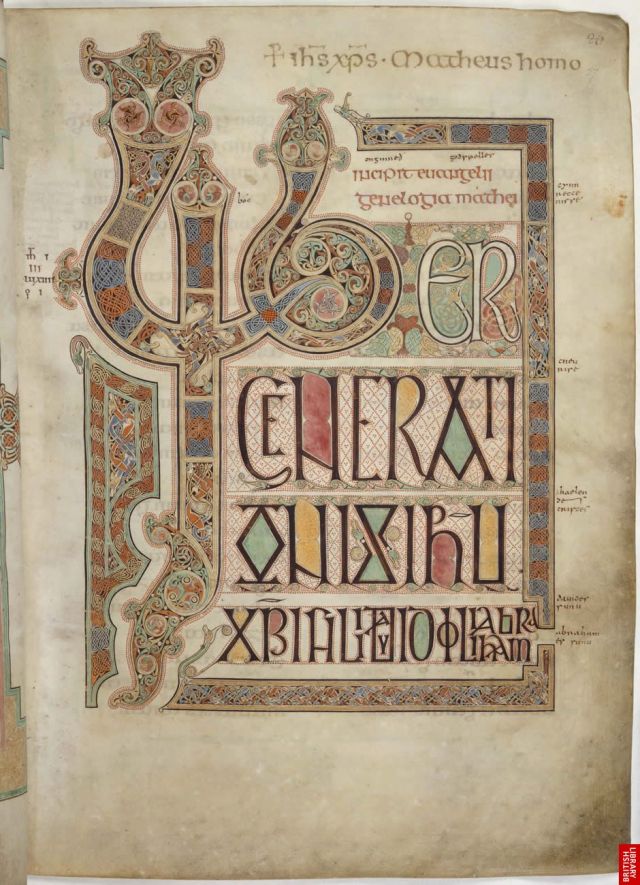
In the early years English knew its place and its place was literally in the margins: we see a small plain English hand crawling its shy translation above the towering, magnificently wrought Latin letters which brought the word of God to save the souls of the English. I have always been ridiculously pleased that the Lindisfarne Gospels, the first great English work of art, was a book. Though using craftsmen from other lands it was made in the Northumbrian part of what was to become England. The Lindisfarne Gospels were executed in brilliant colours, a mixture of Germanic, Irish and Byzantine motifs, elaborately designed letters, decorated with precious stones, works to awe the masses and to praise God.

lindisfarne_lg

The Lindisfarne Gospels: Gospel of St Matthew the Evangelist, initial page, via http://www.bl.uk/onlinegallery/sacredtexts/lindisfarne_lg.html

Source of all quotes:

Melvyn Bragg, The Adventure of English, Kindle edition

Posted in English, Language | Tagged , , , , , , , , , , , | 5 Comments

Cultivating the Mysterious Essence: on Authenticity

I. “The ancient masters cultivated the

mysterious essence.

They were profound, subtle –

beyond our ability to comprehend.

For this reason we cannot know them,

but we can try to describe their

existence:


Cautious, as if crossing an icy river in

winter.

Vigilant, as if surrounded by unseen

dangers.

Reverent, as if receiving honoured

guests.


As malleable as ice when it begins to

melt,

as unspoiled as an uncarved block,

as receptive as a vast and open valley.”

Tao Te Ching (15), interpretive translation by Robert Brookes, Kindle edition


II. “Know the male, but hold to the female.

Imagine a river flowing through a

valley,

never departing from its original path.

Do this and you will return to a state of

innocence.


Perceive the bright, but hold to the

dark.

Like a river, let yourself flow with

virtue,

and set a faultless example for the

world.

Do this and you will return to a state of

perfection.


Be aware of honour, but hold to

humility.

Like a valley, let virtue fill you,

sufficient yet everlasting.

Do this and you will return to the state

of the uncarved block.


Just as when the uncarved block is

shaped it loses its simplicity,

when the wise person loses his

simplicity he is no longer wise.

Therefore it is best to stay on the

original path.”

Tao Te Ching (28), interpretive translation by Robert Brookes, Kindle edition


III. “Below the surface-stream, shallow and light,

Of what we say we feel—below the stream,

As light, of what we think we feel—there flows

With noiseless current strong, obscure and deep,

The central stream of what we feel indeed.”

Matthew Arnold

DOI-100-Years-Ago-2002_redux

Peter Doig, “100 Years Ago”

Beyond all the roles we play every day, beneath the layers of culture, nationality, gender, and other accidental characteristics, lies our authenticity. As Edward Young wrote, we were born as authentic, original works of art, but sadly we so often die copies (quoted after Trilling). The root of the word “authenticity” says a lot about its challenging nature, as Trilling puts it:

“Authenteo: to have full power over; also, to commit a murder. Authentes: not only a master and a doer, but also a perpetrator, a murderer, even a self-murderer, a suicide. Forgetting how much violence there was in its creative will, how ruthless an act was required to assert autonomy in a culture schooled in duty and in obedience to peremptory and absolute law, and how extreme an exercise of personal will was needed to overcome the sentiment of non-being.”

To collide with social norms is a violent act. To act according to the dictates of internal space is the most difficult task we can face. What in Tao Te Ching was names the simplicity of an uncarved block, Hegel called a condition of baseness:

“For Hegel, in the progress of ‘spirit’, the individual consciousness will eventually move from this condition of sincerity to a condition of baseness, in which the individual becomes antagonistic to external societal powers and achieves a measure of autonomy.”

Via http://plato.stanford.edu/entries/authenticity/

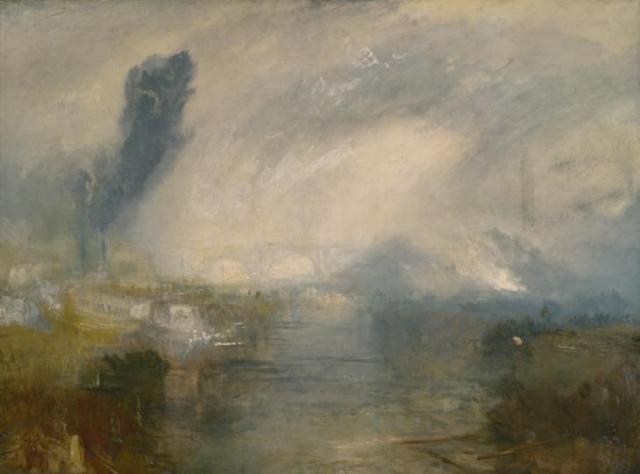
The Thames above Waterloo Bridge c.1830-5 by Joseph Mallord William Turner 1775-1851

Joseph Mallord William Turner, “The Thames above Waterloo Bridge”

The word authenticity in its contemporary use comes from the philosophy of Heidegger, who used the word Eigentlichkeit, which was translated as authenticity into English. The German word eigentlich means really or truly, yet the stem of the word – eigen – means proper, own:

“So the word might be more literally translated as ‘ownedness’ …, or even ‘being one’s own’, implying the idea of owning up to and owning what one is and does.”

http://plato.stanford.edu/entries/authenticity/

To own oneself and not to be owned by anyone lie at the root of authenticity. This is echoed in the famous quote from Hamlet, “This above all: to thine own self be true.” Being true to oneself is not the same as narcissism:

“…authenticity does not amount to egoism or self-absorption. On the contrary, the prevailing view seems to have been that, by turning inward and accessing the “true” self, one is simultaneously led towards a deeper engagement with the social world. This is why Taylor describes the trajectory of the project of authenticity as ‘inward and upward’”

http://plato.stanford.edu/entries/authenticity/

As Jung frequently emphasized, only an individual can individuate; and not a group or a society. The evolution starts within an individual who opens to collective forces and faces a task of making them uniquely his or her own. Collectively, we are driven by individuals. For Heidegger, to be authentic meant to “take a stand” on who we are in every moment of our existence. He believed that as individuals we “fall” into society, a process which is inevitable and inescapable, though as a result we so often do not feel as authors of our own lives:

“To the extent that our lives are unowned or disowned, existence is inauthentic (uneigentlich), not our own (eigen). …

What conscience calls out to us is the fact that we are ‘guilty’ in the German sense of that word, which means that we have a debt (Schuld) and are responsible for ourselves. Conscience tells us that we are falling short of what we can be, and that we are obliged to take up the task of living with resoluteness and full engagement. Such resoluteness is seen clearly in the case of vocational commitments, where one has heard a calling and feels pulled toward pursuing that calling.”

http://plato.stanford.edu/entries/authenticity/

In a strikingly similar fashion, in his “The Development of Personality,” Carl Jung spoke of vocation as hearing the inner voice, obeying one’s own law, “as if it were a daemon whispering … of new and wonderful paths.” The Jungian axiom is that to become authentic, to develop personality, one must succumb to the dictates of the inner voice:

“Just as the great personality acts upon society to liberate, to redeem, to transform, and to heal, so the birth of personality in oneself has a therapeutic effect. It is as if a river that had run to waste sluggish side-streams and marshes suddenly found its way back to its proper bed, or as if a stone lying on a germinating seed were lifted away so that the shoot could begin its natural growth.”

Collected Works of C.G. Jung, Volume 17: Development of Personality, Kindle edition, par. 317

In current discourse the term authenticity seems to have been replaced by empowerment. This article ridicules the trendiness of the buzzword and the phenomenon and my first reaction was to agree with the author. However, perhaps it showcases the same hunger that has been with humanity for millennia: to let our actions be dictated by inner impulses and to free ourselves from being judged by external norms that ultimately are not our own.

Mikalojus_Konstantinas_Ciurlionis_-_SPRING_(II)_-_1907

M.K. Ciurlionis, “Spring”

Sources:

Lionel Trilling, Sincerity and Authenticity, Kindle edition

Somogy Varga, Charles Guignon, “Authenticity,” http://plato.stanford.edu/entries/authenticity/

Posted in Authenticity | Tagged , , , , , , , , , , , | 25 Comments

Sense and Meaning

“Contrary to what is generally believed, meaning and sense were never the same thing, meaning shows itself at once, direct, literal, explicit, enclosed in itself, univocal, if you like, while sense cannot stay still, it seethes with second, third and fourth senses, radiating out in different directions that divide and subdivide into branches and branch-lets, until they disappear from view, the sense of every word is like a star hurling spring tides out into space, cosmic winds, magnetic perturbations, afflictions.”

Jose Saramago, “All the Names,” translated by Margaret Jull Costa, London: The Harvill Press, p. 115

The root of the word “meaning” can be traced to the Old Saxon menian – “intend, signify, make known,” whereas the word “sense” is etymologically connected to the five senses and may be a figurative use of a literal meaning “to find one’s way.” Consequently, meaning may be understood as a static, atemporal construct of the mind, while sense is more changeable, rooted in the body, constantly evolving, growing and temporal. Sense is bodily, meaning is abstract. Both feed off each other. Sense without meaning is like a colourful, elusive butterfly; meaning without sense can be likened to a pinned butterfly. Together, sense and meaning coexist in harmony in Chuang Tzu’s dream quoted by Borges in “A New Refutation of Time”:

“Chuang Tzu, some twenty-four centuries ago, dreamt he was a butterfly and did not know, when he awoke, if he was a man who had dreamt he was a butterfly or a butterfly who now dreamt he was a man.”

5647560_f520

Katsushika Hokusai, “Philosopher Watching a Pair of Butterflies”

Posted in Quotations | Tagged , , , , , , , | 17 Comments

Jung on Alchemy (6): Sol and Sulphur – the Fiery Ferment of the Soul’s Hidden Depth

“As in the hand a sulfur match flares white
and sends out flicking tongues on every side
before it bursts into flame –: in that ring
of crowded onlookers, hot, eager, and precise
her round dance begins to dart and spread.

And all at once it is entirely flame.

With a glance she sets her hair ablaze
and whirls suddenly with daring art
her slender dress into this fiery rapture,
from which, like snakes awakened,
two naked arms uncoil, aroused and rattling.

And then: as if she felt the fire grow tight,
she gathers it all up and casts it off
disdainfully, and watches with imperious
command: it lies there raging on the ground
and still flares up and won’t surrender –.
But unwavering, assured, and with a sweet
welcoming smile she lifts her face
and stamps it out with rock-hard little feet.”

Reiner Maria Rilke, “Spanish Dancer,” translated by Edward Snow, quoted from “New Poems,” Kindle edition

hansrudolfstruplercompositioninred

Hans Rudolf Strupler, Composition in Red

Mysterium Coniunctionis: An Inquiry into the Separation and Synthesis of Psychic Opposites in Alchemy (volume 14 of Collected Works) was completed by Jung when he was 81 and is a synthesis of his lifelong work on marrying alchemy and psychology. A central symbol of alchemy was Mercurius, which was a subject of part 5 of this series. In basic terms, Mercurius can be understood as the unconscious matrix itself, the cosmic Nous (Mind), or the spirit which appears in reality in differentiated form. The active, masculine aspect of Mercurius is Sol, the feminine and passive one – Luna (par. 109 of Mysterium Coniunctionis – all subsequent quotes comes from this book). Mercurius in Jung’s words is “a dark, latent, non-manifest side, the unconscious, whose presence can be known only by the light of consciousness” (par. 109).  To manifest itself, Mercurius needs other transformative substances, sol and sulphur being vital in this equation.

tumblr_n55hoaj77g1qa1j80o1_500

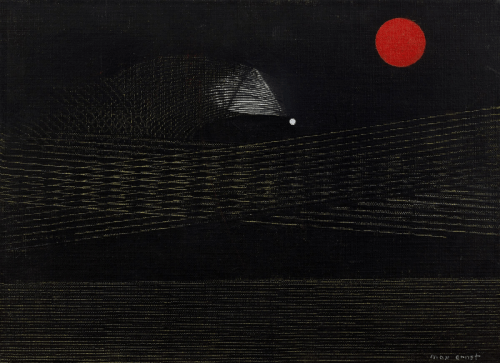
Max Ernst, “Red Sun”

The sun is as ambivalent and multi-faceted as any other alchemical symbol. It was perceived as “an active substance hidden in the gold” and extracted as red tincture (par. 109). It was believed to contain an active, hot, dry and red sulphur, which is how the alchemists explained its redness. Sulphur has always been a universal attribute of the devil and infernal fires. As a chemical substance it is sharply penetrating and has an extremely pungent smell. It ignites rapidly and produces a very bright and a very hot flame. When burned, it melts to a blood-red liquid and emits a blue flame. However, chemists know that in fact it is not sulphur that can make gold red, but copper, which for alchemists was associated with Venus. This makes things interesting, since the planet Venus in its appearance as the morning star (Venus Phosphorus – “Light-Bringer) was called “Lucifer” in Latin, a name also given to the most beautiful of fallen angels. In alchemy, all symbols are light and dark in equal measure. Darkness is not the absence of light, but an entity of equal importance and endowed with a tangible substance.

Jutrzenka

Stanislaw Wyspianski, “Eos, Phosphoros, Hesperos, Helios”

The sun’s favorable effects were its generational and transformative properties, fostering growth of fruit, wine and the mineral gold in the bowels of the earth. In humans, it was said to “enkindle the inner warmth,” will and appetites; as a “vital spirit” it was believed to have “its seat in the brain and its governance in the heart” (par. 110). Alchemists called the sun “the father and begetter of all.” Sulphur was the hot and deamonic principle of life, the vital energy, the “central fire,” in short – the soul (par. 112). What Dylan Thomas called “the force that through the green force drives the flower” in his magnificent classic poem was referred to as “the animating principle” by the alchemists. They believed in the universality and ubiquity of this “universal power of growth, healing, magic and prestige” (par.113). It was present in the sun above and in the plants and humans below. This supreme power was the alchemical gold, which was not the common gold (aurum vulgi), but a miraculous, incorruptible substance, “the true and indubitable treasure” (par. 113), which could only be perceived by those who can see with their mind’s eye.

paul_klee_ad_marginem_2

Paul Klee, “Ad Marginem”

But since every alchemical substance had its shadow, so the sun was equipped with one also. Jung quotes Maier: “For what, in the end is this sun without a shadow? The same as a bell without a clapper” (par. 116). A saying of Hermes, pivotal for all alchemists, deserves to be quoted in its entirety: “Son, extract from the ray its shadow, and the corruption that arises from the mists which gather about it, befoul it and veil its light; for it is consumed by necessity and by its redness.” This admonition can be explicated in the following terms. In the first stage of the alchemical opus, the sun is obscured by the shadow. This is the Black Sun, the earthly sun, which is “an instrument in the physiological and psychological drama of return to the prima materia, the death that must be undergone if man is to get back to the original condition of the simple elements and attain the incorrupt nature of the pre-worldly paradise” (par. 117). The black sun brings about the death of the old. This putrefaction cannot be achieved without sulphur, whose role is to “corrupt man back to his first essence.” In the next stage, the reborn sun will be joined with Mercurius, but before that can happen, the sun is not only obscured by the shadow but it will also be “consumed by necessity and by its redness.” This brings sulphur back onto the stage.

sea-and-sun-1925.jpg!Blog

Max Ernst, “Sea and Sun”

Alchemists distinguished between a red and a white sulphur. The former was the active substance of the moon, the latter was believed to be more virtuous and it was said to be the active substance of the sun. Sulphur was chthonic, corporal and earthly; it was associated with the fire breathing dragon. It was Paracelsus who referred to sulphur as the soul, which together with salt (the body) beget Mercurius. The red masculine sulphur is the fiery ferment of the soul’s hidden depths. Gerhard Dorn (quoted here after Jung) called it “the male and universal seed, …, the first part and most potent cause of all generation” (par. 136). It is a generative power that burns and consumes from within. Too much of it corrupts and weakens, bringing about evil and blackness, violence and rampant instincts, but without it there would be no impetus to life and no progress. In a concluding paragraph, Jung calls compulsion symbolized by sulphur “the great mystery of human life,” “the thwarting of our conscious will and of our reason by an inflammable element within us, appearing now as a consuming fire and now as life-giving warmth” (par. 150).

field-of-mars-1955.jpg!Blog

Marc Chagall, “Field of Mars”


Support my blog

If you appreciate my writing, consider donating and make my day. Thank you in advance.

$1.00

Related posts:

Jung on Alchemy (1): The Moist and Earthly Foundation

Jung on Alchemy (2): The Mandala

Jung on Alchemy (3): Meditation and Imagination

Jung on Alchemy (4): Prima Materia – The One, Who Art All

Jung on Alchemy (5): Hermes, the Arcane Interpreter of All

Posted in Alchemy | Tagged , , , , , , , , , , , , , , , , | 10 Comments

Like the Rainbow on the Waterfall: the Mystical Aura of Consumption

tumblr_o1cz8uVjKd1ummtoro1_1280

John William Waterhouse, “Sleep and His Half Brother Death,” painted after both younger brothers of the painter died of tuberculosis

While the fourteenth century was ravaged by the Black Death, the nineteenth century belonged to tuberculosis, or the White Death, a disease much more insidious and widespread. John Keats died of it at the age of twenty-six, and so did many creative geniuses of the time, such as Friedrich Schiller, Novalis, Emily Brontë, Juliusz Slowacki (a Polish Romantic poet), Frederic Chopin, and countless others. Would Romanticism ever have happened with its eruption of creative spirit, had it not been for tuberculosis? In general, is creativity ever possible without the feeling of malady and dis-ease? In ancient Greece, the sick headed for an asclepeion, a healing temple to the god Asclepius, to find cure for their maladies. In the nineteenth century, it was in the sanatoria typically located in high mountains, where TB patients sought refuge and hope. There they were ordained to take plenty of rest, inhale fresh mountain air and partake proper nutrition. However, before antibiotics were invented the statistics were very grim: around seventy per cent of patients died in the sanatoria. Those who recovered were not seriously ill in the first place. This was also true for the prestigiously located Davos, where dying patients were carefully hidden in order not to ruin the reputation of the resort. Only the rich could afford a curative stay on the Alpine heights. It is worth remembering, however, as Mary Dobson put it, that “the disease hit hardest at those whose lives were blighted by poverty and poor nutrition, and worked in badly ventilated, overcrowded, cold, damp or dusty conditions.” To this day TB remains a disease of the poor and the dispossessed, the ones who are easily forgotten, unlike the high profile figures of the Romantic period.

markievicz-countess-gore-booth-visit-to-a-dublin-family-durin-2109073

Constance Markievicz, “Visit To A Dublin Family During Thetuberculosis Epidemic”

The first sanatorium was built in Davos by Alexander Spengler, who also invented the famous “corpse rest” (Kadaverruhe in German).

magicmountain

Patients were advised to swaddle in warm blankets and spend hours inhaling ice cold mountain air under the beams of the sun.  This procedure was beautifully and memorably described by Thomas Mann in The Magic Mountain. Its hero Hans Castorp comes to Davos “only for two weeks” to visit his cousin, but ends up staying in the sanatorium for seven years after he is also diagnosed with consumption. Thus begins his journey of self-discovery, which leads him to the understanding that to be truly and deeply human is to be frail, to suffer and always remember about death. Or as one of the characters puts it, “to be human was to be ill.” In his Reader’s Guide to Mann’s novel, Rodney Symington quotes the echoing famous words from Beckett’s Endgame: “You’re on earth; there’s no cure for that.” A different sort of consciousness opens with such a realization: one aware of things infinite and ultimate – a mythical understanding of life. The title of the novel came from a passage in Nietzsche’s The Birth of Tragedy: “Now it is as if the Olympian magic mountain had opened before us and revealed its roots to us” (quoted after Symington). Like the World Tree, the magic mountain has its roots planted in the dark earth while its branches reach high to the sky.

08d799dd9a3a51401579f4053e2176a2

Hans Castorp was a conventional young man, a member of the affluent bourgeoisie with a robust work ethic. This conventional way of life, however, did not offer him any fulfillment:

“Hans Castorp respected work… Work was for him, in the nature of things, the most estimable attribute of life;

Exacting occupation dragged at his nerves, it wore him out; quite openly he confessed that he liked better to have his time free, not weighted with the leaden load of effort; lying spacious before him, not divided up by obstacles one had to grit one’s teeth and conquer, one after the other.”

Given the luxury and freedom of time in Davos, Hans Castorp flourished. In a secluded magical shrine of the Alpine valley he was simultaneously made us acutely aware of his own frail body and of his inner spirit. The infinite vistas of contemplation opened to him, accompanied by an aching, fleshy desire for a fellow convalescent – Clavdia Chauchat. In my absolute favorite passage Hans muses over the meaning of life:

“What then was life? It was warmth, the warmth generated by a form-preserving instability, a fever of matter, which accompanied the process of ceaseless decay and repair of albumen molecules that were too impossibly complicated, too impossibly ingenious in structure. It was the existence of the actually impossible-to-exist, of a half-sweet, half-painful balancing, in this restricted and feverish process of decay and renewal, upon the point of existence. It was not matter and it was not spirit, but something between the two, a phenomenon conveyed by matter, like the rainbow on the waterfall, and like the flame. Yet why not material – it was sentient to the point of desire and disgust, the shamelessness of matter become sensible of itself, the incontinent form of being. It was a secret and ardent stirring in the frozen chastity of the universal; it was a stolen and voluptuous impurity of sucking and secreting; an exhalation of carbonic acid gas and material impurities of mysterious origin and composition. It was a pullulation, an unfolding, a form-building (made possible by the overbalancing of its instability, yet controlled by the laws of growth inherent within it), of something brewed out of water, albumen, salt and fats, which was called flesh, and which became form, beauty, a lofty image, and yet all the time the essence of sensuality and desire. For this form and beauty were not spirit-borne; nor, like the form and beauty of sculpture, conveyed by a neutral and spirit-consumed substance, which could in all purity make beauty perceptible to the senses. Rather was it conveyed and shaped by the somehow awakened voluptuousness of matter, of the organic, dying-living substance itself, the reeking flesh.

…the image of life displayed itself to young Hans Castorp. It hovered before him, somewhere in space, remote from his grasp, yet near his sense; this body, this opaquely ehitish form, giving out exhalations, moist, clammy; the skin with all its blemishes and native impurities, with its spots, pimples, discolorations, irregularities; its horny, scalelike regions, covered over by soft streams and whorls of rudimentary lanugo.”

Life came to Hans in the shape of Clavdia.

In the nineteenth century tuberculosis was called the robber of youth. In “Elgin Marbles” Keats wrote contemplatively:

“My spirit is too weak—mortality

Weighs heavily on me like unwilling sleep,

And each imagined pinnacle and steep

Of godlike hardship tells me I must die

Like a sick eagle looking at the sky.”

Keats deathjosephsevern

Joseph Severn, “Keats’s Death”

The Romantics glorified consumption, associating it with beauty (especially in women), delicate spirit and heightened artistic sensitivity. The victims were perceived as innocent and holy. Nevertheless, the gruesome truth was that the disease totally ravaged the lungs of the victims, while the sheer amount of blood coughed up was often astounding. Still, George Sand insisted that Chopin coughed “with infinite grace” while Edgar Allan Poe described his dying wife Virginia as “delicately, morbidly angelic.”

d7d7e3bee373b0d7c80a8356a4981657

Edvard Munch, “Angel of Death”

In one of the most beautiful short stories called “The Birch Grove,” a Polish writer Jaroslaw Iwaszkiewicz gives a more realistic portrayal of the disease, yet without losing its mystical aura. There, a young consumptive man arrives in the countryside “to die.” His elder brother lives there with his young daughter, both deep in mourning after his wife’s recent death. The young man, though extremely weak and in constant pain, is greedier for life than his healthy brother. Towards the end of the story, the older brother, similarly to Hans Castorp, experiences a mystical moment of connection with all life, while standing in the birch grove in the middle of the night. The white entangled trunks remind him of feminine arms pointing upwards as if in ecstasy. This is a moment of sensual awakening, embracing life as it is in the moment. It is natural that great writers think alike, but I find it quite extraordinary that Hans Castorp experienced a very similar epiphany looking at bare arms of Clavdia Chauchat during the Walpurgis-Night ball:

“Poor Hans Castorp! He was reminded of a theory he had once held about these arms, on making their acquaintance for the first time, veiled in diaphanous gauze: that it was the gauze itself, the ‘illusion’ as he called it, which had lent them their indescribable, unreasonable seductiveness. Folly! The utter, accentuated, blinding nudity of these arms, these splendid members of an infected organism, an experience so intoxicating, compared with that earlier one, as to leave our young man no other recourse than again, with drooping heed, to whisper, soundlessly: ‘O my God!’”

A sense of approaching end must render every moment acutely and piercingly real. Looking at John Keats death mask, it is hard not to wonder whether his awareness of the imminent death was instrumental in causing his talent to flower so passionately and frenetically in the last years of his life. Perhaps in a creative individual, life and talent intensify when confronted with death. And yet a creeping feeling of waste and of tremendous loss remains, beautifully expressed by Rilke in one of his Sonnets to Orpheus (translated by Edward Snow):

“Illness was near. Already gripped by shadows,

your blood coursed darker; yet, as if only fleetingly

suspicious, it burst forth into its natural Spring.

Again and again, amid darkness and downfall,

it flared earthly. Until after terrible pounding

it stepped through the hopelessly open gate.”

3681774474_42df43768c

Keats – death mask

Sources:

Mary Dobson, Murderous Contagion: A Human History of Disease, Kindle edition

Rodney Symington, Thomas Mann’s The Magic Mountain: A Reader’s Guide, Cambridge Scholars Publishing 2011

Posted in Tuberculosis | Tagged , , , , , , , , , , , , , , , , , , , | 6 Comments

“That’s just who I am”: Is that Kafka? 99 Finds by Rainer Stach

I have got a lifelong devotion to Kafka, which can be traced back in my blog (https://symbolreader.net/2013/07/16/i-love-you-my-secret-raven/ and https://symbolreader.net/2014/05/14/kafkas-sirens/). I am very happy to reblog this well written review. The question remains: what colour were Kafka’s eyes? They were as mysterious and multiple shaded as his work. The new book casts a lot of light (literally) on the man wrongly presumed to be nothing but morose.

“Four people described Kafka’s eyes as ‘dark,’ four as ‘gray,’ three as ‘blue,’ and three as ‘brown.’ Kafka’s passport had them as ‘dark blue-gray.’ I’m personally inclined to trust the testimony of Kafka’s girlfriend, Dora. She described them as ‘shy, brown,’ which may be its very own shade.”
Via http://www.newyorker.com/books/page-turner/what-color-were-kafkas-eyes

roughghosts's avatarroughghosts

“Now I’ve taken a closer look at my desk and realized that nothing good can be produced on it. There’s so much lying around here, it creates disorder without regularity, and with none of that agreeableness of disorderly things that otherwise makes every disorder bearable.”  (Find #29 Kafka’s Desk)

I have never understood those who feel inclined to disparage Franz Kafka. It should be sufficient to admit that a writer, especially one whose work has entertained and inspired so many and has clearly withstood the test of time, is simply not one who speaks to you. Admit, if you like, that you just don’t “get it”. But why, like Joseph Epstein in a 2013 Atlantic Monthly column, declare that Kaka’s apparent joyless, dark vision of the world reflects a personal defect that undermines his worth and proclaim: “Great writers are impressed by the mysteries of life; poor Franz Kafka…

View original post 1,154 more words

Posted in Franz Kafka | Tagged , , , | 2 Comments