A Gripping Spring Project

These modern analysts! They charge so much. In my day, for five marks Freud himself would treat you. For ten marks, he would treat you and press your pants. For fifteen marks, Freud would let you treat him, and that included a choice of any two vegetables. Thirty dollars an hour! Fifty dollars an hour! The Kaiser only got twelve and a quarter for being Kaiser! And he had to walk to work! And the length of treatment! Two years! Five years! If one of us couldn’t cure a patient in six months we would refund his money, take him to any musical revue and he would receive either a mahogany fruit bowl or a set of stainless steel carving knives. I remember you could always tell the patients Jung failed with, as he would give them large stuffed pandas.

Woody Allen

Image

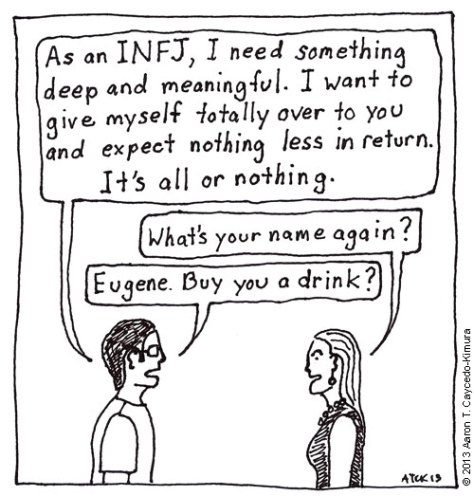
At one time I was really hooked on a TV series In Treatment, especially its first and second season (you can see the trailer here). Gabriel Byrne plays a psychotherapist, who has weekly sessions with his patients and his own therapy sessions. The format was brilliant, I think – two people facing each other, having a deep meaningful conversation. Half an hour just flew by. I guess what appealed to me in that series was that it showed people behind their facades, real gut reactions but also various patterns and stories that govern people’s lives. I simply enjoy observing and finding out what makes people tick and I find small talk rather draining. I hope a fellow blogger does not mind me including his cartoon here:

Image

credit: http://infjoe.wordpress.com/2013/05/14/cut-the-crap/

I might have used Woody Allen’s quote as a motto, but in fact I do believe in therapy, or rather I believe in certain therapists and a sacred bond that they are able to create with the patient. The method is secondary I believe, all that matters is an alchemical relationship that forms between the patient and the therapist. First and foremost they need to be right for each other. Specific patients gravitate towards specific therapists, I think.

But the reason I am writing this is to recommend a certain art project I have been following with enthusiasm and awe recently. Like therapy, it is about fascinating dialogue, and what makes it so good is that it is not staged, but completely natural. Kelsey Lynore of the Tarot Nook has been working with the tarot since she was 13. That piece of information was enough to blow my mind because I discovered the esoteric world when I was 26 years old. What I really appreciate about her approach to the tarot is that she is as far away from eso tv as possible, she is completely natural and she does not need a starry backdrop or spooky tunes to do her tarot readings. Nonetheless, even without the props but thanks to her insights, she totally embodies the high priestess to me. The tarot is meant to inspire, to deepen our understanding and to show us the hidden patterns (archetypes) influencing our lives. It is like the mirror that we can set up to our deeper thoughts and intentions. It is about myth and storytelling, as Kelsey says. It has nothing to do with fatalism.

Basically the project is about Kelsey giving free tarot readings via skype to volunteers who are brave enough to let themselves be recorded and put on youtube. What I found most shocking, being a secretive introvert, was that people actually revealed a lot during these sessions, acting naturally and spontaneously. I have seen all the ten parts of the Spring edition of the Anti-Film Tarot Art Project. I loved each installment, but parts 3 and 9 somehow linger in my memory for whatever reason. Like therapy, the tarot is a tool that might not appeal to everybody but if you view life through the lenses of myth and narrative, like me, you will enjoy watching Kelsey in action.

Here is a link to her channel:

http://www.youtube.com/user/thetarotnook?feature=watch

She is looking for volunteers for the summer project.

Posted in Uncategorized | Tagged , , , , , , , | 23 Comments

Where Do You Go After You’ve Been to the Moon?

Image

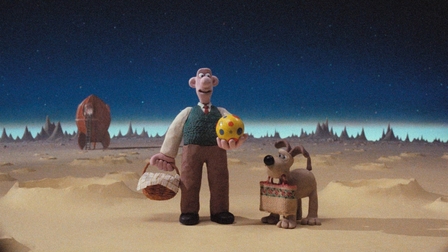
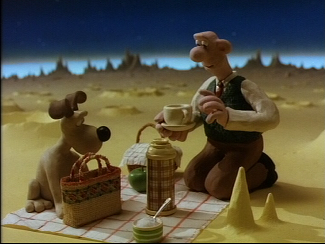
In a comedy clay animation film A Grand Day Out, Wallace and Gromit, an inventor and his faithful dog, build a rocket in their basement and fly to the moon to sample some cheese (everyone knows that the moon is made of cheese…). What I adore about this timeless duo is their relationship. Gromit communicates only through facial expressions ad body language and does so ingeniously, like a pantomime artist. Wallace is a bachelor with delightful quirks, a pair of timeless slippers and a cozy waistcoat. They live in a tiny cozy bubble of their own world, building bizarre contraptions together and not needing the outside world to be blissfully happy together.  I think it was a brilliant idea on the part of the film creator to send the two of them to the moon because theirs is a perfectly lunar relationship. They understand each other without words, they feel safe and familiar around each other, bringing each other comfort, warmth and nurturing most naturally, without effort. An astrologer would say that their respective Moons must be in a harmonious aspect to each other, possibly a conjunction or perhaps Wallace’s Moon is on Gromit’s Ascendant.

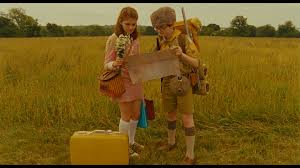
Creating a magical space together with a special person is a lunar quality. A film which bestows  a similar warm heart feeling is Moonrise Kingdom by Wes Anderson. The two teenagers in love are also lost in their lunar magical kingdom. It is the most delightful film I have seen in years. If there is a strong lunar connection between two people they will create a homey and cozy space no matter where they are, even on the move as the two protagonists of Wes Anderson were. The girl’s suitcase and the boy’s furry hat have got to be the most brilliant lunar symbols I have seen in a movie in many years. The suitcase symbolizes a miniature home, the hat is a subtle allusion to the moon goddess Artemis, the huntress, associated with the dark heart of wild nature.

Image

Image

Picnicking on the Moon

Image

Moonrise Kingdom

I have been thinking a lot about the Moon in the last few days. It is a special week for all moon lovers:  the so called Super Moon will be visible on 23 June. The moon will appear larger, being closer to the earth and being in the full moon phase. It is interesting that this should happen right after Summer Solstice when the Sun’s power is at its highest. The exceptionally large looking moon will show its potency and importance. In many pagan traditions summer solstice is believed to be a magical time when heaven and earth can be united and when magical opportunities abound. This year with the opposition of the Sun and the Moon this sacred marriage between heaven and earth and between the Sun and the Moon may be fruitful and harmonious because the lights are in balance, neither the Sun nor the Moon are privileged. We may at least hope for a union between our conscious (the Sun) needs and the unconscious ones (the Moon).

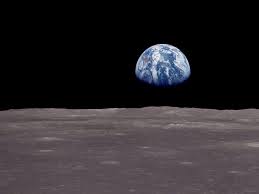
In keeping with the moon theme, I decided to see the film Apollo 13 at the weekend. I had not seen it before. I found it quite interesting and it made me think a lot about my long-standing fascination with the moon. The number 13 is very telling: there are 12 solar months in a year but 13 lunar months. Also, right after the launch one of the five engines failed, leaving just four. Let me point out that in astrology five is the number related to the Sun, four to the Moon.  And finally, the three astronauts aboard the ship reminded me of the triad of lunar goddesses, who personified the three phases of the Moon. Thus Apollo 13 was an archetypal lunar mission: the solar (conscious) purpose of walking on the moon was not achieved but the mission was very fruitful from the lunar perspective. Symbolically, the Moon represents the feeling intuitive nature of the individual, emotional needs and emotional security, which to most of us stems from our roots, home and family, understood in many individual ways. The Moon, ruled by the water sign Cancer, is also connected with our habits and reactions, as well as with the unconscious and the rhythm of life (since all life originated in water – think of the amniotic fluid but also of the ocean where evolution of all species started). During the Apollo 13 mission, nothing tangible was accomplished that might be labeled as success from a conventional perspective, but it was not about the mission but about the people and their essential humanity: fear of survival, rapidly changing emotions, hope, closeness, attachment and love. Being able to return to earth after all instruments had been broken required a great deal of lunar intuition. Another lunar theme is the collective effort that the whole operation required: there was not a single successful solar hero but a collective hero with a thousand faces. Also during the Apollo 13 mission astronauts suffer all kinds of physical symptoms, reminding us that the symbolism of the moon is first and foremost related to the body and to Mother. “The human being is not the lord of beings, but the shepherd of Being,” wrote the philosopher Martin Heidegger. If we are reminded of our own mortality through suffering bodily symptoms, we get reconnected with the moon principle. We should extend the care of our bodies to the care of the mother earth and all living beings. The astronauts looking down towards the earth always expressed similar sentiments: how fragile and beautiful our planet is.

Image

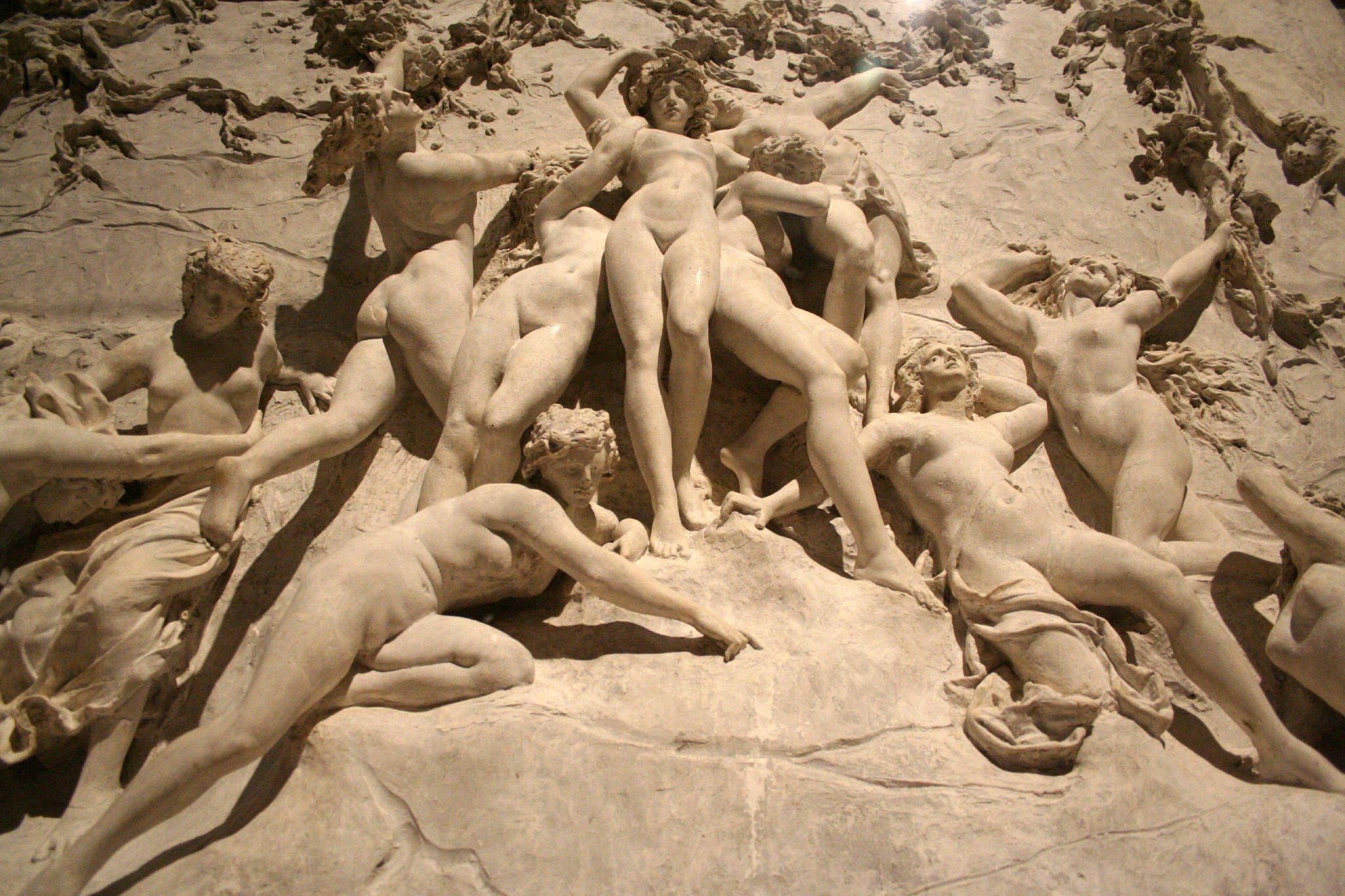
Like every archetype, the moon has its dark side (literally, in this case). Lunar darkness has to do with lunacy, depression, hysteria and compulsiveness – the mythical maenad within. The maenads, whose name meant “the raving ones,” followed the god Dionysus and were associated with orgiastic frenzy and a total lack of control. They were the antithesis to culture and civilization. They were said to devour raw flesh and they murdered King Pentheus by tearing him to pieces because he had banned the worship of Dionysus. There is uncontrollable lunar wildness in every one of us and the position of the astrological Moon may reveal more details on the extent of it.

Image

Gustav Dore, Maenads in a Wood

There is a spellbinding book by Andrew Smith called Moondust: In Search of the Men Who Fell to Earth. There he writes about the twelve astronauts who took part in all Apollo missions and he interviews the nine who were still alive at the time he was writing the book. I have no doubt that the lives of the moon astronauts were closely connected with the moon symbolism. Can you get so close to the moon and not be affected by it? Buzz Aldrin, the second man on the moon, has battled with depression and alcoholism all his life. ‘He resents not being the first man on the moon more than he appreciates being the second,’ as a fellow astronaut observed. If it is true, it is a pity that the need to be a solar hero, to be the first one, would overshadow a life like this. However, I have heard that he turned his life around at an older age. Charlie Duke (Apollo 16) became a drunken bully who beat and terrorized his children and his wife until he and his wife, Dotty, found God and religion. Almost all of the astronauts experienced a sort of an epiphany. While Ed Mitchell returned in his Apollo 14 capsule, he glimpsed ‘an intelligence in the Universe and felt connected to it’. He then established the Institute of Noetic Sciences. An amusing tidbit is connected with Nepal, where it is believed that the dead reside on the moon. When the Apollo 14 veteran visited there he was constantly asked “So did you see my grandmother?” which exasperated him.

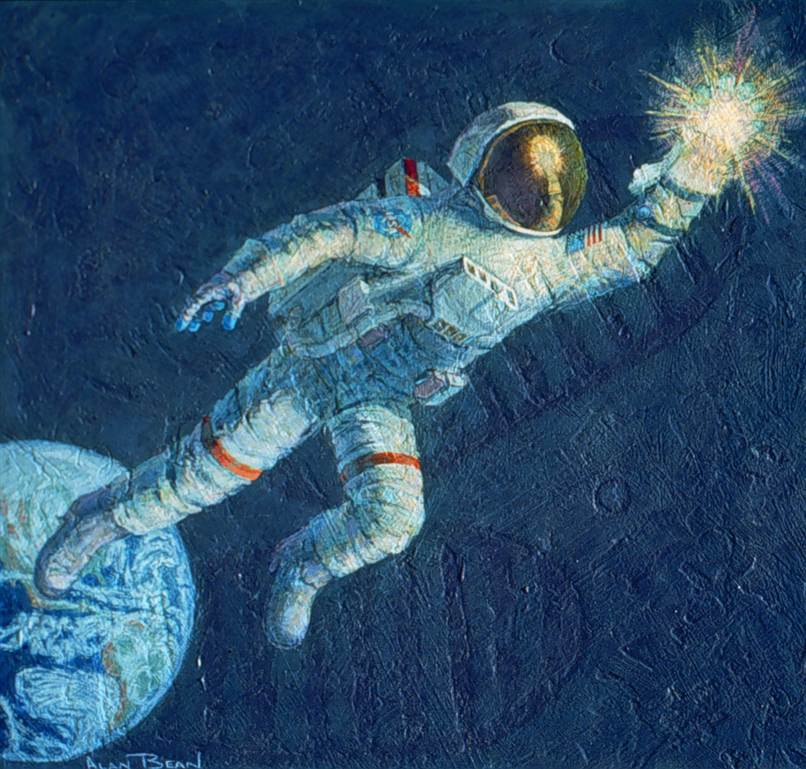
The moon archetype is also connected with art and imagination. Alan Bean of Apollo 12 became a painter and quit space. His subject matter is the moon and the astronauts in space. I quite like this one, called Space Reaching.

Image

Another astronaut, Jim Irwin, claims that God spoke to him at the feet of the Apennine Mountains. He left NASA for the Church. All astronauts spoke of mystical unity of all humankind that they experienced in space. But as Smith notices bitterly: “A lot happened out there. The postflight divorce rate was, in more than one sense, astronomical.” It is hard to rationalize such a kind of transformation that all of them underwent. I naturally put it down to the mysterious power of symbols and I see how their lives are connected to the moon symbolism.

I will be staring at the moon this coming weekend. And if you want to read something very weird about our satellite, take a look at an article called Are We Food for the Moon?, which summarizes the ideas of Gurdijeff and Blavatsky about the Moon being a parasite  and portraying humans as food for the Moon. Madame Blavatsky called the moon soulless and lifeless. But how can something so beautiful not have a soul?

Image

Gilbert Williams, Moon Song (via http://gilbertwilliamsgallery.com/originalworksforsale.html) 

Posted in The Moon | Tagged , , , , , , , , , , , , | 47 Comments

Sunday Book Club: The Inheritance of Loss

Image

Once a month I meet with a group of fellow expats to discuss a book that one of us has picked for the given months (we take it in turns to select books). The weather is heavenly today, sunny and very warm with a delicate breeze. Such days show Switzerland in her full glory with visible signs of affluence, with all the contended people soaking up the sun, enjoying their food, not thinking yet of another super busy day at work in one bank or another. All of this is in such a huge contrast to the book that we read this month. The Inheritance of Loss by Kiran Desai is no doubt beautifully written but the emotional reaction I had from reading it can be only compared to having my heart ripped out.

Chaos and despair seem to rule the lives of the characters in the novel. One character – Biju – is an illegal Indian immigrant in the United States, who experiences all kinds of wretched misfortunes. It all starts with a harrowing scene of a crowd of Indians applying for visas at the American Embassy: “He dusted himself off, presenting himself with the exquisite manners of a cat. I’m civilized, sir, ready for the U.S., I’m civilized, mam.” If you intend to read the novel, do not read on, please. Biju is miserable in New York, treated like vermin and exploited by a string of his shady employees. He manages to accumulate some money and decides to return to India. Once back in Calcutta, he is robbed by his fellow countrymen; he loses his luggage, all the money plus his clothes and shoes. He returns home to his father barefoot and poorer than he left.

While reading the novel I could not help thinking of the supposed melting pot, the global village that we are said to live in right now. My favourite Turkish writer, Orhan Pamuk, wrote something very interesting after the 9/11 tragedy: people in the West are “scarcely aware of this overwhelming feeling of humiliation that is experienced by most of the world’s population,” which “neither magical realistic novels that endow poverty and foolishness with charm nor the exoticism of popular travel literature manages to fathom.”  One quote from the book sounded extremely poignant to me: “Profit could only be harvested in the gap between nations, working one against the other.” I feel guilty as a person from the West of all the suffering that we, the Westerners, have caused. I am not sure we are ready yet to live in harmonious diversity of cultures. I do not see how we can achieve any kind of redemption just yet.

Posted in Uncategorized | Tagged , , , , , , , | 11 Comments

In My Dreams I Paint Like Vermeer van Delft…

The dream is a little hidden door in the innermost and most secret recesses of the psyche, opening into that cosmic night which was psyche long before there was any ego-consciousness, and which will remain psyche no matter how far our ego-consciousness may extend… All consciousness separates; but in dreams we put on the likeness of that more universal, truer, more eternal man dwelling in the darkness of primordial night. There he is still the whole, and the whole is in him, indistinguishable from nature and bare of all egohood.

Carl Gustav Jung, Civilization in Transition

Image

Salvador Dali, The Ghost of Vermeer of Delft, Which Can Be Used as a Table

Dream interpretation is my thing. A frequently quoted passage from the Talmud says that a dream that is not interpreted is like a letter that is not read. I am waiting for that letter each night. My approach is mostly based on Carl Gustav Jung’s approach because even though I have read numerous books on dream interpretation by various authors whose names I do not even remember, Jung’s philosophy seems to be the only one that personally appeals to me. If I manage to interpret a dream in a Jungian way, I feel as if a sparkle within me ignited. A dream I cannot understand can be with me for days, forever present in the semi-consciousness until I finally crack it open. There are still dreams that lie uninterpreted in the dark recesses of my mind.  I never lose hope I will decode them one day. I believe that if and when their time comes, perhaps outside circumstances will reveal their true meaning. Those uninterpreted dreams may contain the seeds of the future that my consciousness is not quite ready to embrace.

Image

Jung’s handwritten letter

If a dream be a letter, who wrote it? Jung always started a dream interpretation session by acknowledging that he had absolutely no idea what the dream meant. We could look at a dream as a text to interpret; the images of a dream beg us to construct a coherent narrative, a tale pertinent to our life situation. Interpreting a dream is a task of hermeneutics – a theory of interpreting written, verbal and non-verbal communication. The word hermeneutics most probably comes from Hermes, who in this case symbolizes the mind which undertakes a task of understanding through interpretation.  When I was a student hermeneutics proposed by Heidegger and Gadamer was all the rage in philosophical circles. I have not looked t their work for a long time but I still have a general understanding of what they proposed and I think it was very similar to Jung’s concept of humility in the face of a dream. We must begin from a position of not knowing and be prepared for our initial intuitions to be refuted. Jung  always emphasized that more often than not “the dream is saying something surprisingly different from what we would expect… for as a rule the standpoint of the unconscious is complementary or compensatory to consciousness and thus unexpectedly different.” (Psychology and Alchemy).

Also, it is important to stay as close to the original text of the dream as possible. If we dreamt of a dog we should go as deeply as possible into the meaning of that particular symbol because particular symbols are generated for a reason and not to stand for something else. In his books, Jung would analyze a particular dream images in pages after pages through a process which he called amplification. I always loved his ability to go deep and deeper into images. We do not do this anymore, we want to look a symbol up in some sort of dream dictionary and have a ready-made answer immediately. That is wrong for two reasons: dream cookbooks are too simplistic and too impersonal. I deeply believe that in order to interpret a symbol in a dream a fusion of two horizons is needed: firstly, the individual horizon of the dreaming person, his or her life situation, and individual associations with the symbol; and, secondly, the horizon of the collective unconscious, i.e. the collective meaning of a given symbol. Here is a pivotal passage from Jung’s Psychology and Alchemy, which explains a general role of symbols in dreams:

The symbols of the process of individuation that appear in dreams are images of an archetypal nature which depict the centralizing process of the production of a new centre of personality. … I call this centre the Self, which should be understood as the totality of the psyche. The Self is not only the centre, but also the whole circumference which embraces both conscious and unconscious; it is the centre of this totality, just as the ego is the centre of consciousness.

This is a crucial quote because it shows that dreams have a prospective function: something new within our psyche wants to reveal itself, our conscious one-sidedness needs to be compensated by a new, fuller view and approach. It was Freud who famously said that the interpretation of dreams is the royal road to a knowledge of the unconscious activities of the mind. In a dream our Self is writing a letter to our ego to show it the hidden potential of the whole psyche and the unlived part of life. The most rudimentary symbol of the Self is a circle with a dot in the middle, the most elaborate – the mandala. Dreams simultaneously show us new ways of finding our spiritual centre and ways of expanding our consciousness by integrating the unconscious, unacknowledged parts of our psyche.

Image

Ancient Egyptians considered the night time of sleep and dreaming as sacred and likened it to the night journey of the Sun god. A sleeping person was said to be submerging in Nun, the primordial watery abyss that surrounds and encapsulates the manifested sphere of life. Nun existed before there was land and was depicted as a deity holding a bark that the sun god Ra travelled in through the night ocean after the sunset.

Image

Image via http://carrington-arts.com/Becoming.html

Image

Jung, an image from The Red Book

In a book Isis. Auf der Suche nach dem göttlichen Geheimnis (Isis. In Search of Divine Mystery), which to my knowledge has not been translated into English, Gisela Schoeller writes beautifully about the night journey the souls undertake each night, as described in Egyptian myth. Dreams offer a unique opportunity to look at ourselves from the perspective of the underground reality, i.e. from the soul perspective. The undiscovered soul truth manifests itself in dreams through images and characters, who want to penetrate our consciousness. The unlived parts of our souls seek embodiment in dream images and characters. They show which powers are waking within our deepest with a desire to act upon our conscious reality.

In a book Visions in the Night: Jungian and Ancient Dream Interpretation, Joel Covitz writes about the art of dream interpretation according to the Zohar. I was fascinated to read that in the Zohar it states that you should only tell your dreams to a person who loves you. He mentioned this in passing without commenting further but I was deeply touched by the truth of it.  I also need to have a deeper connection with a person and an understanding of his or her life circumstances to be even interested in their dreams. A relationship of mutual friendship and understanding is a must for any dream interpretation, at least for me. Who dreams is as important as what is dreamt.

Image

Yacek Yerka, Dream, via Wikipedia

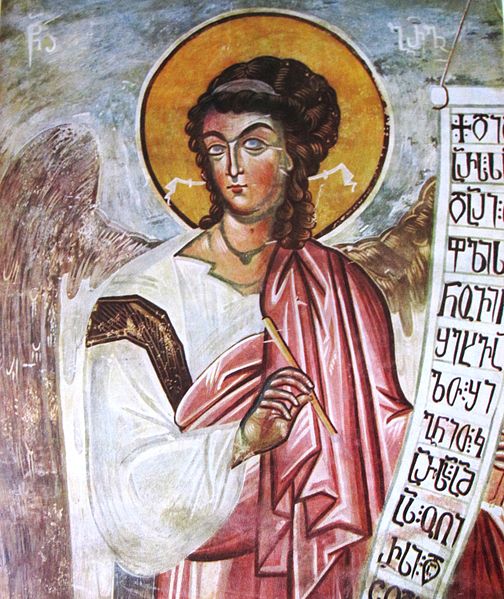
The name Gabriel in Hebrew is a composite of two words: man (gever) and El (God). Thus he is a connecting link between God and humanity. Gabriel is an angel who instructs the soul before its birth, providing it with an a priori knowledge of the divine purpose and intent. Through dreams we are put back in contact with our soul and its vast store of wisdom that we received before we were born. Dreams are like the bridge between our conscious and unconscious life. Gabriel’s function is that of a scribe: he records all our thoughts and deeds and reports them to God, who sends his feedback by means of dreams. Like Hermes, Gabriel is God’s messenger, mediating between our consciousness and unconsciousness.

Image

Archangel Gabriel as a scribe, via Wikipedia

Gabriel confers understanding through dreams. This understanding is equalled with binah, one of the Ten Sefirot in the Kabbalah representing feminine receptive intelligence. Says Covitz:

A key note here is the connection of the dream to the future. Whether for a group or an individual, dreams are a form of prophecy, which focuses on the future dimension. While it is evident that dreams utilize the past as a source of images, the actual purpose of most dreams is to facilitate a creative union between the past and present, while laying the foundation for future possibilities. This is clearly the case in dreams throughout the Bible, where God communicates to people through their “visions in the night” about present and future concerns. Angels like Gabriel represent the whisperings of our mind that we commonly refer to as intuition. Intuitions can come to us through dreamwork, and it is the task of the dream interpreter to help uncover these hidden meanings and allusions.

I think interpreting dreams is a very delicate task, which should be undertaken tactfully and receptively. Any forced or hasty interpretation is usually wrong and arrogant. We dream in the soft lunar feminine light and we should not be too eager to use the flashlight of intellect to classify and understand the spectres of the dream. It is never wise to tear open a letter from the unconscious. Lunar light is also associated with feelings. Therefore dream interpretation is first and foremost an act of love.

In case you were wondering about the title of the post, it is the first line of a poem by Szymborska’s In Praise of Dreams. I also happen to adore Vermeer’s paintings and I find Dali’s tribute to Vermeer featured above quite captivating.

Image

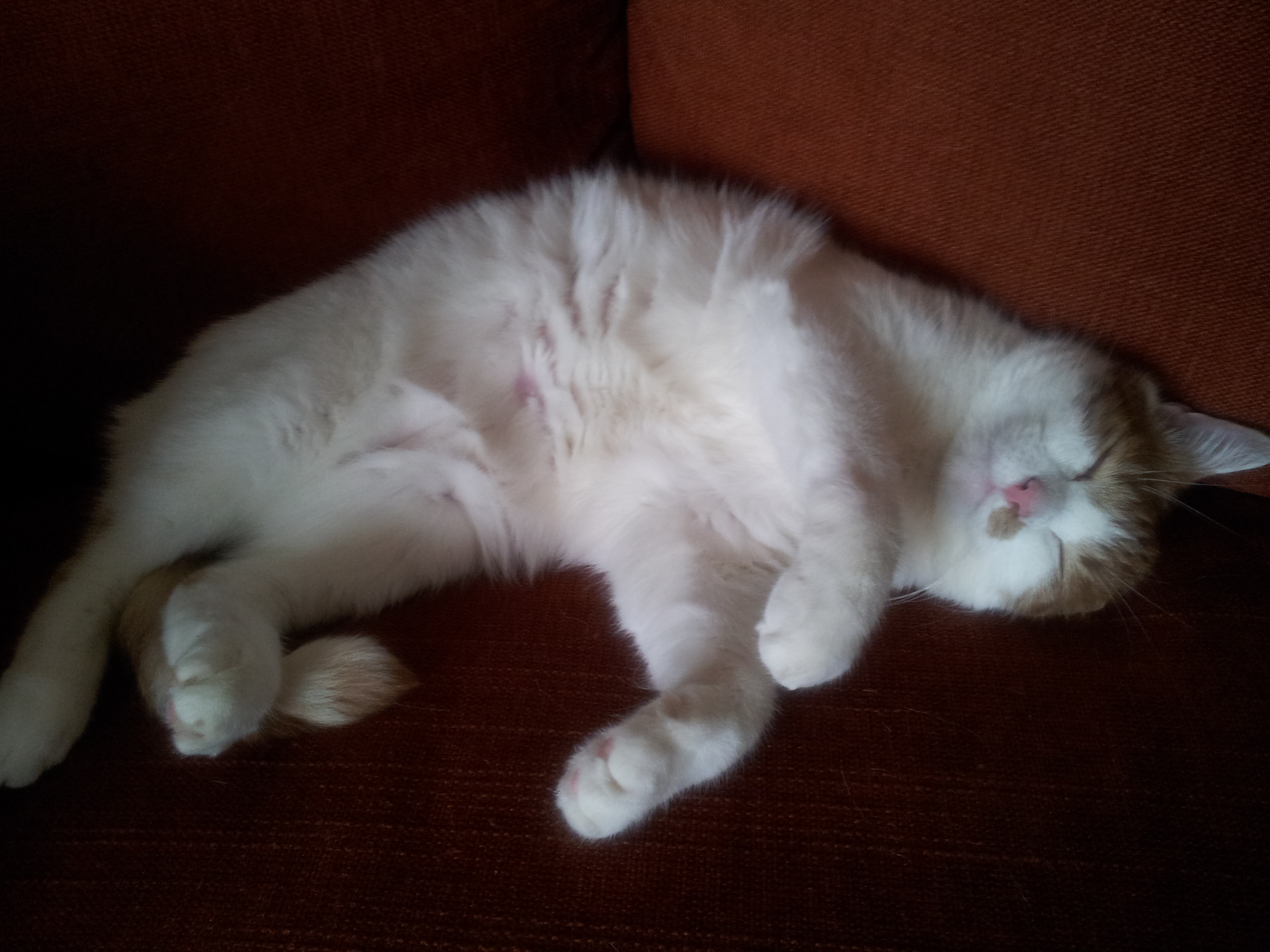
My cat asleep next to me while I am writing this

Posted in Dreams | Tagged , , , , , , , , , , , , , | 31 Comments

The Beautiful Life Giving Power of the Sun

This is a beautiful article about the symbolism of the Sun that I have read recently.

astralvisions's avatarjourneys in the astral light

Dear friends, welcome back and today I have some more on the nature of the Sun to share with you. If you enjoy this sharing, please consider supporting further posts on Patreon.

sun_rounding_earth_nasa-HD

“In all things, great and small, I see the Beauty of the Divine expression”.

 The Sun is a symbol of what is eternal, natural and essential in us; it shows what we are expressing of the Beauty of the Divine through the individualised radiation of consciousness. The influences that come from it permeate everything in our life and radiate through it. They are central to our existence and our consciousness.

Quite simply, the Sun is the most vital body in the solar system because it gives off the most energy and so it follows that it is the most vital body in our horoscopes too, the stellar nucleus of its energy source. The Sun is the central…

View original post 1,766 more words

Posted in Uncategorized | Tagged , , , , | Leave a comment

Birds on My Mind

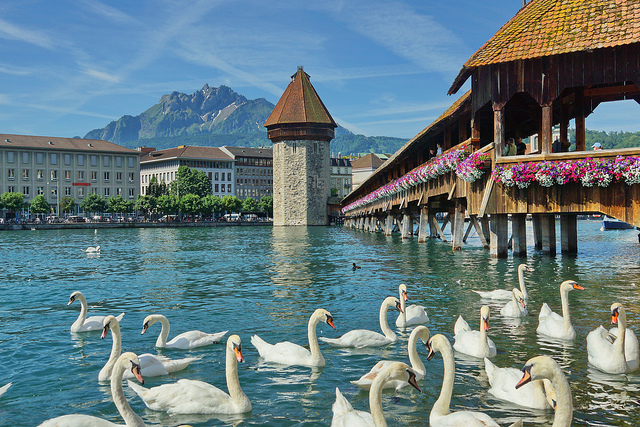
I have been thinking recently of exploring bird symbolism, as birds seem to capture my attention wherever I go. The Sun is still in the air sign (Gemini), which means that airborne creatures deserve some focus. I have had some interesting encounters with birds recently. First, a bird of prey just landed in front of me, which compelled me to reblog a post (https://symbolreader.wordpress.com/2013/06/03/eagle-spirit-feathers/). Then I admired a multitude of swans in the city of Lucerne, Switzerland.

Image

Lucerne swans

A swan is a symbol of great complexity. The Greeks viewed the swan as sacred to both Aphrodite and Apollo. I am reminded that William Shakespeare was called the Sweet Swan of Avon, a brilliant nickname for this particular genius. Bachelard, whom I quote here after Cirlot, the author of The Dictionary of Symbols, links the swan with the hermaphrodite because its body shape has both feminine and masculine features, a phallic neck and a rounded body. The swan stands therefore for complete satisfaction of desire, which finds its expression in the beautiful legendary swan song, sung before the bird’s death. For alchemists the swan represented a union of opposites and the philosophical Mercurius, the world-creating spirit. Thus the swan is linked with the astrological sign Gemini, which symbolizes the jin/jang duality, and is ruled by Mercury exoterically. The esoteric ruler of Gemini is Venus, which also resonates with the graceful, beautiful and harmonious swan energy. In Richard Wagner’s opera Lohengrin, the title character is an Arthurian knight of the Holy Grail, who travels in a boat pulled by swans. He is supposed to rescue a princess falsely accused of murder. He had got mystical powers from the Grail, but the important condition was to keep those powers secret; the princess was forbidden to ever ask what her rescuer’s identity was. I think this legend really resonates with the sign Gemini, whose special challenge is to learn to keep secrets. Mercury/Hermes was the messenger who was the only god allowed to enter Hades. He would have been severely punished if he had revealed the secrets of the underworld, which means that an evolved Gemini individual must learn the value of words and the value of guarding mysteries.

Image

Lohengrin

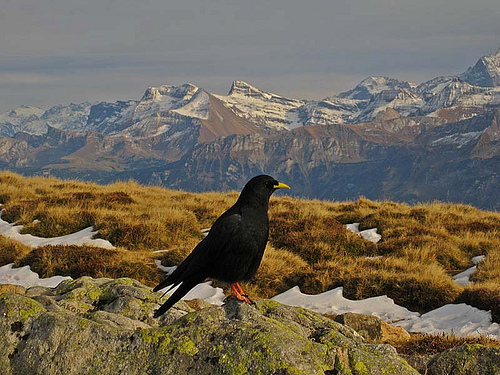
A further encounter with birds that I had was last Saturday while hiking in the Swiss Alps. There we were surrounded by very peculiar birds, which are black, look like small ravens, but whose beaks are bright yellow and whose feet are red. The birds were very trusting, they begged for food and sat on people’s arms, and they even rested on my friend’s head. At one point the friend looked like the “witcher” with two birds on his arms and one on his head. The bird is called the Alpine chough and has a very peculiar name in my native Polish, which translated into English means a soothsayer.

Image

Image

The local legend claims the choughs are the spirits of mountaineers. This comes as no surprise, as in symbolism birds are in general stand for spiritualization. As a famous and celebrated quotes from the Upanishads goes:

Two birds, inseparable companions, inhabit the same tree; the first eats of the fruit of the tree, the second regards it but does not eat.

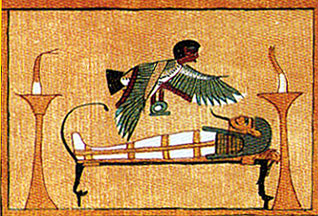
As far as I understand this passage, the first bird is like the material, limited, everyday (lower) mind, while the second bird stands for the eternal (higher) mind. In ancient Egypt, the ba (soul, spirit, spiritual manifestation) was represented as a bird with a human head. The ba survived a person’s death carrying the spirit and individuality of the deceased into eternity.

Image

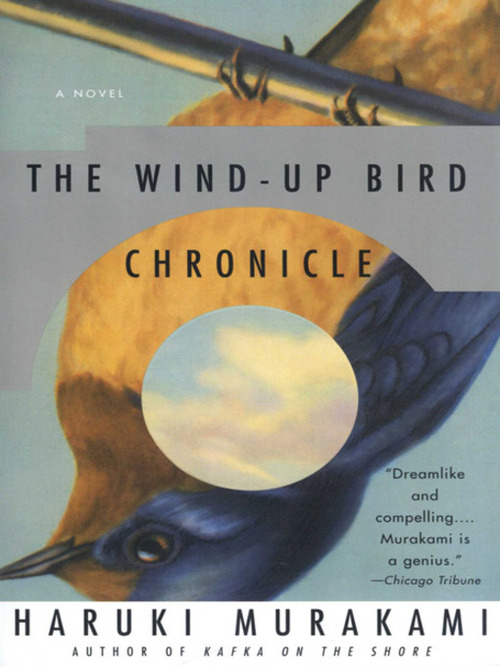
One of my favourite novels has a bird as its central symbol. It was written by a Japanese author Haruki Murakami and is called The Wind-Up Bird Chronicle. It is a story of a man whose life has become sterile, numb and unproductive. He has lost touch with his feelings, has no purpose in life and is supported by his wife while he runs the household. Murakami’s novels are very much like dreams (or labyrinths) you can immerse yourself in, he never plans his plot but just allows the story to reveal itself, which you can see for yourself in the following summary I took from The New York Times:

The story of ”The Wind-Up Bird Chronicle” is a hallucinatory vortex revolving around several loosely connected searches carried out in suburban Tokyo by the protagonist-narrator, Toru Okada, a lost man-boy in his early 30’s who has no job, no ambition and a failing marriage. When his cat disappears, he consults a whimsical pair of psychics, sisters named Malta and Creta Kano, who visit him in his dreams as often as in reality. Then his wife leaves him, suddenly and with no explanation, and he spends his days hanging out with an adolescent girl named May Kasahara, a high-school dropout obsessed with death, who works for a wig factory. At one point, seeking solitude, Toru descends to the bottom of a dry well in the neighborhood, and while he’s down there, he has a bizarre experience, which might or might not be another dream: he passes through the subterranean stone wall into a dark hotel room, where a woman seduces him. This experience leaves a blue-black mark on his cheek that gives him miraculous healing powers. Eventually, he’s rescued by Creta Kano, who reveals to him that she has been defiled in some hideous, unnatural way by Toru’s brother-in-law, a politician whose rising career appears to be propelled by demonic powers.

Retrieved from http://www.nytimes.com/books/97/11/02/reviews/971102.02jamest.html

The wind-up bird is a very mysterious symbol. On the one hand, it is like the soul of the world, being responsible for winding up the spring of the world. It can only be heard by certain individuals who are marked as “doomed,” and in that sense it is menacing. Also, it seems to be a call for rebirth and transformation. Nobody ever sees it, it can only be heard, which would mean that it belongs to the invisible world of the psyche. The novel has very dark elements, exploring the nature of individual and collective shadow. Perhaps the wind-up bird is symbolic of the invisible and deep realms of the soul, which are both dark and light, benevolent and malignant at the same time.

murakami

Finally, I’d like to recommend two blog posts related to birds, which I find to be very beautiful. Strange how the collective mind revolves around the same subjects.

http://scvincent.com/2013/06/09/birds-of-a-feather/

http://esotericembers.wordpress.com/2013/06/04/gemini-and-the-ugly-duckling/

Support my blog

If you appreciate my writing, consider donating and make my day. Thank you in advance.

$1.00

Posted in Uncategorized | Tagged , , , , , , , , , , , , , , , , , | 19 Comments

The Wounded Lion

Image

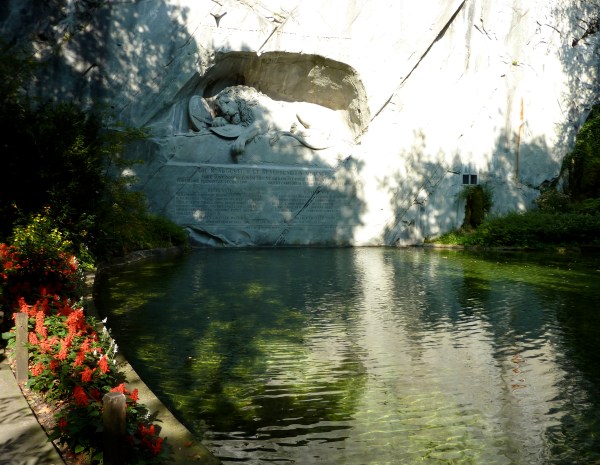
Whenever I am visiting the beautiful city of Lucerne in Switzerland, I always must pay my respects to the Lion Monument, a sad sculpture designed by a famous Danish sculptor Bertel Thorvaldsen. The sculpture shows a mortally wounded, weeping lion, impaled by a spear and resting on a shield. It commemorates the Swiss Guards who were massacred in large numbers during the French Revolution.

Mark Twain, who travelled extensively in Switzerland, called the sculpture “the most mournful and moving piece of stone in the world.” I have seen the sculpture in every season but I was particularly moved by it yesterday on a warm and sunny day. First the lion was in full sun but then the shade started approaching fast, engulfing his body mercilessly. The lion, identified with the Sun in myth, was being defeated and swallowed by the shadow. And yet he looked so noble and brave despite his weakness and misery. I thought of the Sun entering its nightly course through the night sea in the Egyptian mythology. The death of the Sun every night was symbolically compared by Jung to the death of the ego before it takes a plunge into the waters of the unconscious.

Here are more reflections of Mark Twain on this extraordinary sculpture:

The Lion lies in his lair in the perpendicular face of a low cliff — for he is carved from the living rock of the cliff. His size is colossal, his attitude is noble. His head is bowed, the broken spear is sticking in his shoulder, his protecting paw rests upon the lilies of France. Vines hang down the cliff and wave in the wind, and a clear stream trickles from above and empties into a pond at the base, and in the smooth surface of the pond the lion is mirrored, among the water-lilies.

Around about are green trees and grass. The place is a sheltered, reposeful woodland nook, remote from noise and stir and confusion — and all this is fitting, for lions do die in such places, and not on granite pedestals in public squares fenced with fancy iron railings. The Lion of Lucerne would be impressive anywhere, but nowhere so impressive as where he is.

Mark Twain, A Tramp Abroad

Image

Image

Posted in Sculpture | Tagged , , , , , , , , , , , , | 24 Comments

Fate: A Jungian Perspective

My fate cries out,
And makes each petty artery in this body
As hardy as the Nemean lion’s nerve.

Shakespeare, Hamlet

The following article is greatly inspired by Liz Greene’s book The Astrology of Fate. I have yet to find an author who goes deeper into myth and symbol, weaving the Jungian psychology and astrology into the mix. All references to Greek myth come mainly from Karl Kerényi, the author of The Gods of the Greeks.

Even Zeus was afraid of Nyx, the night goddess. Her three daughters were the Moirai, goddesses of fate. They were born before other Olympian gods. According to members of the cult of Orpheus, the three sisters of fate lived in a hole in the sky over a pond. From that hole white water was cascading into the pond, which was symbolically suggestive of lunar light. The three Moirae (Greek for parts or allotted portions) were very much lunar goddesses. They personified the three phases of the Moon. Klotho, the Spinner, would spin the thread of life, Lakhesis, the disposer of lots, would measure it, Atropos, she who cannot be turned, cut it. I must admit I always feel a shudder reading about these three primordial goddesses, whose power seems so final and immeasurable.

Image

image via

http://www.sarah-young.co.uk/untitled-gallery-32266/238553_the-three-moirai.html

The other formidable mythological trio related to the Moirai were the Erinyes (avengers and persecutors). They had snakes for hair, their skin was black, their clothes grey. Philosopher Heraclitus wrote about them: “Sun will not overstep his measures; if he does, the Erinyes, the minions of Justice, will find him out.”  When the Titan Cronus castrated his father Uranus, Erinyes were born from the drops of blood that fell to the earth (Gaia). To our day they symbolize all kinds of violent and destructive emotions and are looked upon as metaphoric avengers of moral injustice. What I found interesting and portent symbolically was that they appeared fastest and without fail when evil was committed against a mother. First and foremost they protected the law of family ties, avenging any transgressions against the mother. Thus Fate is inextricably bound with the symbolism of Mother.
Image

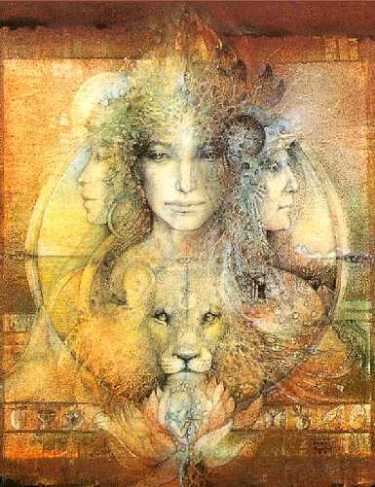
Susan Seddon Boulet, Triple Goddess

Symbolically and etymologically, Mother is linked to Matter and to the law of fate. Jung devoted much of his writing to the Mother archetype, who broadly speaking is symbolic of the left and nocturnal side of existence, the water of life and the passive acceptance of natural phenomena. She is connected with the body, the flesh, pain and pleasure, birth, heredity, disease, decay and death. Archetypes and symbols, which emerge from the collective unconscious, are also within her realm in the sense that they signify natural laws not made consciously by humans. They have always been and they always will be. We are forever subject to them.

One Greek story which links mother, fate and the Erinyes is the myth of Orestes. He was ordered by Apollo to murder his mother in order to avenge his father’s death. He lost his sanity as a result of being pursued by the Erinyes and had to undergo a lengthy and arduous process of expiation and purification before he was able find peace. Orestes’ trial was a clash between the new Olympian gods and the gods of the old order, the Erinyes. The only way to contain the wrath of the Erinyes, who were called the Furies in Roman mythology, was to build an underground temple for them and keep them there. Thus they were honoured and Orestes was saved. The younger gods represent here consciousness and the modern idea of justice while the Erinyes stand for the implacable fury of the instinctual violent emotions as well as an old idea of justice related to blood ties.

In Norse mythology, there were the three Norns who ruled the fate of gods and people. They ruled over the past, present and future and were the most powerful of all deities. They tended the World Tree by watering it with water drawn from the well and sprinkling gravel around it, not allowing its roots to rot or to dry. They possessed knowledge of the delicate equilibrium that characterizes the way Nature works, and the wisdom of great cycles of birth and death.  I was inspired to read that the name Norns might have actually meant “the ones that communicate quietly, by whispering.”  I find it quite fascinating that the Norns would whisper, for this can be related to the unconscious inner voice that lacks the extroversion or forcefulness of self-confident public speaking, but can nevertheless be very potent and powerful. I am reminded of my favourite lecturer at university, a female who taught us existential psychology. Her voice was very low and very subtle, yet the ones who wanted to listen to her were mesmerized and enchanted.

Image

David Kreitzer, Norns Roots

The interesting question that Liz Greene asks in her book is why in all myths the deities of fate are always female. The following pivotal quote explains this very elegantly, I think:

Fate is imagined as feminine because fate is experienced in the body, and the inherent predispositions of the body cannot be altered regardless of the consciousness that inhabits the flesh just as Zeus cannot, ultimately, alter Moira. The instinctual drives of a species are also the province of Moira, because these too are inherent in flesh and although they are not unique to one family or another they are universal to the human family. It seems that we cannot overstep that in us which is nature, which belongs to the species – however much we repress it or feed it with culture.

The quote would suggest that fate is related to the realm of instinct, it is biological or natural. It springs from within and is compulsive. On a related note, Carl Gustav Jung  spoke of an instinct to individuate, to grow from an inner seed into a tree. “My fate is what I am, and what I am is also why I am and what happens to me,” writes Liz Greene, summarizing Jung’s thought. All the events that fall upon us, all that happens to us, is caused to happen by our inner reality, by the inner archetypes that govern our lives. Instincts and archetypes can be thus differentiated: instincts determine our physical or natural behavior, they are natural forces governing our lives; while archetypes are images of these natural forces, they are unconscious patterns that are experienced by the psyche in the form of myths, images and symbols. Archetypes go deeper than symbols, they are shared by all humans irrespective of culture; whereas symbols and myths are culture specific. The Greeks had the Moirai, Scandinavians the Norns, but they both expressed the same basic archetype of the immutable law of fate.

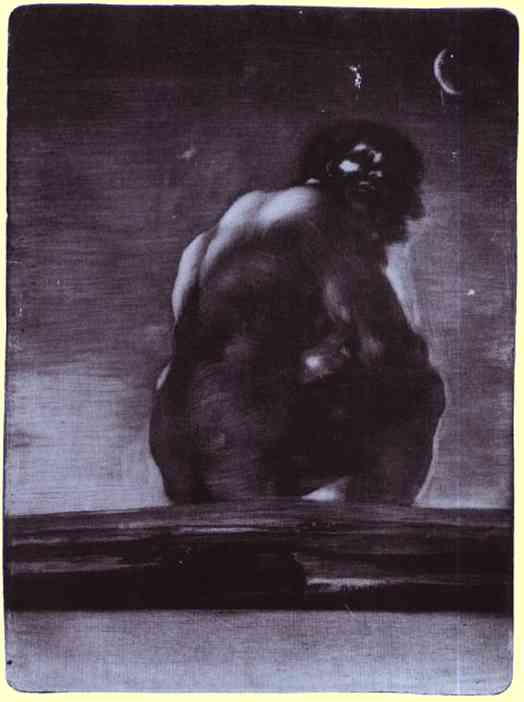
All great archetypes are ambivalent, that is possessing the dark and light side. The dark aspects of the mother are typically symbolised by monsters, death, the experience of being devoured, seduced and poisoned. It is important to remember that the Moirai were given birth by the goddess Night without the help of a male. In The Great Mother Erich Neumann writes (quoting here after Liz Greene): “The terrible aspect of the feminine always includes the uroboric snake woman, the woman with the phallus, the unity of childbearing and begetting, of life and death…” As I was reading that passage, I remembered a dream I had when I was a girl. It was a very vivid dream, the one that Jung would call numinous. According to the theologian Rudolf Otto, the numinous experience shows the tendency to invoke fear and trembling, as well as the tendency to attract, fascinate and compel. My dream inspired fear and awe in equal measure. I did not dare to look but I did all the same. I dreamt that I was looking at a full Moon out of my bedroom window. I was trying to see the features of the face on the Moon. Suddenly the face became alive and it seemed to be looking at me. It was a man’s face. I was a child so I obviously did not analyze it: why was the face male if lunar goddesses are usually female? Suddenly a giant emerged out of the Moon, whose head was touching the sky. He bent forward and put his giant face opposite mine, pressing on the window pane. I was terrified but also fascinated. No words were said, we were just looking at each other.

Image

Francisco Goya, The Giant

In Greek myth, the Giants were the children of Gaia (Earth) who like Erinyes sprang up from Uranus’ blood that fell on Gaia’s body. There were also the Titans, who were the primeval race of giants also born to Gaia and Uranus, but long before the Giants. The Titans were imprisoned by the new gods, the Olympians, in the Tartarus. There seems to be a clear pattern emerging in Greek mythology showing how repression of our primordial instincts work. They can be shoved into the unconscious but they can never be completely eradicated. The Giants were defeated through the joined effort of the Olympians, the Moirai and Heracles. They were subsequently buried beneath the earth, where their seething rage and writhing caused volcanic activity and earthquakes. How could that be interpreted in symbolic terms? I believe I can try to rephrase this symbolic tale. The hero in each and every one of us needs help from his or her ‘Olympians’ that is the traits of his or her own psyche, his inner qualities symbolized by the gods (or planets in his astrology chart), he or she needs fate (luck?) to be on his or her side, and he or she needs to remember that the natural instincts can be contained momentarily but cannot be destroyed forever.

Writing all this I was also inspired by this article: http://shamanictracking.com/2013/06/01/changing-your-destiny-part-1/

I basically agree that we humans have a higher potential and we are not prisoners of our fate. The questions on my mind were the following:  How can the notion so old and ancient as Fate be translated into the terms of modern psychology and symbolism which would be palatable for a modern man/woman with our strong belief in self-determination and free will? In what sense are we still bound by fate? In what sense are we free or how can we free ourselves?

There is Fate but it comes from within – this is what Jung seems to be saying. Fateful events may appear to come out of the blue but in fact it is our own internal archetypal structure and make-up that bring the events into our lives. Central to Jungian thought is the polarity of ego self and the Self, i.e. the principle of higher order emerging from integrating all that was repressed or unwanted by the ego (the shadow) but also all that we could become or achieve, our highest  and  brightest idea of ourselves. The Self connects us with our inner divinity, our infinite potential.  I think that shamanictracking may be on to something important when they differentiate fate and destiny. All I was trying to say was that in order to grow into our destiny, our highest and lofty potential, we need to honour the gods of Fate that forever reside within us.

Posted in Fate | Tagged , , , , , , , , , , , , , , , , , , , , , , , , | 52 Comments

Eagle Spirit Feathers

Thank you to the Seven Worlds, who posted this. I believe the passage about the eagle symbolism relates to my post post on Johfra’s Gemini painting.
https://symbolreader.wordpress.com/2013/05/30/images-of-the-zodiac-contemplating-gemini/
I really did not know that the eagle was so closely connected to the theme of duality.
A few days ago I saw a majestic bird of prey over my head. I do not think it was an eagle, I doubt it. Suddenly it swooped down and landed quite near me on the grass. This was quite unusual to see a bird like this in a residential area.

thesevenminds's avatarThe Seven Worlds

intricate-feather-cutouts-chris-maynard-10Native American Feathers

Native American feathers are an important symbol of the Indian way of life. It is used to represent freedom, power, wisdom, honor, trust, strength, and much more. Feathers were seen in wardrobes, headpieces, adorning their homes, and tattooed on their bodies.

The Native American feather was given as a sign of respect and honor. A Native American who had a personal accomplishment or achieved something great for the tribe was often given feathers by chiefs or elders as a symbol of strength. The Native American with the most feathers in his headdress is usually the chief.

View original post 543 more words

Posted in Uncategorized | Tagged , , , , , , , , , , , | 12 Comments

Self-deception and Self-knowledge

Self-deception is a defining part of our human nature. By recognizing its various forms in ourselves and reflecting upon them, we may be able to disarm them and even, in some cases, to employ and enjoy them. This self-knowledge opens up a whole new world before us, rich in beauty and subtlety, and frees us not only to take the best out of it, but also to give it back the best of ourselves, and, in so doing, to fulfil our potential as human beings. I don’t really think it’s a choice.
Neel Burton, Hide and Seek: The Psychology of Self-Deception

People will do anything, no matter how absurd, to avoid facing their own souls.
C.G. Jung

943281_587996954555820_421563937_n

Posted in Uncategorized | Tagged , , , , , , , , , | 14 Comments