Soaring High on the Wings of Ambition

“As Caesar loved me, I weep for him; as he was fortunate, I rejoice at it; as he was valiant, I honour him: but, as he was ambitious, I slew him. There is tears for his love; joy for his
fortune; honour for his valour; and death for his ambition.”

Brutus’ speech in Shakespeare’s Julius Caesar

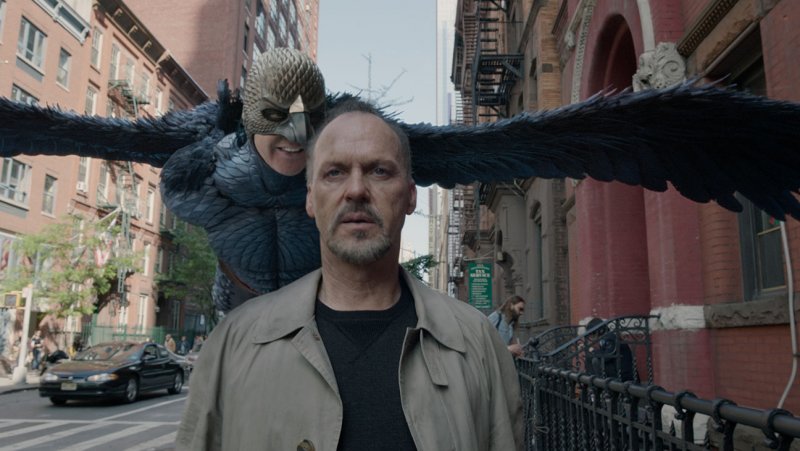
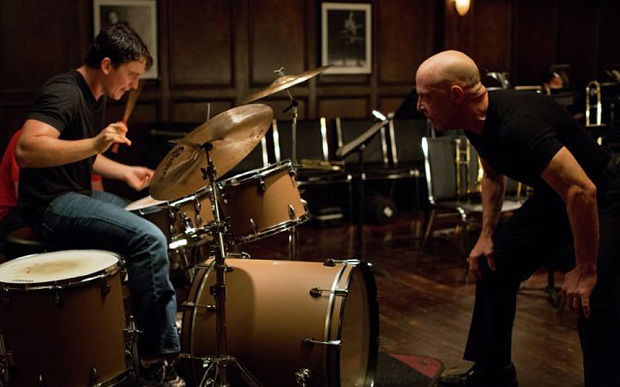
Two excellent movies I have seen recently – Birdman directed by Alejandro G. Iñárritu and Whiplash directed by Damien Chazelle- seem to revolve around the theme of ambition, marked by single-mindedness of purpose, cut-throat competitiveness, extreme exertion and toil, the willingness to prove oneself and achieve greatness with a total lack of consideration for relationships, by way of contradiction accompanied by a need to be recognized and admired. Narcissism seems to be at the etymological root of the word “ambition,” which is connected with going around to solicit votes; ambition is “a striving for favor, courting, flattery; a desire for honor, thirst for popularity” (via http://www.etymonline.com/index.php?term=ambition). In both movies, the shadow side, the price paid for the desire to soar above the ordinary is blood, sweat and tears of suffering and a poignant feeling of alienation. The question that occurred to me was this: can excellence and mastery be achieved only through merciless tyranny? In order for the wet soulful emotionality to be translated into the geometrical order of crystallized ambition, some amount of ruthless despotism seems to be indispensable. The root of the word “discipline” hides penitential chastisement, physical punishment, teaching, martyrdom and military drill.

In Birdman, I was particularly impressed by the ingenious deconstruction of the superhero archetype. By having played Birdman in his younger years, a superhero able to fly, move objects and destroy his enemies with the power of the mind, the actor underwent an inflation: he has acquired all of these superpowers, and yet he is still struggling with the usual human depression, listlessness, powerlessness and old age. Ostensibly, the actor seems to want to shake the mantle of the superhero and go back to being human again. However, his inner Birdman is not willing to go away and the two seem to be in symbiosis now. The young protagonist of Whiplash – an aspiring jazz drummer – has a similar task to fulfill: he needs to integrate the fierce taskmaster represented by his teacher into his own personality. The master is a projection of the student’s own soaring and unrelenting ambition. Without this crucial integration, no success will ever be possible for him. In the final exhilarating drumming scene, we are pulled back to the primal roots of music: the ecstatic, “phallic” drumming. I was left with this thought: dreams of success and ambition are not social constructs. They are natural and instinctual primal expressions of the soul. The hypocrisy of Brutus’ justification for assassinating Caesar is very apparent.

Posted in Ambition | Tagged , , , , , , , , , , | 14 Comments

The Secrets of the Odyssey (13): Journeying on Snakelike Wet Paths

While reading Hermes Guide of Souls: The Mythologem of the Masculine Source of Life by Karl Kerènyi I came across the following passage describing the nature of Odysseus’s journeying and the special patronage of Hermes over Odysseus:

“We previously called the Odyssey a journey epic, and we must now imagine the often experienced reality of ‘journeying’ as something very special, in contradistinction to ‘roaming’ or ‘travelling.’ Odysseus is not a ‘traveller.’ He is a ‘journeyer,’ not simply because of his moving from place to place, but because of his existential situation. The traveller, despite his motion, adheres to a solid base, albeit one that is not narrowly circumscribed. With each step, he takes possession of another piece of earth. This taking possession is, of course, only psychological. In that with each extension of the horizon he also expands himself, his claim of possession on the earth expands continuously as well. But he remains always bound to a solid earth beneath his feet, and he even looks for human fellowship. At every hearth that he encounters he lays claim to a kind of native citizenship for himself. … His guardian is not Hermes, but Zeus, the god of the widest horizon and the firmest ground. In contrast, the situation of the journeyer is defined by movement, fluctuation. To someone more deeply rooted, even to the traveler, he appears to be always in flight. In reality, he makes himself vanish (‘volatizes himself’) to everyone, also to himself. Everything around him becomes to him ghostly and improbable, and even his own reality appears to him as ghostlike. He is completely absorbed by movement, but never by a human community that would tie him down.

The journeyer is at home while underway, at home on the road itself, the road being understood not as a connection between two definite points on the earth’s surface, but as a particular world. It is the ancient world of the path, also of the ‘wet paths’ … of the sea, which are above all, the genuine roads of the earth. For, unlike the Roman highways which cut unmercifully straight through the countryside, they run snakelike, shaped like irrationally waved lines, conforming to the contours of the land,  winding, yet leading everywhere. Being open to everywhere is part of their nature. Nevertheless, they form a world in its own right, a middle-domain, where a person in that volatized condition has access to everything. He who moves about familiarly in this world-of-the-road has Hermes for his God, for it is here that the most salient aspect of Hermes’s world is portrayed. Hermes is constantly underway: he is enodios (‘by the road’) and hodios (‘belonging to a journey’), and one encounters him on every path. … His role as leader and guide is often cited and celebrated, and, at least since the time of the Odyssey, he is also called angelos (‘messenger’), the messenger of the Gods.” (pp. 13-15)

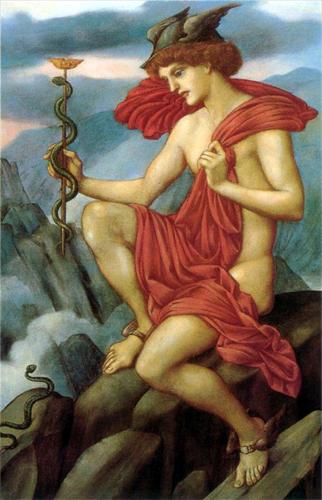
Evelyn de Morgan, "Mercury"

Evelyn de Morgan, “Mercury”

Posted in The Odyssey | Tagged , , , , , , , , , , , , , , , , | 31 Comments

Jung on Alchemy (1): The Moist and Earthly Foundation

Frame capture from a movie "Spring, Summer, Fall, Winter, ... and Spring"

Frame capture from the movie “Spring, Summer, Fall, Winter, … and Spring”

My upcoming series of posts is going to be based on three works of C.G. Jung:

1) Psychology and Alchemy, volume 12 of the Collected Works

2) Alchemical Studies, volume 13 of the Collected Works

3) Mysterium Coniunctionis, volume 14 of the Collected Works

The guiding thought for the series, which is not going to be a summary of Jung’s works but rather a collection of various thoughts and a tribute to Jung, comes from Psychology and Alchemy, where Jung states:

 “I for my part prefer the precious gift of doubt, for the reason that it does not violate the virginity of things beyond our ken.”

Alchemy, as well as the totality of the psyche (i.e. the conscious and the unconscious), is a sphere of deepest mystery, not explainable by abstract concepts or categories. Alchemy is not an abstraction from life, as its chief premise states that the unconscious is both the fertile ground and the water of life that nourishes all life. The word “alchemy” combines two root meanings etymologically: “land of black earth” (i.e. Egypt) and “that which is poured out” (juice, sap), which means that the word itself spells moisture and fecundity. It seems that by applying too much intellectual rigidity we risk drying alchemy out, stripping it of its pristine mysteriousness. As Jung writes in volume 12, pars 93-94:

“By acknowledging the reality of the psyche and making it a co-determining ethical factor in our lives, we offend against the spirit of convention which for centuries has regulated psychic life from outside by means of institutions as well as by reason. Not that unreasoning instinct rebels of itself against firmly established order; by the strict logic of its own inner laws it is itself of the firmest structure imaginable and, in addition, the creative foundation of all binding order. But just because this foundation is creative, all order which proceeds from it – even in its most ‘divine’ form – is a phase, a stepping stone. Despite appearances to the contrary, the establishment of order and the dissolution of what has been established are at bottom beyond human control. The secret is that only that which can destroy itself is truly alive. …

Painting by Jung from The Red Book: “Watering Hades” with the inscription: “This the holy caster of water. The Cabiri grow out of the flowers which spring from the body of the dragon. Above the temple."

Painting by Jung from The Red Book: “Watering Hades” with the inscription: “This the holy caster of water. The Cabiri grow out of the flowers which spring from the body of the dragon. Above the temple.”

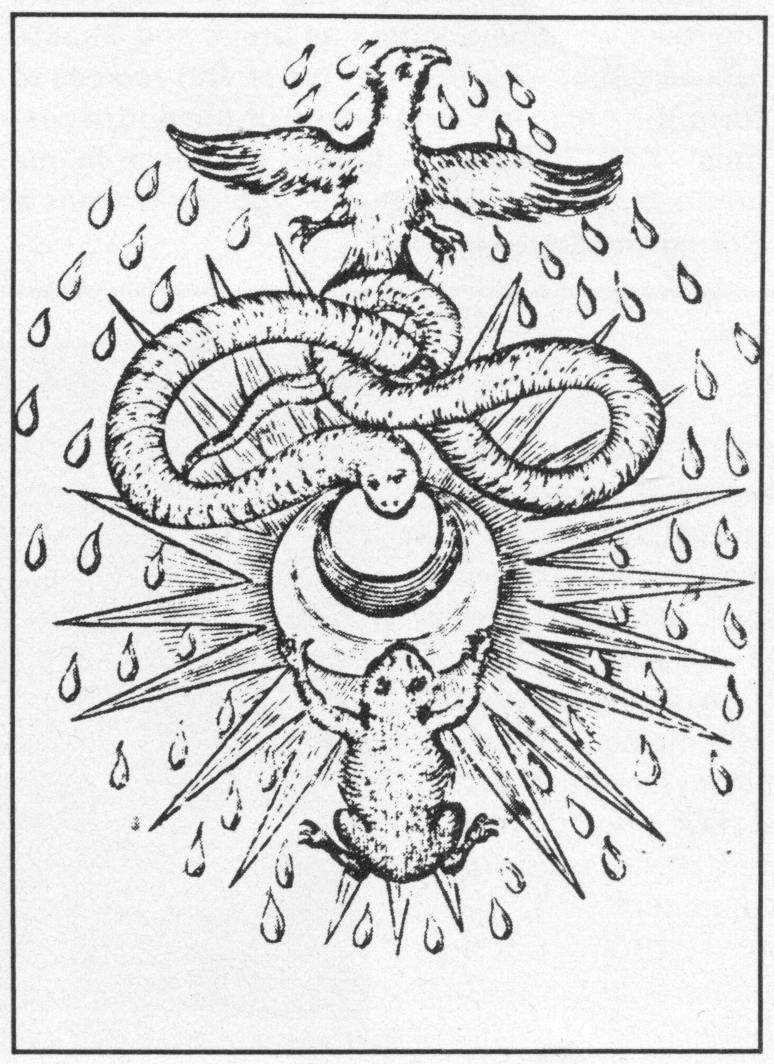
The water that the mother, the unconscious, pours into the basin belonging to the anima, is an excellent symbol for the living power of the psyche. The old alchemists never tired of devising new and expressive synonyms for this water. They called it aqua nostra, mercurius vivus, argentum vivum, vinum ardens, aqua vitae, succus lunariae, and so on, by which they meant a living being not devoid of substance, as opposed to the rigid immateriality of mind in the abstract. The expression succus lunariae (sap of the moon-plant) refers clearly enough to the nocturnal origin of the water, and aqua nostra, like mercurius vivus, to its earthliness.”

From Theatrum Chemicum Britannicum by Elias Ashmole. (London, 1652). (Photo by Oxford Science Archive/Print Collector/Getty Images), image via http://www.gettyimages.ch/detail/nachrichtenfoto/alchemical-symbolism-1652-a-toad-and-serpent-nachrichtenfoto/463916645?Language=de

From Theatrum Chemicum Britannicum by Elias Ashmole. (London, 1652). (Photo by Oxford Science Archive/Print Collector/Getty Images), image via http://www.gettyimages.ch/detail/nachrichtenfoto/alchemical-symbolism-1652-a-toad-and-serpent-nachrichtenfoto/463916645?Language=de

The greatest question of alchemy, as it appears to me, is how to live according to the dictates of one’s inner life by tapping into its rich, fertile and dark unconscious roots; how to resist the imposed outside regulations and instead self-regulate from the depths within; finally, how to let go if the order that seemed to have worked for us for some time has stopped being nourishing, and instead has turned into scary, derelict ruins or a haunting dead forest. The need for fluid transformation seems to be the first law of alchemy. Such a transformation does not mean merciless hacking away at the coarse woody debris of our past life, but rather acknowledging that even that which needs to be left behind paradoxically nourishes us, just as the fallen tree logs actually recycle nutrients essential for all living organisms, provide shelter for countless creatures of the forest, and, when placed in streams, provide shelter for fish and a place for turtles to lay their eggs. On slopes, coarse wood debris “stabilizes soils by slowing downslope movement of organic matter and mineral soil“ (source: Wikipedia).  Dead trees, just as the dying and crumbling structures of our lives, are a valuable resource that needs to be maintained and protected as a sine qua non of our regeneration.


Support my blog

If you appreciate my writing, consider donating and make my day. Thank you in advance.

$1.00

Jung on Alchemy (2): The Mandala

Jung on Alchemy (3): Meditation and Imagination

Jung on Alchemy (4): Prima Materia – The One, Who Art All

Jung on Alchemy (5): Hermes, the Arcane Interpreter of All

Jung on Alchemy (6): Sol and Sulphur – the Fiery Ferment of the Soul’s Hidden Depth

Posted in Alchemy | Tagged , , , , , , , , , , , , , , , | 21 Comments

Hope, Faith and Sublime Beauty in the Clamor of Suffering: “Ida”

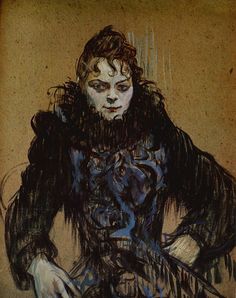
Recently, the Polish movie Ida made a tremendous emotional impact on me. It is the sort of movie about which the less is known before seeing it the better, in order to approach it without any expectations. It is wonderfully minimalistic in expression but extremely harrowing emotions are palpable, gut-wrenching, heart-stopping all throughout its duration. The shadows of the past chased after by the two main female characters cover the movie’s narrated time with a sticky, suffocating sediment. I keep wondering, though, why the director chose Mozart’s “Jupiter Symphony” to sound in one of the saddest moments? In astrology Jupiter correlates with faith, expansion, courage, optimism, redemption. The two main female characters: the “saint” and the “sinner,” in my humble view, both possess these qualities, which gracefully uplifts the movie to Jupiterian heights. No matter the stark circumstances of the post-war communist Poland, no matter the truth about the past, both Ida and her aunt achieve the seemingly impossible in their performances: they evoke the sublime and the beautiful. Ida’s face seems to have come straight from the canvas of Vermeer, while her aunt has the fleshy dignity of Lautrec’s ladies of the evening. She evokes Mary Magdalene. In one of the interviews, the director of the movie said:

 “One of my favorite writers is Chekhov. I love his attitude toward the world. Just accept things for what they are. Don’t judge. Be moral as you tell your story, but have no moral at the end. Just look at it.”

I find it quite impressive that Pawlikowski achieved the impossible paradox: his movie is still and minimalistic, seemingly detached, and yet it lingeringly conveys the turmoil, passion, frenzy and intensity of the full on engagement with the terrors of existence.

Henri de Toulouse Lautrec, "La femme au boa noir"

Henri de Toulouse Lautrec, “La femme au boa noir”

ida2

Johannes Vermeer, “Woman Holding a Balance”

Posted in Movie Review | Tagged , , , , , , | 20 Comments

“The Gazelle” by Reiner Maria Rilke

Enchanted one: how shall the harmony
of two perfect words attain that rhyme
which ripples through you like a spell?
From your forehead rise leaf and lyre,

and all you are already moves in simile
through love-songs whose words, softly
like rose petals, settle on the gaze of one
who, no longer reading, closes his eyes:

and sees you there: transported, as if
each limb were charged with leaps and only
held its fire for the instant your neck
keeps your head still, listening: as when a woman
bathing in a forest hears something stir:
the lake’s reflection in her quick-turned face.

translated by Edward Snow

image

Art by Amanda Clark via http://earthangelsart.blogspot.pt/?m=1

Posted in Poetry | Tagged , , , | 8 Comments

The Guilt of Prometheus and Pandora’s Gifts

Jean Delville, "Prometheus"

Jean Delville, “Prometheus”

Prometheus was one of the Titans – the gods who descended from primordial deities, and preceded Olympian gods and goddesses. His name meant “forethought;” he proved he deserved it by showing a gift of premonition and prophecy when he sided with the Olympians during the war with the Titans. He knew beforehand who the winners would be and chose to cooperate with the bringers of the new order. However, his defiant and unyielding nature rebelled whenever he felt that the Olympians did not have the interest of humans at heart. Prometheus and his brother Epimetheus (“afterthought”) did not get imprisoned in Tartarus after the war with the Titans because they had displayed their loyalty to the Olympians. Zeus entrusted them with the task of creating humans, which Prometheus accomplished using mud (clay), into which the goddess Athena breathed life. Prometheus fell in love with his earth-born creation, imperfect though it was. Epimetheus was a slower, plodding, deliberate and more earthy shadow side of his quick-witted and brilliant brother, endowed with the gift of foresight and fiery intuition. Athena, as Graves writes in Greek Myths, had taught him “architecture, astronomy, mathematics, navigation, medicine, metallurgy, and other useful arts, which he passed on to mankind.” Further says Graves:

 “One day, when a dispute took place at Sicyon, as to which portions of a sacrificial bull should be offered to the gods, and which should be reserved for men, Prometheus was invited to act as arbiter. He therefore rayed and jointed a bull, and sewed its hide to form two open-mouthed bags, filling these with what he had cut up. One bag contained all the flesh, but this he concealed beneath the stomach, which is the least tempting part of any animal; and the other contained the bones, hidden beneath a rich layer of fat. When he offered Zeus the choice of either, Zeus, easily deceived, chose the bag containing the bones and fat (which are still the divine portion); but punished Prometheus, who was laughing at him behind his back, by withholding fire from mankind. ‘Let them eat their flesh raw!’ he cried.”

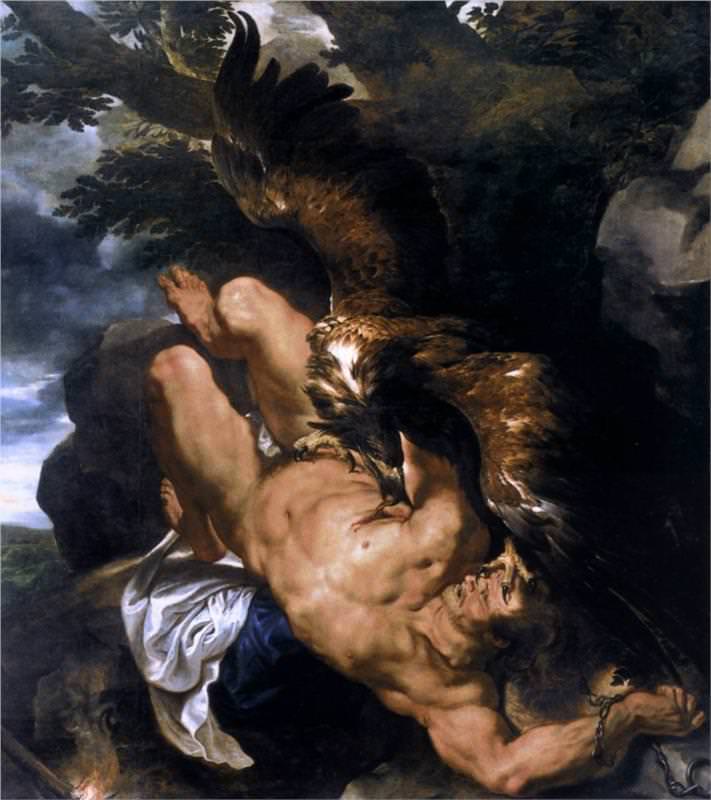
Athena helped Prometheus to enter Olympus in secret. He lighted a torch at the chariot of the Sun, broke from it a glowing charcoal and hid it inside a fennel stalk. The image of fire hidden inside a tube does remind one of the kundalini snake fire coiled in the spine. Prometheus descended to the earth under the cover of darkness and presented humankind with the gift of fire. He paid dearly for his crime, though, for Zeus chained him to a rock in the Caucasian mountains and ordered a ferocious vulture to tear at his liver all day. The pain was unbearable and never-ending, as the liver would grow back each night.
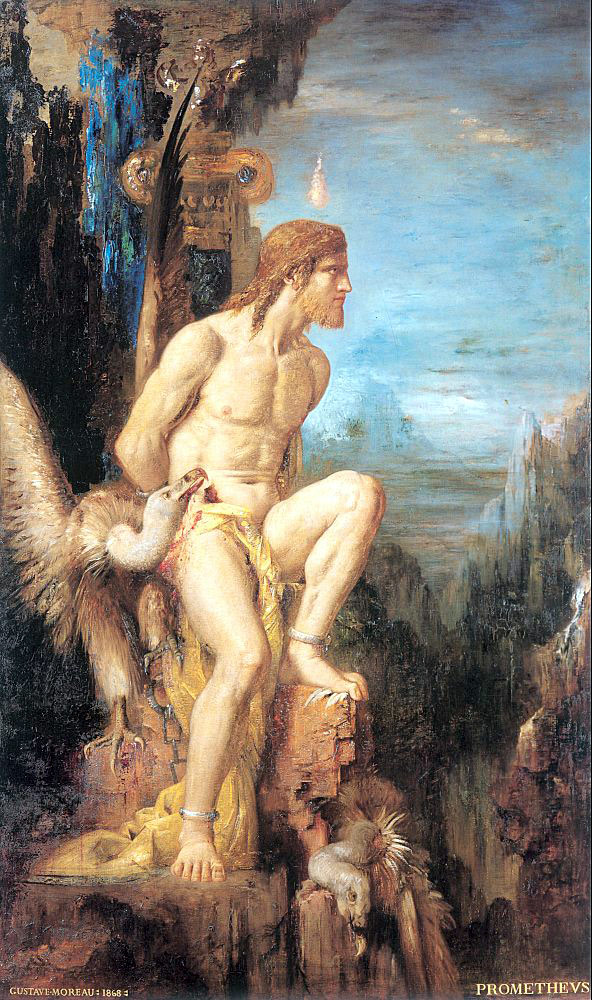
Gustave Moreau, "Prometheus"

Gustave Moreau, “Prometheus”

As further punishment, Zeus ordered Hephaestus to create the first woman ever out of clay. Her name was Pandora (“all gifts,” “all giving”) and she was gifted to Epimetheus as his wife. She brought with her the infamous jar, which Prometheus had warned his brother to keep closed at all cost. Her curiosity was stronger than any admonishments and she opened it releasing all the calamities and evils that plague humankind: old age, disease, insanity, destructive emotions, etc. Only Hope stayed inside the jar to prevent people from losing their minds or committing suicide.

John William Waterhouse, "Pandora"

John William Waterhouse, “Pandora”

It is worth pointing out that the story of Pandora comes from one author – Hesiod. Graves comments:

 “Hesiod’s account of Prometheus, Epimetheus, and Pandora is not genuine myth, but an antifeminist fable, probably of his own invention.”

Like Eve in the Old Testament, Pandora (supposedly) brings evil and mischief on humanity. The famous Pandora’s box was not a box, however, but a jar (Greek ‘pithos’).
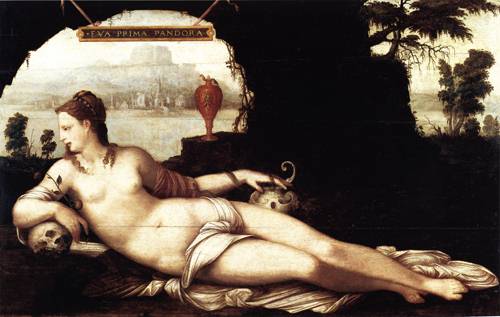
Jean Cousin, "Eva Prima Pandora"

Jean Cousin, “Eva Prima Pandora”

In ancient Greece, the pithos was used for storage of food, especially grains, seeds and wine. Pithoi were so large that they were also used as grave jars, so they were symbolically associated both with nourishment and death. Pandora, the first woman, was endowed with all gifts from the gods but she also brought pain, suffering and darkness to the world. She was gifted with beauty and all the divine graces by the Olympic gods. We can look at her as the one who brought gifts to humans that were indispensable for their growth and wisdom. She opened humankind to their own darkness and thus in fact enlarged their existence. She was both a life- and death-force.

Prometheus’ plight was stopped by Heracles, who pleaded with Zeus to pardon the Titan. Chiron, who had been accidentally wounded by Heracles and longed for mortality, went to Tartarus in Prometheus’ stead, and in this way relieved Prometheus’ suffering. Zeus, in turn, relieved Chiron being moved by his selfless sacrifice. Prometheus, not unlike Jesus, was a god who experienced what it was like to be human and suffering the slings and arrows constantly piercing the flesh. In his Dictionary of Symbolism, Hans Biedermann points out that:

 “It should be noted that the very beginnings of civilization, of human life, millions of years ago, are marked by the successful ‘quest for fire’; prescientific theories of our origins used to speak of earlier ‘primal’ humans, ‘living free in the wild,’ but these creatures cannot be called human. Fire is the only one of the elements that humans can produce themselves; it thus symbolizes the similarity of mortals and gods.”

Just as the serpent did in biblical paradise, so Prometheus brought the gift of knowledge and consciousness to humanity. That gift also encompassed the experience of our inherent darkness symbolized by the opening of Pandora’s jar. Pandora and Epithemeus were very vital players in the story: forethought without afterthought is heartless and cruel, fire without darkness and water can be destructive. As Prometheus was, we are also chained to this rock of a planet, destined for endless rebirths into the samsara. The myth of Prometheus also encompasses endless suffering and a feeling of hopelessness, being chained to one’s circumstances, the necessity of cruel sacrifice, weariness of life, and palpable, gnawing pain. There is a short parable by Franz Kafka, which mirrors this aspect of the myth:

“There are four legends concerning Prometheus:

According to the first, he was clamped to a rock in the Caucasus for betraying the secrets of the gods to men, and the gods sent eagles to feed on his liver, which was perpetually renewed.

According to the second, Prometheus, goaded by the pain of the tearing beaks, pressed himself deeper and deeper into the rock until he became one with it.

According to the third, his treachery was forgotten in the course of thousands of years, the gods forgotten, the eagles, he himself forgotten.

According to the fourth, every one grew weary of the meaningless affair. The gods grew weary, the eagles grew weary, the wound closed wearily.

There remained the inexplicable mass of rock.–The legend tried to explain the inexplicable. As it came out of a substratum of truth it had in turn to end in the inexplicable.”

Peter Paul Rubens, "Prometheus Bound"

Peter Paul Rubens, “Prometheus Bound”

In his interpretation of Prometheus’s story, C.G. Jung focuses on the guilt inherent in individuation and on the mortal risk for those who tear sacred secrets from the gods:

 “Genesis represents the act of becoming conscious as a taboo infringement, as though knowledge meant that a sacrosancy barrier had been impiously overstepped. I think that Genesis is right in so far as every step towards greater consciousness is a kind of Promethean guilt: through knowledge, the gods are as it were robbed of their fire, that is, something that was the property of the unconscious powers is torn out of its natural context and subordinated to the whims of the conscious mind. The man who has usurped the new knowledge suffers, however, a transformation of enlargement of consciousness, which no longer resembles that of his fellow men. He has raised himself above the human level of his age (‘ye shall become like unto God’), but in doing so has alienated himself from humanity. The pain of this loneliness is the vengeance of the gods, for never again can he return to mankind. He is, as the myth says, chained to the lonely cliffs of the Caucasus, forsaken of God and man.”

C.G. Jung, Two Essays on Analytical Psychology, CW7, para 243

The only redemption possible is when the hero pregnant with divine knowledge brings it back to humanity and enriches the collective with new values:

 “… the first step in individuation is a tragic guilt. The accumulation of guilt demands expiation. …

Individuation cuts one off from personal conformity and hence from collectivity. That is the guilt which the individuant leaves behind him for the world, that is the guilt he must endeavor to redeem. He must offer a ransom in place of himself, that is, he must bring forth values which are an equivalent substitute for his absence in the collective personal sphere. Without this production of values, final individuation is immoral and – more than that – suicidal. The man who cannot create values should sacrifice himself consciously to the spirit of collective conformity. … Only to the extent that the man creates objective values can he and may he individuate. Every further step in individuation creates new guilt and necessitates new expiation. Hence individuation is possible only as long as substitute values are produced. Individuation is exclusive adaptation to inner reality and hence an allegedly ‘mystical’ process. The expiation is adaptation to the outer world.

…individuation… means farewell to personal conformity with the collective, and stepping over into solitude, into the cloister of the inner self. Only the shadow of the personality remains in the outer world. … But inner adaptation leads to the conquest of inner realities, from which values are won for the reparation of the collective.”

Collected Works of C.G. Jung volume 18: The Symbolic Life: Miscellaneous, paragraphs 1094-1098

What are the values of Prometheus? On the one hand, he denotes the positive aspects of fire: foresight, intuition, growth, civilization, mastery of the earth. His gifts also have to do with just rebellion against oppressive authority. But on the other hand, Prometheus’ gift of fire brought us destruction and an excessive focus on development without regard for sustainability. The gift of Epimetheus is afterthought: reflecting whether the neverending, ongoing progress of civilization beneficial to the human collective? Pandora – like the earth goddess Gaia – is the balancing symbol of the other side – nature suffering under the boot of the tyranny of progress.

Odilon Redon, “Pandora”

More on Pandora:

http://pandoras-box.hubpages.com/hub/The-Story-of-Pandoras-Box

Posted in Prometheus | Tagged , , , , , , , , , , , , , , , , , , , , , , | 39 Comments

“The End” by Mark Strand

“Not every man knows what he shall sing at the end,
Watching the pier as the ship sails away, or what it will seem like
When he’s held by the sea’s roar, motionless, there at the end,
Or what he shall hope for once it is clear that he’ll never go back.

When the time has passed to prune the rose or caress the cat,
When the sunset torching the lawn and the full moon icing it down
No longer appear, not every man knows what he’ll discover instead.
When the weight of the past leans against nothing, and the sky

Is no more than remembered light, and the stories of cirrus
And cumulus come to a close, and all the birds are suspended in flight,
Not every man knows what is waiting for him, or what he shall sing
When the ship he is on slips into darkness, there at the end.”

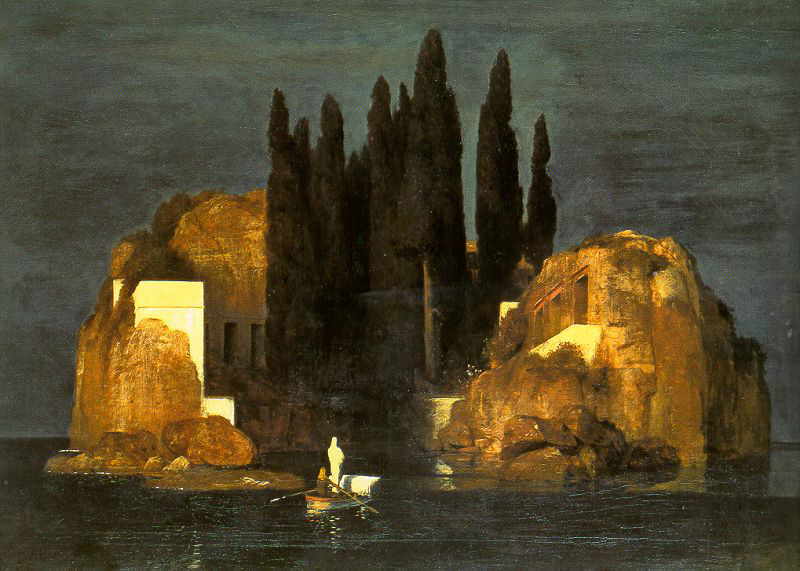
Arnold Böcklin, "Isle of the Dead"

Arnold Böcklin, “Isle of the Dead”

Posted in Poetry | Tagged , , , , | 10 Comments

What Is Truth?

Tintoretto, "Christ before Pilate"

Tintoretto, “Christ before Pilate”

The dialogue between Jesus and Pilate from the Gospel of John (18:28) is one of the most profound exchanges regarding Truth:

“Therefore Pilate … summoned Jesus and said to Him, … ‘So You are a king?’ Jesus answered, ‘You say correctly that I am a king. For this I have been born, and for this I have come into the world, to testify to the truth. Everyone who is of the truth hears My voice.’ Pilate said to Him, ‘What is truth?’”

There are times in our lives which call for standing for the truth, unwaveringly testifying to it with all the awareness of the consequences or sacrifices which are called for. This is the path Jesus chose. This is also the path most prone to sick distortions of fanaticism. On the other hand, what Pilate seems to be imparting to us is that Truth is not fixed or defined eternally: it shifts because it is always relative; it calls for periodic rebirths and renewals. The question “What is truth?” should be asked repeatedly and vigilantly at every single moment of our existence.

Aletheia - Greek goddess of truth, truthfulness and sincerity

Aletheia – Greek goddess of truth, truthfulness and sincerity

Martin Heidegger discussed the etymology of the Greek word for truthalétheia, which means un-concealing. Truth uncovers and reveals that which is hidden. How does Truth remain hidden? What conceals it? I believe that Truth is something that lies beyond conditioning, thoughts, concepts (“the graveyard of perceptions,” as Nietzsche called them), ideas or even symbols. I would equal the Truth with the One, i.e. what Plotinus saw as the ineffable foundation of everything. Perhaps Truth can also be likened to Nothingness – “reality without objects and without forms yet nurturing the seeds of all things,“ as defined in Cirlot’s Dictionary of Symbols. Two thinkers, who are rarely paired together, appear to have answered this question in a similar way: Jiddu Krishnamurti and Friedrich Netzsche. Compare these:

1.“So, why do we create ideas about truth? … Either we see the truth nakedly, as it is, or we do not. But why do we have a picture about it, a symbol, a word, an image? … What would happen if the mind did not create the idea? It is its function to create ideas, to verbalize, to recall memories, to recognize, to calculate. We know that. But the mind is not free, and it is only when the mind is capable of looking at the truth fully, totally, completely, without any barrier, that there is a freedom. … if you can, if I may suggest it, observe your own mind in operation and watch how it thinks, how it reacts, when a truth is put before it, then you will experience step by step what I am talking about. Then there will be an extraordinary experience. And it is this direct approach, direct experience of what truth is, that is so essential in bringing about a creative life. “

Krishnamurti, “On Truth,” (Fifth Talk in London 1952) via http://www.jkrishnamurti.org/krishnamurti-teachings/view-text.php?tid=385&chid=4705

2.“We obtain the concept, as we do the form, by overlooking what is individual and actual; whereas nature is acquainted with no forms and no concepts, and likewise with no species, but only with an X which remains inaccessible and undefinable for us.

What, then, is truth? A mobile army of metaphors, metonyms, and anthropomorphisms—in short, a sum of human relations which have been enhanced, transposed, and embellished poetically and rhetorically, and which after long use seem firm, canonical, and obligatory to a people: truths are illusions about which one has forgotten that this is what they are; metaphors which are worn out and without sensuous power; coins which have lost their pictures and now matter only as metal, no longer as coins.

Everything which distinguishes man from the animals depends upon this ability to volatilize perceptual metaphors in a schema, and thus to dissolve an image into a concept.

Only by forgetting this primitive world of metaphor can one live with any repose, security, and consistency: only by means of the petrification and coagulation of a mass of images which originally streamed from the primal faculty of human imagination like a fiery liquid, only in the invincible faith that this sun, this window, this table is a truth in itself, in short, only by forgetting that he himself is an artistically creating subject, does man live with any repose, security, and consistency. If but for an instant he could escape from the prison walls of this faith, his ‘self-consciousness’ would be immediately destroyed.”

Friedrich Nietzsche, On Truth and Lie in an Extra-moral Sense” via http://oregonstate.edu/instruct/phl201/modules/Philosophers/Nietzsche/Truth_and_Lie_in_an_Extra-Moral_Sense.htm

Both thinkers seem to point out to entities (“truths,” ideas, concepts) covering up or burying Truth, which springs from the source that lies deeper than any human ways of expressing it. The creative power of Truth will out, though, through the hard crust of crystallized, conditioned and outworn thought patterns and towards a more authentic existence.

the allegory of Truth in Cesare Ripa’s Iconologia (1593)

the allegory of Truth in Cesare Ripa’s Iconologia (1593)

This post was inspired by L. Caruana and a chapter “The Symbol That Conceals” in his book Enter through the Image.

Posted in Truth | Tagged , , , , , , , , | 29 Comments

I Feel, Therefore I Can Be Free: Tribute to Audre Lorde

I.“A self-described ‘black, lesbian, mother, warrior, poet,’ Audre Lorde dedicated both her life and her creative talent to confronting and addressing the injustices of racism, sexism, and homophobia.”

Via http://www.poetryfoundation.org/bio/audre-lorde

II.“For each of us as women, there is a dark place within, where hidden and growing our true spirit rises, ‘beautiful/ and tough as chestnut/stanchions against (y)our nightmare of weakness/’ and of impotence.

These places of possibility within ourselves are dark because they are ancient and hidden; they have survived and grown strong through that darkness. Within these deep places, each one of us holds an incredible reserve of creativity and power, of unexamined and unrecorded emotion and feeling. The woman’s place of power within each of us is neither white nor surface; it is dark, it is ancient, and it is deep.

When we view living in the European mode only as a problem to be solved, we rely solely upon our ideas to make us free, for these were what the white fathers told us were precious. But as we come more into touch with our own ancient, non-European consciousness of living as a situation to be experienced and interacted with, we learn more and more to cherish our feelings, and to respect those hidden sources of our power from where true knowledge and, therefore, lasting action comes.

The white fathers told us: I think, therefore I am. The Black mother within each of us – the poet – whispers in our dreams: I feel, therefore I can be free. Poetry coins the language to express and charter this revolutionary demand, the implementation of that freedom.”

Audre Lorde, “Poetry Is Not a Luxury” in “Sister Outsider: Essays and Speeches”

III. “Black Mother Woman” by Audre Lorde

I cannot recall you gentle.
Through your heavy love
I have become
an image of your once delicate flesh
split with deceitful longings.

When strangers come and compliment me
your aged spirit takes a bow
jingling with pride
but once you hid that secret
in the center of furies
hanging me
with deep breasts and wiry hair
with your own split flesh and long suffering eyes
buried in myths of no worth.

But I have peeled away your anger
down to its core of love
and look mother
I am
a dark temple where your true spirit rises
beautiful and tough as a chestnut
stanchion against your nightmares of weakness
and if my eyes conceal
a squadron of conflicting rebellions
I learned from you
to define myself
through your denials.

 Yaroslav Gerzhedovich, "Still Life"

Yaroslav Gerzhedovich, “Still Life”

Support my blog

If you appreciate my writing, consider donating and make my day. Thank you in advance.

$1.00

Posted in Quotations | Tagged , , , , | 10 Comments

The Rupture of the Mother Line and the Cost of Becoming Real

I’m feeling very grateful for this article.

Posted in Uncategorized | 3 Comments