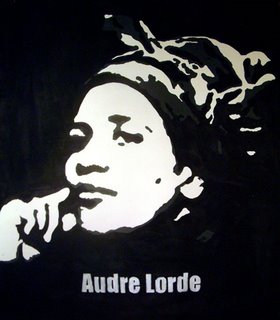
I.“A self-described ‘black, lesbian, mother, warrior, poet,’ Audre Lorde dedicated both her life and her creative talent to confronting and addressing the injustices of racism, sexism, and homophobia.”
II.“For each of us as women, there is a dark place within, where hidden and growing our true spirit rises, ‘beautiful/ and tough as chestnut/stanchions against (y)our nightmare of weakness/’ and of impotence.
These places of possibility within ourselves are dark because they are ancient and hidden; they have survived and grown strong through that darkness. Within these deep places, each one of us holds an incredible reserve of creativity and power, of unexamined and unrecorded emotion and feeling. The woman’s place of power within each of us is neither white nor surface; it is dark, it is ancient, and it is deep.
When we view living in the European mode only as a problem to be solved, we rely solely upon our ideas to make us free, for these were what the white fathers told us were precious. But as we come more into touch with our own ancient, non-European consciousness of living as a situation to be experienced and interacted with, we learn more and more to cherish our feelings, and to respect those hidden sources of our power from where true knowledge and, therefore, lasting action comes.
…
The white fathers told us: I think, therefore I am. The Black mother within each of us – the poet – whispers in our dreams: I feel, therefore I can be free. Poetry coins the language to express and charter this revolutionary demand, the implementation of that freedom.”
Audre Lorde, “Poetry Is Not a Luxury” in “Sister Outsider: Essays and Speeches”
III. “Black Mother Woman” by Audre Lorde
I cannot recall you gentle.
Through your heavy love
I have become
an image of your once delicate flesh
split with deceitful longings.
When strangers come and compliment me
your aged spirit takes a bow
jingling with pride
but once you hid that secret
in the center of furies
hanging me
with deep breasts and wiry hair
with your own split flesh and long suffering eyes
buried in myths of no worth.
But I have peeled away your anger
down to its core of love
and look mother
I am
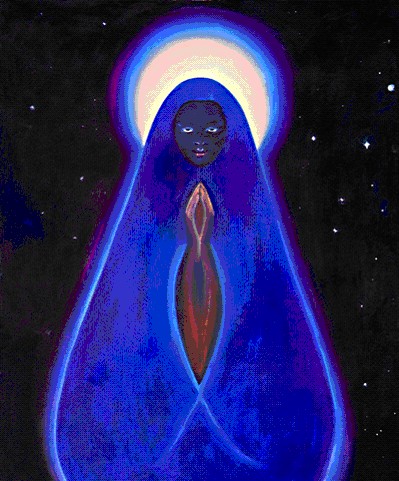
a dark temple where your true spirit rises
beautiful and tough as a chestnut
stanchion against your nightmares of weakness
and if my eyes conceal
a squadron of conflicting rebellions
I learned from you
to define myself
through your denials.
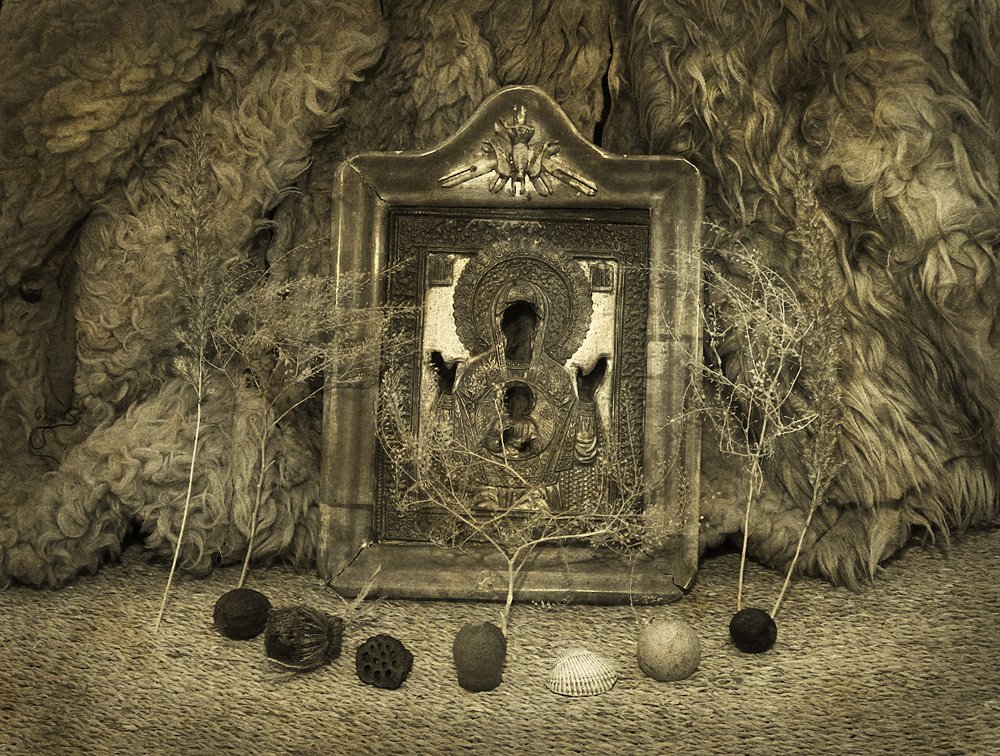
Yaroslav Gerzhedovich, “Still Life”
Support my blog
If you appreciate my writing, consider donating and make my day. Thank you in advance.
I.“A Sufi legend, likely of Persian origin, suggests that god created spirit in the form of a peacock. Shown its own divine image in a mirror, the peacock was seized with awe and drops of sweat fell from which all other beings were created.“
Hope B. Wernes, The Continuum Encyclopedia of Animal Symbolism in World Art, entry: Peacock
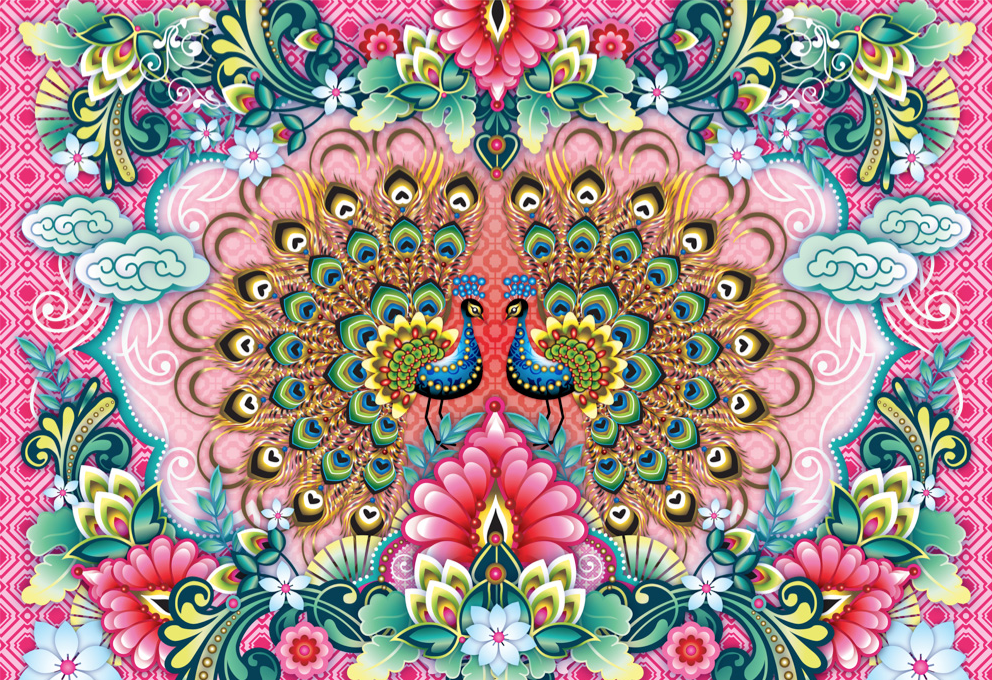
Catalina Estrada, “Pavos“
II.“The serene and starry sky and the shining sun are peacocks. The deep-blue firmament shining with a thousand brilliant eyes, and the sun rich with the colors of the rainbow, present the appearance of a peacock in all the splendour of its eye-bespangled feathers. When the sky of the thousand-rayed sun … is hidden by clouds … it again resembles the peacock, which, in the dark part of the year … sheds its beautiful plumage, and becomes drab and unadorned; the crow which had put on the peacock’s feathers then caws with the other crows in funereal concert. In winter the peacock-crow has nothing left to it except its shrill disagreeable cry, which is not dissimilar to that of the crow. It is commonly said of the peacock that it has an angel‘s feathers, a devil’s voice, and a thief’s walk.“
Angelo de Gubernatis, Zoological Mythology, quoted by C.G. Jung in Mysterium Coniunctionis
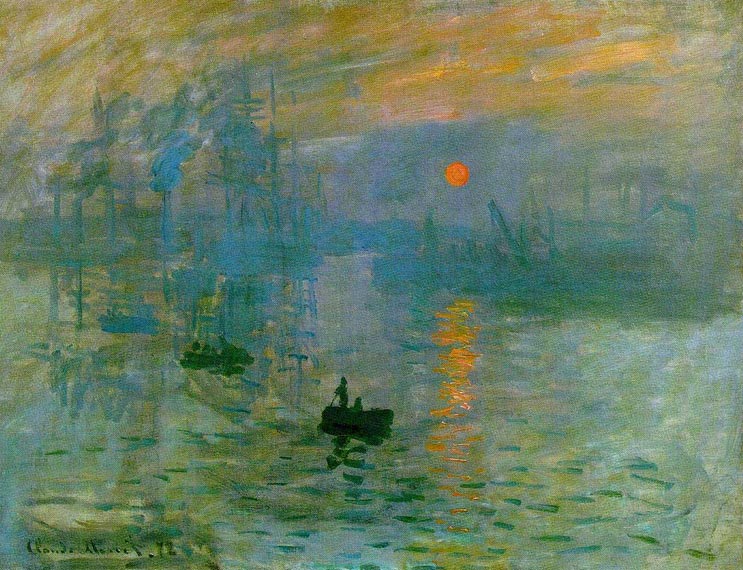
Claude Monet, “Impression, Sunrise”
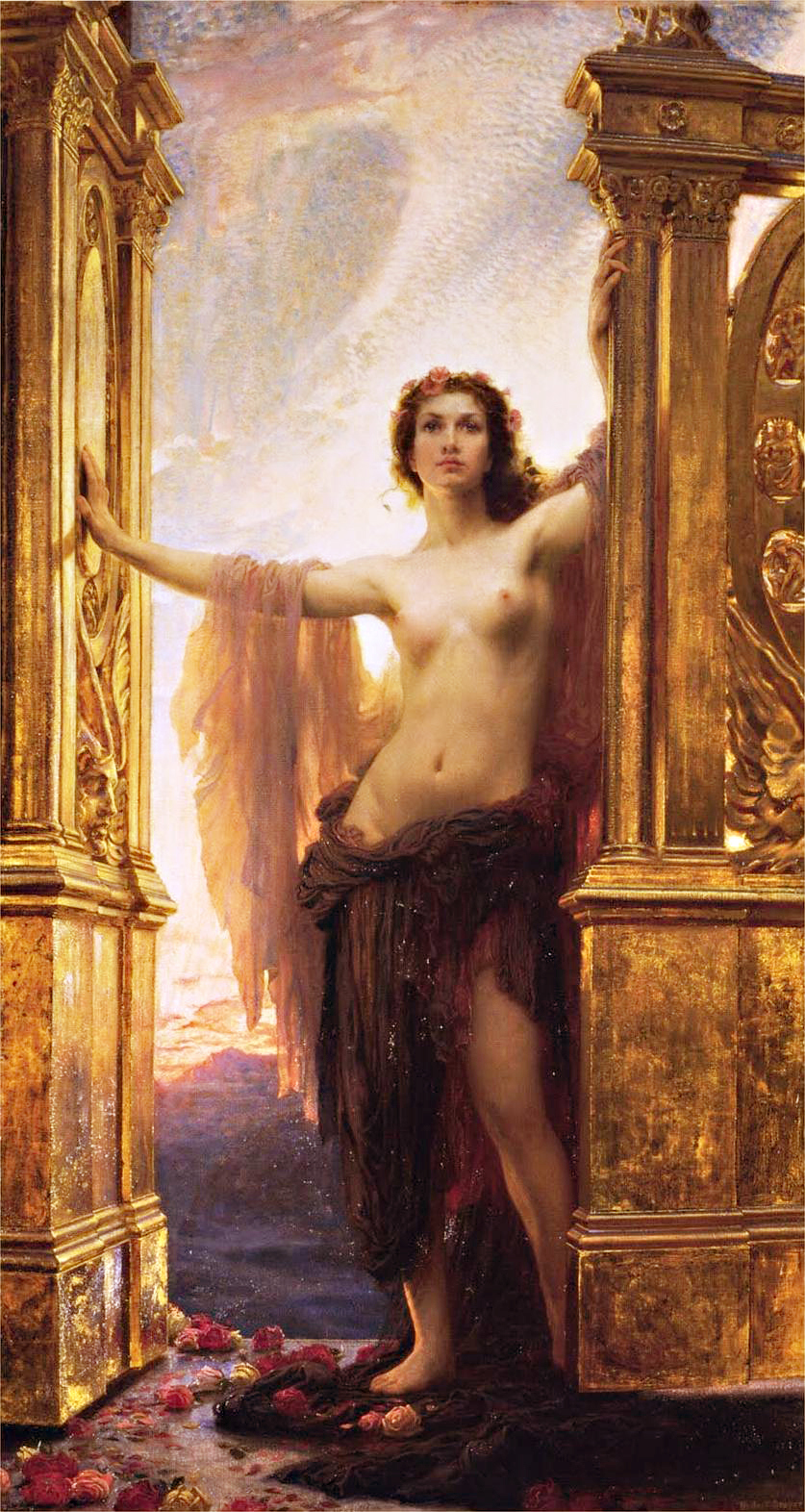
Herbert James Draper, “The Gates of Dawn“
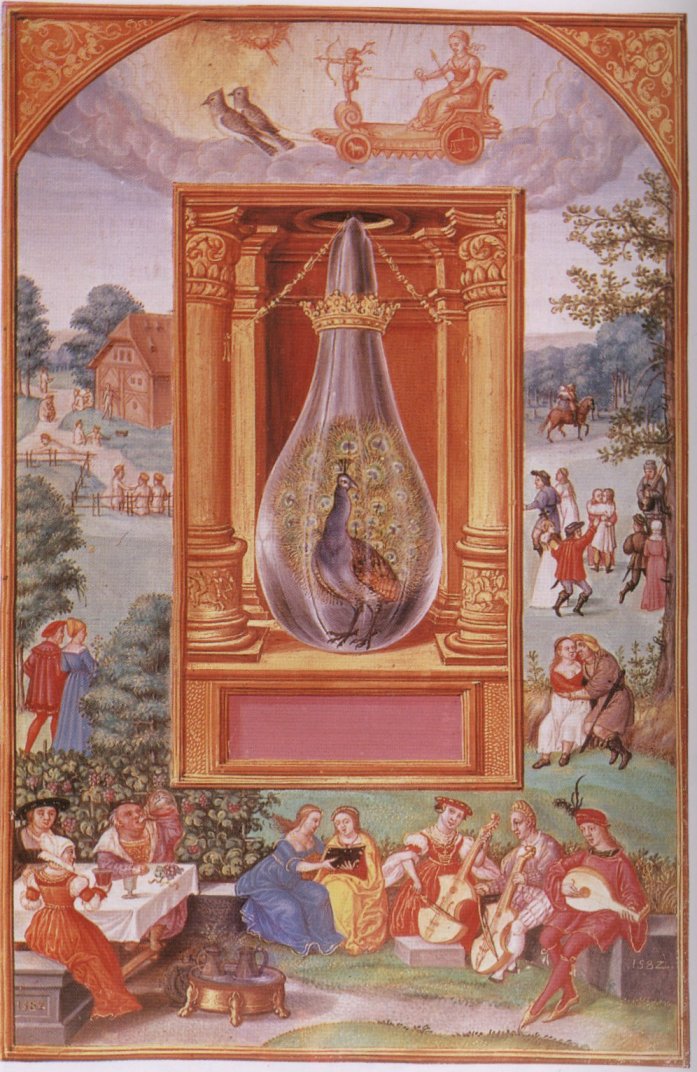
At winter solstice, peaceful, regenerative darkness slowly gives way to the life-giving radiance of the sun. With the break of dawn, the alchemical period of nigredo (blackness) gradually and in stages gives way to a splendid display of the peacock’s tail. The peacock is predominantly (but not exclusively) a solar symbol – its cry greets the rising sun, its splendid tail, as Hope B. Wernes wrote in The Continuum Encyclopedia of Animal Symbolism in World Art,“ fanned out in all its glory, shines like the sun.“ The symmetrical forms of light and colour on the peacock’s tail are symbolic of the expansion of consciousness occurring as a result of an encounter with the immaterial universal archetypal patterns (the peacock’s invisible aspect) and the material multiplicity of forms (the peacock’s visible aspect) present in the entire universe. In Mysterium Coniunctionis, C.G. Jung stated that the peacock stands for the unity of “all colors (i.e., the integration of all qualities).“ The peacock also symbolizes the “inner beauty and perfection of the soul.“ Jung extensively quotes from Khunrath’s alchemical work entitled Amphitheatrum sapientiae, where the peacock, as a symbol integrating all polarities, was called the “soul of the world, nature, the quintessence, which causes all things to bring forth.“
The Splendor Solis by Salomon Trismosin, Plate 16 Venus: Peacock’s Tail
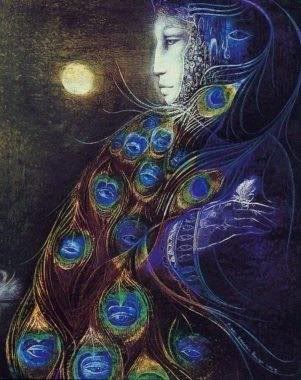
Susan Seddon Boulet, “Hera the Queen of the Gods“
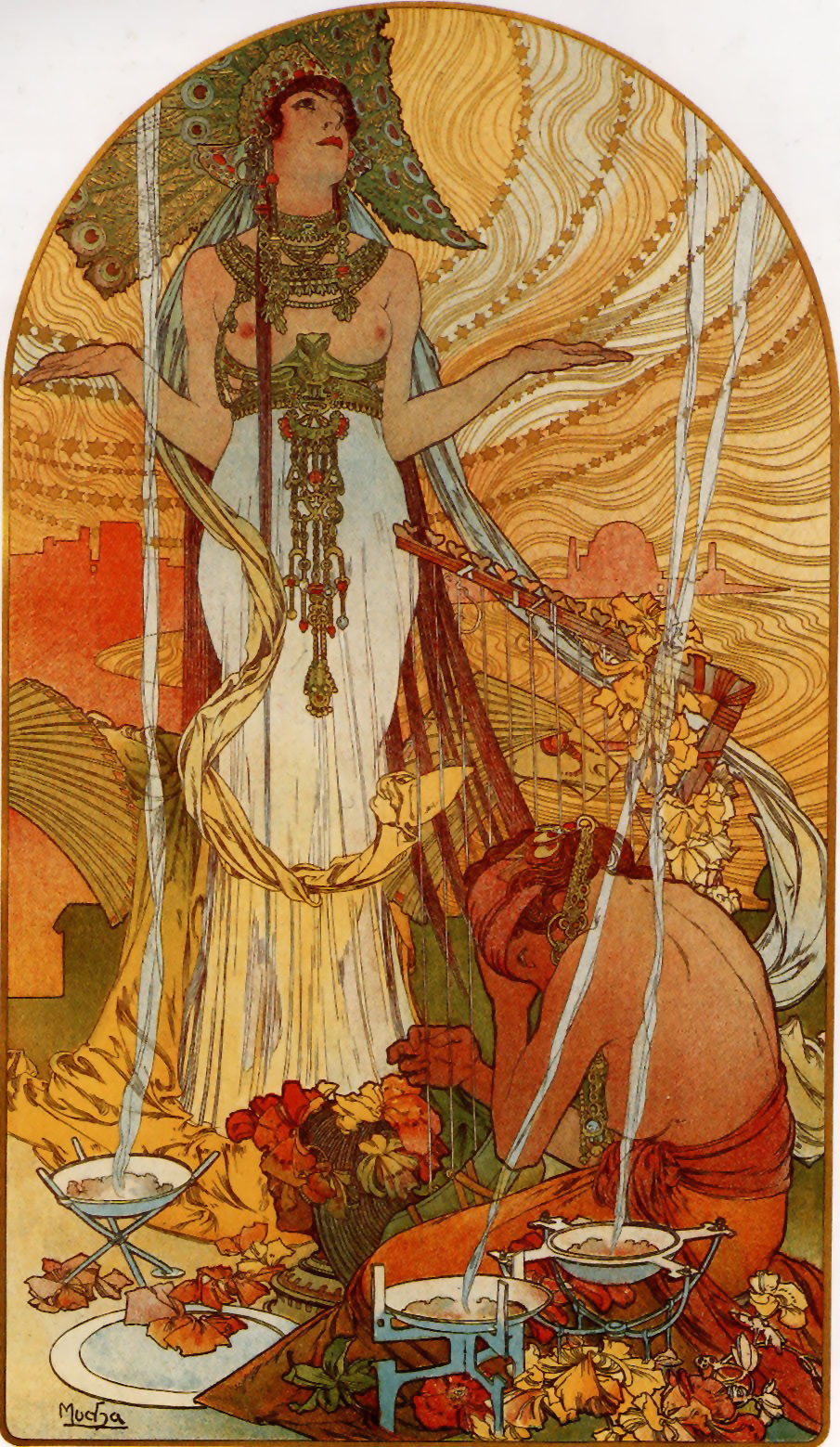
Alphonse Mucha, “Peacock Princess”
The predominant colour of the peacock’s tail is green, which connects it with Venus as a ruler of the sign Taurus, and thus with “life, procreation and resurrection“ as a bird associated with Hera (Juno), Mother Queen of the gods. Says Jung: “Just as the Queen Mother or the mother of the gods grants renewal, so the peacock annually renews his plumage, and therefore has a relation to all the changes in nature.“
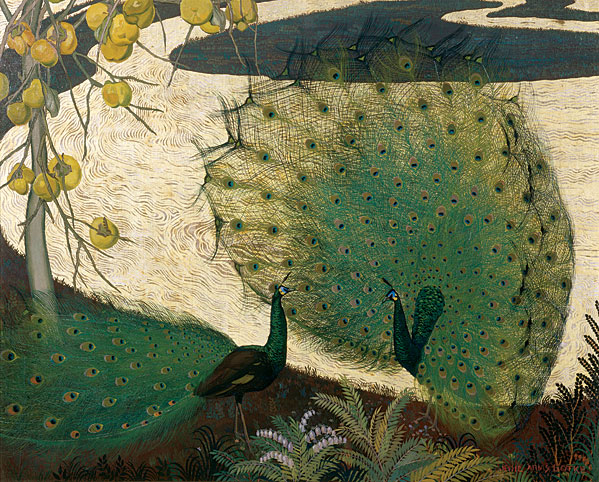
Jessie Arms Botke, “Black Peacocks with Japanese Persimmons“
In Christianity, the peacock was likewise considered a bird of resurrection, a conviction which stemmed from the Aristotelian notion that the flesh of the peacock never putrifies.
Gerhard Dorn, another alchemist quoted by Jung, explicated the succession of alchemical stages of the opus in relation to colours and associated animal symbolism: “the ‘dead spiritual body‘ is ‘the bird without wings.‘ It ‘changes into the raven’s head and finally into the peacock’s tail, after which it attains the whitest plumage of the swan and, last of all, to the highest redness, the sign of its fiery nature.‘ This plainly alludes to the phoenix, which, like the peacock, plays a considerable role in alchemy as a symbol of renewal and resurrection, and more especially as a synonym for the lapis.“ The emergence of the peacock’s tail in the alchemical opus heralded the imminent successful end of the work and the attainment of its goal. It was believed by alchemists and in medieval lore that peacocks destroyed serpents and dragons, transforming their poison into the healing medicine.
Hieronymus Bosch, “The Garden of earthy Delights” (detail)
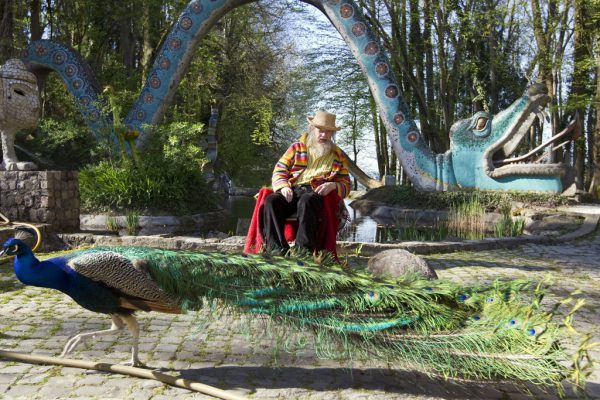
Although I chose the quote by Gubernatis as the second motto for my article, I am not in agrrement with him about the cry of the peacock. I do understand, though, how the peacock as the symbol of wholeness (and as the bird of Venus) also embraces the shadow associated with the seductiveness of beauty, vanity and pride. A few years ago, I had something short of a mystical experience while walking through the Bruno Weber park and hearing peacocks‘cries.
There is a magnificent poem by Wallace Stevens called “Domination of Black,“ which features the symbolism of the cry of the peacock:
At night, by the fire,
The colors of the bushes
And of the fallen leaves,
Repeating themselves,
Turned in the room,
Like the leaves themselves
Turning in the wind.
Yes: but the color of the heavy hemlocks
Came striding.
And I remembered the cry of the peacocks.
The colors of their tails
Were like the leaves themselves
Turning in the wind,
In the twilight wind.
They swept over the room,
Just as they flew from the boughs of the hemlocks
Down to the ground.
I heard them cry — the peacocks.
Was it a cry against the twilight
Or against the leaves themselves
Turning in the wind,
Turning as the flames
Turned in the fire,
Turning as the tails of the peacocks
Turned in the loud fire,
Loud as the hemlocks
Full of the cry of the peacocks?
Or was it a cry against the hemlocks?
Out of the window,
I saw how the planets gathered
Like the leaves themselves
Turning in the wind.
I saw how the night came,
Came striding like the color of the heavy hemlocks
I felt afraid.
And I remembered the cry of the peacocks.
“Dramatically, the poem moves through an extended comparison of a flickering fireplace fire with first the autumn leaves literally reflected from the outside into the room, then to the colors of peacocks tails (and the encroaching night to the dark green of hemlock trees). Then the noise the fire makes is compared to the noises of both peacocks and hemlocks (with some questioning of who is talking and listening to whom), and finally the planets in the sky seem like the same turning of the leaves, the changing of the seasons, a holistic sense of relatedness that soon resolves both in the fireplace and outside to darkness. This encroachment of night scares the speaker, but he remembers the cry of the peacock and feels better.
… hemlocks are evergreen trees that never change with the seasons, while peacocks replace their feathers annually. Thus, it’s quite easy to see a contrast between the elegant and artistic peacock and her strange cry signaling a continuation of life and the hemlock (also the name of the elixir which suicided the great philosopher Socrates) signaling the “domination of black” – the constant presence of death in our lives due to its unresolvable mystery.“
Interestingly, as can be read on an excellent website dedicated to constellations (http://www.constellationsofwords.com/Constellations/Pavo.html), the words “peacock” and “paean,” i.e. ‘a hymn, a song joy and triumph’ are related. Other cognates of the peacock (pavo in Latin) are ‘pavor’ (dread which strikes the heart) and ‘pave,’ as in “pave the way.” The cry of the peacock in the poem becomes a true “mystical call,“ a voice from beyond addressing directly our incorruptible essence – the Soul – and beckoning us to cross the threshold of awakening.
I. “Without Contraries is no progression. Attraction and Repulsion, Reason and Energy, Love and Hate, are necessary to Human existence.
From these contraries spring what the religious call Good & Evil. Good is the passive that obeys Reason. Evil is the active springing from Energy.
Good is Heaven. Evil is Hell.
…
All Bibles or sacred codes have been the causes of the following Errors.
That Man has two real existing principles Viz: a Body & a Soul.
That Energy, call’d Evil, is alone from the Body, & that Reason, call’d Good, is alone from the Soul.
That God will torment Man in Eternity for following his Energies.
But the following Contraries to these are True.
Man has no Body distinct from his Soul for that call’d Body is a portion of Soul discern’d by the five Senses, the chief inlets of Soul in this age
2. Energy is the only life and is from the Body and Reason is the bound or outward circumference of Energy.
3 Energy is Eternal Delight
Those who restrain desire, do so because theirs is weak enough to be restrained; and the restrainer or reason usurps its place & governs the unwilling.
And being restrain’d it by degrees becomes passive till it is only the shadow of desire.
…
He who desires but acts not, breeds pestilence.
…
The pride of the peacock is the glory of God.
The lust of the goat is the bounty of God.
The wrath of the lion is the wisdom of God.
…
The tygers of wrath are wiser than the horses of instruction.
Expect poison from the standing water.
You never know what is enough unless you know what is more than enough.”
William Blake, “The Marriage of Heaven and Hell“ (extracts)
II. “(T)he very first thing to understand about evil is that what we … want to call evil, the energy of, consciousness of, was put in motion simultaneously at the very moment of the manifested creation itself. So what this then means is that what we want to call God or the Source is, itself not perfect. And again, if you want to debate such a thought, simply ask yourself a Piscean question, ‘How can a perfect anything create an imperfect anything?‘ So, in essence, the very creation point is born, relative to what we can call imperfection, and, therefore, we have the principles of duality as a direct reflection of that creation once it was set in motion. And relative to that natural law of duality – night/day – male/female – etc., we also have the natural duality in polarity of what we call good – God, and evil. It is simultaneous to the creation point.“
III. “The shadow cannot, by definition, be “integrated” in the sense that it would disappear or become unimportant. Every time one aspect of the shadow is brought to light, another part of the psyche moves into the dark. Whenever a new attitude is adopted, it is at the cost of another potential behavior that becomes part of the shadow.”
Francoise O’Kane, “Sacred Chaos: Reflections on God’s Shadow and the Dark Self“
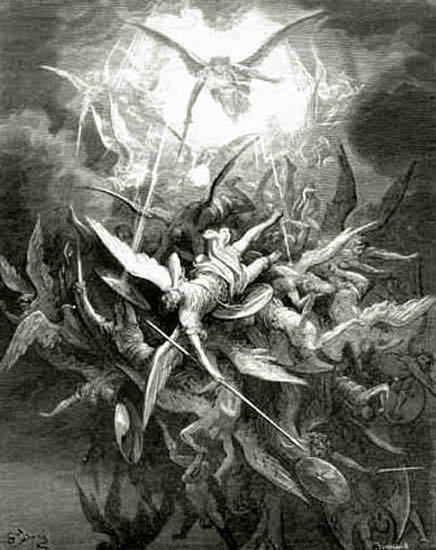
Gustave Doré, “Lucifer Is Cast Out of Heaven” (from Milton’s Paradise Lost)
Jeffrey Wolf Green’s ideas are very close to the ones expressed by Carl Gustav Jung, who would debate with Christian theologians about the nature of God. To me, this particular aspect of Jung’s legacy is especially important. Unlike Christian doctrinarians, Jung did not see God as Summum Bonum (The Highest Good); instead, he insisted that the ultimate Divinity is a complex of opposites equal in light and shadow. In his view, the moral struggle is inextricable from life: the Shadow is not to ever be eradicated. Jung went as far as accusing Christianity of splitting off half of the opposites by calling them evil, Satan, or devil. In a letter to James Kirsch, Jung wrote that as a result of this split “the indispensable dark side has been left behind or stripped off, and the feminine aspect is missing.“ For Jung, the Holy Trinity was essentially incomplete; what was missing was the fourth part, i.e. the material, the feminine, the dark, the “evil.“ This incompleteness has impoverished the Western psyche, whereas the truth is that both poles are equally important and indispensable to life.
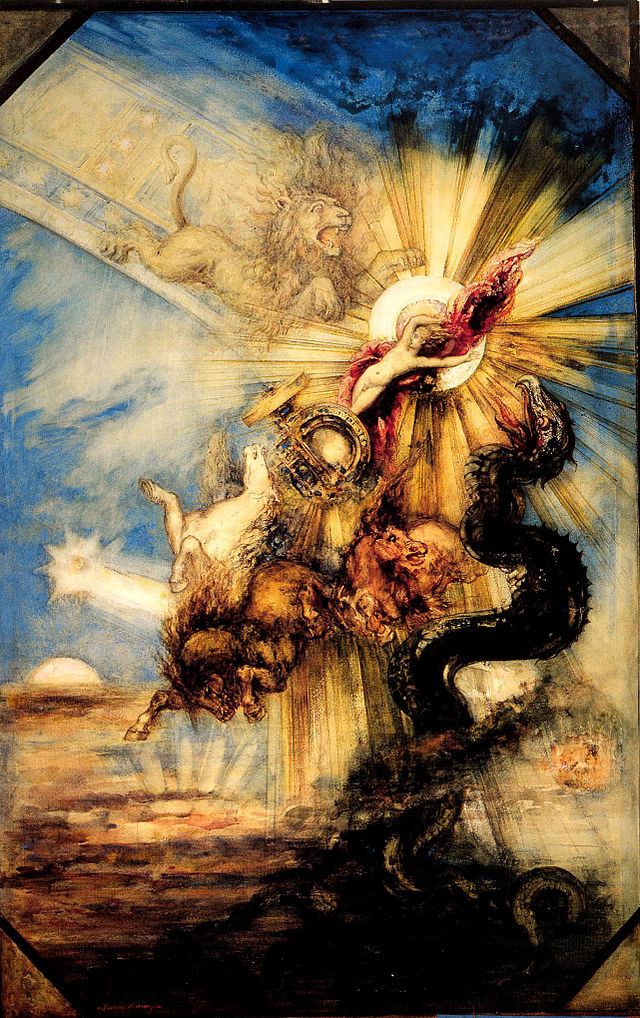
“Phaethon [struck by Zeus from the chariot of the Sun], flames ravaging his auburn hair, falls headlong down, a streaming trail of light, as sometimes through the cloudless vault of night a star, though never falling, seems to fall.”
Meteor showers, little balls of rock that appear to be balls of fire, can be so enchanting. On December 13-14 each year the Earth passes the debris of an extinct comet called 3200 Phaethon, causing a very bright and luminous meteor shower called the Geminids because they appear to be coming from the constellation Gemini. A week before Winter Solstice, which marks the Sun’s rebirth, we may reflect on the myth of how Phaeton, the son of the Sun god Helios, fell from short-lasting grace:
“While living with his mother, Klymene, he was insulted by other boys who said,‘The Sun is not really your father. You’re a bastard.‘ So he went off to prove his identity, journeying through Ethiopians and Indians until he came to the palace of Helios. His father promised anything he wanted, but regretted it when Phaethon made his choice. Nevertheless, he taught the boy to drive, telling him not to fear the dizzying heights or the beasts he would encounter in the sky – Bear and Scorpion, Lion and Bull. Phaethon was supremely happy. He mounted the gem-studded chariot and flicked his whip on the backs of its four shining horses … . But the steeds of the Sun ran off as though no driver ruled them … Careening through the sky, Phaethon froze in terror and lost control. The burning bright chariot of the Sun plunged close to earth. Mountains and cities were set ablaze, rivers and seas dried up, the earth cracked open. Gaia called on Zeus for relief. His only solution was to strike down Phaethon with a thunderbolt. The boy plummeted into the Eridanos. His sisters, weeping continually after on the river’s banks, were turned to poplars. Their tears flowed out of the trunks and turned to amber.“
Richard P. Martin, “Myths of the Ancient Greek“
A Jungian reading of the tale that immediately springs to mind would go along the lines of the ego being flooded by the contents of the Self (i.e. the total personality, the psyche as a whole encompassing both conscious and unconscious elements), symbolized by the true Sun God Helios (and by the Sun). The inflation of the ego that happens in this myth consists in Phaeton deluding himself that he can safely navigate the numinous, divine, archetypal powers, which are in fact totally out of his control. Such hubris and ignorance bring about his downfall. The sign Gemini is the mental matrix of all polarities, which are interestingly juxtaposed in Phaeton’s myth. The unfortunate mortal sun of an immortal father, struck by Zeus‘ thunderbolt, tumbles down, down, and down to meet the solid temporal realm of Gaia, and the moistness of the river Eridanos.
Gustave Moreau, “Phaethon“
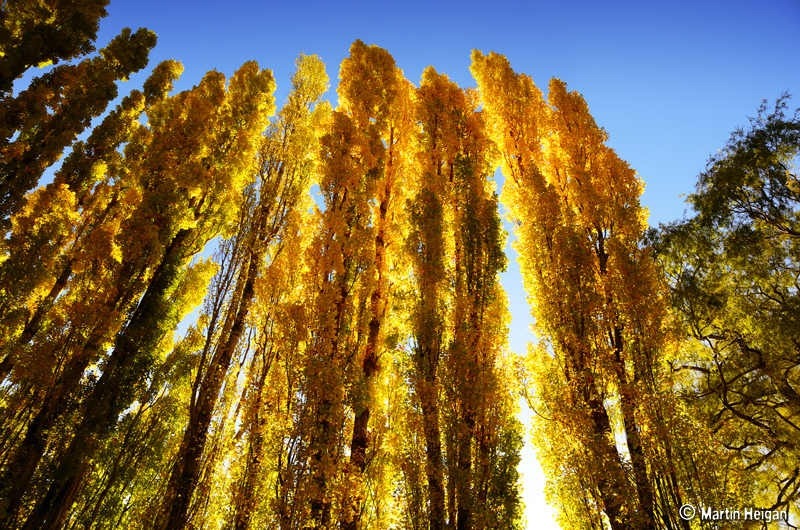
The mourning of his sisters, who get turned into poplars, leads to the creation of a very beautiful stone – amber. The poplar leaf, as Cirlot notes in his Dictionary of Symbols, has two sides, which have different shades of green: “Thus, it becomes the tree of life, bright green on the side of water (moon) and a darker green on the side of fire (sun).”
Poplar leaves
The poplar becomes thus yet another representation of duality, consistent with the Gemini theme. Because Phaethon partook in the glory of the Self (if only for a moment), he can be likened to a brief flash of brilliant light, a beacon of genius, even a theophany (the appearance of a god in a visible form to a human being). Since his name in Greek means to “burn, shine,“ some authors, including Plato, connect the myth to the cosmic disaster stories, such as the destruction of Atlantis caused by a comet (or a meteor) colliding with the earth.
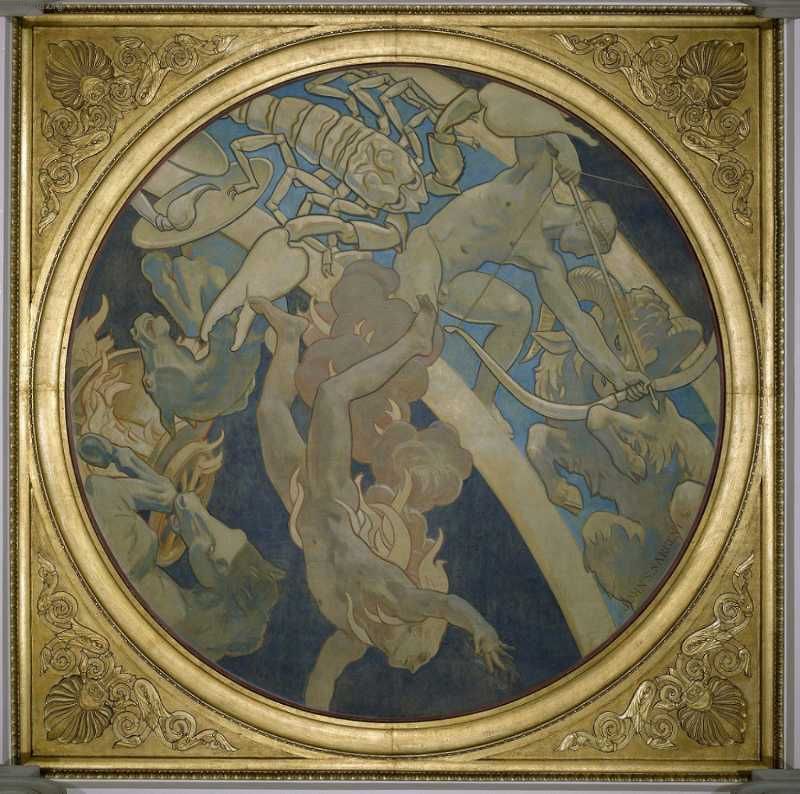
John Singer Sargent, “Phaethon“ “Phaethon’s hair is flowing back like flames with smoke streaming thick beyond. Our poor Phaethon is now hurdling towards the the earth, along with his chariot, just like a meteoroid.“ via http://www.jssgallery.org/Paintings/MFA/Phaethon.htm
Yet another reading of the myth, saluting seasonal autumnal change of color, comes from Sri Aurobindo, who wrote a beautiful poem called “Phaethon“:
“Symbols throw us across a spiritual abyss. When contemplating a sacred work of art, it may feel as if a great divide separated us from the Holy hidden in images. Then, our vision expands, and the image becomes transparent to its transcendent source. We are thrown together with the Sacred in a fleeting moment of epiphany…
The expressions just used were not ill-chosen. If we take the time to trace the etymology of the word ‘symbol’ through its Attic Greek antecedent, symbolé, we discover that it means literally to throw (balló) two things together (sym).
What symbols throw together, essentially, are sacred and mundane experiences, making them one.
…
The process of symbolization occurs by overwhelming necessity: the mind, over-awed and frightened by a profound and soul-shattering experience of the Sacred, desperately seeks those objects which can, by virtue of their structure, contain such a momentous outpouring of the Divine – which is threatening otherwise to blast apart the very vessel into which it is being poured. At such a moment, an object is sought for its power to appropriately contain the awesome appearance of the Numinosum, and so, a symbol is created.
In the earliest ages of mankind, the Sacred was experienced in this way – as a thunderous epiphany that led per force to the creation of a symbol. Then, a series of symbols were strung together by ancient myth, with certain Threshold Images at their nadir, to become our hieratic works of art. And, as we survey the many masterpieces of ars sacrum created over the course of history, we find that most offer us symbolic doorways, constructed by the visionary artists of old, as images to enter through, and then left behind for succeeding generations to attempt in crossing.
The symbols of the past are not totally outdated, antiquated and useless; they resonate still with unseen powers. Yet, it is only by bringing our own lives, preoccupied with its present conflicts and needs, to these eternal symbols, that the forms forgotten by time may thus be enlivened, and our own lives may be transformed thereby – informed once more by their ancient inhering power.”
L. Caruana, Enter Through the Image: The Ancient Image Language of Myth, Art and Dreams, Recluse Publishing 2009, pp. 111 and 128
“Of course the Man was wild too. He was dreadfully wild. He didn’t even begin to be tame till he met the Woman, and she told him that she did not like living in his wild ways. She picked out a nice dry Cave, instead of a heap of wet leaves, to lie down in; and she strewed clean sand on the floor; and she lit a nice fire of wood at the back of the Cave; and she hung a dried wild-horse skin, tail-down, across the opening of the Cave; and she said, ‘Wipe you feet, dear, when you come in, and now we’ll keep house.'”
Rudhyar Kipling, “The Cat That Walked by Himself“
Marija Gimbutas captures my heart for at least three reasons: she was born in a Slavic country like me (Lithuania in her case, Poland in mine), spent her life in emigration, and stirred the patriarchal archaeological scientific community with her unique theory of old European Neolithic culture. As it is stated in my post’s featured biographical documentary, “her theories painted a new picture of the oldest layer of western cultures.” What is fascinating is that those first communities showed no evidence of warfare: they were based on the principle of sharing and co-operation.
The phrase “Old Europe” refers to Neolithic Europe, or the portions of the European continent inhabited by people who made pottery and lived in small villages, ate domesticated and wild plant foods, between about 7000 BC and around 1500 BC; via http://thesga.org/2009/12/what-is-old-europe/
She never stated clearly whether those early communities were patriarchal or matriarchal. However, the centre of their religious practices was very clearly a worship of the “self-generating Goddess, Giver of Life, Wielder of Death and Regeneratrix,” whose power was “in water and stone, in tomb and cave, in animals and birds, snakes and fish, hill, trees, and flowers.” She embodied the living earth and the wisdom of her cycles of death and rebirth.
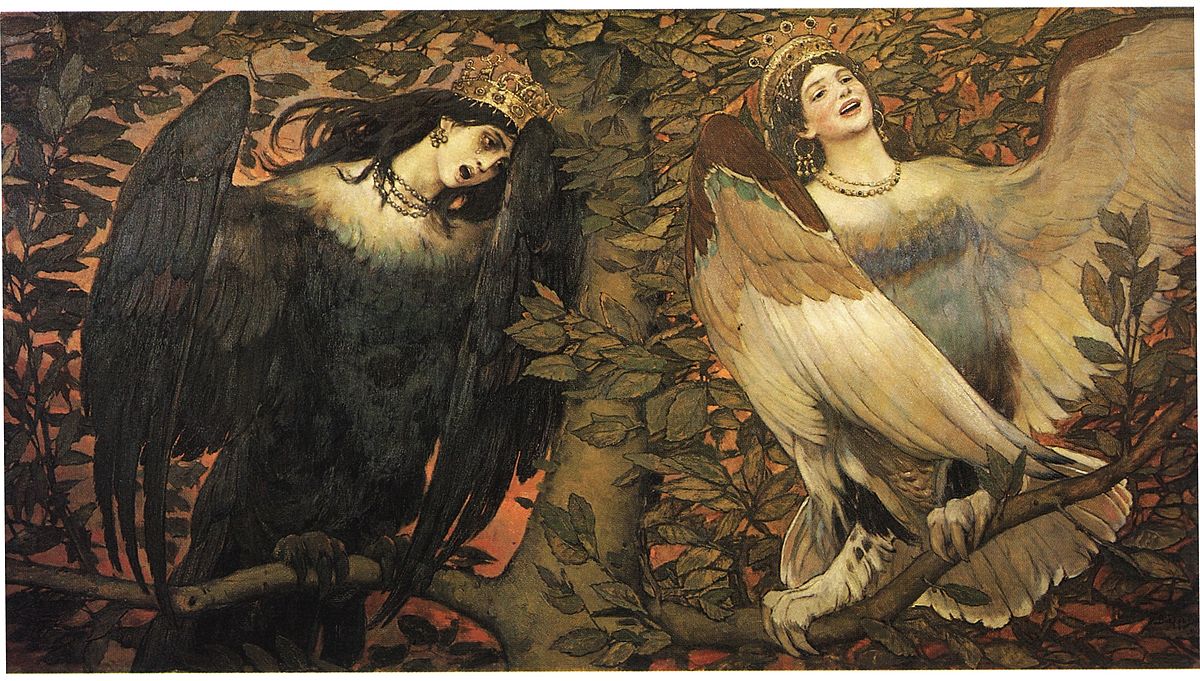
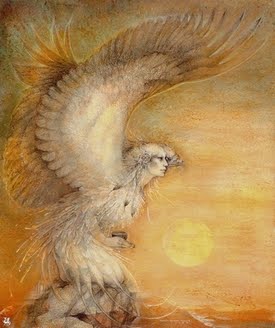
In an interview featured in the documentary, Marija Gimbutas said: “The Paleolithic Goddess was the Creatrix. Her body parts like breasts, belly, buttocks, vulva, are the procreative parts of the body ….” The incredibly numerous figurines and images that Gimbutas excavated in the area of Old Europe can be described as amalgams of birds and animals with female form.
“Bird Lady,” a Neolithic ceramic
Viktor Vasnetsov, “Sirin and Alkonost: the Birds of Joy and Sorrow”
Susan Seddon Boulet, “Eagle Woman”
What was unique for Gimbutas‘ scientific approach was that she was not happy with the strict, statistical, dry methodology of science, but she preferred a more non-orthodox approach focusing on myth and imagery. She was later shunned by scientific community for indulging her intuition and imagination in what they believed to be excessive and arbitrary manner. However, to me her findings and conclusions are deeply stirring and appealing. What she tried to to do was translate the language of images that comes from over 10,000 years ago. To achieve that, she had to go beyond the narrow confines of her discipline – to synthesize in a visionary way.
Richard Buchan, Librarian from Pacifica Graduate Institute says in the documentary: “She’s pointing out a whole time here, and it’s a time where everyone’s roughly equal in rank, it’s a female-centered culture, not male dominated, it’s relatively peaceful. People can live like that, and still maintain a large village, and an elaborate culture. Some of the late Cucuteni things had, those villages had 15,000 people living in them. Cucuteni, Vinça, Sesklo – our history books never told us these names. Perhaps because without kings, warfare, and conquest, they don’t fit the classic definition of civilization.” In the Neolithic Era humans moved on from a Nomadic lifestyle towards a settled culture. This is the actual cradle of civilization that was thriving much earlier than the cultures of Sumer and Egypt.
Gimbutas decided to step off the beaten econometric track of scientific archaelogy by engaging imagery, intuition, mythology, folklore and poetry. She took a leap of faith, deciding to follow her own truth and a difficult path of a misfit. Because synthesis and a global approach are anathemas in modern science, she consequently lost all her privileges and grants, which did not stop her from pursuing her findings. In her time, hardly any archaeologists were interested in such intangible, unquantifiable matters. Gimbutas, however, even before her emigration to the US, used to collect beautiful folk songs, called Dainos in Lithuanian. She poetically described them as “the rhythms of a bird, a wedding dance, a lament,a liturgy of nature and the milestones of everyday life.” She had started very early to stray from the consensus scientific path.
In an interview, she remembers her early days at Harvard university in the 50s: “There was no real chance to stay as a woman at Harvard, I knew that I could stay as a research fellow and lecturer, but I probably would never be a professor there. In the nineteen-fifties, as a staff member I couldn’t join the faculty club if I went alone, not escorted by men. Also, two libraries were closed to women. So that I couldn’t, I couldn’t really stand. I hated the situation.” She was much more appreciated at UCLA in California, where she spent a few successful years, yet after a while it turned out that even this progressive establishment was not ready for her revolutionary ideas.
The documentary tribute to Gimbutas ends with a recitation dedicated to the Goddess, which I cannot resist quoting in full:
“Her breasts are like her eyes, which also stream life-giving moisture. The coiled spirals are writhing snakes that shed their skin and come out new again, symbols of regeneration. In the duck faced waterbird these symbols combine. The bird lays the eggs that are seeds of rebirth. The fat, fertile Goddess, Mountain mother, mother earth is sow, temple, body, portal, mother and child, animal mother, the original madonna. She is linked to the uterine-shaped bull’s head. His upraised horns are symbols of the birth-giving goddess whose children are also males – music-makers, bards, shamans. From her vulva come rebirth and regeneration. She is the owl, the funerary urn, the bird of prey, the meandering soul’s journey… The goddess was fish, she had many animal forms: egglike, fertile, water; she was the womblike hedgehog, the double axe butterfly of transformation, and Marija saw these symbols repeat again and again, in infinite combinations that spelled out a mythology.”
“The soul is the greatest of all miracles in nature. All other things beneath God are always one single being, but the soul is all things together…Therefore it may rightly be called the centre of nature, the middle term of all things, the series of the world, the face of all, the bond and juncture of the universe.“
Marsilio Ficino
Portrait of Marsilio Ficino at the Duomo, Florence
This “diligent capturer of planetary light” (Latin “sedulus erraticarum luminis captator“) was a most crucial figure in the Florentine Renaissance. As Liz Greene boldly asserts in Astrology of Fate, “(Ficino), it would be no exaggeration to state, started the Florentine Renaissance virtually single-handed.” Not many of us know that he was the one who translated Plato’s writings into Latin as well as the writings attributed to Hermes Trismegistus, known as The Corpus Hermeticum. He influenced the most eminent Renaissance thinkers and artists throughout all of Europe, including masters like Shakespeare and Leonardo da Vinci. What he did was spread and expand awareness of the greatest mind of the Renaissance through his unique blending of philosophy, music, medicine, therapy, astrology, and magic. In the book Friend to Mankind: Marsilio Ficino (1433-1499), Adrian Bertoluzzi wrote:
“In the bright firmament of the Italian Renaissance no luminary has suffered in recent times a more unmerited eclipse than Marsilio Ficino. Today in Florence anyone can freely admire the majestic grace of Brunelleschi’s cupola. Ficino left no such tangible testimony of his life’s work. The influence he bequeathed to posterity was celebrated under the sacrosanct names of Plato, Plotinus, Hermes Trismegistus and Dionysius the Areopagite. But during his lifetime which spanned sixty-six years Ficino was hailed as something of a legend in his own right; recognised as a philosopher, musician and doctor, a healer of souls.
Plato’s Works translated by Ficino
…
Shakespeare’s debt to Ficino has been obscured for us by his sheer genius – transmuting philosophic gold into poetic gold with a lightning-swift intuitive understanding of the most profound thought which makes the term ‘influence’ almost irrelevant: the origin, the aim, the effect is one.“
Ficino’s translation of Plotinus
As Ficino fecundated the entire progeny of brilliant minds of his time what we owe him is acknowledgement of his crucial role as a genius of humankind. In his understanding, the true genius lay in the soul “caught up in the rapture of divine embrace.” In Divine Fury, The History of Genius, Darrin McMahon elaborates Ficino’s notion of furor, i.e. “vast zeal, burning piety, and sedulous worship of divinity,” without which no great work can be accomplished. There is poetic furor under the Muses, religious furor under Dionysius, prophetic furor under Apollo but the greatest furor of all is the furor of love under Venus:
“For Ficino, the divine madness of love permeated all the furors — it lay behind true oracular, prophetic, and mystical power just as it animated the ecstatic visions of the genuine poet, who was blessed by God with the ability to see and re-create the beauty of the world. All those special abilities were divine gifts, which raised us to something higher than ourselves. That was the transformative power of the furor divinus, without which, Ficino judged, ‘no man has ever been great.’”
Ficino saw the soul as a messenger, mediator, “the middle term of all things in the universe.” It connects the body with the mind, acting as the greatest binding factor of all:
“The way, Ficino makes as clear as can be, is to cultivate the soul as an intermediate factor. The life of the soul will be connected fully to sensuous living and to rational thinking. But the soul will have its own way of connecting to each. Thinking might be sensuous, poetic, grounded, full of imagery. Physical life will be soulful–brimming with value, beauty, pleasure, art.“
Thomas Moore, “Marsilio Ficino: Magus and Cultural Visionary“ in: Friend to Mankind: Marsilio Ficino (1433-1499), edited by Michael Shepherd
I am particularly drawn to this notion of the soul as mediator – argent vive (quicksilver), Mercurius, which, according to alchemists, was “the second part of the philosophical stone.”.As Marsilio Ficino wrote himself in his treatise on alchemical art, linking Mercurius to Virgin Mary:
“We say the mercury vive is the second part of the stone. Which since it is living and crude, is said to dissolve the bodies themselves, because it naturally adheres to them in their profundity. This is the stone without which Nature operates nothing. Whence the philosophers advise us not to work but in Sol and mercury; which being joined make up the stone of the philosophers. Who therefore can deservedly praise the merits of mercury, since it is he alone who maketh gold thin and who has so great a power, that he can reduce Sol itself into the first nature? Which power nothing else in the world is discerned to have. It is thus said of the mercury which the wise men seek for, is in mercury. Mercury destroys all foliated Sol: it dissolves and softens it, and takes the soul out of the body. If it be sublimated, then there is made aqua vitae. If anyone therefore ask you: What are the stones? You shall answer, that Sol and mercury are the physical stones. But these stones are dead on Earth and operate nothing, but what is by the industry of men supplied to them.
image from the manuscript De Sphaera illustrated by Cristoforo de Predis
I will propose you a similitude of gold. The ethereal heaven was shut from all men, so that all men should descend to the infernal seats, and be there perpetually detained. But Jesus Christ opened the gate of the ethereal Olympus, and has now unlocked the kingdoms of Pluto, that the souls may be taken out; when by the co-operation of the holy spirit in the virginal womb, the virgin Mary did by an ineffable mystery and most profound sacraments conceive what was the most excellent in the heavens and on the earth; and at length brought forth for us the saviour of the whole world, who out of his super abundant bounty shall save all who are able to sin, if the sinner turn himself to him. But she remained an untouched and undefiled virgin: whence mercury is not undeservedly compared to the most glorious saint the virgin Mary. For mercury is a virgin because it never propagated in the womb of the Earth and metallic body, and yet it generates the stone for us; by dissolving heaven, that is, gold, it opens it, and brings out the soul; which understand you to be the divinity, and carries it some little while in its womb, and at length in its own time transmits it into a cleansed body. From whence a child, that is, the stone, is born to us, by whose blood the inferior bodies being tinged are brought safe into the golden heaven, and mercury remains a virgin without a stain, such as is was ever before.”
“Marsilio Ficino on the alchemical art”
Item 7 from Ms. Sloane 3638. Transcribed by Justin von Budjoss.
This text is a translation of a Latin text, Marsilius Ficinus, ‘Liber de Arte Chemica’, which was printed in the Theatrum Chemicum, Vol 2, Geneva, 1702, p172-183. It is not entirely certain if this text was actually written by Ficino, or was later ascribed to him.
An absolute
patience.
Trees stand
up to their knees in
fog. The fog
slowly flows
uphill.
White
cobwebs, the grass
leaning where deer
have looked for apples.
The woods
from brook to where
the top of the hill looks
over the fog, send up
not one bird.
So absolute, it is
no other than
happiness itself, a breathing
too quiet to hear.
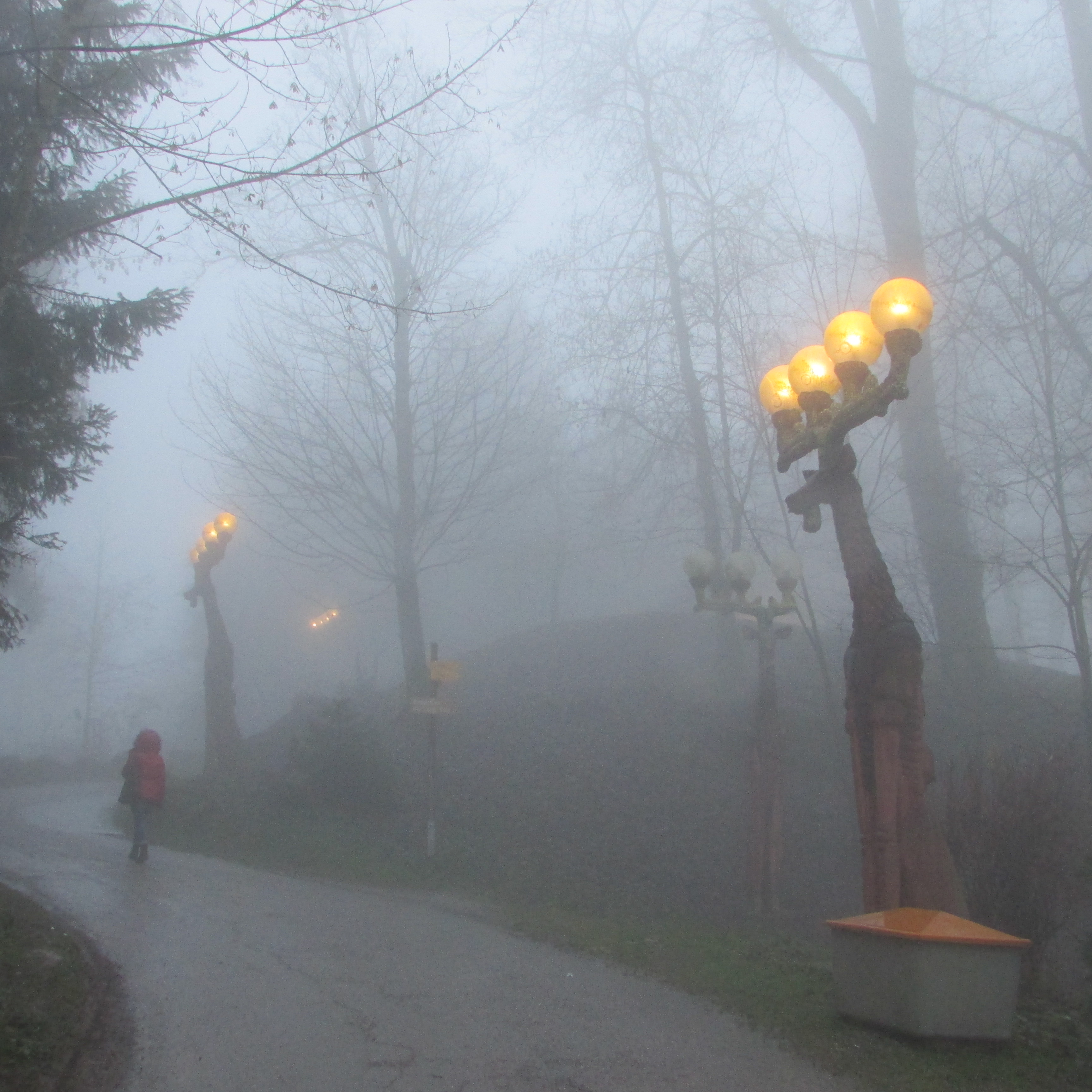
Me walking in Zurich along statues of deer by an amazing artist Bruno Weber
1. “At the dawn of history, the whole world – animate and inanimate, natural and supernatural – was interpreted symbolically. Life, death and rebirth were in constant close proximity, and these unceasing transformations were explained through stories and symbols: the passage between this world and the next, the rebirth of each new day and each spring. Such stories were symbolically relieved through ritual, art, dance, sacrifice, masks, hieroglyphs, talismans, fetishes, architecture and music. They served to keep a community in close connection with its defining narratives, above all its creation myths and stories of origin.” Sacred Symbols: Peoples, Religions, Mysteries, edited by Robert Adkinson
2. “Rites and symbols, both of which are essential elements of every initiation, and, more generally are associated with everything traditional, are in fact closely linked by their very nature. All the constituent elements of a rite necessarily have a symbolic sense, whereas, inversely, a symbol produces — and this indeed is its essential purpose — in one who meditates upon it with the requisite aptitudes and disposition, effects rigorously comparable to those of rites properly speaking, with the reservation of course that when this meditation is undertaken there be, as a preliminary condition, that regular initiatic transmission failing which the rites would be in any case nothing more than a vain counterfeit, as with their pseudo-initiatic parodies. We must also add that the origin of authentic rites and symbols (anything less does not deserve the name, since it amounts in the end to entirely profane and fraudulent imitations) is likewise ‘non-human’. Thus the impossibility of assigning to them any definite author or maker is not due to a lack of information, as profane historians suppose (that is, if for want of a better solution they have not been driven to look on them as the product of a sort of “collective consciousness”, which, even if it existed, would in any case be quite incapable of producing things of a transcendent order, such as these), but is a necessary consequence of that very origin, something that can only be contested by those who completely misunderstand the true nature of tradition and of all its integral parts, as is evidently the case with rites and symbols.
…
… (E)very word is nothing more than a symbol of the idea it is intended to express. Thus all language, whether spoken or written, is truly a body of symbols, and it is precisely for this reason that language, despite all the “naturalistic” theories contrived in modern times to explain it, cannot be a more or less artificial human creation nor a simple product of man’s individual faculties.
…
… (E)very rite is literally made up of a group of symbols which include not only the objects used or the figures represented, as we might be tempted to think if we
stopped at the most superficial meaning, but also the gestures effected and the words pronounced (the latter, as we have said, really constituting moreover only a particular case of the former); in a word, all the elements of the rite without exception; and these elements then have a symbolic value by their very nature and not by virtue of any superadded meaning that might attach to them from outward circumstances without really being inherent to them. Again, it might be said that rites are symbols ‘put into action’, or that every ritual gesture is a symbol ‘enacted,’ but this is only another way of saying the same thing. Highlighting more particularly the rite’s characteristic that, like every action, it is something necessarily accomplished in time, whereas the symbol as such can be envisioned from a timeless point of view. In this sense one could speak of a certain pre-eminence of symbols over rites; but rites and symbols are fundamentally only two aspects of a single reality, which is, after all, none other than the “correspondence” that binds together all the degrees of universal Existence in such a way that by means of it our human state can enter into communication with the higher states of being.”
Rene Guenon,The Essential Rene Guenon: Metaphysics Tradition and the Crisis of Modernity, edited by John Herlihy, 2009 World Wisdom. Pp. 226-230



















 symbolreader
