The Secrets of the Odyssey (5): Lotus-Eaters, Auriga and Polyphemus

What makes the Odyssey so fascinating to me is the constant presence of gods and goddesses, who ceaselessly impinge on the human world. In Homeric Moments, Eva Brann, reflects on the qualities of Greek gods:

 “Living lightly is the god’s way. The gods are ever at leisure. Since almost nothing they do has serious consequences for them, they give themselves over completely to the present… And the ichor is stemmed, and all the wounds are healed immediately, and death is not a prospect. … Seen against them, as dark shadows against a scene of light, human mortals gain their gravity.

The world of the gods is incorruptibly beautiful, full of hilarity, exquisite artifacts, ever-fresh lovemaking, a  world in which distance is not laboriously conquered and time is not inescapable. The gods fly through the sky and skim over the earth, assume whatever look suits them, and what is more, females become males, while all are untrammeled by the social decencies of the human world…

These gods, who have time on their hands and sacrifices on their minds, are also inveterate onlookers, watchers of humanity and eager interferers. … The heroes live under the regard of their observing gods, and it gives them dignity.”

The Odyssey is a profound meditation on archetypal patterns, a celestial journey through Zodiac signs and constellations. Gods and goddesses are present both as themselves, in the flesh, and as archetypes projected upon the starry firmament. A special protectress of Odysseus is Athena, who has a special relationship with our hero. In her Asteroid Goddesses, Demetra George credits Pallas Athene with “advancing the civilizing influence of culture upon humanity.” Like Odysseus, she was a master of tactics and strategy, and stood for creative intelligence. Athena’s mother, Metis, was a Titaness of wisdom, deep thought and “magical cunning.” Metis, meaning wisdom and cunning, was a quality Athena bestowed on Odysseus, her beloved protégé.

Image

Sandro Botticelli, “Athena and the Centaur” (detail)

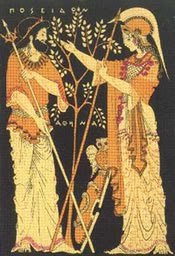
Athena is symbolically present in one of the most famous adventures of Odysseus: his encounter with the Cyclop Polyphemus, son of Poseidon. Poseidon and Athena had a long history of being divine adversaries, who disputed between themselves whose name should be given to a new mighty city in Attica. The dispute was to be settled by a contest: whoever offers a more precious gift to the citizens, will also lend his or her name to the city. Athena’s gift of an olive tree was deemed as more precious than Poseidon’s stream of salty water. The new city was named Athens. In the story of Cyclop the conflict between Poseidon and Athene lurks in the background, which I will reveal in more detail shortly.

Image

Athena blesses the olive tree

Before Odysseus landed on the Cyclops’ island, he visited the Lotus-Land. The book Homer’s Secret Odyssey plots his adventures along the ecliptic of a star chart. In the first month of Odysseus’ post-Troyan adventures, the Sun passes northern fish (Pisces) and Odysseus’ fleet gets hit by a hurricane. As the Sun passes Pisces and Cetus, the sea monster, he lands in the Land of the Lotus. His three companions, who were sent there on a scouting mission, taste the sweet flower and fall into mellow oblivion, forgetting about their homes and the purpose of their journey. Odysseus orders them to be dragged back to the ship and bound under the rowing benches. This occurs with the Sun on the verge of entering the sign Aries, which symbolically means the disentanglement from the sweet oblivion of the Piscean collective waters and making a decisive step towards Arian consciousness.

Image

“Lotus-Eater Male” by Biffno

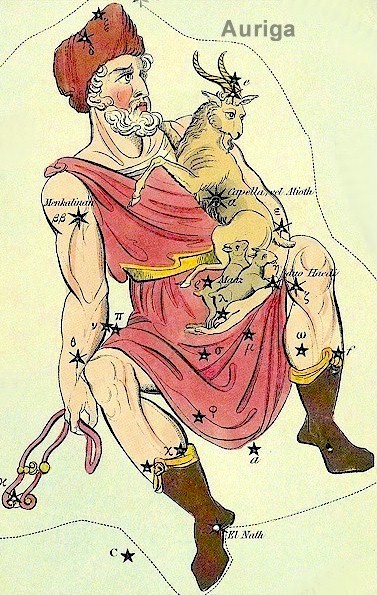
Next the Sun moves into Taurus and the crew make a stopover on the idyllic, beautiful and bountiful Goat’s Island, where they replenish their stocks and have a peaceful sojourn. The island is symbolically identified with the constellation Auriga, the Chariot which is driven by Erichthonius, son of Athena and Hephaestus. The suffix –chthonius means “earth,” Taurus being an earth sign. The following story of Erichthonius comes from Anne Wight’s website The Constellation of Words (http://www.constellationsofwords.com/Constellations/Auriga.html):

 “He is the child produced by Hephaestus’ aborted attempt to have sex with Athena. In the fight (eris) that ensued between the two, some of Hephaestus’ semen fell on Athena’s leg. The goddess wiped it off in disgust with a woolen cloth (eri) and threw it to the ground. Gaia (Earth) gave birth to the child. Erichthonius, in his childhood, enjoyed the protection of Athena, who hid him in a basket or chest woven from Actaean osiers (willows), as she did not want the other gods to know that she was taking care of the child.”

Image

Auriga

The Taurean adventures of Odysseus, i.e. his stay on Auriga and his encounter with the Cyclopes, can be looked upon as a journey through the dark underbelly of primal instincts. On Auriga, nature is presented as benevolent, but on Cyclopes’ island it is dangerous and devouring. The image of the chariot brings to mind Plato’s chariot allegory from his dialogue Phaedrus. He explains there that the soul is like a chariot drawn by two horses: the white one is reasonable and easy to control, the dark one wild and unruly. Polyphemus is the dark son of Poseidon and an antithesis to the principle of Athenian metis. What is more, this adventure occurs when the moon is in its dark period and possibly a solar eclipse takes place. The Woods say: “Polyphemus blocks out light from the entrance to the cave (representing the sun) with a large stone (the moon) … .”  Odysseus and his twelve crew members get trapped in the cave of the wild, devouring Cyclop, “a brute so huge, he seemed no man at all of those who eat good wheaten bread; but he seemed rather a shaggy mountain reared in solitude.” His cruelty is thus described by Homer:

 “Neither reply nor pity came from him,

but in one stride he clutched at my companions

and caught two in his hands like squirming puppies

to beat their brains out, spattering the floor.

Then he dismembered them and made his meal,

gaping and crunching like a mountain lion—

everything: innards, flesh, and marrow bones.

We cried aloud, lifting our hands to Zeus,

powerless, looking on at this, appalled;

but Kyklop went on filling up his belly

with manflesh and great gulps of whey,

then lay down like a mast among his sheep.”

David Enelow gives an illuminating discourse on two Greek words: techne (craft, skill) and themis (customs, manners, morality), both of which the Cyclopes lack:

 “Under the heading of techne we are concerned with the manipulation of nature; under the heading of themis we are concerned with relations among human beings and relations between human beings and the gods.”

Tete de Polypheme_jpg

Gustave Moreau, “Head of Polyphemus”

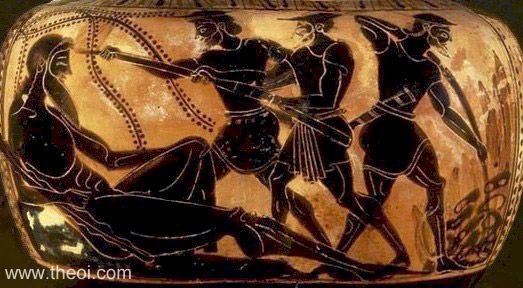
Civilization, accompanied by the advent of patriarchy to Greece, is about calming down and harnessing the wildness of nature, which is seen as hostile and life-threatening. It is significant that Odysseus blinds Polyphemus by means of an olive branch. We are reminded of the story of Athena and Athens, as olive tree is identified with civilization. It is also ironic that this act of violence was performed with an olive branch, a symbol of peace. According to Demetra George, Athena was the goddess promoted by the new Greek patriarchal order, which I have already written about here.

Image

The blinding of Polyphemus

Another tool that Odysseus uses to outwit Polyphemus is language. He tells him that his name is “Nobody.” The Cyclop bellows in pain attracting other other Cyclopes to the entrance of his cave. When asked by his compatriots what had happened, Polyphemus tells them that “nobody” had hurt him. Odysseus thinks to himself at that point: “…the heart within me/ laughed over how my name and my perfect planning had fooled him.” Polyphemus has not quite grasped the abstract, metaphoric properties of language while Odysseus once again has proved his metis, the skill in planning with tremendous foresight. Enelow speaks of Polyphemus as representative of “the mute and unintelligible substratum of human existence which always retains the power, if its demands are unappeased, to efface voice, memory, identity, and finally civilization.” He adds: “It is an apt piece of symbolism that Odysseus, in the cave of the Cyclops–which itself resembles an enormous stomach–, should call himself ‘Nobody.’ ” The one-eyed Cyclop has no binocular, double vision. He displays no objective judgments of what is right or wrong. He is primary, wild and brute force of instinct incarnate.

Odysseus and his companions manage to escape the monster hidden under the bellies of rams. The Woods notice that in the spring skies of 2300 BC the constellation of Aries (the Ram) had its heliacal rising on the eastern horizon at dawn, just as Odysseus and his men were leaving the cave of Polyphemus. From the safety of his ship, Odysseus could no longer stand being anonymous and proudly shouted to the son of Poseidon:

 “Kyklops,

if ever mortal man inquire

how you were put to shame and blinded, tell him

Odysseus, raider of cities, took your eye:

Laërtês’ son, whose home’s on Ithaka!”

Polyphemus, wronged and enraged, prayed to his father Poseidon:

 “O hear me, lord, blue girdler of the islands,

if I am thine indeed, and thou art father:

grant that Odysseus, raider of cities, never

see his home: Laërtês’ son, I mean,

who kept his hall on Ithaka. Should destiny

intend that he shall see his roof again

among his family in his father land,

far be that day, and dark the years between.

Let him lose all companions, and return

under strange sail to bitter days at home.”

Blinding of Polyphemus was Odysseus’ felix culpa because it spurred him on a long journey of individuation through the fantastic lands of his unconscious. On a personal level, he will pay a huge price, losing all his companions, but the odyssey will also grant him illumination and bring him closer to the gods.

Image

Joseph Mallord William Turner, “Ulysseus Deriding Polyphemus”

Support my blog

If you appreciate my writing, consider donating and make my day. Thank you in advance.

$1.00

Sources:

Eva Brann, Homeric Moments: Clues to the Delight in Reading the Odyssey and the Iliad

David Enelow, “In the Cave of the Cyclops: A Reading of Book 9 of the Odysseyhttps://www.headroyce.org/uploaded/faculty/denelow/Homer/odynarrhetoric.html

Homer, The Odyssey, translated by Robert Fitzgerald

Roger Sworder, Science & Religion in Archaic Greece: Homer on Immortality, Parmenides at Delphi

Kenneth and Florence Wood, Homer’s Secret Odyssey

Related posts:

The Secrets of the Odyssey (1)

The Secrets of the Odyssey (2): Elements of Time (the Muse and the Moon)

The Secrets of the Odyssey (3): Calypso and Phaecians

The Secrets of the Odyssey (4): A Tribute to Penelope

The Secrets of the Odyssey (6): the God of Winds

The Secrets of the Odyssey (7): Circe and the Underworld

The Secrets of the Odyssey (8): the Sirens, Scylla & Charybdis, and Thrinacia

The Secrets of the Odyssey (9): Leucothea in the Sea of Space and Time

https://symbolreader.wordpress.com/2014/07/14/the-secrets-of-the-odyssey-10-return-to-ithaca-through-the-cave-of-the-nymphs/?preview=true

The Secrets of the Odyssey (11): Death of Odysseus, Master of Land Ways and Sea Ways

Posted in The Odyssey | Tagged , , , , , , , , , , , , , , , , | 18 Comments

The Gift of Otherness

Joseph Conrad, a Polish writer who wrote in English and lived in England, summarized beautifully what I also feel to be the role of an artist:

 “The changing wisdom of successive generations discards ideas, questions facts, demolishes theories. But the artist appeals to that part of our being which is not dependent on wisdom; to that in us which is a gift and not an acquisition — and, therefore, more permanently enduring. He speaks to our capacity for delight and wonder, to the sense of mystery surrounding our lives; to our sense of pity, and beauty, and pain; to the latent feeling of fellowship with all creation — and to the subtle but invincible conviction of solidarity that knits together the loneliness of innumerable hearts, to the solidarity in dreams, in joy, in sorrow, in aspirations, in illusions, in hope, in fear, which binds men to each other, which binds together all humanity — the dead to the living and the living to the unborn.”

I left Poland, my native country, three years ago, and to all intents and purposes it looks like I will never live there again. For now, my adopted country is Switzerland. But when you leave your country, it always stays with you: there is a layer if your psyche which is forever connected to your homeland. I have never been the kind of expat who tries to uphold the external ways or traditions of their native land. Speaking frankly, the outer vestiges of Polishness have never been that appealing to me. You have these in every country: the chocolate and cheese of Switzerland, the pierogi of Poland, the American hamburger, etc. I have never attended the Polish Mass in Zurich, as so many other immigrants do. But when I am back in Poland, I immediately notice all the unique things that make my heart flutter. I would ride in a car and look at curbs and lawns and think that they look so unmistakably Polish. I would gaze at railway embankments and thing the same thing. I would walk along Kanonicza street in Krakow and catch a glimpse of the Wawel Castle with a lump in my throat. Yes, where you come from forever stays in your blood.

Image

The Wawel castle as seen from Kanonicza street (via Wikipedia)

I have been thinking a lot recently what being Polish means to me. I have come up with two qualities that I associate with the deeper layer of being Polish:

  1. Martyrology, heroism and fight for freedom

You may have heard of the partitioning of Poland and the fact that it was wiped off of the map of Europe between the years 1795 and 1918. The first lines of the Polish national anthem go: “Poland has not perished as long as we are still alive. What the alien power has seized from us, we shall recapture with a sabre.” The alien armies of Germany and Russia invaded us again in 1939. In 1945 communism was forced upon us. But the spirits were never crushed and a string of equally hopeless and heroic uprisings were proof of that. We were the first country in Eastern Europe where communism collapsed, which was achieved by a gentle revolution without the unnecessary bloodshed.

On the negative side, victimhood and the feeling of being wronged is still strong, especially among the nationalist right wingers. Forgetting and letting go is something they find extremely difficult.

2. Cultural wars

We are and always have been a deeply divided society. We are always on the barricades fighting each other. To be honest, one of the reasons why I found Switzerland so appealing is that it is a civilized culture of consensus. Disagreements are welcome because they fuel dialogue and compromise. But we, the Poles, are always extremely passionate when we defend our cause. Right now in my home country, there is a cultural war between the progressive, tolerant, open-minded, feminist, pro-gay group and their opposite conservative Catholic, often misogynistic, homophobic or anti-Semitic opposing side. Yes, I realize I am making a crude distinction for the sake of simplicity and that I am clearly showing who I side with. The language of civilized dialogue is completely lost between the two sides of the barricade.

Image

March of Equality, Krakow

I realize that similar cultural wars are going on in many places in the world. Ryszard Kapuscinski, a Polish reporter, journalist and traveler, saw the encounter with the Other as the most important challenge for the 21st century. The idea of Otherness comes from the philosopher Emmanuel Levinas. Through a loving encounter with the Other, we realize we all have a fragment of otherness in ourselves. Kapuscinski wrote about the need to overcome the warlike chaos and tumult and opening ourselves to the meeting of the Other’s distinct uniqueness. Seeking dialogue and understanding in relation to the Other was also a theme of Martin Buber’s beautiful book I and Thou, in which he wrote:

 “Man wishes to be confirmed in his being by man, and wishes to have a presence in the being of the other….
Secretly and bashfully he watches for a YES which allows him to be and which can come to him only from one human person to another.”

All of these thoughts have been coming to me ever since the planet Mars began its retrograde movement in Libra. There are many themes associated with the planet of war going backwards in the sign of peace, diplomacy and partnership. I have been thinking how the warlike mentality still feeds the minds of those living in the eastern part of Europe. Peace comes more easily in a country which has never known war (I am speaking of Switzerland). In my final words I feel I need to mention Ukraine with the central symbolism of the Maidan, i.e. the central square in Kiev:

“What does it mean to come to the Maidan? The square is located close to some of the major buildings of government, and is now a traditional site of protest. Interestingly, the word ‘maidan’ exists in Ukrainian but not in Russian, but even people speaking Russian use it because of its special implications. In origin it is just the Arabic word for ‘square,’ a public place. But a ‘maidan’ now means in Ukrainian what the Greek word ‘agora’ means in English: not just a marketplace where people happen to meet, but a place where they deliberately meet, precisely in order to deliberate, to speak, and to create a political society.”

Timothy Snyder, “Fascism, Russia, and Ukraine,” The New York Review of Books, March 20, 2014

Perhaps with Mars going retrograde in Libra, we should go back to the ancient idea of Agora as a place where Otherness was welcome and embraced in fruitful debate.

Image

The Agora in Athens

Posted in Krakow | Tagged , , , , , , , , , , , , , , , | 31 Comments

White Magic

“Standing before the mirror of silence
with her hands in her hair,
Barbara pours into her glass body
silver droplets of her voice.

And then like a jar
she fills with light and glasslike
filters stars through herself
and the white dust of the moon.

Through the quivering prism of her body
in the music of white sparks
minks will glide past
like fluffy leaves of sleep.

Hoarfrost will coat the bears in it
brightened by polar stars
and a stream of mice will weave through
flowing in a loud avalanche.

Until filled up with milk
she’ll slowly sink into sleep
as melodically time will settle at the bottom
in a cascade of glare.

And so Barbara has a silver body. In it
the white mink of silence stiffens softly
under an unseen arm.”

Krzysztof Kamil Baczynski, “White Magic” (translated from the Polish by Alex Kurczaba)

Image

Image via http://www.pinterest.com/kvp134/

Baczynski was a Polish poet who died in the Warsaw Uprising (1944) at the age of 23. In his short life, he wrote a lot of beautiful poems, such as this one, dedicated to his wife, Barbara.

Image

Posted in Poetry | Tagged , , , | 9 Comments

The Secrets of the Odyssey (4): A Tribute to Penelope

Image

Penelope

While Odysseus, cursed by Poseidon, cannot find his way home and lives through a series of fantastical adventures, his wife Penelope is experiencing a deep wound of longing and despair. She is left to run the kingdom of Ithaca alone. At times she gives way to despair but she has an enormous ability to pull herself together and stay sober and level-headed amidst all the chaos and disarray of the suitors taking over her kingdom. The three epithets that Homer uses to describe her most frequently are “urbane”, “mentally present” and “thoughtful” or “wise.” While Odysseus sinks deeper and deeper into the inner world of his fantasy, she remains his anchor, a constant, a beacon, the safe harbor he hopes to reach one day.

sandys13

Anthony Frederick Sandys, “Penelope”

Her name is hard to trace back etymologically, but apparently, and very significantly, it is connected with aquatic birds (species of a duck) and weaving. A bird, particularly aquatic bird, is an important aspect of the Mother Goddess, who in many myths, notably the Syrian one, is born out of an egg brought up from the watery depths by a fish and brooded by a bird. According to Barbara Hand Clow, the author of The Pleiadian Agenda, aquatic birds are linked to the stars of the Pleiades; birdsong being the sound and vibration connected with the Harmony of the Spheres and the creation of the universe. A winged goddess, so well-known in many mythologies, descended from the heavens to bring culture and civilization through transforming nature. Penelope is not unlike a goddess herself, being full of dignity and displaying a truly regal demeanor. In the previous posts of the series, I linked Odysseus’ ever changing adventures with him being a personification of the moon; it seems to me that his alchemical spouse, Penelope, in her constancy may be associated with the Sun. Also, we may say that her husband is getting in touch with his feminine, lunar side while she needs to develop her archetypal, solar/masculine side to restore harmony to her troubled kingdom.

But Penelope is also, and perhaps first and foremost, the ultimate woman. She tends the hearth, which is the centre of the house and the original altar. She accepts presents from her suitors to replenish Ithaca’s wealth. She is the giver of shelter and protection:

 “Down to our day, the feminine vessel character, originally of the cave, later of the house (the sense of being inside, of being sheltered, protected, and warmed in the house), has always borne a relation to the original containment of the womb.”

Erich Neumann, “The Great Mother”

She also guards the marital bed, which in the Odyssey is constructed upon a sturdy pillar, keeping all the suitors at bay and awaiting Odysseus, her husband and soul mate. She is as cunning as Odysseus having developed a strategy to trick the suitors through weaving a burial shroud for Laertes, Odysseus’ father and undoing it at night to buy herself more time. There is pathos and glory in her character, which is very human, but it is weaving which puts her on par with the goddess. In the Odyssey, weaving is presented as a preoccupation of the goddess, notably of Circe and Calypso, also Athena, who was an accomplished weaver.

Image

John William Waterhouse, “Penelope Weaving”

The Moirai, Greek goddesses of fate, constantly spin the thread of life. The Latin word “destino” means “that which is woven,” fixed with cords and threads, “bound to happen,” says Barbara G. Walker. By weaving, stalling and preventing the time from running out, Penelope tries to take control of her destiny which she believes is bound to that of Odysseus. In the Mahabharata, an Indian epic poem, G. Walker writes, there is an image of three Goddesses “weaving the veil of nights and days in an underground ’city of serpents,’ representing cycles of light and darkness with threads of white and black linked with the blood-red thread of life.” Penelope is intimately connected with the cycles of light and darkness. As a character, she makes an entrance during a dark moon period, when she is suicidal, desperate and suffers from dreary nightmares. She waits for 19 years to be reunited with Odysseus:

 “Only then, with the moon at the same phase and in the same position against the background of stars as it had been 19 years earlier, would Odysseus and Penelope be reunited in their rejuvenated marriage bed.”

Florence and Kenneth Wood, “Homer’s Secret Odyssey”

For the Woods, Penelope is a personification of the luni-solar cycle:

 “She tells the suitors in some anger that they should not be eating her out of house and home but instead presenting her with gifts. In response she is given a gown, 12 brooches, a gold chain and a pair of earrings, all of which are metaphorically evocative. On the embroidered gown of beautiful material were attached 12 golden brooches ‘each fitted with a pin with a curved sheath’ or fitted with ‘curved clasps’. If the golden brooches are metaphors for the sun and the curved clasps for the new moon, then Homer may be indicating the 12 solar months and 12 new moons of the lunar calendar set against the background of the heavens.”

Penelope, the weaver, personifies both the archetypal, immutable goddess and a mortal, mutable, woman: a victim of her circumstance with her proper fate apportioned to her. Having recently read a very illuminating essay on the symbolism of weaving written by Rene Guenon, I would like to conclude by quoting a few significant excerpts on the symbolism of weaving, as he understands it:

 “If the meaning of this symbolism is to be clearly grasped, it should first be observed that the warp, formed as it is by threads stretched upon the loom, represents the immutable, principal elements, whereas the threads of the weft, which pass between those of the warp by the to-and-fro movement of the shuttle, represent the variable and contingent elements, in other words the applications of the principle to this or that set of particular conditions. Again, if one thread of the warp and one of the weft are considered, it will at once be seen that their meeting forms the cross, of which they are respectively the vertical line and the horizontal; and every stitch in the fabric, being thus the meeting-point of two mutually perpendicular threads, is thereby the center of such a cross. Now, following . . . the general symbolism of the cross, the vertical line represents that which joins together all the degrees of Existence by connecting their corresponding points to one another, whereas the horizontal line represents the development of one of these states or degrees. Thus the horizontal direction may be taken as depicting, for example, the human state, and the vertical direction that which is transcendent in relation to that state. … the vertical line represents the active or masculine principle (Purusha), and the horizontal one the passive or feminine principle (Prakriti), all manifestation being produced by the “actionless” influence of the first upon the second. Now, in another context, Shruti is likened to direct light, depicted by the sun, and Smriti to reflected light, depicted by the moon; but, at the same time, the sun and moon, in nearly all traditions, also respectively symbolize the masculine and feminine principles in universal manifestation…. From this standpoint again, the threads of the warp, by which the corresponding points in all states are connected, form the sacred book which is the prototype (or rather, archetype) of all traditional scriptures, and of which these scriptures are merely expressions in human language. The threads of the weft, each of which is the development of events in a certain state, form the commentary, in the sense that they give the applications relating to the different states; all events, envisaged in the simultaneity of the “timeless”, are thus inscribed in the Book, of which each represents as it were one character, being also identified with one stitch in the fabric.”

“The Essential Rene Guenon: Metaphysics Tradition and the Crisis of Modernity”

The Odyssey is a sacred Book, in which the human world meets the divine realm. It shows how our human destinies are interwoven with the timeless world of the archetypes.

Image

Related posts:

The Secrets of the Odyssey (1)

The Secrets of the Odyssey (2): Elements of Time (the Muse and the Moon)

The Secrets of the Odyssey (3): Calypso and Phaecians

The Secrets of the Odyssey (5): Lotus-Eaters, Auriga and Polyphemus

The Secrets of the Odyssey (6): the God of Winds

The Secrets of the Odyssey (7): Circe and the Underworld

The Secrets of the Odyssey (8): the Sirens, Scylla & Charybdis, and Thrinacia

The Secrets of the Odyssey (9): Leucothea in the Sea of Space and Time

https://symbolreader.wordpress.com/2014/07/14/the-secrets-of-the-odyssey-10-return-to-ithaca-through-the-cave-of-the-nymphs/?preview=true

The Secrets of the Odyssey (11): Death of Odysseus, Master of Land Ways and Sea Ways

Posted in The Odyssey | Tagged , , , , , , , , , , , , , , , , , | 22 Comments

Images of the Zodiac: Contemplating Pisces

Image

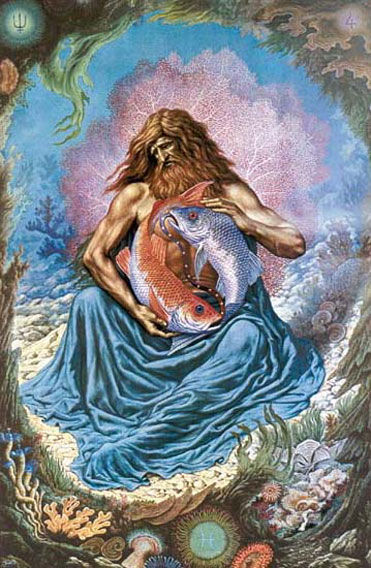
Johfra Bosschart, “Pisces”

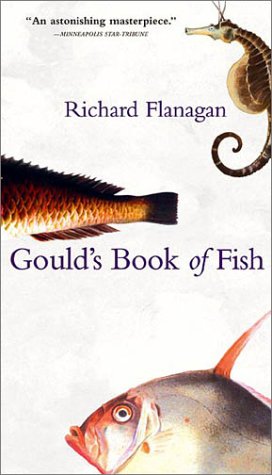
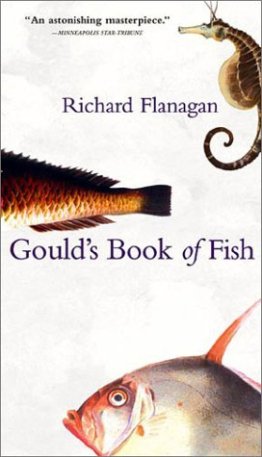
One of the best novels I have read in my whole life is without any shadow of a doubt Gould’s Book of Fish: A Novel in 12 Fish by Richard Flanagan. Its narrator, William Buelow Gould, is a forger serving a sentence in a penal colony on Sarah Island (today’s Tasmania). While imprisoned there, he creates remarkable paintings of fish. In the original edition of the book, each chapter is printed in a different colour, which makes the book look extraordinary. The narrator is very unreliable and scattered: he does not tell the story in a linear fashion, but more in a circular way, jumping forwards and backwards and letting his imagination spiral and twist in all directions. The book is wonderfully irrational and one hundred per cent Piscean. The main character’s anathema is scientific classification; he says that in the world “where science knew absolutely every species and phylum and genus, … no one knew love because it had disappeared along with the fish.” He says about himself: “I am not bound to any idea of who I will be. I am not contained between my toes and my turf but am infinite as sand… my soul is in a process of constant decomposition and reinvention.” He calls the book he is writing “the story of my compost heap of a heart.” Painting fish, he muses on its elusive beauty:

“A fish is a slippery and three-dimensional monster that exists in all manner of curves, whose colouring and surfaces & translucent fins suggest the very reason & riddle of life… a fish is a truth.”

The book is Protean at heart: full of transformations, melding, mingling, opalescent shapes and other flickering gems of the author’s fancy. The narrator, while painting the fish in 12 different colours and 12 different modes, fantasizes about an audience looking at his paintings in the future:

“They would find themselves swimming in a strange ocean they could not recognise and they would feel a Great Sorrow about who they were and a Great Love for who they were not and it would be all mixed up and all clear at the same time, and they would never be able to explain any of it to anybody.”
Image

To understand our times at the end of the Age of Pisces, we must try to understand this last Zodiac sign, which closes the Great Round of the Zodiac. In his Zodiac as the Universal Matrix, Rudhyar calls Pisces “the symbol of time fulfilled” and “a pulsating womb, gathering in social experience and synthesizing the past of a people and a culture.” We are at the moment when all that is old disintegrates, decays and crumbles, in a moment of transition, when the new is yet unborn and the old is not dead yet:

“The germinating seed must draw from the humus fertilized by the manure of thoroughly decayed leaves, if it is to grow. It is because every cycle ends loaded with refuse and failures that there must be a new cycle in order to give to these remains a new chance to reach the stage of fulfillment in the seed.”

Approaching spring, many of us will start a period of fasting during which the body feeds on its poison until it becomes purified again. Humanity is in dire need of such purification reached through the death of the old. Rudhyar warns against passivity, the anathema of Pisces, because it involves the risk of getting “polluted and overwhelmed by the refuse of the old, instead of transfiguring it into the new birth.”

The Return of the Divine Feminine is an extremely prominent theme in the Age of Pisces, as Rudhyar notices in another book, The Pulse of Life:

“In Pisces, the individual must go through the Eternal Feminine. This is the eternal Chrysalis, which is as nothing, yet which contains all potencies of renewal. It is the realm of metamorphosis and that of psychic glamour; the world of rapture and that of eternal mist; openness to God and mediumship to the phantasms of a decaying past; the martyr’s sacrifice and the ghastly Inquisitions which feed sadistic frustrations under the mask of religious work.”

The realm of Pisces eludes language and any rational description. Pisces is the last sign of the Zodiac wheel but also the source of all the signs, the fertile oceanic womb out of which all life springs. The ocean is first and foremost the realm of the goddess, and although the sign Pisces is ruled by Jupiter (traditionally) and Neptune (in modern astrology), those male deities are late arrivals and their rulership over the ocean is merely historical, associated with the advent of patriarchy, while the oceanic dominion of the goddess is primordial and atemporal. According to Liz Greene:

“In extant Sumerian tablets, the goddess Nammu, whose name is written with the ideogram “A,” meaning “sea,” is described as “the Mother who gave birth to heaven and earth.” The word ‘nammu’ or ‘namme’ is given another interpretation by Nicholas Campion; he suggests it can be roughly equated with essence, fate or destiny. The two interpretations are related, since the divine source is also the essence and destiny of all life, which emerges from and returns to it. Sumerian myth offers no explanation for the origin of the primeval sea. It just is. … In the Sumerian language, the word for water is also synonymous with the word for sperm, conception, and generation. The great Sumerian sea-mother is parthenogenic; she is both fertilizing sperm and the moist, receiving womb; she is male-female, androgynous and undifferentiated, an image both of cosmic primal chaos and of the dark unformed world of the womb.”

Ever ebbing and flowing, water as prime matter appears in all creation myths of the world. As Liz Greene also says, “it will exist even at the end of creation, containing the seeds of future worlds waiting to germinate in its depths.”

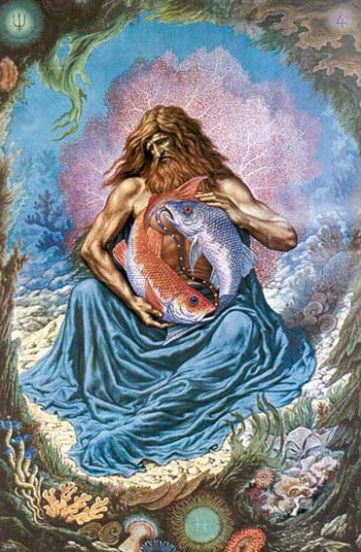
I think Johfra’s depiction of Pisces is beautiful. On the bottom of the ocean two fish form a yin/yang symbol. They are lovingly held by a powerful male sage who is operating in the oceanic womb of the great mother. The ocean is home to breathtaking diversity and abundance of life forms, which are exquisitely presented by Johfra in their metaphysical, otherworldly beauty. Look at the fertile and luscious ripeness of the fish, the muscular arms of the god: these attributes speak of strength and power that this, often underrated, sign possesses in abundance. This is what Johfra himself wrote about the two fish:

“The red fish which represents the active part of the person points downwards, diving into its inner world. The blue fish, the passive part, represents the outside world because man has no more interest in the world of phenomena; it has become unreal to him. His only reality is the immeasurable kingdom of the primordial oceans of his inner world.”

I am quite fond of Johfra’s choice to present the two fish as an uroboros or as an image of the yin/yang equilibrium. In his celebrated book Aion, Carl Gustav Jung proposes an interesting thesis that the two fish swimming in opposite directions is a recent, Christian depiction of a primordial, pagan symbol. At the heart of Christianity lies a tension of opposites, he claims. I hope you do not mind me quoting a longer passage, which shows that his thesis is tentative, although quite compelling:

“There would be some justification for drawing a parallel between the tension of opposites in early Christian psychology and the fact the zodiacal sign for Pisces frequently shows two fishes moving in opposite directions, but only if it could be proved that their contrary movement dates from pre-Christian times or is at least contemporary with Christ. Unfortunately, I know of no pictorial representation from this period that would give us any information about the position of the fishes. In the fine bas-relief of the zodiac from the Little Metropolis in Athens, Pisces and Aquarius are missing. There is one representation of the fishes, near the beginning of our era, that is certainly free from Christian influence. This is the globe of the heavens from the Farnese Atlas in Naples. The first fish, depicted north of the equator, is vertical, with its head pointing to the celestial Pole; the second fish, south of the equator, is horizontal, with its head pointing West. The picture follows the astronomical configuration and is therefore naturalistic. The zodiac from the temple of Hathor at Denderah shows the fishes, but they both face the same way. The planisphere of Timochares, mentioned by Hipparchus, has only one fish where Pisces should be. On coins and gems from the time of the emperors, and also on Mithraic monuments the fishes are shown either facing the same way or moving in opposite directions. The polarity which the fishes later acquired may perhaps be due to the fact that the astronomical constellation shows the first (northerly) fish as vertical, and the second (southerly) fish as horizontal. … This countermovement, which was unknown to the majority of the oldest sources, was much emphasized in Christian times, and this leads one to suspect a certain tendentiousness.”

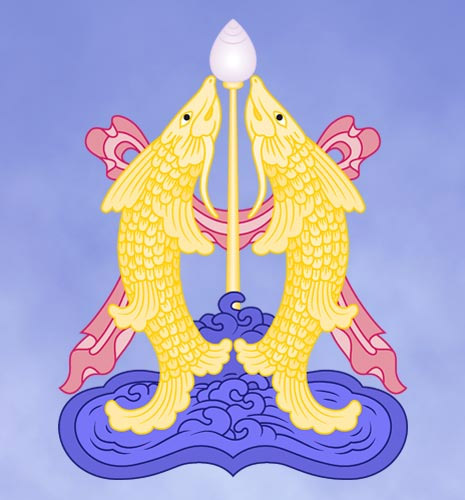
In Buddhism, a pair of golden fish is one of the eight sacred symbols of the Buddha. They stand vertically with their heads turned towards each other.

Image

Western depiction of Pisces

Image

Tibetan pair of golden fish

They symbolize the two sacred rivers of India, Ganges and Yamuna. Perhaps the fish that swim in different directions are symbolic of a radical western dualism, the irreconcilability of opposites and constant tensions and conflicts that are at the heart of our civilization. The Western mind is used to thinking in either/or categories, differentiating and drawing sharp distinctions in our judgements. The Chinese yin and yang symbol with its gentle curves shows a unity of opposites, their mutual penetrability and relatedness. Jaeger writes:

“The white area of the Yin-Yang symbol is typically called Yang. It begins at the winter solstice and indicates a beginning dominance of daylight over darkness, which is the reason why the ancient Chinese associated it with the sun (or male). Accordingly, the dark area of the Yin-Yang symbol represents Yin, which begins with the summer solstice. Yin indicates a beginning dominance of darkness over daylight. The ancient Chinese therefore associated it with the moon (or female).”

Image

image via http://www.galactic-centre-2012.com/

Typically, mythical figures associated with Pisces transcend all self-made limits, especially gender. One of such androgynous deities is Dionysus, known as “he of the sea,” another, the Egyptian Hapi, a Nile-god called “the Primeval One,” imagined as a man with long hair and large breasts: a personification of the male and female life creating forces of the cyclically overflowing Nile.

Image

Hapi

The fish has also an interesting part to play in the Egyptian myth. Liz Greene makes a compelling analysis of the myth of Osiris, “Egypt’s great mythic victim-redeemer.” She writes:

“Osiris was dismembered by the dark god Set, portrayed as a great river-snake or crocodile – the Egyptian version of Leviathan, the destructive phallic face of the sea-mother – and his penis was swallowed by a fish. Although he was put back together again, the penis was never found, and one made of clay had to be substituted instead.

This story suggests, on one level, that the phallus of the god was thus the only mortal or corruptible part of him, since it was made of clay – the substance out of which the artisan-god Ptah formed human beings on his potter’s wheel. Osiris, although he is divine, is therefore vulnerable through his sexuality. … For it is through our sexuality that we are most vulnerable to the inundation of the waters … The encroachment of the deep is all too often through genital, rather than spiritual, feeling although the physical union which initially seems such a desirable aspect of Neptunian romantic entanglements is usually anticipated as a mere gateway to the more important soul-union that lies beyond. … Thus Osiris … remained for the Egyptians a bittersweet and poignant god of the underworld, promising a redemption which could occur only in the afterlife, but never in mortal form.”

“Concupiscentia,” Jung notices, is the shadow side of Pisces – the quality of being “ambitious, libidinous, voracious, avaricious, lascivious.” The womb of the great mother, voracious as it may be, is also a baptismal font, where the baptized are purified and swim like fish. Jung quotes St Augustine from his Confessions: “But [the earth] eats the fish that was drawn from the deep, at the table which you have prepared for them that believe; for the fish was drawn from the deep in order to nourish the needy ones of the earth.” As a symbol of Christianity, fish, like Corpus Christi, is soul nourishment, satisfying the most acute hunger of all: the spiritual one. The highest expression of Piscean energy is pure compassion. Says Rudhyar in The Pulse of Life: “Here we see the great Personage whose being is full to overflowing, because he has absorbed the wholeness of his race’s experience. … Compassion is the heart of reality, because reality is based on the experience of organic wholeness…” Rudhyar shows the connection between the words “compassion” and “encompass” to further emphasize the all-inclusiveness of the sign of Pisces. Rudhyar had his Mercury in Pisces, therefore his words that I am going to quote now as a conclusion sound like an inspired prayer to me:

“And this is the last blessing of the closing cycle, the eternal promise of all cyclic consummation: that the constant dualism of ever-changing life can be integrated in organic wholes ceaselessly more encompassing, through the creative behavior of Personalities ever more compassionate and more deeply integrated; that Day and Night may be realized as the two complementary poles of life and consciousness, in moments of human perception so lucid and so rich with universal contents that such illuminations may remain as beacon lights to be guidance and joy to ever vaster reaches of life. It is the promise of eternal rebirth, which leaves nothing unredeemed and excludes no one; the promise of the everlasting and timeless Presence of God in the man who fully welcomes the total integration of all that brought him to his present consummation; in whom, therefore, is accomplished the synthesis of past and future in the fullness and glory of moments that are the “eternal Now.”

Support my blog

If you appreciate my writing, consider donating and make my day. Thank you in advance.

$1.00

Sources:

Johfra Bosschart, Astrology

Liz Greene, The Astrological Neptune and the Quest for Redemption

Stefan Jaeger, “A Geomedical Approach to Chinese Medicine: The Origin of the Yin-Yang Symbol”

http://www.intechopen.com/books/recent-advances-in-theories-and-practice-of-chinese-medicine/a-geomedical-approach-to-chinese-medicine-the-origin-of-the-yin-yang-symbol

Carl Gustav Jung, Aion: Researches into the Phenomenology of the Self

Dane Rudhyar, The Pulse of Life: New Dynamics in Astrology (http://www.khaldea.com/rudhyar/pofl/)

Dane Rudhyar, The Zodiac as the Universal Matrix

Related posts:

Images of the Zodiac: Contemplating Aries

Images of the Zodiac: Contemplating Taurus

Images of the Zodiac: Contemplating Gemini

Images of the Zodiac: Contemplating Cancer

Images of the Zodiac: Contemplating Leo

Images of the Zodiac: Contemplating Virgo

Images of the Zodiac: Contemplating Libra

Images of the Zodiac: Contemplating Scorpio

Images of the Zodiac: Contemplating Sagittarius

Images of the Zodiac: Contemplating Capricorn

Images of the Zodiac: Contemplating Aquarius

Posted in Johfra Bosschart | Tagged , , , , , , , , , , , , , , , , , , , , , , | 27 Comments

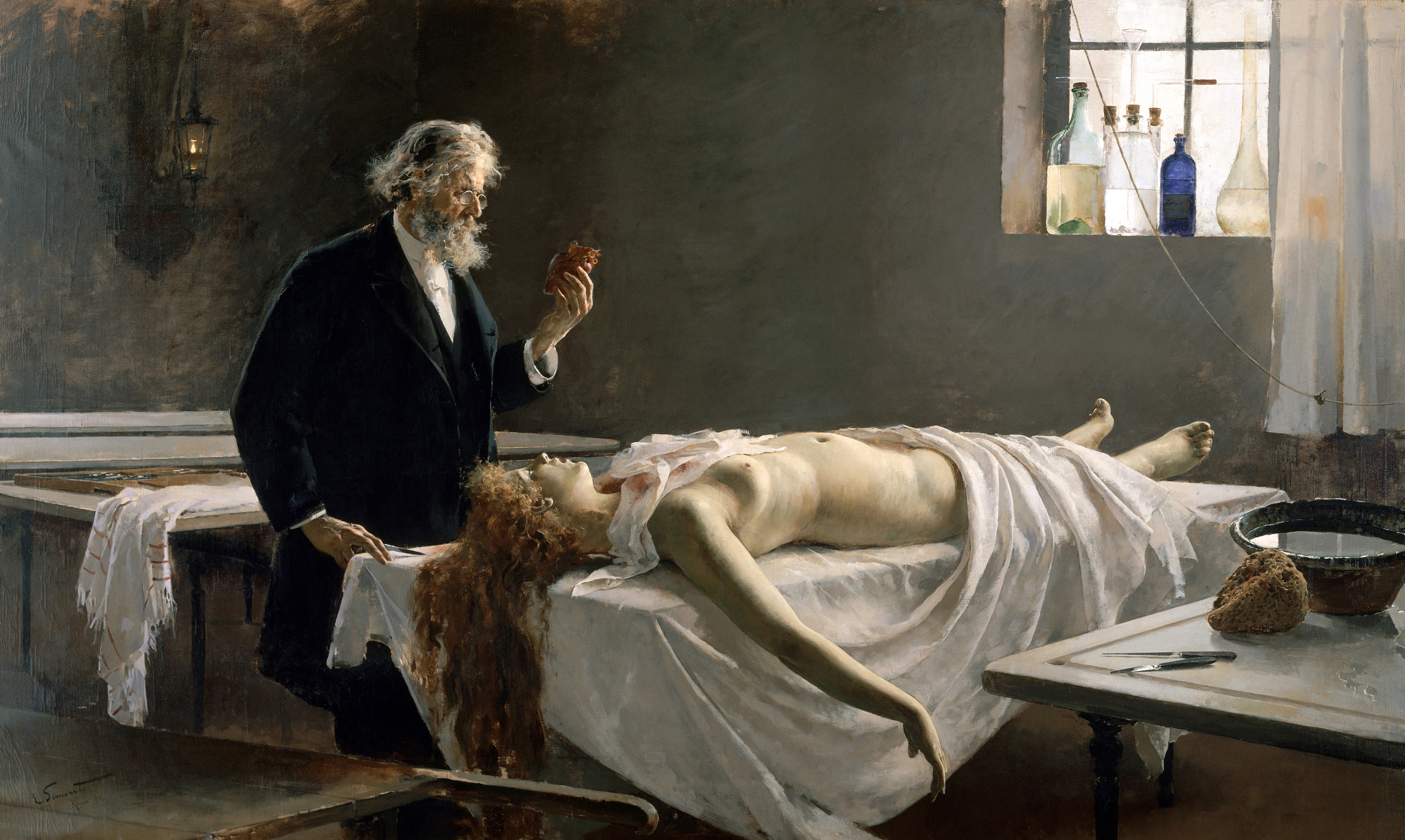
Famous Paintings: “Anatomy of the Heart” by Enrique Simonet y Lombardo

Image

“The Spanish painter Enrique Simonet y Lombardo, in the last year of the nineteenth century, … produced an admirable canvas showing the anatomic exploration of a woman’s body. … an old man holds in his hand the heart he has just extracted from the cadaver. The professor gazes at it admiringly, as though he might be able to discover in this mass of muscle and blood a trace of feeling, a last breath of life. … the pictorial argument rests on the opposition between the objective and the subjective; the civilized and the savage; the masculine and the feminine. … The solitude of this figure in black, who contemplates with incredulity the trophy he has just ripped from the body, is more than just slightly perturbing. The axis of the painting is the triangle formed by the heart in the anatomist’s left hand, the scalpel in his right hand, and his sad, almost perplexed, ecstatic and incredulous expression as he contemplates the remains of the dead young woman. The painting’s marked chiaroscuro, the contrast in light between scientific activity and the deathly passivity, the profile of the anatomist and the foreshortening of the corpse, along with the neutral background of the room, make up the basic themes of the work. The painting was initially called “And She Had a Heart!”, and only later came to be known as ‘Anatomy of the Heart.’ ”

Javier Moscoso, Pain: A Cultural History

Support my blog

If you appreciate my writing, consider donating and make my day. Thank you in advance.

$1.00

Posted in Painting | Tagged , , , , , , , | 26 Comments

The Secrets of the Odyssey (3): Calypso and Phaecians

According to a well-known saying by Whitehead, all Western philosophy is a footnote to Plato. Philosophy may have begun with Plato but storytelling and literature began with minstrel poets such as Homer. Our cultural womb and cradle is ancient Greece; rereading the Odyssey and marveling at its psychological depth left me with no doubt about that. The world of the Odyssey is imbued with the presence of gods and goddesses. You may be familiar with James Hillman’s notion that in our times gods have been replaced with symptoms with some dire consequences for our collective and individual psyches. Reading myths helps us keep in touch with the divine realm and our own divine essence, hence my little project with the Odyssey. Tracing Hillman’s thought, it is true that we can say that Odysseus is depressed on the island of Calypso, but how much more fascinating and non-pathologizing is to view his sojourn there as gestation, deepening, getting in touch with his soul or feminine side. Homer chooses to start his epic while Odysseus is on the island of the veiled nymph and sorceress Calypso, whose name means “She Who Conceals”: it is on day seven, when the moon is in its dark, balsamic phase, that we encounter our hero for the first time, weeping on the shores of Calypso’s island:

“Her ladyship Kalypso

clung to him in her sea-hollowed caves—

a nymph, immortal and most beautiful,

who craved him for her own.” (translated by Robert Fitzgerald)

Eva Brann, a Greek scholar, thus comments on this line, referring to its sound in Greek:

“It is the Concealer’s signature line, her longing expressed in bewitchingly gliding, slithering sounds, and with them goes a luxurious landscape surrounding the cavernous womb of Ogygia, which is ‘the navel of the sea’.”

Image

Richard Westall, “Telemachus Landing on the Isle of Calypso”

The primordial island of Ogygia, where Odysseus makes love to Calypso in her hollow cave, is an important stopover in Odysseus’ journey of the soul. What is Odysseus like, what makes him such a fascinating and delightful presence in Homer’s epic? He charms all those he encounters being both incredibly clever and deeply imaginative and tender-hearted. He is “a man of many devices,” as Homer puts it; an “Olympic-class liar,” wittily remarks Brann. In the Iliad he showed consummate diplomatic skills acting as a successful messenger between heroes. In the Iliad he proved to be “the man of metis,” says Brann, i.e. of measured, calculated planning. He has an enormous, uncanny capacity for change and shape-shifting: he transforms his behaviour, appearance a few times throughout the story and beyond recognition (hence his affinity with the Moon, addressed in my previous post). Poli and polla, the Greek words for “much, multi-, many,” are very often used to describe him. He experiences many pleasures and endures many hardships, encounters multiple beings during his journey, living through numerous adventures:

“He saw the townlands

and learned the minds of many distant men,

and weathered many bitter nights and days

in his deep heart at sea …” (all quotes from the Odyssey come from the Fitzgerald translation)

He is also characterized by steadfastness, loyalty, enormous self-control and endurance: he always shows cold blood in crisis. Through all vicissitudes and changing fortunes, his heart remains stable, forever devoted to Penelope and his homeland, Ithaca. It is his deep heart and wild imagination that makes him such a compelling character, I think. As Brann says:

“The man of order, balance, and tradition, the centrist par excellence in public life, is a vividly imagining free spirit in his inner life.”

His journeys take him deep into the world of imagination. It is interesting to see how many times throughout his adventures he is actually sleeping, missing a decisive part of the action and not being an active agent in the occurrences. Telemachus describes his father, very aptly, as “unsightable, undiscoverable.” This happens to all of us: as we sink into the world of imagination, we become invisible to the outside world. Brann has very illuminating things to say about the meaning of Odysseus’ name. First, she mentions a talk of Athena with Zeus when she asks her father: “Why do you now hate (odysao) him so much, Zeus?” Odysseus is hated for a long while by Poseidon for killing his son Polyphemus. Also in Greek odyromenos means “the one who weeps and laments.” And finally, odyne stands for “pain or suffering.”  She summarizes:

 “One who is hated, has grief, and gives pain; the man who attracts persecution, the man who feels deeply, who inflicts pain – here is the counterweight to another Odysseus: the crafty survivor, the insouciantly imaginative poet, the faithful family man.”

Another crucial aspect of his personality is his poetic talent for storytelling. After Calypso finally lets him out of her grasp, he is brought to the island of Scheria, home of Phaecians. There his true identity is revealed and he gets to tell the story of his ongoing odyssey to the king of Phaecians. The name “Phaecians” carries the world phainein, meaning “to bring light, to make appear.” The words “fantasy” or “imagination” come from this root. Odysseus talks about his adventures, coining a new word: mythologein, “to-give-an-account-in-story-form.” Brann calls him “the first original Mythologist”:

“With the deftness of a minstrel he strings his great ancestral bow, with the easy smooth motion of a skilled singer who inspects his lyre… Odysseus’ archery is like that of the archer-musician Apollo, the teacher of fingers, to whose altar in Delos he has made a pilgrimage and on whose feast day he will retake his palace by means of his lyrelike bow.”

If you are lost in the chronology of the Odyssey, I encourage you to look back at the second part of my series. Homer does not tell the story linearly, because the progress of the soul is not linear. I find it very significant that he would start with the events on Calypso’s island, which chronologically happen towards the end of Odysseus’ adventures. Calypso’s island is the womb of the world, home to luxuriant nature. It is Calypso, as I see it, who makes Odysseus into a poet. After staying with her, he sails to Scheria, where he tells his story to a mesmerized crowd. Ogygia, Calypso’s island, and Scheria are two different worlds, as different as nature (Ogygia) and culture (Scheria). Let me quote a passage from the Odyssey about Ogygia:

“Divine Kalypso,

the mistress of the isle, was now at home.

Upon her hearthstone a great fire blazing

scented the farthest shores with cedar smoke

and smoke of thyme, and singing high and low

in her sweet voice, before her loom a-weaving,

she passed her golden shuttle to and fro.

A deep wood grew outside, with summer leaves

of alder and black poplar, pungent cypress.

Ornate birds here rested their stretched wings—

horned owls, falcons, cormorants—long-tongued

beachcombing birds, and followers of the sea.

Around the smoothwalled cave a crooking vine

held purple clusters under ply of green;

and four springs, bubbling up near one another

shallow and clear, took channels here and there

through beds of violets and tender parsley.

Even a god who found this place

would gaze, and feel his heart beat with delight.”

In Homer’s Secret Odyssey we come across an interesting interpretation of the passage above:

“At this time of the year the sun has left Sagittarius and Homer’s lyrical description of Calypso’s home becomes a splendid metaphor for the heliacal rising of beautiful Sagittarius and the glittering Milky Way. The ‘loom and shuttle’ suggest the more familiar ‘bow and arrow’ of Sagittarius, while the cave is proposed as asterism, known in more modern terms as the ‘teapot’ or ‘milk ladle.’ The seashore is the Milky Way and the four rivulets are represented by four stars from which can be traced four bands of the Milky Way.”

Image

Nicholas Roerich, “Mother of the World”

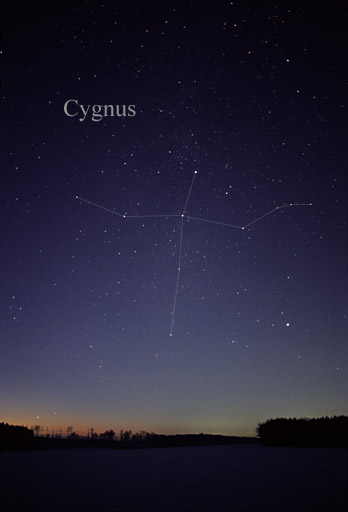
The island of Calypso turns out to be the womb and the cradle of the universe, she a High Priestess working unseen behind her veil, spinning and weaving reality into existence.  She teaches Odysseus how to use stars and constellations in sailing. Having left Calypso’ centre of the Milky Way he sails across the sea/sky sighting many wonderful constellations, notably the Pleiades and Orion. Scheria, where he lands after a heavy storm which destroys his ship, is not a natural setting, but rather one that is highly crafted. A description of this island matches the Cygnus  (Swann) constellation, according to the Woods:

Image

Cygnus

“The palace of king Alcinous is as beautiful as the sun and the moon, says Homer. The starry metaphors and references to the constant movement of the Milky Way continue as women folk go ceaselessly about grinding yellow corn and spinning and weaving white linen cloth, their hands fluttering like (white) aspen leaves. The king’s garden is lush with pears, pomegranates, figs, apples, grapes, and fruits grow on fruits, apples on apples, figs on figs, and grapes on grapes.  … the fruits never rot nor die, the flowers bloom all year – like stars, they are everlasting.”

Image

Peter Paul Rubens, “Ulysses on the Island of Phaecians”

Image

Francesco Hayez, “Odysseus at the Palace of Alcinous”

Compare this with a beautiful passage from the Odyssey:

 “Through all the rooms, as far as he could see,

tall chairs were placed around the walls, and strewn

with fine embroidered stuff made by the women.

Here were enthroned the leaders of Phaiákia

drinking and dining, with abundant fare.

Here, too, were boys of gold on pedestals

holding aloft bright torches of pitch pine

to light the great rooms, and the night-time feasting.

And fifty maids-in-waiting of the household

sat by the round mill, grinding yellow corn,

or wove upon their looms, or twirled their distaffs,

flickering like the leaves of a poplar tree;

while drops of oil glistened on linen weft.

Skillful as were the men of Phaiákia

in ship handling at sea, so were these women

skilled at the loom, having this lovely craft

and artistry as talents from Athena.”

Image

From Ogygia, the dark navel of the universe, Odysseus emerges into the cultural scene of Scheria, resplendent with light. He shows himself as a godlike poet, a minstrel transforming his adventures into beautiful storytelling. Myth and literature are born at that moment.

Sources:

Eva Brann, Homeric Moments: Clues to the Delight in Reading the Odyssey and the Iliad

Kenneth and Florence Wood, Homer’s Secret Odyssey

Related posts:

The Secrets of the Odyssey (1)

The Secrets of the Odyssey (2): Elements of Time (the Muse and the Moon)

The Secrets of the Odyssey (4): A Tribute to Penelope

The Secrets of the Odyssey (5): Lotus-Eaters, Auriga and Polyphemus

The Secrets of the Odyssey (6): the God of Winds

The Secrets of the Odyssey (7): Circe and the Underworld

The Secrets of the Odyssey (8): the Sirens, Scylla & Charybdis, and Thrinacia

The Secrets of the Odyssey (9): Leucothea in the Sea of Space and Time

https://symbolreader.wordpress.com/2014/07/14/the-secrets-of-the-odyssey-10-return-to-ithaca-through-the-cave-of-the-nymphs/?preview=true

The Secrets of the Odyssey (11): Death of Odysseus, Master of Land Ways and Sea Ways

Posted in The Odyssey | Tagged , , , , , , , , , , , , , , , , , , , , , , | 16 Comments

Dionysus and Pisces

Posted in Uncategorized | Leave a comment

Healing through Relationships

During one of my walks recently I went along the Planet Trail, learning about the size and properties of the planets. I was happy to discover that the dwarf planet Ceres had her place along the trail, and, what is more, its model was placed in a very charming spot in the forest, next to a stream. The gentle sound of water made it a very fitting place for the goddess. A few hundred metres further was Mars, and its part of the forest had a decisively different quality about it.

Referring to astrology, in the days to come, Ceres is going to make a conjunction with the mean north node of the moon, which seems to be very significant, perhaps bringing along heavily charged, fated encounters along with an enormous potential of healing through relationships. The following article, in my opinion, summarizes this influence quite well:
http://www.cosmicintelligenceagency.com/2014/02/ceres-in-scorpio-conjunct-north-node-february3rd-march-22nd/
I particularly liked this passage:

“Of course there is a bittersweet element to every Scorpionic encounter. At some point we may discover that those we become involved with, even those we grow to love and  help transform, may develop a deep dependence upon our special brand of nurturing, a strange attachment to have more, even to expect or demand this from us. This is mostly because their former ego is now destroyed and their regenerated sense of self is largely based upon their relationship to us. Jealousy, possessiveness and obsessive behaviour may ensue, and if we are not careful, once we show any sign of denying them of our assistance they could become resentful, even spiteful towards us should we try to distance ourselves or abandon them. Isolation issues are often just as likely to replace the problems which needed our nurturing in the first place.”

Louise Labé was a female French poet of the Renaissance. I have come across one of her Sonnets, which I think is quite amazing, and very timely with the transit of Ceres:

“Nor Ulysses, nor any craftier man,
At the sight of your O so godly face,
So full of honour & respect & grace,
Could have predicted what a wreck I am.

Love, your eyes drove through me like a blade,
Piercing my startled heart with one fell deed,
And there you settle down, there you feed,
But you alone can heal the wound you make.

How cruel a thing is fate, how inhumane!
Here I am, recovering from a scorpion’s bite,
Asking its venom to make me well again.

Love, rid me of everything I sorely dread,
But don’t erase that ache I so desire:
Without this lack, I might as well be dead.”
(Translated by Richard Sieburth, published in the latest issue of “The New York Review of Books”)

image

Evelyn de Morgan, “Demeter Mourning for Persephone”

Posted in Ceres | Tagged , , , , , , , , | 8 Comments

The Secrets of the Odyssey (2): Elements of Time (the Muse and the Moon)

Image

 “Homer, the astronomer, considered wisest of all Greeks.”

Heraclitus

I am about to begin my reading of the Odyssey having already selected the English translation I am going to use. It is going to be the one by Robert Fitzgerald for two reasons: first, it is in verse but still modern and easy to follow, secondly, because he kept Greek names of gods and goddesses, while some translators used Roman names for a reason I cannot comprehend. I also cannot understand how anyone would want to read Homer in prose. I have found this recommendation on Amazon’s page: “Of the many translations published since World War II, only Fitzgerald’s has won admiration as a great poem in English.” Today’s is the last overview and preparatory post before I start my journey with Odysseus across the dark seas (or the dark skies) of the ocean he was crossing with his twelve ships.

The Odyssey begins with an invocation to the Muse:

“Sing in me, Muse, and through me tell the story

of that man skilled in all ways of contending,

the wanderer, harried for years on end,

after he plundered the stronghold

on the proud height of Troy.”

Mnemosyne, the goddess of memory, gave Zeus nine daughters – the Muses; she also invented language and words. She was the patroness of the bards of the oral tradition such as Homer. I would like to give her more space in my writing in future.

Image

Dante Gabriel Rosetti, “Mnemosyne”

For me, memory is the chief faculty of the soul, keeping us in a nourishing connection with our roots. The bards were able to memorize 120,000 words of the Odyssey thanks to the marriage of intellect and soul effected by the goddess Mnemosyne. Their recitations were accompanied by “the beat and rhythm of the music of the lyre”, says Wood:

“… a vital aid to memory for the poet-astronomer was the ever-turning night sky, where the rhythms of the moon, sun, stars and constellations are unforgettably associated with events in the epics.”

Odysseus himself was a master minster and story teller, who recounts a big part of his adventures himself in the Odyssey. He keeps his listeners enchanted and entranced. His adventures are closely linked to the phases of the moon, and the Moon in astrology is linked to memory. Here is an overview of the links between moon phases and the changing fortunes of our hero, experienced during the forty-day period described in the first books of the Odyssey, summarized by the authors of Homer’s Secret Odyssey:

Moon’s third quarter: The Odyssey opens with a period of discord. The gods debate whether to allow Odysseus to leave Calypso’s island and return home; the suitors hold sway in unruly Ithaca and much-troubled Telemachus goes to Pylos and Lacedaemon in search of news of his father. When the suitors learn that he has left Ithaca they plan to ambush and kill him on his return. Meanwhile, Penelope, wife of Odysseus, sleeps fitfully and has strange dreams.

Dark period: Hermes tells Calypso that the gods have said she must allow Odysseus to go free. Odysseus enters the story bemoaning his fate and goes to bed with the goddess, hidden deep in a cave on a moonless night.

New crescent: Odysseus builds a raft and embarks with a happy heart after Calypso gives him advice on how to use the Pleiades, Boötes, the Bear and Orion to navigate his craft.

The moon waxes to full and then wanes: All goes smoothly for Odysseus as he sails for ‘seven days and ten’ across the seas, a period which covers the days when the moon is at its most prominent from first quarter to third quarter.

Third quarter: As the moon wanes tension increases and disaster strikes. On his eighteenth day at sea Odysseus’ raft breaks up in a storm created by Poseidon. He loses everything, including his clothing, and drifts for two day before scrambling ashore on the island of Scherie in the evening. He sleeps until well after midday and then meets Nausicaa, daughter of Alcinous, King of the Phaecians. The same evening Odysseus arrives at the king’s palae and weeps at Demodocus’ song of Troy. The following day Odysseus takes part in the Phaecian games and later recounts his terrible adventures to the Phaecians, who the next day take him on an overnight voyage to Ithaca.

Last sighting of the waning crescent: Only the last thin crescent of the waning moon can be seen when Odysseus lands on Ithaca before dawn. The crescent disappears in the morning sunlight as the moon goes into conjunction with the sun and Athene disguises Odysseus as a beggar so that he, like the moon, is hidden from view.

Dark period: Odysseus hides away for three dark nights in the hut of the pig-keeper Eumaeus, who fails to recognize his long-lost friend and master. Telemachus returns safely from Lacedaemon after sailing unseen through a dark night, and when Athene magically and briefly reveals Odysseus to his son they plot the downfall of the suitors.

New crescent imminent: Odysseus, still in disguise, travels to his palace to be reunited with his wife after 19 years away. The new moon is not yet risen, but when the nurse Eurycleia washes his feet she recognizes a scar on his leg made by the curved white tusk of a wild boar; both scar and tusk are metaphor for the impending new crescent.

Appearance of the new crescent: Next day Odysseus strings his mighty curved bow and to mark the coming together of the sun and moon he fires an arrow (the sun) through a line of 12 axe-heads, representing the months of a lunar year. As the new crescent moon appears in the evening sky it marks the coming together of the sun and moon after 19 years. Odysseus casts off his disguise and like the moon is dressed anew as the suitors who had been seeking to marry his wife are killed.

(I am reminded here of what Rudhyar said in his “Lunation Types”: “At the New Moon, the Moon is united, as it were, with the Sun (i.e., in conjunction). It is being impregnated by the ray of the Sun. This ray of spirit impresses upon it a new purpose, a new act of spiritual will, a new creative impulse — indeed, a new answer to a vital need which had become outstanding at the close of the lunation cycle just ended.”)

The cycle continues: On the second day of the new lunation – the final day of the Odyssey – Odysseus meets his father, Laertes, and Athene restores peace between Odysseus and relatives of the slain suitors; in other words the lunar and solar calendars are at that moment in harmony at the beginning of both a new calendar year and a new 19-year cycle of the sun and moon.”

Image

The authors of the book propose that Odysseus’ adventures “occurred amongst the stars and constellations.” Homer gives the exact number of days Odysseus spends on each part of his adventures and these numbers are precisely correlated with the number of days between moon phases. Eratosthenes, an ancient astronomer, once wrote: “You will find the scene of the wanderings of Odysseus when you find the cobbler who sewed up the bag of the winds.” Odysseus’ route can only be charted amongst the stars.

I think it is extremely profound that Homer would put so much emphasis on lunation cycles in his epic. They are the soul making cycles of relationships, as Dane Rudhyar called them. He wrote in Lunation Types:

“This period, the month, is necessary as a vital intermediary between the year and the day — just as, philosophically speaking, “mind” is the necessary intermediary between the realm of “spirit” (the Sun and its yearly rhythm) and that of “material body” (the Earth and its daily rotation). There is but one Latin word for “mind” and “month”, mens, from which also is derived the word for “measure”. Mind — and also in a certain sense, soul — belongs to the middle realm in all trinities of principles of being. Mind is the “formative principle”; this principle, which is the controlling factor in all actual manifestations of life (i.e., in all “organisms”), can be understood only in terms of the interplay of polarities — the yang and yin of old Chinese philosophy, the solar and lunar factors in Alchemy and in the more profound systems of modern psychology.”

In his epic Homer linked solar with lunar time and an eight-year cycle of the sun, moon and Venus, which is presented in the following chart:

Image

We read in Homer’s Secret Odyssey:

“To link solar time with lunar time, the scenarios for each of Odysseus’ adventures are set amongst the stars through which the sun passes during the course of a lunation. Homer’s fulsome images of the lands and islands on which Odysseus finds himself are proposed as brilliant metaphorical descriptions of constellations, largely on or close to the ecliptic. … In support of this premise, a study of constellations in and about the zodiacal band reveals a series of relatively prominent stars on or close to the ecliptic, each of which is about 30 degrees apart and it takes the sun 29-30 days to travel between them. In our calendrical model, a new lunar month (adventure of Odysseus) begins when the sun reaches one of these prominent stars which we refer to as a ‘station of the sun’.”

It is the sky which is the ocean that our souls navigate.

Image

Alfonso Cuaron, “Gravity”

Sources:

Dane Rudhyar, “Lunation Types”

Kenneth and Florence Wood, Homer’s Secret Odyssey
Related posts:

The Secrets of the Odyssey (1)

The Secrets of the Odyssey (3): Calypso and Phaecians

The Secrets of the Odyssey (4): A Tribute to Penelope

The Secrets of the Odyssey (5): Lotus-Eaters, Auriga and Polyphemus

The Secrets of the Odyssey (6): the God of Winds

The Secrets of the Odyssey (7): Circe and the Underworld

The Secrets of the Odyssey (8): the Sirens, Scylla & Charybdis, and Thrinacia

The Secrets of the Odyssey (9): Leucothea in the Sea of Space and Time

https://symbolreader.wordpress.com/2014/07/14/the-secrets-of-the-odyssey-10-return-to-ithaca-through-the-cave-of-the-nymphs/?preview=true

The Secrets of the Odyssey (11): Death of Odysseus, Master of Land Ways and Sea Ways

Posted in The Odyssey | Tagged , , , , , , , , , , , , , , , , , | 18 Comments