Earth Day

“The word ‘nature’ derives from natura, a philosophical term derived from the verb for birth, which was used as a translation for the earlier Ancient Greek term phusus which was derived from the verb for natural growth, for example that of a plant.”

Wikipedia

“Urban living has always tended to produce a sentimental view of nature. Nature is thought of as a garden, or a view framed by a window, or as an arena of freedom. Peasants, sailors, nomads have known better. Nature is energy and struggle. It is what exists without any promise. If it can be thought of by a man as an arena, a setting, it has to be thought of as one which lends itself as much to evil as to good. Its energy is fearsomely indifferent. The first necessity of life is shelter. Shelter against nature. The first prayer is for protection. The first sign of life is pain. If the Creation was purposeful, its purpose is a hidden one which can only be discovered intangibly within signs, never by the evidence of what happens.”

John Berger, “The Sense of Sight”

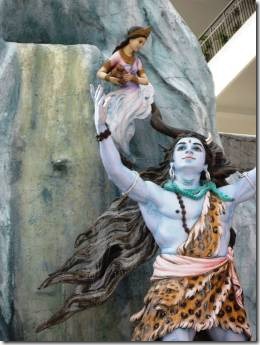
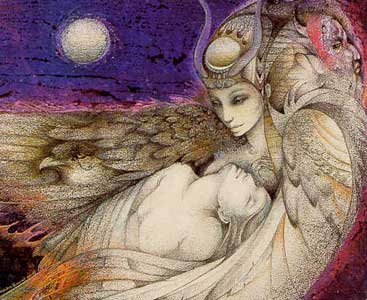
Having just found out it is international Earth Day Today, I thought it was a nice coincidence that I have seen the movie Noah today. It was extremely thought provoking to me. Thanks to James Lovelock, we now tend to personalize Earth as Gaia. I was not happy that although the Goddess was markedly present in the movie, she was never acknowledged by name. The giants, her progeny, were not called her sons. Female characters were shown as little more than passive receptacles for new life that must be protected by strong men, although they were beautifully portrayed by both Emma Watson and Jennifer Connelly. But there was raw honesty in such a depiction: I kept thinking that at the very basic level of survival, the first chakra, we maybe operate like this. On the other hand, I could not help thinking about Noah’s spiritual crisis at the end of the movie. I think he understood that if we operate at the basic instinct level, the earth indeed does not need us. We need to do two things as human species: acknowledge that we are not more evolved than animals (that we are essentially the same) and, having done that, having acknowledged our basic equality with the animal kingdom, step into the position of wise curators of all Creation.

Image

Posted in Earth | Tagged , , , , , , | 21 Comments

The Art of Resurrection

Today my thoughts were directed to the phenomenon of Greek “abaton”:

“Also called a mundus or earth-womb, the abaton was a real pit, standard equipment in a pagan temple. Those who entered it to ‘incubate,’ or to sleep overnight in magical imitation of the incubatory sleep in the womb, were thought to be visited by an ‘incubus’ or spirit who brought prophetic dreams. Novice priests went down into the pit for longer periods of incubation, pantomiming death, burial, and rebirth from the womb of Mother Earth. …

The Old Testament Joseph earned his oneiromantic talent by incubation in a Pit. The ‘brothers’ who put him there seem to have been fellow priests. He could interpret Pharaoh’s dreams only after he had submitted to the ritual. Assyrian priests derived similar powers from a sojourn in the Pit. They then assumed the priestly coat of many colors, signifying communion with the Goddess under her oneiromantic name of Nanshe, ‘Interpreter of Dreams.'”

Barbara G. Walker, “The Woman’s Encyclopedia of Myths and Secrets”

Incubation in the pit may be equaled to a “lesser death” while today we are celebrating the magic descent and rebirth through overcoming of even greater forces of darkness. I have been looking closely at painting of the Resurrection this morning and I came across this website with various depictions of the theme:

http://www.jesus-story.net/painting_resurrection.htm

My attention was caught by a few wondrous paintings:

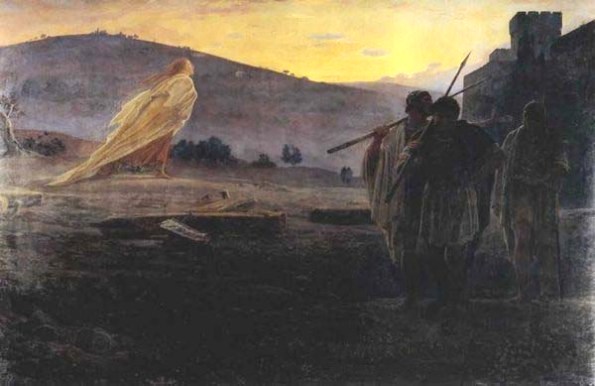
1.Nikolay Gay, “Harbingers of the Resurrection”

Image

Sometimes, when the whole world is still in darkness but if we are attentive we notice a brightly shining harbinger of hope announcing the good news. In his magnificent poem “Patmos,” Friedrich Hölderlin (frequently quoted by C.G. Jung) wrote: “The god Is near, and hard to grasp. / But where there is danger, /A rescuing element grows as well.”

2. Peter Paul Rubens, “Christ Risen”

Image

What I adore about this is the fleshiness of the body of Christ. There are no traces of death, no emaciation or death pallor. He is strong, powerful but also very human.

3. Rembrandt van Rijn, “The Resurrection”

Image

I find this painting breathtaking. Unlike Rubens, he focuses on the divinity of Christ and the sheer numinosity of the moment. There is an enormous out of this world quality about the scene. Rembrandt was a master painter of supernatural light.

4. Pieter Bruegel the Elder, “The Resurrection”

Image

You can barely see Christ here hovering over the figure of the angel. Where do I start? Paintings bathed in gold have always been my favorite. I am fascinated also by the tumult among the people faced with this miracle.

5. William Blake, “Angels Rolling away the Stone from the Sepulchre”

Image

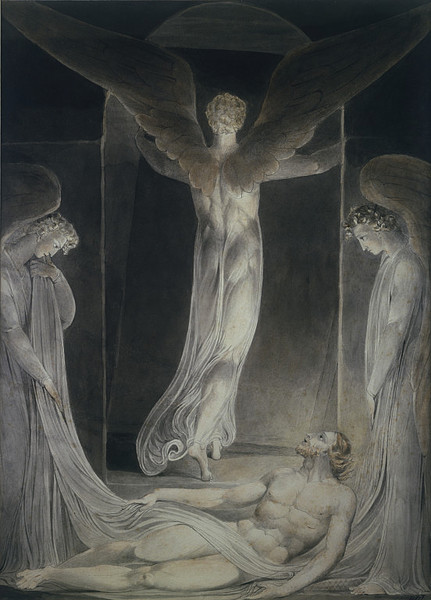
This is another depiction of “the moment before.” I am especially enchanted by the composition.

6. Michel Ciry, “The Risen Christ”

Image

This very modern image struck me particularly. On the one hand, I thought that it shows the inherent divinity in every human being. On the other hand, I thought of the suffering of the Holocaust victim although I am not sure whether the artist intended for such a reception.

Support my blog

If you appreciate my writing, consider donating and make my day. Thank you in advance.

$1.00

Posted in Painting | Tagged , , , , , , , , , , , , , , , | 15 Comments

The Flowers

Image

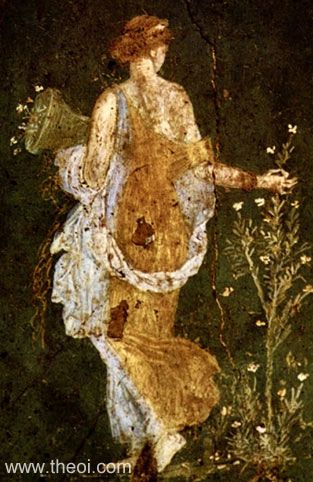
Goddess Flora


“The Flowers” by Stéphane Mallarmé

(translated by Henry Weinfield)

“From golden showers of the ancient skies,
On the first day, and the eternal snow of stars,
You once unfastened giant calyxes
For the young earth still innocent of scars:
Young gladioli with the necks of swans,
Laurels divine, of exiled souls the dream,
Vermilion as the modesty of dawns
Trod by the footsteps of the seraphim;
The hyacinth, the myrtle gleaming bright,
And, like the flesh of woman, the cruel rose,
Hérodiade blooming in the garden light,
She that from wild and radiant blood arose!
And made the sobbing whiteness of the lily
That skims a sea of sighs, and as it wends
Through the blue incense of horizons, palely
Toward the weeping moon in dreams ascends!
Hosanna on the lute and in the censers,
Lady, and of our purgatorial groves!
Through heavenly evenings let the echoes answer,
Sparkling haloes, glances of rapturous love!
Mother, who in your strong and righteous bosom,
Formed calyxes balancing the future flask,
Capacious flowers with the deadly balsam
For the weary poet withering on the husk.”
Image
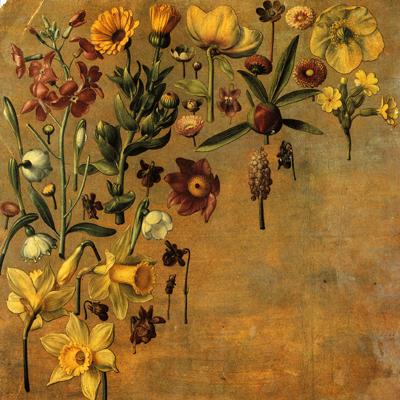
Albrecht Dürer, “Daffodils and Other Flowers”
Image
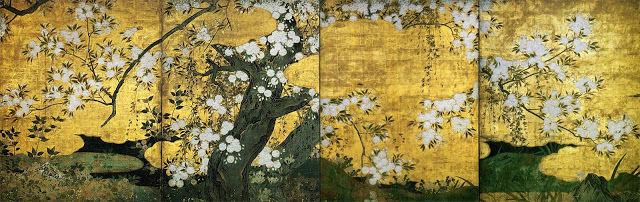
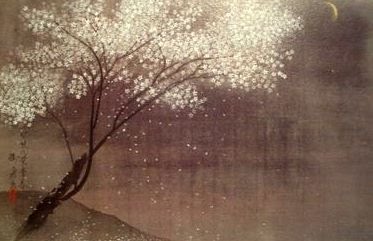
Hasegawa Kyuzo, “Cherry Blossoms”
Image
Hayami Gyoshu, “Spring Evening”
Posted in Poetry | Tagged , , , , , , , , , | 7 Comments

The Secrets of the Odyssey (7): Circe and the Underworld

Image

J.W. Waterhouse, “Circe Invidiosa”

As his journey progresses, Odysseus gradually loses all his ships and companions, all of his spoils of war, until he becomes solitary at the very end of the epic. Right after the disaster with contrary winds, he loses eleven out of his twelve ships in the encounter with Laestrygonians, man-eating giants. Broken and in mourning, while the moon is still in her dark period, he arrives at Aiaia, Circe’s island. The Sun has now entered Leo and the Midsummer is approaching. Odysseus is about to meet the solar goddess queen Circe, daughter of the sun god Helios. But before that he decides to feed his crew by killing a giant stag and carrying it back to the ship:

 “In describing the killing of the stag Homer establishes important times not only in the day but also in the solar year and the 19-year cycle. The stag’s death-blow comes from a bronze-tipped spear, a metaphor for the sun and one that is repeated at the climax of the Odyssey. The spear strikes halfway down the line of the beast’s spine, which metaphorically places the sun on the ecliptic below the ‘back’ of Leo. It is now just halfway through the solar year. It is also the mid-point of the 19-year cycle and there are a further nine and a half years to go before Odysseus will be reunited with Penelope. Odysseus carries a giant stag back to his ship at the halfway point of the 19-year cycle with the sun in the stars of Leo. The stag’s golden horns represent the rays of the sun.”

Florence and Kenneth Wood, “Homer’s Secret Odyssey”

The name Circe means “circling hawk” or “Encircler” and her island lies in the centre of the starry seas of the universe. The encircling horizon of the island is the Sun’s ecliptic. Odysseus notices the smoke from Circe’s chimney, which is the focal point of the island around which heavens seem to rotate. The constellation of Leo represents Circe’s enchanted palace. While the Moon is still dark, Odysseus sends a scouting mission to the palace, himself prudently staying behind:

 “In the wild wood they found an open glade,

around a smooth stone house—the hall of Kirkê—

and wolves and mountain lions lay there, mild

in her soft spell, fed on her drug of evil.

None would attack—oh, it was strange, I tell you—

but switching their long tails they faced our men

like hounds, who look up when their master comes

with tidbits for them—as he will—from table.

Humbly those wolves and lions with mighty paws

fawned on our men—who met their yellow eyes

and feared them.

Low she sang

in her beguiling voice, while on her loom

she wove ambrosial fabric sheer and bright,

by that craft known to the goddesses of heaven.”

(translated by Robert Fitzgerald)

circe

What ensues is probably the most famous episode of the Odyssey: Circe turns Odysseus’ companions into pigs while their minds remain human. When Odysseus finds out what has happened, he sets about rescuing his companions, encountering Hermes on the way, who instructs him how to resist the spell of the goddess by means of the moly flower and a sword. A very deep symbolic message is encoded in that part of the Odyssey. Roger Sworder, in his book Science and Religion in Ancient Greece, restores Circe’s true power lost throughout the ages of patriarchal discourse. Before I summarize his musings, I would like to stop for a moment and ponder on the above passage from the Odyssey. She appears as a powerful Lady of the Beasts in it, a tamer of wild animals (wild instincts), a bringer of order to the universe. She is portrayed as the ultimate goddess from whose body the universe was formed, yet she is also the chaos that universe will eventually return to. She acts as a powerful and crucial initiator for Odysseus. In The Women’s Encyclopedia of Myths and Secrets, Barbara G. Walker writes that the word “kirkos” (falcon) comes from the same root as the Latin circus, which was originally an enclosure for funerary games. The falcon is a fitting totem for her because in symbolism it is both a solar bird and a death-bird. Walker also calls Circe a fate-spinner, “weaver of the destinies of men,” who manipulates forces of creation and destruction. What is more, Pliny wrote that Circe “commanded all the lights of heaven.”

Image

J.W. Waterhouse, “Circe Offering the Cup to Odysseus”

Roger Sworder gives an amazing analysis of the role of Circe in the Odyssey. She is the only one who calls Odysseus a “hero” in the whole epic and he is the only one who was able to resist her attempts to bewitch him. She was able to recognize his exceptionality instantly. Also Plato was of the opinion that Odysseus was very wise. Sworder summarizes Plato’s “Myth of Er,” (a legend which concludes his Republic), which contains references to the Circe episode. He remarks:

“Towards the end of the myth, the souls who are about to be born again choose the next lives which they will lead, and there is a general metamorphosis as the souls who were once people become other animals and those who were animals become people. This passage is certainly comparable to Homer’s account of Circe….”

Image

 Edward Burne Jones, “Circe”

Sworder calls the transformation into pigs “a descent into a lower form of life” and “an incarnation in a lower body.” He adds that “in Circe’s sties we are given an uncanny sense of the interchangeability of human and animal bodies….” Like Plato’s goddess Necessity, Circe seems to know Odysseus’ destiny and she helps him do what the gods and the task of soul making require him to do. She gives him detailed instructions how to get to the Underworld, where he needs to consult the blind soothsayer Teiresias. Sworder says she wields three crucial powers: “the power of metamorphosis over other beings; access to the realm of the dead; knowledge of the passage over the heavenly circuits represented by the Sirens, Scylla, Charybdis and Thrinacie.” He adds that “Circe’s palace is our whole world of physical nature. She is not primarily the goddess of metamorphosis; she precipitates people into their earthly embodiment.” Before Odysseus leaves her island, she gives him detailed instructions about the journey ahead of him. He is under the aegis of Circe from now on; also he is one of the precious few humans who have mated with goddesses. Circe gives Odysseus a son, Telegonus, who in the distant future back on Ithaca will accidentally kill his father, not having recognized who he really is.

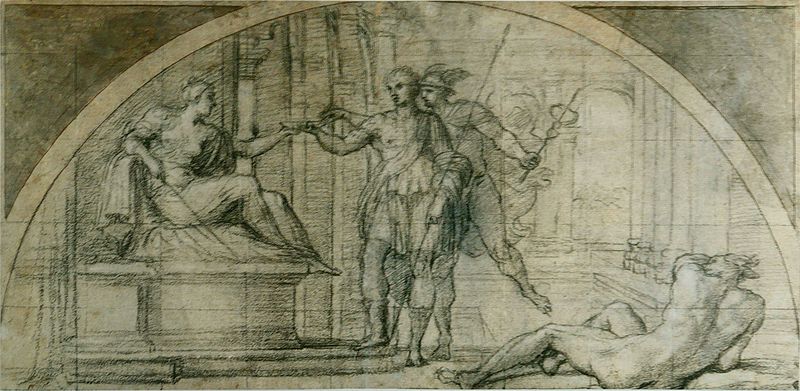
But how was Odysseus able to resist Circe’s spell? He used two props to achieve that end: the moly flower given to him by Hermes and a sword. Sworder writes of the moly herb:

 “…the plant comes with its root. It has been plucked from the ground entire, not picked, and its flower is the very opposite color from its root, milk-white against black.

And just as the eastern lotus represents the evolved soul which has reached bliss from its root in the world of illusion, so the Moly may symbolize the double nature of the human being whose base black root yields the lovely flower of compassion.

This is the symbol of the human being who is liberated or enlightened while still living. The entire physical organism remains but it is no longer attached to the realm in which it developed and from which it grew.

She cannot debase him because he is uprooted and detached.”

Image

Annibale Carracci, “Hermes Protects Odysseus”

Odysseus had already been uprooted and detached in the Cyclop episode, where he called himself No one. While his companions still wallowed in the mud, Circe bathed Odysseus in a hall of glowing gold, silver and bronze. But as the lotus flower grows over and beyond the mud of the world, so do Odysseus’ companions get turned back again into human form. It turns out the experience has transformed them: they look younger, taller and more radiant.

As the Sun leaves Leo and enters Virgo, Odysseus and the rest of his crew set off towards Hades. Visiting Hades is a pivotal point in the Odyssey and Odysseus’ most important adventure. Circe tells him that lifeless shadows of the dead crave blood because they desire embodiment. Odysseus needs to pour blood of a sacrificial black ram in order to give the shades their voice and be able to speak to them. Like many mythological figures before him, Odysseus descends to the underworld to bring up his soul. Talking to the blind Teiresias is part of his mission which does not seem to be the most crucial one. The real crux of the matter is giving a say and listening to countless voices of all the famous dead men and women, the superheroes, superheroins and myth makers that lived before him. He speaks, among others, to: Ajax, Agamemnon, Minos, Orion, Tartarus, Sisyphus, Heracles, and twenty-nine famous mythical women such as Phaedra, Ariadne and Leda. It is a poignant episode, especially when he meets his mother who had died before his return, out of grief for not seeing him. She cannot clasp him while he tries to embrace her corporeal nothing in vain.

Image

Russell Flint, “Odysseus in Hades”

What he returns to the surface with is immaterial but incredibly substantial: it is the stuff that dreams are made of, namely all the myths of Greece. In Homeric Moments, Eva Brann calls Hades “the safe-depository of tales, the treasure house of myth.” The ghosts are like “gibbering phantasms” but the story teller such as Homer or Odysseus infuses them with life and blood through his gift of poetry. Odysseus drinks from the source of Mnemosyne: the collective Greek memory. He is the last mythical hero, for after him begins a historical era, as Roberto Calasso wrote in his Marriage of Cadmus and Harmony:

 “Partly because he is so near the boundary, so near the point where the circle closes, Odysseus is the hero who most often tells stories. …last among the heroes to return from Troy, Odysseus is also the one who right up to the end maintains his contact – and what an intimate contact it was – with the primordial powers who appeared in the first phases of the cycle. His wanderings were partly a compendium, a roll call, of all those beings and places that were already growing confused in many a memory, already being removed to the realm of the fabulous. … After his return to Ithaca, man’s approach to primordial beings and places could only take place through literature.”

Support my blog

If you appreciate my writing, consider donating and make my day. Thank you in advance.

$1.00
Related posts:

The Secrets of the Odyssey (1)

The Secrets of the Odyssey (2): Elements of Time (the Muse and the Moon)

The Secrets of the Odyssey (3): Calypso and Phaecians

The Secrets of the Odyssey (4): A Tribute to Penelope

The Secrets of the Odyssey (5): Lotus-Eaters, Auriga and Polyphemus

The Secrets of the Odyssey (6): the God of Winds

The Secrets of the Odyssey (8): the Sirens, Scylla & Charybdis, and Thrinacia

The Secrets of the Odyssey (9): Leucothea in the Sea of Space and Time

https://symbolreader.wordpress.com/2014/07/14/the-secrets-of-the-odyssey-10-return-to-ithaca-through-the-cave-of-the-nymphs/?preview=true

The Secrets of the Odyssey (11): Death of Odysseus, Master of Land Ways and Sea Ways

Posted in The Odyssey | Tagged , , , , , , , , , , , , | 16 Comments

The Secrets of the Odyssey (6): the God of Winds

Image

In the fourth month of his journey, Odysseus, guided by friendly winds, reaches the kingdom of Aeolia, where the god of winds Aeolus resides with his family: wife and twelve children. Homer depicts it as a rectangular island, which brings to mind the constellation of Gemini. Indeed, the Sun is in Gemini during this adventure.

 “The rectangular island can also be perceived as the bed in which Aeolus and his wife and family of 12 children sleep warm and snug under the blanket of the Milky Way.”

Kenneth and Florence Wood, Homer’s Secret Odyssey

Image

The constellation of Gemini has an old connection with windy and stormy weather. The two twins, Castor and Pollux, were put in heavens as a reward for protecting the ship Argo from violent storms during the quest for the Golden Fleece. In ancient Greece, the twins were believed to bring good luck to sailors. This is how Odysseus retells this adventure:

Image

“He kept me

one full month to hear the tale of Troy,

the ships and the return of the Akhaians,

all which I told him point by point in order.

When in return I asked his leave to sail

and asked provisioning, he stinted nothing,

adding a bull’s hide sewn from neck to tail

into a mighty bag, bottling storm winds;

for Zeus had long ago made Aiolos

warden of winds, to rouse or calm at will.

He wedged this bag under my afterdeck,

lashing the neck with shining silver wire

so not a breath go through; only the west wind

he lofted for me in a quartering breeze

to take my squadron spanking home.”

(transl. Robert Fitzgerald)

The whole stay on the island was very auspicious and pleasant for Odysseus and his crew. Why would the god of winds go out of his way to help Odysseus? Why would he give him a sack containing all the contrary winds except for Zephyr, a gentle western wind which will guide the hero to Ithaca? I think this short episode offers important clues regarding Odysseus’ personality. The symbolism of the sign Gemini is heavily pronounced in this part: Odysseus spends the whole month talking to Aeolus about his adventures, the whole island is not fixed but keeps moving, being a floating island. Winds are naturally connected with the element air, and the airy sign of Gemini, ruled by Mercury, is associated with short journeys, movement, communication, conversation and intelligence. The quick-witted, easily-lying Odysseus, the cleverest trickster, the smartest strategist is, at least the way I see him, an epitome of Gemini. His endless curiosity spurs him on and on, making him lose his cautiousness to look in every cave, every nook of each island he visits to satisfy his endless quest for new vistas and new experience. It takes one to know one, and Aelous recognized these qualities in Odysseus, making him a guest of honour on Aeolia. Dane Rudhyar, in his book Zodiac as the Universal Matrix, says this about the sign Gemini:
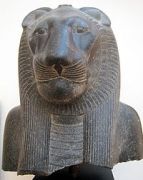
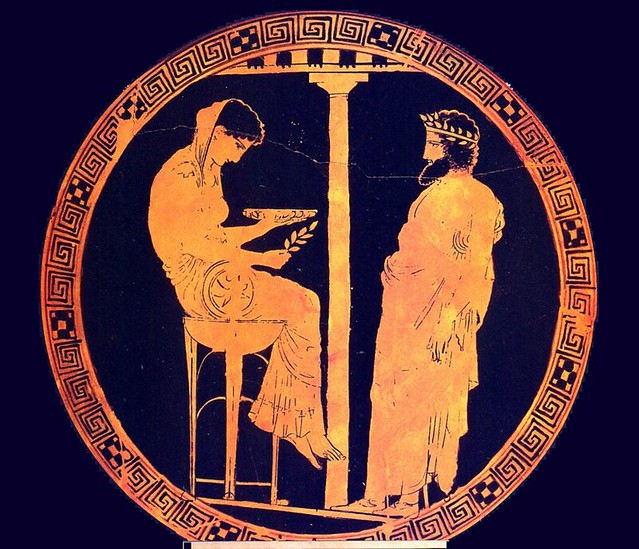
“The scatteredness of the Gemini type has often been over-emphasized. It is scatteredness only if the person does not succeed in finding the synthesizing factor, the God-seed, the guru, the “program” – through which his seemingly roundabout flight finds a direction and a purpose. … Without it, his stirrings become aimless wanderings. … The axis must be either rooted an old and secure tradition which the Gemini person fulfills (as was Dante – a strong Gemini type); or else it must be the all-powerful pull of an envisioned goal drawing the mind, as the strong vacuum at the centre of the tornado or twister draws all that is found on its path (Walt Whitman path).

At any rate it is essential for the person born with the Sun in Gemini to realize that his life normally progresses in a spiral motion. He must learn to understand cycles and to go over and over again the same things; but actually the repetition should be each time at a higher or deeper level. Gemini energy is associative energy – energy generated by relationship, by finding new ways of relating things and principles. … At the same time, the Gemini force moves one to seek escape from earth-bondage … and at times from normal biological instincts.”

Aeolus hid the winds he gifted Odysseus in a bull’s hide, alluding to the previous phase of the Zodiac, Taurus and neatly transiting to the sign of Gemini, which is associated with the winds. Odysseus and his companions sailed peacefully towards Ithaca, which appeared on the horizon at the moment when the Sun entered Cancer, the sign associated with home, among its other meanings. Unfortunately, the relieved Odysseus fell asleep at this point and his companions, who had not been informed about the contents of the bag, opened it because they suspected it contained a treasure. A violent storm ensued and blew their ships far, far away from Ithaca. When Odysseus awoke he was in such deep despair that he pondered suicide. But he endured, covered himself and lay down on the bottom of his ship in quiet despair.

 “Here are his most marked traits of character and his odyssean modus vivendi in capsule form: endurance and hiding.”

Eva Brann, Homeric Moments

There is more to Odysseus than just endurance and hiding. These qualities are means to a much more important end, which will be revealed in the next crucial part dedicated to the goddess Circe and Odysseus’ visit in the Underworld. These two episodes are pivotal for the Odyssey, for they endow our hero with the program, direction and purpose of his quest, for Odysseus was indeed like Dante to the Greeks.

Image

Related posts:

The Secrets of the Odyssey (1)

The Secrets of the Odyssey (2): Elements of Time (the Muse and the Moon)

The Secrets of the Odyssey (3): Calypso and Phaecians

The Secrets of the Odyssey (4): A Tribute to Penelope

The Secrets of the Odyssey (5): Lotus-Eaters, Auriga and Polyphemus

The Secrets of the Odyssey (7): Circe and the Underworld

The Secrets of the Odyssey (8): the Sirens, Scylla & Charybdis, and Thrinacia

The Secrets of the Odyssey (9): Leucothea in the Sea of Space and Time

https://symbolreader.wordpress.com/2014/07/14/the-secrets-of-the-odyssey-10-return-to-ithaca-through-the-cave-of-the-nymphs/?preview=true

The Secrets of the Odyssey (11): Death of Odysseus, Master of Land Ways and Sea Ways

Posted in The Odyssey | Tagged , , , , , , , , , | 17 Comments

Life’s Prose and Love’s Poetry: On Various Types of Relationships

“Dream delivers us to dream, and there is no end to illusion. Life is like a train of moods like a string of beads, and, as we pass through them, they prove to be many-colored lenses which paint the world their own hue.”
Ralph Waldo Emerson Essays, Second Series

jof.anima.501

Johfra Bosschart, “Animus and Anima”

Today the planet Venus will move into the sign of Pisces. Here is a short quote from Dane Rudhyar’s Zodiac as Universal Matrix about Venus in Pisces:

“In Pisces, Venus operates primarily with memories, with the essence of things now vanishing, with fantasies and transcendent ideals. For this very reason it is so full of charm and mystery. Venus in Pisces is the dream-lover, the mystic Beloved, Dante’s Beatrice, the ‘redeeming woman’ of the Romantics. It often gives to a person a disarming kind of fascination which can hardly be defined. Yet no one should trust too much such a person in emotional matters. Her love is usually based on the projection of some complex, and it lacks either freshness or the constructive power of emotional maturity.”

Image

Dante Gabriel Rosetti, “Salutation of Beatrice”

Having read the words of Rudhyar, I started to ruminate. First of all, I think the projection he mentions in the last sentence is definitely something that colours everybody’s experience of relationships in our culture. In a romantic projection, reality recedes into the background while we continue to spin illusions that veil the real world. If the end product of such an illusion is a masterwork similar to the Divine Comedy, then perhaps we may see that the way Dante perceived Beatrice was not entirely false, since “Beauty is Truth,” as the poet said.

Image

Gustave Doré, “Beatrice and Dante”

However, it always helps to see through our own, more run-of-the-mill romantic projections. In his book Healing the Soul: Pluto, Uranus and Lunar Nodes, Mark Jones talks about how romantic projections can bring about our undoing:

“Many relationships never evolve beyond the meeting of the need in mutual projection. We meet someone who fits our image of the perfect partner and we are fortunate that we meet their image of the perfect mate and we then become glued by the fit of imagery. This is necessary glue it could be argued, a tool for bonding. However, if this is all there is, it is sticky!

Image


It is hard to underestimate the extent to which human beings want the word, and other people in the world, to conform to their expectations. Acknowledging this T.S. Eliot writes in Four Quartets, ‘Go, go, go, said the bird: human kind Cannot bear very much reality.’ To bear the reality of another human carries the potential of loving them for who they actually are versus engaging with them in a superficial kind of psychic mutual masturbation.”

Mark Jones was a student of Jeffrey Wolf Green, the founder of the School of Evolutionary Astrology, who has fascinating things to say about relationships, which he divides into five types:

“(1) co-dependent
(2) counselor/counselee
(3) student/teacher
(4) sado/masochistic
(5) self-reliant”

He also offers his unique understanding of the concepts of soul mates, karma mates and twin souls. For a complete discussion, you can look here. I will talk about various types selectively. This is what he says about co-dependent relationships:

“The co-dependent relationship is a relationship in which both people are dependent on one another for their lives to be sustained. In this condition each person will project their needs upon the other in such a way as to expect each other to perpetually meet those needs. This then becomes the basis of mutual projection wherein each person ‘out pictures’ their inner reality upon one another, this out picturing and projection of inner realities upon one another creating a situation wherein neither person can see clearly, if at all, the actual reality of one another.”

Image

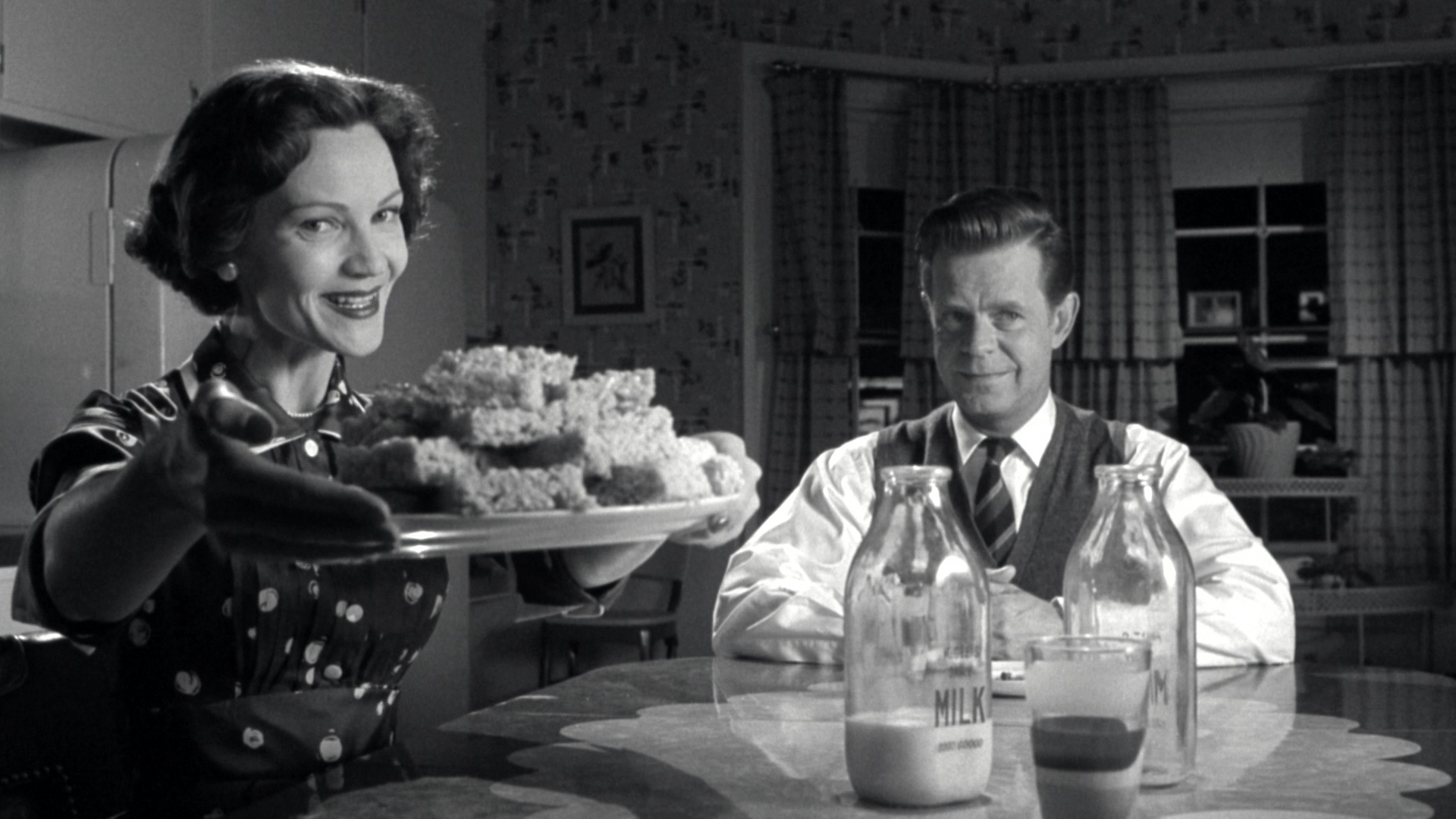
“Pleasantville”

In a co-dependent relationship, people cannot live without one another and cannot picture themselves outside of the relationship.

Moving on to the sadomasochistic type, I found a lot of Green’s statements very striking. He speaks of unconscious thought patterns which “condition, control and create the circumstantial realities of the masochistic type of person.” These are:

“(1) I deserve pain, punishment, crisis, suffering, humility (to be humiliated), and denial and I do not know why. …
(2) For my needs to be met, I must hurt first.
(3) I am essentially worthless, while intellectually knowing better.”

According to Green, masochists frequently attract the type that he calls “emotional wounded birds.” These people always need to be fixed emotionally and psychologically. The needs of the masochistic partner within such a dynamic remain unacknowledged:
“In this situation, the masochistic person does almost all the giving, and is constantly putting out the emotional brush fires that the ‘wounded bird’ is creating. It is as if the masochistic partner might as well walk around the house with a white uniform on, red cross on the shoulder, and a name tag on the breast!”

Sadists, who can be both men and women, operate guided by the unconscious “fear or feeling that the opposite gender will disempower, undermine, capture, enslave, or in some undefined way destroy oneself. Consequently, the sadistic pathology will desire to hurt another first, to attack first, to destroy first, to ‘get even’ first, before it allows itself to get hurt.” It is interesting that both partners feel punished or fear punishment, but the masochist feels that he/she deserves it, while the sadist is angry and vindictive. Both these individuals are driven by subconscious feeling of guilt. Green points out that the sadomasochistic dynamic permeates our culture. Women are still not equal to men, he argues:

“Again, can it not be seen in the man and women doing the same job and the women makes less ? Can it not be seen in a man or a women who withholds their emotional or sexual attention from their partner as a form of punishment ? Can it not be seen in various forms of perpetual criticism from one partner to another; or both. This form can also be linked with “teasing” when that teasing has a motivation of humiliation.
Can it not be seen in the man who expects the women to be merely a vicarious extension of his reality whose only purpose is to SERVE his needs ? That the women is inferior to him: a second class citizens at best. Is this not a form of dominance and submission?
Or, more commonly, the situation of a man who can be emotional and placating to the women in order to have sex with her, and then when the act of sex is over he is suddenly emotionally remote or overtly/covertly disdainful of the women; sometimes even angry at her. Why? He has given in to the temptation! If you can understand this, then you will understand why women has to be PURE, and why women feel that they must be pure for their men: atonement linked with the original guilt generates the need to be clean: pure.”

Image
Medieval painting of a witch preparing a love philter – Flemish School (image source. http://www.luxnoxhex.org/LNXMUS-sabbath-7.html)

Because the above themes correlate astrologically with the signs Virgo and Pisces, Venus entering Pisces can make us think of these issues on a collective and personal level. So much injustice, so many imbalances are currently coming into our global conscious awareness. In this climate, seeking retribution, being stuck in victim mentality is not easy to avoid. What we can choose to do instead is to create a new world and a new reality for ourselves in which these conflicts will be outgrown. This will take years but is a necessary evolutionary step for humanity.

The highest and most sublime form of the sign Pisces or its modern ruler Neptune manifesting itself in relationships is in the so-called soul mate relationships. The Internet is full of idealistic articles about this kind of a blissful union; I think it may be interesting to see how Jeff Green sees it:

“Soul Mates are two people who have independently acted upon their desires to embrace a spiritual or transcendent reality, and the real purpose of the union with one another is to continue their individual spiritual development BECAUSE OF AND THROUGH THE RELATIONSHIP. …
A subtyping within Soul Mates is the phenomena of the same Soul. What this means is that in certain states of advanced evolution, the spiritual state defined earlier, a Soul can manifest itself in more than one body/personality/ego at a time. In essence, the Soul, in order to accelerate its evolution through the progressive elimination of all separating desires, can manifest itself in what appears to be different people who exist at the same time and place, at the same time in different places, or both. …
The classical or archetypal feeling in each of the ego’s or personalities that the Soul has created in order to accelerate its evolution in this way, is one in which there is a deep, permeating sense of not being complete; that there is a great inner existential void. Even when everything else in their life is so full, including a rich and experiential spiritual life, the different “individuals” who emanate from the same Soul have this inner feeling of something missing: it haunts their conscious sense of self. This feeling is registered in the ego’s of the different personalities (people) that the Soul has created. Archetypically, there is a reason for this feeling. And the reason is that, at some point, the Soul who has splintered itself in these ways must merge back into itself the different components of itself that took on the FORM of distinct and separate people.

In the beginning of this reunion, the different people who meet can manifest a resistance to one another. The reason for this is : the ego in each person has defined itself as a separate individual. This is a reflection of the separating desire inherent to the Soul. Thus, for the ego to let go of itself, to merge back to the Soul that created it, is to simultaneously ignite the fear of personal dissolution. So, in the beginning of such a dynamic, there is attraction and repulsion. Over time, such fears will subside. As they do so, the different people that the Soul has created will become ever closer to one another. The last stages of this process will manifest in such a way that the different people will finally commit to one another in a marriage type of dynamic. When this occurs, it will be a relationship within the specialty typing called Soul Mates. When this evolutionary process culminates, the manifestation of the different people will no longer exist. The merging of the Soul’s different components, reflected in antithetical desires as the different people, has occurred. Thus, the Soul is now fully integrated, and ready to begin the conscious merging of itself back to its own Source: God.”

Image

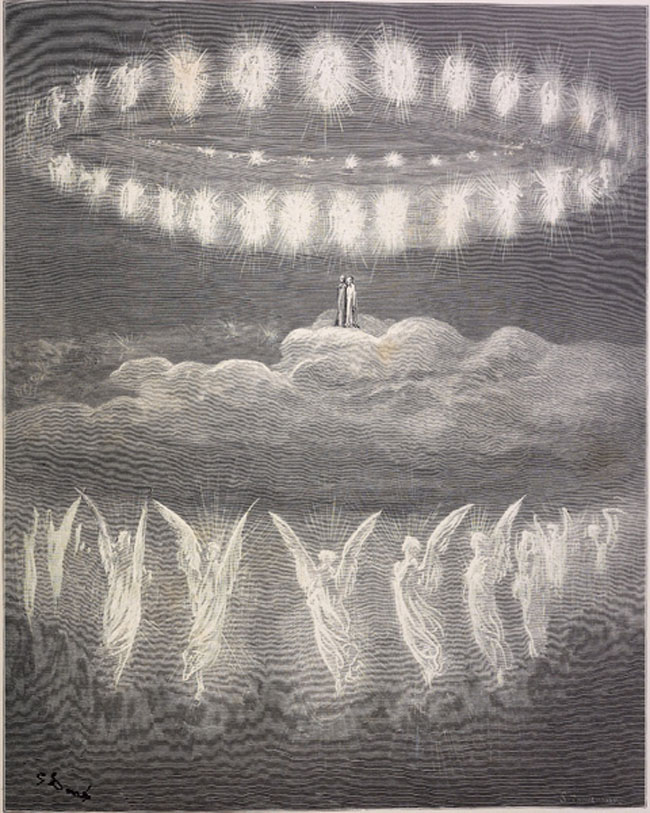
Gustave Dore, “Heavenly Host” (Having reached the Ninth Heaven Dante and his guide Beatrice look at the circles of the heavenly host. After reaching the summit of Purgatory, Dante got a new guide to the afterworld: Beatrice, his Divine Love, who took over after Virgil.)

Posted in Eros and Psyche | Tagged , , , , , , , , , , , , , , , , , , , | 25 Comments

The Art of Sight

Image

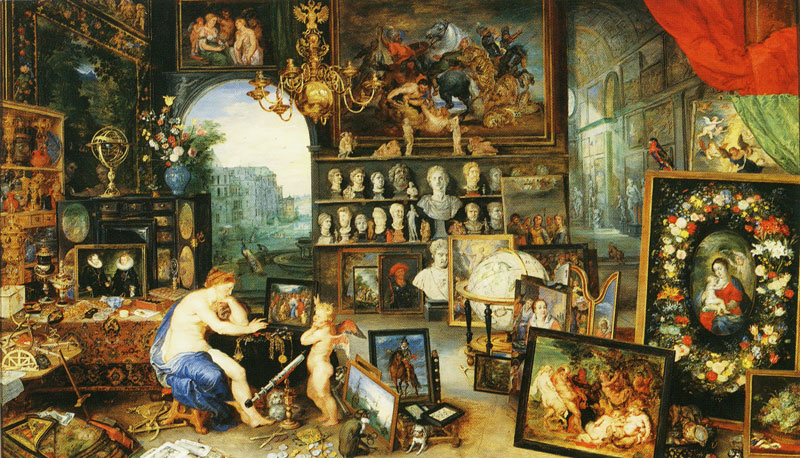
Jan Brueghel the Elder and Peter Paul Rubens, “Allegory of Sight”

“We are all visionaries, and what we see is our soul in things,” wrote Henri Amiel in his journal. The psyche presents itself most directly through images. The world we look at is like a cabinet of curiosities: the collection my eyes see is different to what your eyes see. I love the wonderful plethora of objects huddled in this painting: looking at it, I feel dizzy but also excited about discovering an unclassified world of wonders. I believe the true seeing comes from within and what we see reflects the degree of our attunement with the soul. In an extraordinary novel by Jose Saramago called Blindness, the inhabitants of the whole city, except for one woman, become blind. She becomes the soul of the book, the only one who able to see, nurture others and save them.

Like John Berger, a celebrated art critic, I believe that seeing comes first, before words and thoughts. “When in love, the sight of the beloved has a completeness which no words and no embrace can match…,” wrote Berger in his book Ways of Seeing, which I am reading now with great pleasure. It is only when we are in love that we feel what it really means to see and be seen.

Image

Beautiful images have always exerted a very seductive influence on me. In our digital era, we all have equal access to beautiful images. In the painting featured above, we see a collection of objects that once belonged to a rich aristocratic couple. “For the first time ever, images of art have become ephemeral, ubiquitous, insubstantial, available, valueless, free. They surround us in the same was as a language surrounds us,” says Berger in the same book. But as we are bombarded by millions of images every day, is our gift of seeing becoming sharper? If all images come to us from without, do we still make the effort to imagine out of the depths of our souls? I want to regain my sense of sight. This is why I am going to work my way through John Berger and his Ways of Seeing and another book by him, under the title The Sense of Sight. In the latter book he meditates on visibility, presenting looking as a profound form of meditation:

Image

“Visibility is a quality of light. Colours are the faces of light. This is why looking is to recognize, enter a whole. … The fact is visibility (inseparable from light) is greater than its categories of measurement (small, big, distant, near, dark, light, blue, yellow, etc.). To look is to rediscover, over and beyond these measurements, the primacy of visibility itself.

The eye intercepts the continual intercourse between light and the surfaces which reflect and absorb it. Separate objects are like isolated words. Meaning is only to be found in the relation between them. What is the meaning to be found in the visible? A form of energy, continually transforming itself.

To look:
At everything which overflows the outline, the contour, the category, the name of what it is.”

Image

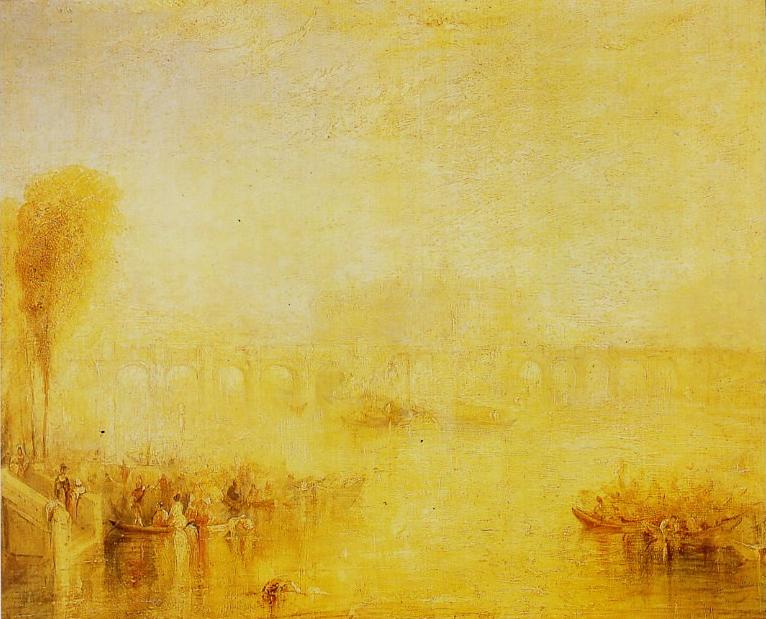
Joseph Mallord William Turner, Landscape with a river and a Bay in the Distance

Posted in Painting | Tagged , , , , , , , , , , , , | 32 Comments

The Well of Feminine Power

Durga is a goddess I’ve wanted to find out more about for a long time.

Posted in Uncategorized | 6 Comments

On Two Levels of Love

Image

Dane Rudhyar

Dane Rudhyar, whose birthday we celebrate tomorrow, always inspired me with awe by his astrological writing which encompassed his vast knowledge of art, music, philosophy, myth and practically all forms of spirituality. The following excerpts come from his short article on “Two Levels of Love,” which you can read here in full. I think it captures the essence of our current astrological weather and can be enjoyed by both an astrologer and a lay person. He spoke the language of the soul, which is understood at a level deeper than any technical terms or obscure terminology. A large collection of his writing can be found here.

I encourage you to read this essay here:

http://www.khaldea.com/rudhyar/astroarticles/twolevelsoflove.php

Here are just a few quotes I loved:

“Love is that power which urges every form of existence to realize as yet unrealized potentialities of existence and, thus, to become more than it has been so far — or, at least, different.”

Image

Jan Soens, “Rinaldo and Armida”

 “Venus has been traditionally known as the planet referring to love; but it is also the symbol of the organs which produce the male as well as the female seed-testicles and ovaries. Venus ‘rules’ over the feeling of love; Mars, over the activity of love and all that carries the seed to its destination. Venus is the rhythm of production of seeds; Mars, the rhythm of impregnation.”


Image

Jan van Eyck, “Giovanni Arnolfini and His Bride”

“There is a love which does not accept being bound by the patterns of social-cultural normality and maturity; it is ever ready to accept the as-yet-unknown, with eyes and heart always open, always warm with the sense of wonder and the precious gift of humility and adoration. Such a love is at the very core of the symbolic meaning of Neptune. ”

“This love is an act of transfiguration, a flow of light, a song of tenderness; it is mother love as well as lover love, for it seeks to hold everything — and, of course, more particularly, the object upon which the love is then focused — in the vast openness of a consciousness for which every contact is, or tends to be, a dissolution of boundaries and an absolution for past fears, refusals or sins.”


dore

Gustave Doré, “Jesus and the Woman of Samaria”


Posted in Eros and Psyche | Tagged , , , , , , , , , | 7 Comments

Orpheus and the Taming of the Wild

Image

Orpheus, a Roman mosaic

I have recently read a fascinating article by Liz Locke, under the title “Orpheus and Orphism: Cosmology and Sacrifice at the Boundary” (Folklore Forum 28:2, 1997). Orpheus is a figure that hides many mysteries. He was a master lyre player and singer whose music “would calm wild beasts and move trees, rocks, and rivers to gather about him to listen.” In the most famous myth, his newly wedded wife, Eurydice, dies of a snake bite. He begs Persephone, the Queen of the Underworld, to bring his wife back. The goddess is so moved by his music that she allows him to descend to the underworld and bring back Eurydice under the condition that he cannot look at her until they are both safely back. Unfortunately, he cannot resist the urge to look at her prematurely and he loses her forever. In another myth, his sad, mournful singing after losing his wife for the second time, drives the Maenads to such a frenzy that they tear his body to pieces. He was also said to have saved the crew of Jason’s Argo from the deadly song of the Sirens. Finally, he is said to have been the founding father of Orphism, an exclusively male religious sect. Asceticism and disavowing of the body was at the core of their beliefs and practices. They strongly believed in reincarnation and a separation of the mortal body and the immortal soul.

They also professed their own version of a creation myth, different from that of Homer and Hesiod. Liz Locke summarizes it in this way:

“First there was Chronos (Time). Out of Time came Aither (Ether), Chaos (Unorder), and Erebos (Darkness). Time fashioned an Egg inside Aither. The Egg split into two parts and from it emerged Phanes, marvelously beautiful, of both sexes, a figure of shining light with four eyes in a lion’s head, and golden wings, who is also called Protogonos, Eriepaios, Metis, Ge, Eros, Kore, and Dionysos … Phanes bore a daughter, Nyx (Night), with whom s/he mated and to whom s/he gave the gift of prophecy. Nyx gave her oracles in a cave guarded by a goddess called Ananke (Necessity), the first law-giver for the gods. Phanes then gave  her/his scepter to Nyx, making her the second ruler of the universe.

Nyx bore Gaia (Earth) and Ouranos (Sky), who together produced the Titans – Kronos, Rhea, Okeanos (Ocean), Mnemosyne (Memory), Themis (Sovereignty), and the rest. Gaia bore the Moirai (Fates), the Hechatoncheires (Hundred-Handers), and the Cyclops, who fashioned and bestowed the thunderbolts. Nyx passed Phanes’ scepter to Ouranos, who was castrated by Kronos (Nyx’s favorite grandchild), and from whose semen arose Aphrodite, the essence of sex. The matings of Kronos and Rhea produced the generation of gods known as the Olympians, among whom was Zeus, whose early protection was undertaken by the Kuretes, male nurturers of Mt. Ida on Crete, at the behest of Nyx.

Having been spared by Rhea from Kronos’ child-killing spree, and castrating him in the traditional way, Zeus swallowed Phanes-Eros-Metis-Dionysos, the originator, thereby becoming ‘the beginning, middle, and end of all.’ Together with Phanes, all things within Zeus were created again: Aither, Chaos, Erebos, Sky, Ocean, Earth, Tartaros and all the gods and goddesses. The commentator of the ‘Derveni Papyrus’ tells us that the animating principle behind all of this work is Moira (a singular female incarnation of Fate), who, having been swallowed as breath (reason), gives Zeus mastery over Time (Being-in-Time) itself . ‘All that was then in being and all that was to come to pass, all was there, mingled like streams in the belly of Zeus.’

Zeus asked his great-grandmother Nyx how he might separate out the Many from himself, the One, and establish his rule. Nyx taught him how to arrange the universe. Athena sprang from Zeus’ head to become ‘the accomplisher of his will.’ Zeus with Rhea (now identified as Demeter) mated in the bodies of snakes to produce Kore-Persephone. Raped by Hades, she bore the Furies; raped by Zeus, she bore the infant Dionysos, to whom Zeus gave Phanes’ throne and scepter, saying to all the generations, ‘This one have I made your king.’

The Titans, renewed with the rest, got past the Kuretes, stationed again as guards, and attacked the child Dionysos (now called Zagreus), while he played with a mirror and other toys. In attempting to escape them, he became ‘a youthful Zeus, an aged Kronos, a babe, a youth, a lion, a horse, a horned snake, a tiger, and a bull’ The Titans killed Zagreus, tore his body into pieces, boiled, roasted, and ate his flesh. Zeus sent Apollo to collect, arrange, and bury his limbs on Mt. Parnassos at Delphi. Athena rescued his heart, which Zeus pounded into a potion and gave to a mortal woman, his lover Semele, to drink. Semele’s body, annihilated at Zeus’ parousia, was no longer suitable for birthing the god, so he snatched the sacred embryo from her womb and replanted it in his thigh. Dionysos was reborn from Zeus. But because some of the Titans had killed and cannibalized the god, Zeus hurled his thunderbolt at them (Atlas and Prometheus, at least, were spared); from their charred remains, there arose a race that had never been seen before, ‘mortal men’ So now to Dionysos we make prayer and sacrifice in all the seasons of the year, yearning to be set free from our lawless ancestry.”

Image

Gustave Moreau, “Night”

It is interesting to notice that Night, the primordial mother “is the first explicitly sexed entity in the universe.” She produces Ouranos and Gaia, the primordial male and female, the Above and the Below. There are so manyfascinating twists and turns in the whole myth that may require a separate post to delve deeper into.In her article, Liz Locke claims that at the heart of Orphism was an inherent split: between Apollo and Dionysos, between the pure man and the impure woman. Orphic rites excluded women, while Dionysian rituals had women at their centre and were always practised first and foremost at the level of the body, while Apollonic rituals were of the mind. Locke quotes another scholar, Helen Deutsch, who was to say that Dionysus was the one who saved women, while Apollo killed them.

 Orpheus, similarly to Apollo, believed that music civilized what was wild, bringing order and decorum. The aim of Orphism was to bring the Dionysian wildness under control, civilizing and utilizing it. Liz Locke makes a very bold statement at the end of her article, claiming that the death of Eurydice was a sacrifice. She says that by Orpheus looking at her she was “brought under a kind of analytic control, but in the process (she was) killed.” The maenads who tore his body to pieces may thus symbolize the ultimate revenge of the shunned Dionysian side, or the revenge of the shunned feminine.

Image

John William Waterhouse, “Nymphs Finding the Head of Orpheus”

Image

 Gustave Moreau, “Orpheus”

However, according to myth, even after his death his head kept on singing while floating towards the island of Lesbos, whose inhabitants buried it and erected a shrine to his honour. People from all over Greece made pilgrimages to the shrine to hear oracles, which enraged Apollo of Delphi, who could not stand such a competition and used all his power to silence the oracle.

Image

Gustave Rodin, “Orpheus and Eurydice”

Posted in Orpheus | Tagged , , , , , , , , , , | 10 Comments