Images of the Zodiac: Contemplating Gemini

Image

Love is heavy and light, bright and dark, hot and cold, sick and healthy, asleep and awake- it’s everything except what it is! ”

William Shakespeare, Romeo and Juliet

I. Romeo and Juliet as an alchemical work

Many years ago I happened to be reading Romeo and Juliet just when I was starting to get interested in Carl Jung and when I had just began to discover all his works dedicated to alchemy. I remember I had a strong intuitive conviction Romeo and Juliet was an alchemical work.

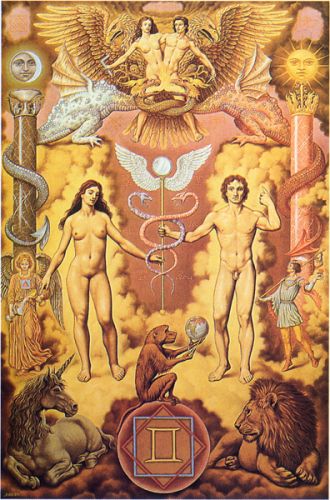
Johfra’s depiction of Gemini is pure alchemy as its central symbols are Sponsus (Bridegroom) and Sponsa (Bride). It is a depiction of  an “alchemical wedding” – the joining of opposites to create unity. This creation of unity in alchemy is assisted by Mercurius, the archetype of the mind.

I am sure now that Romeo and Juliet were thought by Shakespeare as the archetypal alchemical couple. Mercutio, a close friend of Romeo, and in my opinion one of the most delightful characters ever conceived of by Shakespeare, can be interpreted as Mercury: isn’t his name quite thinly disguised? He is neither a Capulet nor a Montague and that is why he can visit both conflicted families freely. He is a very witty and fun-loving character. He even jokes at the time of his own death, saying “Ask for me tomorrow, and you shall find me a grave man….” In the play he symbolizes the mind, more specifically its ever changing, shifting quickness, its airy quality, its ability to make links and connections, and quickly switch sides should boredom occur. All of this can be observed in the following exchange:

ROMEO
Peace, peace, Mercutio, peace!
Thou talk’st of nothing.

MERCUTIO
True, I talk of dreams,
Which are the children of an idle brain,
Begot of nothing but vain fantasy,
Which is as thin of substance as the air
And more inconstant than the wind, who woos
Even now the frozen bosom of the north,

And, being anger’d, puffs away from thence,
Turning his face to the dew-dropping south.

Mercutio is the quicksilver of the play, if he were a planet he would be Mercury, which is the ruler of Gemini, an air sign connected with cognitive processes. It is a dual sign (twins) of dialogue, which is beautifully shown in Johfra’s painting showing a large number of pairs of opposites. Johfra always shows the inner and hidden, esoteric meaning of signs and it makes a lot of sense to mention at this point that the esoteric ruler of Gemini is Venus. The spirit of Venus – the harmony and beauty found in relationships – permeates the painting. Shakespeare placed the action of Romeo and Juliet in Verona because it is a city of exceptional beauty and the women of that city were believed to be the most beautiful in all Italy.  The play contains a rich interplay of pairs of opposites, the central being the pair of lovers themselves. Juliet meets Romeo (his name means “pilgrim”) at the age of 14, he sees her at night (“If love be blind, it best agrees with night,” goes the famous quote from the play). She is the Moon, the feminine principle, and the Moon at the fourteenth day of her cycle is full, while he is the pilgrim, i.e. the Sun, the masculine principle.

I would like to consider the pairs of opposites depicted in Johfra’s  painting and also take a closer look at the dual symbols of wholeness, namely the hermaphrodite at the top and the caduceus in the centre.

II. The dual nature of the mind

The painting seems to be an apt portrayal of the workings of the mind. No idea, concept or thought exists in isolation. It is impossible to explain the meaning of anything without referring it to something else. “All meaning is relationship,” says Ray Grasse in The Waking Dream. We are wired to think in terms of opposites, to think dialogically. Mikhail Bakhtin, a brilliant Russian philosopher and literary critic, introduced the concept of “polyphony” (the multitude of voices), which characterizes the fictional world Dostoevsky. All characters in Dostoevsky’s novels are in eternal dialogue. In one of Bakhtin most memorable thoughts on the nature of being, he equals being with relating and communicating:

To be means to communicate… To be means to be for another, and through the other, for oneself. A person has no internal sovereign territory, he is wholly and always on the boundary; looking inside himself, he looks into the eyes of another or with the eyes of another.

Duality is the main theme of Johfra’s painting.  In fact, every symbol or archetype is essentially a duality – a unity of two which is held in dynamic tension. The Chinese Jin and Jang symbol shows this principle best: every archetype holds within itself a light and a shadow side. Jofhra’s depiction of Gemini resembles the Lovers, the Tarot card of the Major Arcana. In many cultures the fundamental polarity underpinning all phenomenal experience is symbolized by a divine pair: a god and a goddess; in the world of phenomena the divine One functions as a Two. We may actually treat this painting as the western equivalent of the Chinese Jin/Jang symbol. It shows the alchemical Hierosgamos (sacred marriage) – a harmonious union of opposites, with the emphasis on a union of higher and lower powers of the mind.

III. The divine pair

The focus of the painting seems to fall on the divine pair. She is standing on the left, he on the right. In symbolism, the left side is equated with the unconscious whereas the right with consciousness. The right side is solar and positive, the left side lunar and negative. The male is associated with the image of the Sun (Sol) depicted over the pillar on the right-hand side while the female is related to the Moon. The Sun is the active principle of the universe while the Moon is the passive one. In other words, the Moon fulfills a passive role of reflecting the Light which the Sun actively radiates. The painting shows the totality and unity, the conjunction of the Sun and the Moon.  In the image of the Moon we can notice the crescent, the full moon and the dark balsamic moon. In alchemy, the Moon represents the mutable principle on account of the fragmentary nature of its phases. We saw the two pillars already in the Taurus painting. They were mysterious pillars set by Salomon in front of his temple. They were purely symbolic and did not support the construction in a physical sense. The red pillar Jachin on the right is crowned with a staff (wand), which implies a masculine direction and intensity, the action of the will, and relates to the element fire. The black pillar Boaz on the left is crowned with a cup (goblet) which implies feminine receptivity and emotionality and forms a vessel for the Sun’s radiance. In The Hidden Power by Thomas Troward he wrote that Jachin represents the Unity of the Spirit while Boaz stands for the Unity of Love. Johfra himself talks about “the red marble positive pillar of force or strength Jachin on the right, and the black marble negative pillar of form Boaz on the left.” The mystery of the pillars has eluded scholars for centuries, as the Bible does not provide any explanation what they actually signified. Troward traced the etymology of the name Jachin, according to which the word Yak signifies “one” and “hin” means something like “only”, which would mean that Jachin could be rendered as “only One” suggesting Unity. Tracing back the meaning of Boaz, he cites a biblical story of Booz and Ruth. The story goes like this:

Boaz was a very wealthy man who lived in Bethlehem. When Naomi returned to Bethlehem with her widowed daughter-in-law, Ruth, Ruth went into the fields of Boaz to glean. Boaz learned that Ruth’s deceased husband was a distant relative of his. He acted kindly towards Ruth and instructed his farm workers to leave extra sheaves of barley for her to gather. Ruth had another relative of her late husband who was closer than Boaz. By law, the other relative was obligated to marry Ruth, as stated in Deuteronomy 25:5-10. Boaz confronted the other relative with this law, and after the relative refused to marry Ruth, Boaz agreed to marry Ruth, and to buy the estate of Ruth’s deceased husband. After they got married, Ruth had a son named Obed, who became the father of Jesse, who became the father of David. Boaz and Ruth became the great-grandparents of King David. (retrieved from http://www.aboutbibleprophecy.com/p153.htm)

Troward concludes: “Boaz represents the principle of redemption in the widest sense of reclaiming an estate by right of relationship, while the innermost moving power in its recovery is Love.” I find it fascinating and it resonates with me deeply: the positive pillar corresponds to our inner Oneness while the negative one to our desire to enter relationships based on love with our divine Other. I also think that the story of Boaz and Ruth shows the interplay of independence and dependence in relationships as well as openness and surrender. Naturally, Johfra’s painting also means that we carry our divine Other within ourselves, the lover we want to merge with is a projection of our innermost Being. The woman needs to integrate her inner male polarity (Animus) while the man his inner female polarity (Anima). Finally, it is worth pointing out that the man is pointing upwards (Spirit, heaven, the immaterial realm) while the woman downwards towards the earth (body, matter, the manifested reality).

IV: The hermaphrodite as a symbol of wholeness

The alchemists, in their quest for gold (understood as the highest unity of body, mind and spirit and the actualization of the Self) considered the world to be governed by a myriad of paired forces (opposites). They perceived the Soul to be an organ of the Spirit and the Body as an instrument of the Soul. Their goal was self-knowledge and they sought to harmonize and balance the opposing forces first within themselves and then to project that inner order on the outside world. If inner conflict gets resolved, the outside world will follow. The great hermaphrodite (Rebis  – from Latin res bina, meaning double matter) was the symbolic fruit of that unity.

In Mysterium Coniunctionis, C.G. Jung talks about the concept of a spark. Alchemists defined it as Archaeus, i.e. the fiery centre of the earth which is hermaphroditic and consists in a conjunction of a male and a female. It is a fire point created by tension of masculine and feminine principles. It is fitting that in the painting this ball of fire created by the joining of male and female energies is located at the level of the second chakra of sexuality and creativity. This chakra is called Svadisthana, which means “dwelling place of the Self.” In Greek mythology, Hermes and Aphrodite produced a beautiful child named Hermaphroditus. He was born as a handsome male but a nymph fell passionately in love with him and asked the gods for the two to never part. They formed a union of two bodies within one. The fire point also signifies the philosopher’s stone, which was a symbol of inner unity – a result of individuation, i.e. a reconciliation of Body, Soul and Spirit.

V. The caduceus

The divine couple are holding the caduceus, the staff of Mercury. According to Cirlot’s Dictionary of Symbols, the staff represents power, the two snakes wisdom and the wings diligence and lofty thoughts. The snakes also refer to the force of Kundalini. The two twin serpents represent the complementary solar (masculine) and lunar (feminine) forms of divine energy (prana, i.e. “breathing forth”, “life force”). The awakened kundalini energy rises through two channels of energy forming the criss-cross pattern exactly like the one we observe in the caduceus. The channel ida is connected with the left side, has a negative charge and is related to the moon. The channel pingala is identified with the right, is charged positively, and relates to the masculine and the sun. The caduceus is a symbol of balanced duality, emphasizing the supreme state of strength and self-control (and consequently of health) which can be achieved both on a lower plane of the instincts – the root of Being (symbolized by the serpents) and on the higher level of the spirit (represented by the wings).

Of the caduceus Dane Rudhyar wrote this in New Mansions for New Men:

“The central rod of the caduceus and the two intertwining serpents refer to the process of synthesis by which the spiritual potencies latent in every cell are gathered around the spinal axis (the central rod) and led up to the head. The entire symbol is one of centralized and rhythmic relationship. It is the hieroglyph of Mercury, the Master-Weaver in action. The weaving Hands go to and fro; and the tapestry of perfected being emerges, from which Man may learn the significance of his own being and of universal life.”

http://khaldea.com/rudhyar/nmnm/nmnm_mercury.php

VI. The mirror

The mirror featured extremely inventively by Johfra at the top of the caduceus is naturally suggestive of duality. It symbolizes imagination, consciousness, self-reflection and self-contemplation. It is often connected with illumination and treated as a doorway to another dimension. I was reminded of the rune Kenaz when I saw this symbol in the painting. Kenaz means both a torch and a mirror; it is strongly connected with illumination and intuition, representing the search for truth. In the context of relationships Kenaz means learning from each other. It guides the process of a student becoming a master. We can also say that as the moon reflects the light of the sun, so the human mind reflects, like a mirror, the higher mind of the divine source.

A writer who was fascinated by mirrors was Jorge Luis Borges. In a short story “Tlön, Uqbar, Orbis Tertius” he writes about a world created by imagination, a world where idealism rules and materialism is a heresy. In the imaginary land Tlön, people are caught in the world of ideas, while their language defines their reality. As in Wittgenstein’s philosophy: “The limits of my language define the limits of my world,” the Tlönian recognizes perceptions as primary, and denies the existence of any underlying reality. Borges reminds us that the world we see is indeed a projection of the mind.

VII. The lion and the unicorn

Further opposing principles are the lion and the unicorn lying in the foreground. Johfra writes that in ancient India the sign of Gemini was portrayed as a lion and unicorn that guarded the gate to the Holy City. Both unicorn and lion were sacred animals for alchemists, as Jung wrote in Mysterium Coniunctionis. The time will come for me to speak more extensively of the lion symbolism in August with the Sun in Leo. For now I will just mention in passing that alchemists associated the lion with the element fire and with the fiery (beastly, passionate, individuating, masculine) part of the alchemist’s soul. The unicorn is symbolic of sacred and pure sexuality, as it can only be tamed by a virgin (purified matter). Read more on the unicorn here: https://symbolreader.net/2014/09/09/the-homage-to-the-unicorn/

VIII. The baboon and the reptiles

A baboon is sitting on a circle, holding a globe. On the one hand, he may relate to Thoth, the Egyptian god of knowledge, secrets and writing, identified with the Greek Hermes. Baboons were very important in the Egyptian myth and ritual:

“Baboons were kept as sacred animals in several Egyptian temples. There was a belief reported by some Classical writers that the most learned Egyptian priests understood the secret language of baboons. This was thought to be the natural language of true religion.”

Geraldine Pinch, Handbook of Egyptian Mythology

But I also think the ape may signify lower brain functions or the unconscious mind. Since the whole painting seems to be a symbolic vision of the way the human mind works, also snakes and dragons may refer to the so called reptilian brain, the most ancient and primitive, instinctive side of our thinking processes which is in charge of survival and reproduction. It can be aggressive and territorial, and at least some of its functions can be equated with the Jungian shadow. The dragon is created any time we reject part of the contents of our psyche and relegate it to the shadows. The serpents represent the aspects of the unconscious that can be characterized as cold and ruthless but also granting the quality of natural wisdom. This power of instincts is transformed into the ball of fire in front of the figure of the Hermaphrodite, which I have already discussed. The two eagles also refer to the healing power of transformation. They symbolized Spirit as a general principle because they were believed to fly higher than any other birds. They were also emblems of majesty. From an alchemical perspective, they expressed  “the victory of spiritualizing and sublimating activity over involutive, materializing tendencies” (Cirlot). In simple terms, they referred to the transformations of lower instincts into higher spiritual powers.  The power of the unconscious instincts is essential for the human mind to work in a balanced way.

The role of Mercurius in the alchemical opus was very crucial, as this quote from Jung’s Psychology and Alchemy (par. 404) testifies:

“The dragon is probably the oldest pictorial symbol in alchemy of which we have documentary evidence. It appears as the ouroboros, the tail eater, in the Codex Marcianus, which dates from the 10th or 11th century, together with the legend: (the one, the all). Time and again the alchemists reiterate that the opus proceeds from the one that leads back to the one, that it is a sort of circle like a dragon biting its own tail. For this reason the opus was often called circulare (circular) or else rota (the wheel). Mercurius stands at the beginning and end of the work: he is the prima materia, the caput corvi, the nigredo, as dragon he devours himself and as dragon he dies, to rise again as the lapis. He is the play of colours in the cauda pavonis and the division in to four elements. He is the hermaphrodite that was in the beginning, that splits in to the classical brother sister duality and is reunited in the coniunctio, to appear once again at the end in the radiant form of the lumen novum, the stone. He is metallic yet liquid, matter yet spirit, cold yet fiery, poison yet healing draught- a symbol uniting all opposites.“

IX: The Fool and Temperance

The two Tarot cards are Temperance on the left and the Fool on the right. Yet again Johfra represents the polar powers joined in harmony, the solar and lunar lights in the right proportions. She is the Sophia, who has resolved the conflict of opposites with the power of her Divine Mind. The Fool is the Jester, which brings us back to Shakespeare and Mercutio, who embodied this archetype very strongly, the Trickster being  the Jungian archetype very much connected with the sign of Gemini. He is clever and mischievous, always challenging the status quo and bringing in fresh, new ideas. He can often tell the hardest truths. He delights in unmasking our collective shadow. As Byrd Gibbens wrote:

Many native traditions held clowns and tricksters as essential to any contact with the sacred. People could not pray until they had laughed, because laughter opens and frees from rigid preconception. Humans had to have tricksters within the most sacred ceremonies for fear that they forget the sacred comes through upset, reversal, surprise. The trickster in most native traditions is essential to creation, to birth.

X. Conclusion

As a Gemini I realized while writing this that it is the hardest to hold a mirror to oneself.  I leave you with the words of Alan Oken, a spiritual astrologer:

The developed Gemini is the gifted intellectual; the spiritual Gemini is the translator of universal truths.

Support my blog

If you appreciate my writing, consider donating and make my day. Thank you in advance.

$1.00

Related posts:

Why I Love Symbols

Images of the Zodiac: Contemplating Aries

Images of the Zodiac: Contemplating Taurus

https://symbolreader.net/2013/06/26/images-of-the-zodiac-contemplating-cancer/

https://symbolreader.net/2013/08/09/images-of-the-zodiac-contemplating-leo/

https://symbolreader.net/2013/09/04/images-of-the-zodiac-contemplating-virgo/

https://symbolreader.net/2013/10/04/images-of-the-zodiac-contemplating-libra/

https://symbolreader.net/2013/11/18/images-of-the-zodiac-contemplating-scorpio/

Images of the Zodiac: Contemplating Sagittarius

Images of the Zodiac: Contemplating Capricorn

Images of the Zodiac: Contemplating Aquarius

Images of the Zodiac: Contemplating Pisces

Posted in Johfra Bosschart | Tagged , , , , , , , , , , , , , , , , , , , , , , , , , , , , , , , , , , , , | 28 Comments

Why We Write

Image

A Ballad That We Do Not Perish, by Zbigniew Herbert

Those who sailed at dawn
but will never return
left their trace on a wave–

a shell fell to the bottom of the sea
beautiful as lips turned to stone

those who walked on a sandy road
but could not reach the shuttered windows
though they already saw the roofs–

they have found shelter in a bell of air

but those who leave behind only
a room grown cold a few books
an empty inkwell white paper–

in truth they have not completely died
their whisper travels through thickets of wallpaper
their level head still lives in the ceiling

their paradise was made of air
of water lime and earth an angel of wind
will pulverize the body in its hand
they will be
carried over the meadows of this world.

Posted in Poetry | Tagged , , , , | 12 Comments

The Myriad Forms of Meaning

Image

Image via http://thenewforty.areavoices.com/files/2012/01/spectrum.jpg

The following is a beautiful excerpt from a book by Ray Grasse, The Waking Dream: Unlocking the Symbolic Language of Our Lives.

In mythological terms, the process of which the myriad forms of meaning unfold from their source in Spirit is poetically evoked through the image of the dismembered God who, like the Egyptian god Osiris is torn to pieces. Like light dividing into colors as it passes through a prism or notes synthesized from shapeless white noise, so within the realm of time and space, Spirit fractures into many parts. Each embodies facet of the divine nature, much like a particular color represents a single frequency of the entire spectrum. In a sense, the archetypes can be regarded as fragmented aspects of our own being.

All symbols stand in relationship to the ground of Spirit, or Self-conscious awareness. We might say that any archetype expresses a particular trajectory relative to the Divine… Hence, while the entire range of archetypes could be called “spiritual” because they are rooted in the divine Source, the central archetype represents spirit at its purest or most concentrated. Spirit in the mystical sense can be thought of as awareness in undiluted form, in a state of complete and absolute attention upon an object or action or, in its undifferentiated state, on itself.

In religious terms, thus, the fountain from which all meaning flows is the fundamental I AM THAT I AM residing eternally radiant beneath all surface modifications of mind. With its roots deep in this luminous Source, consciousness is at its center eternally Self-aware, giving meaning to the world by forever reflecting upon itself. … In several esoteric traditions, the paradox of the Self reflecting upon its own nature was symbolized by the image of the serpent eating its own tail, called the ouroboros. The Self must forever eat of – meditate upon – the Self in order to sustain the Self. Through this act of Self-reflection, the Self not only regenerates its own existence, but all the existences of which it is aware.

Posted in Quotations | Tagged , , , , , , , , , , , , , , , , , | 31 Comments

Posts in Pairs (3). Violence Against Women

Image

Hypatia, mathematician, astronomer, philosopher, murdered by a Christian mob in Alexandria about 415 AD

I live in Switzerland, which was the last country in Europe to give women the  right to vote. Also the last witch was burnt here. I often wonder how symbolic it is.

I was shocked to read about Princess de Lamballe in the first article and equally shocked to read in the second one that these things are happening to this day.

Post 1.  http://thetarotnook.com/2013/05/23/but-i-heard-she-had-a-rough-childhood-rapunzel-and-the-french-revolution/

Post 2. http://misbehavedwoman.wordpress.com/2013/05/23/its-2013-and-theyre-burning-witches/

Posted in Uncategorized | Tagged , , , , , , | 17 Comments

The Winged Sandals of Higgs Boson

I. A Few Thoughts on Time

Image

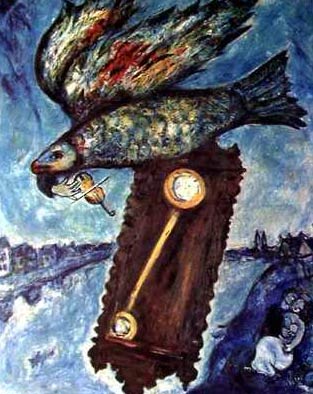
Marc Chagall, Time is a River Without Banks

I have always believed in the world of timeless truths. I find comfort in the conviction that although all visible phenomena are constantly changing, beneath flows a stream of eternal meaning, like a fountain spouting symbolic forms and images that in fact create and sustain the manifested world. And yet I cling to a fascination with Time, a strong need to solve its mystery and perhaps this is why I often come across books or articles on the subject, never consciously looking for them. In the latest issue of The New York Review of Books there is a very interesting article entitled Time Regained!, which compels me to wrestle with this subject yet again. The article is a review of a book Time Reborn: From the Crisis in Physics to the Future of the Universe by Lee Smolin, who goes against the contemporary understanding of time in quantum physics (time is an illusion) and announces that time is very real. The basic idea is that there is no thinking outside of time and we are always time-bound. Furthermore, Smolin believes that the belief in timeless truths is misguided and harmful. I obviously disagree with him (if I did not I might as well erase my entire blog) but there are a few arguments of his that I find quite interesting. He also broaches the subject of space, which is inextricably connected with time.

I am convinced when he talks about misguided scientists who believe that their current discoveries are eternal truths. And yet paradigms shift and fade away and hardly scientific discovery is safe and immutable, unless we speak of mathematics perhaps. I am strongly convinced that a lot of truths which are deemed spiritual nowadays will be treated as scientific facts in the future. Scientists would benefit enormously from being humbler and more inclined to recognize that they are sons and daughters of their time and have no claim of the future that they know little about. A constant evolution is a fact of life, Smolin says.

II. Space Means Connections

Image

The Water Bearer

The question of time is intertwined with the question of space. What Smolin suggested in relation to space came as quite a shock to me. He writes: “Space, at the quantum mechanical level, is not fundamental at all but emergent form a deeper order” – an order of connections and relationships. A network of relationships is a deeper reality out of which physical space emerges. He mentions Leibniz, who also believed that space is the relationship between objects that it contains. This ties in with what I have managed to gather from my reading of quantum physics discoveries, which seem to claim that space is in fact a projection of information stored on the two-dimensional surface that surrounds the universe. What we experience as reality may be a 3D hologram of the ultimate 2D reality existing on the surface of the universe. It is very hard to wrap one’s mind around this. But think of the Internet, Smolin says. It does seem to annihilate space and transcend physical dimension. Connectedness is the new buzz word and something very real and very tangible.

Making connections between distant objects is an everyday occurrence for an increasing number of people, whose minds have begun to tune in to the New Age of Aquarius. Aquarius is connected with the higher mind, group awareness, awareness of universal connections and interconnectedness. While in the age of Pisces we relied on intuition and mystical experience, which could not be rationalized or translated into scientific terms, in the Age of Aquarius we will have tangible, scientific evidence of ‘supernatural’ phenomena. The Water Bearer pours the living waters of the Spirit onto the manifested world. This is an act of creation, out of this water all life comes. But the Age of Aquarius has not come yet, we need time to evolve towards it. The information is already there, stored somewhere on the brink of the universe, but evolution takes time and more time. The ruler of Aquarius is Uranus, who was a Greek god castrated by his son, Cronus (the Roman Saturn). The sky god Uranus symbolizes an ideal and timeless vision that is brought down to earth and embodied in time (time and matter are presided over by Cronus). Every ideal suffers when confronted with reality, brilliant ideas sometimes require a long time and effort before they can be implemented. The myth of  Cronus and Uranus teaches us that in our sublunar world we are ruled by cycles and this is why we need to wait patiently before the ripe time comes for a change to take root.

III. The God’s Particle

Image

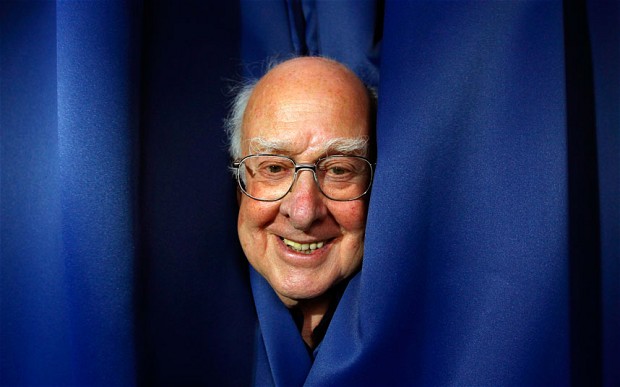
Peter Higgs

Peter Higgs must be the most patient person on the planet. It took half a century to prove his theory of the so called God’s particle. I went on a tour of CERN, the nuclear research centre in Geneva, a few months ago and I remember that the scientists were on the brink of announcing that Boson’s theory is proven now. They also told us that this came as no surprise to them because Higgs’ theory was the only logical explanation of the phenomena they had been observing for a long time. It turns out that space is not a stage or a passive container but an actor and it plays a leading role in a cosmic drama. Higgs wanted to find out what creates mass and why different particles have different masses. He compared space to an ocean or an energy field, in which particles are immersed, pushing through it and interacting with it, thus gaining mass. Bosons are non-matter particles which are force carriers, or messengers that act between matter particles. Mass is crated through interaction with the Higgs field.

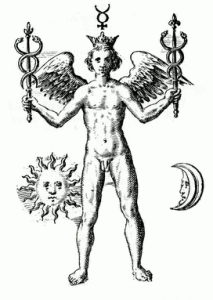
The conclusion of Higgs’ discovery is that relations, links and connections are indispensable to form all living matter.  I find it incredibly neat that Peter Higgs’ Sun sign is Gemini, which is ruled by Mercury (Hermes), the divine messenger of the gods and the archetype of the mind. Thanks to Higgs we know now how everything was created and we can state that it was created by linking things together, by particles interacting with the Higgs field, which is permeated with Higgs particles. To me this discovery can be connected with what the alchemists claimed many centuries ago. This is what Jung wrote about Mercurius: “When the alchemist speaks of Mercurius, on the face of it he means quicksilver (mercury), but inwardly he means the world-creating spirit concealed or imprisoned in matter.”  Mercurius stands at the beginning of alchemical work. He was fluid, dynamic and with infinite capacity for transformation and penetration. The Gnostics called Mercurius logos spermaticos (the generative principle of the Universe) and believed it was scattered all over the universe. Also from the Bible we learn that Word/Logos was at the beginning of creation and it was the Mind that created all there is.

Image

Mercurius

I think it is a sign of the times that we can make these connections between ancient spiritual knowledge and modern science.

Related post:
https://symbolreader.wordpress.com/2013/05/03/in-heraclitus-river-the-mystery-of-time/

Posted in Mercurius, Time | Tagged , , , , , , , , , , , , , , , , , , , , , , | 16 Comments

Manifesto for Change

Manifesto for Change

sunrise

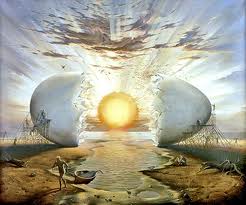
Vladimir Kush, Sunrise on the Beach

No matter if you accept astrology or not, you are probably feeling that the world as we know it is undergoing some radical changes. It is important to emphasise that planets are not causing these events but they correspond to them symbolically. I know a lot of people who do not read the symbolic language of astrology but they nevertheless live the truth and tell the truth of the inevitable global transformation.

I find this manifesto very well crafted and expressing my sentiments as well.

Posted in Uncategorized | Tagged , , , , , , , , , | 20 Comments

The Secret Speech of the Soul

dancing-nymphs

Blendon Reed Campbell, Dancing Nymphs


The language of myth is still, as ever, the secret speech of the inarticulate human soul; and if one has learned to listen to this speech with the heart, then it is not surprising that Aeschylos and Plato and Heraclitus are eternal voices and not merely relics of a bygone and primitive era. Perhaps it is now more than ever important to hear these poetic visions of the orderly nature of the universe, because we have grown so dangerously far from them. The mythic perception of the universe governed by immutable moral as well as physical law is alive and well in the unconscious…
Liz Greene, The Astrology of Fate

Posted in Quotations | Tagged , , , , , , , | 20 Comments

The Knight’s Feet in Soft Slippers

Image

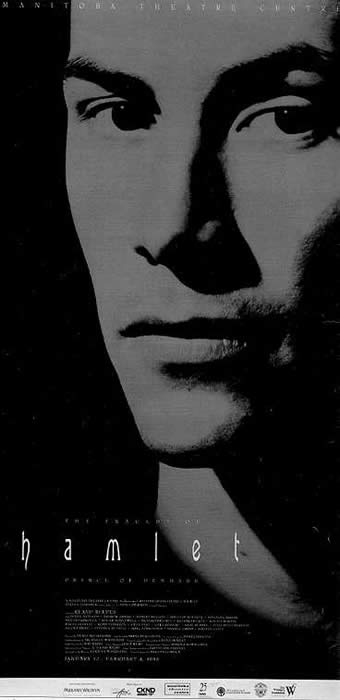
Keanu Reeves, seems perfect to have played Hamlet

Hamlet is such a famous and celebrated play that it was dubbed a ‘collection of quotes.’ Who has not heard: “This above all: to thine own self be true,” or “There is nothing either good or bad, but thinking makes it so,” or “Words, words, words,” or “Something is rotten in the state of Denmark,” or “Though this be madness, yet there is method in’t,” and countless other famous ones. The melancholic Danish prince is a literary character that has always held a special fascination with me. All of us book lovers probably have a character that strikes them at a deep level perhaps because we recognize some of our own essence in theirs. ‘My’ Hamlet is enigmatic, complex, very hard to figure out, and very mysterious. He comes across as extremely refined, and his philosophical speculations are quite astounding. He is a master of elaborate and witty discourse, puns, metaphors, double meaning; in short – all that my Gemini nature rejoices in.

On the other hand, his intellect is accompanied by unquestionable emotional depth; he seems to be torn by the deepest emotions and conflicting feelings. He wants revenge but he starts to feel compassionate towards his potential victim, and he is the only one who genuinely and deeply mourns the dead king, his father. After Ophelia dies he confesses: “I loved Ophelia. Forty thousand brothers could not with all their quantity of love make up my sum.” What I also find fascinating about him is his inner duality and conflicting characteristics: he is deeply melancholic and yet he makes hilarious jokes and pranks, he is determined to get revenge and yet he hesitates and procrastinates, he is passionate and loving at times, and cold, erratic and indifferent shortly after. He always seems to sense more than he gives away. T.S. Eliot, one of the major poets of the twentieth century, summed up Hamlet’s emotional life in an incredibly apt way: “the buffoonery of an emotion which can find no outlet in action.”

Astrologically, Hamlet has been assigned to the sign Pisces, which also incorporates an inherent duality and conflict. He is Piscean to me in a sense that he embodies the rage of Poseidon; he has found out that the new king, Claudius, murdered Hamlet’s father and married his mother Gertrude. This imbalance and injustice need to be rectified, Hamlet feels. Yet, in the course of the play, his consciousness expands, he sees how complex reality is because he is able to perceive all the connections, all the motives of various characters and in addition he is endowed with a deeply feeling nature. Suddenly revenge seems primitive, simple, too straightforward, and as a result of this realization he becomes locked in his musings and inaction. His thoughts soar to heaven and he finds himself increasingly divorced from reality. In the end, the evil is indeed redressed and Claudius has to die, such is the inescapable rage of Poseidon. Yet Hamlet also pays the price. We, the readers, feel that death is the only possibility for the evolution of this character, but it is hard to rationalize why. I found the answer I was looking for in a poem, which I will be quoting later.

Hamlet is very much a mystical play to me, as are indeed all of Shakespeare’s plays. In a book Quintessence of Dust: The Mystical Meaning of Hamlet, Kenneth Chan has tried to grapple with the spiritual message of it. He enumerated the following themes of the play:

1. The need to recognize the mystery world we are all in and the importance of accepting the inevitability of death and facing the profound.

My thoughts: This resonates with another famous line by Hamlet: “There are more things in heaven and earth, Horatio, Than are dreamt of in your philosophy.” Being humble in the face of great mystery that the universe poses is definitely very marked in this particular play.

2. Our propensity, instead, to hide from the truth by indulging in distractions, and by artificially beautifying what is rotten inside.

My thoughts: This is the psychoanalytic Hamlet, emphasizing the importance of acknowledging the truth and owning the shadow, however ugly it may be.

3. How, as a result of being false to ourselves, we become false to others.

My comment: This ties in with the previous theme but also emphasizes the need of honesty in relationships and the need of being true to our Selves.

4. Why revenge and condemnation of others is wrong.

My thoughts: the play seems to convey a very strong ethical message. The last point actually ties in with the poem I would like to present. The ‘I’ of the poem is Fortinbras, who is going to take over the throne of Denmark after Claudius and Hamlet die at the end of the play. He is an important foil for Hamlet, also seeking to avenge his father’s death. He is very decisive and active, however, while all Hamlet seems to be doing to Fortinbras’ understanding  is contemplate, hesitate, sit and wait. I find this poem very touching because Fortinbras acknowledges that he does not ‘get’ Hamlet, he has no understanding of him, but nonetheless he shows respect and he tries to reserve his judgement. This brings to mind the philosophy of Emmanuel Levinas and his ethics of the Other we should embrace without judging or rejecting. Also, the poem has a few deep symbols and haunting images and I could not resist quoting it in full. It was written by Zbigniew Herbert, a brilliant Polish poet, who frequently engaged themes of myth and literature.

Elegy of Fortinbras

for C. M.

Now that we’re alone we can talk prince man to man
though you lie on the stairs and see no more than a dead ant
nothing but black sun with broken rays
I could never think of your hands without smiling
and now that they lie on the stone like fallen nests
they are as defenceless as before The end is exactly this
The hands lie apart The sword lies apart The head apart
and the knight’s feet in soft slippers

You will have a soldier’s funeral without having been a soldier
the only ritual I am acquainted with a little
There will be no candles no singing only cannon-fuses and bursts
crepe dragged on the pavement helmets boots artillery horses drums
drums I know nothing exquisite
those will be my manoeuvres before I start to rule
one has to take the city by the neck and shake it a bit

Anyhow you had to perish Hamlet you were not for life
you believed in crystal notions not in human clay
always twitching as if asleep you hunted chimeras
wolfishly you crunched the air only to vomit
you knew no human thing you did not know even how to breathe

Now you have peace Hamlet you accomplished what you had to
and you have peace The rest is not silence but belongs to me
you chose the easier part an elegant thrust
but what is heroic death compared with eternal watching
with a cold apple in one’s hand on a narrow chair
with a view of the ant-hill and the clock’s dial

Adieu prince I have tasks a sewer project
and a decree on prostitutes and beggars
I must also elaborate a better system of prisons
since as you justly said Denmark is a prison
I go to my affairs This night is born
a star named Hamlet We shall never meet
what I shall leave will not be worth a tragedy

It is not for us to greet each other or bid farewell we live on archipelagos
and that water these words what can they do what can they do prince

I am particularly struck by the image of the knight’s feet in soft slippers because feet are actually ruled by Pisces in astrology. In his soft slippers, Hamlet was not fit to walk this earth, he was floating above the ground in his realms of lofty contemplation. Another thought I have is connected with the role of the dead father in Hamlet’s life. The ghost of the father told Hamlet to take revenge and kill uncle Claudius. How many knights in soft slippers are trapped in other people’s expectations of what it is to be a ‘real’ man, a ‘real’ knight? Don’t we need more knights in soft slippers to get out of the circle of violence in the world today?

Image

Posted in Hamlet | Tagged , , , , , , , , , , , , , , | 20 Comments

A Tribute to Home

Image

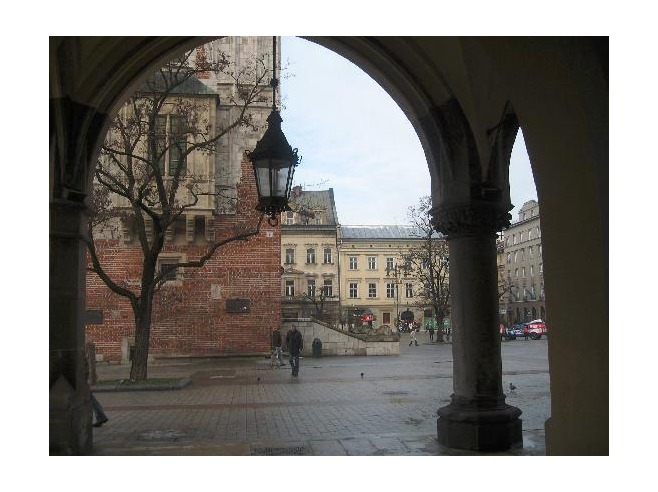
Krakow

I am spending a few days in Krakow, Poland, where I was born and where I grew up. I am reminded of the myth of Antaeus, a Titan who renewed his strength by touching the earth. I have been feeling energized by this return to the source but at the same time I have also wondered why emigration was so easy for me and why I do not miss my home country while I am away, why I do not feel the celebrated feeling of nostalgia, described in so many poems of Polish immigrants. I am happy to return here regularly and to revisit favourite old haunts but I have come to realize that my longing for home is not connected with any particular country or any set of national symbols. And yet when I saw the following quote today, coming from one of my favourite books, which is Tess of the D’Urbervilles by Thomas Hardy, I was strangely touched and felt it to hold a lot of truth about what I am feeling:

All the while she wondered if any strange good thing might come of her being in her ancestral land; and some spirit within her rose automatically as the sap in the twigs. It was unexpected youth, surging up anew after its temporary check, and bringing with it hope, and the invincible instinct towards self-delight.

In his book Ignorance, Milan Kundera wrote: “The Greek word for “return” is nostos. Algos means “suffering.” So nostalgia is the suffering caused by an unappeased yearning to return.” I am not suffering being away from Poland. One of the reasons could be the strong pioneer/explorer archetype within me, who always wants to discover new lands and hungers for an adventure. On the other hand, I have long been aware that my yearning for home has more to do with particular people but also with the longing to become connected with my higher Self, which goes beyond culture or ethnicity. In astrology, the fourth house is related to one’s home, roots, what gives us a sense of security and how we want to be nurtured or how we nurture ourselves. I have the planet Neptune there, which on the one hand may mean always looking for an ideal home, but on the other hand it certainly means that I need to find my home deep within the quietest and the most distant part of my soul, which is unrelated to my current geographical location.

When Poland was partitioned and wiped off from the map of Europe and the country did not exist from 1795 until 1918, the national trauma was enormous. I think we the Poles all have this subconscious fear of being partitioned yet again and losing our home. Only twenty-one years after regaining our independence the second world war broke out, and the actions of Hitler and Stalin were dubbed the fourth partition of Poland. Healing the wounds and recovering the lost wholeness and unity is an important part of our national identity but for some people it is unfortunately a reason to be too nationalistic and too proud.

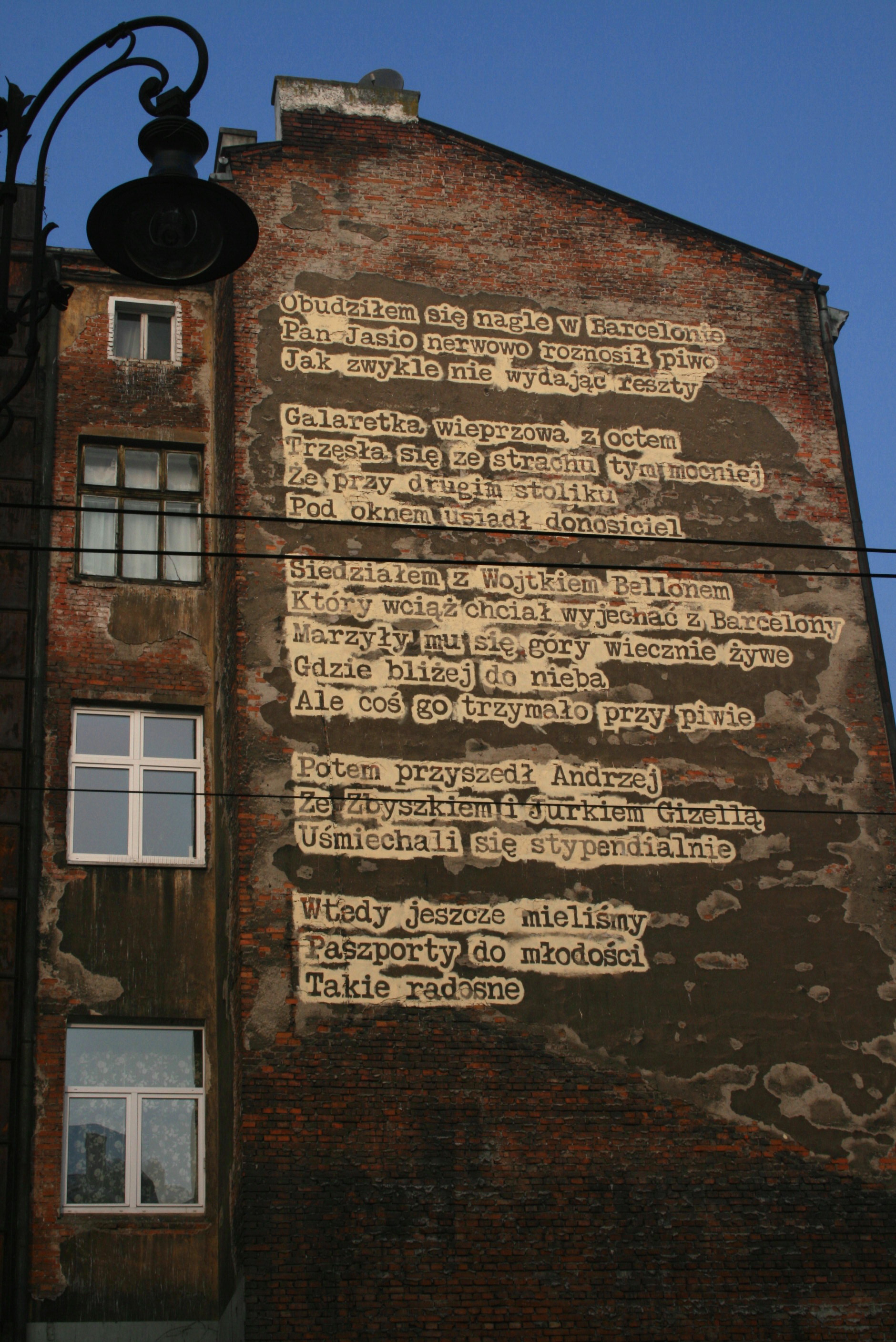
One thing I love about the Poles, though, is that we are born poets. There is a popular notion of the so called ‘Slavic soul’, which is supposedly very artistic, wild, untamed, emotionally explosive and never hiding emotions. It is something everybody has heard about, a very common knowledge without a hint of scientific corroboration. In my country, poetry has always been extremely important and celebrated and for a politically insignificant country that we are, we do have a fair number of world acclaimed poets and Nobel Laureates. My home city, Krakow, has always been a mecca for great poets. Our two Nobel Laureates in poetry, Wislawa Szymborska and Czeslaw Milosz,  lived here. I hope to show you with some photos how incredibly poetic and inspiring this city can be. Yesterday I noticed a poem inscripted on an old building.

Image

Krakow, a poem on a building, very nostalgic, speaking of the lost passports to joyful youth (via http://konteksthr.pl/adam-ziemianin-i-jego-poezja/)

Milosz wrote a very interesting thing about his understanding of what home is: “Language is the only homeland.” This makes me wonder a lot. Polish is my native language and when I am reading some beautiful phrases in Polish I often have a feeling they are ultimately untranslatable, being so deeply rooted in our culture and sensitivity. And yet, at the soul level, there are  no national languages and profound messages and meanings can be communicated between the lines and beyond words. A brilliant translator is able to capture the spirit of poetry and pass it on to the readers in another country. Also for me, as I am writing more and more in English, it does not feel unnatural any more not to write in my native tongue. I am trying to convey my intuitions, which, at the moment of their birth, are feelings or images, they are not born as words. In a sense I am also a translator from the language of my soul into the language of words.

I would like to round up for today with some images of the most soulful places in Krakow.

Image

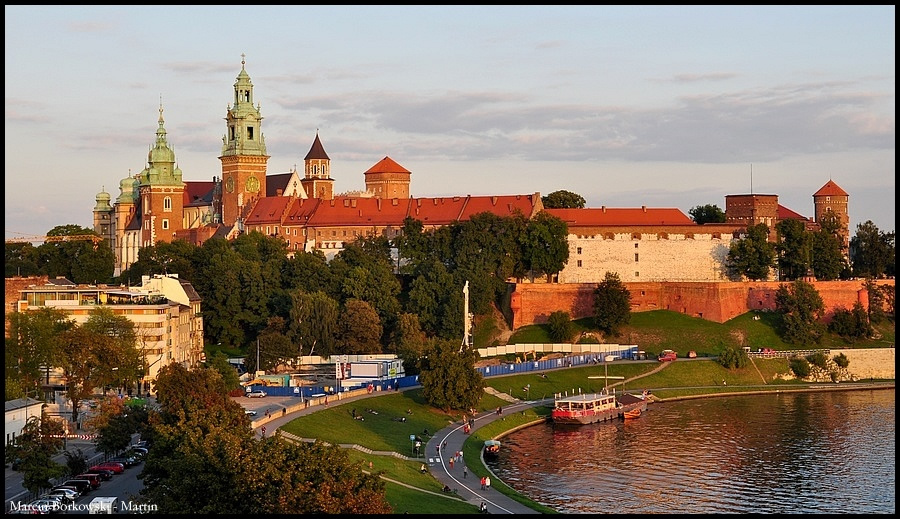
The medieval Wawel castle, which is believed to be one of the world’s main centers of spiritual energy. The Wawel chakra is said to be a place of power, one of the seven on the earth. An old Hindu legend says that God Shiva threw seven stones on seven directions in the Earth. It is said to guard the city and thanks to its powerful protection Krakow was not bombed during the second world war, unlike other Polish cities, which were completely destroyed. I definitely feel powerful energy standing there, in the corner of the western courtyard. There are always people meditating there or just leaning against the walls.(image via http://forum.powiat-piaseczynski.info/viewtopic.php?p=41676)

Image

Kanonicza Street, the most beautiful street in the city, leading to the castle (image via http://www.zoover.com/poland/malopolskie/krakow/ulica-kanonicza/photos)

Image

Kazimierz, the absolutely enchanting old Jewish quarter, where Spielberg shot his Schindler’s List (via http://www.scenicreflections.com/media/326710/Stajnia_cafe_Kazimierz_Krakow_Poland_Wallpaper/)

Image

Inside the famous Alchemia, a bar in Kazimierz (via http://www.luxlux.pl/artykul/alchemia-na-krakowskim-kazimierzu-2307)

Image

Doubting Thomas Corner with another famous bar (via http://kolumber.pl/photos/show/golist:144979/page:184)

Image

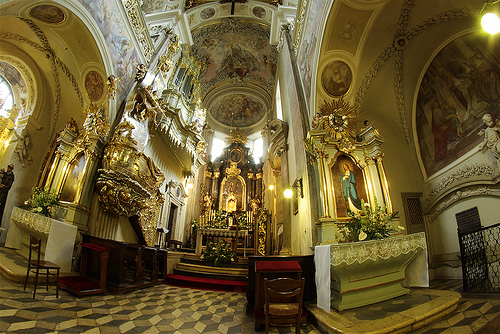
There are countless churches in Krakow, but this one (image via http://epokam.republika.pl/zasp.html) is my favourite, it is Romanesque, with extremely thick walls, looking quite sombre. What captivates me I guess is that inside it is completely different, Baroque with rich and sumptuous gilded decorations. It is shocking to see this contrast. Here is what it looks like inside:

Image

(image via http://www.flickr.com/photos/potrzebie/4897347796/)

Posted in Krakow | Tagged , , , , , , , , , , , , , , , , , , , , , | 30 Comments

Taurus and Incarnation

Posted in Uncategorized | 3 Comments