In Heraclitus’ River: The Mystery of Time

1. Time is the substance I am made of. Time is a river which sweeps me along, but I am the river; it is a tiger which destroys me, but I am the tiger; it is a fire which consumes me, but I am the fire.

Jorge Luis Borges, A New Refutation of Time

2. In Heraclitus’ river
a fish fishes for a fish,
a fish quarters a fish with a sharp fish,
a fish builds a fish, a fish lives in a fish,
a fish escapes from a besieged fish.

In Heraclitus’ river
a fish loves a fish,
your eyes – says she – glitter like fishes in the sky,
I want to swim together with you to the common sea,
oh, most beautiful of the school of fish.

In Heraclitus’ river
a fish invented a fish beyond fish,
a fish kneels before a fish, a fish sings to a fish,
asks a fish for an easier swim.

In Heraclitus’ river
I, the sole fish, I, a fish apart
(say, from the fish tree and the fish stone)
at certain moments tend to write small fish
in silver scales so briefly,
that could it be the darkness is winking in embarrassment?

Wislawa Szymborska

3. Being with you and not being with you is the only way I have to measure time.

Jorge Luis Borges, The Book of Sand

Image

I. Swiss watch-ing: the precision of time

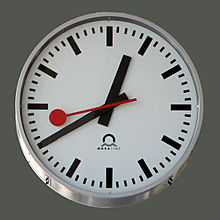
I love calendars, clocks, sundials, hourglasses, and I am really passionate about astronomical clocks. I compulsively need to know which phase the Moon is in. I am quite fond of train timetables, especially here in Switzerland, where everything runs invariably on time. The universe may be heading towards greater and greater chaos and entropy but here patterns of self-organization can only be compared to those observed in ant colonies.  The iconic design of the clock of Swiss Federal Railways was even copied without permission by Apple, who had to pay millions of dollars to Switzerland for this infringement. Just taking a walk through the centre of Zurich is like walking through a timepiece museum: you pass countless clocks, numerous watch retailers and last but not least, St Peter’s Church with the largest clock face in Europe. All of that is very much in sync with the Virgo archetype, which relates to precision, meticulousness and painstaking attention to detail.

Image

The iconic Swiss clock

Image

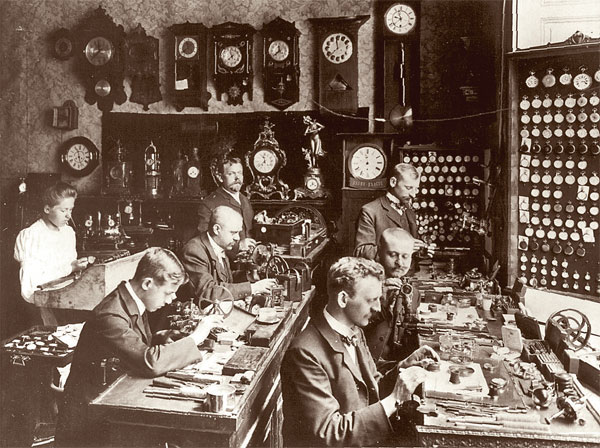
Chronometrie Beyer AG, the oldest watchmaking store in Switzerland

II. Waiting for Godot: phenomenological time

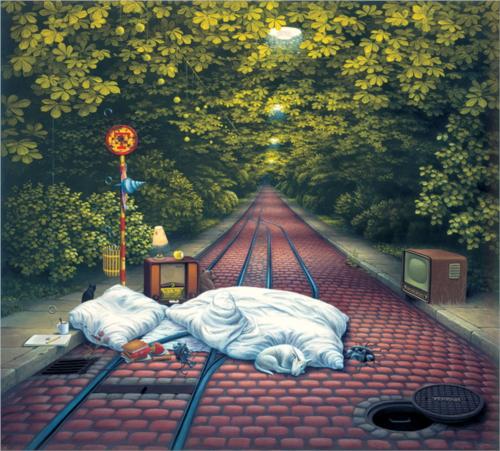
In my home country, Poland, which was quite short handed when the divine mind was distributing the Virgo archetype among nations, waiting for the rain often reminded me of the Yacek Yerka painting featured below. The painting is also a nice illustration of the concept of phenomenological or psychological time, which can be subjectively perceived as running fast or slow according to what we are doing. It is a very Taoist work, I believe, carrying a message that it is necessary to make yourself comfortable and nested in this moment of waiting instead of strutting and fretting in anticipation of the future. Eternal waiting seems to be one of the most important characteristics of human condition, which brings to mind Beckett’s Waiting for Godot, where living equals waiting for the absolute to reveal itself. “Nothing happens. Nobody comes, nobody goes. It’s awful,” despairs one of the characters. Instead of just living, we humans tend live in eternal expectation.

Image

Yacek Yerka, Waiting for the Train (via Wiki paintings)

III. Quantum physics, mysticism and Heraclitus on time

I find comfort in the knowledge that there is now temporal order and structure around me although I am aware that according to mystics and quantum physicists time as we know it is an illusion. The distinction between past, present and future is the most persistent illusion of all, according to Einstein. The past, present and future exist simultaneously in time-space. Also Carl Jung often repeated that the unconscious part of our psyche is not in time or space, which are both an illusion, since the unconscious has no time. Nevertheless, I obstinately feel I need to cling to my lifeboat of time, perhaps because I look too much in the eye of endlessness and eternity, meditating on symbols and archetypes on a daily basis.  I find matter and gravity comforting and I do not wish to escape the world of form. I have always been quite attached to Heraclitus’ metaphor of time as the ever-flowing, always changing river. I cherished an existential view of time as composed of unique moments, bites of here and now, whose tastes are unrepeatable. There was a hit song on a Polish radio, the lyrics of which were Szymborska’s poem:

No day copies yesterday,
no two nights will teach what bliss is
in precisely the same way,
with precisely the same kisses.

I think time is both a flowing river and a frozen river and I have no difficulty withstanding that paradox. Once you start thinking in symbolic terms, you see that there is no longer either/or but it is always both. Like in the philosophy of the Tao, the words of Truth are always paradoxical. From a galactic, universal perspective, there is no time but from our earthly perspective time is very real and cannot be refuted. I saw a documentary last night entitled The Illusion of Time dedicated to time and quantum physics. At one point the presenter tried to demonstrate that according to the laws of physics time can be reversible and can even run backwards. A broken wine glass was shown to magically become whole again. This is all very well, I thought, a neat theory perhaps, but it has little to do with living here and now on the material plane, where we do not get to mend the past and by turning back the river of time.

47_yerka_gr3

Yacek Yerka, The Time Has Asked

IV. Macbeth and the irreversibility of time

This irreversibility of time is for me the major theme of Shakespeare’s Macbeth. In the play, it is evident that there is no going back once certain tragic choices have been made, the merciless clock is ticking. The whole atmosphere of the play is very oppressive and very heavy, which is reflected in the famous monologue “Tomorrow, and tomorrow, and tomorrow.” I had to memorize this monologue because it shook me to the core when I first encountered it. The incredible three witches that tell Macbeth about his destiny to rise as king and then to fall down represent the agents of the higher self, who stand outside the temporal frame of now and who see the whole picture. Their famous line “fair is foul, foul is fair” has been interpreted as leading Macbeth to temptation, but in my humble opinion they are just an expression of the higher archetypal reality, where darkness and light coexist and form a union of opposites. The three witches represent the law of karma. They are like the Norns of Norse mythology, who rule the destiny of people. We cannot apply our earthly logic to these divine messengers.

Image

V. Time and memory

Memory haunts Macbeth throughout the whole play and is one of the reasons of his demise. Time and memory are closely intertwined and interdependent. There is a magnificent novel dealing with memory and time, called A Sense of an Ending and written by Julian Barnes, who won Man Booker Prize for it in 2011. I cannot recommend it enough. I read it once with bated breath because the ultimate mystery is revealed only at the very end. After I finished I immediately started reading it again, but now with this unique ‘godly’ perspective, knowing how the fate of the characters had unfolded. In the book, I found an amazing quote on memory:

…there is objective time, but also subjective time, the kind you wear on the inside of your wrist, next to where the pulse lies. And this personal time, which is the true time is measured in your relationship to memory.

Untitled-3_2073683b

VI. In Search of the Lost Time

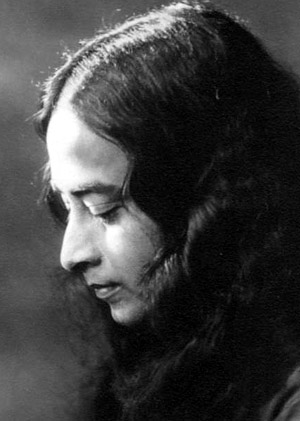
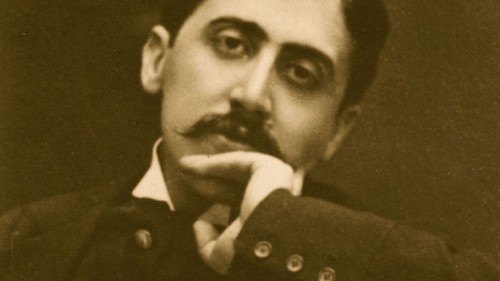
Certain details and images that appear persistently in the memory of the main character gain a totally new illumination through the novel’s ending. I encourage you to read this novel, and it is very short, unlike Proust’s In Search of the Lost Time, which I also love although I managed to read just four out of the total of seven hefty volumes. If you want an abridged version, you might want to read Alain de Botton’s delightful book How Proust Can Change Your Life. Did you know that the longest sentence in Proust’s novel presented in a standard-sized text measures about four meters? At the beginning the book was rejected by a number of publishers, one of whom remarked: “I fail to see why a chap needs thirty pages to describe how he tosses and turns in bed before falling asleep.” Proust’s brother remarked caustically: “The sad thing is that people have to be very ill or have broken a leg in order to have the opportunity to read In Search of Lost Time.” I still live in hope I will be able to finish it one day. The text of the novel is a stream of vivid, rich, intimate and very sensual memories. It is a lesson in observing, looking and taking in, being watchfully aware of the present. It is another paradox that by taking us on the journey to the past, Proust teaches us how to live fully in the present, savouring every moment, how to be sensitive and sensual. Proust teaches us also that remembering is not an intellectual process but an emotional and subconscious one. We might think we have forgotten someone but when we find an object that we associate with that person or when we smell something that we associate with a certain moment in the past, we are immediately caught in the web of memories, the heart pounding, tears in our eyes. In astrology memory is ruled by the Moon and the sign Cancer. Marcel Proust had four planets in this sign (including the Sun conjunct his Mercury) and they resided in the fourth house, which is archetypally connected with Cancer. This shows that he was the most fitting person to teach us about memory.

Image

Marcel Proust

VII. Astrology and time in the Age of Aquarius

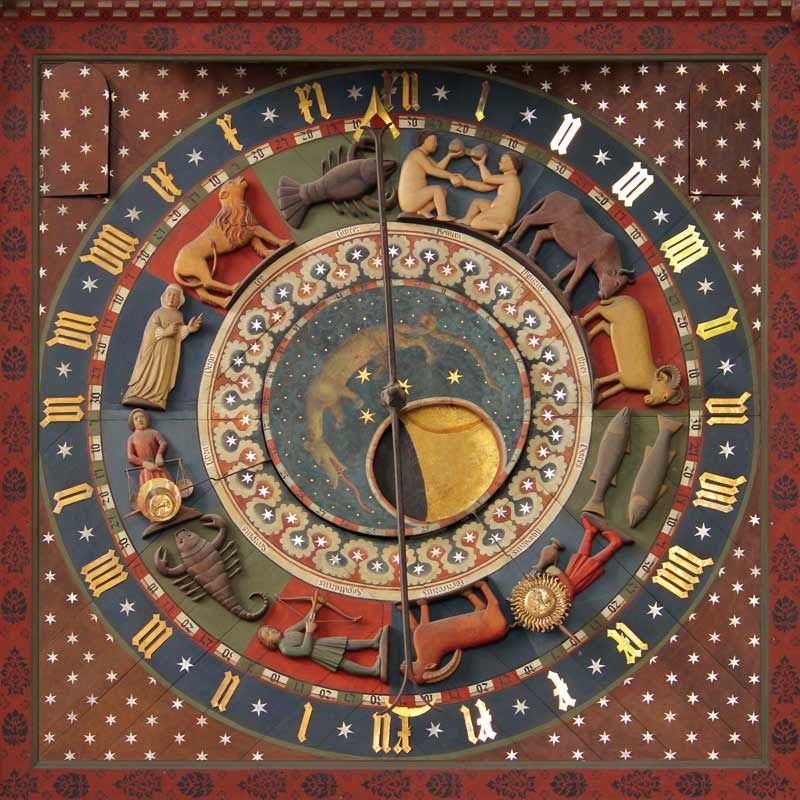
This post is getting too Proustian in length, and I would still like to add a few brief remarks about astrology and time. Astrology deals with the eternal, symbolic time of greater and smaller cycles. Time may be an arrow if we think conventionally but symbolically time is always a circle. The principle of eternal return symbolically governs all personal and global events. Celestial bodies do not cause anything to happen, they are present out there as symbols to be interpreted and which are linked to us on the earth by a golden thread of meaning. Astrology does only this: it shows the quality of the time when you were born and relates it to the quality of the time you currently live in. We are entering the age of Aquarius and Aquarius has a special connection with astrology, being its ruler. Its greatest gift is the ability to look at your life from a celestial perspective and see a unique significance of every single moment of your existence on this earth in this time.  I was particularly amazed when I heard in The Illusion of Time documentary I have already mentioned that at the time of the Big Bang the universe was highly ordered and as it progressed through time, entropy, chaos and disorder ensued. To my mind, astrology and symbolism are like a doorway to the original wholeness and meaning. By showing what was at the beginning, the source of all manifestation, they offer a glimpse of the order behind the seemingly chaotic and unbalanced energies governing our lives.

Image

Detail from an astronomical clock in Gdansk, Poland (I used to live five minutes away from this outstanding piece)

Posted in Time | Tagged , , , , , , , , , , , , , , , , , , , , , , , , , , , , , , , , , | 35 Comments

Archetype Lupus and Astronomy – the Sirius Case

fallenAngel's avatarstOttilien

This is an extension of  the last post: the archetype of the wolf. I am a hobby astronomer and fond of its older sister Astrology. So lets look to the Wolf from that perspective. The wolf is inherently pagan and shamanic, that means American Indian, Chinese, Egyptians, Babylonians should have big stakes in in its Astronomy representation. There is a Constellation – Lupus (the Wolf)  in the southern hemisphere, originally listed as a constellation by the Greek astronomer Ptolemy in the 2nd century CE.  Besides the fact, that Lupus was once the site of the brightest supernova SN 1006 (1006 A:D),  there is little of archetypal concern.

But the Dog Star” Sirius matters as Noah Brosch said in his book. Sirius is the brightest star in the night sky and can’t be missed in a city, nevermind in a desert.  Mostly called the “Dog Star”,  in China the “Blue Beast (wolf)”  Sirius represents the Heavenly Wolf and in Greece…

View original post 2,789 more words

Posted in Uncategorized | 3 Comments

Posts in Threes (2). Where Eternity Closes Its Eyes

spaceout cover 13140416-md

Glory Window, Thanksgiving Square Chapel in Dallas, Texas

I have seen three blog posts in the last week that seem to touch on the same phenomenon or which seem to have sprung from the same source of wisdom.

The first post, informed by the wisdom of the Upanishads, looks at the whole spectrum of speed in the universe between inertia and the speed of life. The manifested world moves frantically, there is constant flurry of activity, but in the centre of the spiral there is stillness, no movement. I found it interesting to read in Cirlot’s Dictionary of Symbols that in Egyptian hieroglyphs the spiral refers to cosmic forms in motion and the “relationship between unity and multiplicity.”

The second post is a wonderful poem, in which the reader gets transported into the eye of the hurricane, where the wisdom of the Upanishads sits.

And finally the third one brings in the Taoist perspective, looking at the spiral again; and at the inner space, the space between lines, the intangible out of which the tangible arises.

Post 1. http://indrajitrathore.wordpress.com/2013/04/25/time-frames-to-eternity/

Post 2. http://vijayasundaram.com/2013/04/28/repeat-ad-infinitum-a-surreal-cosmic-game/

Post 3. http://beyondthedream.co.uk/2013/04/27/tao-te-ching-11-space/

As a bonus, being really obsessed with spiral staircases, I have discovered this great article with 101 dizzying spiral staircase images:

101 dizzying spiral staircases

Related post:

https://symbolreader.wordpress.com/2013/04/22/posts-in-pairs-1-out-of-many-one/

Posted in Uncategorized | Tagged , , , , , , , , , | 19 Comments

Heart Sutra For the Balsamic Moon

Allow your judgments their own silent, undisturbed development, which, like all progress, must come from deep within and cannot be forced or hastened. Everything is gestation and then birthing. To let each impression and each embryo of a feeling come to completion, entirely in itself, in the dark, in the unsayable, the unconscious, beyond the reach of one’s own understanding, and with deep humility and patience to wait for the hour when a new clarity is born: this alone is what it means to live as an artist: in understanding as in creating.

Reiner Maria Rilke, Letters To a Young Poet

I have been rediscovering the Heart Sutra recently in the beautiful rendition of Imee Ooi. I try to ponder its significance in the morning after I wake up and in the evening before I fall asleep. I relate to it and find great comfort in it.

Heart Sutra

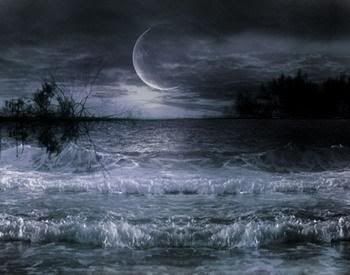
In my mind it is very much related to the moon phase I was born in, i.e. shortly before the new moon, during the so called dark or balsamic moon. In this phase the moon is invisible. Symbolically it is associated with death, sorcery, gestation, right brain processes, instinct, intuition, dreaming, resting, and the goddess Hekate. In his book The Lunation Cycle, Dane Rudhyar speaks of that phase as a transition state and the seed state. In his own words:

This type of personality is, in its highest manifestations, prophetic and completely turned toward the future, even though it feels itself the end-product of the past – yet a past which outwardly or consciously it has left behind. At times the individual feels himself possessed by a social “destiny,” or led by a superior power.

Image

Balsamic Moon, image via here

Rudhyar’s words may sound quite flattering, but I have to admit that the balsamic moon phase may be also very difficult with frequent feeling of dryness, infertility and desperation because the fruit of one’s labours are invisible and manifestation is very hard to achieve.

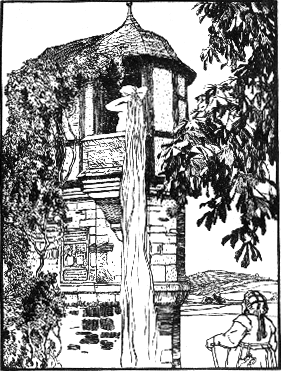
As a balsamic moon person, one is “poised for a lifetime between endings and beginnings,” as astrologer’s Dana Gerhardt’s put it, who quotes the story of Rapunzel as an illustration of the balsamic moon phase. I loved that story as a child. If you do not know it, here’s a link to the Brothers’ Grimm version. I love Gerhardt’s interpretation that the wife should not have been greedy and should not have desired the rampion from the witch’s garden. If the couple’s old garden was barren, they should have accepted the situation and focus on composting, fertilising, maintenance and pruning, as any wise gardener does during the dark phase of the moon. I also relate to the symbol of Rapunzel’s hair. She was locked up in the tower by the evil witch but she gained strength and wisdom and was able to develop her creativity. On her own she reached the ripeness for a change.

Image

Balsamic phase is not the time to force growth and activity or to blindly follow one’s desires. At this time nature’s force is strongest at the roots. Growth is strengthened invisibly. Rapunzel’s story also teaches us the wisdom of the cycles and that there is the right time for everything, as stands in the Ecclesiastes:

1 To everything there is a season, A time for every purpose under heaven: 2 A time to be born, And a time to die; A time to plant, And a time to pluck what is planted; 3 A time to kill, And a time to heal; A time to break down, And a time to build up; 4 A time to weep, And a time to laugh; A time to mourn, And a time to dance; 5 A time to cast away stones, And a time to gather stones; A time to embrace, And a time to refrain from embracing; 6 A time to gain, And a time to lose; A time to keep, And a time to throw away; 7 A time to tear, And a time to sew; A time to keep silence, And a time to speak; 8 A time to love, And a time to hate; A time of war, And a time of peace. (Ecclesiastes 3: 1-8)

The influence of the balsamic phase on my life has always been quite marked. One thing that has improved over time is a new quality of openness to opportunity and readiness to embrace what the future may bring. Like in the words of the heart sutra “gone, gone to the other shore” I accept the necessity to leave the old behind and move on. Two years ago I used to have a recurring dream featuring myself carrying a large suitcase or two, and accidentally leaving it behind on the train or at a train station. I worked with this dream in therapy and I haven’t had it since I managed to grasp its meaning. I can only hope that my old moon, heavy with the experiences of all the previous lunar cycles, has learned how to unburden herself.

Posted in The Balsamic Moon | Tagged , , , , , , , , , , , , , , , , , , , , | 36 Comments

Images of the Zodiac: Contemplating Taurus

Continue reading

Posted in Johfra Bosschart | Tagged , , , , , , , , , , , , , , , , , , , | 48 Comments

Posts in Pairs (1). Out of Many One.

Image

As an ever curious Gemini woman (with Mercury, the messenger of the gods and their intermediary, in conjunction with my Sun) I am always on the lookout for connections, links and associations. I have been paying attention to quite a number of blogs recently and I noticed how similar themes appear in similar time frames on different blogs. I hope such pairs of posts will feature regularly on my blog, that is until I grow tired of the idea, which is always a strong possibility with Geminis. I also hope to give something back to the whole blogging community by offering my views on some posts that I happen to like very much.

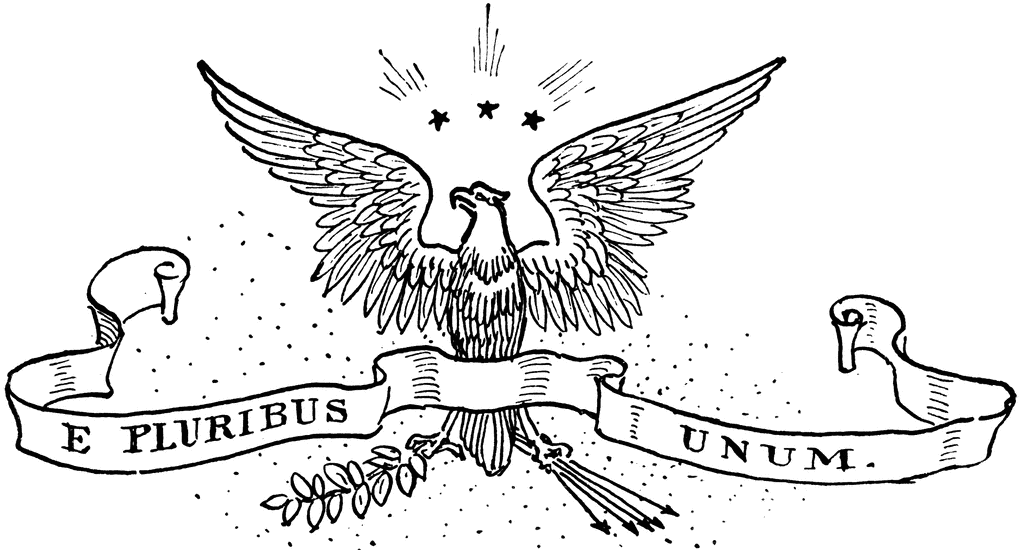
We were all touched beyond measure by what happened in Boston recently. The first post expresses a sentiment which is very close to my heart, namely that our Western society has grown more and more exclusivist and dismembered. The lofty ideal of E pluribus unum (Latin for ‘out of many one’) is just an empty jingle. We are in urgent need of the Jungian archetype of wholeness, otherwise we will never be healed. Those who feel excluded from the community are like the splintered aspects of the Self, which will most probably seek expression in disruptive and destructive ways.

The second post shows the same problem but seen from the eternal, mythical perspective. This is my favourite astrological blog thanks to its depth and scope. You do not even have to know or accept astrology to appreciate the fact that there is a meaningful connection between the myth of Isis and Osiris on the one hand and the problem of dismemberment that is the root cause of all the problems of our collective soul, shattered into millions of icy pieces like the mirror in Andersen’s Snow Queen. After the treacherous Set had cut Osiris body to pieces, Isis sought all the pieces out patiently, lovingly and with devotion and put them back together, thus bringing Osiris back to life. The Egyptian mythology has always held a deep fascination with me. I believe it holds the key to the deepest mysteries that were the everyday reality of ancient Egyptians, and which we are rediscovering again only now, on the verge of the new era of human consciousness.

The ultimate conclusion and message of both posts seems to be this: only love and wisdom can lead to healing and wholeness, which is the only antidote for division, fragmentation and exclusion that breed hatred, terrorism and fanaticism in the world today.

I wonder if anyone else can see the connection?

Post 1.   http://livinginthenow.net/2013/04/22/division-as-the-root-of-conflict/

Post 2.   http://esotericembers.wordpress.com/2013/04/21/isis-archetype-of-love-and-devotion/

Posted in Uncategorized | Tagged , , , , , , , , , , | 18 Comments

The Crossroads of Time

Image

The Selkie, via here

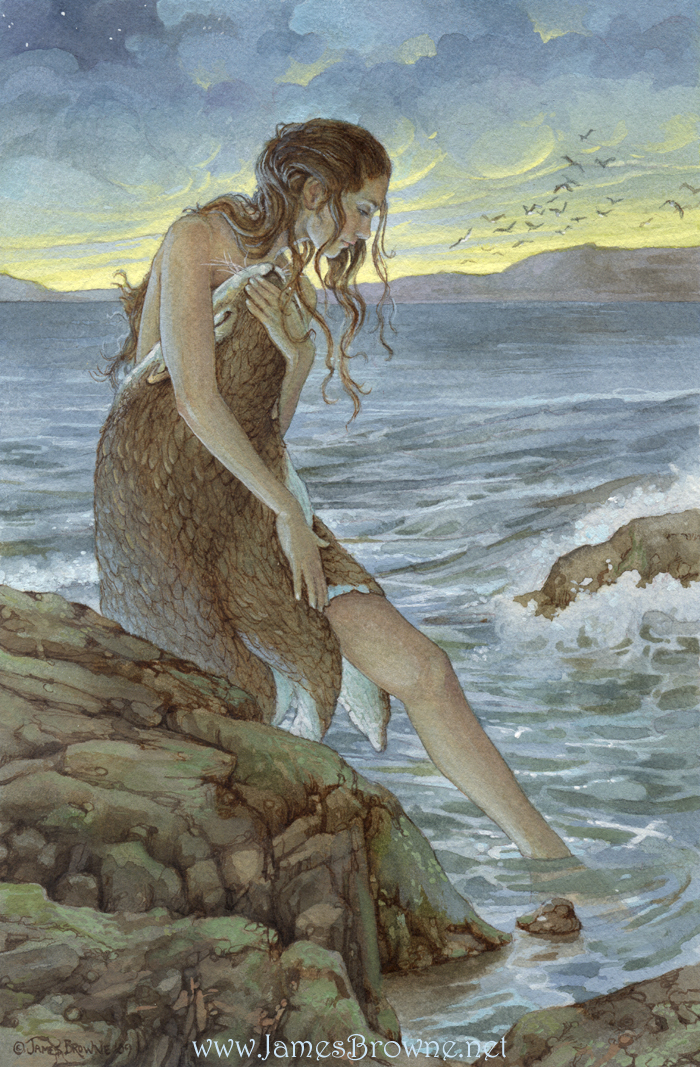
The song featured below captured my mood today with the dark skies and decisively non-Spring weather. Loreena McKennitt’s voice just wraps around me and carries me far away. She was born in Canada but her music is a magnificent expression of the Celtic lore. The old ways she sings about in that particular song are very important for the Irish, who are a proud folk deeply rooted in their traditions. The song reminds me of Ondine, a magically atmospheric film by Neil Jordan, about an Irish man who one day finds a girl caught in his net. His daughter believes her to be a selkie, a creature which lives as a seal in the sea but sheds its skin to go onto the land and live among humans. Yet she cannot stay long on land because the sea will always call her back. The film ends happily but the song I am featuring today contains the idea of loss and longing that cannot be fulfilled, which is more in tune with the nostalgic Irish mythology. It is not only the loss of love that she seems to sing about but also the loss of the old ways, the ancient culture when people lived and breathed in a sacred mythical space. The sound of the thundering waves and the pounding ocean seems to call back the old ways when they were interpreted as words of the gods. Being obsessed with Loreena McKennitt, I read her biography and found out that this particular song was actually written before the tragic accident at sea that claimed the life of her fiancée. Still, she must be thinking of him when performing that song.

Loreena McKennitt, The Old Ways

The thundering waves are calling me home unto you
The pounding sea is calling me home unto you

On a dark new year’s night
On the west coast of Clare
I heard your voice singing
Your eyes danced the song
Your hands played the tune
T’was a vision before me.

We left the music behind as the dance carried on
As we stole away to the seashore
And smelt the brine, felt the wind in our hair
In sadness you paused.

Suddenly I knew that you’d have to go
Your world was not mine, your eyes told me so
Yet it was there I felt the crossroads of time
And I wondered why.

As we cast our gaze on the tumbling sea
A vision came o’er me
Of thundering hooves and beating wings
In clouds above.

As you turned to go I heard you call my name,
You were like a bird in a cage spreading its wings to fly
“The old ways are lost,” you sang as you flew
And I wondered why.

Image

 A scene from Ondine, Colin Farrell finds a girl in his net

Posted in Uncategorized | Tagged , , , , , , , , , , , , , , | 18 Comments

Dragons and Princesses

Fear of the Inexplicable

But fear of the inexplicable has not alone impoverished
the existence of the individual; the relationship between
one human being and another has also been cramped by it,
as though it had been lifted out of the riverbed of
endless possibilities and set down in a fallow spot on the
bank, to which nothing happens. For it is not inertia alone
that is responsible for human relationships repeating
themselves from case to case, indescribably monotonous and
unrenewed: it is shyness before any sort of new, unforeseeable
experience with which one does not think oneself able to cope.

But only someone who is ready for everything, who excludes
nothing, not even the most enigmatical, will live the relation
to another as something alive and will himself draw exhaustively
from his own existence. For if we think of this existence of
the individual as a larger or smaller room, it appears evident
that most people learn to know only a corner of their room, a
place by the window, a strip of floor on which they walk up and
down. Thus they have a certain security. And yet that dangerous
insecurity is so much more human which drives the prisoners in
Poe’s stories to feel out the shapes of their horrible dungeons
and not be strangers to the unspeakable terror of their abode.

We, however, are not prisoners. No traps or snares are set about
us, and there is nothing which should intimidate or worry us.
We are set down in life as in the element to which we best
correspond, and over and above this we have through thousands of
years of accommodation become so like this life, that when we
hold still we are, through a happy mimicry, scarcely to be
distinguished from all that surrounds us. We have no reason to
mistrust our world, for it is not against us. Has it terrors,
they are our terrors; has it abysses, those abysses belong to us;
are dangers at hand, we must try to love them. And if only we
arrange our life according to that principle which counsels us
that we must always hold to the difficult, then that which now
still seems to us the most alien will become what we most trust
and find most faithful. How should we be able to forget those
ancient myths about dragons that at the last moment turn into
princesses; perhaps all the dragons of our lives are princesses
who are only waiting to see us once beautiful and brave. Perhaps
everything terrible is in its deepest being something helpless
that wants help from us.

Rainer Maria Rilke
Image
Posted in Uncategorized | Tagged , , , , | 24 Comments

The Fountain or Death as the Road to Awe

83fountain

The Fountain by Darren Aronofsky is by far the most powerful symbolic movie I have seen in the last few years. Watching it is always like being transported into another reality; the music, the powerful images and the three interwoven stories that are presented are just hypnotizing. The core story is that of Tommy Creo, a doctor who is losing his wife Izzi to cancer. Instead of sharing their last moments together he focuses on finding a cure for her and embarks on a hopeless, quixotic fight with her disease. After she inevitably dies he keeps on resuscitating her for a prolonged, painful stretch of time, refusing to let go and accept that she is no longer with him. She, on the other hand, accepted her situation with a lot of grace and dignity. Up to her death, her heart and mind had been occupied with the book she had started writing and wanted her husband to finish after her death. She was writing a story called The Fountain about a 16th century Spanish Queen Isabela, whose country suffered under the bondage of the Grand Inquisitor, who relished in torturing people and wanted to destroy the Queen and take over her kingdom, not unlike the tumour wreaking havoc with Izzi’s body. She sends a conquistador Tomás, her consort, to the Mayan territory in Central America to find the Tree of Life and deliver her and Spain from bondage. The last futuristic story is about an astronaut Tom, who travels in a giant spaceship looking like a bubble, with the Tree of Life on deck, towards the golden nebula of Xibalba (the Mayan underworld, literally ‘the place of fear’). Hugh Jackman and Rachel Weisz play the two main characters in each story. The stories echo and converse with each other; the mythical motives appear and reappear weaving a closely interlinked pattern of human fate consisting in being cast out of Paradise into the world in which we all need to face pain, separation, loss, death and suffering. I also see it as a movie on the healing and transcending power of love. It is the love for his wife that compels Tommy/ Tomás /Tom to keep reincarnating throughout eternity always looking for his divine Other, and finally enables him to let go of fear, and reach release and Enlightenment in the movie’s final scene.

Image

Image

I would not like to go into too much detail about each storyline in case there is anyone reading it who has not seen the film. I would like to focus instead on the symbolic richness of the story. The main symbols of the movie seem to be the Fountain, the Tree of Life, the Book, the Ring (wedding ring in the 21-century story and engagement ring in the conquistador story, and most probably the breathtaking golden ring round the nebula in the futuristic story). The main symbol is undoubtedly that of the Fountain (or Source), which emerges from the Tree of Life. In the words of Cirlot:

In the image of the terrestrial Paradise, four rivers are shown emerging from the centre, that is, from the foot of the Tree of Life itself, to branch out in the four directions of the Cardinal Points. (The Dictionary of Symbols)

Image

From the Source the seeds of creation are sown upon the material plane. The Source is the symbolic matrix which fecundates the world as we know it. The Fountain is the life force itself. In the movie, the main characters discover the true source of immortality. Carl Jung himself wrote a lot about the symbolism of fountains. He likened the Fountain to the Soul as the source of spiritual life and energy.

Image

Hieronymus Bosch, Garden of Earthly Delight, Fountain (detail)

It is fascinating that, as life was leaving her body and cancer was spreading, Izzy found her inner Fountain of fecundity and creativity, and wrote a beautiful book. She seemed to have become whole right before she passed away, as this wonderful dialogue from the movie attests:

Izzi: Remember Moses Morales?
Tom Verde: Who?
Izzi: The Mayan guide I told you about.
Tom Verde: From your trip.
Izzi: Yeah. The last night I was with him, he told me about his father, who had died. Well Moses wouldn’t believe it.
Tom Verde: Izzi…
Izzi: [embraces Tom] No, no. Listen, listen. He said that if they dug his father’s body up, it would be gone. They planted a seed over his grave. The seed became a tree. Moses said his father became a part of that tree. He grew into the wood, into the bloom. And when a sparrow ate the tree’s fruit, his father flew with the birds. He said… death was his father’s road to awe. That’s what he called it. The road to awe. Now, I’ve been trying to write the last chapter and I haven’t been able to get that out of my head!
Tom Verde: Why are you telling me this?
Izzi: I’m not afraid any more, Tommy.

Image

Tommy and Izzy spotting Xibalba

Once again Cirlot speaks about the symbol of the Tree most eloquently:

In its most general sense, the symbolism of the tree denotes the life of the cosmos: its consistence, growth, proliferation, generative and regenerative processes. It stands for inexhaustible life, and is therefore equivalent to a symbol of immortality. According to Eliade, the concept of ‘life without death’ stands, ontologically speaking, for ‘absolute reality’ and, consequently, the tree becomes a symbol of this absolute reality, that is, of the centre of the world.

The Tree of Life from the 16th-century part becomes a cosmic tree in the futuristic part of the movie. Tom takes the tree with him from the earth into space; the upward movement signifying him reaching higher understanding and release. In the final scene of the movie the cosmic tree is bathed in the golden light. You might remember there were two trees in the Biblical paradise: one was the Tree of Knowledge of Good and Evil, the other the Tree of Life; the latter being well hidden and almost impossible to find. I love how the film explores this perennial myth of immortality and of the mysterious dualism of Life and Knowledge.

Image

The movie’s cosmic tree

The ring, which keeps appearing in many scenes, is symbolic of both the loving connection between the main characters, of their souls reincarnating throughout the ages, and also of their wholeness and connection with the divine Self that they both finally reach but in different time frames. The doctor loses the ring at one point, which is symbolic of him losing the connection with Izzy his anima (soul). He is too focused on fixing and conquering the problem instead of just being with her and accepting of what is happening. It is interesting that Cirlot would note additionally that the ring should be symbolically related to a link of a chain. He does not elaborate on that remark, but the theme of bondage seems to permeate the movie. We are bound to this earth and to matter like Prometheus chained to the rock of Caucasus. The only transcendence we can hope for is through finding a connection with our inner Fountain. As an aside, I just had an illumination that the elusive symbolism of the ring in Tolkien is closely related to the bondage of our passions (Jung’s inferno of passions), fears, anxieties and all else that is related to the life of the flesh. And finally the Book that Izzi creates is a powerful testimony that out of physical frailty and transience arise infinite achievements of the human spirit.

Support my blog

If you appreciate my writing, consider donating and make my day. Thank you in advance.

$1.00

Posted in The Fountain | Tagged , , , , , , , , , , , , , , , , , , , , | 39 Comments

The Spirit and Science Fiction

The pulse of the new times beats in science fiction.

Indrajit Rathore's avatarSearch for The Soul - Indrajit Rathore

Over the last  century the cleavage between science and spiritualism has stirred a reaction. The stark materialism engendered by secular science has begun to reach a point of saturation like the spiritual stagnation of the Middle Ages. A new urge is thrusting itself  in a spiritual direction, not necessarily towards organized religion. Even without the vehicle of religion, spiritualism has been active in the human psyche, manifesting itself in the most unlikely quarters – Science Fiction.

I have always found Science Fiction fascinating and elevating because its scientific fantasies appear to reach out and touch an ethereal force. It has become a genre where  spiritual  and scientific impulses appear to merge. In Sci.Fi. the human psyche and imagination have created not only scientific fantasy but mingled it with the spirit and the supernatural.

Arthur C. Clarke‘s ‘Childhood’s End’ is an outstanding example of Science Fiction postulating the evolution of man into a spiritual being…

View original post 366 more words

Posted in Uncategorized | 2 Comments