
Love is heavy and light, bright and dark, hot and cold, sick and healthy, asleep and awake- it’s everything except what it is! ”
William Shakespeare, Romeo and Juliet
I. Romeo and Juliet as an alchemical work
Many years ago I happened to be reading Romeo and Juliet just when I was starting to get interested in Carl Jung and when I had just began to discover all his works dedicated to alchemy. I remember I had a strong intuitive conviction Romeo and Juliet was an alchemical work.
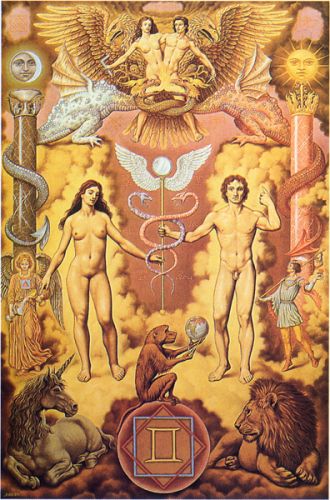
Johfra’s depiction of Gemini is pure alchemy as its central symbols are Sponsus (Bridegroom) and Sponsa (Bride). It is a depiction of an “alchemical wedding” – the joining of opposites to create unity. This creation of unity in alchemy is assisted by Mercurius, the archetype of the mind.
I am sure now that Romeo and Juliet were thought by Shakespeare as the archetypal alchemical couple. Mercutio, a close friend of Romeo, and in my opinion one of the most delightful characters ever conceived of by Shakespeare, can be interpreted as Mercury: isn’t his name quite thinly disguised? He is neither a Capulet nor a Montague and that is why he can visit both conflicted families freely. He is a very witty and fun-loving character. He even jokes at the time of his own death, saying “Ask for me tomorrow, and you shall find me a grave man….” In the play he symbolizes the mind, more specifically its ever changing, shifting quickness, its airy quality, its ability to make links and connections, and quickly switch sides should boredom occur. All of this can be observed in the following exchange:
ROMEO
Peace, peace, Mercutio, peace!
Thou talk’st of nothing.MERCUTIO
True, I talk of dreams,
Which are the children of an idle brain,
Begot of nothing but vain fantasy,
Which is as thin of substance as the air
And more inconstant than the wind, who woos
Even now the frozen bosom of the north,And, being anger’d, puffs away from thence,
Turning his face to the dew-dropping south.
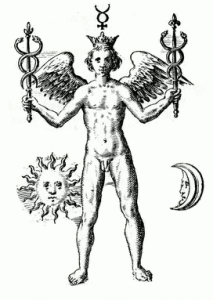
Mercutio is the quicksilver of the play, if he were a planet he would be Mercury, which is the ruler of Gemini, an air sign connected with cognitive processes. It is a dual sign (twins) of dialogue, which is beautifully shown in Johfra’s painting showing a large number of pairs of opposites. Johfra always shows the inner and hidden, esoteric meaning of signs and it makes a lot of sense to mention at this point that the esoteric ruler of Gemini is Venus. The spirit of Venus – the harmony and beauty found in relationships – permeates the painting. Shakespeare placed the action of Romeo and Juliet in Verona because it is a city of exceptional beauty and the women of that city were believed to be the most beautiful in all Italy. The play contains a rich interplay of pairs of opposites, the central being the pair of lovers themselves. Juliet meets Romeo (his name means “pilgrim”) at the age of 14, he sees her at night (“If love be blind, it best agrees with night,” goes the famous quote from the play). She is the Moon, the feminine principle, and the Moon at the fourteenth day of her cycle is full, while he is the pilgrim, i.e. the Sun, the masculine principle.
I would like to consider the pairs of opposites depicted in Johfra’s painting and also take a closer look at the dual symbols of wholeness, namely the hermaphrodite at the top and the caduceus in the centre.
II. The dual nature of the mind
The painting seems to be an apt portrayal of the workings of the mind. No idea, concept or thought exists in isolation. It is impossible to explain the meaning of anything without referring it to something else. “All meaning is relationship,” says Ray Grasse in The Waking Dream. We are wired to think in terms of opposites, to think dialogically. Mikhail Bakhtin, a brilliant Russian philosopher and literary critic, introduced the concept of “polyphony” (the multitude of voices), which characterizes the fictional world Dostoevsky. All characters in Dostoevsky’s novels are in eternal dialogue. In one of Bakhtin most memorable thoughts on the nature of being, he equals being with relating and communicating:
To be means to communicate… To be means to be for another, and through the other, for oneself. A person has no internal sovereign territory, he is wholly and always on the boundary; looking inside himself, he looks into the eyes of another or with the eyes of another.
Duality is the main theme of Johfra’s painting. In fact, every symbol or archetype is essentially a duality – a unity of two which is held in dynamic tension. The Chinese Jin and Jang symbol shows this principle best: every archetype holds within itself a light and a shadow side. Jofhra’s depiction of Gemini resembles the Lovers, the Tarot card of the Major Arcana. In many cultures the fundamental polarity underpinning all phenomenal experience is symbolized by a divine pair: a god and a goddess; in the world of phenomena the divine One functions as a Two. We may actually treat this painting as the western equivalent of the Chinese Jin/Jang symbol. It shows the alchemical Hierosgamos (sacred marriage) – a harmonious union of opposites, with the emphasis on a union of higher and lower powers of the mind.
III. The divine pair
The focus of the painting seems to fall on the divine pair. She is standing on the left, he on the right. In symbolism, the left side is equated with the unconscious whereas the right with consciousness. The right side is solar and positive, the left side lunar and negative. The male is associated with the image of the Sun (Sol) depicted over the pillar on the right-hand side while the female is related to the Moon. The Sun is the active principle of the universe while the Moon is the passive one. In other words, the Moon fulfills a passive role of reflecting the Light which the Sun actively radiates. The painting shows the totality and unity, the conjunction of the Sun and the Moon. In the image of the Moon we can notice the crescent, the full moon and the dark balsamic moon. In alchemy, the Moon represents the mutable principle on account of the fragmentary nature of its phases. We saw the two pillars already in the Taurus painting. They were mysterious pillars set by Salomon in front of his temple. They were purely symbolic and did not support the construction in a physical sense. The red pillar Jachin on the right is crowned with a staff (wand), which implies a masculine direction and intensity, the action of the will, and relates to the element fire. The black pillar Boaz on the left is crowned with a cup (goblet) which implies feminine receptivity and emotionality and forms a vessel for the Sun’s radiance. In The Hidden Power by Thomas Troward he wrote that Jachin represents the Unity of the Spirit while Boaz stands for the Unity of Love. Johfra himself talks about “the red marble positive pillar of force or strength Jachin on the right, and the black marble negative pillar of form Boaz on the left.” The mystery of the pillars has eluded scholars for centuries, as the Bible does not provide any explanation what they actually signified. Troward traced the etymology of the name Jachin, according to which the word Yak signifies “one” and “hin” means something like “only”, which would mean that Jachin could be rendered as “only One” suggesting Unity. Tracing back the meaning of Boaz, he cites a biblical story of Booz and Ruth. The story goes like this:
Boaz was a very wealthy man who lived in Bethlehem. When Naomi returned to Bethlehem with her widowed daughter-in-law, Ruth, Ruth went into the fields of Boaz to glean. Boaz learned that Ruth’s deceased husband was a distant relative of his. He acted kindly towards Ruth and instructed his farm workers to leave extra sheaves of barley for her to gather. Ruth had another relative of her late husband who was closer than Boaz. By law, the other relative was obligated to marry Ruth, as stated in Deuteronomy 25:5-10. Boaz confronted the other relative with this law, and after the relative refused to marry Ruth, Boaz agreed to marry Ruth, and to buy the estate of Ruth’s deceased husband. After they got married, Ruth had a son named Obed, who became the father of Jesse, who became the father of David. Boaz and Ruth became the great-grandparents of King David. (retrieved from http://www.aboutbibleprophecy.com/p153.htm)
Troward concludes: “Boaz represents the principle of redemption in the widest sense of reclaiming an estate by right of relationship, while the innermost moving power in its recovery is Love.” I find it fascinating and it resonates with me deeply: the positive pillar corresponds to our inner Oneness while the negative one to our desire to enter relationships based on love with our divine Other. I also think that the story of Boaz and Ruth shows the interplay of independence and dependence in relationships as well as openness and surrender. Naturally, Johfra’s painting also means that we carry our divine Other within ourselves, the lover we want to merge with is a projection of our innermost Being. The woman needs to integrate her inner male polarity (Animus) while the man his inner female polarity (Anima). Finally, it is worth pointing out that the man is pointing upwards (Spirit, heaven, the immaterial realm) while the woman downwards towards the earth (body, matter, the manifested reality).
IV: The hermaphrodite as a symbol of wholeness
The alchemists, in their quest for gold (understood as the highest unity of body, mind and spirit and the actualization of the Self) considered the world to be governed by a myriad of paired forces (opposites). They perceived the Soul to be an organ of the Spirit and the Body as an instrument of the Soul. Their goal was self-knowledge and they sought to harmonize and balance the opposing forces first within themselves and then to project that inner order on the outside world. If inner conflict gets resolved, the outside world will follow. The great hermaphrodite (Rebis – from Latin res bina, meaning double matter) was the symbolic fruit of that unity.
In Mysterium Coniunctionis, C.G. Jung talks about the concept of a spark. Alchemists defined it as Archaeus, i.e. the fiery centre of the earth which is hermaphroditic and consists in a conjunction of a male and a female. It is a fire point created by tension of masculine and feminine principles. It is fitting that in the painting this ball of fire created by the joining of male and female energies is located at the level of the second chakra of sexuality and creativity. This chakra is called Svadisthana, which means “dwelling place of the Self.” In Greek mythology, Hermes and Aphrodite produced a beautiful child named Hermaphroditus. He was born as a handsome male but a nymph fell passionately in love with him and asked the gods for the two to never part. They formed a union of two bodies within one. The fire point also signifies the philosopher’s stone, which was a symbol of inner unity – a result of individuation, i.e. a reconciliation of Body, Soul and Spirit.
V. The caduceus
The divine couple are holding the caduceus, the staff of Mercury. According to Cirlot’s Dictionary of Symbols, the staff represents power, the two snakes wisdom and the wings diligence and lofty thoughts. The snakes also refer to the force of Kundalini. The two twin serpents represent the complementary solar (masculine) and lunar (feminine) forms of divine energy (prana, i.e. “breathing forth”, “life force”). The awakened kundalini energy rises through two channels of energy forming the criss-cross pattern exactly like the one we observe in the caduceus. The channel ida is connected with the left side, has a negative charge and is related to the moon. The channel pingala is identified with the right, is charged positively, and relates to the masculine and the sun. The caduceus is a symbol of balanced duality, emphasizing the supreme state of strength and self-control (and consequently of health) which can be achieved both on a lower plane of the instincts – the root of Being (symbolized by the serpents) and on the higher level of the spirit (represented by the wings).
Of the caduceus Dane Rudhyar wrote this in New Mansions for New Men:
“The central rod of the caduceus and the two intertwining serpents refer to the process of synthesis by which the spiritual potencies latent in every cell are gathered around the spinal axis (the central rod) and led up to the head. The entire symbol is one of centralized and rhythmic relationship. It is the hieroglyph of Mercury, the Master-Weaver in action. The weaving Hands go to and fro; and the tapestry of perfected being emerges, from which Man may learn the significance of his own being and of universal life.”
VI. The mirror
The mirror featured extremely inventively by Johfra at the top of the caduceus is naturally suggestive of duality. It symbolizes imagination, consciousness, self-reflection and self-contemplation. It is often connected with illumination and treated as a doorway to another dimension. I was reminded of the rune Kenaz when I saw this symbol in the painting. Kenaz means both a torch and a mirror; it is strongly connected with illumination and intuition, representing the search for truth. In the context of relationships Kenaz means learning from each other. It guides the process of a student becoming a master. We can also say that as the moon reflects the light of the sun, so the human mind reflects, like a mirror, the higher mind of the divine source.
A writer who was fascinated by mirrors was Jorge Luis Borges. In a short story “Tlön, Uqbar, Orbis Tertius” he writes about a world created by imagination, a world where idealism rules and materialism is a heresy. In the imaginary land Tlön, people are caught in the world of ideas, while their language defines their reality. As in Wittgenstein’s philosophy: “The limits of my language define the limits of my world,” the Tlönian recognizes perceptions as primary, and denies the existence of any underlying reality. Borges reminds us that the world we see is indeed a projection of the mind.
VII. The lion and the unicorn
Further opposing principles are the lion and the unicorn lying in the foreground. Johfra writes that in ancient India the sign of Gemini was portrayed as a lion and unicorn that guarded the gate to the Holy City. Both unicorn and lion were sacred animals for alchemists, as Jung wrote in Mysterium Coniunctionis. The time will come for me to speak more extensively of the lion symbolism in August with the Sun in Leo. For now I will just mention in passing that alchemists associated the lion with the element fire and with the fiery (beastly, passionate, individuating, masculine) part of the alchemist’s soul. The unicorn is symbolic of sacred and pure sexuality, as it can only be tamed by a virgin (purified matter). Read more on the unicorn here: https://symbolreader.net/2014/09/09/the-homage-to-the-unicorn/
VIII. The baboon and the reptiles
A baboon is sitting on a circle, holding a globe. On the one hand, he may relate to Thoth, the Egyptian god of knowledge, secrets and writing, identified with the Greek Hermes. Baboons were very important in the Egyptian myth and ritual:
“Baboons were kept as sacred animals in several Egyptian temples. There was a belief reported by some Classical writers that the most learned Egyptian priests understood the secret language of baboons. This was thought to be the natural language of true religion.”
Geraldine Pinch, Handbook of Egyptian Mythology
But I also think the ape may signify lower brain functions or the unconscious mind. Since the whole painting seems to be a symbolic vision of the way the human mind works, also snakes and dragons may refer to the so called reptilian brain, the most ancient and primitive, instinctive side of our thinking processes which is in charge of survival and reproduction. It can be aggressive and territorial, and at least some of its functions can be equated with the Jungian shadow. The dragon is created any time we reject part of the contents of our psyche and relegate it to the shadows. The serpents represent the aspects of the unconscious that can be characterized as cold and ruthless but also granting the quality of natural wisdom. This power of instincts is transformed into the ball of fire in front of the figure of the Hermaphrodite, which I have already discussed. The two eagles also refer to the healing power of transformation. They symbolized Spirit as a general principle because they were believed to fly higher than any other birds. They were also emblems of majesty. From an alchemical perspective, they expressed “the victory of spiritualizing and sublimating activity over involutive, materializing tendencies” (Cirlot). In simple terms, they referred to the transformations of lower instincts into higher spiritual powers. The power of the unconscious instincts is essential for the human mind to work in a balanced way.
The role of Mercurius in the alchemical opus was very crucial, as this quote from Jung’s Psychology and Alchemy (par. 404) testifies:
“The dragon is probably the oldest pictorial symbol in alchemy of which we have documentary evidence. It appears as the ouroboros, the tail eater, in the Codex Marcianus, which dates from the 10th or 11th century, together with the legend: (the one, the all). Time and again the alchemists reiterate that the opus proceeds from the one that leads back to the one, that it is a sort of circle like a dragon biting its own tail. For this reason the opus was often called circulare (circular) or else rota (the wheel). Mercurius stands at the beginning and end of the work: he is the prima materia, the caput corvi, the nigredo, as dragon he devours himself and as dragon he dies, to rise again as the lapis. He is the play of colours in the cauda pavonis and the division in to four elements. He is the hermaphrodite that was in the beginning, that splits in to the classical brother sister duality and is reunited in the coniunctio, to appear once again at the end in the radiant form of the lumen novum, the stone. He is metallic yet liquid, matter yet spirit, cold yet fiery, poison yet healing draught- a symbol uniting all opposites.“
IX: The Fool and Temperance
The two Tarot cards are Temperance on the left and the Fool on the right. Yet again Johfra represents the polar powers joined in harmony, the solar and lunar lights in the right proportions. She is the Sophia, who has resolved the conflict of opposites with the power of her Divine Mind. The Fool is the Jester, which brings us back to Shakespeare and Mercutio, who embodied this archetype very strongly, the Trickster being the Jungian archetype very much connected with the sign of Gemini. He is clever and mischievous, always challenging the status quo and bringing in fresh, new ideas. He can often tell the hardest truths. He delights in unmasking our collective shadow. As Byrd Gibbens wrote:
Many native traditions held clowns and tricksters as essential to any contact with the sacred. People could not pray until they had laughed, because laughter opens and frees from rigid preconception. Humans had to have tricksters within the most sacred ceremonies for fear that they forget the sacred comes through upset, reversal, surprise. The trickster in most native traditions is essential to creation, to birth.
X. Conclusion
As a Gemini I realized while writing this that it is the hardest to hold a mirror to oneself. I leave you with the words of Alan Oken, a spiritual astrologer:
The developed Gemini is the gifted intellectual; the spiritual Gemini is the translator of universal truths.

Support my blog
If you appreciate my writing, consider donating and make my day. Thank you in advance.
$1.00
Related posts:
Images of the Zodiac: Contemplating Aries
Images of the Zodiac: Contemplating Taurus
https://symbolreader.net/2013/06/26/images-of-the-zodiac-contemplating-cancer/
https://symbolreader.net/2013/08/09/images-of-the-zodiac-contemplating-leo/
https://symbolreader.net/2013/09/04/images-of-the-zodiac-contemplating-virgo/
https://symbolreader.net/2013/10/04/images-of-the-zodiac-contemplating-libra/
https://symbolreader.net/2013/11/18/images-of-the-zodiac-contemplating-scorpio/











 symbolreader
