
“The good and the beautiful freeze to the ice of the absolute idea and the bad and hateful become mud puddles full of crazy life.”
C.G. Jung, The Red Book (Liber Primus, chapter VIII)

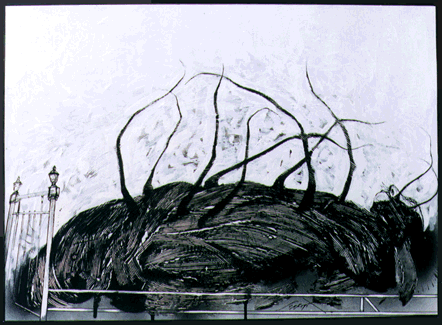
Giuseppe Bernardino Bison, “Don Juan in Hell”
Chapter VIII of The Red Book (Liber Primus) was given the title The Conception of the God. Jung starts by quoting the parable of the mustard seed from the Gospel of Matthew:
“The kingdom of heaven is like to a grain of mustard seed, which a man took, and sowed in his field: Which indeed is the least of all seeds: but when it is grown, it is the greatest among herbs, and becometh a tree.”
The death of the hero, discussed in part 9 of the series, has planted a seed. This seed will grow into a new God, who will take the life of Jung’s psyche in a new direction. The new God is likened to “a wondrous child,” who was conceived in pain but whose birth will be joyful. Like the mustard seed, also the divine child is fragile, easily overlooked and disregarded by the guardians of the status quo, who dedicate their life to the spirit of our time:
“We passed by in our ridiculousness and senselessness when we caught sight of you.
Our eyes were blinded and our knowledge fell silent when we received your radiance.
…
The constellation of your birth is an ill and changing star.”
The psychology of the child archetype was analyzed by Jung in a volume which he co-wrote with Karl Kerenyi. Typically in myth, the birth of the divine child, which in psychological terms is “the nascent form of the Self,”(1) is miraculous, yet early childhood is plagued by abandonment and persecution. The abandonment is a necessary consequence of “evolving towards independence,” says Jung (3). It is vital for the divine child to detach from his/her origins. The conscious factors seek to stifle the child and all the new psychological content that the child represents. The child is therefore “easily overlooked and falls back into the unconscious.” (4)

Peter Paul Rubens, “Boy with Bird”
But like the seed the child has also emerged from the depths of Nature and, as Jung says, “represents the strongest, the most ineluctable urge in very being, namely the urge to realize itself.” (5) As such the child becomes also the symbol of the unity of the opposites, as it “anticipates the self which is produced through the synthesis of the conscious and unconscious elements of the personality,” explains the editor of The Red Book in the footnotes.
Next Jung asks a question, which is hotly debated in Jungian circles to this day: does God encompass evil or is he pure good:
“If the God is absolute beauty and goodness, how should he encompass the fullness of life, which is beautiful and hateful, good and evil, laughable and serious, human and inhuman?”
Jung argues that there are no heights without depths, but the descent to the underworld if full of peril. He warns:
“The depths would like to devour you whole and choke you in mud. He who journeys to Hell also becomes Hell; therefore do not forget from whence you come. The depths are stronger than us; so do not be heroes, be clever and drop the heroics, since nothing is more dangerous than to play the hero. The depths want to keep you.”
The newly emerged consciousness is fragile like a child and always in danger of being swallowed, devoured by the depths. But ascent will only come after “night and Hell,” which is why Christ journeyed to the underworld after his death. The dead, says Jung, require sacrificial gifts, “golden cups full of the sweet drink of life.” Such ambiguity, which consists in being poised between darkness and light, is the way of life.
Another important quality of the divine child is uniqueness. Jung always warned against imitation, which he saw as harmful to true individuation. The hero, whom everyone wanted to imitate, had to suffer a metaphorical death, so that a new identity of the psyche could be forged. Jung says:
“Imitation was a way of life when men still needed the heroic prototype. … Human apishness has lasted a terribly long time, but the time will come when a piece of that apishness will fall away from men. That will be a time of salvation and the dove, and the eternal fire, and redemption will descend.”
The notion of individuation means also being able to achieve singleness within oneself, if necessary also outside of “the communal” and “the external.” As Jung says in this chapter:
“If we are in ourselves, we fulfill the need of the self, we prosper, and through this we become aware of the needs of the communal and can fulfill them.”
According to Jung, those who have achieved individuation can serve their community better than those who have been leading communal or conditioned lives. God dwells within the individualized Self (in some interpretations – the Self is God), not without. It has to be emphasized that individuation does not mean perfection; quite the contrary. By acknowledging that he or she cannot imitate the heroes, an individual accepts his or her “incapacity,” which is a necessary step towards achieving inner unity. In his interpretative guide to reading The Red Book, Sanford L. Grob makes an important point about the hero being “insulated from the negative poles of the features that make him/her heroic.” It is often the unacknowledged opposite that brings about the hero’s downfall.
Grob reminds us that complete unity of opposites is not a desirable effect since it is the conflict between them which “produces interest and activity.” When oppositions are overcome, there is no more energy, no more life, or to quote Jung (after Grob) from his Psychological Types: “He who has… gradually given up all attachments and is freed from all pairs of opposites reposes in Brahman alone.”

William Blake, Illustration from The Gates of Paradise
Footnotes:
(1) Liz Greene, The Astrological World of Jung’s Liber Novus: Daimons, Gods and the Planetary Journey, Kindle edition
(2) Carl Jung, Karl Kerenyi, Introduction to a Science of Mythology: The Myth of the Divine Child and the Mysteries of Eleusis, Routledge and Kegan Paul Ltd, London 1951
(3) Ibid.
(4) Ibid.
(5) Ibid.

Support my blog
If you appreciate my writing, consider donating and make my day. Thank you in advance.
$1.00
Reading The Red Book – part 11
Reading The Red Book – part 12
Reading The Red Book – part 13
Reading The Red Book – part 14
Reading The Red Book – part 15
Reading The Red Book – part 16
Reading The Red Book – part 17
Reading The Red Book – part 18
Reading The Red Book – part 19
Reading The Red Book – part 20
Reading The Red Book – part 21
Reading The Red Book – part 22
Reading The Red Book – part 23
Reading The Red Book – part 24
Reading The Red Book – part 25
Reading The Red Book – part 26
Reading The Red Book – part 27
Reading The Red Book – part 28
Reading The Red Book – part 29
Reading The Red Book – part 30
Reading The Red Book – part 31
Reading The Red Book – part 32
Reading The Red Book – part 33
Reading The Red Book – part 34
Reading The Red Book – part 35
Reading The Red Book – part 36
Reading The Red Book – part 37
Reading The Red Book – part 38
Reading The Red Book – part 39
Reading The Red Book – part 40


















 symbolreader