Haunting Paintings: “Wind from the Sea” by Andrew Wyeth

Image

I saw this painting today and became transfixed by it. The wind has brought the smell of the sea and the birds on the old and frail lace curtain have momentarily caught wind in their wings. I felt nostalgia, melancholia, a certain sweet longing, which the Greeks called pothos – “a yearning desire for a distant object.” In Senex and Puer, James Hillman defined pothos as the feeling that “drives the sailor-wanderer to quest for what cannot be fulfilled.”

I tried to find out what the story behind the painting was, though I was in two minds whether I really wanted to know. The critics point out that it was inspired by the death of Wyeth’s father in a tragic accident that happened a year before the painting was created. The same critics point out that the window overlooks the Wyeth family graveyard. Others point out that “Wind from the Sea” is intimately connected with “Christina’s World”- another painting by Wyeth which was created a year later and which shows the artist’s dear friend, a paraplegic, who used to crawl in the grass because this was the only way she was able to move about.

Image

Wyeth once said about his art: “It’s a moment that I’m after, a fleeting moment, but not a frozen moment.” I may have already said too much: explaining away a work of art destroys the feeling of pothos, freezing the fleetingness of the image. Pothos was the son of the rainbow goddess Iris and Zephyrus, god of the West Wind. Neither the wind nor the rainbow can be harvested for petrified samples, which would give away all their mysteries and hidden meanings.

Support my blog

If you appreciate my writing, consider donating and make my day. Thank you in advance.

$1.00

Sources:

Christopher Benfrey, “Wyeth and the Pursuit of Strangeness” The New York Review of Books, June 19, 2014

James Hillman, Senex and Puer (Uniform Edition of the Writings of James Hillman 3)

Posted in Painting | Tagged , , , , , , , , , , , | 20 Comments

Okeanos

“Okeanos is situated at the outermost limits of the world, which is encircled by its stream. The circular stream of the Okeanos flows eternally around the world and eternally recycles the infinite supply of fresh water that feeds upon itself … This mystical river Okeanos, surrounding not only the earth but even the seas surrounding the earth, defines the limits of the known world. Every evening, as the sun sets at sunset, it literally plunges into the fresh waters of this eternally self-recycling cosmic stream, and it is from these same fresh waters that the sun rises again every morning at sunrise.”

Gregory Nagy, “The Ancient Greek Hero in 24 Hours”

Image

Image via http://www.francisweller.net/

Posted in Quotations | Tagged , , , , , | 17 Comments

Swann’s Dream

“Sometimes, too, just as Eve was created from a rib of Adam, so a woman would come into existence while I was sleeping, conceived from some strain in the position of my limbs. Formed by the appetite that I was on the point of gratifying, she it was, I imagined, who offered me that gratification. My body, conscious that its own warmth was permeating hers, would strive to become one with her, and I would awake. The rest of humanity seemed very remote in comparison with this woman whose company I had left but a moment ago: my cheek was still warm with her kiss, my body bent beneath the weight of hers. If, as would sometimes happen, she had the appearance of some woman whom I had known in waking hours, I would abandon myself altogether to the sole quest of her, like people who set out on a journey to see with their own eyes some city that they have always longed to visit, and imagine that they can taste in reality what has charmed their fancy. And then, gradually, the memory of her would dissolve and vanish, until I had forgotten the maiden of my dream.”

Marcel Proust, “Swann’s Way,” translated from the French by C.K. Scott Moncrieff

Image

Karl Briullov, “A Dream of a Girl Before Sunrise”

Posted in Quotations | Tagged , , , , , , | 14 Comments

Tear Down This Wall: on Psychological Defenses

“If personality is an unbroken series of successful gestures, then there was something gorgeous about him, some heightened sensitivity to the promise of life, as if he were related to one of those intricate machines that register earthquakes ten thousand miles away. This responsiveness had nothing to do with that flabby impressionability which is dignified under the name of the ‘creative temperament’–it was an extraordinary gift for hope, a romantic readiness such as I have never found in any other person and which it is not likely I shall ever find again. No–Gatsby turned out all right at the end; it is what preyed on Gatsby, what foul dust floated in the wake of his dreams that temporarily closed out my interest in the abortive sorrows and short-winded elations of men.”
F. Scott Fitzgerald, “The Great Gatsby”

Image

Each of us has an innocent, soft, vulnerable core that wants to be nourished, cherished and protected. In Aion, Carl Jung spoke of the inner Christ, who personifies the archetype of the Self:

“He is in us and we in him. His kingdom is the pearl of great price, the treasure buried in the field, the grain of mustard seed which will become a great tree, and the heavenly city.”

This radiant inner core requires protection. The walls that our selves build around it often hide it so well and so deep that its light becomes dim and muffled. Every disappointment, injury, trauma strengthens the defenses and weakens the light. This juxtaposition of softness and hardness, victim and perpetrator, innocence and experience is shown marvelously by Fyodor Dostoevsky in an episode of his Brothers Karamazov called “The Grand Inquisitor.” In the story, Jesus returns to Earth to Seville at the time of the Inquisition. People recognize him immediately and flock to be near him:

“The Sun of Love burns in His heart, and warm rays of Light, Wisdom and Power beam forth from His eyes, and pour down their waves upon the swarming multitudes of the rabble assembled around, making their hearts vibrate with returning love. He extends His hands over their heads, blesses them, and from mere contact with Him, aye, even with His garments, a healing power goes forth.”

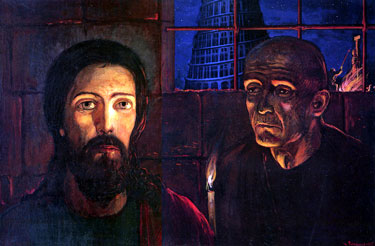
The Grand Inquisitor (“…a tall, gaunt-looking old man of nearly four-score years and ten, with a stern, withered face, and deeply sunken eyes, from the cavity of which glitter two fiery sparks”) has him arrested and interrogates him with the intention of sentencing him to death. The organized religion has lost the true spirit of Christianity; in a touching ending of the episode the Inquisitor, after a long speech to which Jesus listens silently, has made his decision and wants Christ dead. But he changes his mind when Christ kisses him:

Image

Ilya Glazunov,“The Legend of the Grand Inquisitor”

“He bends towards him and softly kisses the bloodless, four-score and-ten-year-old lips. That is all the answer. The Grand Inquisitor shudders. There is a convulsive twitch at the corner of his mouth. He goes to the door, opens it, and addressing Him, ‘Go,’ he says, ‘go, and return no more… do not come again… never, never!’ and—lets Him out into the dark night. The prisoner vanishes. … The kiss burns his heart, but the old man remains firm in his own ideas and unbelief.”

The psychological factor personified by the Grand Inquisitor seems to be the polar opposite of innocence, light, softness and goodness, but yet in this scene the opposites unite if only for a moment. The dramatic split is temporarily healed. Donald Kalsched, a Clinical Psychologist and Jungian Psychoanalyst specializing in trauma, talks about psyche’s protective mechanisms, our very own inner Grand Inquisitor, in an online interview (http://www.cgjungpage.org/learn/articles/analytical-psychology/187-an-interview-with-donald-kalsched):

“It’s been known, for example, that there’s a ‘tyrannical inner object’ that has a great deal to do with psychological depression, with harsh super ego attack. Jung called it the negative animus. Odier calls it the ‘great malevolent beings in the psyche.’ Fairbairn calls it the internal saboteur, and Guntrip, the antilibidinal ego. What may be new in the book is my effort to show this as one half of what I call the ‘archetypal self care system,’ and that it’s related to early trauma. If my hypothesis is correct, we can see this in dreams and other unconscious material as psyche’s primitive defense. Building on what Fordham called ‘defenses of the Self,’ I suggest that in cases of early trauma, we see a remarkable wisdom in the psyche to assure survival of what I call the imperishable personal spirit, the essence of the person.”

He goes on to discuss the analogy of how the immune system functions and how psyche erects its own protective walls:

“The point about the immune system is that it’s a killer! We’d all be dead if we didn’t have killers inside us, called white cells or T cells. The immune system is capable of recognizing non-self elements like viruses and attacking and killing them. Some of the auto-immune diseases like AIDS are particularly problematic because of the trickster element. The system ‘thinks’ it’s attacking something dangerous, but its ‘enemy’ is actually a vital aspect of the body. Let’s imagine a very young child whose dependency needs are attacked or ignored by an over-burdened parent. Pretty soon, the child internalizes the parental attitude toward its own neediness and starts to attack itself as soon as its dependent need is felt. Such children become self-sufficient too early. Ronald Fairbairn has also taught us that they use their own aggression internally to defend against this need. This becomes a defensive structure. It continues to operate later when the person, as an adult, is in a situation which calls for opening up in an intimate relationship and exposing vulnerability to a love partner. The defense will see that opening up process just as it saw it when the person was eighteen months old, when the opening up was immediately followed by humiliation or shaming. So it will attack the inner world in the same way that the auto-immune system will attack the body’s tissues, and it will cut off relatedness to self and other and make the person defensive.”

Image

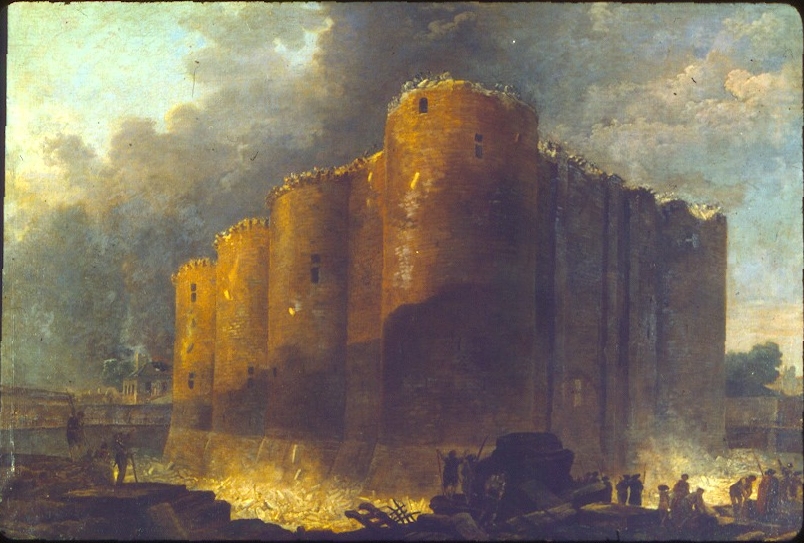
Hubert Robert, “Demolition of the Bastille”

In every ruthless person there is innocence and vulnerability, continues Kalsched:

“You get an inner world that’s both brutal and sentimentally weak at the same time. It’s like Hitler, who cried when his canary died; that kind of sentimental emotion which is infantile. Frequently people who have suffered a lot of early trauma and don’t know it are extremely conscious of all the injured animals and innocent creatures in the world. What they don’t realize is that there’s an innocent creature in themselves that’s been injured that needs attention while they’re taking care of all of the wounded people or animals in the world.”

I think Rumi’s famous words are ideal to finish my post today:

“Your task is not to seek for love, but merely to seek and find all the barriers within yourself that you have built against it.”

Image

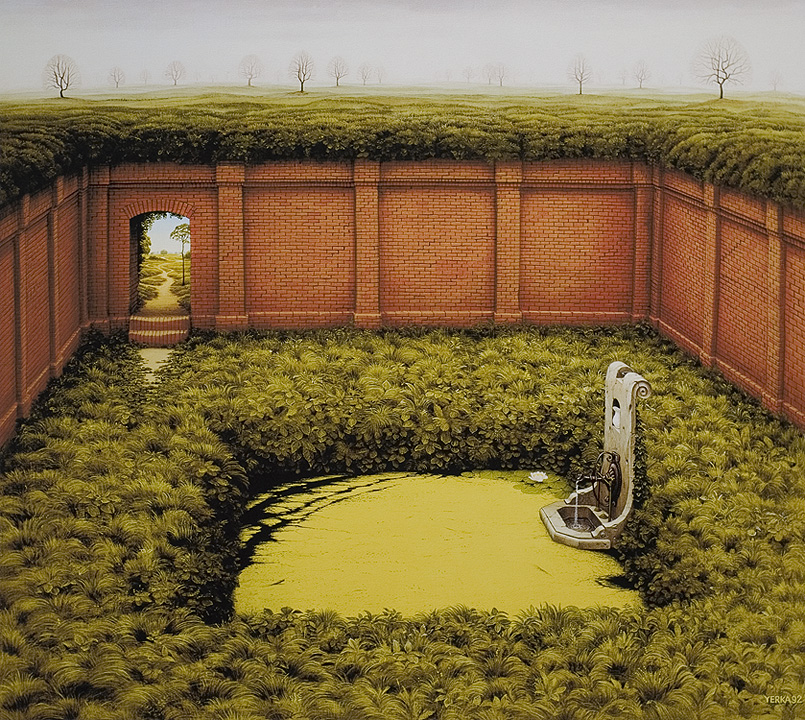
Yacek Yerka, “Oligocene Gardens”

Posted in Trauma | Tagged , , , , , , , , , , , , , , , | 20 Comments

Freeze, Fight or Flight: Dealing with Trauma

1.“When a young tree is injured it grows around that injury. As the tree continues to

develop, the wound becomes relatively small in proportion to the size of the tree. Gnarls, burls and misshapen limbs speak of injuries and obstacles encountered through time and overcome. The way a tree grows around its past contributes to its exquisite individuality, character, and beauty.”

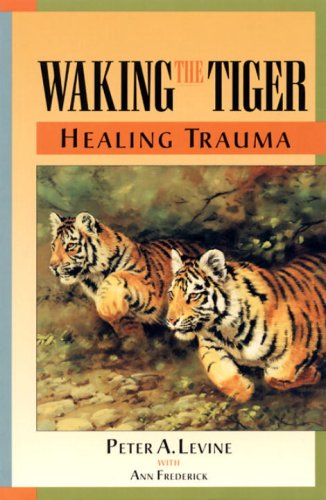
Peter A. Levine, “Waking the Tiger: Healing Trauma”

2.Trauma:

1690s, “physical wound,” medical Latin, from Greek trauma “a wound, a hurt; a defeat,” from PIE *trau-, extended form of root *tere- (1) “to rub, turn,” with derivatives referring to twisting, piercing, etc. Sense of “psychic wound, unpleasant experience which causes abnormal stress” is from 1894.

Online Etymology Dictionary

Image

Frida Kahlo, “Without Hope”

Trauma is an inextricable part of human experience. We are all wounded, we are all damaged. As Carl Jung wrote:

“The patient who comes to us has a story that is not told, and which as a rule no one knows of. To my mind, therapy only really begins after the investigation of that wholly personal story. It is the patient’s secret, the rock against which he is shattered. If I know his secret story, I have a key to treatment.”

That rock against which our psyche or its substantial part got shattered is a treasure that needs to be retrieved from our deep personal underworld. Equally strong in us is the will to tell the story of our trauma to the world and to bury the trauma as deep as we can. In her book Trauma and Recovery: from Domestic Abuse to Political Terror, Judith Herman calls this conflict “the central dialectic of psychological trauma.” This is why victims of trauma (i.e. all of us) oscillate between numbness and intense reliving of a traumatic event. Within our psyches we carry unconscious memories not only of our personal traumas, but also of collective ones, about which we know from history. The wounds of our ancestors are our wounds. I also share the view that not only do we carry traumas from our birth, childhood and from the course of our whole lives but our subtle mind has imprints of past life traumas which at times may resurface and compel us to feel our old, even ancient wounds.

Mark Jones, an evolutionary astrologer, mentions Judith Herman’s findings on trauma in his own book (Healing the Soul: Pluto, Uranus and the Lunar Nodes). Inspired by her, he discusses three types of psychological trauma that have surfaced into public consciousness in the last two centuries. The first type of trauma has to do with misogyny, which revealed itself as diagnoses of hysteria in women: “a dramatic medical metaphor for everything that men found mysterious or unmanageable in the opposite sex,” as the historian Mark Micale put it (quote after Mark Jones). Women’s “hysterical” symptoms and unmanageable aspects were simply and predominantly manifestations of their unexpressed potentials.

Image

Circumstances for women at that time were unbelievably repressed, as Herman points out:

“Until the late 1870s feminist organizations did not even have the right to hold public meetings or publish their literature. At the first International Congress for the Rights of Women, held in Paris in 1878, advocates of the right to vote were not permitted to speak, because they were considered too revolutionary.”

The suppression of the feminine is at the core of many types of trauma. Connected with it in a way may be combat trauma; we all hold within our unconscious memory the senseless brutality of war violence, the pointless suffering of many of our ancestors. Herman writes:

“The moral legitimacy of the antiwar movement and the national experience of defeat in a discredited war had made it possible to recognize psychological trauma as a lasting and inevitable legacy of war. In 1980, for the first time, the characteristic syndrome of psychological trauma became a ‘real’ diagnosis. In that year the American Psychiatric Association included in its official manual of mental disorders a new category, called ‘post-traumatic stress disorder.’… Thus the syndrome of psychological trauma, periodically forgotten and periodically rediscovered through the past century, finally attained formal recognition within the diagnostic canon.”

One of the chief characteristic of trauma is that we feel compelled to re-enact traumatic events over and over again because the truth will out and the splintered parts of our psyche gravitate towards reintegration. We are drawn to the same scenarios over and over again, which is quite frightening if we think of the implications for the chances of world peace.
Image

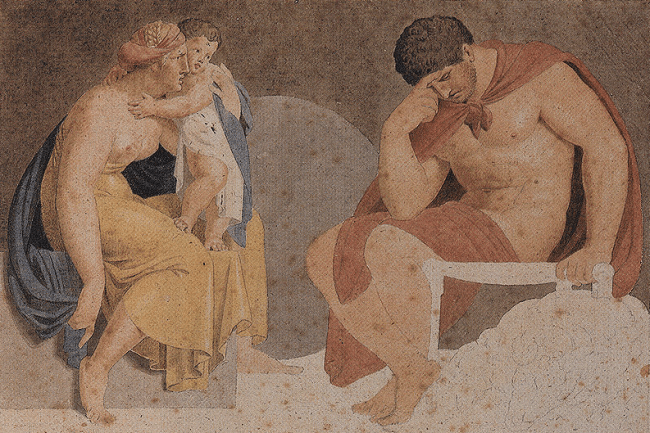
Asmus Jacob Carstens, “Sorrowful Ajax”

The third type of trauma discussed by Herman results from sexual abuse and domestic violence, thus from the public collective domain we turn to the quiet private suffering. Violence and aggression, which are approved of in the public arena, flourish behind closed doors. Mark Jones writes:

“Victims attempt in vain to express personal power, and instead find themselves bound to their poisoned nest. … A high level of self blame among victims of domestic violence and a pattern of chronic victimization work in tandem to keep people trapped in the situation despite their suffering.”

Image

Edvard Munch, “Ashes”

The fourth type of trauma added to Herman’s taxonomy by Mark Jones is the so called evolutionary trauma. It has to do with the unresolved traumas from birth and from past lives. We are reminded of Grof’s COEX systems of condensed experience, i.e. a set of experiences that are related and organized around a powerful emotional core. It all starts with a root experience, to which subsequent, thematically related experiences, are attached as memories. Each subsequent experience acts as a reinforcement of the core (nodal) one. Strong negative COEX systems result in energy blockages: they affect negatively our thoughts, emotions and communicative expression:

“Past-life trauma includes those prior-life memories held within the long-term memory which is signified by Uranus/Aquarius/11th house. …This deep state of the unconscious symbolized by the Uranus archetype can be brought towards conscious awareness through the attention and focus of the individual, as part of the process of individuation. Through contemplation, regression work, dreams and intuition, this state of awareness can arise as the experience of states of being that transcend the merely egocentric focus within the here and now.

The archetype of Uranus corresponds to that part of the core self that holds memory, the subtle mental nature, and this subtle mind or memory can hold traces of trauma which can cause constriction, the formation of patterns within the subtle mind that can then manifest as difficult mental and emotional states, even physical circumstances within a person’s life.”

Image

The most brilliant book I have read on healing trauma was Waking the Tiger by Peter A. Levine. It is deeply satisfying on both theoretical and practical level. He does not mention Grof’s COEX but he does speak a lot about how we remember traumatic events and how we effectively disassociate from them, repress and deny them. Faced with a life-threatening situation, we go into the survival mode. Our mind goes into a research mode, comparing the present situation with past memories in order to make a fast decision. We access pictures, images within our memory, which help us respond to the situation:

“These pictures are organized by their levels of arousal, activation, emotion, and response. Our gestalts of experience are categorized by the levels of activation at which they occurred. An analogy of this could be a multi-storied library with several floors of shelved books. The lower stories hold books associated with lower levels of activation (arousal) and those in higher stories are related to higher levels. If we think of the books as containing images and responses (related pictures) to that level or category of activation, then at each level there are possible, appropriate resources and responses from which we can choose. When we need a response we do not search the entire library; we scan the books at the appropriate level of activation.”

I cannot recommend this book enough. Before reading it I only had a vague understanding of what trauma was. He has nevertheless confirmed a lot of my intuitions regarding the ways to heal trauma. I love his assertion that trauma affects not only the mind but also the body – in equal measure. Talking about it and prescribing medication only serves to heal the mind part of the equation but this is unfortunately what most traditional therapies are limited to. Both mind and the body are profoundly affected by trauma and both need healing. When faced with a threat humans and animals have three responses at their disposal: immobility (freezing), fight or flight. He says:

“I believe that the key to healing traumatic symptoms in humans lies in our being able to mirror the fluid adaptation of wild animals as they shake out and pass through the immobility response and become fully mobile and functional again. Unlike wild animals, when threatened we humans have never found it easy to resolve the dilemma of whether to fight or flee. This dilemma stems, at least in part, from the fact that our species has played the role of both predator and prey. As in the Greek myth of Medusa, the human confusion that may ensue when we stare death in the face can turn us to stone. We may literally freeze in fear, which will result in the creation of traumatic symptoms.

Traumatic symptoms are not caused by the “triggering” event itself. They stem from the frozen residue of energy that has not been resolved and discharged; this residue remains trapped in the nervous system where it can wreak havoc on our bodies and spirits. This residual energy does not simply go away. It persists in the body, and often forces the formation of a wide variety of symptoms e.g. anxiety, depression, and psychosomatic and behavioral problems. These symptoms are the organism’s way of containing (or corralling) the undischarged residual energy.”

It was fascinating for me to realize that at the heart of trauma there is an immense amount of energy waiting to be released. This energy can be a great gift endowing us with wisdom, and “returning us to the natural world of ebb and flow, harmony, love, and compassion,” as Levine says. It is the wounded healer who has the greatest capacity to heal others and the whole world.

Levine’s book is also full of practical examples from his therapy sessions and it contains exercises that may help us get in touch with our own forgotten traumas. He recounts one of his first sessions with a patient, which proved pivotal in his understanding of trauma. Nancy was suffering from intense panic attacks, which were so severe that she was unable to leave her house alone. In their first session she went into an intense anxiety attack:

“She appeared paralyzed and unable to breathe. Her heart was pounding wildly, and then seemed to almost stop. I became quite frightened. Had I paved the yellow brick road to hell? We entered together into her nightmarish attack. Surrendering to my own intense fear, yet somehow managing to remain present, I had a fleeting vision of a tiger jumping toward us. Swept along with the experience, I exclaimed loudly, ‘You are being attacked by a large tiger. See the tiger as it comes at you. Run toward that tree; climb it and escape!’ To my surprise, her legs started trembling in running movements. She let out a bloodcurdling scream that brought in a passing police officer (fortunately my office partner somehow managed to explain the situation). She began to tremble, shake, and sob in full-bodied convulsive waves. Nancy continued to shake for almost an hour. She recalled a terrifying memory from her childhood. When she was three years old she had been strapped to a table for a tonsillectomy. The anesthesia was ether. Unable to move, feeling suffocated (common reactions to ether), she had terrifying hallucinations. This early experience had a deep impact on her. … Nancy was threatened, overwhelmed, and as a result, had become physiologically stuck in the immobility response. In other words, her body had literally resigned itself to a state where the act of escaping could not exist. Along with this resignation came the pervasive loss of her real and vital self as well as loss of a secure and spontaneous personality. Twenty years after the traumatizing event, the subtle and hidden effects emerged. Nancy was in a crowded room taking the Graduate Records Examination when she went into a severe panic attack. Later, she developed agoraphobia (fear of leaving her house alone). The experience was so extreme and seemingly irrational that she knew she must seek help.

I now know that it was not the dramatic emotional catharsis and reliving of her childhood tonsillectomy that was catalytic in her recovery, but the discharge of energy she experienced when she flowed out of her passive, frozen immobility response into an active, successful escape”.
Image

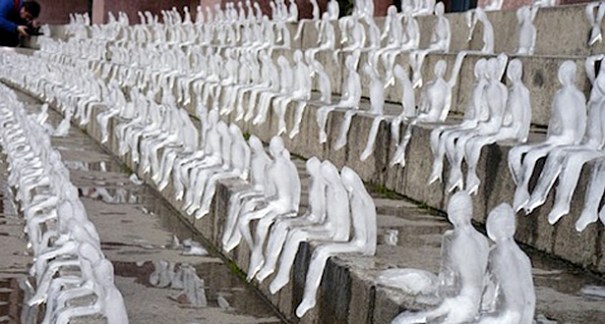
Nele Azevedo, “Ice People” (via http://www.theatlantic.com/entertainment/archive/2013/01/melting-masterpieces-impressive-works-of-art-made-from-snow-and-ice/272538/)

One of the most important findings of Levine, to my mind, is the necessity to empower the victims of trauma. Instead up of constant dredging up and reliving past emotional pain, which will lead to nothing else but further re-traumatizing, he teaches his patients that they are not helpless and the frozen energy can be recovered and used to their benefit. He asserts: “If we remain ignorant of our power to change the course of our instinctual responses in a proactive rather than reactive way, we will continue being imprisoned and in pain.” It is not possible to change past events but we can modify our present reactions. We need to engage our animal natures, our bodies, to get back with our primal and natural instincts in order to heal our traumas and retrieve our souls. Trauma can be a unique opportunity for healing and renewal, both on individual and collective levels. Levine calls a resolved trauma “a blessing from a greater power.” The world of trauma is the same world that brings joy and light.
Image

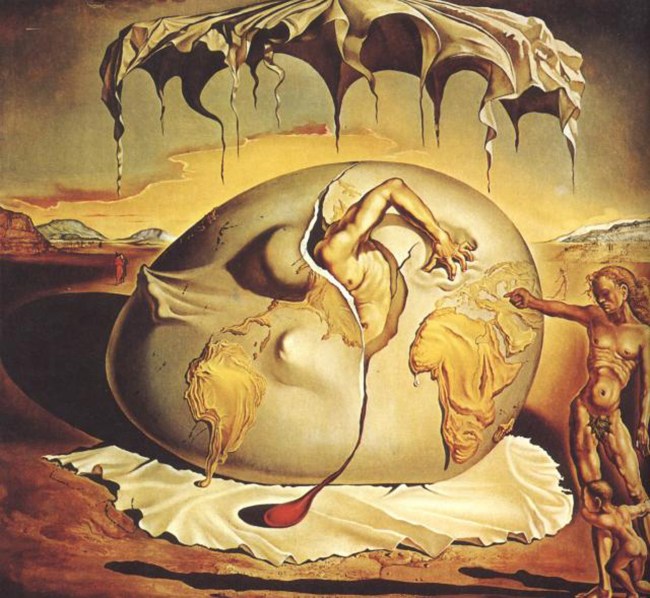
Salvador Dali, “Birth of New Man”

Sources:

Judith Herman, Trauma and Recovery: from Domestic Abuse to Political Terror

Mark Jones, Healing the Soul: Pluto, Uranus and the Lunar Nodes

Peter A. Levine, Waking the Tiger: Healing Trauma

Posted in Trauma | Tagged , , , , , , , , , , , , , , , , , , , , , | 24 Comments
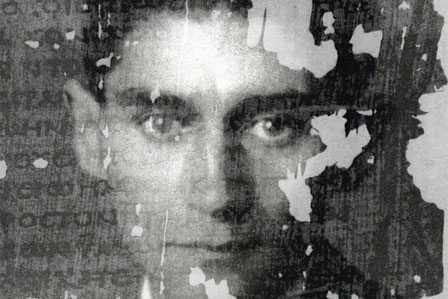
Kafka’s Sirens

“Now the Sirens have a still more fatal weapon than their song, namely their silence… someone might possibly have escaped from their singing; but from their silence, certainly never.”
Franz Kafka

Image

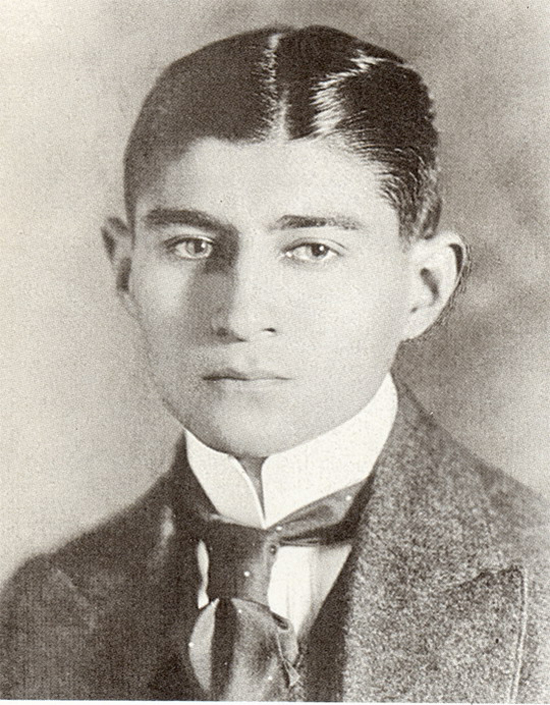
Last year I posted my tribute to Franz Kafka (https://symbolreader.net/2013/07/16/i-love-you-my-secret-raven/) and today I would like to supplement it with some more biographical information. I hope this post will not come across as en extract from a gossip column. I do not necessarily think that an author’s private life and his work are linked by a causative chain but still it has always been fascinating for me to explore the parallels. “Kafka’s Sirens” is my attempt to show how Kafka’s romantic nature may have fed his work. His pattern was to withdraw and try to find a way out of a relationship as soon as things became too certain, too settled, too embodied. He burnt for his Sirens, chased them relentlessly only to slip out when the Protean flickering image of a mermaid became too fleshy, too close for comfort. Milena Jesenska, his translator into Czech and one of his Muses, wrote this in his obituary shortly after he died of lung disease at the age of forty:

“Dr. Franz Kafka, a German writer who lived in Prague, died the day before yesterday in a sanatorium in Kierling at Klosterneuburg, near Vienna. Few people here knew him, for he was a solitary, wise person terrified by life. He suffered for years from lung disease. Although he did treat his illness medically, he also consciously encouraged it, and supported it with his thinking. Once he wrote in a letter, ‘When the soul and the heart can no longer bear the burden, the lungs take over one half of it, so that the weight will at least be evenly distributed.’ That is how it was with his illness. It gave him an almost miraculous delicacy and a frighteningly uncompromising intellectual refinement. As a human being, however, he pushed all his fear of life onto his illness. He was shy, timid, gentle, and kind, but he wrote gruesome and painful books. He saw the world as full of invisible demons, who tear apart and destroy defenseless people. He was too clear-sighted and too wise to be able to live; he was too weak to fight, he had that weakness of noble, beautiful people who are not able to do battle against the fear of misunderstandings, unkindness, or intellectual lies. Such persons know beforehand that they are powerless and go down in defeat in such a way that they shame the victor. He knew people as only people of great sensitivity are able to know them, as somebody who is alone and sees people almost prophetically, from one flash of a face. He knew the world in a deep and extraordinary manner. He was himself a deep and extraordinary world.
He wrote books that belong to the most outstanding works of German literature. They express the struggles of today’s generation, but without any tendentious words. They are truthful, naked, and painful, so that even where they speak symbolically, they are almost naturalistic. They are full of dry mockery and the sensitive gaze of a person who has seen the world so clearly that he could not bear it and had to die; he did not want to retreat and save himself, as others do, even by the noblest intellectual subconscious errors.”

FELICE
Image

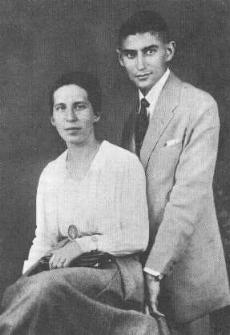
Reiner Stach is the first Kafka’s biographer who has gained access to all the materials which Max Brod, Kafka’s friend, had long kept away from the public. The third and last volume of Stach’s monumental undertaking has not been published yet. From what has been published so far Kafka emerges as a nymph chaser, one who directs all his energies into the pursuit of an idealized object of affection but also one who abhors the relationship’s definitiveness of form. He seems to pour the most of his essence into writing love letters. His first love was Felice, who in their golden times received three letters a day (she lived in Berlin, he in Prague). If she did not respond he demanded an answer, even two or three words, like three breaths of life, otherwise he would suffocate.  He also obsessively demanded photos of her and her family,  wanting to know who took them, at what time, where. After flooding her with correspondence for a few months, he made a trip to Berlin. He only got to kiss her on the cheek because she had no time to spare on that day: she had to attend a funeral. During his next visit to Berlin he was planning to propose while she invited him to a family party organized in his honour. He did not make a good impression on her family when he declared that he was a vegetarian and refused all the juicy pieces of meat placed on the table. Everyone was disappointed, even more so Kafka, who noticed for the first time and to his horror that his beloved had golden teeth!

It was Kafka’s last will that all his writing should be destroyed; the will that was famously disobeyed by his best friend. Shame was one of the most important themes of his work and shame probably motivated him to put forward the request to Max Brod. The letters to Felice take 700 pages revealing all the pathos, the hysterical behaviour, a sense of inferiority, the torment, the lust and doubt that a single anguished soul can hold. The last sentence of The Trial reads: “It was as if he meant the shame of it to outlive him.” It is important to remember that Kafka wrote shortly before the second world war. The demons that tormented his souls were the very ones which reared their ugly heads shortly after his death. Although he led a respectable bourgeois existence on the outside, having a decent job, which he apparently liked much more than the legend has it, he rejected the hypocrisy and deeply despised the banality and shallowness of the consensus culture of Western Europe. Felice did not share any of his deeper views, though: her wish was to become a decent woman and get married. He felt trapped, trying to discourage her, presenting himself in the worst possible light.

Plagued by guilt and not wanting to disappoint Felice, he takes a short break and goes to a sanatorium, where he becomes fascinated by a very young Swiss woman. They play a game consisting in throwing a string from her window down to his: this is as far as the relationship went but at the same time he stopped writing to Felice, who felt alarmed and decided to send a friend (Greta Bloch) to Prague to see what had happened. Naturally, Kafka immediately fell for the friend and started writing to her asking for photos, demanding personal details, etc. Notwithstanding, he came to Berlin and proposed to Felice who said yes.  In the midst of the wedding plans he confided in Greta about not wanting to marry Felice. Greta could not keep this from Felice and the ladies set a trap by organizing a tribunal to expose Kafka’s machinations. He felt shattered and deeply ashamed. Soon after he wrote The Trial.

Felice misses him, however, and she decides to get in touch again. After four years of courting they finally make love. Very soon after this he finds out he has a deadly illness and decides that he cannot get married in such circumstances. He is secretly relieved. To gain his strength, he moves to the countryside to live with his sister. Poor Felice visits him but he seems indifferent and waves goodbye to her, absentmindedly. She goes back to Prague, probably to sell her wedding dress and cancel the wedding plans, and meets someone after two years. She emigrates to the USA and sells Kafka’s letters to get herself out of poverty.

JULIE

Image

He meets Julie Wohryzek at a hotel where both of them are the only guests. They giggle as they bump into each other in empty corridors. He slides letters under her doorstep and tiptoes away. Back in Prague they have sex and he proposes to her. His family does not accept her. They start looking for a flat but do not have enough funds. He once more becomes disappointed, restless, unsure about what to do.

MILENA

Image

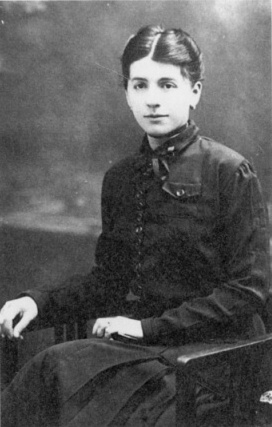
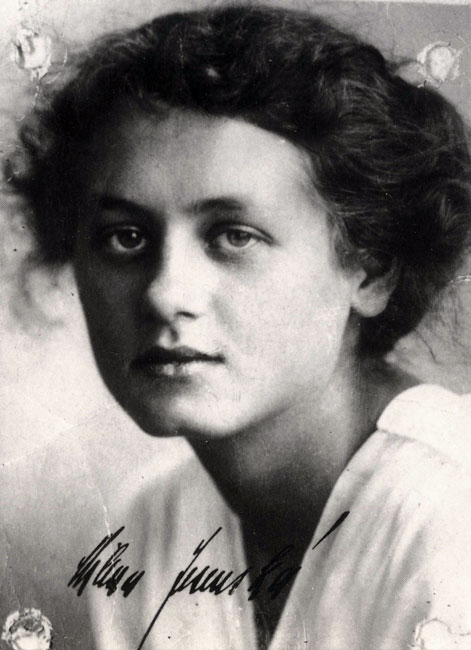
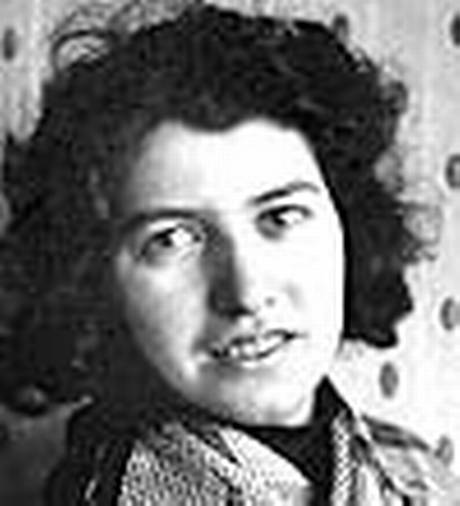
Milena Jesenska was undoubtedly a fascinating woman, perhaps as deep and tormented a soul as Kafka himself. She was perhaps the first woman in his life who totally defied the ways of tradition. She introduced herself to him in Prague, at Café Arco, as a translator who wanted to translate his short stories into the Czech. Her biography is quite astonishing. Her mother died when she was very young and she was raised by a tyrannizing father. She remained a free spirit despite his best efforts, though. She would swim across a river in her clothes to meet with a boyfriend, she would pose nude for painters, drink, take drugs, and at a very young age. She also used to live with two women in a love triangle. She was a minor and her father had still the power to lock her up in a mental institution, which she left when she came of age and married shortly after, unhappily. They moved to Vienna, where they had an open marriage and very little money to support his drinking and numerous lovers. She was forced to prostitute herself and at times she also worked as a luggage porter at the main station. She had a keen intellect and vast literary talent herself, which made her recognize Kafka’s talent and offer him her services as a translator. She was herself a recognized editor, essayist and journalist. Their correspondence was very extensive. Kafka kept writing to her and to Julie at the same time. He begged Milena to leave her husband but she was not able to. He broke off with Julie but that still did not satisfy Milena, who was a very unpredictable woman. At the same time he was getting more and more ill. He was too weak to conduct this affair and they had to part ways. He presented her with his diary as a parting gift. Her subsequent life is even more eventful: she gets a divorce, remarries, becomes addicted to morphine while pregnant and in unbearable pain. She leaves her husband and becomes a communist activist, but leaves the party. When the Germans come to Prague she joins the resistance movement and openly walks in the streets with a yellow star on her arm. Finally, she is sent to a concentration camp, where she dies a hero who has been supporting her fellow prisoners. She was a restless spirit, always trying to live a free life in extremely difficult historical times.

DORA

Image

I wrote more about Dora Diamant, Kafka’s last love, in my first post dedicated to Kafka. She is the one who gave him pineapples and flowers to smell before he died.

Image

Posted in Franz Kafka | Tagged , , , , , , , , , , | 29 Comments

Bird Goddess

“A girl stood before him in midstream, alone and still, gazing out to sea. She seemed like one whom magic had changed into the likeness of a strange and beautiful seabird. Her long slender bare legs were delicate as a crane’s and pure save where an emerald trail of seaweed had fashioned itself as a sign upon the flesh. Her thighs, fuller and soft-hued as ivory, were bared almost to the hips, where the white fringes of her drawers were like feathering of soft white down. Her slate-blue skirts were kilted boldly about her waist and dovetailed behind her. Her bosom was as a bird’s, soft and slight, slight and soft as the breast of some dark-plumaged dove. But her long fair hair was girlish: and girlish, and touched with the wonder of mortal beauty, her face.”
― James Joyce, “A Portrait of the Artist as a Young Man”

image

Posted in Quotations | Tagged , , , , , , , , | 7 Comments

The Secrets of the Odyssey (8): the Sirens, Scylla & Charybdis, and Thrinacia

Image

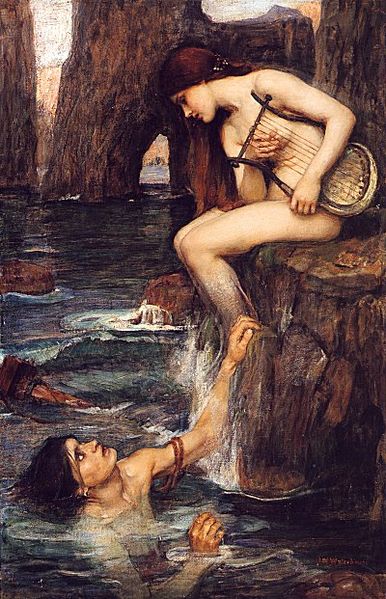
John William Waterhouse, “The Siren”

Reading the Odyssey in a superb translation of Robert Fitzgerald is like listening to the most delightful music. No interpretation can possibly replace the sheer pleasure of experiencing Homer’s talent. The opening lines of Book XII read:

 “The ship sailed on, out of the Ocean Stream,

riding a long swell on the open sea

for the Island of Aiaia.

Summering Dawn

has dancing grounds there, and the Sun his rising;

but still by night we beached on a sand shelf

and waded in beyond the line of breakers

to fall asleep, awaiting the Day Star.”

On the island of Aiaia, Circe receives Odysseus and his companions, who have returned from Hades, with a lavish banquet. Later at night she tells Odysseus in great detail about his next adventures, what perils await him and what precautions he must take. It seems that at this moment Odysseus is endowed with a higher understanding by the Goddess. But although his mind is clear about the right course of action, for various reasons he will not be able to prevent the destiny from “devising ill,” as he himself puts it later. It seems that a clear awareness of what the future will bring cannot stop the events from unfolding. Circe advises Odysseus about the Sirens and then about the monsters Scylla and Charybdis. The following powerful exchange between them seems to be crucial to me for Odysseus’ spiritual development and gaining higher understanding:

 “‘Only instruct me, goddess, if you will,

how, if possible, can I pass Kharybdis,

or fight off Skylla when she raids my crew?’

Swiftly that loveliest goddess answered me:

‘Must you have battle in your heart forever?

The bloody toil of combat? Old contender,

will you not yield to the immortal gods?

That nightmare cannot die, being eternal

evil itself—horror, and pain, and chaos;

there is no fighting her, no power can fight her,

all that avails is flight.”

She predicts that the monster will devour six of his companions but this knowledge of it will not prevent his heartache after this loss. The crucial lesson that Circe seems to be imparting to Odysseus is that we are powerless in the face of the archetypal godlike forces. Life is often like walking a narrow path between Scylla and Charybdis. Acknowledging the power of the gods and doing out uttermost to survive is often the only course of action left for mortals. I will speak of the monsters later, for now let the focus fall on the enchanting temptresses, the Sirens. Circe had warned Odysseus that “the Seirênês will sing his mind away on their sweet meadow lolling,“ and she had offered him a choice: he had to pour wax into his comrades’ ears to prevent them from hearing the Sirens but he could go either way: block his ears with wax or listen to the song of the Sirens while being tied to the mast so that he does not follow them to certain death. Knowing Odysseus’ ever curious character he surely chose the latter option, lying to his companions that Circe had ordered him to do so. The Sirens sang:

 “Sweet coupled airs we sing.

No lonely seafarer

Holds clear of entering

Our green mirror.

Charmed out of time we see.

No life on earth can be

Hid from our dreaming.”

Image

John William Waterhouse, “Ulysses and the Sirens”

In Homeric Moments, Eva Brann offers her interpretation of this episode:

“The Sirens offer to ensnare Odysseus by a flattering and seductive song of nostalgia, ‘return-ache.’ They claim that men who hear it sail away the wiser, but in fact no one gets away. He too will forget the Return that leads homeward to wife and child by changing the direction of his longing to the past. He will molder in pity for his lost comrades-in-arms and in self-pity for the glory gone, wallowing in veteran’s reminiscences, aching to turn back to Troy.”

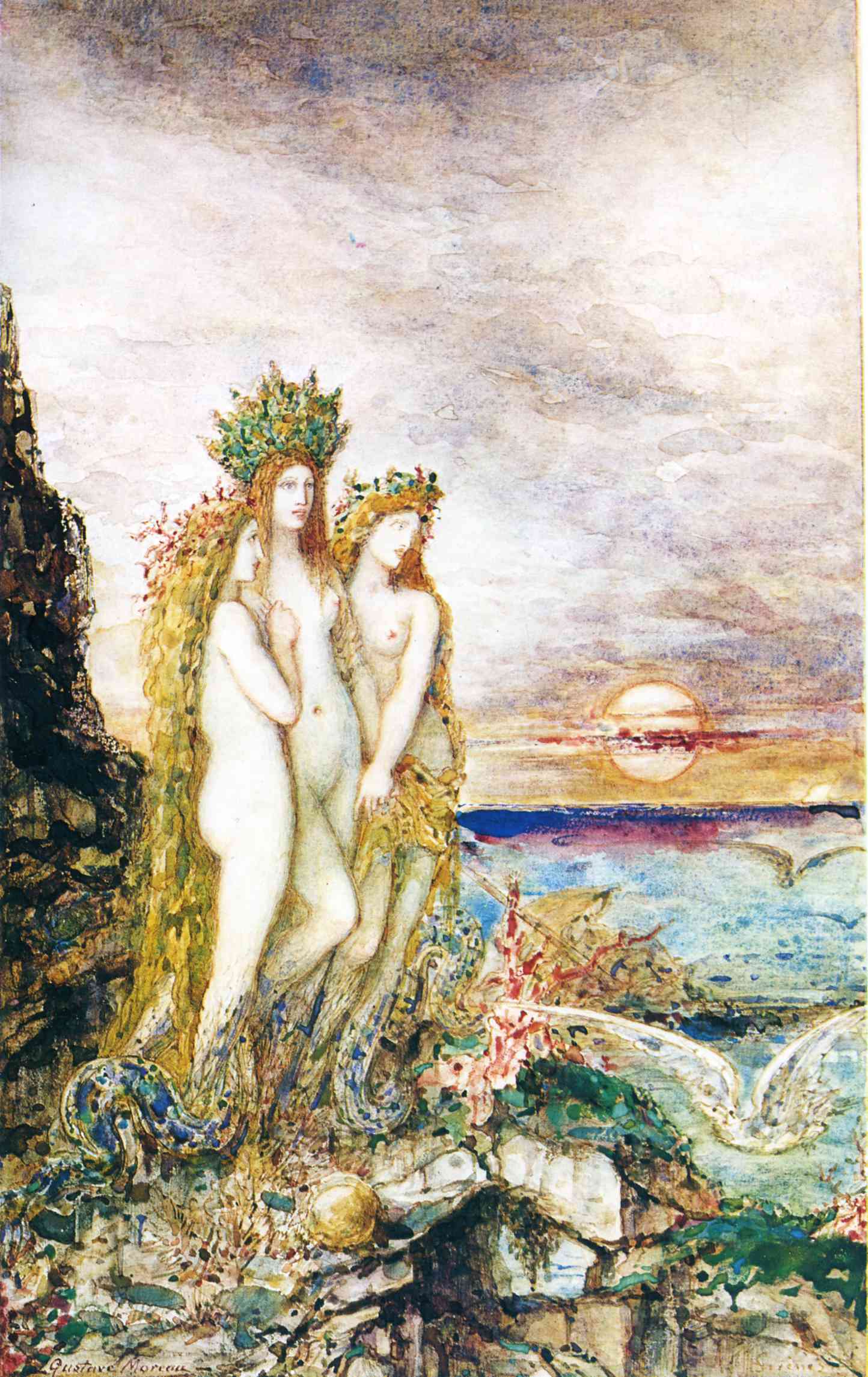
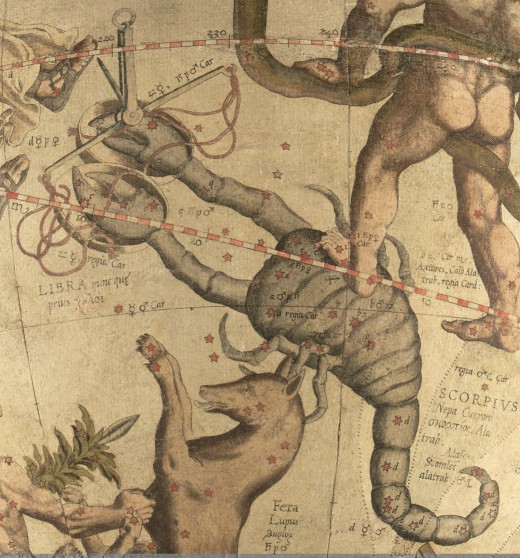
I think that the Sirens personify the charming and seductive face of the sacred feminine energy, the beauty of poetry which sings of the glorious past. Their song is like a regressive pull of the eternal ocean – the realm of myth and dreams. As daughters of either Melpomene (Muse of tragedy) or Terpsichore (muse of choral song ad dancing), the Sirens embody the dark and sad energy on the one hand, and the trance-like oblivion on the other. During this part of Odysseus’ journey the Sun passes Libra and Scorpius. It is worth remembering that in antiquity the stars of Libra were an extension of the constellation of Scorpio and were called the Claws of Scorpius. We read in Homer’s Secret Odyssey by Kenneth and Florence Wood:

“As the sun leaves Virgo it passes through the Claws of Scorpius, where three stars alpha, beta and gamma Librae make an excellent ‘island’ home for the temptresses. The Sirens sit in a grassy meadow and the star Beta Librae is said to have a greenish tinge …”

Image

Gustave Moreau, “The Sirens”

Scorpius links the Sirens with the death force (Thanatos) and darkness that pulls and sucks all creation into it. As Pablo Picasso put it, “Every act of creation is first an act of destruction.” Thanatos, the death drive, represents a push towards extinction and is a brother of Eros, the loving and creative force in the universe. With their alluring song, the Sirens bring ecstasy and death. The two forces are always present in every artistic endeavor. “Seeing out of time” denotes the Sirens’ ability to see the past, the present and the future. They are as mysterious as the Sphinx and almost as fascinating; no wonder they have stirred the imagination of countless readers of the Odyssey although the passage dedicated to them is surprisingly short, taking into account its cultural impact.

The next stage of the journey is extremely traumatic for Odysseus. The moon moves into its dark period and the hero has to pass through a narrow passage between two deadly monsters: Scylla and Charybdis. Meanwhile, the sun passes through the autumn equinox. The Woods point out that in Homer’s times the autumn equinoctial point lay between Libra and Scorpius. During the spring equinox six months before Odysseus had encountered Polyphemus also losing six of his travelling companions. Charybdis is a deadly whirlpool, a gigantic mouth engulfing anything that came near. A huge fig tree marks the dangerous spot where she resides:

“Like Scylla, she was once a beautiful sea nymph, a naiad, and helped her father Poseidon to increase his kingdom by flooding the land. But her uncle Zeus, the god of the earth and sky, was furious and turned her into a hideous mouthlike chasm. She was condemned to always be thirsty and to suck in seawater three times a day and regurgitate it with her thirst unsatisfied.”

Cassandra Eason, “Fabulous Creatures, Mythical Monsters, and Animal Power Symbolism: A Handbook”

Scylla, a six-headed devouring monster with her “deep gullets of black death,” who resides in an underwater cave, is associated with the constellation of Scorpius by the Woods:

“As a metaphorical description of Scorpius, Homer’s imagery of Scylla’s head protruding menacingly out of her cave is reflected in the same proportions in which Scorpius seems to rise out of the Milky Way. …

Image

“Scylla and Charybdis”, an Italian fresco (image Wikipedia)

As with the six men eaten by the Cyclops at the spring equinox, these six victims are important in balancing the days of the solar and lunar years … In the absence of Homer using fractions of numbers, Scylla’s six victims, as with those of Polyphemus, can be seen as the rounded-up five and a half days that the lunar calendar falls short of the solar calendar between one equinox and the next.”

According to myth, Scylla was once a nymph who was seduced by Poseidon. Her tale is that of bitter jealousy accompanied by murderous instincts. In her jealous rage, Poseidon’s wife Amphitrite filled Scylla’s bathing pool with poisonous herbs, which turned the nymph into a monster.

The unavoidable death of his six companions was extremely traumatic to Odysseus, as he relates:

 “She ate them as they shrieked there, in her den,

in the dire grapple, reaching still for me—

and deathly pity ran me through

at that sight—far the worst I ever suffered,

questing the passes of the strange sea.”

Although he had been warned about this loss by Circe he could have done nothing to avoid it. In grim moods the travelers sailed on until the island of Thrinacia appeared. Again, the dire warnings of both Teiresias and Circe about not killing Helios’ cattle grazing on the island were to no avail. While Odysseus was distracted looking for alternative nourishment for his crew, they were too hungry to wait and they feasted on the forbidden meat. Odysseus’ men proved thus once again that they do not match his steady resolve and higher consciousness: again they have succumbed to their simple earthy desires. Eva Brann emphasizes how more alienated Odysseus was getting from his companions, the more awareness he gained:

 “He is disciplined, hardy, and mystifying to his men in his hidden purpose to see, hear, experience, know, and apprehend, the world imaginatively. To them his leadership must look like aimless drifting into continual hazards. They have been falling away from him for quite a while now: They are urgent where he is dilatory, they are slack where he is impulsive. They depend on him but distrust him; he cares for them occasionally but not about them steadily.”

Image

Helios’ cattle, image via https://sites.google.com/site/tayloryustportfolio/humn-3923h-game-design/landscape-thrinacia

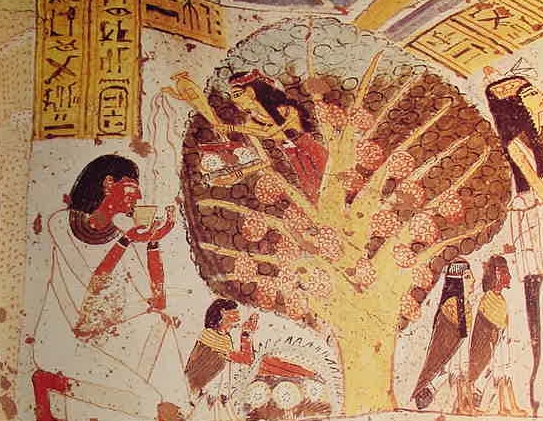
Meanwhile, the Sun has moved into the sign of Sagittarius. Zeus, spurred by Helios, punishes Odysseus’ companions by causing a violent storm in which they all drown while Odysseus drifts in the ocean on what remained of his last ship. He will eventually reach the island of Calypso but not before he is drawn towards the deadly Charybdis again. This time he holds on to the fig tree, which saves his life. Interestingly, Barbara Walkers, the author of The Women’s Encyclopedia of Myths and Secrets, says that the fig tree is a well-known symbol of the goddess.

Image

The Goddess Hathor in a Sycamore fig tree

The Bodhi tree, under which Buddha reached the enlightenment, was in fact a species of a fig tree. Also Babylonian Ishtar took the form of the divine fig tree. Bereft of all his companions and earthy possessions, Odysseus is ready to meet the most mysterious goddess of all, the veiled High Priestess Calypso, who will offer him immortality. Unlike Buddha, he will reject this gift in favor of a life with his beloved Penelope on Ithaka, his home.

Image

Scorpio and Libra drawn on a Mercator globe in the 1500’s, via http://hubpages.com/hub/the-constellation-libra

Support my blog

If you appreciate my writing, consider donating and make my day. Thank you in advance.

$1.00

Related posts:

The Secrets of the Odyssey (1)

The Secrets of the Odyssey (2): Elements of Time (the Muse and the Moon)

The Secrets of the Odyssey (3): Calypso and Phaecians

The Secrets of the Odyssey (4): A Tribute to Penelope

The Secrets of the Odyssey (5): Lotus-Eaters, Auriga and Polyphemus

The Secrets of the Odyssey (6): the God of Winds

The Secrets of the Odyssey (7): Circe and the Underworld

The Secrets of the Odyssey (9): Leucothea in the Sea of Space and Time

https://symbolreader.wordpress.com/2014/07/14/the-secrets-of-the-odyssey-10-return-to-ithaca-through-the-cave-of-the-nymphs/?preview=true

The Secrets of the Odyssey (11): Death of Odysseus, Master of Land Ways and Sea Ways

Posted in The Odyssey | Tagged , , , , , , , , , , , , , , , , , | 29 Comments

Your Golden Hair Margeurite: Hair as a Symbol

Image

Rapanzel, via http://haleys-comet.deviantart.com/art/Rapunzel-Let-Down-Your-Hair-110501671

In an old pagan ritual known as the Maypole dance, on the Eve of May Day, female dancers circled the pole the counter-clockwise direction, which is sacred to women and associated with the moon while male dancers danced in the other direction, that of the sun. In Women’s Encyclopedia of Myths and Secrets, Barbara G. Walker summarizes that “the resulting braid represented interpenetration of masculine and feminine powers.” In Hindu mythology, ‘hairs, like the threads of a fabric, symbolize the ‘lines of force’ of the universe” (Cirlot, Dictionary of Symbols). Throughout the ages hair has appeared as a potent symbol in myth, literature, culture and religion. The maypole dance ritual suggests that it is significant equally for men and women. It is enough to think of the romantic rituals of exchanging talismans with locks of hair between lovers. The supernatural strength of the biblical Samson (Hebrew for “man of the sun”), the one who defeated lions but was lost because of a woman, followed from his abundant hair.

Image

Léon Bonnat, “Samson’s Youth”

Hair like the mane of a lion was also extremely popular in France of Louis XIV, the Sun King. He was the one who propagated the bizarre fashion in Europe, channeling the Greek god Apollo celebrated for his golden locks, symbolic of the golden rays of the sun. In Indian mythology, as Walkers says:

 “The Indian god Shiva, who is the personalized representation of the creative and sexual energy of the universe, is always represented as having a mass of long, tangled, piled-up hair on his head.“

Image

Ganga flowing from Shiva’s hair

On female side of the symbolic history of hair, Berenice stands out, wife of the Egyptian ruler Ptolemy Soter III. She sacrificed her beautiful amber-coloured hair to ensure that her husband returns home safely. Her tresses were left on the altar of Aphrodite for the night and had been mysteriously gone by the morning. The gods had put them in the sky as a beautiful constellation Coma Berenices.

Image

Coma Berenices (http://constellationsofwords.com/)

The symbolism of the Great Mother and witchcraft has always been closely intertwined with hair symbolism. Barbara G. Walker writes:

“An Egyptian found salvation by identifying himself with Osiris, for whom the Goddess made resurrection-magic with her hair: He is found with her hair spread over him; it is shaken out over his brow. When Isis put on mourning garments for Osiris, she cut a lock of her hair to preserve his soul. … When Isis restored vitality to the dead Osiris, entitled the Still Heart, she created his new life with her hair, made his heart beat again and his penis move so she could conceive his reincarnation, Horus. She produced warmth from her hair, she caused air to come …. She caused movement to take place in what was inert in the Still Heart, she drew essence (semen) from him, she made flesh and blood, she suckled her babe alone. She further protected her Divine Child by shaking out her hair over him.”

Witches were feared by the Grand Inquisitors, who always ordered to shave their hair off. Walkers adds: “Gypsies said a witch could be known by her hair, which grew straight for three or four inches, then began to wave, like a waterfall bouncing over rocks.”

Image

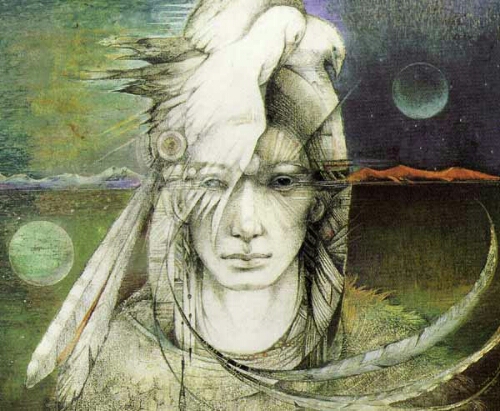
Susan Seddon Boulet, “Osiris and Isis”

At the hour of death, The Great Mother’s hair will cast its shadow over our souls. This is why comets were believed to portend doom: it was Great Mother, the spinner and weaver of our fates, that reminded us of our mortality and the inevitable death of old forms. In Homer’s Odyssey, Circe’s braids signified her power over metempsychosis.

I thought of hair today on the eve of Solar Eclipse, as I have heard that we are about to “celebrate” the anniversary of the establishment of the Nazi concentration camp in Auschwitz (Oswiecim), Poland. I remembered my first visit to the museum where my attention was caught by mountains of human hair on display behind glass. So unbelievably poignant: children’s hair, women’s hair, hair of all colour, even a plait can be spotted like the one from w famous poem by Tadeusz Rozewicz. A famous last stanza of the poem “Pigtail” that every Polish child learns about at school says:

“In huge chests
clouds of dry hair
of those suffocated
and a faded plait
a pigtail with a ribbon
pulled at school
by naughty boys.”

The most moving poem on the Holocaust I have ever read, however, was written by Paul Celan, a Romanian poet, who wrote in German. He lost both of his parents in the Holocaust, himself surviving the camp. He never recovered from his mother’s death and his whole poetry was a cry of mourning for his loss. “The Death Fugue” is his most famous poem and one you simply cannot forget once you have read it. Note the symbolism of golden hair that becomes ashen hair. The title and the form of the poem is evocative of the habit of the Nazis to make the Jews play music at their own executions.

 Death Fugue

(Translated by John Felstiner)


“Black milk of daybreak we drink it at evening
we drink it at midday and morning we drink it at night
we drink and we drink
we shovel a grave in the air there you won’t lie too cramped
A man lives in the house he plays with his vipers he writes
he writes when it grows dark to Deutschland your golden hair Marguerite
he writes it and steps out of doors and the stars are all sparkling
he whistles his hounds to come close
he whistles his Jews into rows has them shovel a grave in the ground
he orders us strike up and play for the dance

Black milk of daybreak we drink it at night
we drink you at morning and midday we drink you at evening
we drink and we drink
A man lives in the house he plays with his vipers he writes
he writes when it grows dark to Deutschland your golden hair Margeurite
your ashen hair Shulamith we shovel a grave in the air there you won’t lie too cramped
He shouts jab this earth deeper you lot there you others sing up and play
he grabs for the rod in his belt he swings it his eyes are blue
jab your spades deeper you lot there you others play on for the dancing

Black milk of daybreak we drink you at night
we drink you at midday and morning we drink you at evening
we drink and we drink
a man lives in the house your goldenes Haar Margeurite
your aschenes Haar Shulamith he plays with his vipers
He shouts play death more sweetly Death is a master from Deutschland
he shouts scrape your strings darker you’ll rise then in smoke to the sky
you’ll have a grave then in the clouds there you won’t lie too cramped

Black milk of daybreak we drink you at night
we drink you at midday Death is a master aus Deutschland
we drink you at evening and morning we drink and we drink
this Death is ein Meister aus Deutschland his eye it is blue
he shoots you with shot made of lead shoots you level and true
a man lives in the house your goldenes Haar Margarete
he looses his hounds on us grants us a grave in the air
he plays with his vipers and daydreams
der Tod is ein Meister aus Deutschland
dein goldenes Haar Margarete
dein aschenes Haar Shulamith”

Image

Paul Celan

Support my blog

If you appreciate my writing, consider donating and make my day. Thank you in advance.

$1.00

Posted in Hair | Tagged , , , , , , , , , , , , , , , , , , , , | 23 Comments

Ninshubur

silverfox57's avatarBrickthology

Ninshubur Etymology: Queen of the East

Also known as: Ninshubar, Nincubura, Nincubur or Ninšubur

In Sumerian mythology, Ninshubur is a messenger of the gods. She is also known as Inanna’s sukkal or second-in-command; a position of great importance as a high-ranking government administrator. It has been pointed out, in an essay written by Diane Wolkstein, “Interpretations of Inanna¹s Stories and Hymns,” that a sukkal often has powers and abilities far superior then those of their Liege or Master. Not only does the sukkal have their own power and abilities, but they often have that power and authority combined with power and authority of whomever they serve.

Ninshubur is a goddess herself, whose name means: “’Queen of the East.” While she is often described as a virgin, Ninshubur is also mentioned as one of Inanna’s lovers. Ninshubur is associated with the element of Air and the planet Mercury.

In later Akkadian myths…

View original post 1,244 more words

Posted in Uncategorized | Leave a comment